


EN 385:2001
(Main)Finger jointed structural timber - Performance requirements and minimum production requirements
General Information
- Abstract
This standard specifies requirements for bonded finger joints and minimum requirements for the manufacture of cut, interlocking, bonded finger joints in structural timber members. Requirements are given for timber, adhesive, moisture content, cutting and bonding.
This standard is only applicable to finger joints between timber members of the same species type.
Although most finger joints are produced in coniferous species this standard also applies to broad-leaved species where information is available to enable them to be satisfactorily bonded.
It does not cover impressed (die-formed) joints. In the case of glued laminated timber it applies only to individual laminations. Large finger joints in glued laminated timber are covered by EN 387.
NOTE This standard is elaborated as a supporting standard for a harmononized standard on structural timber with finger joints to be published in the future.
- Status
- Withdrawn
- Publication Date
- 23-Oct-2001
- Withdrawal Date
- 25-Jun-2013
- Technical Committee
- CEN/TC 124 - Timber structures
- Drafting Committee
- CEN/TC 124/WG 3 - Glued laminated timber
- Current Stage
- 9960 - Withdrawal effective - Withdrawal
- Start Date
- 26-Jun-2013
- Completion Date
- 26-Jun-2013
- Directive
- Harmonized Standard305/2011 - Regulation (eu) No 305/2011 of the European Parliament and of the Council of 9 march 2011 laying down harmonised conditions for the marketing of construction products and repealing council directive 89/106/eec
Not Harmonized89/106/EEC - Construction products

Relations
- Effective Date
- 22-Dec-2008
- Replaced By
EN 14080:2013 - Timber structures - Glued laminated timber and glued solid timber - Requirements - Effective Date
- 08-Jun-2022
- Effective Date
- 08-Jun-2022
- Effective Date
- 18-Mar-2026
- Effective Date
- 28-Jan-2026
- Effective Date
- 28-Jan-2026
- Effective Date
- 28-Jan-2026
- Referred By
EN 386:2001 - Glued laminated timber - Performance requirements and minimum production requirements - Effective Date
- 28-Jan-2026
Get Certified
Connect with accredited certification bodies for this standard

Gozdarski inštitut Slovenije
Slovenian Forestry Institute. Forest management certification support, timber testing.
Sponsored listings
Frequently Asked Questions
EN 385:2001 is a standard published by the European Committee for Standardization (CEN). Its full title is "Finger jointed structural timber - Performance requirements and minimum production requirements". This standard covers: This standard specifies requirements for bonded finger joints and minimum requirements for the manufacture of cut, interlocking, bonded finger joints in structural timber members. Requirements are given for timber, adhesive, moisture content, cutting and bonding. This standard is only applicable to finger joints between timber members of the same species type. Although most finger joints are produced in coniferous species this standard also applies to broad-leaved species where information is available to enable them to be satisfactorily bonded. It does not cover impressed (die-formed) joints. In the case of glued laminated timber it applies only to individual laminations. Large finger joints in glued laminated timber are covered by EN 387. NOTE This standard is elaborated as a supporting standard for a harmononized standard on structural timber with finger joints to be published in the future.
This standard specifies requirements for bonded finger joints and minimum requirements for the manufacture of cut, interlocking, bonded finger joints in structural timber members. Requirements are given for timber, adhesive, moisture content, cutting and bonding. This standard is only applicable to finger joints between timber members of the same species type. Although most finger joints are produced in coniferous species this standard also applies to broad-leaved species where information is available to enable them to be satisfactorily bonded. It does not cover impressed (die-formed) joints. In the case of glued laminated timber it applies only to individual laminations. Large finger joints in glued laminated timber are covered by EN 387. NOTE This standard is elaborated as a supporting standard for a harmononized standard on structural timber with finger joints to be published in the future.
EN 385:2001 is classified under the following ICS (International Classification for Standards) categories: 79.040 - Wood, sawlogs and sawn timber. The ICS classification helps identify the subject area and facilitates finding related standards.
EN 385:2001 has the following relationships with other standards: It is inter standard links to EN 385:1995, EN 14080:2013, EN 15497:2014, EN 301:2023+A1:2026, EN 408:2010+A1:2012, EN 301:2023, EN 14080:2005, EN 386:2001. Understanding these relationships helps ensure you are using the most current and applicable version of the standard.
EN 385:2001 is associated with the following European legislation: EU Directives/Regulations: 305/2011, 89/106/EEC; Standardization Mandates: M/112. When a standard is cited in the Official Journal of the European Union, products manufactured in conformity with it benefit from a presumption of conformity with the essential requirements of the corresponding EU directive or regulation.
EN 385:2001 is available in PDF format for immediate download after purchase. The document can be added to your cart and obtained through the secure checkout process. Digital delivery ensures instant access to the complete standard document.
Standards Content (Sample)
2003-01.Slovenski inštitut za standardizacijo. Razmnoževanje celote ali delov tega standarda ni dovoljeno.Konstrukcijski les z zobatimi stiki - Zahteve za uporabo in minimalne zahteve za proizvodnjoKeilzinkenverbindungen im Bauholz - Leistungsanforderungen und Mindestanforderungen an die HerstellungAboutages a entures multiples dans les bois de construction - Exigences de performance et exigences minimales de fabricationFinger jointed structural timber - Performance requirements and minimum production requirements79.040Les, hlodovina in žagan lesWood, sawlogs and sawn timberICS:Ta slovenski standard je istoveten z:EN 385:2001SIST EN 385:2002en01-julij-2002SIST EN 385:2002SLOVENSKI
STANDARDSIST EN 385:19961DGRPHãþD
EUROPEAN STANDARDNORME EUROPÉENNEEUROPÄISCHE NORMEN 385October 2001ICS 79.040Supersedes EN 385:1995English versionFinger jointed structural timber - Performance requirements andminimum production requirementsAboutages à entures multiples dans les bois deconstruction - Exigences de performance et exigencesminimales de fabricationKeilzinkenverbindungen im Bauholz -Leistungsanforderungen und Mindestanforderungen an dieHerstellungThis European Standard was approved by CEN on 3 September 2001.CEN members are bound to comply with the CEN/CENELEC Internal Regulations which stipulate the conditions for giving this EuropeanStandard the status of a national standard without any alteration. Up-to-date lists and bibliographical references concerning such nationalstandards may be obtained on application to the Management Centre or to any CEN member.This European Standard exists in three official versions (English, French, German). A version in any other language made by translationunder the responsibility of a CEN member into its own language and notified to the Management Centre has the same status as the officialversions.CEN members are the national standards bodies of Austria, Belgium, Czech Republic, Denmark, Finland, France, Germany, Greece,Iceland, Ireland, Italy, Luxembourg, Netherlands, Norway, Portugal, Spain, Sweden, Switzerland and United Kingdom.EUROPEAN COMMITTEE FOR STANDARDIZATIONCOMITÉ EUROPÉEN DE NORMALISATIONEUROPÄISCHES KOMITEE FÜR NORMUNGManagement Centre: rue de Stassart, 36
B-1050 Brussels© 2001 CENAll rights of exploitation in any form and by any means reservedworldwide for CEN national Members.Ref. No. EN 385:2001 ESIST EN 385:2002
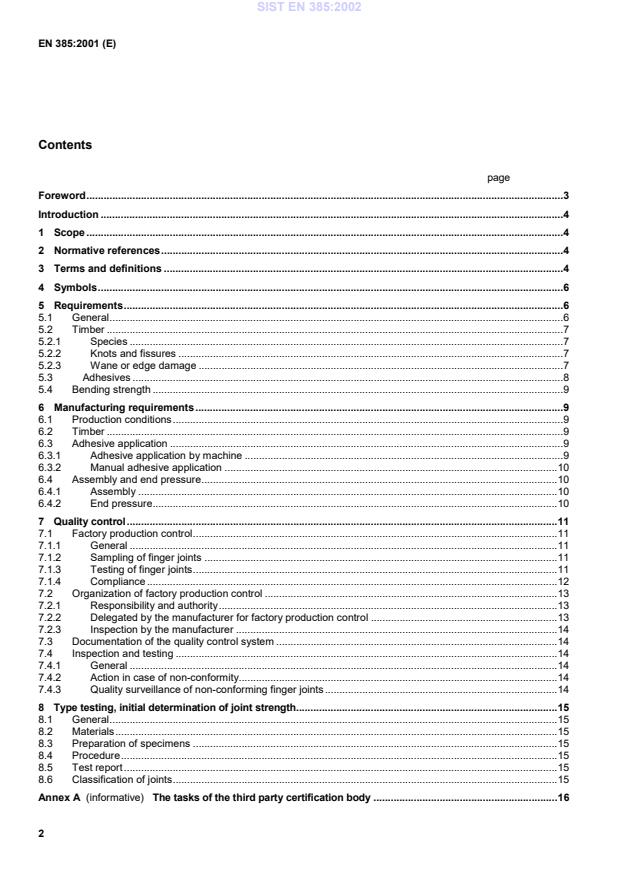
(informative)
The tasks of the third party certification body.16SIST EN 385:2002
This standard is elaborated as a supporting standard for a harmonized standard on structural timber with finger joints to bepublished in the future.2 Normative referencesThis European Standard incorporates by dated or undated reference, provisions from other publications. Thesenormative references are cited at the appropriate places in the text, and the publications are listed hereafter. Fordated references, subsequent amendments to or revisions of any of these publications apply to this EuropeanStandard only when incorporated in it by amendment or revision. For undated references the latest edition of thepublication referred to applies (including amendments).EN 301, Adhesives, phenolic and aminoplastic for load-bearing timber structures - Classification andperformance requirements.EN 408, Timber structures – Structural timber and glued laminated timber – Determination of somephysical and mechanical properties.3 Terms and definitionsFor the purposes of this European Standard, the following terms and definitions apply:3.1finger jointself-locating end joint formed by machining a number of similar, tapered, symmetrical fingers in the ends of timbermembers, which are then bonded together. See Figure 1SIST EN 385:2002
Finger lengthp
Pitchbt
Tip widthlt
Tip gap1)
Symmetry directionFigure 1 - Typical profile of finger joint3.2finger lengthdistance between the finger base and the tip of the finger, measured along the centre line of the finger3.3pitchdistance between fingers, centre to centre3.4production batchjoints, all of which have the same profile, manufactured from the same species of timber, the same strength class,having the same nominal cross section, bonded with the same adhesive and made during a continuous run on oneproduction line3.5service class 1service class characterized by a moisture content in the materials corresponding to a temperature of 20 C and therelative humidity of the surrounding air only exceeding 65 % for a few weeks per yearNOTE
In service class 1 the average equilibrium moisture content in most softwoods will not exceed 12 %.3.6service class 2service class characterized by a moisture content in the materials corresponding to a temperature of 20 C and therelative humidity of the surrounding air only exceeding 85 % for a few weeks per yearNOTE
In service class 2 the average equilibrium moisture content in most softwoods will not exceed 20 %.3.7service class 3service class characterized by climatic conditions leading to higher moisture contents than service class 23.8tip gapdistance between finger tip and opposite slot base in a bonded finger jointSIST EN 385:2002
Conformity with this requirement can be verified by measuring the diagonal aw of the wane and demonstrating that it is lessthan the maximum diagonal given in figure 5 as a function of the cross-sectional area A.SIST EN 385:2002
The adhesive should be chosen considering the climatic conditions in service, the timber species, the preservative used(if any) and the production methods.NOTE 2
Such strength and durability can be achieved by a polycondensation adhesive of the phenolic or aminoplastic type asdefined in EN 301.For adhesives of other
...