


EN 14845-1:2007
(Main)Test methods for fibres in concrete - Part 1: Reference concretes
General Information
- Abstract
This European Standard specifies the composition and characteristics of reference concretes used to evaluate the performance of fibres in concrete.
The purpose of the reference concrete is to determine the general suitability of a fibre for use in concrete.
NOTE The end user needs to satisfy themselves about the effectiveness of the fibre in their own concrete.
- Status
- Published
- Publication Date
- 03-Jul-2007
- Withdrawal Date
- 30-May-2008
- Technical Committee
- CEN/TC 104 - Concrete ( performance, production, placing and compliance criteria )
- Drafting Committee
- CEN/TC 104/WG 11 - Fibres for concrete
- Current Stage
- 9093 - Decision to confirm - Review Enquiry
- Start Date
- 28-Jun-2024
- Completion Date
- 23-Sep-2026
- Directive
- Harmonized Standard305/2011 - Regulation (eu) No 305/2011 of the European Parliament and of the Council of 9 march 2011 laying down harmonised conditions for the marketing of construction products and repealing council directive 89/106/eec
Not Harmonized89/106/EEC - Construction products

Overview
EN 14845-1:2007 - Test methods for fibres in concrete, Part 1: Reference concretes (CEN) defines standard reference concretes and procedures used to evaluate the performance of steel and polymer fibres in concrete. The standard establishes mix compositions, specimen preparation, curing and reporting requirements so that comparative laboratory tests (e.g., flexural performance) are repeatable and meaningful. Its primary purpose is to determine the general suitability of a fibre for use in concrete; end users must also verify fibre effectiveness in their specific mixes.
Key topics and technical requirements
- Reference concretes: Four types are specified by target flexural tensile strength, maximum aggregate size and maximum cement content.
- Mandatory mix example: 16 mm or 20 mm aggregate with target flexural tensile strength 4.3 ± 0.3 MPa, W/C ≈ 0.55, max cement 350 kg/m³.
- Optional higher-strength example: target 5.8 ± 0.4 MPa, W/C ≈ 0.45, max cement 400 kg/m³.
- Materials: Use CEM I 42,5 R cement (EN 197-1), natural silica-based uncrushed aggregates with <2% water absorption, and mixing water per EN 1008. Admixtures (plasticizers/superplasticizers) are allowed per EN 934-2 to meet workability.
- Consistency / workability: Measured by Vebe test (EN 12350-3) - Vebe class V3, or compactability per EN 12350-4 - class C2. Mix must avoid segregation/bleeding.
- Mixing & specimen prep: Forced-action pan mixer; batch volume 50–90% of capacity; add half water to aggregates, mix 2 min, add cement and remaining water, total mix ≤5 min. Fibres added per manufacturer instructions to ensure even dispersion.
- Compaction & moulding: Non-absorbent rigid moulds and high-frequency vibrating table for beam moulds (tests per EN 14845-2 / EN 14651).
- Curing: 24 h in mould at (20 ± 2) °C under polyethylene or ≥95% RH, then demould and water-cure 27 days at (20 ± 2) °C.
- Reporting: Record mix composition (kg/m³), W/C, fibre description (per EN 14889-1/2), particle size, Vebe/compactability, curing, limit of proportionality (LOP) strengths to 0.01 MPa, production date/time and deviations.
Applications and users
- Fibre manufacturers validating product performance for marketing and compliance.
- Independent testing laboratories and research institutes performing comparative fibres in concrete tests (strength and workability).
- Specifiers, product certifiers and R&D teams developing fibre-reinforced concrete mixes and systems (precast, shotcrete, industrial floors, sprayed linings).
- Contractors and precast plants using laboratory reference data to inform in-house trials.
Related standards
- EN 14845-2 (effect on strength), EN 14889-1/2 (fibre definitions), EN 14651 (flexural test), EN 197-1, EN 206-1, EN 1766, EN 12350 series, EN 934-2, EN 933-2, EN 1008.
Keywords: EN 14845-1:2007, reference concrete, fibres in concrete, test methods, flexural tensile strength, water/cement ratio, mix design, specimen preparation, curing.
Relations
- Effective Date
- 28-Jan-2026
- Effective Date
- 28-Jan-2026
- Effective Date
- 28-Jan-2026
- Effective Date
- 28-Jan-2026
- Effective Date
- 28-Jan-2026
- Effective Date
- 28-Jan-2026
- Effective Date
- 28-Jan-2026
- Effective Date
- 28-Jan-2026
- Effective Date
- 28-Jan-2026
- Effective Date
- 28-Jan-2026
- Effective Date
- 28-Jan-2026
- Effective Date
- 28-Jan-2026
Get Certified
Connect with accredited certification bodies for this standard

DIBt (Deutsches Institut für Bautechnik)
German Institute for Building Technology.
DIN CERTCO
DIN Group product certification.

Aboma Certification B.V.
Specialized in construction, metal, and transport sectors.
Sponsored listings
Frequently Asked Questions
EN 14845-1:2007 is a standard published by the European Committee for Standardization (CEN). Its full title is "Test methods for fibres in concrete - Part 1: Reference concretes". This standard covers: This European Standard specifies the composition and characteristics of reference concretes used to evaluate the performance of fibres in concrete. The purpose of the reference concrete is to determine the general suitability of a fibre for use in concrete. NOTE The end user needs to satisfy themselves about the effectiveness of the fibre in their own concrete.
This European Standard specifies the composition and characteristics of reference concretes used to evaluate the performance of fibres in concrete. The purpose of the reference concrete is to determine the general suitability of a fibre for use in concrete. NOTE The end user needs to satisfy themselves about the effectiveness of the fibre in their own concrete.
EN 14845-1:2007 is classified under the following ICS (International Classification for Standards) categories: 91.100.30 - Concrete and concrete products. The ICS classification helps identify the subject area and facilitates finding related standards.
EN 14845-1:2007 has the following relationships with other standards: It is inter standard links to EN 206-1:2000, EN 933-2:2020, EN 1008:2002, EN 14651:2005+A1:2007, EN 14845-2:2006, EN 197-1:2000, EN 12350-3:2019, EN 12350-1:2019, EN 1766:2000, EN 12350-4:2019, EN 14889-1:2006, EN 14889-2:2006. Understanding these relationships helps ensure you are using the most current and applicable version of the standard.
EN 14845-1:2007 is associated with the following European legislation: EU Directives/Regulations: 305/2011, 89/106/EEC; Standardization Mandates: M/128. When a standard is cited in the Official Journal of the European Union, products manufactured in conformity with it benefit from a presumption of conformity with the essential requirements of the corresponding EU directive or regulation.
EN 14845-1:2007 is available in PDF format for immediate download after purchase. The document can be added to your cart and obtained through the secure checkout process. Digital delivery ensures instant access to the complete standard document.
Standards Content (Sample)
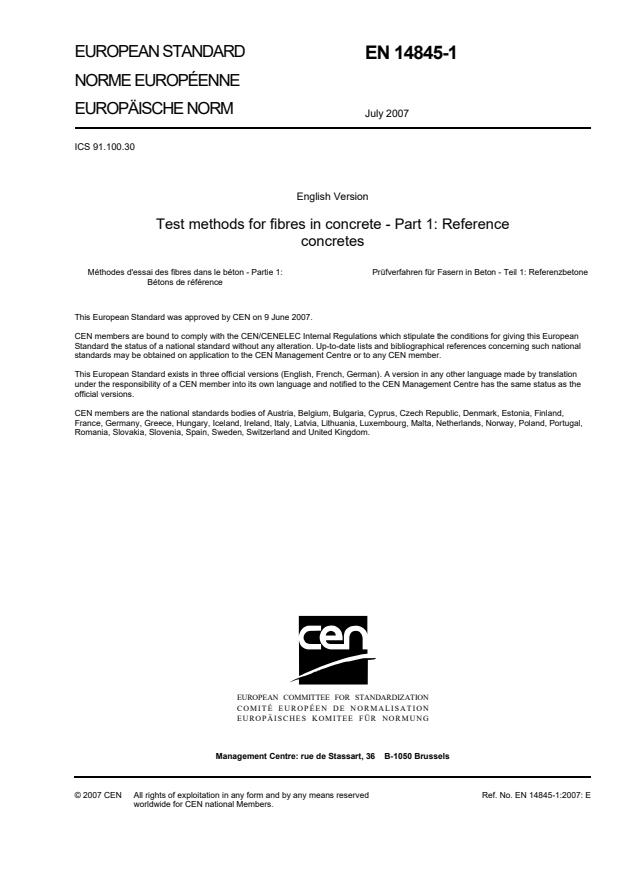
2003-01.Slovenski inštitut za standardizacijo. Razmnoževanje celote ali delov tega standarda ni dovoljeno.Test methods for fibres in concrete - Part 1: Reference concretesMéthodes d'essai des fibres dans le béton - Partie 1: Bétons de référencePrüfverfahren für Fasern in Beton - Teil 1: ReferenzbetoneTa slovenski standard je istoveten z:EN 14845-1:2007SIST EN 14845-1:2007en91.100.30Beton in betonski izdelkiConcrete and concrete productsICS:SLOVENSKI
STANDARDSIST EN 14845-1:200701-oktober-2007
EUROPEAN STANDARDNORME EUROPÉENNEEUROPÄISCHE NORMEN 14845-1July 2007ICS 91.100.30 English VersionTest methods for fibres in concrete - Part 1: ReferenceconcretesMéthodes d'essai des fibres dans le béton - Partie 1:Bétons de référencePrüfverfahren für Fasern in Beton - Teil 1: ReferenzbetoneThis European Standard was approved by CEN on 9 June 2007.CEN members are bound to comply with the CEN/CENELEC Internal Regulations which stipulate the conditions for giving this EuropeanStandard the status of a national standard without any alteration. Up-to-date lists and bibliographical references concerning such nationalstandards may be obtained on application to the CEN Management Centre or to any CEN member.This European Standard exists in three official versions (English, French, German). A version in any other language made by translationunder the responsibility of a CEN member into its own language and notified to the CEN Management Centre has the same status as theofficial versions.CEN members are the national standards bodies of Austria, Belgium, Bulgaria, Cyprus, Czech Republic, Denmark, Estonia, Finland,France, Germany, Greece, Hungary, Iceland, Ireland, Italy, Latvia, Lithuania, Luxembourg, Malta, Netherlands, Norway, Poland, Portugal,Romania, Slovakia, Slovenia, Spain, Sweden, Switzerland and United Kingdom.EUROPEAN COMMITTEE FOR STANDARDIZATIONCOMITÉ EUROPÉEN DE NORMALISATIONEUROPÄISCHES KOMITEE FÜR NORMUNGManagement Centre: rue de Stassart, 36
B-1050 Brussels© 2007 CENAll rights of exploitation in any form and by any means reservedworldwide for CEN national Members.Ref. No. EN 14845-1:2007: E
...