


FprEN 12541
(Main)Sanitary tapware - Pressure flushing valves and automatic closing urinal valves PN 10
Sanitary tapware - Pressure flushing valves and automatic closing urinal valves PN 10
This document applies to flushing valves for WCs and valves for urinals, with automatic hydraulic closure, intended for:
- WC pans EN 997;
- single flush urinals EN 13407;
- siphon acting urinals EN 13407.
It does not apply to no-contact detection valves.
It is intended to specify:
- marking and identification, physico-chemical, dimensional, leaktightness, pressure behaviour, hydraulic, mechanical endurance and acoustic characteristics of flushing valves for WCs and urinals with automatic closure;
- test methods used to verify these characteristics;
- and to determine requirements for the atmospheric interrupter which shall be an integral part of the WC flushing valve.
It applies in the following pressure and temperature conditions:
Table 1 — Conditions of use for tapware
Dynamic Pressure range recommended for a good working Urinals
WC DN 15
WC DN 20 0,1 MPa ≤ P ≤ 0,5 MPa
(1 bar ≤ P ≤ 5 bar)
WC DN 25 0,08 MPa ≤ P ≤ 0,25 MPa
(0,8 bar ≤ P ≤ 2,5 bar)
WC DN 32 0,08 MPa ≤ P ≤ 0,25 MPa
(0,8 bar ≤ P ≤ 2,5 bar)
Maximum static pressure 1 MPa (10 bar)
Water temperature ≤ 25 °C
NOTE 1 Although this document limits the pressure for WC DN 25 and WC DN 32 valves till 0,25 MPa (2,5 bar), some European countries have legislation and recommendations for higher pressures.
Health and quality requirements in accordance to European and national legislation for final materials in contact with water intended for human consumption are not covered by this document.
Sanitärarmaturen - WC- und Urinaldruckspüler mit selbsttätigem Abschluss PN 10
Das vorliegende Dokument gilt für WC Druckspüler und Urinaldruckspüler mit selbsttätigem Abschluss für:
- WC Becken nach EN 997;
- Verdrängungsbecken nach EN 13407;
- Absaugurinale nach EN 13407.
Sie gilt nicht für berührungslos ausgelöste Armaturen.
Ihr Zweck ist die Festlegung von:
- Anforderungen an Kennzeichnung und Markierung, an physikalisch chemische Eigenschaften, Maße, Dichtheit, Druckbeständigkeit, hydraulische Eigenschaften, mechanisches Zeitstandverhalten und Geräuschverhalten der WC Druckspüler und Urinaldruckspüler mit selbsttätigem Abschluss;
- Verfahren zur Überprüfung dieser Eigenschaften;
- Anforderungen an den Rohrunterbrecher, der integrierter Bestandteil des WC Druckspülers sein muss.
Sie findet unter folgenden Fließdruck und Temperaturbedingungen Anwendung:
Tabelle 1 — Einsatzbedingungen für Armaturen
Empfohlener Fließdruckbereich für einwandfreien Betrieb Urinal 0,1 MPa ≤ P ≤ 0,5 MPa
WC DN 15 (1 bar ≤ P ≤ 5 bar)
WC DN 20
WC DN 25 0,08 MPa ≤ P ≤ 0,25 MPa
(0,8 bar ≤ P ≤ 2,5 bar)
WC DN 32 0,08 MPa ≤ P ≤ 0,25 MPa
(0,8 bar ≤ P ≤ 2,5 bar)
max. Ruhedruck 1 MPa (10 bar)
Wassertemperatur ≤ 25 °C
ANMERKUNG 1 Obwohl dieses Dokument den Druck für WC DN 25 und WC DN 32 Druckspüler auf 0,25 MPa (2,5 bar) begrenzt, gibt es in einigen europäischen Ländern Gesetze und Empfehlungen für höhere Drücke.
Gesundheits und Qualitätsanforderungen nach der europäischen und nationalen Gesetzgebung für Endmaterialien, die Kontakt mit Wasser für den menschlichen Gebrauch haben, werden in diesem Dokument nicht behandelt.
Robinetterie sanitaire - Robinets de chasse d'eau et d'urinoirs à fermeture hydraulique automatique PN 10
Le présent document s’applique aux robinets de chasses pour WC et aux robinets d’urinoirs, à fermeture hydraulique automatique, destinés aux :
- cuvettes de WC, EN 997 ;
- urinoirs à simple rinçage, EN 13407 ;
- urinoirs à action siphonique, EN 13407.
Il ne s’applique pas aux robinets à détection sans contact.
Il a pour objet de fixer :
- le marquage et l’identification, les caractéristiques physico-chimiques, dimensionnelles, d’étanchéité, de tenue en pression, hydrauliques, acoustiques, d’endurance mécanique des robinets de chasse d’eau et robinets d’urinoirs à fermeture automatique ;
- les méthodes d’essais à employer pour vérifier ces caractéristiques ;
- les exigences du rupteur atmosphérique qui doit faire partie intégrante du robinet de chasse d’eau.
Il s’applique dans les conditions de pression et température suivantes :
Tableau 1 — Conditions d’utilisation des robinetteries
Plage de pression dynamique recommandée pour un bon fonctionnement Urinoirs
WC DN15
WC DN20 0,1 MPa ≤ P ≤ 0,5 MPa
(1 bar ≤ P ≤ 5 bar)
WC DN25 0,08 MPa ≤ P ≤ 0,25 MPa
(0,8 bar ≤ P ≤ 2,5 bar)
WC DN32 0,08 MPa ≤ P ≤ 0,25 MPa
(0,8 bar ≤ P ≤ 2,5 bar)
Pression statique maximale 1 MPa (10 bar)
Température de l’eau ≤ 25 °C
NOTE 1 Bien que le présent document limite la pression pour les robinets de WC DN25 et WC DN32 à 0,25 MPa (2,5 bar), la législation et les recommandations de certains pays européens fixent des pressions plus élevées.
Le présent document ne traite pas des exigences de santé et de qualité fixées par la législation européenne et les réglementations nationales relatives aux matériaux finaux en contact avec l’eau destinée à la consommation humaine.
Sanitarne armature - Tlačni izplakovalniki in samozaporni izplakovalniki PN10 za WC in pisoarje
General Information
- Status
- Not Published
- Publication Date
- 07-Apr-2026
- Technical Committee
- CEN/TC 164 - Water supply
- Drafting Committee
- CEN/TC 164/WG 8 - Sanitary tapware
- Current Stage
- 5060 - Closure of Vote - Formal Approval
- Start Date
- 29-Jan-2026
- Due Date
- 26-Feb-2025
- Completion Date
- 29-Jan-2026
Relations
- Effective Date
- 28-Jan-2023
Overview
FprEN 12541 - Sanitary tapware - Pressure flushing valves and automatic closing urinal valves PN 10 (CEN draft prEN 12541:2024) specifies performance and test requirements for pressure flushing valves for WCs and automatic closing urinal valves with hydraulic closure. It applies to valves intended for WC pans (EN 997) and single‑flush or siphon‑acting urinals (EN 13407). The standard excludes no‑contact detection valves and does not set health/quality limits for materials in contact with drinking water (these remain subject to European or national legislation).
Key topics and requirements
The standard defines mandatory characteristics, test methods and marking for PN 10 flushing valves, including:
- Scope and classification for WC and urinal flushing valves and designation rules.
- Marking and identification requirements for traceability and conformity.
- Materials and surface quality for exposed parts (physico‑chemical considerations noted; material health requirements are out of scope).
- Dimensional characteristics for top‑entry and side‑entry valves (WC and urinal configurations).
- Leaktightness tests upstream and downstream of the seat and leaktightness test methods.
- Pressure resistance and mechanical behaviour tests under specified dynamic and static pressures.
- Hydraulic and flow characteristics (flow rate–time–volume and impact force tests for WC valves; flow tests for urinal valves). The update introduces a 4 L flow rate category.
- Atmospheric pipe interrupter: composition, required integration into WC valves, verification of absence of water splash/backflow and vacuum operation tests.
- Operating force, mechanical endurance (cycle testing) and acoustic characteristics (noise grouping and measurement).
- Conditions of use: dynamic pressure ranges and temperature limits:
- Urinals and WC DN15/DN20: 0.1–0.5 MPa (1–5 bar)
- WC DN25/DN32: 0.08–0.25 MPa (0.8–2.5 bar)
- Maximum static pressure: 1 MPa (10 bar)
- Water temperature ≤ 25 °C
- Note: some countries allow higher working pressures by regulation.
Applications and users
FprEN 12541 is used by:
- Manufacturers of flushing valves to design and declare compliant products (WC and urinal tapware).
- Test laboratories to perform standardised leaktightness, hydraulic, endurance and acoustic tests.
- Specifiers, consultants and engineers writing project performance requirements for sanitary installations.
- Installers and procurement teams who need verified product data for compliant building projects.
- Regulatory bodies and certification schemes assessing conformity to European requirements.
Keywords: FprEN 12541, sanitary tapware, pressure flushing valves, automatic closing urinal valves, PN 10, WC flushing valves, atmospheric interrupter, leaktightness, hydraulic characteristics, mechanical endurance.
Related standards
- EN 997 - WC pans (referenced for intended install)
- EN 13407 - Single‑flush and siphon‑acting urinals
- EN 12541:2002 - previous version to be superseded by prEN 12541:2024

Get Certified
Connect with accredited certification bodies for this standard

ICC Evaluation Service
Building products evaluation and certification.

QAI Laboratories
Building and construction product testing and certification.

Aboma Certification B.V.
Specialized in construction, metal, and transport sectors.
Sponsored listings
Frequently Asked Questions
FprEN 12541 is a draft published by the European Committee for Standardization (CEN). Its full title is "Sanitary tapware - Pressure flushing valves and automatic closing urinal valves PN 10". This standard covers: This document applies to flushing valves for WCs and valves for urinals, with automatic hydraulic closure, intended for: - WC pans EN 997; - single flush urinals EN 13407; - siphon acting urinals EN 13407. It does not apply to no-contact detection valves. It is intended to specify: - marking and identification, physico-chemical, dimensional, leaktightness, pressure behaviour, hydraulic, mechanical endurance and acoustic characteristics of flushing valves for WCs and urinals with automatic closure; - test methods used to verify these characteristics; - and to determine requirements for the atmospheric interrupter which shall be an integral part of the WC flushing valve. It applies in the following pressure and temperature conditions: Table 1 — Conditions of use for tapware Dynamic Pressure range recommended for a good working Urinals WC DN 15 WC DN 20 0,1 MPa ≤ P ≤ 0,5 MPa (1 bar ≤ P ≤ 5 bar) WC DN 25 0,08 MPa ≤ P ≤ 0,25 MPa (0,8 bar ≤ P ≤ 2,5 bar) WC DN 32 0,08 MPa ≤ P ≤ 0,25 MPa (0,8 bar ≤ P ≤ 2,5 bar) Maximum static pressure 1 MPa (10 bar) Water temperature ≤ 25 °C NOTE 1 Although this document limits the pressure for WC DN 25 and WC DN 32 valves till 0,25 MPa (2,5 bar), some European countries have legislation and recommendations for higher pressures. Health and quality requirements in accordance to European and national legislation for final materials in contact with water intended for human consumption are not covered by this document.
This document applies to flushing valves for WCs and valves for urinals, with automatic hydraulic closure, intended for: - WC pans EN 997; - single flush urinals EN 13407; - siphon acting urinals EN 13407. It does not apply to no-contact detection valves. It is intended to specify: - marking and identification, physico-chemical, dimensional, leaktightness, pressure behaviour, hydraulic, mechanical endurance and acoustic characteristics of flushing valves for WCs and urinals with automatic closure; - test methods used to verify these characteristics; - and to determine requirements for the atmospheric interrupter which shall be an integral part of the WC flushing valve. It applies in the following pressure and temperature conditions: Table 1 — Conditions of use for tapware Dynamic Pressure range recommended for a good working Urinals WC DN 15 WC DN 20 0,1 MPa ≤ P ≤ 0,5 MPa (1 bar ≤ P ≤ 5 bar) WC DN 25 0,08 MPa ≤ P ≤ 0,25 MPa (0,8 bar ≤ P ≤ 2,5 bar) WC DN 32 0,08 MPa ≤ P ≤ 0,25 MPa (0,8 bar ≤ P ≤ 2,5 bar) Maximum static pressure 1 MPa (10 bar) Water temperature ≤ 25 °C NOTE 1 Although this document limits the pressure for WC DN 25 and WC DN 32 valves till 0,25 MPa (2,5 bar), some European countries have legislation and recommendations for higher pressures. Health and quality requirements in accordance to European and national legislation for final materials in contact with water intended for human consumption are not covered by this document.
FprEN 12541 is classified under the following ICS (International Classification for Standards) categories: 91.140.70 - Sanitary installations. The ICS classification helps identify the subject area and facilitates finding related standards.
FprEN 12541 has the following relationships with other standards: It is inter standard links to EN 12541:2002. Understanding these relationships helps ensure you are using the most current and applicable version of the standard.
FprEN 12541 is available in PDF format for immediate download after purchase. The document can be added to your cart and obtained through the secure checkout process. Digital delivery ensures instant access to the complete standard document.
Standards Content (Sample)
SLOVENSKI STANDARD
oSIST prEN 12541:2024
01-september-2024
Sanitarne armature – Tlačni izplakovalniki in samozaporni izplakovalniki PN10 za
WC in pisoarje
Sanitary tapware - Pressure flushing valves and automatic closing urinal valves PN 10
Sanitärarmaturen - WC- und Urinaldruckspüler mit selbsttätigem Abschluss PN 10
Robinetterie sanitaire - Robinets de chasse d'eau et d'urinoirs à fermeture hydraulique
automatique PN 10
Ta slovenski standard je istoveten z: prEN 12541
ICS:
91.140.70 Sanitarne naprave Sanitary installations
oSIST prEN 12541:2024 en,fr,de
2003-01.Slovenski inštitut za standardizacijo. Razmnoževanje celote ali delov tega standarda ni dovoljeno.
oSIST prEN 12541:2024
oSIST prEN 12541:2024
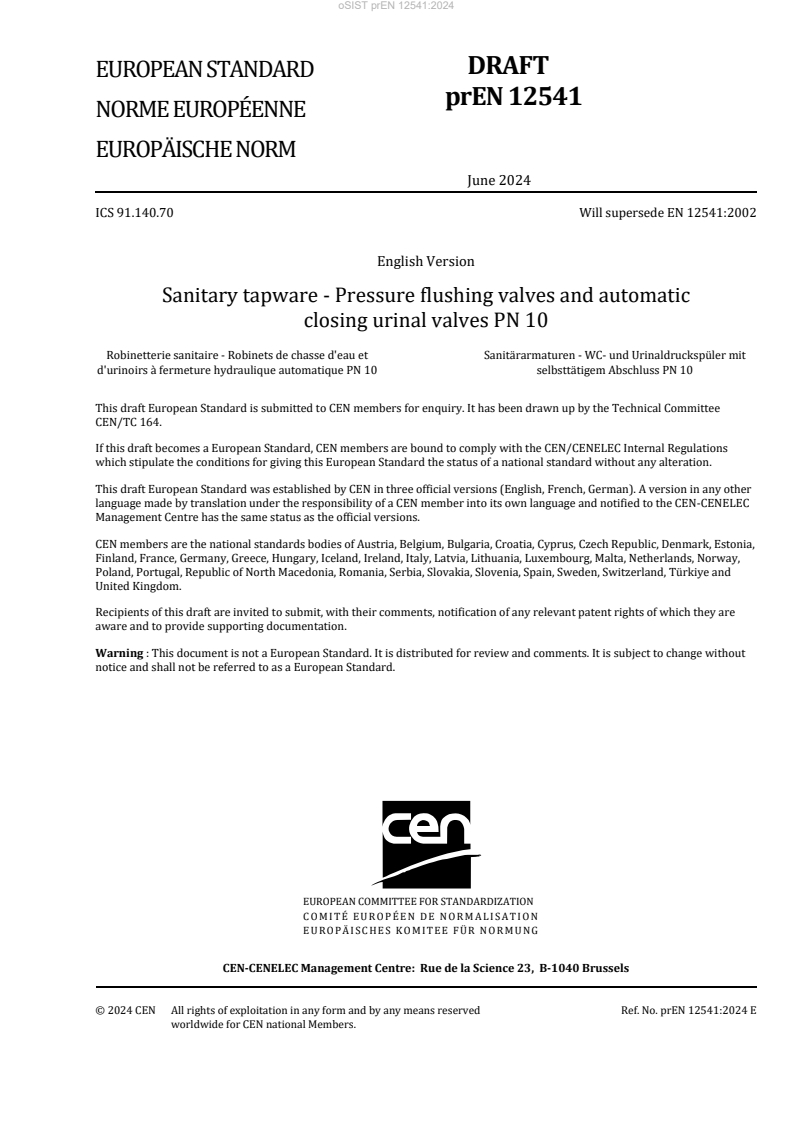
DRAFT
EUROPEAN STANDARD
prEN 12541
NORME EUROPÉENNE
EUROPÄISCHE NORM
June 2024
ICS 91.140.70 Will supersede EN 12541:2002
English Version
Sanitary tapware - Pressure flushing valves and automatic
closing urinal valves PN 10
Robinetterie sanitaire - Robinets de chasse d'eau et Sanitärarmaturen - WC- und Urinaldruckspüler mit
d'urinoirs à fermeture hydraulique automatique PN 10 selbsttätigem Abschluss PN 10
This draft European Standard is submitted to CEN members for enquiry. It has been drawn up by the Technical Committee
CEN/TC 164.
If this draft becomes a European Standard, CEN members are bound to comply with the CEN/CENELEC Internal Regulations
which stipulate the conditions for giving this European Standard the status of a national standard without any alteration.
This draft European Standard was established by CEN in three official versions (English, French, German). A version in any other
language made by translation under the responsibility of a CEN member into its own language and notified to the CEN-CENELEC
Management Centre has the same status as the official versions.
CEN members are the national standards bodies of Austria, Belgium, Bulgaria, Croatia, Cyprus, Czech Republic, Denmark, Estonia,
Finland, France, Germany, Greece, Hungary, Iceland, Ireland, Italy, Latvia, Lithuania, Luxembourg, Malta, Netherlands, Norway,
Poland, Portugal, Republic of North Macedonia, Romania, Serbia, Slovakia, Slovenia, Spain, Sweden, Switzerland, Türkiye and
United Kingdom.
Recipients of this draft are invited to submit, with their comments, notification of any relevant patent rights of which they are
aware and to provide supporting documentation.
Warning : This document is not a European Standard. It is distributed for review and comments. It is subject to change without
notice and shall not be referred to as a European Standard.
EUROPEAN COMMITTEE FOR STANDARDIZATION
COMITÉ EUROPÉEN DE NORMALISATION
EUROPÄISCHES KOMITEE FÜR NORMUNG
CEN-CENELEC Management Centre: Rue de la Science 23, B-1040 Brussels
© 2024 CEN All rights of exploitation in any form and by any means reserved Ref. No. prEN 12541:2024 E
worldwide for CEN national Members.
oSIST prEN 12541:2024
prEN 12541:2024 (E)
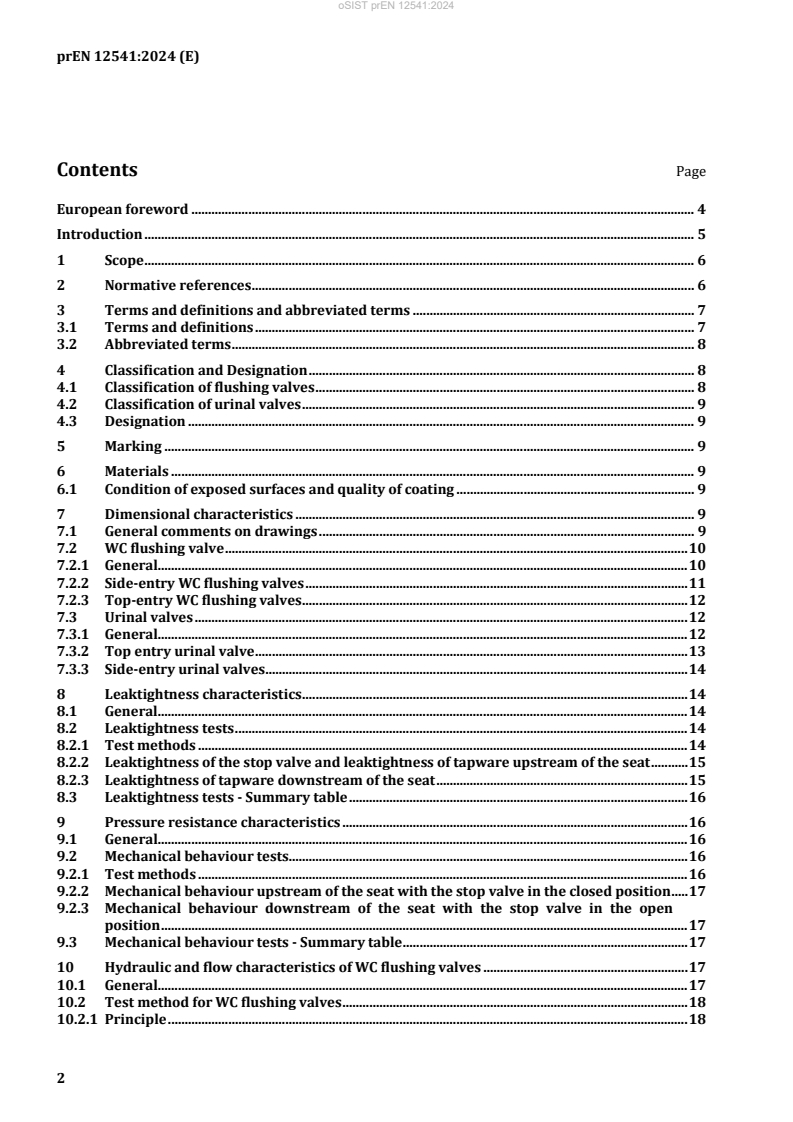
Contents Page
European foreword . 4
Introduction . 5
1 Scope . 6
2 Normative references . 6
3 Terms and definitions and abbreviated terms . 7
3.1 Terms and definitions . 7
3.2 Abbreviated terms . 8
4 Classification and Designation . 8
4.1 Classification of flushing valves . 8
4.2 Classification of urinal valves . 9
4.3 Designation . 9
5 Marking . 9
6 Materials . 9
6.1 Condition of exposed surfaces and quality of coating . 9
7 Dimensional characteristics . 9
7.1 General comments on drawings . 9
7.2 WC flushing valve . 10
7.2.1 General. 10
7.2.2 Side-entry WC flushing valves . 11
7.2.3 Top-entry WC flushing valves . 12
7.3 Urinal valves . 12
7.3.1 General. 12
7.3.2 Top entry urinal valve . 13
7.3.3 Side-entry urinal valves . 14
8 Leaktightness characteristics . 14
8.1 General. 14
8.2 Leaktightness tests . 14
8.2.1 Test methods . 14
8.2.2 Leaktightness of the stop valve and leaktightness of tapware upstream of the seat . 15
8.2.3 Leaktightness of tapware downstream of the seat . 15
8.3 Leaktightness tests - Summary table . 16
9 Pressure resistance characteristics . 16
9.1 General. 16
9.2 Mechanical behaviour tests. 16
9.2.1 Test methods . 16
9.2.2 Mechanical behaviour upstream of the seat with the stop valve in the closed position . 17
9.2.3 Mechanical behaviour downstream of the seat with the stop valve in the open
position . 17
9.3 Mechanical behaviour tests - Summary table . 17
10 Hydraulic and flow characteristics of WC flushing valves . 17
10.1 General. 17
10.2 Test method for WC flushing valves . 18
10.2.1 Principle . 18
oSIST prEN 12541:2024
prEN 12541:2024 (E)
10.2.2 Test apparatus . 18
10.2.3 Measurement of impact force and requirements . 21
10.2.4 Fitting the WC flushing valve . 22
10.3 Outline of flow rate-time-volume-impact force test and requirements . 23
10.3.1 Definitions . 23
10.3.2 Test methodology . 24
10.3.3 Test at lower dynamic pressure . 25
10.3.4 Test at upper dynamic pressure . 26
10.4 Summary of requirements . 27
10.5 Measurement of water hammer . 28
10.5.1 Test method . 28
10.5.2 Requirements . 28
11 Principle and verification of atmospheric pipe interrupters of WC flushing valves . 28
11.1 General . 28
11.2 Atmospheric pipe interrupter composition . 28
11.2.1 General . 28
11.2.2 Requirements . 28
11.2.3 Measurement method of dry part . 28
11.3 Installation conditions . 29
11.4 Verification of absence of water splashes at backflow protection . 30
11.4.1 Test method . 30
11.4.2 Requirements . 30
11.5 Verification of operation at vacuum . 30
11.5.1 General . 30
11.5.2 Test method . 31
11.5.3 Requirements . 31
12 Hydraulic or flow characteristics of urinal valves . 31
12.1 General . 31
12.2 Test method for urinal valves . 31
12.2.1 Test apparatus . 31
12.3 Requirements . 32
13 Operating force . 32
14 Mechanical endurance characteristics . 32
14.1 General . 32
14.2 WC flushing valves . 32
14.2.1 Procedure . 32
14.2.2 Minimum requirements . 33
14.3 Urinal valves . 33
14.3.1 Procedure . 33
14.3.2 Minimum requirements . 33
15 Acoustic characteristics . 33
15.1 General . 33
15.2 Procedure . 34
15.2.1 Installation conditions and valve operation . 34
15.2.2 Test method . 34
15.3 Requirements . 34
15.3.1 Expression of results . 34
15.3.2 Determination of acoustic groups . 34
Bibliography . 36
oSIST prEN 12541:2024
prEN 12541:2024 (E)
European foreword
This document (prEN 12541:2024) has been prepared by Technical Committee CEN/TC 164“Water
supply”, the secretariat of which is held by AFNOR.
This document is currently submitted to the CEN Enquiry.
This document will supersede EN 12541:2002.
prEN 12541:2024 includes the following significant technical changes with respect to EN 12541:2002:
— the document has been technically updated;
— the classifications for flushing and urinal valves have been updated;
— the 4l flow rate was introduced.
oSIST prEN 12541:2024
prEN 12541:2024 (E)
Introduction
As for possible unfavourable effects of the product to which this document applies on the quality of
water for human consumption, no information is provided by this document on possible use
restrictions of the product in any of the member states of the EU or the EFTA.
NOTE While awaiting the adoption of verifiable European criteria, attention is also drawn to existing national
regulation that can apply.
oSIST prEN 12541:2024
prEN 12541:2024 (E)
1 Scope
This document applies to flushing valves for WCs and valves for urinals, with automatic hydraulic
closure, intended for:
— WC pans EN 997;
— single flush urinals EN 13407;
— siphon acting urinals EN 13407.
It does not apply to no-contact detection valves.
It is intended to specify:
— marking and identification, physico-chemical, dimensional, leaktightness, pressure behaviour,
hydraulic, mechanical endurance and acoustic characteristics of flushing valves for WCs and urinals
with automatic closure;
— test methods used to verify these characteristics;
— and to determine requirements for the atmospheric interrupter which shall be an integral part of
the WC flushing valve.
It applies in the following pressure and temperature conditions:
Table 1 — Conditions of use for tapware
Urinals 0,1 MPa ≤ P ≤ 0,5 MPa
WC DN 15 (1 bar ≤ P ≤ 5 bar)
WC DN 20
Dynamic Pressure
WC DN 25 0,08 MPa ≤ P ≤ 0,25 MPa
range recommended
for a good working
(0,8 bar ≤ P ≤ 2,5 bar)
WC DN 32 0,08 MPa ≤ P ≤ 0,25 MPa
(0,8 bar ≤ P ≤ 2,5 bar)
Maximum static pressure 1 MPa (10 bar)
Water temperature ≤ 25 °C
NOTE 1 Although this document limits the pressure for WC DN 25 and WC DN 32 valves till 0,25 MPa (2,5 bar),
some European countries have legislation and recommendations for higher pressures.
Health and quality requirements in accordance to European and national legislation for final materials
in contact with water intended for human consumption are not covered by this document.
2 Normative references
The following documents are referred to in the text in such a way that some or all of their content
constitutes requirements of this document. For dated references, only the edition cited applies. For
undated references, the latest edition of the referenced document (including any amendments) applies.
EN 248, Sanitary tapware — General specification for electrodeposited coatings of Ni-Cr
EN 997, WC pans and WC suites with integral trap
oSIST prEN 12541:2024
prEN 12541:2024 (E)
EN 13407:2015+A1:2018, Wall-hung urinals — Functional requirements and test methods
EN ISO 3822-1, Acoustics — Laboratory tests on noise emission from appliances and equipment used in
water supply installations — Part 1: Method of measurement (ISO 3822-1)
EN ISO 3822-4, Acoustics — Laboratory tests on noise emission from appliances and equipment used in
water supply installations — Part 4: Mounting and operating conditions for special appliances (ISO 3822)
ISO 228-1:2000, Pipe threads where pressure-tight joints are not made on the threads — Part 1:
Dimensions, tolerances and designation
3 Terms and definitions and abbreviated terms
3.1 Terms and definitions
For the purposes of this document, the following terms and definitions apply.
ISO and IEC maintain terminological databases for use in standardization at the following addresses:
• IEC Electropedia: available at https://www.electropedia.org/
• ISO Online browsing platform: available at https://www.iso.org/obp
3.1.1
automatic closing valve
tapware whose opening is operated by a mechanical action on the control device, and whose closure
happens automatically after a period of adjustable or non-adjustable duration
3.1.2
WC flushing valve
automatic closing valve intended to ensure the flushing out of WC pans in accordance with EN 997, and
comprising an atmospheric interrupter
3.1.2.1
stop valve for flushing valve
valve used to stop water flow upstream of the flushing valve
Note 1 to entry: It may be integrated into the flushing valve, or separate from it.
3.1.2.2
flow control equipment
manual or automatic equipment controlling the flush flow and which is an integral part of the flushing
valve or of the stop valve
Note 1 to entry: If it is part of the stop valve, this latter shall not be linked to the flushing valve by a ISO 228-1
thread.
3.1.2.3
volume control equipment
equipment used to control the volume of water delivered by a flushing valve
3.1.3
urinal valve
oSIST prEN 12541:2024
prEN 12541:2024 (E)
3.1.3.1
single flush urinal valve
valve intended for flushing single flush urinals in accordance with EN 13407:2015+A1:2018, 3.6 and 3.7
3.1.3.2
siphon action urinal valve
valve intended for flushing siphon acting urinals in accordance with EN 13407:2015+A1:2018, 3.4
3.1.3.3
stop valves for urinal valve
valve used to stop water supply
Note 1 to entry: It may be integrated in the urinal valve and may be used to control the flow.
3.2 Abbreviated terms
For the purposes of this document, the abbreviated terms in Table 2 apply.
Table 2 — Abbreviated terms
DESIGNATION ABBREV. UNIT DEFINITION
Nominal size DN mm Defines the hydraulic and dimensional values
of the valve
Flow rate Q l/s Volume of water supplied in the unit of time
Operating time T s Time elapsing between the start of activation
and the return to 0 of the flow rate
Volume of V l Volume of water supplied during the
water operating time
Static pressure Ps MPa (bar) Pressure upstream of valve in absence of
flow
Dynamic Pd MPa (bar) Pressure upstream of valve during flow
pressure
Water hammer ΔP MPa (bar) Overpressure occurring upstream of valve at
time of closure
Impact force F N Force produced by jet at outlet of flushing
pipe.
4 Classification and Designation
4.1 Classification of flushing valves
Flushing valves are classified according to their volume class as shown in Table 3:
Table 3 — Volume class of flushing valves
Class Amount of delivered water (v)
4 4 l ≤ v < 6 l
6 6 l ≤ v < 9 l
oSIST prEN 12541:2024
prEN 12541:2024 (E)
9 9 l ≤ v < 10 l
4.2 Classification of urinal valves
Urinal valves are classified according to their “volume class” as shown in Table 4:
Table 4 — Volume class of urinal valves
Class Amount of delivered water (v)
1 v ≤ 1 l
2 1 l < v ≤ 2 l
4 2 l < v ≤ 4 l
6 4 l < v ≤ 6 l
4.3 Designation
An automatic closing flushing or urinal valve is designated by:
— the type of appliance for which it is intended (WC, siphon action urinal, single flush urinals…);
— volume class (e.g. class 6, class 9, etc);
— type of control (push-button, remote control.);
— mounting method (top-entry, side-entry, flush.);
— its nominal DN size;
— its connecting dimension;
— the presence of an incorporated stop valve;
— the acoustic group (if classified).
EXAMPLE flushing valve / for WC / Class 6 / push-button / top-entry / DN 20 / G3/4 B with incorporated
stop valve / Group 1
5 Marking
Tapware complying with this document shall be marked indelibly and permanently on the appliance
with the mark or name of the manufacturer and the acoustic group, if tested.
6 Materials
6.1 Condition of exposed surfaces and quality of coating
Coated visible surfaces shall comply with the requirements of EN 248.
7 Dimensional characteristics
7.1 General comments on drawings
The design and construction of components without defined dimensions permits various design
solutions to be adopted by the manufacturer.
oSIST prEN 12541:2024
prEN 12541:2024 (E)
7.2 WC flushing valve
7.2.1 General
Table 5 — Threads and outlet pipe (see Figure 1 and Figure 2)
Dimensions Designation DN15 DN20 DN25 DN32
A Male thread (ISO 228-1:2000) G1/2B G3/4B G1B G1 1/4B
D Female thread (ISO 228-1:2000) G1/2 G1/2 G3/4 G1
G (+0/-0,5) mm Diameter of pipe connection sleeve 20 26 26 or 30 30
H (+0,2/+0,5) Diameter of valve outlet for 22 28 28 or 32 32
mm connection to pipe by compression
joint
Table 6 — Permitted thread lengths (see Figure 1 and Figure 2)
Dimension Comment G1/2B G1/2 G3/4B G3/4 G1B G1 G1
1/4B
C min Useful thread length (mm) 8 - 10 - 10 - 11
L min Male thread (mm) 11 - 13 - 15 - 19
F min Female thread (mm) - 10 - 12 - 12 -
oSIST prEN 12541:2024
prEN 12541:2024 (E)
7.2.2 Side-entry WC flushing valves
Figure 1 — Side entry WC flushing valves (see Table 5 and Table 6)
oSIST prEN 12541:2024
prEN 12541:2024 (E)
7.2.3 Top-entry WC flushing valves
Figure 2 — Top entry WC flushing valves (see Table 5 and Table 6)
7.3 Urinal valves
7.3.1 General
Table 7— Threads (see Figure 3 and Figure 4)
DIMENSIONS DESIGNATION DN15 DN20
a
Male thread (ISO 228-1:2000) G1/2B G3/4B
A
a
Female thread (ISO 228-1:2000) G1/2 G1/2
D
C min Useful thread length 8 10
L min Male thread 11 13
F min Female thread 10 12
a
If the urinal connecting pipe is supplied with the valve, dimensions A and D are not mandatory at the outlet.
oSIST prEN 12541:2024
prEN 12541:2024 (E)
7.3.2 Top entry urinal valve
Figure 3 — Top-entry urinal valve (see Table 7)
oSIST prEN 12541:2024
prEN 12541:2024 (E)
7.3.3 Side-entry urinal valves
Figure 4 — Side -entry urinal valve (see Table 7)
NOTE Where the outlet and inlet are different, the nominal size is that of the inlet and the outlet diameter will
be shown (e.g.: top-entry urinal valve G1/2 male with female outlet G3/4H).
8 Leaktightness characteristics
8.1 General
The tests described below are type tests (laboratory tests) and not quality control tests carried out
during manufacture. They are carried out in water whose temperature is inferior or equal to 25 °C.
This clause specifies test methods for verifying the leaktightness of the tapware unit and gives the
corresponding specifications.
If flow rate adjustment is incorporated in the stop valve, it is the mounted unit, which shall be tested.
8.2 Leaktightness tests
8.2.1 Test methods
8.2.1.1 Principle
The test principle consists of verifying under cold water pressure:
a) the leaktightness of the stop valve;
b) the leaktightness of the tapware (body, head-body unit, etc.).
oSIST prEN 12541:2024
prEN 12541:2024 (E)
8.2.1.2 Apparatus
This comprises a hydraulic test circuit capable of supplying the required static and dynamic pressures
and which can maintain them throughout the duration of the test.
8.2.2 Leaktightness of the stop valve and leaktightness of tapware upstream of the seat
8.2.2.1 Procedure
— Connect tapware to test circuit;
— apply a static water pressure of (1,6 ± 0,05) MPa [(16 ± 0,5) bar] for (60 ± 5) s;
— apply a static water pressure of (0,1 ± 0,01) MPa [(1 ± 0,1) bar] for (60 ± 5) s.
8.2.2.2 Requirements
a) Verify the leaktightness of stop valve. There shall be no leakage at the stop valve for the duration of
the test;
b) verify the leaktightness upstream of the seat. There shall be no leakage or seepage through the
body of the valve for the duration of the test.
8.2.3 Leaktightness of tapware downstream of the seat
8.2.3.1 General
This test only applies to urinal valves.
8.2.3.2 Procedure
— Connect tapware to test circuit;
— open the stop valve with the outlet of the urinal valve closed and generally facing downwards;
— apply a static water pressure of (0,4 ± 0,02) MPa [(4 ± 0,2) bar] for (60 ± 5) s;
— apply a static water pressure of (0,02 ± 0,005) MPa [(0,2 ± 0,05) bar] for (60 ± 5) s.
8.2.3.3 Requirements
There shall be no leakage or seepage through the walls for the duration of the test.
oSIST prEN 12541:2024
prEN 12541:2024 (E)
8.3 Leaktightness tests - Summary table
Table 8 — Informative summary of leaktightness tests
Leaktightness of: Position of Outlet Pressure Duration Requirements
stop valve opening
Stop valve Closed Open (0,1 ± 0,01) MPa 60 ± 5 s
(1 ± 0,1) bar
Closed Open (1,6 ± 0,05) MPa 60 ± 5 s
(16 ± 0,5) bar
Tapware Unit Upstream of Closed Open (1,6 ± 0,05) MPa 60 ± 5 s
No leakage
seat
(16 ± 0,05) bar
a
Downstream Closed (0,4 ± 0,02) MPa 60 ± 5 s
Open
of seat
(4 ± 0,2) bar
b
(0,020 ± 0,005) MPa 60 ± 5 s
c
(0,2 ± 0,05) bar
a
In the case of tapware with a system to prevent locking in permanent flow position, carry out the test with
the stop valve immobilised mechanically.
b
In the case of hydraulic opening valves, the test at 0,02 MPa (0,2 bar) is not mandatory.
c
Only for urinal valves
9 Pressure resistance characteristics
9.1 General
The tests described below are type tests (laboratory tests) and not quality contro
...
Questions, Comments and Discussion
Ask us and Technical Secretary will try to provide an answer. You can facilitate discussion about the standard in here.
Loading comments...