


EN 14333-3:2004
(Main)Non fatty foods - Determination of benzimidazole fungicides carbendazim, thiabendazole and benomyl (as carbendazim) - Part 3: HPLC method with liquid/liquid-partition clean up
General Information
- Abstract
This draft European Standard specifies a high performance liquid chromatographic (HPLC) method for the determination of the benzimidazole fungicides carbendazim and thiabendazole in fruits, vegetables and processed products.
When benomyl is present, it is completely degraded to carbendazim and is also determined as carbendazim. Thiophanate-methyl is not determined with the method.
The method has been validated for carbendazim and thiabendazole in an interlaboratory test with homogenates of apples, French beans, mushrooms, lemons and fruit based infant food.
- Status
- Withdrawn
- Publication Date
- 05-Oct-2004
- Withdrawal Date
- 31-Dec-2014
- Technical Committee
- CEN/TC 275 - Food analysis - Horizontal methods
- Drafting Committee
- CEN/TC 275/WG 4 - Pesticides in foods of plant origin
- Current Stage
- 9960 - Withdrawal effective - Withdrawal
- Start Date
- 01-Jan-2015
- Completion Date
- 01-Jan-2015

Get Certified
Connect with accredited certification bodies for this standard

BSI Group
BSI (British Standards Institution) is the business standards company that helps organizations make excellence a habit.

Bureau Veritas
Bureau Veritas is a world leader in laboratory testing, inspection and certification services.

DNV
DNV is an independent assurance and risk management provider.
Sponsored listings
Frequently Asked Questions
EN 14333-3:2004 is a standard published by the European Committee for Standardization (CEN). Its full title is "Non fatty foods - Determination of benzimidazole fungicides carbendazim, thiabendazole and benomyl (as carbendazim) - Part 3: HPLC method with liquid/liquid-partition clean up". This standard covers: This draft European Standard specifies a high performance liquid chromatographic (HPLC) method for the determination of the benzimidazole fungicides carbendazim and thiabendazole in fruits, vegetables and processed products. When benomyl is present, it is completely degraded to carbendazim and is also determined as carbendazim. Thiophanate-methyl is not determined with the method. The method has been validated for carbendazim and thiabendazole in an interlaboratory test with homogenates of apples, French beans, mushrooms, lemons and fruit based infant food.
This draft European Standard specifies a high performance liquid chromatographic (HPLC) method for the determination of the benzimidazole fungicides carbendazim and thiabendazole in fruits, vegetables and processed products. When benomyl is present, it is completely degraded to carbendazim and is also determined as carbendazim. Thiophanate-methyl is not determined with the method. The method has been validated for carbendazim and thiabendazole in an interlaboratory test with homogenates of apples, French beans, mushrooms, lemons and fruit based infant food.
EN 14333-3:2004 is classified under the following ICS (International Classification for Standards) categories: 67.080.01 - Fruits, vegetables and derived products in general. The ICS classification helps identify the subject area and facilitates finding related standards.
EN 14333-3:2004 is available in PDF format for immediate download after purchase. The document can be added to your cart and obtained through the secure checkout process. Digital delivery ensures instant access to the complete standard document.
Standards Content (Sample)
2003-01.Slovenski inštitut za standardizacijo. Razmnoževanje celote ali delov tega standarda ni dovoljeno.D]LPFettarme Lebensmittel - Bestimmung der Benzimidazol-Fungizide Carbendazim, Thiabendazol und Benomyl (als Carbendazim) - Teil 3: HPLC-Verfahren mit Reinigung durch Flüssig/Flüssig-VerteilungAliments non gras - Détermination des benzimidazoles antifongiques : le carbendazime, le thiabendazole et le bénomyl en tant que carbendazime - Partie 3: Méthode CLHP avec purification par séparation liquide/liquideNon fatty foods - Determination of benzimidazole fungicides carbendazim, thiabendazole and benomyl (as carbendazim) - Part 3: HPLC method with liquid/liquid-partition clean up67.050Splošne preskusne in analizne metode za živilske proizvodeGeneral methods of tests and analysis for food productsICS:Ta slovenski standard je istoveten z:EN 14333-3:2004SIST EN 14333-3:2005en01-januar-2005SIST EN 14333-3:2005SLOVENSKI
STANDARD
EUROPEAN STANDARDNORME EUROPÉENNEEUROPÄISCHE NORMEN 14333-3October 2004ICS 67.080.01 English versionNon fatty foods - Determination of benzimidazole fungicidescarbendazim, thiabendazole and benomyl (as carbendazim) -Part 3: HPLC method with liquid/liquid-partition clean upAliments non gras - Détermination des benzimidazolesantifongiques : le carbendazime, le thiabendazole et lebénomyl en tant que carbendazime - Partie 3: MéthodeCLHP avec purification par séparation liquide/liquideFettarme Lebensmittel - Bestimmung der Benzimidazol-Fungizide Carbendazim, Thiabendazol und Benomyl (alsCarbendazim) - Teil 3: HPLC-Verfahren mit Reinigungdurch Flüssig/Flüssig-VerteilungThis European Standard was approved by CEN on 29 July 2004.CEN members are bound to comply with the CEN/CENELEC Internal Regulations which stipulate the conditions for giving this EuropeanStandard the status of a national standard without any alteration. Up-to-date lists and bibliographical references concerning such nationalstandards may be obtained on application to the Central Secretariat or to any CEN member.This European Standard exists in three official versions (English, French, German). A version in any other language made by translationunder the responsibility of a CEN member into its own language and notified to the Central Secretariat has the same status as the officialversions.CEN members are the national standards bodies of Austria, Belgium, Cyprus, Czech Republic, Denmark, Estonia, Finland, France,Germany, Greece, Hungary, Iceland, Ireland, Italy, Latvia, Lithuania, Luxembourg, Malta, Netherlands, Norway, Poland, Portugal, Slovakia,Slovenia, Spain, Sweden, Switzerland and United Kingdom.EUROPEAN COMMITTEE FOR STANDARDIZATIONCOMITÉ EUROPÉEN DE NORMALISATIONEUROPÄISCHES KOMITEE FÜR NORMUNGManagement Centre: rue de Stassart, 36
B-1050 Brussels© 2004 CENAll rights of exploitation in any form and by any means reservedworldwide for CEN national Members.Ref. No. EN 14333-3:2004: ESIST EN 14333-3:2005
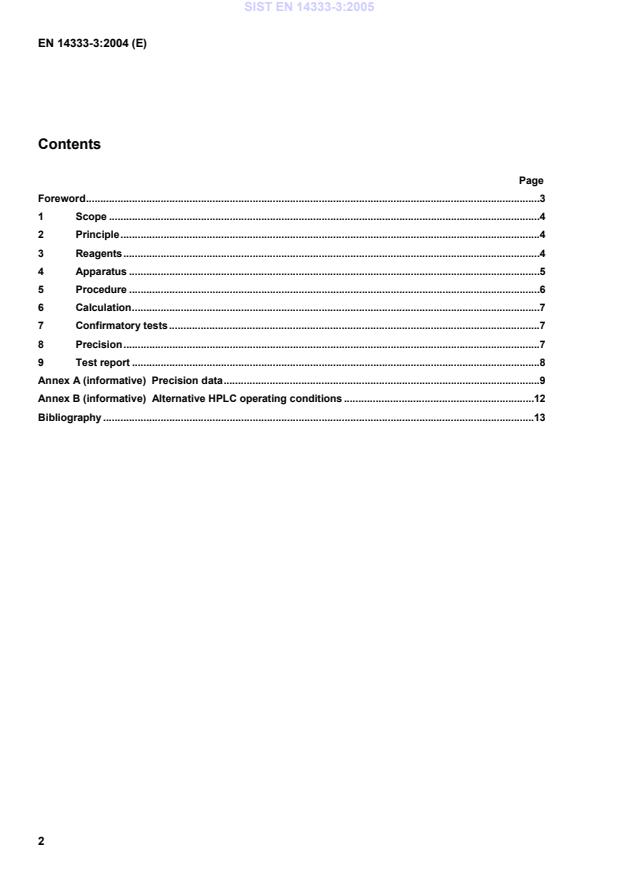
Precision data.9 Annex B (informative)
Alternative HPLC operating conditions.12 Bibliography.13
When benomyl is present, it is completely degraded to carbendazim and is also determined as carbendazim. Thiophanate-methyl is not determined with the method. The method has been validated for carbendazim and thiabendazole in an interlaboratory test with homogenates of apples, French beans, mushrooms, lemons and fruit based infant food.
2 Principle The sample is homogenized with ethyl acetate, sodium hydroxide solution and anhydrous sodium sulfate and the homogenate is filtered. An aliquot portion of the ethyl acetate extract is partitioned with hydrochloric acid solution; the aqueous phase is made alkaline and partitioned with ethyl acetate. The organic layer is evaporated and the residue is dissolved in the HPLC mobile phase. Carbendazim and thiabendazole are determined by reversed-phase high performance liquid chromatography (HPLC) with UV or UV and fluorescence detectors.
3 Reagents 3.1 General Unless otherwise specified, use reagents of recognized analytical grade, preferably for HPLC and pesticide residue analysis, and only distilled or demineralized water. 3.2 Safety aspects associated with reagents Vapours from some volatile solvents are toxic. Several of these solvents are readily absorbed through skin. Use an effective fume hood to remove vapours of these solvents as they are set free. Carbendazim and thiabendazole are toxic; avoid contact with skin and eyes.
3.3 Ethyl acetate 3.4 Methanol 3.5 Sodium hydroxide solution, mass concentration
(NaOH) = 26 g/100 ml 3.6 Diluted sodium hydroxide solution,
(NaOH) = 2,6 g/100 ml 3.7 Sodium sulfate, anhydrous 3.8 Hydrochloric acid solution,
(HCl) = 0,1 mol/l 3.9 Alkaline solution, pH 13,4 Dissolve 33 g of anhydrous sodium acetate, 200 g of sodium chloride and 40 g of sodium hydroxide in 1 l of water. 3.10 Phosphate buffer solution, pH 7,2 to 7,5 Dissolve 2 g of dipotassium hydrogen phosphate trihydrate and 0,5 g of potassium dihydrogen phosphate in 1 l of water. SIST EN 14333-3:2005
Prior to use, filter the mixture through a membrane filter (4.7). 3.12 Carbendazim stock solution,
(carbendazim) = 10 mg/100 ml In a 50 ml volumetric flask, weigh 5 mg, to the nearest 0,1 mg, of carbendazim. Add 5 ml of the hydrochloric acid solution (3.8) and allow the flask to stand in an ultrasonic bath for 5 min to 10 min. Dilute the solution with 40 ml of water, allow the flask to stand again in the ultrasonic bath for 10 min and dilute to the mark with water. 3.13 Thiabendazole stock solution,
(thiabendazole) = 50 mg/100 ml in methanol (3.4)
3.14 Standard solutions Dilute the carbendazim stock solution (3.12) or the thiabendazole stock solution (3.13) as appropriate with the mobile phase for HPLC (3.11). 4 Apparatus 4.1 General Usual laboratory equipment and in particular the following: 4.2 Food chopper 4.3 High speed blender or homogenizer 4.4 Separatory funnels, capacity 100 ml 4.5 Rotary evaporator, with a water bath
4.6 High performance liquid chromatograph, equipped with 4.6.1 Pumping system, an injection valve for 50 µl, a UV detector and a fluorescence detector connected in series and a quantification unit with an integrating system. 4.6.2 HPLC analytical column, stainless steel cartridge, e.g. 250 mm long, 4,6 mm inner diameter, packed with ODS-120T®, TSK-GEL® 1), particle size 5 µm. 4.7 Membrane filter, pore size 0,45 µm, suitable for water and methanolic solutions 4.8 Glass fibre filter, 90 mm diameter 4.9 Syringe filter, pore size 0,45 µm, suitable for water and methanolic solutions
1) TSK-GEL® is a trade name of a product supplied by Tosoh Biosep, USA.
This information is given for the convenience of users of this European Standard and does not constitute an endorsement by CEN of the product named. Equivalent products may be used if they can be shown to lead to the same results. SIST EN 14333-3:2005
5.2.2 Lemons, limes and plums Proceed as described in 5.2.1, but add 6,0 ml sodium hydroxide solution (3.5) instead of 3,0 ml. 5.2.
...