


EN 1991-1-6:2026/prA1
(Amendment)Eurocode 1 - Actions on structures - Part 1-6: Actions during execution
General Information
- Abstract
1.1 Scope of prEN 1991-1-6
(1) prEN 1991-1-6 provides guidance and general rules on the determination of actions relevant for the design of buildings and civil engineering works, including geotechnical structures, for their execution stage.
NOTE Actions for design during execution include those that only arise from execution activities and act during execution, termed construction actions (for example personnel and hand tools, auxiliary structures, equipment and elements used during execution), and others that are present during the service life of the completed structure (for example self-weight, wind, etc.) but which can act differently and/or have different values during execution.
(2) prEN 1991-1-6 provides guidance and general rules for the determination of actions for the design of auxiliary structures, elements and equipment used during execution in case they are designed to the Eurocodes and not to other European Standards.
NOTE Other European Standards (e.g. EN 12810, EN 12811, EN 12812) provide specific rules for certain types of auxiliary structures, equipment and elements used during execution.
(3) prEN 1991-1-6 gives rules for buildings and bridges during execution to supplement the provisions in EN 1990.
NOTE For combination rules for execution, see EN 1990.
1.2 Assumptions
(1) The general assumptions given in EN 1990 apply.
(2) The application of this document follows the limit state principle and is based on the partial factor method, unless explicitly prescribed differently.
(3) The verification of buildings and civil engineering structures in transient design situations is undertaken in accordance with the Eurocodes, accounting for the interaction with any auxiliary structures, elements and/or equipment.
(4) When using European product standards covering auxiliary structures, equipment and elements used during execution, it is assumed that the design basis, design requirements and, if provided, the safety and operational design limits specified in these product standards are taken into account.
(5) Adequate planning, documentation, communication, control and supervision are provided during execution, involving all relevant parties.
NOTE Execution of a structure can involve interaction between several parties from diverse engineering fields, responsible for the design, fabrication, transportation and execution of different subsystems used during the execution of a structure.
- Status
- Not Published
- Publication Date
- 29-Nov-2027
- Technical Committee
- CEN/TC 250 - Structural Eurocodes
- Current Stage
- 4020 - Submission to enquiry - Enquiry
- Start Date
- 23-Jul-2026
- Due Date
- 30-Nov-2026
- Completion Date
- 23-Jul-2026

Overview
EN 1991-1-6:2026/prA1, also known as Eurocode 1 - Actions on structures - Part 1-6: Actions during execution, is a draft European standard developed by CEN (European Committee for Standardization). This document provides essential guidance and general rules for determining structural actions during the execution phase of buildings and civil engineering works, including geotechnical structures. The standard forms a critical part of the Eurocodes, which are the primary basis for structural safety and reliability across Europe.
By addressing actions specific to the construction process-such as loads from personnel, equipment, and temporary structures-EN 1991-1-6:2026/prA1 helps ensure that structures remain safe and compliant during erection, assembly, and completion. It supplements the general design requirements of EN 1990 and other relevant Eurocodes.
Key Topics
EN 1991-1-6:2026/prA1 covers several key aspects relevant to the execution stage of construction:
- Determination of Construction Actions
Provides rules for identifying and quantifying loads and actions unique to the execution phase, such as those from construction personnel, hand tools, temporary equipment, and auxiliary structures. - Existing and Modified Actions
Addresses how standard design loads (such as self-weight and wind) may act differently or with different intensity during construction compared to the structure's service life. - Auxiliary Elements and Equipment
Offers guidance for designing auxiliary structures and equipment according to Eurocodes when relevant product standards do not apply. - Design Situations
Includes considerations for transient stages, covering situations like the removal of temporary supports or installation of prefabricated elements. - Compliance with Safety Principles
Reinforces the use of the limit state principle and partial factor method as outlined in EN 1990, ensuring consistent levels of safety throughout execution. - Coordination Among Project Stakeholders
Emphasizes adequate planning, documentation, communication, control, and supervision, involving all parties responsible for design and execution.
Applications
The practical applications of EN 1991-1-6:2026/prA1 span a wide range of construction and engineering scenarios:
- Building Construction
Ensures that risks from temporary loads and execution-specific activities are addressed during the construction of residential, commercial, and industrial buildings. - Bridge and Civil Engineering Works
Provides frameworks for safe assembly and support, especially during critical stages such as lifting or sliding bridge sections into place. - Geotechnical Structures
Applies specialized considerations for foundations and earthworks during execution. - Temporary Works and Auxiliary Installations
Offers general rules for designing temporary structures (e.g., scaffolding, falsework) where no specific European product standard exists. - Project Management and Supervision
Guides project stakeholders-including engineers, contractors, and inspectors-in planning and overseeing structural safety during execution.
Related Standards
EN 1991-1-6:2026/prA1 works in conjunction with several other key European and international standards:
- EN 1990-1:2023+A1:2026 – Eurocode: Basis of structural and geotechnical design
- EN 1991-1-1:2025+prA1:2026 – Actions on structures: General actions
- EN 12810 – Façade scaffolds made of prefabricated components
- EN 12811 – Temporary works equipment
- EN 12812 – Falsework
- EN 1998 – Eurocode 8: Design of structures for earthquake resistance (for seismic action considerations)
By adopting EN 1991-1-6:2026/prA1, designers and contractors can ensure that all actions during construction are correctly accounted for, helping maintain structural safety, regulatory compliance, and operational continuity across a wide range of building and civil engineering projects. This standard is integral to European harmonization efforts in the construction sector, supporting safe, reliable, and efficient execution practices.
Relations
- Effective Date
- 29-Apr-2026
Get Certified
Connect with accredited certification bodies for this standard

DIBt (Deutsches Institut für Bautechnik)
German Institute for Building Technology.
DIN CERTCO
DIN Group product certification.

Aboma Certification B.V.
Specialized in construction, metal, and transport sectors.
Sponsored listings
Frequently Asked Questions
EN 1991-1-6:2026/prA1 is a draft published by the European Committee for Standardization (CEN). Its full title is "Eurocode 1 - Actions on structures - Part 1-6: Actions during execution". This standard covers: 1.1 Scope of prEN 1991-1-6 (1) prEN 1991-1-6 provides guidance and general rules on the determination of actions relevant for the design of buildings and civil engineering works, including geotechnical structures, for their execution stage. NOTE Actions for design during execution include those that only arise from execution activities and act during execution, termed construction actions (for example personnel and hand tools, auxiliary structures, equipment and elements used during execution), and others that are present during the service life of the completed structure (for example self-weight, wind, etc.) but which can act differently and/or have different values during execution. (2) prEN 1991-1-6 provides guidance and general rules for the determination of actions for the design of auxiliary structures, elements and equipment used during execution in case they are designed to the Eurocodes and not to other European Standards. NOTE Other European Standards (e.g. EN 12810, EN 12811, EN 12812) provide specific rules for certain types of auxiliary structures, equipment and elements used during execution. (3) prEN 1991-1-6 gives rules for buildings and bridges during execution to supplement the provisions in EN 1990. NOTE For combination rules for execution, see EN 1990. 1.2 Assumptions (1) The general assumptions given in EN 1990 apply. (2) The application of this document follows the limit state principle and is based on the partial factor method, unless explicitly prescribed differently. (3) The verification of buildings and civil engineering structures in transient design situations is undertaken in accordance with the Eurocodes, accounting for the interaction with any auxiliary structures, elements and/or equipment. (4) When using European product standards covering auxiliary structures, equipment and elements used during execution, it is assumed that the design basis, design requirements and, if provided, the safety and operational design limits specified in these product standards are taken into account. (5) Adequate planning, documentation, communication, control and supervision are provided during execution, involving all relevant parties. NOTE Execution of a structure can involve interaction between several parties from diverse engineering fields, responsible for the design, fabrication, transportation and execution of different subsystems used during the execution of a structure.
1.1 Scope of prEN 1991-1-6 (1) prEN 1991-1-6 provides guidance and general rules on the determination of actions relevant for the design of buildings and civil engineering works, including geotechnical structures, for their execution stage. NOTE Actions for design during execution include those that only arise from execution activities and act during execution, termed construction actions (for example personnel and hand tools, auxiliary structures, equipment and elements used during execution), and others that are present during the service life of the completed structure (for example self-weight, wind, etc.) but which can act differently and/or have different values during execution. (2) prEN 1991-1-6 provides guidance and general rules for the determination of actions for the design of auxiliary structures, elements and equipment used during execution in case they are designed to the Eurocodes and not to other European Standards. NOTE Other European Standards (e.g. EN 12810, EN 12811, EN 12812) provide specific rules for certain types of auxiliary structures, equipment and elements used during execution. (3) prEN 1991-1-6 gives rules for buildings and bridges during execution to supplement the provisions in EN 1990. NOTE For combination rules for execution, see EN 1990. 1.2 Assumptions (1) The general assumptions given in EN 1990 apply. (2) The application of this document follows the limit state principle and is based on the partial factor method, unless explicitly prescribed differently. (3) The verification of buildings and civil engineering structures in transient design situations is undertaken in accordance with the Eurocodes, accounting for the interaction with any auxiliary structures, elements and/or equipment. (4) When using European product standards covering auxiliary structures, equipment and elements used during execution, it is assumed that the design basis, design requirements and, if provided, the safety and operational design limits specified in these product standards are taken into account. (5) Adequate planning, documentation, communication, control and supervision are provided during execution, involving all relevant parties. NOTE Execution of a structure can involve interaction between several parties from diverse engineering fields, responsible for the design, fabrication, transportation and execution of different subsystems used during the execution of a structure.
EN 1991-1-6:2026/prA1 is classified under the following ICS (International Classification for Standards) categories: 91.010.30 - Technical aspects. The ICS classification helps identify the subject area and facilitates finding related standards.
EN 1991-1-6:2026/prA1 has the following relationships with other standards: It is inter standard links to EN 1991-1-6:2026. Understanding these relationships helps ensure you are using the most current and applicable version of the standard.
EN 1991-1-6:2026/prA1 is available in PDF format for immediate download after purchase. The document can be added to your cart and obtained through the secure checkout process. Digital delivery ensures instant access to the complete standard document.
Standards Content (Sample)
SLOVENSKI STANDARD
01-september-2026
Evrokod 1 - Vplivi na konstrukcije - 1-6. del: Vplivi med gradnjo
Eurocode 1 - Actions on structures - Part 1-6: Actions during execution
Eurocode 1 - Einwirkungen auf Tragwerke - Teil 1-6 : Einwirkungen während der
Bauausführung
Eurocode 1 - Actions sur les structures - Partie 1-6 : Actions en cours d'exécution
Ta slovenski standard je istoveten z: EN 1991-1-6:2026/prA1
ICS:
91.010.30 Tehnični vidiki Technical aspects
2003-01.Slovenski inštitut za standardizacijo. Razmnoževanje celote ali delov tega standarda ni dovoljeno.
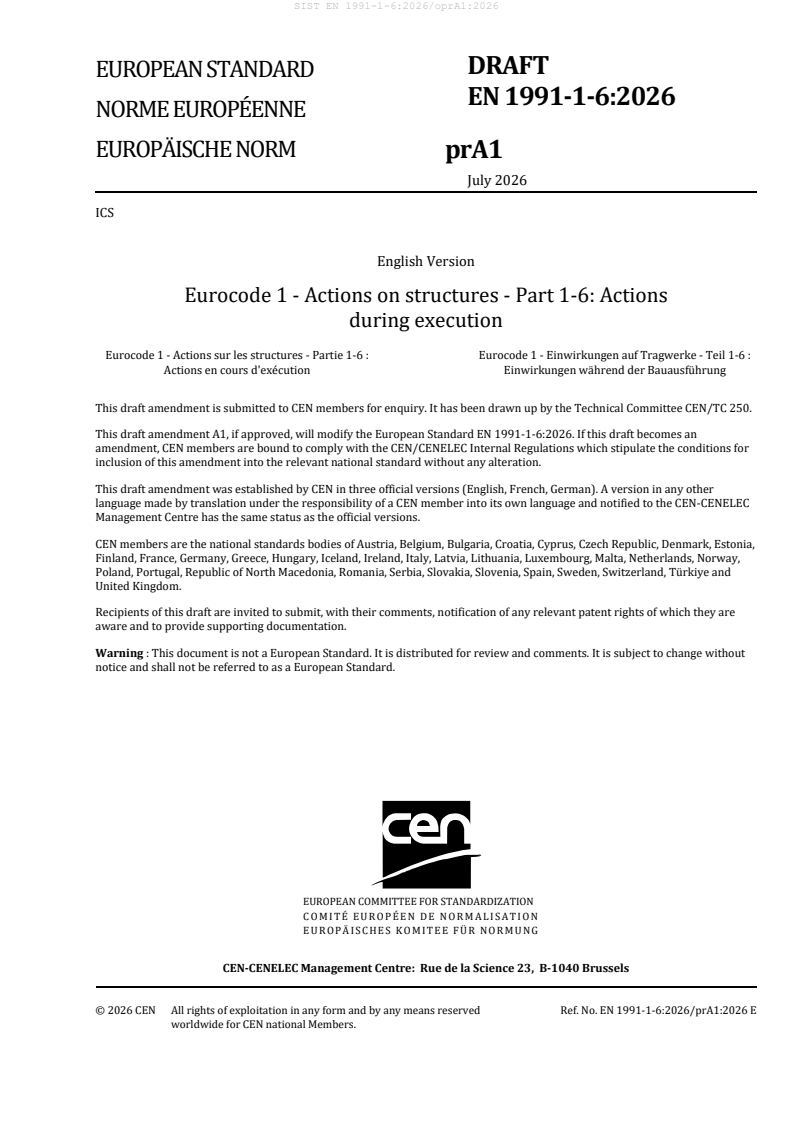
DRAFT
EUROPEAN STANDARD
EN 1991-1-6:2026
NORME EUROPÉENNE
EUROPÄISCHE NORM
prA1
July 2026
ICS
English Version
Eurocode 1 - Actions on structures - Part 1-6: Actions
during execution
Eurocode 1 - Actions sur les structures - Partie 1-6 : Eurocode 1 - Einwirkungen auf Tragwerke - Teil 1-6 :
Actions en cours d'exécution Einwirkungen während der Bauausführung
This draft amendment is submitted to CEN members for enquiry. It has been drawn up by the Technical Committee CEN/TC 250.
This draft amendment A1, if approved, will modify the European Standard EN 1991-1-6:2026. If this draft becomes an
amendment, CEN members are bound to comply with the CEN/CENELEC Internal Regulations which stipulate the conditions for
inclusion of this amendment into the relevant national standard without any alteration.
This draft amendment was established by CEN in three official versions (English, French, German). A version in any other
language made by translation under the responsibility of a CEN member into its own language and notified to the CEN-CENELEC
Management Centre has the same status as the official versions.
CEN members are the national standards bodies of Austria, Belgium, Bulgaria, Croatia, Cyprus, Czech Republic, Denmark, Estonia,
Finland, France, Germany, Greece, Hungary, Iceland, Ireland, Italy, Latvia, Lithuania, Luxembourg, Malta, Netherlands, Norway,
Poland, Portugal, Republic of North Macedonia, Romania, Serbia, Slovakia, Slovenia, Spain, Sweden, Switzerland, Türkiye and
United Kingdom.
Recipients of this draft are invited to submit, with their comments, notification of any relevant patent rights of which they are
aware and to provide supporting documentation.
Warning : This document is not a European Standard. It is distributed for review and comments. It is subject to change without
notice and shall not be referred to as a European Standard.
EUROPEAN COMMITTEE FOR STANDARDIZATION
COMITÉ EUROPÉEN DE NORMALISATION
EUROPÄISCHES KOMITEE FÜR NORMUNG
CEN-CENELEC Management Centre: Rue de la Science 23, B-1040 Brussels
© 2026 CEN All rights of exploitation in any form and by any means reserved Ref. No. EN 1991-1-6:2026/prA1:2026 E
worldwide for CEN national Members.
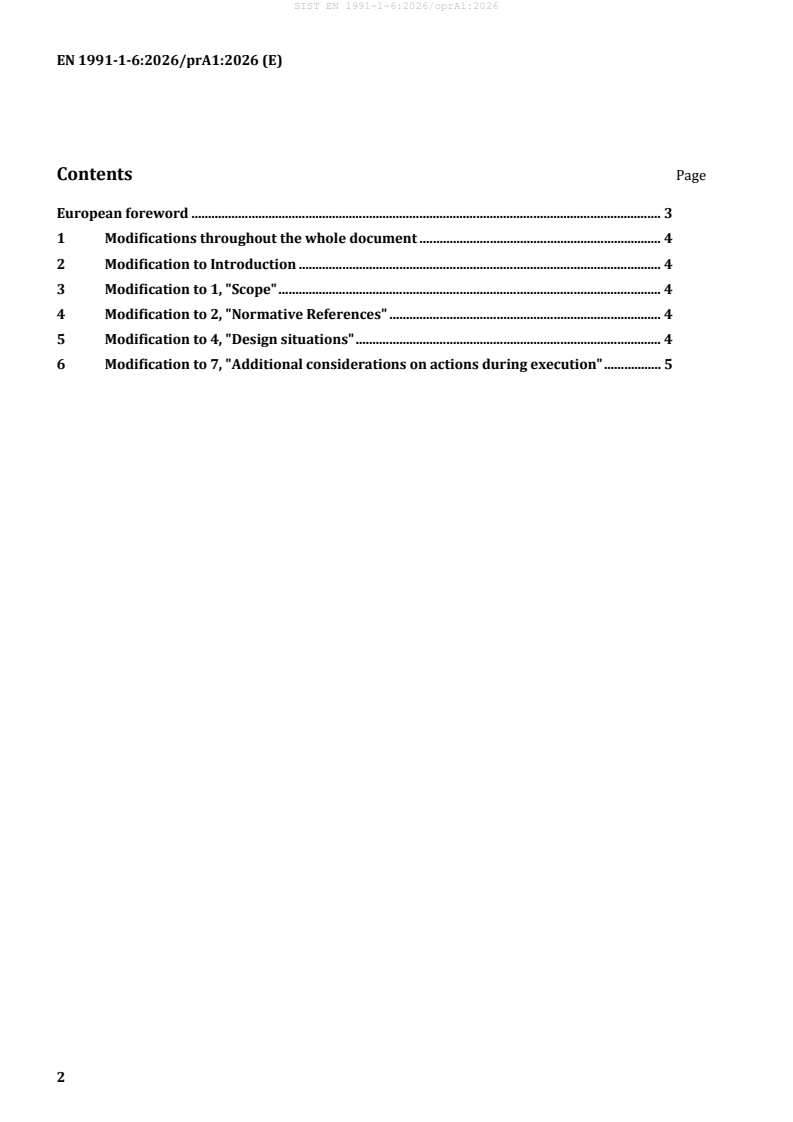
Contents Page
European foreword . 3
1 Modifications throughout the whole document . 4
2 Modification to Introduction . 4
3 Modification to 1, "Scope" . 4
4 Modification to 2, "Normative References" . 4
5 Modification to 4, "Design situations" . 4
6 Modification to 7, "Additional considerations on actions during execution" . 5
European foreword
This document (EN 1991-1-6:2026/prA1:2026) has been prepared by
...