


prEN 16361
(Main)Power operated pedestrian doorsets - Product standard, performance characteristics - Pedestrian doorsets, other than swing type, initially designed for installation with power operation
General Information
- Abstract
This document specifies requirements and test/assessment/calculation methods for power operated pedestrian doorsets, other than swing type, initially designed for installation with power operation.
Such doorset constructions can be operated electro-mechanically, electro-hydraulically or pneumatically.
These doorsets include power operated pedestrian sliding doorsets, revolving doorsets, balanced (sliding/swing) doorsets and folding doorsets with one or more horizontally moving leaves.
This document applies to power operated pedestrian doorsets with flush or panelled leaves, complete with:
— integral fanlights, if any;
NOTE 1 A fanlight is a panel over a door, which is part of the doorset.
— side panels that are contained within a single frame for inclusion in a single aperture, if any.
The intended uses of the products covered by this document are:
— doorsets with or without fire resistance and smoke control characteristics for external use in escape routes and other declared specific uses and/or uses subject to other specific requirements, in particular noise, energy and tightness in construction works;
— doorsets with or without fire resistance and smoke control characteristics for internal use in escape routes, communication and other declared specific uses and/or uses subject to other specific requirements, in particular noise in construction works;
— doorsets with or without fire resistance and smoke control characteristics for internal use in escape routes, communication and other declared specific uses and/or uses subject to other specific requirements, in particular noise and energy in construction works.
The products covered by this document are not assessed for structural applications of the building.
This document does not cover operation in environments where the electromagnetic disturbances are outside the range of those specified in EN 61000-6-2.
This document does not apply to:
— external pedestrian doorsets according to EN 14351-1;
— internal pedestrian doorsets according to EN 14351-2;
— lifts doorsets;
— vehicles doorsets;
— doorsets used in industrial processes;
— doorsets in partition walls;
— doorsets outside the reach of people (such as crane gantry fences);
— pedestrian entrance control equipment such as turnstiles, swing lanes and retractable lanes;
— platform doorsets.
This document does not cover special functions of doorsets (e.g. security).
- Status
- Not Published
- Publication Date
- 16-May-2021
- Withdrawal Date
- 16-Nov-2021
- Technical Committee
- CEN/TC 33 - Doors, windows, shutters and building hardware
- Drafting Committee
- CEN/TC 33/WG 9 - Powered Pedestian Doors (PPD)
- Current Stage
- 4098 - Decision to abandon - Enquiry
- Start Date
- 01-Mar-2021
- Completion Date
- 23-Sep-2026

Overview
prEN 16361 is a CEN product standard that defines performance characteristics and test/assessment methods for power operated pedestrian doorsets other than swing doors. It covers doorsets initially designed for powered operation - electrically, electro-hydraulically or pneumatically - including automatic sliding doors, revolving doors, balanced (sliding/swing) doorsets and folding doorsets with one or more horizontally moving leaves. The standard addresses complete doorsets (leaves, frames, integral fanlights and side panels where applicable) and supports regulatory requirements such as EU Directive 2014/30/EU and Regulation (EU) No. 305/2011.
Key topics and requirements
- Scope and exclusions: Applies to powered pedestrian doorsets but excludes swing-type doors, lift doors, vehicle doors, industrial-process doors, platform doors, turnstiles and other pedestrian entrance control equipment; it also excludes doorsets covered by EN 14351-1 / EN 14351-2.
- Performance characteristics: Defines characteristics to be declared and assessed, including:
- Impact resistance (for glazed doors with injury risk)
- Direct airborne sound insulation (for acoustic performance)
- Operating forces and safety in use (for automatic devices)
- Water tightness and wind load resistance (for external doors)
- Thermal transmittance and air permeability (energy and airtightness aspects)
- Radiation properties, fire resistance and smoke control
- Ability to release, self-closing and durability (cycle testing)
- Electromagnetic compatibility (EMC) - within ranges consistent with EN 61000-6-2
- Testing and assessment: Specifies test methods, sampling, conditioning, type testing and factory production control (FPC).
- Conformity & AVCP: Details Assessment and Verification of Constancy of Performance (AVCP) procedures and FPC requirements.
- Supporting guidance: Annexes cover glazing standards, installation/maintenance, classification summaries and pre-test conditioning.
Practical applications
- Use prEN 16361 to specify, test and certify powered pedestrian doorsets for:
- Entrances in commercial buildings, hospitals, airports and transit hubs
- External and internal escape routes where fire/smoke performance is declared
- Projects requiring declared acoustic, thermal or airtightness performance
- It is used during product design, factory quality control, procurement specifications and third‑party certification.
Who should use this standard
- Manufacturers and designers of automatic sliding, revolving, folding and balanced doorsets
- Test laboratories and certifiers performing type testing and AVCP
- Specifiers, consultants, architects and building owners requiring compliant powered doorsets
- Installers and maintenance teams referring to performance and durability requirements
Related standards
- EN 14351‑1 / EN 14351‑2 (external/internal pedestrian doorsets) - excluded scopes
- EN 16034 (fire and smoke performance for doors) - related definitions and requirements
- EN 61000 series (EMC) - referenced for electromagnetic disturbance ranges
Keywords: prEN 16361, power operated pedestrian doorsets, automatic sliding doors, revolving doors, folding doorsets, performance characteristics, testing, fire resistance, smoke control, EMC, thermal transmittance.
Relations
- Effective Date
- 19-Jan-2023
Get Certified
Connect with accredited certification bodies for this standard

DIBt (Deutsches Institut für Bautechnik)
German Institute for Building Technology.
DIN CERTCO
DIN Group product certification.

Aboma Certification B.V.
Specialized in construction, metal, and transport sectors.
Sponsored listings
Frequently Asked Questions
prEN 16361 is a draft published by the European Committee for Standardization (CEN). Its full title is "Power operated pedestrian doorsets - Product standard, performance characteristics - Pedestrian doorsets, other than swing type, initially designed for installation with power operation". This standard covers: This document specifies requirements and test/assessment/calculation methods for power operated pedestrian doorsets, other than swing type, initially designed for installation with power operation. Such doorset constructions can be operated electro-mechanically, electro-hydraulically or pneumatically. These doorsets include power operated pedestrian sliding doorsets, revolving doorsets, balanced (sliding/swing) doorsets and folding doorsets with one or more horizontally moving leaves. This document applies to power operated pedestrian doorsets with flush or panelled leaves, complete with: — integral fanlights, if any; NOTE 1 A fanlight is a panel over a door, which is part of the doorset. — side panels that are contained within a single frame for inclusion in a single aperture, if any. The intended uses of the products covered by this document are: — doorsets with or without fire resistance and smoke control characteristics for external use in escape routes and other declared specific uses and/or uses subject to other specific requirements, in particular noise, energy and tightness in construction works; — doorsets with or without fire resistance and smoke control characteristics for internal use in escape routes, communication and other declared specific uses and/or uses subject to other specific requirements, in particular noise in construction works; — doorsets with or without fire resistance and smoke control characteristics for internal use in escape routes, communication and other declared specific uses and/or uses subject to other specific requirements, in particular noise and energy in construction works. The products covered by this document are not assessed for structural applications of the building. This document does not cover operation in environments where the electromagnetic disturbances are outside the range of those specified in EN 61000-6-2. This document does not apply to: — external pedestrian doorsets according to EN 14351-1; — internal pedestrian doorsets according to EN 14351-2; — lifts doorsets; — vehicles doorsets; — doorsets used in industrial processes; — doorsets in partition walls; — doorsets outside the reach of people (such as crane gantry fences); — pedestrian entrance control equipment such as turnstiles, swing lanes and retractable lanes; — platform doorsets. This document does not cover special functions of doorsets (e.g. security).
This document specifies requirements and test/assessment/calculation methods for power operated pedestrian doorsets, other than swing type, initially designed for installation with power operation. Such doorset constructions can be operated electro-mechanically, electro-hydraulically or pneumatically. These doorsets include power operated pedestrian sliding doorsets, revolving doorsets, balanced (sliding/swing) doorsets and folding doorsets with one or more horizontally moving leaves. This document applies to power operated pedestrian doorsets with flush or panelled leaves, complete with: — integral fanlights, if any; NOTE 1 A fanlight is a panel over a door, which is part of the doorset. — side panels that are contained within a single frame for inclusion in a single aperture, if any. The intended uses of the products covered by this document are: — doorsets with or without fire resistance and smoke control characteristics for external use in escape routes and other declared specific uses and/or uses subject to other specific requirements, in particular noise, energy and tightness in construction works; — doorsets with or without fire resistance and smoke control characteristics for internal use in escape routes, communication and other declared specific uses and/or uses subject to other specific requirements, in particular noise in construction works; — doorsets with or without fire resistance and smoke control characteristics for internal use in escape routes, communication and other declared specific uses and/or uses subject to other specific requirements, in particular noise and energy in construction works. The products covered by this document are not assessed for structural applications of the building. This document does not cover operation in environments where the electromagnetic disturbances are outside the range of those specified in EN 61000-6-2. This document does not apply to: — external pedestrian doorsets according to EN 14351-1; — internal pedestrian doorsets according to EN 14351-2; — lifts doorsets; — vehicles doorsets; — doorsets used in industrial processes; — doorsets in partition walls; — doorsets outside the reach of people (such as crane gantry fences); — pedestrian entrance control equipment such as turnstiles, swing lanes and retractable lanes; — platform doorsets. This document does not cover special functions of doorsets (e.g. security).
prEN 16361 is classified under the following ICS (International Classification for Standards) categories: 91.060.50 - Doors and windows. The ICS classification helps identify the subject area and facilitates finding related standards.
prEN 16361 has the following relationships with other standards: It is inter standard links to EN 16361:2013+A1:2016. Understanding these relationships helps ensure you are using the most current and applicable version of the standard.
prEN 16361 is associated with the following European legislation: EU Directives/Regulations: 2014/30/EU, 305/2011; Standardization Mandates: M/101, M/101_126_Am1, M/130, M/552. When a standard is cited in the Official Journal of the European Union, products manufactured in conformity with it benefit from a presumption of conformity with the essential requirements of the corresponding EU directive or regulation.
prEN 16361 is available in PDF format for immediate download after purchase. The document can be added to your cart and obtained through the secure checkout process. Digital delivery ensures instant access to the complete standard document.
Standards Content (Sample)
SLOVENSKI STANDARD
01-maj-2019
Avtomatska vrata za prehod ljudi - Standard za proizvod, zahtevane lastnosti -
Sestavi vrat za prehod ljudi, razen nihajnih vrat, najprej zasnovani za montažo s
pogonom
Power operated pedestrian doorsets - Product standard, performance characteristics -
Pedestrian doorsets, other than swing type, initially designed for installation with power
operation
Kraftbetätigte Türen - Produktnorm, Leistungseigenschaften - Türsysteme, mit
Ausnahme von Drehflügeltüren, vorgesehen für den kraftbetätigten Betrieb
Blocs-portes motorisés pour piétons - Norme de produit, caractéristiques de performance
- Blocs-portes pour piétons, autres que de type battant, initialement conçus pour une
installation avec un système de motorisation
Ta slovenski standard je istoveten z: prEN 16361
ICS:
91.060.50 Vrata in okna Doors and windows
2003-01.Slovenski inštitut za standardizacijo. Razmnoževanje celote ali delov tega standarda ni dovoljeno.
DRAFT
EUROPEAN STANDARD
NORME EUROPÉENNE
EUROPÄISCHE NORM
March 2019
ICS 91.060.50 Will supersede EN 16361:2013+A1:2016
English Version
Power operated pedestrian doorsets - Product standard,
performance characteristics - Pedestrian doorsets, other
than swing type, initially designed for installation with
power operation
Blocs-portes motorisés pour piétons - Norme de Kraftbetätigte Türen - Produktnorm,
produit, caractéristiques de performance - Blocs- Leistungseigenschaften - Türsysteme, mit Ausnahme
portes pour piétons, autres que de type battant, von Drehflügeltüren, vorgesehen für den
initialement conçus pour une installation avec un kraftbetätigten Betrieb
système de motorisation
This draft European Standard is submitted to CEN members for enquiry. It has been drawn up by the Technical Committee
CEN/TC 33.
If this draft becomes a European Standard, CEN members are bound to comply with the CEN/CENELEC Internal Regulations
which stipulate the conditions for giving this European Standard the status of a national standard without any alteration.
This draft European Standard was established by CEN in three official versions (English, French, German). A version in any other
language made by translation under the responsibility of a CEN member into its own language and notified to the CEN-CENELEC
Management Centre has the same status as the official versions.
CEN members are the national standards bodies of Austria, Belgium, Bulgaria, Croatia, Cyprus, Czech Republic, Denmark, Estonia,
Finland, Former Yugoslav Republic of Macedonia, France, Germany, Greece, Hungary, Iceland, Ireland, Italy, Latvia, Lithuania,
Luxembourg, Malta, Netherlands, Norway, Poland, Portugal, Romania, Serbia, Slovakia, Slovenia, Spain, Sweden, Switzerland,
Turkey and United Kingdom.
Recipients of this draft are invited to submit, with their comments, notification of any relevant patent rights of which they are
aware and to provide supporting documentation.
Warning : This document is not a European Standard. It is distributed for review and comments. It is subject to change without
notice and shall not be referred to as a European Standard.
EUROPEAN COMMITTEE FOR STANDARDIZATION
COMITÉ EUROPÉEN DE NORMALISATION
EUROPÄISCHES KOMITEE FÜR NORMUNG
CEN-CENELEC Management Centre: Rue de la Science 23, B-1040 Brussels
© 2019 CEN All rights of exploitation in any form and by any means reserved Ref. No. prEN 16361:2019 E
worldwide for CEN national Members.
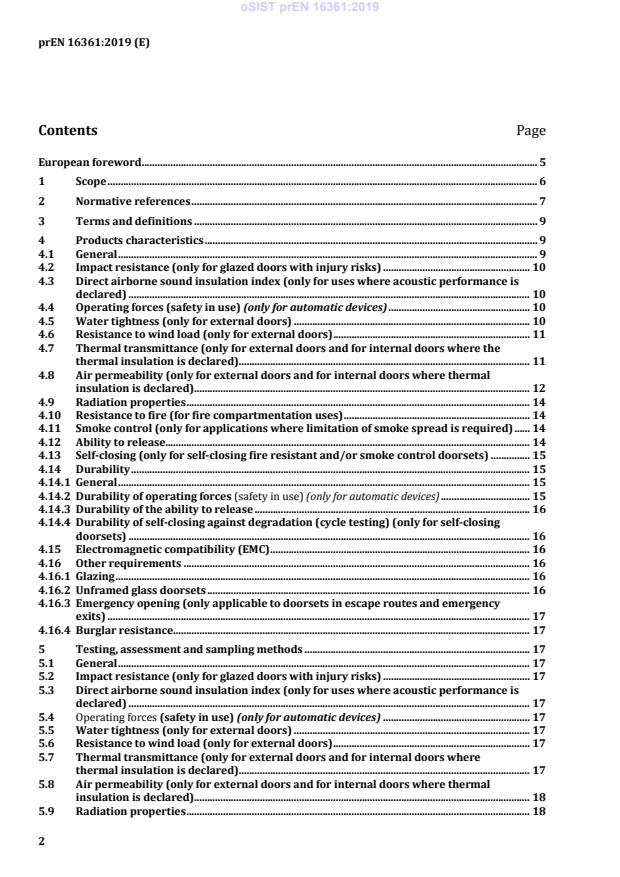
Contents Page
European foreword . 5
1 Scope . 6
2 Normative references . 7
3 Terms and definitions . 9
4 Products characteristics . 9
4.1 General . 9
4.2 Impact resistance (only for glazed doors with injury risks) . 10
4.3 Direct airborne sound insulation index (only for uses where acoustic performance is
declared) . 10
4.4 Operating forces (safety in use) (only for automatic devices) . 10
4.5 Water tightness (only for external doors) . 10
4.6 Resistance to wind load (only for external doors) . 11
4.7 Thermal transmittance (only for external doors and for internal doors where the
thermal insulation is declared). 11
4.8 Air permeability (only for external doors and for internal doors where thermal
insulation is declared) . 12
4.9 Radiation properties . 14
4.10 Resistance to fire (for fire compartmentation uses) . 14
4.11 Smoke control (only for applications where limitation of smoke spread is required) . 14
4.12 Ability to release. 14
4.13 Self-closing (only for self-closing fire resistant and/or smoke control doorsets) . 15
4.14 Durability . 15
4.14.1 General . 15
4.14.2 Durability of operating forces (safety in use) (only for automatic devices) . 15
4.14.3 Durability of the ability to release . 16
4.14.4 Durability of self-closing against degradation (cycle testing) (only for self-closing
doorsets) . 16
4.15 Electromagnetic compatibility (EMC) . 16
4.16 Other requirements . 16
4.16.1 Glazing . 16
4.16.2 Unframed glass doorsets . 16
4.16.3 Emergency opening (only applicable to doorsets in escape routes and emergency
exits) . 17
4.16.4 Burglar resistance . 17
5 Testing, assessment and sampling methods . 17
5.1 General . 17
5.2 Impact resistance (only for glazed doors with injury risks) . 17
5.3 Direct airborne sound insulation index (only for uses where acoustic performance is
declared) . 17
5.4 Operating forces (safety in use) (only for automatic devices) . 17
5.5 Water tightness (only for external doors) . 17
5.6 Resistance to wind load (only for external doors) . 17
5.7 Thermal transmittance (only for external doors and for internal doors where
thermal insulation is declared). 17
5.8 Air permeability (only for external doors and for internal doors where thermal
insulation is declared) . 18
5.9 Radiation properties . 18
5.10 Resistance to fire (for fire compartmentation uses) . 18
5.11 Smoke control (only for applications where limitation of smoke spread is required) . 18
5.12 Ability to release . 18
5.13 Self-closing . 18
5.14 Durability . 19
5.14.1 General . 19
5.14.2 Durability of operating forces (safety in use) (only for automatic devices). 19
5.14.3 Durability of the ability to release and of self-closing (only for self-closing doorsets)
against degradation (cycle testing) . 19
5.15 Electromagnetic compatibility (EMC) . 19
5.15.1 Verification . 19
5.15.2 Test for electromagnetic emissions . 19
5.15.3 Tests for immunity to disturbances . 19
5.16 Other requirements . 20
5.16.1 Glazing . 20
5.16.2 Unframed glass doorsets. 20
5.16.3 Emergency opening . 20
5.16.4 Burglar resistance . 20
6 Assessment and verification of constancy of performance – AVCP . 20
6.1 General . 20
6.2 Type testing . 20
6.2.1 General . 20
6.2.2 Test samples, testing and compliance criteria . 21
6.2.3 Test reports . 22
6.2.4 Shared other party results . 23
6.2.5 Cascading determination of the product type results . 23
6.3 Factory production control (FPC) . 24
6.3.1 General . 24
6.3.2 Requirements . 25
6.3.3 Product specific requirements . 28
6.3.4 Initial inspection of factory and of FPC . 28
6.3.5 Continuous surveillance of FPC for products covered by AVCP system 1 . 29
6.3.6 Procedure for modifications . 29
6.3.7 One-off products, pre-production products (e.g. prototypes) and products produced
in very low quantity . 29
Annex A (normative) Standards on glass . 31
Annex B (informative) Summary of the characteristics . 32
B.1 Summary of the characteristics of power operated pedestrian doorsets, other than
swing type, initially designed for installation with power operation . 32
Annex C (informative) Handling, installation, maintenance and care . 34
Annex D (informative) Summary of classification of characteristics . 35
Annex E (informative) Example of air permeability calculation . 42
Annex F (normative) Pre-test conditioning . 44
F.1 General . 44
F.2 Before the resistance to fire test . 44
F.2.1 General . 44
F.2.2 Shakedown conditioning . 44
Annex ZA (informative) Relationship of this European Standard with Regulation (EU)
No. 305/2011 . 45
Annex ZB (informative) Relationship between this European standard and the essential
requirements of Directive 2014/30/EU [2014 OJ L96] aimed to be covered . 52
Bibliography . 53
European foreword
This document (prEN 16361:2019) has been prepared by Technical Committee CEN/TC 33 “Doors,
windows, shutters, building hardware and curtain walling”, the secretariat of which is held by AFNOR.
This document is currently submitted to the CEN Enquiry.
This document will supersede EN 16361:2013+A1:2016.
This document has been prepared under a mandate given to CEN by the European Commission and the
European Free Trade Association, and supports essential requirements of EU Directive 2014/30/EU
and Regulation (EU) 305/2011.
For relationship with EU Directive 2014/30/EU and Regulation (EU) 305/2011, see informative
Annexes ZA and ZB, which are an integral part of this document.
Compared with EN 16361:2013+A1:2016, the following changes have been made:
— relevant requirements and definitions from EN 16034 relevant to fire and smoke characteristics
have been incorporated in this document and subclauses number has been consequently updated;
— title of Clause 4 has been changed to comply with the model standard;
— subclause 4.4 “Height” has been deleted;
— subclause 4.4 has been modified to align with Mandate M/101;
— subclause 4.16.3 (previous 4.14.3) Emergency opening (only applicable to doorsets in escape
routes and emergency exits) has been updated;
— Clause 6 has been updated to CPR requirements;
— Annex ZA has been updated to CPR requirements;
— editorial changes in the text.
1 Scope
This document specifies requirements and test/assessment/calculation methods for power operated
pedestrian doorsets, other than swing type, initially designed for installation with power operation.
Such doorset constructions can be operated electro-mechanically, electro-hydraulically or
pneumatically.
These doorsets include power operated pedestrian sliding doorsets, revolving doorsets, balanced
(sliding/swing) doorsets and folding doorsets with one or more horizontally moving leaves.
This document applies to power operated pedestrian doorsets with flush or panelled leaves, complete
with:
— integral fanlights, if any;
NOTE A fanlight is a panel over a door, which is part of the doorset.
— side panels that are contained within a single frame for inclusion in a single aperture, if any.
The intended uses of the products covered by this document are:
— doorsets with or without fire resistance and smoke control characteristics for external use in
escape routes and other declared specific uses and/or uses subject to other specific requirements,
in particular noise, energy and tightness in construction works;
— doorsets with or without fire resistance and smoke control characteristics for internal use in escape
routes, communication and other declared specific uses and/or uses subject to other specific
requirements, in particular noise in construction works;
— doorsets with or without fire resistance and smoke control characteristics for internal use in escape
routes, communication and other declared specific uses and/or uses subject to other specific
requirements, in particular noise and energy in construction works.
The products covered by this document are not assessed for structural applications of the building.
This document does not cover operation in environments where the electromagnetic disturbances are
outside the range of those specified in EN 61000-6-2.
This document does not apply to:
— external pedestrian doorsets according to EN 14351-1;
— internal pedestrian doorsets according to EN 14351-2;
— lifts doorsets;
— vehicles doorsets;
— doorsets used in industrial processes;
— doorsets in partition walls;
— doorsets outside the reach of people (such as crane gantry fences);
— pedestrian entrance control equipment such as turnstiles, swing lanes and retractable lanes;
— platform doorsets.
This document does not cover special functions of doorsets (e.g. security).
2 Normative references
The following documents are referred to in the text in such a way that some or all of their content
constitutes requirements of this document. For dated references, only the edition cited applies. For
undated references, the latest edition of the referenced document (including any amendments) applies.
EN 572-9, Glass in building — Basic soda lime silicate glass products — Part 9: Evaluation of
conformity/Product standard
EN 1026:2016, Windows and doors — Air permeability — Test method
EN 1027:2016, Windows and doors — Water tightness — Test method
EN 1096-4, Glass in building — Coated glass — Part 4: Product standard
EN 1279-5, Glass in building — Insulating glass units — Part 5: Product standard
EN 1627, Pedestrian doorsets, windows, curtain walling, grilles and shutters — Burglar resistance —
Requirements and classification
EN 1634-1:2014+A1:2018, Fire resistance and smoke control tests for door and shutter assemblies,
openable windows and elements of building hardware — Part 1: Fire resistance test for door and shutter
assemblies and openable windows
EN 1634-3:2004, Fire resistance and smoke control tests for door and shutter assemblies, openable
windows and elements of building hardware — Part 3: Smoke control test for door and shutter assemblies
EN 1748-1-2, Glass in building — Special basic products — Borosilicate glasses — Part 1-2: Evaluation of
conformity/Product standard
EN 1748-2-2, Glass in building — Special basic products — Glass ceramics — Part 2-2: Evaluation of
conformity/Product standard
EN 1863-2, Glass in building — Heat strengthened soda lime silicate glass — Part 2: Evaluation of
conformity/Product standard
EN 12150-2, Glass in building — Thermally toughened soda lime silicate safety glass — Part 2: Evaluation
of conformity/Product standard
EN 12207:2016, Windows and doors — Air permeability — Classification
EN 12208:1999, Windows and doors — Watertightness — Classification
EN 12210:2016, Windows and doors — Resistance to wind load — Classification
EN 12211:2016, Windows and doors — Resistance to wind load — Test method
EN 12337-2, Glass in building — Chemically strengthened soda lime silicate glass — Part 2: Evaluation of
conformity/Product standard
EN 12519:2018, Windows and pedestrian doors — Terminology
EN 13024-2, Glass in building — Thermally toughened borosilicate safety glass — Part 2: Evaluation of
conformity/Product standard
EN 13049, Windows — Soft and heavy body impact — Test method, safety requirements and classification
EN 14178-2, Glass in building — Basic alkaline earth silicate glass products — Part 2: Evaluation of
conformity/Product standard
EN 14179-2, Glass in building — Heat soaked thermally toughened soda lime silicate safety glass — Part
2: Evaluation of conformity/Product standard
EN 14321-2, Glass in building — Thermally toughened alkaline earth silicate safety glass — Part 2:
Evaluation of conformity/Product standard
EN 14351-1:2006+A2:2016, Windows and doors — Product standard, performance characteristics —
Part 1: Windows and external pedestrian doorsets
EN 16005:2012, Power operated pedestrian doorsets — Safety in use — Requirements and test methods
EN 61000-6-2, Electromagnetic compatibility (EMC) — Part 6-2: Generic standards — Immunity for
industrial environments (IEC 61000-6-2)
EN 61000-6-3, Electromagnetic compatibility (EMC) — Part 6-3: Generic standards — Emission standard
for residential, commercial and light-industrial environments (IEC 61000-6-3)
EN ISO 717-1, Acoustics — Rating of sound insulation in buildings and of building elements — Part 1:
Airborne sound insulation (ISO 717-1)
EN ISO 10077-1:2017, Thermal performance of windows, doors and shutters — Calculation of thermal
transmittance — Part 1: General (ISO 10077-1:2017)
EN ISO 10077-2, Thermal performance of windows, doors and shutters — Calculation of thermal
transmittance — Part 2: Numerical method for frames (ISO 10077-2)
EN ISO 10140-2, Acoustics — Laboratory measurement of sound insulation of building elements — Part 2:
Measurement of airborne sound insulation (ISO 10140-2)
EN ISO 12543-2, Glass in building — Laminated glass and laminated safety glass — Part 2: Laminated
safety glass (ISO 12543-2)
EN ISO 12567-1, Thermal performance of windows and doors — Determination of thermal transmittance
by the hot-box method — Part 1: Complete windows and doors (ISO 12567-1)
EN ISO 13849-1, Safety of machinery - Safety-related parts of control systems - Part 1: General principles
for design (ISO 13849-1)
3 Terms and definitions
For the purposes of this document, the terms and definitions given in EN 16005:2012, EN 12519:2018,
EN 14351-1:2006+A2:2016 and the following apply.
ISO and IEC maintain terminological databases for use in standardization at the following addresses:
• IEC Electropedia: available at http://www.electropedia.org/
• ISO Online browsing platform: available at http://www.iso.org/obp
3.1
power operated pedestrian doorset
doorset for pedestrian passage only with one or more leaves that is moved, at least in one direction, by
an external energy supply (e.g. electrically) instead of manual or stored mechanical energy; including
drive, leaves, side panel(s), vision panel(s), flush over panel(s), transom panel(s) and/or glazing,
building hardware, seals, protective devices and any components needed for its safe operation
[SOURCE: EN 16005 modified]
3.2
night shield
additional element to close the entrance of a revolving doorset
3.3
self-closing
ability of an open doorset to fully close, without human intervention, into its frame and engage any
fitted latching device
3.4
ability to release
release of the hold-open device of a doorset to ensure reliable closing of the doorset
3.5
friable material
material which could crumble, slump, drop or shake down during the normal life of a doorset
EXAMPLES Loose infill mineral fibre, loose materials filled in or blown in the door leaf and gypsum boards.
Note 1 to entry: Gypsum plasterboards, mineral fibre boards with adhesive binder and silicate fibre boards are
not considered to be friable.
4 Products characteristics
4.1 General
The performance characteristics for power operated pedestrian doorsets, other than swing type,
initially designed for installation with power operation shall be determined and expressed in
accordance with 4.2 to 4.16.
NOTE 1 The order in which the performance characteristics are identified does not imply an order of priority
or a test sequence.
The performance characteristics of 4.2, 4.4, 4.6 to 4.9 and the burglar resistance of 4.16.4 shall be
determined with closed and locked doorsets; for revolving doorsets with night shield this shall be
closed.
NOTE 2 Without night shield most of the following requirements are not applicable to revolving doorsets due
to requirements of safety in use (e.g. safety distances).
For revolving doorsets the external side is the part of the doorset which is exposed to the weather.
4.2 Impact resistance (only for glazed doors with injury risks)
Impact resistance is the ability of a doorset to keep in place the glazing without creating hazards in case
of impact with a body.
This test is applicable to all the intended uses of the products covered by this document.
Doorsets fitted with glass or other fragmental material and doorsets with unframed glass leaves shall be
tested and the results shall be expressed in accordance with EN 13049. Where relevant, the test shall be
carried out from both sides.
4.3 Direct airborne sound insulation index (only for uses where acoustic performance is
declared)
The direct airborne sound insulation index is the ability of a doorset to protect an ambient from the
noise coming from another one.
This test is applicable to all the intended uses of the products covered by this document when the
acoustic performance is declared.
The direct airborne sound insulation index, when declared, shall be determined in accordance with
EN ISO 10140-2 (reference method).
The test results shall be evaluated and expressed in accordance with EN ISO 717-1.
4.4 Operating forces (safety in use) (only for automatic devices)
This test is applicable to all intended uses of the products covered by this document.
It shall be possible to open or close the doorset leaf or leaves by means of a force ≤ 220 N. The influence
of wind or other environmental factors shall not be taken into account.
The force shall be measured as described in 5.5 and classified as “complied”.
4.5 Water tightness (only for external doors)
Water tightness is the ability of a closed doorset to reduce penetration of water in the environment
where the doorset is installed.
This test is only applicable to doorsets for external use.
The test shall be carried out in accordance with EN 1027:2016 with the following additions and
modifications:
— Clause 1: Addition: revolving doorsets need not be fully assembled but shall include the relevant
parts of the doorset for the test, e.g. night shield;
— Subclause 6.1: Addition: the test sample needs not be fully functional but shall include the relevant
parts of the doorset for the test (e.g. night shield for revolving doorset) and to open and close it
after the test;
— Subclause 7.1: Modification: the minimum test pressure of 500 Pa is not required.
The results shall be expressed in accordance with EN 12208:1999 with the following additions and
modifications:
— Clause 4: Addition: water penetration through the gap between floor level and the door leaf shall
not be considered for classification of the doorset;
— Clause 4, Table 1: Modification: classes are limited to 1 to 5A, 1 to 5B and Exxx for P > 200 Pa.
max
The test for water tightness of side panels shall be carried out on the side panel or on its individual
parts. In the latter case, the classification of the side panel shall be determined by the part(s) with the
most unfavourable performance.
NOTE Installation of a weather shield or similar can reduce the need for water tightness of the doorset.
4.6 Resistance to wind load (only for external doors)
Resistance to wind load is the ability of a closed doorset to withstand the load of the wind in the
environment where the doorset is installed.
This test is only applicable to doorsets for external use.
Tests shall be carried out in accordance with EN 12211:2016 with the following modifications:
— Subclause 6.1: the test sample needs not be fully functional but shall include the relevant parts of
the doorset for the test (e.g. night shield for revolving doorset) and to open and close it after the
test;
— Subclause 7.1: the air permeability test according to EN 1026 (P1 and P2) shall not be performed;
— Subclause 7.3: the number of cycles shall be 20 and the air permeability test according to EN 1026
shall not be repeated.
The deflection of frame elements (e.g. transoms and mullions) shall be determined by calculation or by
test (reference method).
The results shall be expressed in accordance with EN 12210:2016 with the following modifications:
— Clause 4: Table 1 is modified as follows:
Table 1 — Classification of wind load for external doorsets (EN 12210:2016, Table 1)
Class P1 a P3
P2
(Pa) (Pa)
(Pa)
PPD0,value b 0,5 value 1,5 value
value
PPD1 200 100 300
PPD2 300 150 450
PPD(xxx) c 0,5 xxx 1,5 xxx
xxx
a
This pressure is repeated 20 times.
b
“value” is the actual test pressure P1 lower than 200 Pa (e.g. 150, etc.).
c
xxx is the actual test pressure P1 higher than 300 Pa (e.g. 350, etc.).
— Subclause 6.2: the air permeability requirement (after the P1 and P2 tests) is not applicable.
4.7 Thermal transmittance (only for external doors and for internal doors where the
thermal insulation is declared)
Thermal transmittance is the ability of a doorset to avoid the temperature of an ambient is influenced
by the temperature of another ambient next to it.
The test is only applicable to doorsets for external use and to doorsets for internal use where thermal
insulation is declared and shall be determined:
a) by calculation using:
1) EN ISO 10077-1; or
2) EN ISO 10077-1 and EN ISO 10077-2.
Calculation previously performed in accordance with EN ISO 10077-1 and tabulated values in
accordance with EN ISO 10077-1:2017, Table H.1 may be taken into account.
or
b) by hot box method using EN ISO 12567-1.
The collective symbols for thermal transmittance is U , i.e. the symbol U used in EN ISO 12567-1 is
D st
equivalent to U .
D
4.8 Air permeability (only for external doors and for internal doors where thermal
insulation is declared)
Air permeability is the ability of a doorset to reduce unwanted air exchange between two ambients at
different temperature.
The test is only applicable to doorsets for external use and to doorsets for internal use where thermal
insulation is declared.
Two air permeability tests shall be carried out in accordance with EN 1026 (reference method), one
with positive test pressures and one with negative test pressures.
EN 1026:2016 is applicable with the following modification:
— Subclause 7.3.2: the minimum test pressure of 500 Pa is not required.
The tests for air permeability of side panels shall be carried out on the side panel or on its individual
parts including joints between the individual parts. In the latter case the air permeability of the side
panel shall be calculated as the sum of the air permeability of the individual parts and the joints.
The test result, defined as the numerical average of the two air permeability values (m /h) at each
pressure step, shall be expressed in accordance with EN 12207:2016, 4.5 and 4.6 which are applicable
with the following modifications:
Table 2 — Reference air permeability at 100 Pa and maximum test pressures, related to overall
area, for classes 1 to 4 (EN 12207:2016, Table 1)
Class Reference air permeability Maximum test pressure
3 Pa
m
100 Pa
hm×
PPD0,value – < 150
PPD1 50 150
PPD2 27 300
PPD(xxx) – > 300
Table 3 — Reference air permeability related to overall area (for internal doors)
Reference air permeability at Maximum test pressure
100 Pa Pa
Class
3 2
m /h⋅m
A 50 100
B 27 100
C 9 150
D 3 150
Table 4 — Reference air permeabilities at 100 Pa and maximum test pressures, related to joints
length, for classes 1 to 4 (EN 12207:2016, Table 3)
Class Reference air permeability Maximum test pressure
3 Pa
m
100 Pa
hm×
PPD0,value – < 150
PPD 1 12,5 150
PPD 2 6,75 300
PPD(xxx) – > 300
Table 5 — Reference air permeability related to joints length (for internal doors)
Reference air permeability at Maximum test pressure
100 Pa Pa
Class
m /h ⋅ m
A 12,50 100
B 6,75 100
C 2,25 150
D 0,75 150
The value PPD0, value shall be calculated as described hereafter by measuring the air permeability up
to 150 Pa.
The worst performance of the unit in the measurement range relating to the overall area and the length
of joints (EN 12207:2016, Figure 1, Y1 and Y2) shall be referred to 100 Pa reference pressure, using the
following formula:
2/3
p
QQ=
YY1, 2 100
or
Q
yy12,
Q =
100,,yy1 2
2/3
p
where
Q is the measured air permeability;
Y1Y2
p is the test pressure at which the air permeability was measured;
Q is the air permeability at 100 Pa reference pressure.
100,y1,y2
EN 12207:2016, Figure A.1 shows that the values related to the overall area and to the length of joints
have a fixed factor of 4 at the same pressure. Because of this Q to be comparable with Q
100,y2, 100,y1,
shall be converted to an adjusted Q value using the following formula
100,y2adj
Q 4⋅ Q
100, y2adj 100, y2
Factor F relevant to the relation between the overall area value Q and the joints length value
oj 100,y1
Q is given by the following formula:
100,y2adj
Q
100, y2adj
F =
oj
Q
100, y1
Considering 4.5 and EN 12207:2016, Figure A.1, and considering that the range of acceptable values for
Class 1 equipment at 100 Pa is approximately 2, PPD0,value may only be declared if 0,5 ≤ F ≤ 2,
oj
otherwise the product may not be classified.
The declared value shall be the better (i.e. the smaller) between Q and Q , rounded to
100,y2adj 100,y1
nearest integer.
NOTE Annex E shows an example how to calculate PPD0,value referring to EN 12207:2016, Figure A.1.
The value PPD(xxx) shall be expressed as the worst reference air permeability values related to the
overall area and to the joint length and the maximum test pressure (e.g. PPD(25/6/500)). The
maximum test pressure shall be the same for both the measurements related the overall area and to the
joint length.
4.9 Radiation properties
Radiation properties is the ability of a glazed doorset leaf to reduce the solar heat gain of an ambient.
This test is only applicable to doorsets for external use.
The glazing material panes shall either be certified against EN 1279-5 or shall be tested and classified
according to EN 1279-5.
4.10 Resistance to fire (for fire compartmentation uses)
The capability of the products covered by this document to provide “integrity” (E), “integrity and
insulation” (EI , EI ) or “integrity and radiation” (EW) for a certain period of time in the event of fire is
1 2
tested according to 5.11 and results are classified according to EN 13501-2.
4.11 Smoke control (only for applications where limitation of smoke spread is required)
The capability of the products covered by this document to prevent smoke leakage at medium
temperature (S ) or smoke leakage at ambient temperature (S ) in the event of smoke is tested
200 a
according to 5.12 and results are classified according to EN 13501-2.
4.12 Ability to release
In order to release the products covered by this document and enable the reliable closing of a doorset in
the event of fire and/or smoke or failure of the mains power supply, the device holding the doorset
=
open shall be tested according to 5.13. The doorset shall be released within 3 s after a fire/smoke signal
or within 15 s after mains power supply failure. Test results shall be expressed as “released”.
4.13 Self-closing (only for self-closing fire resistant and/or smoke control doorsets)
Power operated doorsets shall be provided with a means to close the door in response to a fire and/or
smoke alarm and in case of mains power supply failure. The self-closing may be from stored energy.
The self-closing mechanism shall be able to close the door from any opening position ≥ 300 mm.
The self-closing shall operate the doorset in the normal operating speed or in a low energy speed
according to EN 16005:2012, Annex F or with an average leaf speed within a range of 100 mm/s to
300 mm/s. Systems using stored electrical energy for self-closing shall have a monitoring system
checking that the energy level stored is enough to provide a minimum of three consecutive cycles of
operation at the minimum battery charge.
The three cycles of operation are required to demonstrate the capability of the doorset to close under
minimum battery charge, including a possible interruption of operation. These doorsets are for fire
resistance purposes and are not intended to be re-opened as escape route doorsets.
Electrical stored energy shall be guaranteed by a fail-safe system according to Performance Level “d” of
EN ISO 13849-1 and any electrical faults preventing self-closing of the doorset shall be automatically or
at the activation of the doorset detected within 15 s and cause the doorset to close and remain close.
The fail-safe system shall be tested at least after connection to the power supply and subsequently at
least once every 24 h.
Self-closing is verified according to 5.14.
Results are classified according to EN 13501-2 and expressed by “C” and may be completed with a digit
of 0 to 5 according to the use category determined by the number of cycles performed (see 4.14.4,
Table 1).
4.14 Durability
4.14.1 General
The manufacturer shall provide information about maintenance and the replaceable parts.
By means of adequate choice of materials (including coatings, preservations, composition and
thickness), components and assembly methods, the manufacturer shall ensure the durability of his
product(s) for an economically reasonable working life taking into account his published maintenance
recommendations.
NOTE The durability of power operated doorsets, other than swing type, initially designed for installation
with power operation depends on the long-term performance of the individual components and materials as well
as the assembly of the product and its maintenance. Specifications and classifications for individual materials and
components can be found in their respective material and component standards.
4.14.2 Durability of operating forces (safety in use) (only for automatic devices)
The durability against aging/degradation of this characteristic shall be tested according to 5.15.2
verifying the operating force required in 4.4 after performing the defined number of cycles. The results
shall be expressed according to the following classes:
— Class PPD1: 200 000 cycles
— Class PPD2: 500 000 cycles
— Class PPD3: 1 000 000 cycles
— Class PPD (number of cycles performed): > 1 000 000 cycles
4.14.3 Durability of the ability to release
The durability of the ability to release is verified together with the durability of self-closing according to
5.15.3 and the result is expressed as “release maintained”.
4.14.4 Durability of self-closing again
...