


EN 12255-16:2021
(Main)Wastewater treatment plants - Part 16: Physical (mechanical) filtration
General Information
- Abstract
This document specifies design principles and performance requirements for tertiary clarification (receiving effluent from secondary treatment) by physical filtration plant at wastewater treatment plants serving more than 50 PT.
NOTE 1 Ultrafiltration, nanofiltration and reverse osmosis are not covered within the scope of this document as they are not considered to be used for tertiary clarification.
NOTE 2 Soil filtration is not covered in this document.
NOTE 3 Activated carbon filtration is excluded from the scope of this document as it is not considered to be a form of mechanical filtration.
- Status
- Published
- Publication Date
- 27-Jul-2021
- Withdrawal Date
- 30-Jan-2022
- Technical Committee
- CEN/TC 165 - Waste water engineering
- Drafting Committee
- CEN/TC 165/WG 40 - Wastewater treatment plants > 50 PT
- Current Stage
- 6060 - Definitive text made available (DAV) - Publishing
- Start Date
- 28-Jul-2021
- Completion Date
- 28-Jul-2021

Overview
EN 12255-16:2021 - Wastewater treatment plants - Part 16: Physical (mechanical) filtration (CEN) specifies design principles and performance requirements for tertiary clarification by physical (mechanical) filtration at wastewater treatment plants (WWTPs) serving more than 50 population equivalents (PT). The standard focuses on mechanical filtration following secondary treatment and excludes membrane processes (ultrafiltration, nanofiltration, reverse osmosis), soil filtration and activated carbon filtration.
Key topics and technical requirements
The standard provides structured guidance on the engineering and operation of mechanical filters used for tertiary treatment. Key topics include:
- Process types: classification and function of major filter types - deep bed (granular/sand), surface filtration (mesh/cloth), pilecloth and rotating devices (drum/disc/microstrainer).
- Terms and definitions: consistent terminology (e.g., filtration, deep bed filtration, sand filter, particle size ratio).
- Design factors: principles for sizing and specifying filters for tertiary clarification, including reference to an informative filter dimensioning table (Annex A).
- Filter media selection: guidance on selecting granular media, synthetic media and textile/mesh media according to process needs.
- Cleaning systems: requirements for backwashing, air scouring and mechanical cleaning appropriate to deep-bed and surface filters.
- Hydraulics and layout: dimensions, flow distribution and area/load considerations to achieve target effluent quality.
- Construction and materials: recommended construction principles and materials suitable for long-term operation in WWTP environments.
- Mechanical/electrical equipment and controls: specification of pumps, valves, drives, instrumentation and automation for reliable filter operation.
- Performance monitoring and maintenance: parameters to monitor, inspection and maintenance needs, and hazard protection measures.
Applications and users
EN 12255-16:2021 is intended for:
- Municipal and industrial WWTP designers and consulting engineers specifying tertiary filtration systems.
- Plant operators and maintenance teams implementing, commissioning and operating mechanical filtration units.
- Equipment manufacturers and suppliers of filters, media and cleaning systems.
- Regulatory bodies and procurers referencing accepted European design and performance criteria for tertiary clarification.
Typical applications include tertiary polishing to remove suspended solids, additional phosphorus or microplastics removal, and pretreatment before disinfection or reuse.
Related standards
Relevant cross-references within the EN 12255 series and normative documents:
- EN 12255-1 (General construction principles)
- EN 12255-10 (Safety principles)
- EN 12255-12 (Control and automation)
- EN 16323 (Glossary of wastewater engineering terms)
Keywords: EN 12255-16:2021, wastewater treatment, physical filtration, mechanical filtration, tertiary clarification, deep bed filtration, surface filtration, pilecloth filter, sand filter, drum filter, filter media, filter design.
Relations
- Effective Date
- 08-Nov-2017
- Refers
EN 12255-1:2024 - Wastewater treatment plants - Part 1: General design and construction principles - Effective Date
- 28-Jan-2026
- Effective Date
- 28-Jan-2026
- Effective Date
- 28-Jan-2026
- Effective Date
- 28-Jan-2026
Get Certified
Connect with accredited certification bodies for this standard

CIS Institut d.o.o.
Personal Protective Equipment (PPE) certification body. Notified Body NB-2890 for EU Regulation 2016/425 PPE.

Kiwa BDA Testing
Building and construction product certification.
Kmetijski inštitut Slovenije
Agricultural Institute of Slovenia. Soil testing, plant health, agricultural product analysis.
Sponsored listings
Frequently Asked Questions
EN 12255-16:2021 is a standard published by the European Committee for Standardization (CEN). Its full title is "Wastewater treatment plants - Part 16: Physical (mechanical) filtration". This standard covers: This document specifies design principles and performance requirements for tertiary clarification (receiving effluent from secondary treatment) by physical filtration plant at wastewater treatment plants serving more than 50 PT. NOTE 1 Ultrafiltration, nanofiltration and reverse osmosis are not covered within the scope of this document as they are not considered to be used for tertiary clarification. NOTE 2 Soil filtration is not covered in this document. NOTE 3 Activated carbon filtration is excluded from the scope of this document as it is not considered to be a form of mechanical filtration.
This document specifies design principles and performance requirements for tertiary clarification (receiving effluent from secondary treatment) by physical filtration plant at wastewater treatment plants serving more than 50 PT. NOTE 1 Ultrafiltration, nanofiltration and reverse osmosis are not covered within the scope of this document as they are not considered to be used for tertiary clarification. NOTE 2 Soil filtration is not covered in this document. NOTE 3 Activated carbon filtration is excluded from the scope of this document as it is not considered to be a form of mechanical filtration.
EN 12255-16:2021 is classified under the following ICS (International Classification for Standards) categories: 13.060.30 - Sewage water. The ICS classification helps identify the subject area and facilitates finding related standards.
EN 12255-16:2021 has the following relationships with other standards: It is inter standard links to EN 12255-16:2005, EN 12255-1:2024, EN 16323:2014, EN 12255-10:2023, EN 12255-12:2024. Understanding these relationships helps ensure you are using the most current and applicable version of the standard.
EN 12255-16:2021 is associated with the following European legislation: EU Directives/Regulations: 305/2011. When a standard is cited in the Official Journal of the European Union, products manufactured in conformity with it benefit from a presumption of conformity with the essential requirements of the corresponding EU directive or regulation.
EN 12255-16:2021 is available in PDF format for immediate download after purchase. The document can be added to your cart and obtained through the secure checkout process. Digital delivery ensures instant access to the complete standard document.
Standards Content (Sample)
SLOVENSKI STANDARD
01-oktober-2021
Nadomešča:
SIST EN 12255-16:2005
Čistilne naprave za odpadno vodo - 16. del: Fizična (mehanska) filtracija
Wastewater treatment plants - Part 16: Physical (mechanical) filtration
Kläranlagen - Teil 16: Abwasserfiltration
Stations d’épuration - Partie 16 : Filtration physique (mécanique)
Ta slovenski standard je istoveten z: EN 12255-16:2021
ICS:
13.060.30 Odpadna voda Sewage water
2003-01.Slovenski inštitut za standardizacijo. Razmnoževanje celote ali delov tega standarda ni dovoljeno.
EN 12255-16
EUROPEAN STANDARD
NORME EUROPÉENNE
July 2021
EUROPÄISCHE NORM
ICS 13.060.30 Supersedes EN 12255-16:2005
English Version
Wastewater treatment plants - Part 16: Physical
(mechanical) filtration
Stations d'épuration - Partie 16 : Filtration physique Kläranlagen - Teil 16: Abwasserfiltration
(mécanique)
This European Standard was approved by CEN on 21 June 2021.
CEN members are bound to comply with the CEN/CENELEC Internal Regulations which stipulate the conditions for giving this
European Standard the status of a national standard without any alteration. Up-to-date lists and bibliographical references
concerning such national standards may be obtained on application to the CEN-CENELEC Management Centre or to any CEN
member.
This European Standard exists in three official versions (English, French, German). A version in any other language made by
translation under the responsibility of a CEN member into its own language and notified to the CEN-CENELEC Management
Centre has the same status as the official versions.
CEN members are the national standards bodies of Austria, Belgium, Bulgaria, Croatia, Cyprus, Czech Republic, Denmark, Estonia,
Finland, France, Germany, Greece, Hungary, Iceland, Ireland, Italy, Latvia, Lithuania, Luxembourg, Malta, Netherlands, Norway,
Poland, Portugal, Republic of North Macedonia, Romania, Serbia, Slovakia, Slovenia, Spain, Sweden, Switzerland, Turkey and
United Kingdom.
EUROPEAN COMMITTEE FOR STANDARDIZATION
COMITÉ EUROPÉEN DE NORMALISATION
EUROPÄISCHES KOMITEE FÜR NORMUNG
CEN-CENELEC Management Centre: Rue de la Science 23, B-1040 Brussels
© 2021 CEN All rights of exploitation in any form and by any means reserved Ref. No. EN 12255-16:2021 E
worldwide for CEN national Members.
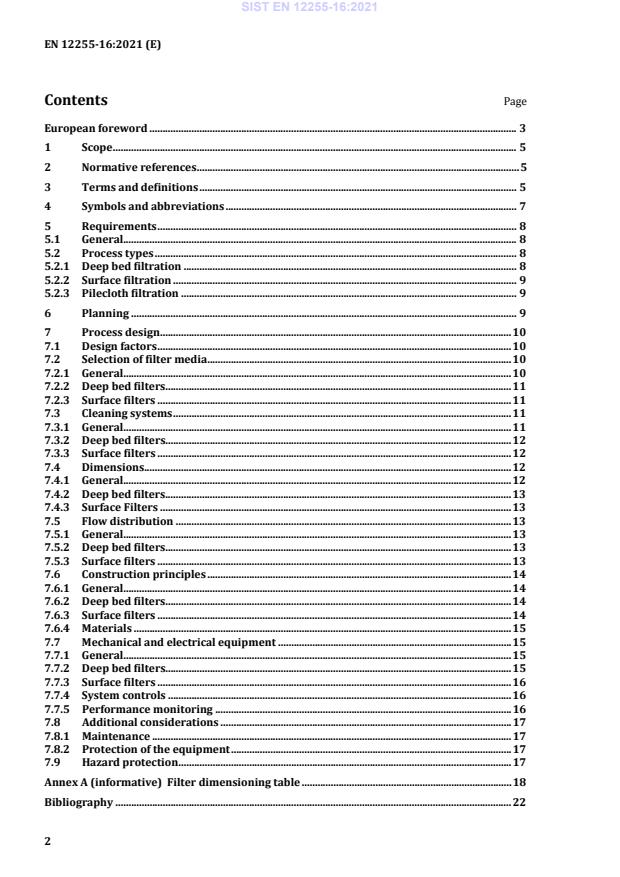
Contents Page
European foreword . 3
1 Scope . 5
2 Normative references . 5
3 Terms and definitions . 5
4 Symbols and abbreviations . 7
5 Requirements . 8
5.1 General. 8
5.2 Process types . 8
5.2.1 Deep bed filtration . 8
5.2.2 Surface filtration . 9
5.2.3 Pilecloth filtration . 9
6 Planning . 9
7 Process design . 10
7.1 Design factors . 10
7.2 Selection of filter media . 10
7.2.1 General. 10
7.2.2 Deep bed filters. 11
7.2.3 Surface filters . 11
7.3 Cleaning systems . 11
7.3.1 General. 11
7.3.2 Deep bed filters. 12
7.3.3 Surface filters . 12
7.4 Dimensions. 12
7.4.1 General. 12
7.4.2 Deep bed filters. 13
7.4.3 Surface Filters . 13
7.5 Flow distribution . 13
7.5.1 General. 13
7.5.2 Deep bed filters. 13
7.5.3 Surface filters . 13
7.6 Construction principles . 14
7.6.1 General. 14
7.6.2 Deep bed filters. 14
7.6.3 Surface filters . 14
7.6.4 Materials . 15
7.7 Mechanical and electrical equipment . 15
7.7.1 General. 15
7.7.2 Deep bed filters. 15
7.7.3 Surface filters . 16
7.7.4 System controls . 16
7.7.5 Performance monitoring . 16
7.8 Additional considerations . 17
7.8.1 Maintenance . 17
7.8.2 Protection of the equipment . 17
7.9 Hazard protection . 17
Annex A (informative) Filter dimensioning table . 18
Bibliography . 22
EN 12255-16:202 1 (E)
European foreword
This document (EN 12255-16:2021) has been prepared by Technical Committee CEN/TC 165 “Waste
water engineering”, the secretariat of which is held by DIN.
This European Standard shall be given the status of a national standard, either by publication of an
identical text or by endorsement, at the latest by January 2022, and conflicting national standards shall
be withdrawn at the latest by January 2022.
Attention is drawn to the possibility that some of the elements of this document may be the subject of
patent rights. CEN shall not be held responsible for identifying any or all such patent rights.
This is the sixteenth part prepared by Working Group CEN/TC 165/WG 40 relating to the general
requirements and processes for treatment plants for a total number of inhabitants and population
equivalents (PT) over 50.
EN 12255 with the generic title “Wastewater treatment plants” consists of the following parts:
• Part 1: General construction principles
• Part 2: Storm management systems
• Part 3: Preliminary treatment
• Part 4: Primary settlement
• Part 5: Lagooning processes
• Part 6: Activated sludge process
• Part 7: Biological fixed-film reactors
• Part 8: Sludge treatment and storage
• Part 9: Odour control and ventilation
• Part 10: Safety principles
• Part 11: General data required
• Part 12: Control and automation
• Part 13: Chemical treatment — Treatment of wastewater by precipitation/flocculation
• Part 14: Disinfection
• Part 15: Measurement of the oxygen transfer in clean water in aeration tanks of activated sludge plants
• Part 16: Physical (mechanical) filtration
NOTE For requirements on pumping installations at wastewater treatment plants see EN 752 “Drain and sewer
systems outside buildings - Sewer system management” and EN 16932 (all parts) “Drain and sewer systems outside
buildings – Pumping systems”.
Differences in wastewater treatment throughout Europe have led to a variety of systems being developed.
This document gives fundamental information about the systems; this document has not attempted to
specify all available systems. A generic arrangement of wastewater treatment plants is illustrated in
Figure 1.
Key
1 preliminary treatment
2 primary treatment
3 secondary treatment
4 tertiary treatment
5 additional treatment (e.g. disinfection or removal of micropollutants)
6 sludge treatment
7 lagoons (as an alternative)
A raw wastewater
B effluent for re-use (e.g. irrigation)
C discharged effluent
D screenings and grit
E primary sludge
F secondary sludge
G tertiary sludge
H digested sludge
I digester gas
J returned water from dewatering
Figure 1 — Schematic diagram of wastewater treatment plants
Detailed information additional to that contained in this document may be obtained by referring to the
bibliography.
The primary application is for wastewater treatment plants designed for the treatment of domestic and
municipal wastewater.
Any feedback and questions on this document should be directed to the users’ national standards body.
A complete listing of these bodies can be found on the CEN website.
According to the CEN-CENELEC Internal Regulations, the national standards organisations of the
following countries are bound to implement this European Standard: Austria, Belgium, Bulgaria, Croatia,
Cyprus, Czech Republic, Denmark, Estonia, Finland, France, Germany, Greece, Hungary, Iceland, Ireland,
Italy, Latvia, Lithuania, Luxembourg, Malta, Netherlands, Norway, Poland, Portugal, Republic of North
Macedonia, Romania, Serbia, Slovakia, Slovenia, Spain, Sweden, Switzerland, Turkey and the United
Kingdom.
EN 12255-16:202 1 (E)
1 Scope
This document specifies design principles and performance requirements for tertiary clarification
(receiving effluent from secondary treatment) by physical filtration plant at wastewater treatment plants
serving more than 50 PT.
NOTE 1 Ultrafiltration, nanofiltration and reverse osmosis are not covered within the scope of this document as
they are not considered to be used for tertiary clarification.
NOTE 2 Soil filtration is not covered in this document.
NOTE 3 Activated carbon filtration is excluded from the scope of this document as it is not considered to be a
form of mechanical filtration.
2 Normative references
The following documents are referred to in the text in such a way that some or all of their content
constitutes requirements of this document. For dated references, only the edition cited applies. For
undated references, the latest edition of the referenced document (including any amendments) applies.
EN 16323:2014, Glossary of wastewater engineering terms
EN 12255-1, Wastewater treatment plants - Part 1: General construction principles
EN 12255-10, Wastewater treatment plants - Part 10: Safety principles
EN 12255-12, Wastewater treatment plants - Part 12: Control and automation
3 Terms and definitions
For the purposes of this document, the terms and definitions given in EN 16323:2014 and the following
apply.
ISO and IEC maintain terminological databases for use in standardization at the following addresses:
• IEC Electropedia: available at https://www.electropedia.org/
• ISO Online browsing platform: available at https://www.iso.org/obp
3.1
filtration
process of retention of matter on or in a filter medium when passed by a fluid
Note 1 to entry: The filter medium can be a porous bed or a surface whereon a filter cake is building up.
[SOURCE: EN 16323:2014, 2.3.5.17, modified, to reflect that dissolved matter can also be removed by
some filter types (e.g. granular activated carbon)]
3.2
deep bed filtration
process for the removal of solids from a fluid whereby the fluid flows through a filter medium consisting
of a porous bed
3.3
surface filtration
process for the removal of solids from a fluid whereby the fluid flows through a filter cake building up on
an essentially two dimensional filter medium
3.4
granular medium filter
deep bed filter with a granular filter medium
[SOURCE: EN 16323:2014, 2.3.5.22, modified, so as not to exclude crossflow and activated carbon]
3.5
sand filter
deep bed filter using natural or artificial fine particles as filter medium
[SOURCE: EN 16323:2014, 2.3.3.12, modified, to not exclude purpose made manufactured media]
3.6
cloth filter
filter with textile fabric as filter medium
3.7
disc filter
surface filter with rotating discs that are covered with a mesh or cloth as filter medium
3.8
drum filter
surface filter with a rotating drum that is covered with a mesh or cloth as filter medium
[SOURCE: EN 16323:2014, 2.3.8.8, modified, to not exclude materials other than cloth and remove
limitation on axis orientation]
3.9
microstrainer
type of rotating filter with a fine mesh
Note 1 to entry: Microstrainers can be drum or disc filters.
[SOURCE: EN 16323:2014, 2.3.8.15, modified, so as not to exclude rotation about any axis]
3.10
fuzzy filter
deep bed upstream filter with a filter medium consisting of porous and compressible plastic components
3.11
filter medium
material through which a fluid flows and on which matter contained in the fluid is retained
Note 1 to entry: The filter medium of surface filters is the mesh or cloth on which a filter cake is building up. Most
of the solids are retained on or within the filter cake.
[SOURCE: EN 16323:2014, 2.3.8.10]
3.12
particle size ratio
PSR
characteristic of a granular filter medium by means of a sieve analysis and the resulting sieving diagram
whereby the ratio of the two mesh sizes, permitting passage of 60 % and 10 % of the granular mass, is
determined
EN 12255-16:202 1 (E)
4 Symbols and abbreviations
A Effective filter area m
eff
AL Area load kg/(m ∙ h)
C Concentration of SS in the inflow mg/l
SS,in
g Acceleration due to gravity m/s
H Filter bed height m
Ṁ Load due to addition of powdered activated carbon kg /h
AC
Ṁ SS influent load kg /h
in
Ṁ SS effluent load kg /h
out
Ṁ SS load due to precipitation kg /h
prec
NH -N Ammonium nitrogen
NO -N Nitrate nitrogen
PT Total Phosphorous
Q Filtrate flow m /h
SS Suspended solids
VL Volumetric Load kg/(m ∙ h)
v Filtration Rate m/h
Δh Head Loss m
Δp Required air pressure for backwashing kPa
ρ Water density kg/m
5 Requirements
5.1 General
Filtering according to this document is used to remove suspended solids from biologically treated
wastewater by mechanical filtration. Mechanical filters may also be used for further removal of
phosphorous, micro-plastics and micro-pollutants. Mechanical filters may also be used for biological
treatment.
Filters take a number of forms. These are summarized in Table 1.
Table 1 — Effluent filter classification
Filter medium Deep bed Surface
Downflow
Filter type Moving bed filter Upflow filter Pilecloth filter Mesh filter
filter
Granulate (e.g.
Granulate (e.g. Sand or Stainless steel
sand or activated
Filter material activated carbon), beads or Pilecloth or plastic
carbon) or small
plastic foam fibre mesh
beads
Retention of Retention of
solids on solids on
Filter effect Retention of solids in pores or adsorption
surface and in mesh and
pores filter cake
Filtration Continuous Batch Continuous
Filtration flow
Up Down Up In Out
direction
Continuous or
Backwashing Intermittent Continuous or intermittent
intermittent
Filter medium Single or
Single Single Single
layer(s) dual
Biological effect Possible No
5.2 Process types
5.2.1 Deep bed filtration
5.2.1.1 General
Deep bed filters include:
— Moving filters;
— Downflow filters;
— Upflow filters.
The filter material can include granulate (e.g. sand or activated carbon), beads or plastic pieces. Solids
are retained mechanically or by surface adsorption.
Under certain circumstances deep bed filters can be used for biological processes.
Depending on the type of filter, the filtration process is either continuous or batched (intermittent).
EN 12255-16:202 1 (E)
5.2.1.2 Batch filtration
An upflow or downflow of effluent percolates through a bed of filter media trapping solids within the bed.
During filtration solids accumulate in the bed and increase the head loss. At intervals, the bed shall be
taken out of service and washed using filtered effluent with or without air scouring to remove
accumulated solids. Washing can be effected by either a pumped or siphonic upflow of filtered effluent
through the entire bed or by a travelling bridge washing individual compartments.
Downflow filters can have one or more layers in addition to a support layer. Upflow filters can only have
a single layer.
Fuzzy filters are batch upflow filters with a filter medium of plastic foam pieces. During filtration the foam
layer is compressed. For filter cleaning the pressure is released and then the filter is backwashed with
water and air. After the cleaning the foam is compressed again.
Because of the intermittent nature of batch filtration several units shall be provided.
5.2.1.3 Continuous filtration
In this style of filter, an upflow of effluent passes continuously through a bed of granular media to remove
solids. An air lift raises granular media from the bottom of the bed for washing and returns cleaned media
to the top of the bed, enabling continuous filtration. This backwashing can be undertaken continuously
or intermittently. Where intermittent backwashing is possible there may be an energy saving.
5.2.2 Surface filtration
Disc filters and drum filters are covered with mesh and rotate horizontally about their longitudinal axis.
The filters are partially submerged. The filtration flow is continuous from inside to out. The backwashing
with spray water occurs continuously or intermittently from outside to in by using the filtered water.
Disc and drum filters have a lower head loss than deep bed filters, but their solids removal efficiency is
usually lower. Disc filters are more compact than drum filters.
5.2.3 Pilecloth filtration
Pilecloth filters can be disc filters or drum filters that are covered with pilecloth and rotate horizontally
about the longitudinal axis. The filters are entirely submerged. A filtration flow is continuous from outside
to inside. The backwashing is undertaken by forcing water under pressure from the inside to outside.
6 Planning
The choice of physical filtration process depends on the size of the treatment plant, space available, the
type, quality, quantity and variability of effluent to be treated, the final quality of effluent required, and
the frequency of maintenance that is required for the process.
Physical filtration can be used to supplement secondary clarification. The following primary factors shall
be considered during design:
— flow to be treated, including return flows;
— type and efficacy of secondary treatment and clarification processes;
— nature and concentration of solids to be removed;
— required quality of treated effluent;
— ranges of hydraulic or suspended solids loads;
— available head;
— available space (e.g. footprint);
— environmental conditions (e.g. climate).
The following secondar
...