


EN 13363-1:2003+A1:2007
(Main + Amendment)Solar protection devices combined with glazing - Calculation of solar and light transmittance - Part 1: Simplified method
General Information
- Abstract
This European Standard specifies a simplified method based on the thermal transmittance and total solar energy transmittance of the glazing and on the light transmittance and reflectance of the solar protection device to estimate the total solar energy transmittance of a solar protection device combined with glazing.
The method applies to all types of solar protection devices parallel to the glazing such as louvre, venetian or roller blinds. The position of the solar protection device can be interior, exterior or between single panes in a dual glazing system. It is applicable when the total solar energy transmittance of the glazing is between 0,15 and 0,85. Venetian or louvre blinds are assumed to be adjusted so that there is no direct solar penetration. It is assumed that for external solar protection devices and for integrated solar protection devices, the space between the solar protection devices and the glazing is unventilated and for internal solar protection devices this space is ventilated.
The resulting g-values of the simplified method given here are approximate and their deviation from the exact values lie within the range between +0,10 and -0,02. The results generally tend to lie on the safe side for cooling load estimations. The results are not intended to be used for calculating beneficial solar gains or thermal comfort criteria.
The simplified method is based on the normal incidence of radiation and does not take into account either the angular dependence of transmittance and the reflectance or the differences of spectral distribution. An allowance can be made for this fact when applying the method.
- Status
- Withdrawn
- Publication Date
- 03-Jul-2007
- Withdrawal Date
- 22-Sep-2026
- Technical Committee
- CEN/TC 89 - Thermal performance of buildings and building components
- Drafting Committee
- CEN/TC 89/WG 7 - Thermal properties of doors and windows
- Current Stage
- 9960 - Withdrawal effective - Withdrawal
- Start Date
- 19-Jul-2017
- Completion Date
- 23-Sep-2026
- Directive
- Harmonized Standard305/2011 - Regulation (eu) No 305/2011 of the European Parliament and of the Council of 9 march 2011 laying down harmonised conditions for the marketing of construction products and repealing council directive 89/106/eec
Not Harmonized89/106/EEC - Construction products

Relations
- Effective Date
- 19-Jan-2023
- Effective Date
- 26-Jul-2017
- Effective Date
- 28-Jan-2026
- Effective Date
- 28-Jan-2026
- Refers
EN 410:1998 - Glass in building - Determination of luminous and solar characteristics of glazing - Effective Date
- 28-Jan-2026
- Effective Date
- 28-Jan-2026
- Effective Date
- 28-Jan-2026
- Effective Date
- 28-Jan-2026
- Effective Date
- 28-Jan-2026
- Effective Date
- 28-Jan-2026
- Effective Date
- 28-Jan-2026
- Effective Date
- 28-Jan-2026
- Effective Date
- 28-Jan-2026
- Effective Date
- 28-Jan-2026
- Effective Date
- 28-Jan-2026
Get Certified
Connect with accredited certification bodies for this standard

DIBt (Deutsches Institut für Bautechnik)
German Institute for Building Technology.
DIN CERTCO
DIN Group product certification.

Aboma Certification B.V.
Specialized in construction, metal, and transport sectors.
Sponsored listings
Frequently Asked Questions
EN 13363-1:2003+A1:2007 is a standard published by the European Committee for Standardization (CEN). Its full title is "Solar protection devices combined with glazing - Calculation of solar and light transmittance - Part 1: Simplified method". This standard covers: This European Standard specifies a simplified method based on the thermal transmittance and total solar energy transmittance of the glazing and on the light transmittance and reflectance of the solar protection device to estimate the total solar energy transmittance of a solar protection device combined with glazing. The method applies to all types of solar protection devices parallel to the glazing such as louvre, venetian or roller blinds. The position of the solar protection device can be interior, exterior or between single panes in a dual glazing system. It is applicable when the total solar energy transmittance of the glazing is between 0,15 and 0,85. Venetian or louvre blinds are assumed to be adjusted so that there is no direct solar penetration. It is assumed that for external solar protection devices and for integrated solar protection devices, the space between the solar protection devices and the glazing is unventilated and for internal solar protection devices this space is ventilated. The resulting g-values of the simplified method given here are approximate and their deviation from the exact values lie within the range between +0,10 and -0,02. The results generally tend to lie on the safe side for cooling load estimations. The results are not intended to be used for calculating beneficial solar gains or thermal comfort criteria. The simplified method is based on the normal incidence of radiation and does not take into account either the angular dependence of transmittance and the reflectance or the differences of spectral distribution. An allowance can be made for this fact when applying the method.
This European Standard specifies a simplified method based on the thermal transmittance and total solar energy transmittance of the glazing and on the light transmittance and reflectance of the solar protection device to estimate the total solar energy transmittance of a solar protection device combined with glazing. The method applies to all types of solar protection devices parallel to the glazing such as louvre, venetian or roller blinds. The position of the solar protection device can be interior, exterior or between single panes in a dual glazing system. It is applicable when the total solar energy transmittance of the glazing is between 0,15 and 0,85. Venetian or louvre blinds are assumed to be adjusted so that there is no direct solar penetration. It is assumed that for external solar protection devices and for integrated solar protection devices, the space between the solar protection devices and the glazing is unventilated and for internal solar protection devices this space is ventilated. The resulting g-values of the simplified method given here are approximate and their deviation from the exact values lie within the range between +0,10 and -0,02. The results generally tend to lie on the safe side for cooling load estimations. The results are not intended to be used for calculating beneficial solar gains or thermal comfort criteria. The simplified method is based on the normal incidence of radiation and does not take into account either the angular dependence of transmittance and the reflectance or the differences of spectral distribution. An allowance can be made for this fact when applying the method.
EN 13363-1:2003+A1:2007 is classified under the following ICS (International Classification for Standards) categories: 17.180.20 - Colours and measurement of light; 91.120.10 - Thermal insulation of buildings. The ICS classification helps identify the subject area and facilitates finding related standards.
EN 13363-1:2003+A1:2007 has the following relationships with other standards: It is inter standard links to EN 13363-1:2003, EN ISO 52022-1:2017, EN 673:1997, EN ISO 7345:1995, EN 410:1998, EN 675:1997, EN 674:1997, EN ISO 11810-1:2009, EN ISO 15367-1:2003, EN ISO 11551:2003, EN ISO 15367-2:2005, EN ISO 12005:2003, EN ISO 11670:2003, EN ISO 11146-2:2005, EN ISO 13696:2002. Understanding these relationships helps ensure you are using the most current and applicable version of the standard.
EN 13363-1:2003+A1:2007 is associated with the following European legislation: EU Directives/Regulations: 305/2011, 89/106/EEC; Standardization Mandates: M/122. When a standard is cited in the Official Journal of the European Union, products manufactured in conformity with it benefit from a presumption of conformity with the essential requirements of the corresponding EU directive or regulation.
EN 13363-1:2003+A1:2007 is available in PDF format for immediate download after purchase. The document can be added to your cart and obtained through the secure checkout process. Digital delivery ensures instant access to the complete standard document.
Standards Content (Sample)
2003-01.Slovenski inštitut za standardizacijo. Razmnoževanje celote ali delov tega standarda ni dovoljeno.Sonnenschutzeinrichtungen in Kombination mit Verglasungen - Berechnung der Solarstrahlung und des Lichttransmissionsgrades - Teil 1: Vereinfachtes VerfahrenDispositifs de protection solaire combinés a des vitrages - Calcul du facteur de transmission solaire et lumineuse - Partie 1: Méthode simplifiéeSolar protection devices combined with glazing - Calculation of solar and light transmittance - Part 1: Simplified method91.120.10Toplotna izolacija stavbThermal insulation17.180.20Barve in merjenje svetlobeColours and measurement of lightICS:Ta slovenski standard je istoveten z:EN 13363-1:2003+A1:2007SIST EN 13363-1:2003+A1:2007en01-oktober-2007SIST EN 13363-1:2003+A1:2007SLOVENSKI
STANDARD
EUROPEAN STANDARD NORME EUROPÉENNE EUROPÄISCHE NORM
EN 13363-1:2003+A1
July 2007 ICS 17.180.20; 91.120.10 Supersedes EN 13363-1:2003English Version
Solar protection devices combined with glazing - Calculation of solar and light transmittance - Part 1: Simplified method
Dispositifs de protection solaire combinés à des vitrages - Calcul du facteur de transmission solaire et lumineuse - Partie 1: Méthode simplifiée
Sonnenschutzeinrichtungen in Kombination mit Verglasungen - Berechnung der Solarstrahlung und des Lichttransmissionsgrades - Teil 1: Vereinfachtes VerfahrenThis European Standard was approved by CEN on 7 May 2003 and includes Amendment 1 approved by CEN on 24 May 2007.
CEN members are bound to comply with the CEN/CENELEC Internal Regulations which stipulate the conditions for giving this European Standard the status of a national standard without any alteration. Up-to-date lists and bibliographical references concerning such national standards may be obtained on application to the CEN Management Centre or to any CEN member.
This European Standard exists in three official versions (English, French, German). A version in any other language made by translation under the responsibility of a CEN member into its own language and notified to the CEN Management Centre has the same status as the official versions.
CEN members are the national standards bodies of Austria, Belgium, Bulgaria, Cyprus, Czech Republic, Denmark, Estonia, Finland, France, Germany, Greece, Hungary, Iceland, Ireland, Italy, Latvia, Lithuania, Luxembourg, Malta, Netherlands, Norway, Poland, Portugal, Romania, Slovakia, Slovenia, Spain, Sweden, Switzerland and United Kingdom.
EUROPEAN COMMITTEE FOR STANDARDIZATION
COMITÉ EUROPÉEN DE NORMALISATION EUROPÄISCHES KOMITEE FÜR NORMUNG
Management Centre: rue de Stassart, 36
B-1050 Brussels © 2007 CEN All rights of exploitation in any form and by any means reserved worldwide for CEN national Members. Ref. No. EN 13363-1:2003+A1:2007: ESIST EN 13363-1:2003+A1:2007
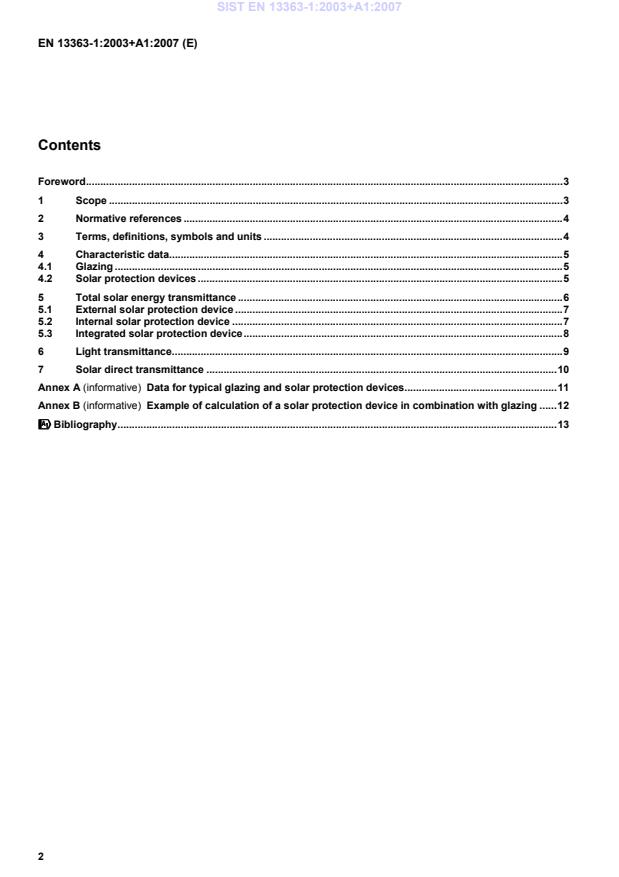
Data for typical glazing and solar protection devices.11 Annex B (informative)
Example of calculation of a solar protection device in combination with glazing.12 !!!!Bibliography.13
The scope of the standard was made more precise." According to the CEN/CENELEC Internal Regulations, the national standards organizations of the following countries are bound to implement this European Standard: Austria, Belgium, Bulgaria, Cyprus, Czech Republic, Denmark, Estonia, Finland, France, Germany, Greece, Hungary, Iceland, Ireland, Italy, Latvia, Lithuania, Luxembourg, Malta, Netherlands, Norway, Poland, Portugal, Romania, Slovakia, Slovenia, Spain, Sweden, Switzerland and United Kingdom.
1 Scope This European Standard specifies a simplified method based on the thermal transmittance and total solar energy transmittance of the glazing and on the light transmittance and reflectance of the solar protection device to estimate the total solar energy transmittance of a solar protection device combined with glazing.
The method applies to all types of solar protection devices parallel to the glazing such as louvre, venetian or roller blinds. The position of the solar protection device can be interior, exterior or between single panes in a dual glazing system. It is applicable when the total solar energy transmittance of the glazing is between 0,15 and 0,85. Venetian or louvre blinds are assumed to be adjusted so that there is no direct solar penetration. It is assumed that for external solar protection devices and for integrated solar protection devices, the space between the solar protection devices and the glazing is unventilated and for internal solar protection devices this space is ventilated. !The resulting g-values of the simplified method given here are approximate and their deviation from the exact values lie within the range between +0,10 and -0,02. The results generally tend to lie on the safe side for cooling load estimations. The results are not intended to be used for calculating beneficial solar gains or thermal comfort criteria. The simplified method is based on the normal incidence of radiation and does not take into account either the angular dependence of transmittance and the reflectance or the differences of spectral distribution.
0 ≤ τe,B ≤ 0,5 and 0,1 ≤ ρe,B ≤ 0,8
For reflectance and transmittance values outside these ranges EN 13363-2 [1] applies. An allowance can be made for this fact when applying the method. For cases not covered by the method given in this standard more exact calculations based on the optical properties (in general the spectral data) of glass and solar protection device can be carried out in accordance with EN 13363-2 [1]." 2 Normative references This European Standard incorporates by dated or undated reference, provisions from other publications. These normative references are cited at the appropriate places in the text, and the publications are listed hereafter. For dated references, subsequent amendments to or revisions of any of these publications apply to this European Standard only when incorporated in it by amendment or revision. For undated references the latest edition of the publication referred to applies (including amendments). EN 410:1998, Glass in building – Determination of luminous and solar characteristics of glazing. EN 673, Glass in building – Determination of thermal transmittance (U value) – Calculation method. EN 674, Glass in building – Determination of thermal transmittance (U value) – Guarded hot plate method. EN 675, Glass in building – Determination of thermal transmittance (U value) – Heat flow meter method. EN ISO 7345:1995, Thermal insulation – Physical quantities and definitions (ISO 734
...