


CEN/TS 13126-1:2004
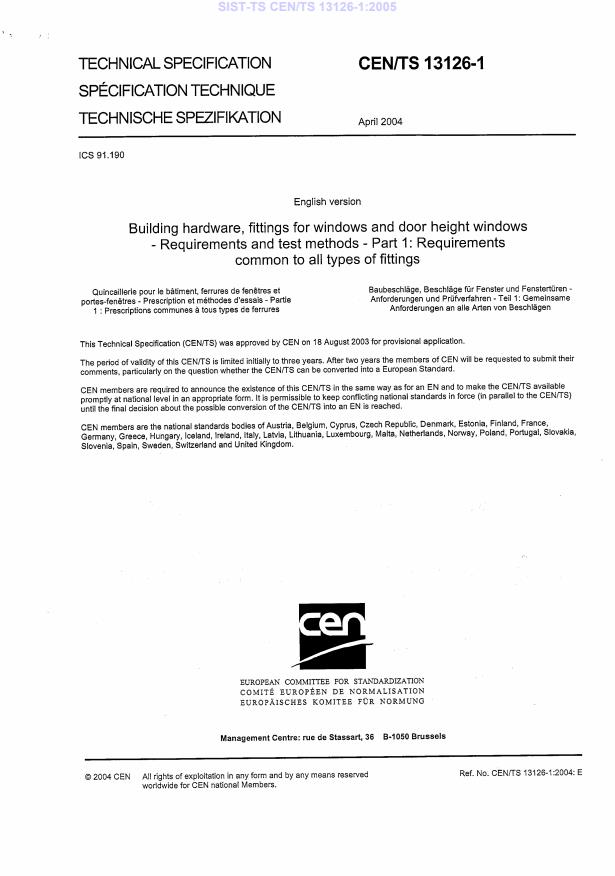
(Main)Building hardware, fittings for windows and door height windows - Requirements and test methods - Part 1: Requirements common to all types of fittings
General Information
- Abstract
This part specifies performance requirements for the strength and durability of fittings for the operation of movable leaves of windows and door height windows including requirements and test methods common to all fittings.
This Technical Specification is applicable to the fittings suitable for windows and door height windows listed in Table 1 and illustrated in normative annex B, whatever the material used for the construction of the window.
Table 1 - Window types
Window type Description Figure
A Side-hung casement inward opening B1
B Side-hung casement outward opening B1
C Bottom-hung casement inward opening and outward opening B2
D Top-hung casement inward opening and outward opening B2
E Tilt and turn casement and turn and tilt casement B3
F Horizontal pivot casement B4
G Vertical pivot casement B4
H Projecting top-hung inward and outward opening casement B5
J Projecting bottom-hung inward and outward opening casement B5
K Top-hung projecting reversible casement B6
L Side-hung projecting reversible casement B7
M Vertical sliding sash B8
N Horizontal sliding sash B9
P Lifting sliding sash B10
Q Folding casement (centre pivot) B11
R Folding outward opening casement (corner pivot) B12
S Folding inward opening casement (corner pivot) B12
T Tilting sliding sash B13
U Top-hung inward opening casement multi-light B14
V Bottom-hung inward opening casement multi-light B14
W Horizontal balanced casement B15
This Technical Specification does not apply to the following: -
Fusible links, fittings for lifting side-hung casements; fittings for windows that remain parallel to their own plane and move perpendicular to it on pantograph type gear, devices that are used for the permanent connection of window frame members to each other, devices that are used for the permanent fixing of complete window assemblies into the structure of a building, mechanisms for the remote operation of windows, whether mechan
- Status
- Withdrawn
- Publication Date
- 06-Apr-2004
- Withdrawal Date
- 14-Feb-2006
- Technical Committee
- CEN/TC 33 - Doors, windows, shutters and building hardware
- Drafting Committee
- CEN/TC 33/WG 4 - Building hardware
- Current Stage
- 9960 - Withdrawal effective - Withdrawal
- Start Date
- 15-Feb-2006
- Completion Date
- 15-Feb-2006
- Directive
- Harmonized Standard305/2011 - Regulation (eu) No 305/2011 of the European Parliament and of the Council of 9 march 2011 laying down harmonised conditions for the marketing of construction products and repealing council directive 89/106/eec
Not Harmonized89/106/EEC - Construction products

Relations
- Effective Date
- 22-Dec-2008
- Effective Date
- 28-Jan-2026
- Effective Date
- 28-Jan-2026
- Effective Date
- 28-Jan-2026
- Effective Date
- 28-Jan-2026
- Effective Date
- 28-Jan-2026
- Effective Date
- 28-Jan-2026
Get Certified
Connect with accredited certification bodies for this standard

DIBt (Deutsches Institut für Bautechnik)
German Institute for Building Technology.
DIN CERTCO
DIN Group product certification.

Aboma Certification B.V.
Specialized in construction, metal, and transport sectors.
Sponsored listings
Frequently Asked Questions
CEN/TS 13126-1:2004 is a technical specification published by the European Committee for Standardization (CEN). Its full title is "Building hardware, fittings for windows and door height windows - Requirements and test methods - Part 1: Requirements common to all types of fittings". This standard covers: This part specifies performance requirements for the strength and durability of fittings for the operation of movable leaves of windows and door height windows including requirements and test methods common to all fittings. This Technical Specification is applicable to the fittings suitable for windows and door height windows listed in Table 1 and illustrated in normative annex B, whatever the material used for the construction of the window. Table 1 - Window types Window type Description Figure A Side-hung casement inward opening B1 B Side-hung casement outward opening B1 C Bottom-hung casement inward opening and outward opening B2 D Top-hung casement inward opening and outward opening B2 E Tilt and turn casement and turn and tilt casement B3 F Horizontal pivot casement B4 G Vertical pivot casement B4 H Projecting top-hung inward and outward opening casement B5 J Projecting bottom-hung inward and outward opening casement B5 K Top-hung projecting reversible casement B6 L Side-hung projecting reversible casement B7 M Vertical sliding sash B8 N Horizontal sliding sash B9 P Lifting sliding sash B10 Q Folding casement (centre pivot) B11 R Folding outward opening casement (corner pivot) B12 S Folding inward opening casement (corner pivot) B12 T Tilting sliding sash B13 U Top-hung inward opening casement multi-light B14 V Bottom-hung inward opening casement multi-light B14 W Horizontal balanced casement B15 This Technical Specification does not apply to the following: - Fusible links, fittings for lifting side-hung casements; fittings for windows that remain parallel to their own plane and move perpendicular to it on pantograph type gear, devices that are used for the permanent connection of window frame members to each other, devices that are used for the permanent fixing of complete window assemblies into the structure of a building, mechanisms for the remote operation of windows, whether mechan
This part specifies performance requirements for the strength and durability of fittings for the operation of movable leaves of windows and door height windows including requirements and test methods common to all fittings. This Technical Specification is applicable to the fittings suitable for windows and door height windows listed in Table 1 and illustrated in normative annex B, whatever the material used for the construction of the window. Table 1 - Window types Window type Description Figure A Side-hung casement inward opening B1 B Side-hung casement outward opening B1 C Bottom-hung casement inward opening and outward opening B2 D Top-hung casement inward opening and outward opening B2 E Tilt and turn casement and turn and tilt casement B3 F Horizontal pivot casement B4 G Vertical pivot casement B4 H Projecting top-hung inward and outward opening casement B5 J Projecting bottom-hung inward and outward opening casement B5 K Top-hung projecting reversible casement B6 L Side-hung projecting reversible casement B7 M Vertical sliding sash B8 N Horizontal sliding sash B9 P Lifting sliding sash B10 Q Folding casement (centre pivot) B11 R Folding outward opening casement (corner pivot) B12 S Folding inward opening casement (corner pivot) B12 T Tilting sliding sash B13 U Top-hung inward opening casement multi-light B14 V Bottom-hung inward opening casement multi-light B14 W Horizontal balanced casement B15 This Technical Specification does not apply to the following: - Fusible links, fittings for lifting side-hung casements; fittings for windows that remain parallel to their own plane and move perpendicular to it on pantograph type gear, devices that are used for the permanent connection of window frame members to each other, devices that are used for the permanent fixing of complete window assemblies into the structure of a building, mechanisms for the remote operation of windows, whether mechan
CEN/TS 13126-1:2004 is classified under the following ICS (International Classification for Standards) categories: 91.190 - Building accessories. The ICS classification helps identify the subject area and facilitates finding related standards.
CEN/TS 13126-1:2004 has the following relationships with other standards: It is inter standard links to EN 13126-1:2006, EN ISO 13856-2:2013, EN ISO 13856-1:2013, EN ISO 19014-3:2018, CEN/TS 13126-9:2004, CEN ISO/TS 19392-1:2022, EN 15859:2010. Understanding these relationships helps ensure you are using the most current and applicable version of the standard.
CEN/TS 13126-1:2004 is associated with the following European legislation: EU Directives/Regulations: 305/2011, 89/106/EEC. When a standard is cited in the Official Journal of the European Union, products manufactured in conformity with it benefit from a presumption of conformity with the essential requirements of the corresponding EU directive or regulation.
CEN/TS 13126-1:2004 is available in PDF format for immediate download after purchase. The document can be added to your cart and obtained through the secure checkout process. Digital delivery ensures instant access to the complete standard document.
Standards Content (Sample)
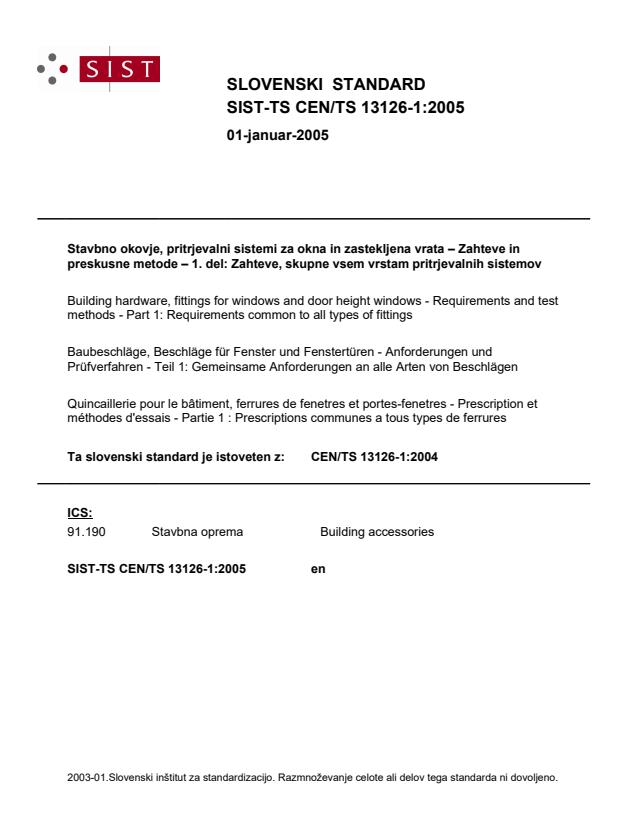
SLOVENSKI STANDARD
01-januar-2005
Stavbno okovje, pritrjevalni sistemi za okna in zastekljena vrata – Zahteve in
preskusne metode – 1. del: Zahteve, skupne vsem vrstam pritrjevalnih sistemov
Building hardware, fittings for windows and door height windows - Requirements and test
methods - Part 1: Requirements common to all types of fittings
Baubeschläge, Beschläge für Fenster und Fenstertüren - Anforderungen und
Prüfverfahren - Teil 1: Gemeinsame Anforderungen an alle Arten von Beschlägen
Quincaillerie pour le bâtiment, ferrures de fenetres et portes-fenetres - Prescription et
méthodes d'essais - Partie 1 : Prescriptions communes a tous types de ferrures
Ta slovenski standard je istoveten z: CEN/TS 13126-1:2004
ICS:
91.190 Stavbna oprema Building accessories
2003-01.Slovenski inštitut za standardizacijo. Razmnoževanje celote ali delov tega standarda ni dovoljeno.
------
...