


EN 12369-2:2011
(Main)Wood-based panels - Characteristic values for structural design - Part 2: Plywood
General Information
- Abstract
This European Standard provides information on the characteristic values for use in designing structures incorporating wood-based panels. The characteristic values given in this standard are to be used in accordance with EN 1995-1-1.
When utilizing the classification system for derivation of plywood characteristic values, this part of this standard can only be applied with reference to EN 636.
This part of this standard includes the characteristic values of the mechanical properties for plywood complying with EN 636 in bending, tension, compression, panel shear and planar shear. EN 636 classifies bending properties into two sets of classes, one for stiffness and another for strength. Stiffness and strength in tension and compression are related to the same properties in bending.
For shear properties, fixed values determined by correlation to density are provided.
Where optimised values are needed, the characteristic values are determined directly by testing in accordance with EN 789 and EN 1058 or by combination of testing according to the latter two standards and calculation according to prEN 14272.
This part of this standard applies to panels complying with the three following conditions:
- 5 layers or more and 6 mm overall thickness and more;
- the ratio of the cumulative thickness of veneers in alternate directions does not exceed 2,5;
- wood species with a mean density greater than 350 kg/m3 and not exceeding 750 kg/m3.
- Status
- Withdrawn
- Publication Date
- 14-Jun-2011
- Withdrawal Date
- 16-Sep-2026
- Technical Committee
- CEN/TC 112 - Woodbased panels
- Drafting Committee
- CEN/TC 112/WG 4 - Test methods
- Current Stage
- 9960 - Withdrawal effective - Withdrawal
- Start Date
- 17-Sep-2025
- Completion Date
- 17-Sep-2026
- Directive
- Harmonized Standard305/2011 - Regulation (eu) No 305/2011 of the European Parliament and of the Council of 9 march 2011 laying down harmonised conditions for the marketing of construction products and repealing council directive 89/106/eec
Not Harmonized89/106/EEC - Construction products

Relations
- Replaces
EN 12369-2:2004 - Wood-based panels - Characteristic values for structural design - Part 2: Plywood - Effective Date
- 18-Jun-2011
- Replaced By
EN 12369-2:2025 - Wood-based panels - Characteristic values for structural design - Part 2: Plywood - Effective Date
- 28-Jan-2023
- Effective Date
- 03-Jun-2026
- Effective Date
- 28-Jan-2026
- Effective Date
- 28-Jan-2026
- Effective Date
- 28-Jan-2026
- Effective Date
- 28-Jan-2026
- Effective Date
- 28-Jan-2026
- Effective Date
- 28-Jan-2026
- Effective Date
- 28-Jan-2026
- Effective Date
- 09-Feb-2026
- Effective Date
- 28-Jan-2026
- Effective Date
- 28-Jan-2026
Get Certified
Connect with accredited certification bodies for this standard

Gozdarski inštitut Slovenije
Slovenian Forestry Institute. Forest management certification support, timber testing.
Sponsored listings
Frequently Asked Questions
EN 12369-2:2011 is a standard published by the European Committee for Standardization (CEN). Its full title is "Wood-based panels - Characteristic values for structural design - Part 2: Plywood". This standard covers: This European Standard provides information on the characteristic values for use in designing structures incorporating wood-based panels. The characteristic values given in this standard are to be used in accordance with EN 1995-1-1. When utilizing the classification system for derivation of plywood characteristic values, this part of this standard can only be applied with reference to EN 636. This part of this standard includes the characteristic values of the mechanical properties for plywood complying with EN 636 in bending, tension, compression, panel shear and planar shear. EN 636 classifies bending properties into two sets of classes, one for stiffness and another for strength. Stiffness and strength in tension and compression are related to the same properties in bending. For shear properties, fixed values determined by correlation to density are provided. Where optimised values are needed, the characteristic values are determined directly by testing in accordance with EN 789 and EN 1058 or by combination of testing according to the latter two standards and calculation according to prEN 14272. This part of this standard applies to panels complying with the three following conditions: - 5 layers or more and 6 mm overall thickness and more; - the ratio of the cumulative thickness of veneers in alternate directions does not exceed 2,5; - wood species with a mean density greater than 350 kg/m3 and not exceeding 750 kg/m3.
This European Standard provides information on the characteristic values for use in designing structures incorporating wood-based panels. The characteristic values given in this standard are to be used in accordance with EN 1995-1-1. When utilizing the classification system for derivation of plywood characteristic values, this part of this standard can only be applied with reference to EN 636. This part of this standard includes the characteristic values of the mechanical properties for plywood complying with EN 636 in bending, tension, compression, panel shear and planar shear. EN 636 classifies bending properties into two sets of classes, one for stiffness and another for strength. Stiffness and strength in tension and compression are related to the same properties in bending. For shear properties, fixed values determined by correlation to density are provided. Where optimised values are needed, the characteristic values are determined directly by testing in accordance with EN 789 and EN 1058 or by combination of testing according to the latter two standards and calculation according to prEN 14272. This part of this standard applies to panels complying with the three following conditions: - 5 layers or more and 6 mm overall thickness and more; - the ratio of the cumulative thickness of veneers in alternate directions does not exceed 2,5; - wood species with a mean density greater than 350 kg/m3 and not exceeding 750 kg/m3.
EN 12369-2:2011 is classified under the following ICS (International Classification for Standards) categories: 79.060.10 - Plywood. The ICS classification helps identify the subject area and facilitates finding related standards.
EN 12369-2:2011 has the following relationships with other standards: It is inter standard links to EN 12369-2:2004, EN 12369-2:2025, ISO 3131:1975, EN 326-2:2010+A1:2014, EN 635-2:1995, EN 310:1993, EN 323:1993, EN 635-3:1995, EN 636:2003, EN 1995-1-1:2004, EN IEC 61400-1:2019, EN 13107:2004, EN 1993-3-1:2006. Understanding these relationships helps ensure you are using the most current and applicable version of the standard.
EN 12369-2:2011 is associated with the following European legislation: EU Directives/Regulations: 305/2011, 89/106/EEC. When a standard is cited in the Official Journal of the European Union, products manufactured in conformity with it benefit from a presumption of conformity with the essential requirements of the corresponding EU directive or regulation.
EN 12369-2:2011 is available in PDF format for immediate download after purchase. The document can be added to your cart and obtained through the secure checkout process. Digital delivery ensures instant access to the complete standard document.
Standards Content (Sample)
2003-01.Slovenski inštitut za standardizacijo. Razmnoževanje celote ali delov tega standarda ni dovoljeno.Holzwerkstoffe - Charakteristische Werte für die Berechnung und Bemessung von Holzbauwerken - Teil 2: SperrholzPanneaux à base de bois - Valeurs caractéristiques pour la conception des structures - Partie 2: ContreplaquéWood-based panels - Characteristic values for structural design - Part 2: Plywood79.060.10Vezan lesPlywoodICS:Ta slovenski standard je istoveten z:EN 12369-2:2011SIST EN 12369-2:2011en,fr,de01-oktober-2011SIST EN 12369-2:2011SLOVENSKI
STANDARDSIST EN 12369-2:20041DGRPHãþD
EUROPEAN STANDARD NORME EUROPÉENNE EUROPÄISCHE NORM
EN 12369-2
June 2011 ICS 79.060.10 Supersedes EN 12369-2:2004English Version
Wood-based panels -Characteristic values for structural design - Part 2: Plywood
Panneaux à base de bois - Valeurs caractéristiques pour la conception des structures - Partie 2: Contreplaqué
Holzwerkstoffe - Charakteristische Werte für die Berechnung und Bemessung von Holzbauwerken - Teil 2: Sperrholz This European Standard was approved by CEN on 11 May 2011.
CEN members are bound to comply with the CEN/CENELEC Internal Regulations which stipulate the conditions for giving this European Standard the status of a national standard without any alteration. Up-to-date lists and bibliographical references concerning such national standards may be obtained on application to the CEN-CENELEC Management Centre or to any CEN member.
This European Standard exists in three official versions (English, French, German). A version in any other language made by translation under the responsibility of a CEN member into its own language and notified to the CEN-CENELEC Management Centre has the same status as the official versions.
CEN members are the national standards bodies of Austria, Belgium, Bulgaria, Croatia, Cyprus, Czech Republic, Denmark, Estonia, Finland, France, Germany, Greece, Hungary, Iceland, Ireland, Italy, Latvia, Lithuania, Luxembourg, Malta, Netherlands, Norway, Poland, Portugal, Romania, Slovakia, Slovenia, Spain, Sweden, Switzerland and United Kingdom.
EUROPEAN COMMITTEE FOR STANDARDIZATION
COMITÉ EUROPÉEN DE NORMALISATION EUROPÄISCHES KOMITEE FÜR NORMUNG
Management Centre:
Avenue Marnix 17,
B-1000 Brussels © 2011 CEN All rights of exploitation in any form and by any means reserved worldwide for CEN national Members. Ref. No. EN 12369-2:2011: ESIST EN 12369-2:2011
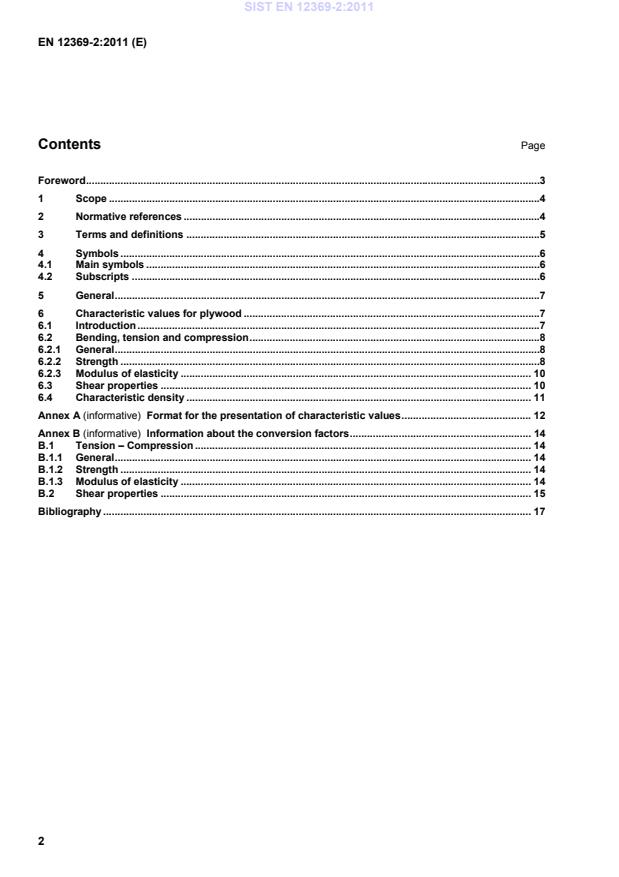
Format for the presentation of characteristic values . 12Annex B (informative)
Information about the conversion factors . 14B.1 Tension – Compression . 14B.1.1 General . 14B.1.2 Strength . 14B.1.3 Modulus of elasticity . 14B.2 Shear properties . 15Bibliography . 17 SIST EN 12369-2:2011
Where optimised values are needed, the characteristic values are determined directly by testing in accordance with EN 789 and EN 1058 or by combination of testing according to the latter two standards and calculation according to prEN 14272.
This European Standard applies to panels complying with the three following conditions: 5 layers or more and 6 mm overall thickness and more; the ratio of the cumulative thickness of veneers in alternate directions does not exceed 2,5; wood species with a mean density greater than 350 kg/m3 and not exceeding 750 kg/m3. 2 Normative references The following referenced documents are indispensable for the application of this document. For dated references, only the edition cited applies. For undated references, the latest edition of the referenced document (including any amendments) applies. EN 310, Wood-based panels
Determination of modulus of elasticity in bending and of bending strength EN 323, Wood-based panels
Determination of density
EN 326-2, Wood-based panels
Sampling, cutting and inspection
Part 2: Initial type testing and factory production control EN 635-2, Plywood — Classification by surface appearance — Part 2: Hardwood EN 635-3, Plywood — Classification by surface appearance — Part 3: Softwood EN 636:2003, Plywood
Specifications EN 1995-1-1:2004, Eurocode 5: Design of timber structures — Part 1-1: General — Common rules and rules for buildings ISO 3131, Wood — Determination of density for physical and mechanical tests SIST EN 12369-2:2011
3.2.2 service class 2 conditions of exposure resulting in moisture content in the materials corresponding to a temperature of 20 °C and the relative humidity of the surrounding air exceeding 85 % for only a few weeks per year NOTE
In these conditions the moisture content of coniferous plywood can be expected not to exceed 18 %.
3.2.3 service class 3 conditions of exposure resulting in higher moisture content in the materials than in service class 2
NOTE In these conditions the moisture content of coniferous plywood can be expected to exceed 18 %.
3.3 load duration class class characterized by the effect of a constant load acting for a certain period of time in the life of the structure NOTE 1 For a variable action, the appropriate class is determined on the basis of an estimate of the interaction between the typical variation of the load with time and the rheological properties of the materials. NOTE 2 For strength and stiffness calculations, actions are assigned to one of the load-duration classes given in Table 1, derived from EN 1995-1-1. SIST EN 12369-2:2011
Table 1 — Load duration classes Load duration class Order of accumulated duration of characteristic load Examples of loading Permanent More than 10 years Self weight Long-term 6 months to 10 years Storage Medi
...