


EN 14019:2016
(Main)Curtain Walling - Impact resistance - Performance requirements
General Information
- Abstract
This European Standard defines performance requirements of curtain walling (excluding ‘glass in building’ which is classified under EN 12600) under soft body impact load criteria specified herein and tested in accordance with EN 13049.
Its criteria is targeted to safety in use and integrity of curtain wall in the event of sudden impact forces on the curtain wall surfaces. Compliance with the performance requirement is determined by the laboratory test.
It applies to those areas of curtain walling which face onto areas of human activity, either internally or externally and takes account of accidental impacts brought on by people going about their normal daily activities and impacts brought about by equipment and similar devices for maintenance, cleaning, repair and similar occasional activities.
It does not set out to define performance requirements of impact under exceptional circumstances such as acts of vandalism, vehicular collision, firearm projectiles, etc..
This standard will have no bearing whatsoever on any National Building / Health and Safety regulations which may exist and whose requirements shall apply separately and in parallel with these test performance requirements.
- Status
- Published
- Publication Date
- 21-Jun-2016
- Withdrawal Date
- 30-Dec-2016
- Technical Committee
- CEN/TC 33 - Doors, windows, shutters and building hardware
- Drafting Committee
- CEN/TC 33/WG 6 - Curtain walling
- Current Stage
- 9093 - Decision to confirm - Review Enquiry
- Start Date
- 20-Jan-2022
- Completion Date
- 23-Sep-2026

Overview
EN 14019:2016 - "Curtain Walling - Impact resistance - Performance requirements" is a CEN European Standard that defines laboratory performance requirements for the impact resistance of curtain walling subject to soft‑body (pendulum) impact loads. Its aim is to protect safety in use and the integrity of curtain wall surfaces exposed to normal human activity, maintenance or cleaning operations. Testing is carried out in accordance with EN 13049 (with referenced test hardware and pendulum impactor details given in EN 12600).
This standard does not cover exceptional impacts (vandalism, vehicle collisions, firearms) and does not replace any national building or health & safety regulations.
Key Topics and Requirements
- Scope and objective
- Applies to curtain walling facing areas of human activity (internal or external).
- Targets accidental impacts from people, equipment and routine maintenance.
- Failure criteria
- No part heavier than 50 g may fall from the assembly.
- No hole shall permit passage of the EN 1630 test block E2 (ellipse).
- Permanent deformation of framing is tolerated provided no fracturing or separation into multiple fragments occurs.
- Test specimen and infill panels must not detach or dislodge.
- Glass infills must be classified per EN 12600.
- Impact positions
- Defined impact positions for stick and unitised curtain wall constructions (mullion, transom, infill centre, transom ends, etc.). The worst result among tested positions determines classification.
- Test method
- Pendulum impactor (tyre/metal core) mounted per EN 12600; specimens must be at least one storey high and fixed as per intended installation.
- Environmental testing range: 5 °C to 30 °C, 25 % to 75 % RH.
- Tests progress through drop‑heights until classification or failure; impacts per position include the classification drop height followed by a 100 mm drop.
- Classification
- Internal classes I0–I5 and external classes E0–E5 with associated drop heights (e.g., I1/E1 = 200 mm, up to I5/E5 = 950 mm). Class 0 = not tested.
Applications and Who Uses It
- Façade designers and structural engineers specifying curtain wall safety and performance.
- Curtain wall manufacturers and fabricators for product design and quality control.
- Third‑party testing laboratories and Notified Bodies conducting compliance tests and issuing reports.
- Specifiers, architects and building owners selecting appropriate impact classes for public, private or elevated facade zones.
- Maintenance planners assessing safe access and risks during cleaning/repairs.
Related Standards
- EN 13049 - curtain walling testing framework (referenced in scope)
- EN 12600 - pendulum impactor and glass classification
- EN 13119 - terminology for curtain walling
- EN 1630 - test block (E2) used to assess holing and passage
- EN 13830 - curtain walling product standard (series context)
Keywords: EN 14019:2016, curtain walling, impact resistance, performance requirements, façade impact testing, pendulum impactor, soft‑body impact, curtain wall safety.
Relations
- Effective Date
- 01-May-2013
- Effective Date
- 28-Jan-2026
- Effective Date
- 28-Jan-2026
- Effective Date
- 28-Jan-2026
- Effective Date
- 28-Jan-2026
- Effective Date
- 28-Jan-2026
- Effective Date
- 28-Jan-2026
- Effective Date
- 28-Jan-2026
Get Certified
Connect with accredited certification bodies for this standard

DIBt (Deutsches Institut für Bautechnik)
German Institute for Building Technology.
DIN CERTCO
DIN Group product certification.

Aboma Certification B.V.
Specialized in construction, metal, and transport sectors.
Sponsored listings
Frequently Asked Questions
EN 14019:2016 is a standard published by the European Committee for Standardization (CEN). Its full title is "Curtain Walling - Impact resistance - Performance requirements". This standard covers: This European Standard defines performance requirements of curtain walling (excluding ‘glass in building’ which is classified under EN 12600) under soft body impact load criteria specified herein and tested in accordance with EN 13049. Its criteria is targeted to safety in use and integrity of curtain wall in the event of sudden impact forces on the curtain wall surfaces. Compliance with the performance requirement is determined by the laboratory test. It applies to those areas of curtain walling which face onto areas of human activity, either internally or externally and takes account of accidental impacts brought on by people going about their normal daily activities and impacts brought about by equipment and similar devices for maintenance, cleaning, repair and similar occasional activities. It does not set out to define performance requirements of impact under exceptional circumstances such as acts of vandalism, vehicular collision, firearm projectiles, etc.. This standard will have no bearing whatsoever on any National Building / Health and Safety regulations which may exist and whose requirements shall apply separately and in parallel with these test performance requirements.
This European Standard defines performance requirements of curtain walling (excluding ‘glass in building’ which is classified under EN 12600) under soft body impact load criteria specified herein and tested in accordance with EN 13049. Its criteria is targeted to safety in use and integrity of curtain wall in the event of sudden impact forces on the curtain wall surfaces. Compliance with the performance requirement is determined by the laboratory test. It applies to those areas of curtain walling which face onto areas of human activity, either internally or externally and takes account of accidental impacts brought on by people going about their normal daily activities and impacts brought about by equipment and similar devices for maintenance, cleaning, repair and similar occasional activities. It does not set out to define performance requirements of impact under exceptional circumstances such as acts of vandalism, vehicular collision, firearm projectiles, etc.. This standard will have no bearing whatsoever on any National Building / Health and Safety regulations which may exist and whose requirements shall apply separately and in parallel with these test performance requirements.
EN 14019:2016 is classified under the following ICS (International Classification for Standards) categories: 91.060.10 - Walls. Partitions. Facades. The ICS classification helps identify the subject area and facilitates finding related standards.
EN 14019:2016 has the following relationships with other standards: It is inter standard links to EN 14019:2004, EN 1630:2021, EN 12600:2002, EN 13119:2016, EN 13830:2015+A1:2020, EN 16807:2016, EN 13830:2015, EN 13830:2003. Understanding these relationships helps ensure you are using the most current and applicable version of the standard.
EN 14019:2016 is available in PDF format for immediate download after purchase. The document can be added to your cart and obtained through the secure checkout process. Digital delivery ensures instant access to the complete standard document.
Standards Content (Sample)
2003-01.Slovenski inštitut za standardizacijo. Razmnoževanje celote ali delov tega standarda ni dovoljeno.Obešene fasade - Odpornost proti udarcu - Zahtevane lastnostiVorhangfassaden - Stoßfestigkeit - LeistungsanforderungenFaçades rideaux - Résistance au choc - Prescriptions de performanceCurtain Walling - Impact resistance - Performance requirements91.060.10Stene. Predelne stene. FasadeWalls. Partitions. FacadesICS:Ta slovenski standard je istoveten z:EN 14019:2016SIST EN 14019:2016en,fr,de01-september-2016SIST EN 14019:2016SLOVENSKI
STANDARDSIST EN 14019:20041DGRPHãþD
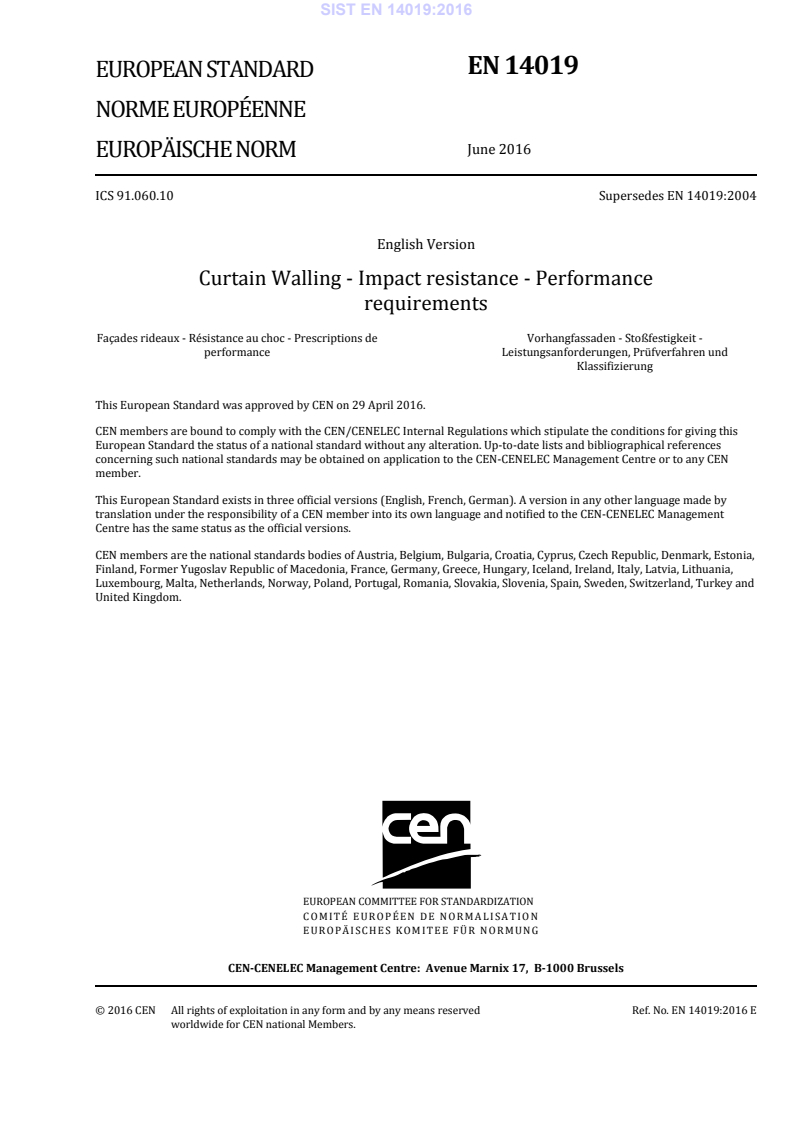
EUROPEAN STANDARD NORME EUROPÉENNE EUROPÄISCHE NORM
EN 14019
June
t r s x ICS
{ sä r x rä s r Supersedes EN
s v r s {ã t r r vEnglish Version
Curtain Walling æ Impact resistance æ Performance requirements Façades rideaux æ Rßsistance au choc æ Prescriptions de performance
Vorhangfassaden æ Stoßfestigkeit æ Leistungsanforderungená Prüfverfahren und Klassifizierung This European Standard was approved by CEN on
t { April
t r s xä
egulations which stipulate the conditions for giving this European Standard the status of a national standard without any alterationä Upætoædate lists and bibliographical references concerning such national standards may be obtained on application to the CENæCENELEC Management Centre or to any CEN memberä
translation under the responsibility of a CEN member into its own language and notified to the CENæCENELEC Management Centre has the same status as the official versionsä
CEN members are the national standards bodies of Austriaá Belgiumá Bulgariaá Croatiaá Cyprusá Czech Republicá Denmarká Estoniaá Finlandá Former Yugoslav Republic of Macedoniaá Franceá Germanyá Greeceá Hungaryá Icelandá Irelandá Italyá Latviaá Lithuaniaá Luxembourgá Maltaá Netherlandsá Norwayá Polandá Portugalá Romaniaá Slovakiaá Sloveniaá Spainá Swedená Switzerlandá Turkey and United Kingdomä
EUROPEAN COMMITTEE FOR STANDARDIZATION COMITÉ EUROPÉEN DE NORMALISATION EUROPÄISCHES KOMITEE FÜR NORMUNG
CEN-CENELEC Management Centre:
Avenue Marnix 17,
B-1000 Brussels
t r s x CEN All rights of exploitation in any form and by any means reserved worldwide for CEN national Membersä Refä Noä EN
s v r s {ã t r s x ESIST EN 14019:2016
...