


EN 589:2018+A1:2022
(Main + Amendment)Automotive fuels - LPG - Requirements and test methods
General Information
- Abstract
This document specifies requirements and test methods for marketed and delivered automotive liquefied petroleum gas (LPG), with LPG defined as low pressure liquefied gas composed of one or more light hydrocarbons which are assigned to UN 1011, 1075, 1965, 1969 or 1978 only and which consists mainly of propane, propene, butane, butane isomers, butenes with traces of other hydrocarbon gases.
This standard is applicable to automotive LPG for use in LPG engine vehicles designed to run on automotive LPG.
NOTE For the purposes of this European Standard, the terms "% (m/m)" and "% (V/V)" are used to represent respectively the mass fraction, µ, and the volume fraction, φ.
WARNING - Attention is drawn to the risk of fire and explosion when handling LPG and to the hazard to health arising through inhalation of excessive amounts of LPG.
LPG is a highly volatile hydrocarbon liquid which is normally stored under pressure. If the pressure is released large volumes of gas will be produced which form flammable mixtures with air over the range of approximately 2 % (V/V) to 10 % (V/V). This European Standard involves the sampling, handling and testing of LPG. Naked flames, unprotected electrical equipment electrostatic hazards etc. are sources of ignition for LPG.
LPG in liquid form can cause cold burns to the skin. The national health and safety regulations apply.
LPG is heavier than air and accumulates in cavities. There is a danger of suffocation when inhaling high concentrations of LPG.
CAUTION - One of the tests described in this European Standard involves the operator inhaling a mixture of air and LPG vapour. Particular attention is drawn to the cautionary statement provided in A.1, where this method is referred to.
- Status
- Withdrawn
- Publication Date
- 22-Feb-2022
- Withdrawal Date
- 22-Sep-2026
- Technical Committee
- CEN/TC 19 - Petroleum products, lubricants and related products
- Drafting Committee
- CEN/TC 19 - Petroleum products, lubricants and related products
- Current Stage
- 9960 - Withdrawal effective - Withdrawal
- Start Date
- 13-Mar-2024
- Completion Date
- 23-Sep-2026
- Directive
- Not Harmonized98/70/EC - Quality of petrol and diesel fuels (Dir. 93/12/EEC amendment)

Relations
- Effective Date
- 18-Jan-2023
- Effective Date
- 18-Jan-2023
- Effective Date
- 18-Jan-2023
- Effective Date
- 24-Jun-2026
- Effective Date
- 28-Jan-2026
- Effective Date
- 28-Jan-2026
- Effective Date
- 28-Jan-2026
- Effective Date
- 28-Jan-2026
- Refers
EN 27941:1993 - Commercial propane and butane - Analysis by gas chromatography (ISO 7941:1988) - Effective Date
- 28-Jan-2026
- Effective Date
- 28-Jan-2026
- Effective Date
- 28-Jan-2026
- Effective Date
- 28-Jan-2026
- Effective Date
- 28-Jan-2026
- Effective Date
- 28-Jan-2026
- Effective Date
- 28-Jan-2026
Get Certified
Connect with accredited certification bodies for this standard

Element Materials Technology
Materials testing and product certification.

ABS Group Brazil
ABS Group certification services in Brazil.

ABS Quality Evaluations Inc.
American Bureau of Shipping quality certification.
Sponsored listings
Frequently Asked Questions
EN 589:2018+A1:2022 is a standard published by the European Committee for Standardization (CEN). Its full title is "Automotive fuels - LPG - Requirements and test methods". This standard covers: This document specifies requirements and test methods for marketed and delivered automotive liquefied petroleum gas (LPG), with LPG defined as low pressure liquefied gas composed of one or more light hydrocarbons which are assigned to UN 1011, 1075, 1965, 1969 or 1978 only and which consists mainly of propane, propene, butane, butane isomers, butenes with traces of other hydrocarbon gases. This standard is applicable to automotive LPG for use in LPG engine vehicles designed to run on automotive LPG. NOTE For the purposes of this European Standard, the terms "% (m/m)" and "% (V/V)" are used to represent respectively the mass fraction, µ, and the volume fraction, φ. WARNING - Attention is drawn to the risk of fire and explosion when handling LPG and to the hazard to health arising through inhalation of excessive amounts of LPG. LPG is a highly volatile hydrocarbon liquid which is normally stored under pressure. If the pressure is released large volumes of gas will be produced which form flammable mixtures with air over the range of approximately 2 % (V/V) to 10 % (V/V). This European Standard involves the sampling, handling and testing of LPG. Naked flames, unprotected electrical equipment electrostatic hazards etc. are sources of ignition for LPG. LPG in liquid form can cause cold burns to the skin. The national health and safety regulations apply. LPG is heavier than air and accumulates in cavities. There is a danger of suffocation when inhaling high concentrations of LPG. CAUTION - One of the tests described in this European Standard involves the operator inhaling a mixture of air and LPG vapour. Particular attention is drawn to the cautionary statement provided in A.1, where this method is referred to.
This document specifies requirements and test methods for marketed and delivered automotive liquefied petroleum gas (LPG), with LPG defined as low pressure liquefied gas composed of one or more light hydrocarbons which are assigned to UN 1011, 1075, 1965, 1969 or 1978 only and which consists mainly of propane, propene, butane, butane isomers, butenes with traces of other hydrocarbon gases. This standard is applicable to automotive LPG for use in LPG engine vehicles designed to run on automotive LPG. NOTE For the purposes of this European Standard, the terms "% (m/m)" and "% (V/V)" are used to represent respectively the mass fraction, µ, and the volume fraction, φ. WARNING - Attention is drawn to the risk of fire and explosion when handling LPG and to the hazard to health arising through inhalation of excessive amounts of LPG. LPG is a highly volatile hydrocarbon liquid which is normally stored under pressure. If the pressure is released large volumes of gas will be produced which form flammable mixtures with air over the range of approximately 2 % (V/V) to 10 % (V/V). This European Standard involves the sampling, handling and testing of LPG. Naked flames, unprotected electrical equipment electrostatic hazards etc. are sources of ignition for LPG. LPG in liquid form can cause cold burns to the skin. The national health and safety regulations apply. LPG is heavier than air and accumulates in cavities. There is a danger of suffocation when inhaling high concentrations of LPG. CAUTION - One of the tests described in this European Standard involves the operator inhaling a mixture of air and LPG vapour. Particular attention is drawn to the cautionary statement provided in A.1, where this method is referred to.
EN 589:2018+A1:2022 is classified under the following ICS (International Classification for Standards) categories: 75.160.20 - Liquid fuels. The ICS classification helps identify the subject area and facilitates finding related standards.
EN 589:2018+A1:2022 has the following relationships with other standards: It is inter standard links to EN 589:2018, EN 589:2018/prA1, EN 589:2024, EN ISO 4259-2:2026, EN ISO 4259-2:2017, EN 17178:2019, EN ISO 4257:2001, EN ISO 6251:1998, EN 27941:1993, EN 16942:2024, EN 16423:2013, EN 15471:2017, EN ISO 4256:1998, EN ISO 8973:1999, EN ISO 8819:1995. Understanding these relationships helps ensure you are using the most current and applicable version of the standard.
EN 589:2018+A1:2022 is associated with the following European legislation: EU Directives/Regulations: 98/70/EC. When a standard is cited in the Official Journal of the European Union, products manufactured in conformity with it benefit from a presumption of conformity with the essential requirements of the corresponding EU directive or regulation.
EN 589:2018+A1:2022 is available in PDF format for immediate download after purchase. The document can be added to your cart and obtained through the secure checkout process. Digital delivery ensures instant access to the complete standard document.
Standards Content (Sample)
SLOVENSKI STANDARD
01-maj-2022
Goriva za motorna vozila - Utekočinjeni naftni plin (UNP) - Zahteve in preskusne
metode
Automotive fuels - LPG - Requirements and test methods
Kraftstoffe - Flüssiggas - Anforderungen und Prüfverfahren
Carburants pour automobiles - GPL - Exigences et méthodes d'essai
Ta slovenski standard je istoveten z: EN 589:2018+A1:2022
ICS:
75.160.20 Tekoča goriva Liquid fuels
2003-01.Slovenski inštitut za standardizacijo. Razmnoževanje celote ali delov tega standarda ni dovoljeno.
EN 589:2018+A1
EUROPEAN STANDARD
NORME EUROPÉENNE
February 2022
EUROPÄISCHE NORM
ICS 75.160.20 Supersedes EN 589:2018
English Version
Automotive fuels - LPG - Requirements and test methods
Carburants pour automobiles - GPL - Exigences et Kraftstoffe - Flüssiggas - Anforderungen und
méthodes d'essai Prüfverfahren
This European Standard was approved by CEN on 19 October 2018 and includes Amendment 1 approved by CEN on 6 January
2022.
CEN members are bound to comply with the CEN/CENELEC Internal Regulations which stipulate the conditions for giving this
European Standard the status of a national standard without any alteration. Up-to-date lists and bibliographical references
concerning such national standards may be obtained on application to the CEN-CENELEC Management Centre or to any CEN
member.
This European Standard exists in three official versions (English, French, German). A version in any other language made by
translation under the responsibility of a CEN member into its own language and notified to the CEN-CENELEC Management
Centre has the same status as the official versions.
CEN members are the national standards bodies of Austria, Belgium, Bulgaria, Croatia, Cyprus, Czech Republic, Denmark, Estonia,
Finland, France, Germany, Greece, Hungary, Iceland, Ireland, Italy, Latvia, Lithuania, Luxembourg, Malta, Netherlands, Norway,
Poland, Portugal, Republic of North Macedonia, Romania, Serbia, Slovakia, Slovenia, Spain, Sweden, Switzerland, Turkey and
United Kingdom.
EUROPEAN COMMITTEE FOR STANDARDIZATION
COMITÉ EUROPÉEN DE NORMALISATION
EUROPÄISCHES KOMITEE FÜR NORMUNG
CEN-CENELEC Management Centre: Rue de la Science 23, B-1040 Brussels
© 2022 CEN All rights of exploitation in any form and by any means reserved Ref. No. EN 589:2018+A1:2022 E
worldwide for CEN national Members.
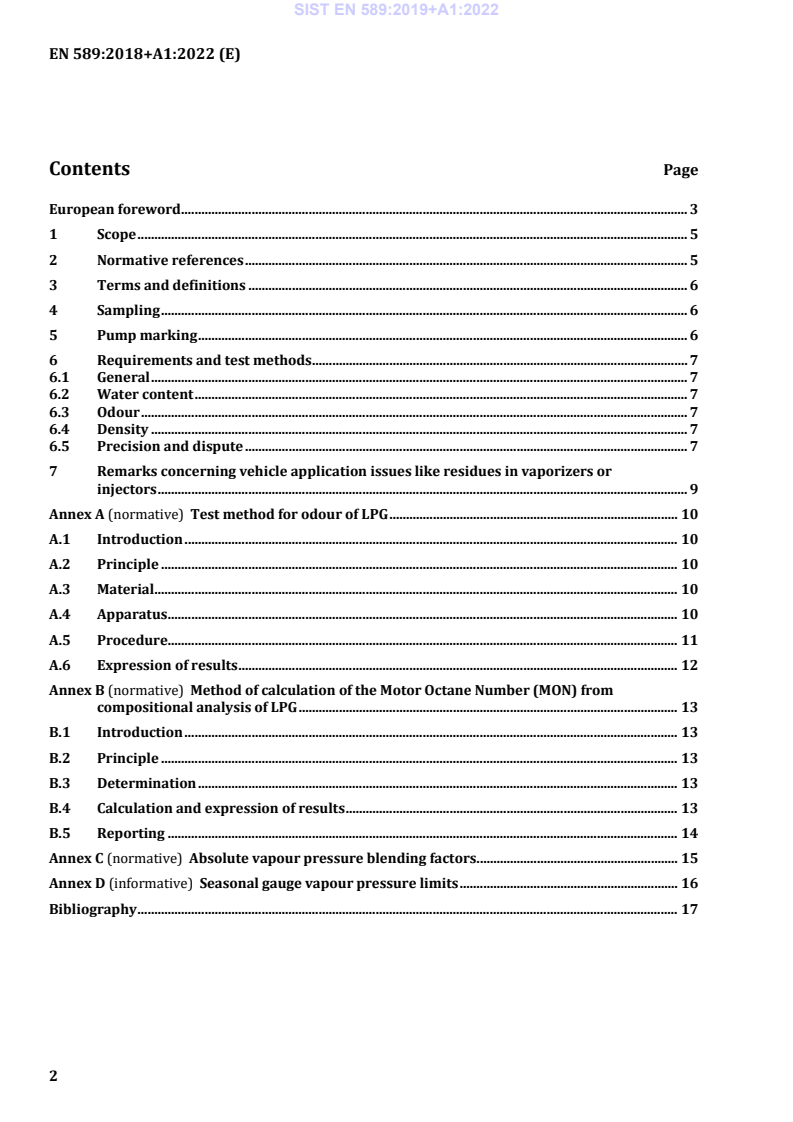
Contents Page
European foreword . 3
1 Scope . 5
2 Normative references . 5
3 Terms and definitions . 6
4 Sampling . 6
5 Pump marking . 6
6 Requirements and test methods . 7
6.1 General . 7
6.2 Water content . 7
6.3 Odour . 7
6.4 Density . 7
6.5 Precision and dispute . 7
7 Remarks concerning vehicle application issues like residues in vaporizers or
injectors . 9
Annex A (normative) Test method for odour of LPG . 10
A.1 Introduction . 10
A.2 Principle . 10
A.3 Material . 10
A.4 Apparatus . 10
A.5 Procedure. 11
A.6 Expression of results . 12
Annex B (normative) Method of calculation of the Motor Octane Number (MON) from
compositional analysis of LPG . 13
B.1 Introduction . 13
B.2 Principle . 13
B.3 Determination . 13
B.4 Calculation and expression of results . 13
B.5 Reporting . 14
Annex C (normative) Absolute vapour pressure blending factors . 15
Annex D (informative) Seasonal gauge vapour pressure limits . 16
Bibliography . 17
European foreword
This document (EN 589:2018+A1:2022) has been prepared by Technical Committee CEN/TC 19
“Gaseous and liquid fuels, lubricants and related products of petroleum, synthetic and biological origin”,
the secretariat of which is held by NEN.
This European Standard shall be given the status of a national standard, either by publication of an
identical text or by endorsement, at the latest by August 2022, and conflicting national standards shall
be withdrawn at the latest by August 2022.
Attention is drawn to the possibility that some of the elements of this document may be the subject of
patent rights. CEN shall not be held responsible for identifying any or all such patent rights.
This document supersedes !EN 589:2018".
This document includes Amendment 1 approved by CEN on 6 January 2022.
The start and finish of text introduced or altered by amendment is indicated in the text by tags !".
th
This is the 7 edition of EN 589. The main technical changes include:
a) reduction of the sulfur limit value to 30 mg/kg;
b) removal of ASTM D 3246, sulfur determination by oxidative microcoulometry, as being incapable of
measuring that level;
c) addition of single limit value for propane in Table 1;
d) addition of a single limit value for 1,3 butadiene in Table 1 due to CLP requirements [5];
e) !introduction of new test methods for the determination of 1,3 butadiene and hydrocarbon
composition (DIN 51619), of low levels of sulfur content (EN 17178) and of evaporation residue
(EN 16423)";
f) addition of Clause 7 “Remarks concerning vehicle application issues like residues in vaporizers or
injectors”;
g) permission to use alternative odour tests added to sub-clause 6.3. The odour test according to
Annex A is not a precise test method with any given precision. Odour is subjectively perceived, not
measured. For this reason it is hard to define a referee method;
h) inclusion of reference to EN 16942 regarding pump marking in line with the requirements set by
the new Directive 2014/94/EU [1].
!The following is a list of significant technical changes between this amendment
EN 589:2018/A1:2022 and the actual European Standard, EN 589:2018:
— update of revised test method standards;
— adjustment of vapour pressure reporting format to the format required by the test methods
EN ISO 8973 and Annex C;
— removal of the increase of the propane content by 2022-05-01;
— modification of the footnote to table g to Table 1 on the performance requirement."
Any feedback and questions on this document should be directed to the users’ national standards body.
A complete listing of these bodies can be found on the CEN website.
According to the CEN-CENELEC Internal Regulations, the national standards organisations of the
following countries are bound to implement this European Standard: Austria, Belgium, Bulgaria,
Croatia, Cyprus, Czech Republic, Denmark, Estonia, Finland, France, Germany, Greece, Hungary, Iceland,
Ireland, Italy, Latvia, Lithuania, Luxembourg, Malta, Netherlands, Norway, Poland, Portugal, Republic of
North Macedonia, Romania, Serbia, Slovakia, Slovenia, Spain, Sweden, Switzerland, Turkey and the
United Kingdom.
1 Scope
This document specifies requirements and test methods for marketed and delivered automotive
liquefied petroleum gas (LPG), with LPG defined as low pressure liquefied gas composed of one or more
light hydrocarbons which are assigned to UN 1011, 1075, 1965, 1969 or 1978 only and which consists
mainly of propane, propene, butane, butane isomers, butenes with traces of other hydrocarbon gases.
This standard is applicable to automotive LPG for use in LPG engine vehicles designed to run on
automotive LPG.
NOTE For the purposes of this European Standard, the terms “% (m/m)” and “% (V/V)” are used to represent
respectively the mass fraction, µ, and the volume fraction, φ.
WARNING — Attention is drawn to the risk of fire and explosion when handling LPG and to the
hazard to health arising through inhalation of excessive amounts of LPG.
LPG is a highly volatile hydrocarbon liquid which is normally stored under pressure. If the
pressure is released large volumes of gas will be produced which form flammable mixtures with
air over the range of approximately 2 % (V/V) to 10 % (V/V). This European Standard involves
the sampling, handling and testing of LPG. Naked flames, unprotected electrical equipment
electrostatic hazards etc. are sources of ignition for LPG.
LPG in liquid form can cause cold burns to the skin. The national health and safety regulations
apply.
LPG is heavier than air and accumulates in cavities. There is a danger of suffocation when
inhaling high concentrations of LPG.
CAUTION — One of the tests described in this European Standard involves the operator inhaling a
mixture of air and LPG vapour. Particular attention is drawn to the cautionary statement provided in
A.1, where this method is referred to.
2 Normative references
The following documents are referred to in the text in such a way that some or all of their content
constitutes requirements of this document. For dated references, only the edition cited applies. For
undated references, the latest edition of the referenced document (including any amendments) applies.
EN 15469, Petroleum products - Test method for free water in liquefied petroleum gas by visual inspection
EN 15470, Liquefied petroleum gases - Determination of dissolved residues - High temperature Gas
chromatographic method
EN 15471, Liquefied petroleum gases - Determination of dissolved residues - High-temperature
gravimetric method
EN 16423, Liquefied petroleum gases - Determination of dissolved residue - Gas chromatographic method
using liquid, on-column injection
EN 16942, Fuels - Identification of vehicle compatibility - Graphical expression for consumer information
!EN 17178, Liquid petroleum products — Determination of the total volatile sulfur content in liquefied
petroleum gases by ultraviolet fluorescence spectroscopy"
EN 27941, Commercial propane and butane - Analysis by gas chromatography (ISO 7941)
EN ISO 4256, Liquefied petroleum gases - Determination of gauge pressure - LPG method (ISO 4256)
EN ISO 4257, Liquefied petroleum gases - Method of sampling (ISO 4257)
EN ISO 4259-2, Petroleum and related products - Precision of measurement methods and results - Part 2:
Interpretation and application of precision data in relation to methods of test (ISO 4259-2)
EN ISO 6251, Liquefied petroleum gases - Corrosiveness to copper - Copper strip test (ISO 6251)
EN ISO 8819, Liquefied petroleum gases - Detection of hydrogen sulfide - Lead acetate method (ISO 8819)
EN ISO 8973, Liquefied petroleum gases - Calculation method for density and vapour pressure (ISO 8973)
DIN 51619, Testing of mineral oil hydrocarbons — Determination of the composition of liquid petroleum
gases — Gas chromatographic analysis under special consideration of 1,3-butadiene with mass fractions
≤ 0,1 % (m/m)
ASTM D6667–14, Standard Test Method for Determination of Total Volatile Sulfur in Gaseous
Hydrocarbons and Liquefied Petroleum Gases by Ultraviolet Fluorescence
3 Terms and definitions
For the purposes of this document, the following terms and definitions apply.
ISO and IEC maintain terminological databases for use in standardization at the following addresses:
• IEC Electropedia: available at https://www.electropedia.org/
• ISO Online browsing platform: available at https://www.iso.org/obp
3.1
liquefied petroleum gas
LPG
petroleum gas that can be stored and/or handled in the liquid phase under moderate conditions of
pressure and at ambient temperature, consisting predominantly of propane and butanes, with small
proportions of propene
...