


EN 15017:2005
(Main)Funeral Services - Requirements
Funeral Services - Requirements
This European Standard sets out the requirements for the provision of funeral services.
This European Standard does not apply to product-related technical requirements. Occupational health and safety requirements are not covered by this European Standard.
Bestattungs-Dienstleistungen - Anforderungen
Diese Europäische Norm legt die Anforderungen an Bestattungs-Dienstleistungen fest.
Diese Europäische Norm gilt nicht für produktbezogene technische Anforderungen. Anforderungen an den betrieblichen Arbeitsschutz sind nicht Inhalt dieser Europäischen Norm.
Services funéraires - Exigences
Cette Norme européenne établit les exigences relatives aux prestations des services funéraires.
Cette Norme européenne ne s'applique pas aux exigences techniques relatives aux fournitures/produits. Les exigences relatives à la santé et à la sécurité au travail ne sont pas traitées dans cette Norme européenne.
Pogrebne storitve – Zahteve
General Information
- Status
- Withdrawn
- Publication Date
- 11-Oct-2005
- Withdrawal Date
- 08-Feb-2026
- Technical Committee
- CEN/TC 448 - Funeral services
- Drafting Committee
- CEN/TC 448 - Funeral services
- Current Stage
- 9960 - Withdrawal effective - Withdrawal
- Start Date
- 11-Sep-2019
- Completion Date
- 11-Feb-2026
Relations
- Effective Date
- 18-Sep-2019



Get Certified
Connect with accredited certification bodies for this standard

Great Wall Tianjin Quality Assurance Center
Established 1993, first batch to receive national accreditation with IAF recognition.
Hong Kong Quality Assurance Agency (HKQAA)
Hong Kong's leading certification body.

Innovative Quality Certifications Pvt. Ltd. (IQCPL)
Known for integrity, providing ethical & impartial Assessment & Certification. CMMI Institute Partner.
Sponsored listings
Frequently Asked Questions
EN 15017:2005 is a standard published by the European Committee for Standardization (CEN). Its full title is "Funeral Services - Requirements". This standard covers: This European Standard sets out the requirements for the provision of funeral services. This European Standard does not apply to product-related technical requirements. Occupational health and safety requirements are not covered by this European Standard.
This European Standard sets out the requirements for the provision of funeral services. This European Standard does not apply to product-related technical requirements. Occupational health and safety requirements are not covered by this European Standard.
EN 15017:2005 is classified under the following ICS (International Classification for Standards) categories: 03.080.30 - Services for consumers. The ICS classification helps identify the subject area and facilitates finding related standards.
EN 15017:2005 has the following relationships with other standards: It is inter standard links to EN 15017:2019. Understanding these relationships helps ensure you are using the most current and applicable version of the standard.
EN 15017:2005 is available in PDF format for immediate download after purchase. The document can be added to your cart and obtained through the secure checkout process. Digital delivery ensures instant access to the complete standard document.
Standards Content (Sample)
2003-01.Slovenski inštitut za standardizacijo. Razmnoževanje celote ali delov tega standarda ni dovoljeno.Funeral Services - RequirementsPogrebne storitve – ZahteveServices funéraires - ExigencesBestattungs-Dienstleistungen - AnforderungenTa slovenski standard je istoveten z:EN 15017:2005SIST EN 15017:2006en,fr,de03.080.30ICS:SLOVENSKI
STANDARDSIST EN 15017:200601-julij-2006
EUROPEAN STANDARDNORME EUROPÉENNEEUROPÄISCHE NORMEN 15017October 2005ICS 03.080.30 English VersionFuneral Services - RequirementsServices de pompes funèbres - ExigencesBestattungs-Dienstleistungen - AnforderungenThis European Standard was approved by CEN on 29 August 2005.CEN members are bound to comply with the CEN/CENELEC Internal Regulations which stipulate the conditions for giving this EuropeanStandard the status of a national standard without any alteration. Up-to-date lists and bibliographical references concerning such nationalstandards may be obtained on application to the Central Secretariat or to any CEN member.This European Standard exists in three official versions (English, French, German). A version in any other language made by translationunder the responsibility of a CEN member into its own language and notified to the Central Secretariat has the same status as the officialversions.CEN members are the national standards bodies of Austria, Belgium, Cyprus, Czech Republic, Denmark, Estonia, Finland, France,Germany, Greece, Hungary, Iceland, Ireland, Italy, Latvia, Lithuania, Luxembourg, Malta, Netherlands, Norway, Poland, Portugal, Slovakia,Slovenia, Spain, Sweden, Switzerland and United Kingdom.EUROPEAN COMMITTEE FOR STANDARDIZATIONCOMITÉ EUROPÉEN DE NORMALISATIONEUROPÄISCHES KOMITEE FÜR NORMUNGManagement Centre: rue de Stassart, 36
B-1050 Brussels© 2005 CENAll rights of exploitation in any form and by any means reservedworldwide for CEN national Members.Ref. No. EN 15017:2005: E
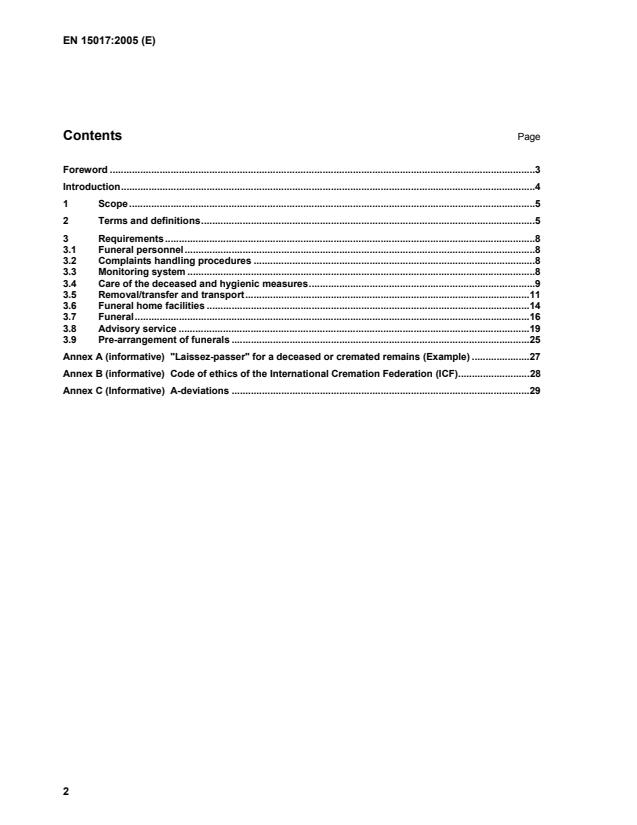
"Laissez-passer" for a deceased or cremated remains (Example).27 Annex B (informative)
Code of ethics of the International Cremation Federation (ICF).28 Annex C (Informative)
A-deviations.29
elaboration of an individual proposal regarding the deliveries and services for a future funeral, including its financing 2.7 Cortege procession of people who are walking and/or riding to a funeral 2.8 Cosmetic application superficial corrections, covering, and enhancement of the natural features of the deceased 2.9 Cremation entire procedure of incineration of the deceased 2.10 Cremation services any services pertaining to the cremation process 2.11 Crematorium building fitted with appliances for the purpose of exclusively burning human remains, including everything incidental or ancillary thereto and with a public area, which allows a dignified farewell ceremony
2.43 Urn burial interment of the urn into an earth grave, burial at sea or placing of the urn in a columbarium 2.44 Viewing room suitable room for the bereaved to view the deceased 3 Requirements 3.1 Funeral personnel Management shall ensure that funeral personnel receive regular training. Funeral personnel shall have the skills and experience to deal with deceased persons and their relatives. One member of the funeral personnel shall be a supervisor. Funeral personnel shall behave in a respectful manner. Funeral personnel shall be properly trained and suitable for the task and shall observe an appropriate dress code. Funeral personnel shall show due respect for the social, religious and cultural beliefs of the deceased and the client. Where possible the training shall lead to a diploma or the experience of the personnel shall be approved by a recognised organisation. 3.2 Complaints handling procedures The management and/or the professional organisation shall have a procedure in place for handling complaints from customers. 3.3 Monitoring system A system of monitoring the quality of the services is recommended.
3.4.1.3 Practical procedures Initial care-taking shall comprise: undressing; removal and listing of personal effects; ensuring that all bandages, cannulae and medical implants have been removed; washing and superficial disinfection of the deceased (circumstances permitting); packing of bodily orifices, relieving of rigor mortis as much as possible; shaving (if appropriate); replacing dentures; closing of eyes and mouth; combing and hair-dressing.
While these activities are being performed, the deceased should be covered appropriately. Implants that could be dangerous for staff or equipment of the crematorium have to be removed by authorized and qualified persons. NOTE Deactivation of defibrillators is necessary before removal.
If it is desired and possible, the deceased can be kept at home for an appropriate period of time. 3.4.1.4 Dressing of the deceased The deceased shall be handled with due care and deference. Compliance with legal requirements regarding clothing shall be ensured before the deceased is dressed. Care shall be taken to prevent soiling by body fluids. 3.4.2 Encoffining The encoffining, performed by the funeral personnel, shall be carried out in accordance with the following procedures. If requested, designated persons, e.g. relatives or bereaved, shall be allowed to assist in the procedures, but they shall be advised if this is recommendable/appropriate.
The Embalming/Thanatopraxy process may only be carried out after the completion of all legal procedures and the consent of the client.
3.4.3.4 Facilities Preferably, Embalming/Thanatopraxy shall be effected in a room especially provided for these purposes as laid out under 3.6.1.1.5 and should include the preparation of the remains as under 3.4.3.1.
The following criteria shall be noted before transportation: time of death; duration of transport/journey; mode of transport. For transportation of the body regardless of the length of time between the time of death and the departure of the body the following requirements apply: use of hermetical sealing is compulsory if death resulted from a contagious disease, e. g.: smallpox or similar diseases; cholera; anthrax;
The conditions required for long distance international transport outside Europe are: hermetically sealed container; and/or embalming/thanatopractical treatment; and/or refrigeration. In the case of refrigeration at no time shall the temperature inside the container exceed 8°C during transport. 3.5.2.3 Conditions required for national/European transport (after encoffining) The conditions required for national transport and transport inside Europe are: deceased person has to be transported in a coffin/casket; inner lining and/or the outer cover of the coffin/casket shall meet necessary sanitary requirements. 3.5.2.4 Transport of cremated remains When cremated remains are being transported, whether it be by post, courier, or any other means, they should be secured in a suitable container for such purpose which should clearly identify the contents and be accompanied by any necessary statutory documentation needed from the country from which they emanate and their ultimate destination. 3.5.3 Means of transport for deceased The shape, colour and appearance of the means of transport shall correspond to the general feeling of respect for the deceased. The means of transport used for the transport of deceased persons shall be especially equipped for this purpose. A hearse in normal circumstances contains only one coffin.
3.5.4 Equipment for the transport of deceased persons The nature of the equipment used for the transport of deceased persons shall be such as to ensure safe and dignified transport. This is subject to the unavoidable manual manipulation of the load, and to minimise the physical burden on the personnel. Equipment used for the transport of deceased persons shall be checked for faults and cleanliness before and after use.
The provider of special transport services shall be accessible at any time. The short-term collection of deceased persons by the provider of such services shall be guaranteed at any time of day or night.
Suitable working facilities shall be provided, e. g. washing or embalming table. The floor and the walls shall be impervious and easy to clean. There shall be a drainage point as well as waste collection facilities and adequate lighting and ventilation. Drainage openings in the floor shall be equipped with a trap. The surfaces of furniture and equipment shall be easy to clean and disinfect.
The preparation and/or embalming rooms should be used for hygienic treatment and presentation purposes only. Emergency first aid facilities shall be provided.
3.6.1.2 Public area 3.6.1.2.1 Arrangement room A suitable room shall be available within or away from the funeral home for the purpose of arranging the funeral in confidence and privacy. 3.6.1.2.2 Sanitary facilities Sanitary facilities (e. g. toilets) shall be provided. 3.6.1.2.3 Viewing room The viewing room shall be an area where the deceased can be viewed in private, following any treatment carried out, according to the wishes of the client. Strict hygienic conditions shall be maintained. The furnishings shall be designed in accordance with the intended use of the rooms. Adequate seating for the bereaved should be provided. Viewing rooms should be ventilated and/or air-conditioned. Viewing rooms should be suitably sound-proofed. A suitable means of communication with the funeral staff may be provided. 3.6.1.2.4 Ceremony room A ceremony room may be made available. 3.6.1.3 Staff facilities Adequate facilities shall be provided for the staff, e.g. washing and toilet facilities, kitchen, resting and changing area. 3.6.1.4 Administration facilities Administration facilities shall be available.
...
Questions, Comments and Discussion
Ask us and Technical Secretary will try to provide an answer. You can facilitate discussion about the standard in here.
Loading comments...