


EN 15725:2010
(Main)Extended application reports on the fire performance of construction products and building elements
General Information
- Abstract
This European Standard gives the procedures for preparing reports on the extended application process using the results of reaction to fire tests, fire resistance tests and external fire exposure to roof tests undertaken for fire classification of products and product families in accordance with the various parts of EN 13501.
This standard makes reference to ‘extended application standards’ throughout; wherever this term is used it refers to either a standard prepared by CEN/TC 127 ‘Fire safety in buildings’ or the relevant product standard which includes information on extended application. In some cases, where a standard is not yet published, relevant bodies may issue recommendations for use by Notified Bodies in attestation procedures for CE marking under the Construction Products Directive (CPD), http://ec.europa.eu/enterprise/newapproach/nando/.
The European system currently permits extended application rules to be included in technical specifications. CEN Technical Committees and EOTA Working groups producing these rules are asked to seek the guidance of CEN/TC 127 to ensure that their rules comply with standards prepared by CEN/TC 127. In cases where extended application rules in harmonised EN product standards and ETAs do not comply with standards prepared by CEN/TC 127 the CEN BT shall be informed.
- Status
- Withdrawn
- Publication Date
- 22-Jun-2010
- Withdrawal Date
- 22-Sep-2026
- Technical Committee
- CEN/TC 127 - Fire safety in buildings
- Drafting Committee
- CEN/TC 127/WG 7 - Classification
- Current Stage
- 9960 - Withdrawal effective - Withdrawal
- Start Date
- 22-Mar-2023
- Completion Date
- 23-Sep-2026
- Directive
- Harmonized Standard305/2011 - Regulation (eu) No 305/2011 of the European Parliament and of the Council of 9 march 2011 laying down harmonised conditions for the marketing of construction products and repealing council directive 89/106/eec
Not Harmonized89/106/EEC - Construction products

Relations
- Effective Date
- 18-Jan-2023
- Effective Date
- 05-Aug-2026
- Effective Date
- 28-Jan-2026
- Effective Date
- 28-Jan-2026
- Effective Date
- 28-Jan-2026
- Effective Date
- 28-Jan-2026
- Effective Date
- 28-Jan-2026
- Effective Date
- 28-Jan-2026
- Effective Date
- 28-Jan-2026
- Effective Date
- 28-Jan-2026
- Effective Date
- 28-Jan-2026
- Effective Date
- 12-Nov-2011
Get Certified
Connect with accredited certification bodies for this standard

CIS Institut d.o.o.
Personal Protective Equipment (PPE) certification body. Notified Body NB-2890 for EU Regulation 2016/425 PPE.

Kiwa BDA Testing
Building and construction product certification.
Kmetijski inštitut Slovenije
Agricultural Institute of Slovenia. Soil testing, plant health, agricultural product analysis.
Sponsored listings
Frequently Asked Questions
EN 15725:2010 is a standard published by the European Committee for Standardization (CEN). Its full title is "Extended application reports on the fire performance of construction products and building elements". This standard covers: This European Standard gives the procedures for preparing reports on the extended application process using the results of reaction to fire tests, fire resistance tests and external fire exposure to roof tests undertaken for fire classification of products and product families in accordance with the various parts of EN 13501. This standard makes reference to ‘extended application standards’ throughout; wherever this term is used it refers to either a standard prepared by CEN/TC 127 ‘Fire safety in buildings’ or the relevant product standard which includes information on extended application. In some cases, where a standard is not yet published, relevant bodies may issue recommendations for use by Notified Bodies in attestation procedures for CE marking under the Construction Products Directive (CPD), http://ec.europa.eu/enterprise/newapproach/nando/. The European system currently permits extended application rules to be included in technical specifications. CEN Technical Committees and EOTA Working groups producing these rules are asked to seek the guidance of CEN/TC 127 to ensure that their rules comply with standards prepared by CEN/TC 127. In cases where extended application rules in harmonised EN product standards and ETAs do not comply with standards prepared by CEN/TC 127 the CEN BT shall be informed.
This European Standard gives the procedures for preparing reports on the extended application process using the results of reaction to fire tests, fire resistance tests and external fire exposure to roof tests undertaken for fire classification of products and product families in accordance with the various parts of EN 13501. This standard makes reference to ‘extended application standards’ throughout; wherever this term is used it refers to either a standard prepared by CEN/TC 127 ‘Fire safety in buildings’ or the relevant product standard which includes information on extended application. In some cases, where a standard is not yet published, relevant bodies may issue recommendations for use by Notified Bodies in attestation procedures for CE marking under the Construction Products Directive (CPD), http://ec.europa.eu/enterprise/newapproach/nando/. The European system currently permits extended application rules to be included in technical specifications. CEN Technical Committees and EOTA Working groups producing these rules are asked to seek the guidance of CEN/TC 127 to ensure that their rules comply with standards prepared by CEN/TC 127. In cases where extended application rules in harmonised EN product standards and ETAs do not comply with standards prepared by CEN/TC 127 the CEN BT shall be informed.
EN 15725:2010 is classified under the following ICS (International Classification for Standards) categories: 13.220.50 - Fire-resistance of building materials and elements. The ICS classification helps identify the subject area and facilitates finding related standards.
EN 15725:2010 has the following relationships with other standards: It is inter standard links to EN 15725:2023, EN 13238:2026, EN 13501-5:2016, EN 13501-2:2023, CEN/TS 15447:2006, EN 13501-1:2007+A1:2009, CEN/TS 15117:2005, EN 13238:2010, EN 13501-4:2016, EN 13501-3:2025, EN 15254-7:2018, EN 15725:2010/AC:2012. Understanding these relationships helps ensure you are using the most current and applicable version of the standard.
EN 15725:2010 is associated with the following European legislation: EU Directives/Regulations: 305/2011, 89/106/EEC; Standardization Mandates: M/117. When a standard is cited in the Official Journal of the European Union, products manufactured in conformity with it benefit from a presumption of conformity with the essential requirements of the corresponding EU directive or regulation.
EN 15725:2010 is available in PDF format for immediate download after purchase. The document can be added to your cart and obtained through the secure checkout process. Digital delivery ensures instant access to the complete standard document.
Standards Content (Sample)
2003-01.Slovenski inštitut za standardizacijo. Razmnoževanje celote ali delov tega standarda ni dovoljeno.Berichte zum erweiterten Anwendungsbereich bezogen auf das Brandverhalten von Bauprodukten und BauartenRapports d'application étendue des performances au feu des produits et éléments de constructionExtended application reports on the fire performance of construction products and building elements13.220.50Požarna odpornost gradbenih materialov in elementovFire-resistance of building materials and elementsICS:Ta slovenski standard je istoveten z:EN 15725:2010SIST EN 15725:2010en,de01-december-2010SIST EN 15725:2010SLOVENSKI
STANDARD
EUROPEAN STANDARD NORME EUROPÉENNE EUROPÄISCHE NORM
EN 15725
June 2010 ICS 13.220.50 English Version
Extended application reports on the fire performance of construction products and building elements
Rapports d'application étendue des performances au feu des produits et éléments de construction
Berichte zum erweiterten Anwendungsbereich bezogen auf das Brandverhalten von Bauprodukten und Bauarten This European Standard was approved by CEN on 19 May 2010.
CEN members are bound to comply with the CEN/CENELEC Internal Regulations which stipulate the conditions for giving this European Standard the status of a national standard without any alteration. Up-to-date lists and bibliographical references concerning such national standards may be obtained on application to the CEN Management Centre or to any CEN member.
This European Standard exists in three official versions (English, French, German). A version in any other language made by translation under the responsibility of a CEN member into its own language and notified to the CEN Management Centre has the same status as the official versions.
CEN members are the national standards bodies of Austria, Belgium, Bulgaria, Croatia, Cyprus, Czech Republic, Denmark, Estonia, Finland, France, Germany, Greece, Hungary, Iceland, Ireland, Italy, Latvia, Lithuania, Luxembourg, Malta, Netherlands, Norway, Poland, Portugal, Romania, Slovakia, Slovenia, Spain, Sweden, Switzerland and United Kingdom.
EUROPEAN COMMITTEE FOR STANDARDIZATION
COMITÉ EUROPÉEN DE NORMALISATION EUROPÄISCHES KOMITEE FÜR NORMUNG
Management Centre:
Avenue Marnix 17,
B-1000 Brussels © 2010 CEN All rights of exploitation in any form and by any means reserved worldwide for CEN national Members. Ref. No. EN 15725:2010: ESIST EN 15725:2010
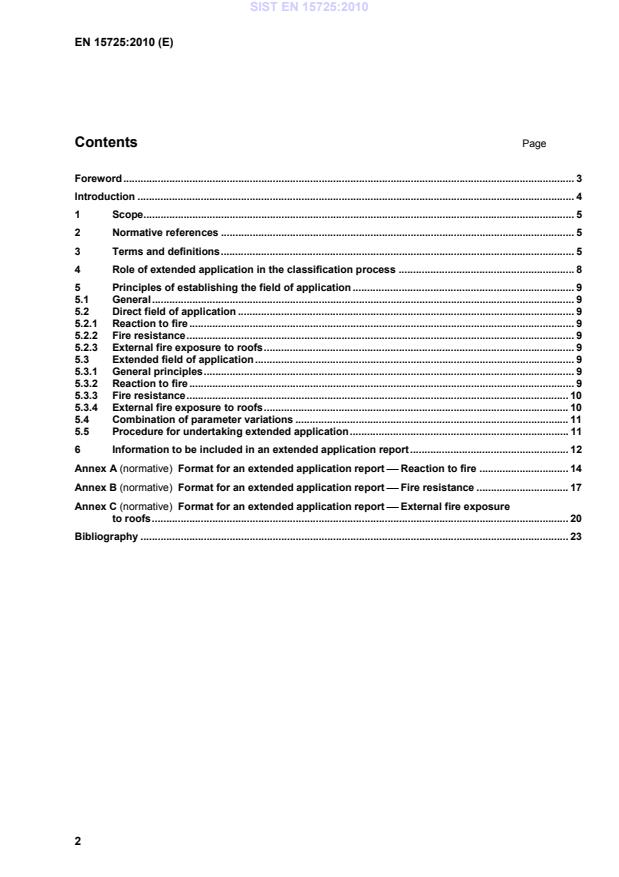
Format for an extended application report Reaction to fire . 14Annex B (normative)
Format for an extended application report Fire resistance . 17Annex C (normative)
Format for an extended application report External fire exposure to roofs . 20Bibliography . 23 SIST EN 15725:2010
The relevant classes and related criteria are specified in the following Commission Decisions: a) Resistance to fire: 1) EC Decision 2000/367/EC (OJEU L 133 of 6.6.2000) as amended by EC Decision 2003/629/EC (OJEU L 218 of 30.8.2003); b) Reaction to fire: 1) EC Decision 2000/147/EC (OJEU L 50 of 23.2.2000) as amended by EC Decision 2003/632/EC (OJEU L 220 of 3.9.2003) and by EC Decision 2006/751/EC (OJEU L 305 of 4.11.2006); c) External fire performance for roofs: 1) EC Decision 2001/671/EC (OJUE L 235 of 4.9.2001) as amended by EC Decision 2005/823/EC (OJEU L 307 of 25.11.2005). 3.2 product material, element or component about which information is required [EN 13501-1:2007+A1:2009] 3.3 product family range of products within defined limits of variability (defined by the manufacturer or a technical specification) of the product parameters and, if relevant, end use parameters, for which the fire performance remains unchanged (i.e. does not get worse) 3.4 product parameter aspect of a product (for example thickness, composition, density) which may vary and which may or may not have an influence on the product’s fire performance 3.5 end use application where in the building the product is to be used, e.g. wall lining, flooring 3.6 end use condition way the product is incorporated into the building, e.g. jointing, fixing and position with respect to adjacent products NOTE The mounting and fixing conditions for testing reflect the end use conditions. 3.7 test result outcome of a testing process and its associated procedures detailed within a specific test standard (which may include some processing of the results from the testing of a number of specimens) and expressed in terms of one or more fire performance parameter(s) SIST EN 15725:2010
Expert judgement cannot form any part of extended application for CE marking, but may be obtained by manufacturers as a voluntary judgement outside of CE-marking. 3.14 constructional parameter design and construction that may be varied and which may result in a change in the fire resistance performance, e.g. in a stud framed separating element a change in the dimensions of a stud 3.15 thermal and mechanical parameters conditions of a test that may influence the classification given, e.g. the pressure differential that will exist at the top of a larger element than existed at the top of the specimen when tested 3.16 factor variation that may be applied to a parameter, e.g. a change in the stiffness as a result of a dimensional change in the stud SIST EN 15725:2010
An extended application report is equivalent to a test report in that it then forms the basis for preparing a classification report. This process is illustrated in Figure 1.
(a) In some cases, where a standard is not yet published, relevant bodies may issue recommendations, available for use by Notified Bodies in attestation procedures for CE marking under the Construction Products Directive. (http://ec.europa.eu/enterprise/newapproach/nando/). Figure 1 — Role of extended application in the fire classification process Classification report within the field of direct application in accordance with EN 13501-X Test report(s) (with direct field of application) inaccordance with: - EN test standard and also taking into account, where relevant (a): - EC Decisions - EN 13238 - CEN/TS 15447 - CEN/TS 15117
Classification report within the field of extended application in accordance with EN 13501-x Extended application report(s) (with extended field of application) in accordance with:
- EN extended application standard
- EN product standard - ETAG and also taking into account, where relevant(a): - EC Decisions
- EN 13238 - CEN/TS 15447 - CEN/TS 15117 SIST EN 15725:2010
EN 13501-1:2007+A1 using results from the relevant EN classification test methods and taking into account information on substrates given in EN 13238 and information in CEN/TS 15117 and any other relevant European Technical Specification. 5.2.2 Fire resistance The rules governing the direct field of application of results from fire resistance tests are given in the individual test methods.
5.2.3 External fire exposure to roofs The rules governing the direct field of application of results from external fire exposure to roof tests are given in EN 13501-5:2005+A1. 5.3 Extended field of application 5.3.1 General principles Extended application shall be undertaken by the laboratory which has carried out the relevant fire tests. If test results are to be used from more than one laboratory, then the extended application shall be undertaken by one of these laboratories and consultation should be made with the other laboratories.
NOTE When extended application is intended to be used for CE marking purposes the intervention of a Notified Body is mandatory.
When a Notified Body is requested to produce an EXAP Report which requires the consideration of evidence from third parties (e.g. test reports, DIRAP reports, other EXAP reports, etc.), such evidence shall only be used when permission has been obtained from the original sponsor/owner of that evidence.
Extended application shall be undertaken in accordance with the relevant EN extended application standard. Extended application shall be based on test methods in accordance with the relevant European standards or ETAG, which may be supplemented by: documents mentioned in Figure 1 5.3.2 Reaction to fire Information on undertaking extended application from the results of reaction to fire tests and an explanation of the influence of product and end use parameters on reaction to fire performance is given in CEN/TS 15117. SIST EN 15725:2010
...