


FprEN ISO/IEC 17020
(Main)Conformity assessment - Requirements for bodies performing inspection (ISO/IEC FDIS 17020:2025)
Conformity assessment - Requirements for bodies performing inspection (ISO/IEC FDIS 17020:2025)
This document contains requirements for the competence and impartiality of bodies performing inspection, and for the consistent operation of their inspection activities.
Konformitätsbewertung - Anforderungen an Stellen, die Inspektionen durchführen (ISO/IEC FDIS 17020:2025)
Évaluation de la conformité - Exigences pour les organismes effectuant des inspections (ISO/IEC FDIS 17020:2025)
Le présent document contient des exigences relatives aux compétences et à l’impartialité des organismes effectuant des inspections, ainsi qu’à la cohérence de leurs activités d’inspection.
Ugotavljanje skladnosti - Zahteve za delovanje različnih organov, ki izvajajo kontrolo (ISO/IEC 17020:2026)
General Information
- Status
- Not Published
- Publication Date
- 16-Apr-2026
- Technical Committee
- CEN/CLC/TC 1 - Criteria for conformity assessment bodies
- Drafting Committee
- CEN/CLC/TC 1 - Criteria for conformity assessment bodies
- Current Stage
- 6055 - CEN Ratification completed (DOR) - Publishing
- Start Date
- 17-Feb-2026
- Completion Date
- 17-Feb-2026
Relations
- Consolidated By
ISO/IEC 17020:2026 - Conformity assessment — Requirements for bodies performing inspection - Effective Date
- 12-Feb-2026
- Effective Date
- 22-Jan-2023
Overview
ISO/IEC 17020 (2025 draft) - titled "Conformity assessment - Requirements for bodies performing inspection" - defines requirements to ensure the competence, impartiality and consistent operation of inspection bodies. The 2025 edition (third edition, replacing ISO/IEC 17020:2012) is issued under ISO/CASCO and applies to inspection bodies of Type A and Type non‑A (previously Type B/C definitions). It covers inspection at any stage (design, initial, in‑service, surveillance) and is used as a basis for accreditation, peer assessment and regulatory acceptance of inspection results.
Key Topics
The standard addresses technical, organizational and management elements including:
- General requirements: impartiality, confidentiality and professional judgement in inspection activities.
- Structural requirements: independence, legal entity, organization and management responsibilities.
- Resource requirements: competence and qualification of personnel, facilities, equipment, and control of externally provided services.
- Process requirements: review of requests/contracts, inspection methods and procedures, handling of items, recordkeeping, data control, inspection reports/statements, appeals and complaints.
- Management system: policies, documented information, risk and opportunity management, corrective actions, internal audits and management review.
- Annexes: independence requirements for Type A bodies and guidance for in‑house/other non‑A inspection bodies, plus optional report elements.
Applications
ISO/IEC 17020 is practical for organizations and stakeholders who need robust inspection outcomes and recognized conformity assessment:
- Inspection bodies seeking accreditation or to demonstrate impartiality and technical competence.
- Accreditation and regulatory authorities evaluating inspection providers for conformity assessment schemes.
- Owners/operators and industry with in‑house inspection units (e.g., manufacturing, construction, energy, transport, utilities) aiming to align with international inspection practice.
- Contracting parties and procurement teams specifying inspection requirements in contracts and inspection schemes.
- Quality and compliance managers integrating inspection with testing (ISO/IEC 17025), certification and QA systems.
Practical benefits include improved consistency of inspection reports, clearer contractual scope for inspection activities, stronger evidence for regulatory compliance, and a framework to manage conflicts of interest and data integrity.
Related standards
- ISO/IEC 17000 (vocabulary and general principles) - normative reference in the standard.
- Commonly used alongside conformity assessment standards such as ISO/IEC 17025 (testing labs), ISO/IEC 17065 (product certification) and ISO 9001 (quality management) when inspection interacts with testing, certification and management systems.
Keywords: ISO/IEC 17020, conformity assessment, inspection bodies, accreditation, impartiality, inspection report, inspection scheme, competence.

Get Certified
Connect with accredited certification bodies for this standard

BSI Group
BSI (British Standards Institution) is the business standards company that helps organizations make excellence a habit.

Bureau Veritas
Bureau Veritas is a world leader in laboratory testing, inspection and certification services.

DNV
DNV is an independent assurance and risk management provider.
Sponsored listings
Frequently Asked Questions
FprEN ISO/IEC 17020 is a draft published by the European Committee for Standardization (CEN). Its full title is "Conformity assessment - Requirements for bodies performing inspection (ISO/IEC FDIS 17020:2025)". This standard covers: This document contains requirements for the competence and impartiality of bodies performing inspection, and for the consistent operation of their inspection activities.
This document contains requirements for the competence and impartiality of bodies performing inspection, and for the consistent operation of their inspection activities.
FprEN ISO/IEC 17020 is classified under the following ICS (International Classification for Standards) categories: 03.120.20 - Product and company certification. Conformity assessment. The ICS classification helps identify the subject area and facilitates finding related standards.
FprEN ISO/IEC 17020 has the following relationships with other standards: It is inter standard links to ISO/IEC 17020:2026, EN ISO/IEC 17020:2012. Understanding these relationships helps ensure you are using the most current and applicable version of the standard.
FprEN ISO/IEC 17020 is associated with the following European legislation: EU Directives/Regulations: 765/2008; Standardization Mandates: M/580. When a standard is cited in the Official Journal of the European Union, products manufactured in conformity with it benefit from a presumption of conformity with the essential requirements of the corresponding EU directive or regulation.
FprEN ISO/IEC 17020 is available in PDF format for immediate download after purchase. The document can be added to your cart and obtained through the secure checkout process. Digital delivery ensures instant access to the complete standard document.
Standards Content (Sample)
SLOVENSKI STANDARD
oSIST prEN ISO/IEC 17020:2025
01-april-2025
Ugotavljanje skladnosti - Zahteve za delovanje različnih organov, ki izvajajo
kontrolo (ISO/DIS 17020:2025)
Conformity assessment - Requirements for bodies performing inspection (ISO/DIS
17020:2025)
Konformitätsbewertung - Anforderungen an Stellen, die Inspektionen durchführen
(ISO/IEC DIS 17020:2025)
Évaluation de la conformité - Exigences pour le fonctionnement de différents types
d'organismes procédant à l'inspection (ISO/DIS 17020:2025)
Ta slovenski standard je istoveten z: prEN ISO/IEC 17020
ICS:
03.120.20 Certificiranje proizvodov in Product and company
podjetij. Ugotavljanje certification. Conformity
skladnosti assessment
oSIST prEN ISO/IEC 17020:2025 en,fr,de
2003-01.Slovenski inštitut za standardizacijo. Razmnoževanje celote ali delov tega standarda ni dovoljeno.
oSIST prEN ISO/IEC 17020:2025
oSIST prEN ISO/IEC 17020:2025
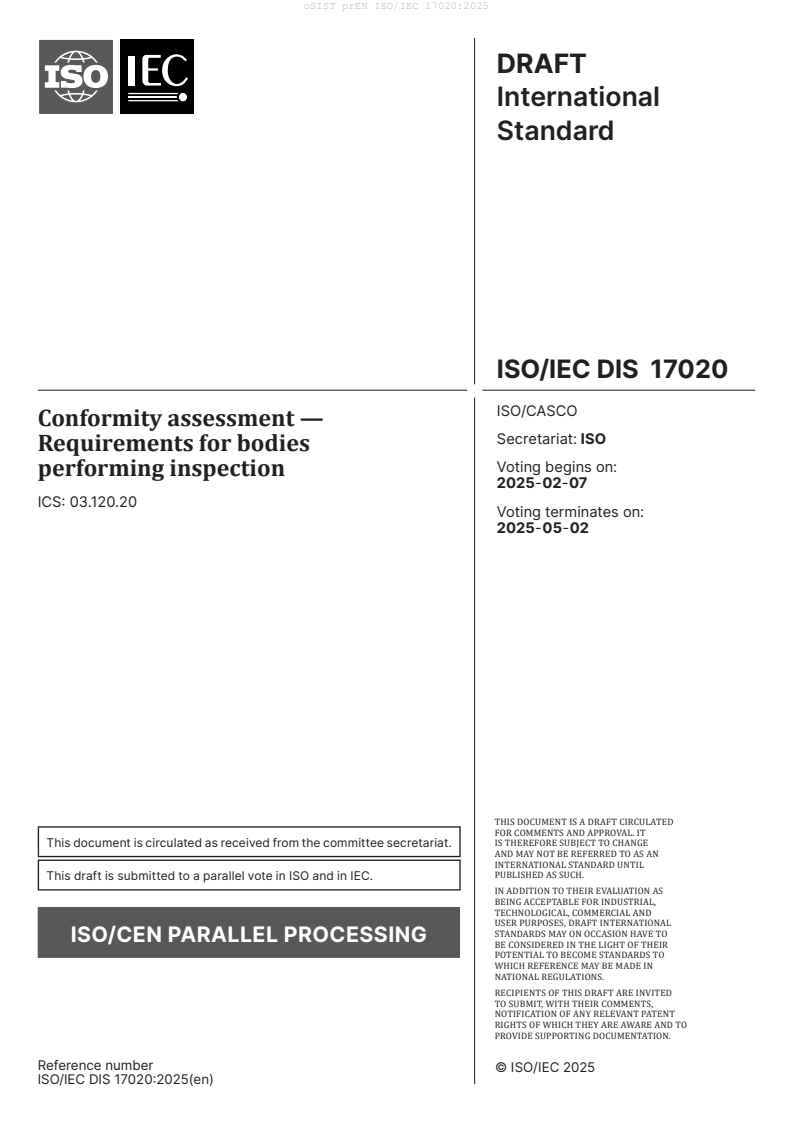
DRAFT
International
Standard
ISO/IEC DIS 17020
ISO/CASCO
Conformity assessment —
Secretariat: ISO
Requirements for bodies
Voting begins on:
performing inspection
2025-02-07
ICS: 03.120.20
Voting terminates on:
2025-05-02
THIS DOCUMENT IS A DRAFT CIRCULATED
FOR COMMENTS AND APPROVAL. IT
This document is circulated as received from the committee secretariat. IS THEREFORE SUBJECT TO CHANGE
AND MAY NOT BE REFERRED TO AS AN
INTERNATIONAL STANDARD UNTIL
PUBLISHED AS SUCH.
This draft is submitted to a parallel vote in ISO and in IEC.
IN ADDITION TO THEIR EVALUATION AS
BEING ACCEPTABLE FOR INDUSTRIAL,
TECHNOLOGICAL, COMMERCIAL AND
USER PURPOSES, DRAFT INTERNATIONAL
STANDARDS MAY ON OCCASION HAVE TO
ISO/CEN PARALLEL PROCESSING
BE CONSIDERED IN THE LIGHT OF THEIR
POTENTIAL TO BECOME STANDARDS TO
WHICH REFERENCE MAY BE MADE IN
NATIONAL REGULATIONS.
RECIPIENTS OF THIS DRAFT ARE INVITED
TO SUBMIT, WITH THEIR COMMENTS,
NOTIFICATION OF ANY RELEVANT PATENT
RIGHTS OF WHICH THEY ARE AWARE AND TO
PROVIDE SUPPORTING DOCUMENTATION.
Reference number
© ISO/IEC 2025
ISO/IEC DIS 17020:2025(en)
oSIST prEN ISO/IEC 17020:2025
DRAFT
ISO/IEC DIS 17020:2025(en)
International
Standard
ISO/IEC DIS 17020
ISO/CASCO
Conformity assessment —
Secretariat: ISO
Requirements for bodies
Voting begins on:
performing inspection
ICS: ISO ics
Voting terminates on:
THIS DOCUMENT IS A DRAFT CIRCULATED
FOR COMMENTS AND APPROVAL. IT
IS THEREFORE SUBJECT TO CHANGE
This document is circulated as received from the committee secretariat.
AND MAY NOT BE REFERRED TO AS AN
INTERNATIONAL STANDARD UNTIL
PUBLISHED AS SUCH.
This draft is submitted to a parallel vote in ISO and in IEC.
IN ADDITION TO THEIR EVALUATION AS
BEING ACCEPTABLE FOR INDUSTRIAL,
© ISO/IEC 2025
TECHNOLOGICAL, COMMERCIAL AND
USER PURPOSES, DRAFT INTERNATIONAL
All rights reserved. Unless otherwise specified, or required in the context of its implementation, no part of this publication may
STANDARDS MAY ON OCCASION HAVE TO
ISO/CEN PARALLEL PROCESSING
be reproduced or utilized otherwise in any form or by any means, electronic or mechanical, including photocopying, or posting on
BE CONSIDERED IN THE LIGHT OF THEIR
the internet or an intranet, without prior written permission. Permission can be requested from either ISO at the address below
POTENTIAL TO BECOME STANDARDS TO
WHICH REFERENCE MAY BE MADE IN
or ISO’s member body in the country of the requester.
NATIONAL REGULATIONS.
ISO copyright office
RECIPIENTS OF THIS DRAFT ARE INVITED
CP 401 • Ch. de Blandonnet 8
TO SUBMIT, WITH THEIR COMMENTS,
CH-1214 Vernier, Geneva
NOTIFICATION OF ANY RELEVANT PATENT
Phone: +41 22 749 01 11
RIGHTS OF WHICH THEY ARE AWARE AND TO
PROVIDE SUPPORTING DOCUMENTATION.
Email: copyright@iso.org
Website: www.iso.org
Published in Switzerland Reference number
© ISO/IEC 2025
ISO/IEC DIS 17020:2025(en)
© ISO/IEC 2025 – All rights reserved
ii
oSIST prEN ISO/IEC 17020:2025
ISO/IEC DIS 17020 ISO/IEC DIS 17020:2025(en)
Contents
§Foreword . v
Introduction . vi
1 Scope . 1
2 Normative references . 1
3 Terms and definitions . 1
4 General requirements . 3
4.1 Impartiality . 3
4.2 Confidentiality . 3
5 Structural requirements . 4
5.1 Independence . 4
5.2 Legal entity and liabilities . 4
5.3 Organization and management. 4
6 Resource requirements . 5
6.1 Personnel . 5
6.2 Facilities and equipment . 7
6.3 Externally provided products and services. 9
7 Process requirements . 10
7.1 Review of requests, tenders and contracts . 10
7.2 Inspection methods and procedures . 10
7.3 Handling of items . 12
7.4 Inspection records . 12
7.5 Control of data and information . 12
7.6 Inspection report and inspection statement . 12
7.7 Handling of appeals . 13
7.8 Handling of complaints . 14
8 Management system requirements . 14
8.1 General . 14
8.2 Policies and responsibilities . 14
8.3 Documented information . 15
8.4 Actions to address risks and opportunities . 15
8.5 Corrective actions . 16
8.6 Internal audits . 17
8.7 Management review . 18
Annex A (Normative) Independence requirements for inspection bodies . 20
A.1 Requirements for independent inspection bodies (Type A) . 20
A.2 Requirements for other inspection bodies (Type non-A) . 21
Annex B (informative) Optional elements of inspection reports and certificates . 22
Annex C (informative) . 23
C.1 Context and rationale for the change . 23
C.2 Sensitivity to Stakeholder Impact . 23
C.3 Issues to consider when defining additional requirements for In-House Inspection
Bodies (Formerly Type B) . 23
© ISO/IEC 2025 – All rights reserved iii
oSIST prEN ISO/IEC 17020:2025
ISO/IEC DIS 17020:2025(en)
ISO/IEC DIS 17020
C.4 Issues to consider when defining additional requirements for other Type Non-A
Inspection Bodies (Formerly Type C) .24
Bibliography .25
iv © ISO/IEC 2025 – All rights reserved
oSIST prEN ISO/IEC 17020:2025
ISO/IEC DIS 17020 ISO/IEC DIS 17020:2025(en)
Foreword
ISO (the International Organization for Standardization) is a worldwide federation of national standards
bodies (ISO member bodies). The work of preparing Documents is normally carried out through ISO
technical committees. Each member body interested in a subject for which a technical committee has
been established has the right to be represented on that committee. International organizations,
governmental and non-governmental, in liaison with ISO, also take part in the work. ISO collaborates
closely with the International Electrotechnical Commission (IEC) on all matters of electrotechnical
standardization.
The procedures used to develop this document and those intended for its further maintenance are
described in the ISO/IEC Directives, Part 1. In particular, the different approval criteria needed for the
different types of ISO documents should be noted. This document was drafted in accordance with the
editorial rules of the ISO/IEC Directives, Part 2 (see www.iso.org/directives).
ISO draws attention to the possibility that the implementation of this document may involve the use of
(a) patent(s). ISO takes no position concerning the evidence, validity or applicability of any claimed
patent rights in respect thereof. As of the date of publication of this document, ISO received notice of (a)
patent(s) which may be required to implement this document. However, implementers are cautioned
that this may not represent the latest information, which may be obtained from the patent database
available at www.iso.org/patents. ISO shall not be held responsible for identifying any or all such patent
rights.
Any trade name used in this document is information given for the convenience of users and does not
constitute an endorsement.
For an explanation of the voluntary nature of standards, the meaning of ISO specific terms and
expressions related to conformity assessment, as well as information about ISO's adherence to the World
Trade Organization (WTO) principles in the Technical Barriers to Trade (TBT), see
www.iso.org/iso/foreword.html.
This document was prepared by ISO CASCO.
This third edition cancels and replaces the second edition (ISO/IEC 17020:2012), which has been
technically revised.
The main changes are as follows:
— xxx xxxxxxx xxx xxxx
Any feedback or questions on this document should be directed to the user’s national standards body. A
complete listing of these bodies can be found at www.iso.org/members.html.
© ISO/IEC 2025 – All rights reserved v
oSIST prEN ISO/IEC 17020:2025
ISO/IEC DIS 17020:2025(en)
ISO/IEC DIS 17020
Introduction
This document has been drawn up with the objective of promoting confidence in bodies performing
inspection.
Inspection bodies carry out assessments on behalf of private clients, their parent organizations, or
authorities, with the objective of providing information about the conformity of inspected items with
regulations, standards, specifications, inspection schemes or contracts. Inspection parameters include
matters of quantity, quality, safety, fitness for purpose, and continued compliance of inspected item(s)
(e.g continued safety compliance of installations or systems in operation). This document provides
requirements for the competence, impartiality and consistent operation of inspection bodies as a basis
for confidence about and acceptance of inspection results by clients, authorities and others.
This document covers the activities of inspection bodies whose work can include the examination of
materials, products, installations, plants, processes, work procedures or services, and the determination
of their conformity with requirements and the subsequent reporting of results of these activities to clients
and, when required, to authorities. Inspection can concern all stages during the lifetime of these items,
including the design stage. Such work normally requires the exercise of professional judgement in
performing inspection, in particular when assessing conformity with general requirements.
This document can be used as a requirements document for accreditation or peer assessment or other
assessments.
This set of requirements can be interpreted when applied to particular sectors.
Inspection activities can overlap with testing, validation and verification and certification activities where
these activities have common characteristics. However, an important difference is that many types of
inspection involve professional judgement to determine acceptability against general requirements, for
which reason the inspection body needs the necessary competence to perform the task.
Inspection can be an activity embedded in a larger process. For example, inspection can be used as a
surveillance activity in a product certification scheme. Likewise, results of other conformity assessment
activities like testing can be used as an input when performing inspection activities. Inspection can be an
activity that precedes maintenance or simply provides information about the inspected item with no
determination of conformity with requirements. In such cases, further interpretation of the results in
terms of considering the suitability, adequacy and effectiveness of the results (review function of
conformity assessment) and a conclusion that fulfilment of specified requirements has or has not been
demonstrated (decision function of conformity assessment) might be needed.
The categorization of inspection bodies as type A and type non-A is essentially a measure of their
independence and not related to impartiality requirements which are equally applicable to both type A
and type non-A inspection bodies.
In this Document, the following verbal forms are used:
“shall” indicates a requirement;
“should” indicates a recommendation;
“may” indicates a permission;
“can” indicates a possibility or a capability.
vi © ISO/IEC 2025 – All rights reserved
oSIST prEN ISO/IEC 17020:2025
ISO/IEC DIS 17020 ISO/IEC DIS 17020:2025(en)
Conformity assessment — Requirements for bodies performing
inspection
1 Scope
This document contains requirements for the competence of bodies performing inspection and for the
impartiality and consistency of their inspection activities.
It applies to inspection bodies of type A and type non-A, as defined in this document, and it applies to any
stage of inspection.
NOTE The stages of inspection can include design stage, type examination, initial inspection, in-service inspection
or surveillance.
2 Normative references
The following documents are referred to in the text in such a way that some or all of their content
constitutes requirements of this document. For dated references, only the edition cited applies.
ISO/IEC 17000:2020, Conformity assessment — Vocabulary and general principles
3 Terms and definitions
For the purposes of this document, the terms and definitions given in ISO/IEC 17000 and the following
apply.
ISO and IEC maintain terminology databases for use in standardization at the following addresses:
— ISO Online browsing platform: available at https://www.iso.org/obp
— IEC Electropedia: available at https://www.electropedia.org/
3.1
inspection
examination of an item and determination of its conformity with specified requirements or, on the basis
of professional judgement, with general requirements or regulations
Note 1 to entry: Examination can include direct or indirect observations, which can include measurements or the
output of instruments.
Note 2 to entry: Inspection can result in a statement of conformity of the item (i.e. include review, decision and
attestation functions of conformity assessment). However, schemes or contracts can specify inspection as
examination only (i. e. limiting to selection and determination functions of conformity assessment).
Note 3 to entry: Inspection of processes can include personnel, facilities, technology or methodology.
SOURCE ISO/IEC 17000:2020, definition 6.3 modified, notes 2 and 3 to entry have been added.
3.2
inspection body
body that performs inspection
3.3
inspection scheme
set of rules and procedures that describes the object of inspection, identifies the specified requirements
and provides the methodology for performing the inspection
© ISO/IEC 2025 – All rights reserved 1
oSIST prEN ISO/IEC 17020:2025
ISO/IEC DIS 17020:2025(en)
ISO/IEC DIS 17020
Note 1 to entry: Inspection schemes can be operated at international, regional, national, sub-national or industry
sector level.
Note 2 to entry: Schemes are sometimes also referred to as “programmes”.
Note 3 to entry: A scheme can cover all or part of the conformity assessment functions, i.e. it can include examination
only (selection and determination functions) or result in an attestation or a statement of conformity (review and
decision functions).
Note 4 to entry: when relevant, the inspection scheme can define specific independence requirements.
SOURCE ISO/IEC 17000:2020, definition 4.9 modified, notes 2, 4 and 5 to entry have been added.
3.4
impartiality
objectivity with regard to the outcome of an inspection
Note 1 to entry: Objectivity means that conflicts of interest do not exist or are resolved so as not to adversely
influence activities of the inspection body.
Note 2 to entry: Other terms that are useful in conveying the element of impartiality are: freedom from conflict of
interests, freedom from bias, lack of prejudice, neutrality, fairness, open-mindedness, even-handedness,
detachment, balance.
SOURCE ISO/IEC 17000:2020, definition 5.3 modified, note 1 to entry changed and note 2 to entry added.
3.5
appeal
request by the client to the inspection body for reconsideration by that body of a decision it has made
relating to the conformity of the item inspected
SOURCE ISO/IEC 17000:2020, definition 8.6 modified.
3.6
complaint
expression of dissatisfaction, other than appeal, by any person or organization to an inspection body,
relating to the activities of that body, where a response is expected
SOURCE ISO/IEC 17000:2020, definition 8.7.
3.7
client
person or organisation requesting inspection of an item
Note to entry: the client can not be responsible for providing the item.
3.8
item
object of inspection to which the specified requirements for the inspection apply
Note 1 to entry: The term “item” is used in this document to encompass product, process, service, material, location,
premises, installation, or their design, as appropriate.
Note 2 to entry: A group of items can be the object of inspection.
3.9
2 © ISO/IEC 2025 – All rights reserved
oSIST prEN ISO/IEC 17020:2025
ISO/IEC DIS 17020 ISO/IEC DIS 17020:2025(en)
competence
ability to apply knowledge and skills to achieve intended results
SOURCE ISO/IEC 17024:2012, 3.6.
NOTE FROM SECRETARIAT to ballotters: the text shaded in grey in the document correspond to the obligatory
requirements from the CASCO Common Elements and as such are not open for comments
4 General requirements
4.1 Impartiality
4.1.1 Inspection activities shall be undertaken impartially.
4.1.2 The inspection body shall be responsible for the impartiality of its inspection activities and shall
not allow commercial, financial or other pressures to compromise its impartiality.
4.1.3 The inspection body shall monitor its activities and its relationships to identify on an ongoing
basis threats to its impartiality. This monitoring shall include the relationships of its personnel.
NOTE A relationship can be based on ownership, governance, management, personnel, shared resources,
finances, contracts or marketing (including branding). Such relationships do not necessarily present a body with a
threat to impartiality.
4.1.4 If a threat to impartiality is identified, its effect shall be eliminated or minimized so that the
impartiality is not compromised. The inspection body shall demonstrate how it eliminates or minimizes
such threats.
4.1.5 The inspection body shall have top management commitment to impartiality.
4.1.6 The inspection body shall be structured and managed so as to safeguard impartiality.
4.1.7 All personnel of the inspection body, either internal or external, that could influence the
inspection activities shall act impartially. In particular, personnel involved in inspection activities shall
not be remunerated in a way that influences the results of inspections.
4.2 Confidentiality
4.2.1 The inspection body shall be responsible, through legally enforceable commitments, for the
management of all information obtained or created during the performance of inspection activities. The
inspection body shall inform the client, in advance, of the information it intends to place in the public
domain. Except for information that the client makes publicly available, or when agreed between the
inspection body and the client, all other information is considered proprietary information and shall be
regarded as confidential.
NOTE Legally enforceable commitments can be, for example, contractual agreements commitments related to
confidentiality policy published on Inspection Body’s website or in Inspection Body’s documentation.
4.2.2 When the inspection body is required by law or authorized by contractual arrangements to
release confidential information, the client concerned shall be notified of the information provided,
unless prohibited by law.
4.2.3 Information about the client obtained from sources other than the client (e.g. complainant,
regulatory authorities) shall be treated as confidential.
© ISO/IEC 2025 – All rights reserved 3
oSIST prEN ISO/IEC 17020:2025
ISO/IEC DIS 17020:2025(en)
ISO/IEC DIS 17020
4.2.4 Personnel, including any committee members, contractors, personnel of external bodies, or persons
acting on the inspection body's behalf, shall keep confidential all information obtained or created during
the performance of the inspection activities.
5 Structural requirements
5.1 Independence
The inspection body shall meet Type A or Type non-A independence requirements specified in Annex A
based on the conditions under which it performs its inspection activities and if applicable as required by
the inspection scheme.
NOTE 1 An inspection body can have different types of independence (i.e. type A, type non-A) for different
inspection activities.
NOTE 2 Information on the rationale for the change, in this version, to the classification of types from types B and
C to type non-A, is contained in Annex C.
5.2 Legal entity and liabilities
5.2.1 The inspection body shall be a legal entity, or a defined part of a legal entity, that is legally
responsible for all its inspection activities.
NOTE A governmental inspection body is a legal entity on the basis of its governmental status.
5.2.2 An inspection body that is part of a legal entity shall be identifiable within that entity.
NOTE Identifiable means visible in the general organization and structure of the legal entity.
5.2.3 The inspection body shall define and document the inspection activities for which it conforms
with this document.
NOTE The description of the activities includes defining the general field and range of inspection (e.g.
categories/sub-categories of products, processes, services, or installations) and the stage of inspection, and, where
applicable, the regulations, inspection scheme, standards or specifications containing the requirements against
which the inspection will be performed.
5.2.4 The inspection body shall have adequate provision (e.g. insurance or reserves) to cover liabilities
arising from its operations. The inspection body shall:
a) analyse the risks arising from the inspection activities;
b) assess the potential liabilities associated with identified risks; and
c) establish the level of provisions consistent with those liabilities.
NOTE The liability can be assumed by the State in accordance with national laws, or by the organization of which
the inspection body forms a part.
5.2.5 The inspection body shall have documentation describing the contractual conditions under which
it provides the inspection, except when it provides inspection services to the legal entity of which it is a
part.
NOTE The contractual conditions cover the general and specific conditions for the performance of the inspections.
5.3 Organization and management
5.3.1 The inspection body shall:
4 © ISO/IEC 2025 – All rights reserved
oSIST prEN ISO/IEC 17020:2025
ISO/IEC DIS 17020 ISO/IEC DIS 17020:2025(en)
a) define its organization and management structure, its place in any parent organization and the
relevant relationships between the management, technical operations and support services;
b) specify the responsibility, authority and interrelationships of all personnel who manage, perform
or verify work affecting the results of its inspection activities; and
c) maintain its capability to carry out inspection activities as described in 5.2.3.
NOTE To maintain the capability for inspection activities carried out infrequently it can be needed to carry out
simulated inspections or similar.
5.3.2 The inspection body shall have technical management who have overall authority and
responsibility for the:
a) development of inspection activities including inspection methods and associated processes, and
ensuring their compliance;
b) performance of technical monitoring;
c) access to the necessary and adequate resources, including personnel competences requirements;
d) technical provision of contractual arrangements; and
e) performance of inspection activities.
5.3.3 The inspection body technical management shall be technically competent and have a relevant
experience for the operation of an inspection body.
5.3.4 The inspection body shall have personnel who, irrespective of other responsibilities, have the
authority and resources needed to carry out their duties, including:
a) implementation, maintenance and improvement of the management system;
b) identification of deviations from the management system;
c) initiation of actions to prevent or minimize such deviations;
d) reporting to inspection body management on the performance of the management system and
any need for improvement;
e) ensuring the effectiveness of inspection body activities.
5.3.5 The inspection body shall document the duties, responsibilities and authorities for each function
involved in inspection activities. The job description or other documentation shall detail the duties,
responsibilities and authorities for each position category.
NOTE The functions involved in inspection activities are inspectors and other positions which can have an effect
on the management, performance, recording or reporting of inspections.
6 Resource requirements
6.1 Personnel
6.1.1 General
The inspection body shall have access to a suf�icient number of competent persons to perform the type,
range and volume of its inspection activities. The inspection body shall make clear to each person their
duties, responsibilities and authorities.
© ISO/IEC 2025 – All rights reserved 5
oSIST prEN ISO/IEC 17020:2025
ISO/IEC DIS 17020:2025(en)
ISO/IEC DIS 17020
6.1.2 Competence management
6.1.2.1 The inspection body shall have a process for managing competence of its personnel involved in
inspection activities. The process shall address the following:
a) determination of the competence requirements including where needed for, making professional
judgement (e.g. education, training, technical knowledge, skills and experience),
b) selection of personnel;
c) initial training of personnel;
d) authorization of personnel;
e) monitoring of competence of personnel; and
f) continuous training.
6.1.2.2 The personnel performing the inspection shall have the relevant knowledge of the following:
a) the technology used for the manufacture of the products inspected, the operation of processes
and the delivery of services;
b) the way in which products are used, processes are operated and services are delivered;
c) any defects which can occur during the use of the product, any failures in the operation of the
process and any deficiencies in the delivery of services; and
d) understanding of the significance of deviations in the normal use of products, the operation of
processes and the provision of services.
6.1.2.3 Initial training
The initial training shall include an induction period and a mentored working period with authorized
persons.
6.1.2.4 Monitoring
6.1.2.4.1 Personnel involved in inspection activities shall be monitored by authorized personnel in
accordance with a programme at defined frequency.
NOTE The following can be considered in the design of the programme:
- the risks and complexities of the inspections,
- results of previous monitoring activities, and
- technical, procedural or legislative developments relevant to the inspections.
6.1.2.4.2 Results of monitoring shall be used as a means of identifying training needs (see 6.1.2.5) and
shall be considered for maintenance of authorisation.
NOTE Monitoring can include a combination of techniques, such as on-site observations, report reviews,
interviews, simulated inspections and other techniques to assess performance and will depend on the nature of
the inspection activities.
6.1.2.4.3. Each inspector shall be witnessed on-site unless there is suf�icient supporting evidence that
the inspector is continuing to perform competently.
6 © ISO/IEC 2025 – All rights reserved
oSIST prEN ISO/IEC 17020:2025
ISO/IEC DIS 17020 ISO/IEC DIS 17020:2025(en)
NOTE 1 Depending on the �ields, types and ranges of inspection covered by the inspector’s authorisations, there
can be more than one observation per inspector necessary to adequately cover the whole range of required
competencies. Also, more frequent on-site observations can be necessary if there is lack of evidence of continuing
satisfactory performance.
NOTE 2 Sufficient evidence of an inspector’s continuous competent performance can be substantiated by a
combination of information such as satisfactory:
—performance of examinations and determinations;
—outcome of monitoring;
—outcome of separate evaluations to confirm the outcome of the inspections;
—outcome of mentoring and training; and
—results of observation by a competent body, e.g. a body operating certification of persons.
6.1.2.5 Continuous training
The inspection body shall identify training needs and provide relevant training to personnel involved in
the inspection activities to keep pace with technology developments and inspection methods depending
on their competence and experience and upon the results of monitoring (see 6.1.2.4).
6.1.3 The inspection body shall have documented information demonstrating competence of its
personnel (see 6.1.2).
6.2 Facilities and equipment
6.2.1 The inspection body shall have available, suitable and adequate facilities and equipment to ensure
that the inspections activities and all activities associated with them are carried out in a competent and
safe manner.
NOTE The inspection body need not be the owner of the facilities or equipment that it uses. Facilities and
equipment can be borrowed, rented, hired, leased or provided by another party (e.g. the manufacturer or installer
of the equipment). However, the responsibility for the suitability and the calibration status of the equipment used
in inspection, whether owned by the inspection body or not, lies solely with the inspection body.
6.2.2 The inspection body shall have rules for the access to, and the use of, specified facilities and
equipment used to perform inspections.
6.2.3 The inspection body shall ensure the continued suitability of the equipment and the facilities
mentioned in 6.2.1 for their intended use.
NOTE Continued suitability can be established by visual inspection, functional checks and/or re-calibration.
6.2.4 All equipment having a significant influence on the results of the inspection shall be defined and
where appropriate:
a) be uniquely identified;
b) be subjected to in-service checks when they are necessary to maintain confidence in the
performance of the equipment, according to a procedure;
c) for measuring equipment, be calibrated before being put into service, and thereafter calibrated
according to an established programme.
NOTE 1 Inspection bodies can document and retain the rationale for decisions on the significance of influence of equipment on
the inspection, including environmental conditions, when relevant.
NOTE 2 The procedure in b) can specify the nature of such checks, the frequency and acceptance criteria.
© ISO/IEC 2025 – All rights reserved 7
oSIST prEN ISO/IEC 17020:2025
ISO/IEC DIS 17020:2025(en)
ISO/IEC DIS 17020
6.2.5 The inspection body shall have a procedure for handling, transport, storage, use and planned
maintenance of equipment in 6.2.4 in order to ensure proper functioning and to prevent contamination
or deterioration.
6.2.6 The inspection body shall verify that equipment conforms to specified requirements before being
placed or returned into service.
6.2.7 The inspection body shall ensure that measurement results which have a significant influence on
the result of the inspection are metrologically traceable to the International System of Units (SI) through:
a) calibration provided by a competent laboratory; or
NOTE Laboratories fulfilling the requirements of ISO/IEC 17025 are considered to be competent.
b) certified values of certified reference materials provided by a competent producer with stated
metrological traceability to the SI; or
NOTE Reference material producers fulfilling the requirements of ISO 17034 are considered to be
competent.
c) direct realization of the SI units ensured by comparison, directly or indirectly, with national
standards or normative documents.
NOTE Details of practical realization of the definitions of some important units are given in the SI
brochure.
6.2.8 When metrological traceability to the SI units is not technically possible, the metrological
traceability to an appropriate reference shall be ensured by, e.g.:
a) certified values of certified reference materials provided by a competent producer;
b) results of reference measurement procedures, specified methods or consensus standards that are
clearly described and accepted as providing measurement results fit for their intended use and
ensured by suitable comparison.
6.2.9 If the inspection body uses computers or automated equipment, data processing and results
through artificial intelligence, augmented reality or remote inspection, in connection with inspections, it
shall ensure that:
a) technology is adequate for use;
NOTE This can be done by the following:
— validation of calculations before use;
— periodic revalidation of related hardware and software;
— revalidation whenever changes are made to related hardware or software;
— software updates implemented as required.
b) procedures are established and implemented for protecting the integrity and security of data; and
c) equipment, including hardware and software, is maintained in order to ensure proper
functioning.
8 © ISO/IEC 2025 – All rights reserved
oSIST prEN ISO/IEC 17020:2025
ISO/IEC DIS 17020 ISO/IEC DIS 17020:2025(en)
6.2.10 The inspection body shall have documented procedures for dealing with defective equipment.
Defective equipment shall be removed from service by segregation, prominent labeling or marking. The
inspection body shall examine the effect of defects on previous inspections and follow the procedure in
clause 8.5.
6.2.11 Relevant information on the equipment, including software, shall be recorded. This shall include
identification and, where appropriate, information on calibration and maintenance.
6.3 Externally provided products and services
6.3.1 The inspection body shall ensure that only suitable externally provided products and services
that affect inspection activities are used, when such products and services:
a) are intended for incorporation into the inspection’s own activities;
b) are provided, in part or in full, directly to the client by the inspection body, as received from the
external provider; and
c) are used to support the operation of the inspection body.
NOTE Products can include, for example, equipment, installations, consumable materials and reference materials.
Services can include, for example, calibration services, testing services in the framework of inspection process,
inspection services, facility and equipment maintenance services, IT services, expertise services and auditing
services.
6.3.2 The inspection body shall have a procedure and retain records for:
a) defining, reviewing and approving the inspection body’s requirements for externally provided
products and services;
b) defining the criteria for evaluation, selection, monitoring of performance and re-evaluation of the
external providers;
c) ensuring that externally provided products and services conform to the inspection body’s
established requirements, or when applicable, to the relevant requirements of this document or
in other relevant standards for conformity assessment bodies, before they are used or directly
provided to the client; and
d) taking any actions arising from evaluations, monitoring of performance and re-evaluations of the
external providers.
6.3.3 The inspection body shall itself normally perform the inspections that it contracts to undertake.
The use of external service providers for part of the inspection or the entire inspection is only possible in
exceptional circumstances.
NOTE 1 examples of exceptional circumstances can be:
a) an unforeseen or abnormal overload;
b) key inspection staff members being incapacitated;
c) key facilities or items of equipment being temporarily unfit for use.
NOTE 2 The terms “subcontracting”, “outsourcing” and “externally provided services” are considered to be
synonyms.
NOTE 3 Where the inspection body engages individuals or employees of other organizations to provide additional
resources or competence, these individuals are not considered to be subcontractors provided they are formally
contracted to operate under the inspection body's management system (see 6.1).
© ISO/IEC 2025 – All rights reserved 9
oSIST prEN ISO/IEC 17020:2025
ISO/IEC DIS 17020:2025(en)
ISO/IEC DIS 17020
6.3.4 The inspection body shall inform the client of its intention to subcontract part of the inspection, in
order to provide the client with an opportunity to object in advance.
6.3.5 Whenever subcontractors carry out work that forms part of an inspection or the entire inspection,
the responsibility for any determination of conformity of the inspected item with the requirements shall
remain with the inspection body.
6.3.6 The inspection body shall retain a register of approved external service providers and activities
performed.
7 Process requirements
7.1 Review of requests, tenders and contracts
7.1.1 The inspection body shall have a procedure for the review of inspection requests, tenders, and
contracts. The procedure shall ensure that:
a) the inspection to be carried out is defined, the item to be inspected is clearly identified and the
requirements to be satisfied are adequately defined, documented, and understood;
NOTE The requirements can be part of the inspection scheme.
b) the inspection body has the capability, including adequate resources, to meet the client
requirements;
c) the appropriate inspection methods or procedures are available or to be developed to meet the
client requirements;
d) The requirements, including any special conditions of the client, are adequately defined and
understood, so that clear instructions can be issued to personnel performing the required
services; and
e) the requirements of the contract or work order have been met.
NOTE For routine or repeat work requests, reviews of requests, tenders and contracts can be performed in a
simplified way.
7.1.2 The inspection body shall inform the client if a proposed inspection method or criteria is
considered to be inappropriate or out of date.
7.1.3 Any differences between the request or tender and the contract shall be resolved before
inspection activities start.
7.1.4 Each contract shall be acceptable both to the inspection body and the client. Deviations
requested by the client shall not impact the impartiality of the inspection body or the validity of the
results.
7.1.5 Records of review of requests, tenders and contracts, including any significant changes, shall be
retained.
7.2 Inspection methods and procedures
7.2.1 The inspection body shall perform inspections using appropriate methods and procedures (e.g.,
as part of the inspection scheme).
NOTE The requirements against which the inspection is performed are normally specified in regulations,
standards, specifications, inspection schemes or contracts. Specifications can include client or in-house
requirements.
10 © ISO/IEC 2025 – All rights reserved
oSIST prE
...
Questions, Comments and Discussion
Ask us and Technical Secretary will try to provide an answer. You can facilitate discussion about the standard in here.
Loading comments...