


prEN 1520
(Main)Precast lightweight concrete products with an open structure
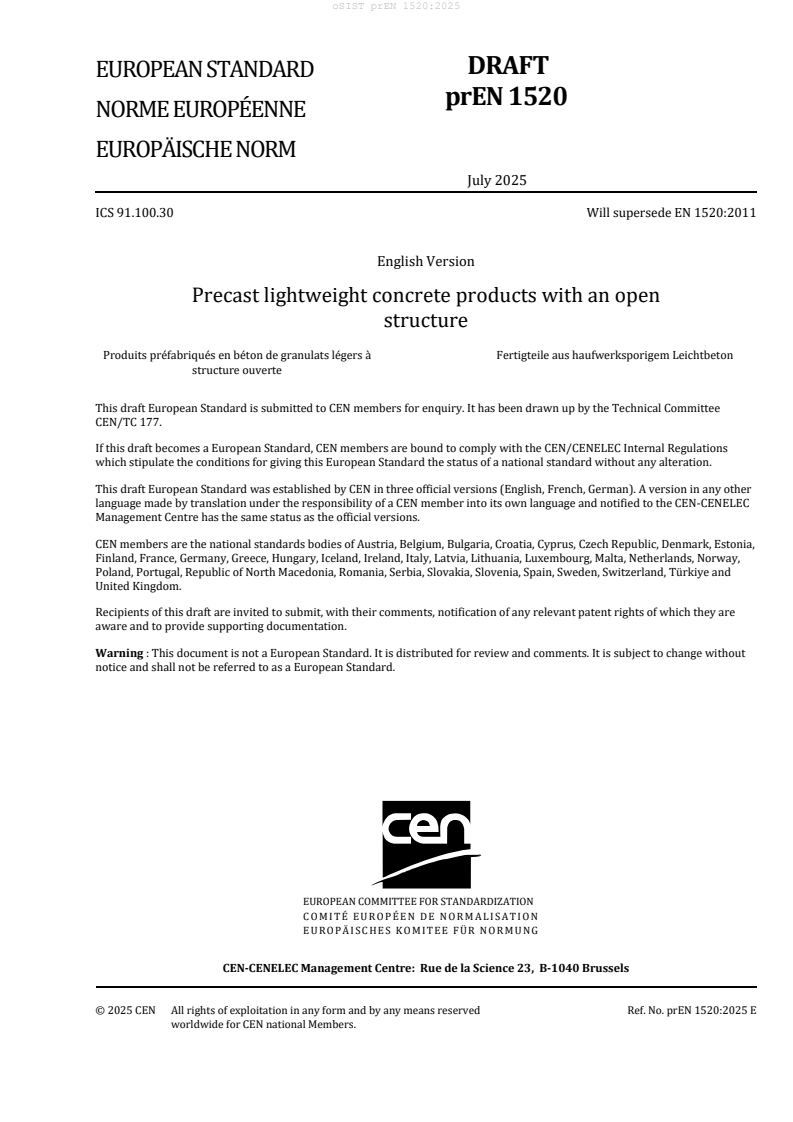
Precast lightweight concrete products with an open structure
This document covers, regardless of if manufactured in factories or in temporary plants on site under the same conditions, precast concrete elements made of lightweight concrete with an open structure, and with a dry density between 400 and 2000 kg/m3 intended for:
— solid, hollow core and multilayer load-bearing wall elements;
— solid, hollow core and multilayer non-load-bearing wall elements;
— retaining wall elements, excluding retaining walls intended to retain tanks or reservoirs of liquids and diaphragm walls (concrete sheet piling);
— solid, hollow core and multilayer roof elements, excluding ribbed floor elements and floor slabs elements;
— solid, hollow core and multilayer floor elements excluding floor elements with the intended use to carry traffic loads;
— solid and hollow core beams;
— solid piers;
— cladding elements;
— box culverts;
— components for noise barriers.
NOTE In addition to their loadbearing and encasing function, elements can also be used to provide fire resistance, sound insulation and thermal insulation.
Recycled lightweight concrete with an open structure (other than closed-loop recycling during production) is covered by this document.
Reused precast concrete elements made of lightweight concrete with an open structure are covered by this document.
Fertigteile aus haufwerksporigem Leichtbeton
Dieses Dokument gilt für vorgefertigte Bauteile aus haufwerksporigem Leichtbeton mit einer Trockenrohdichte zwischen 400 kg/m3 und 2 000 kg/m3, die, unabhängig davon, ob sie fabrikmäßig oder unter gleichen Bedingungen in zeitweise betriebenen Anlagen auf der Baustelle hergestellt werden, für Folgendes vorgesehen sind:
tragende Massiv-, Hohl- und mehrschichtige Wandelemente;
nichttragende Massiv-, Hohl- und mehrschichtige Wandelemente;
Stützwandelemente, ausgenommen Stützwände, die zur Sicherung von Tanks oder Flüssigkeitsspeichern vorgesehen sind, und Schlitzwände (Betonspundwandsetzung);
Massiv-, Hohl- und mehrschichtige Dachelemente, ausgenommen Deckenelemente mit Stegen und Bodenplatten- bzw. Geschossdeckenelemente;
Massiv-, Hohl- und mehrschichtige Deckenelemente, ausgenommen Deckenelemente, deren vorgesehener Verwendungszweck das Tragen von Verkehrslasten ist;
Massiv- und Hohlbalken;
massive Pfeiler;
Verkleidungselemente;
kastenförmige Hohlquerschnitte;
Bauteile für Lärmschutzwände.
ANMERKUNG Zusätzlich zu ihrer tragenden und raumabschließenden Funktion können die Bauteile auch für Zwecke des Brandschutzes, der Schalldämmung und der Wärmedämmung verwendet werden.
Dieses Dokument deckt rezyklierten haufwerksporigen Leichtbeton ab (sofern dieser nicht in einem geschlossenen Kreislauf-Recyclingsystem hergestellt wird).
Wiederverwendete vorgefertigte Betonbauteile aus haufwerksporigem Leichtbeton werden ebenfalls von diesem Dokument abgedeckt.
Produits préfabriqués en béton de granulats légers à structure ouverte
Le présent document couvre, qu’ils soient fabriqués en usine ou dans des installations temporaires sur site dans les mêmes conditions, les éléments préfabriqués en béton de granulats légers à structure ouverte, d’une masse volumique sèche comprise entre 400 kg/m3 et 2 000 kg/m3 destinés aux :
— éléments de murs porteurs pleins, alvéolés et multicouches ;
— éléments de murs non porteurs pleins, alvéolés et multicouches ;
— éléments de murs de soutènement, à l’exclusion des murs de soutènement destinés à retenir des réservoirs ou des citernes de liquides et des parois moulées (palplanches en béton) ;
— éléments de toiture pleins, alvéolés et multicouches, à l’exclusion des éléments de plancher nervurés et des éléments de dalle de plancher ;
— éléments de plancher pleins, alvéolés et multicouches, à l’exclusion des éléments de plancher destinés à supporter des charges de circulation ;
— poutrelles pleines et alvéolées ;
— trumeaux pleins ;
— éléments de parement ;
— cadres enterrés ;
— composants de dispositifs de réduction du bruit.
NOTE Outre leur fonction porteuse et d’encloisonnement, les éléments peuvent également être utilisés pour assurer la résistance au feu, l’isolation acoustique et l’isolation thermique.
Le présent document traite du béton de granulats légers à structure ouverte recyclé (ne provenant pas du recyclage en boucle fermée pendant la production).
Le présent document couvre les éléments préfabriqués en béton réutilisés de granulats légers à structure ouverte.
Montažni lahki betonski proizvodi z odprto strukturo
General Information
Relations
Standards Content (Sample)
SLOVENSKI STANDARD
01-september-2025
Montažni izdelki iz betona iz lahkega agregata z odprto strukturo
Precast lightweight concrete products with an open structure
Fertigteile aus haufwerksporigem Leichtbeton
Produits préfabriqués en béton de granulats légers à structure ouverte
Ta slovenski standard je istoveten z: prEN 1520
ICS:
91.100.30 Beton in betonski izdelki Concrete and concrete
products
2003-01.Slovenski inštitut za standardizacijo. Razmnoževanje celote ali delov tega standarda ni dovoljeno.
DRAFT
EUROPEAN STANDARD
NORME EUROPÉENNE
EUROPÄISCHE NORM
July 2025
ICS 91.100.30 Will supersede EN 1520:2011
English Version
Precast lightweight concrete products with an open
structure
Produits préfabriqués en béton de granulats légers à Fertigteile aus haufwerksporigem Leichtbeton
structure ouverte
This draft European Standard is submitted to CEN members for enquiry. It has been drawn up by the Technical Committee
CEN/TC 177.
If this draft becomes a European Standard, CEN members are bound to comply with the CEN/CENELEC Internal Regulations
which stipulate the conditions for giving this European Standard the status of a national standard without any alteration.
This draft European Standard was established by CEN in three official versions (English, French, German). A version in any other
language made by translation under the responsibility of a CEN member into its own language and notified to the CEN-CENELEC
Management Centre has the same status as the official versions.
CEN members are the national standards bodies of Austria, Belgium, Bulgaria, Croatia, Cyprus, Czech Republic, Denmark, Estonia,
Finland, France, Germany, Greece, Hungary, Iceland, Ireland, Italy, Latvia, Lithuania, Luxembourg, Malta, Netherlands, Norway,
Poland, Portugal, Republic of North Macedonia, Romania, Serbia, Slovakia, Slovenia, Spain, Sweden, Switzerland, Türkiye and
United Kingdom.
Recipients of this draft are invited to submit, with their comments, notification of any relevant patent rights of which they are
aware and to provide supporting documentation.
Warning : This document is not a European Standard. It is distributed for review and comments. It is subject to change without
notice and shall not be referred to as a European Standard.
EUROPEAN COMMITTEE FOR STANDARDIZATION
COMITÉ EUROPÉEN DE NORMALISATION
EUROPÄISCHES KOMITEE FÜR NORMUNG
CEN-CENELEC Management Centre: Rue de la Science 23, B-1040 Brussels
© 2025 CEN All rights of exploitation in any form and by any means reserved Ref. No. prEN 1520:2025 E
worldwide for CEN national Members.
Contents Page
European foreword . 5
1 Scope . 6
2 Normative references . 6
3 Terms, definitions, symbols and abbreviations . 9
3.1 Terms and definitions . 9
3.2 Symbols . 10
3.2.1 General symbols . 10
3.2.2 Subscripts . 10
3.2.3 Symbols used in this document . 10
3.3 Abbreviations . 11
4 Characteristics . 11
4.1 Concrete . 11
4.1.1 Compressive strength lightweight concrete with an open structure . 11
4.1.2 Dry density lightweight concrete with an open structure . 11
4.1.3 Modulus of elasticity lightweight concrete with an open structure - testing . 11
4.1.4 Modulus of elasticity lightweight concrete with an open structure - calculation . 11
4.1.5 Drying shrinkage lightweight concrete with an open structure- testing . 11
4.1.6 Drying shrinkage lightweight concrete with an open structure – tabulated values . 11
4.1.7 Creep lightweight concrete with an open structure - testing . 11
4.1.8 Freeze–thaw resistance of concrete . 11
4.1.9 Corrosion protection . 12
4.2 Reinforcing steel . 12
4.2.1 Elongation at maximum load — reinforcing steel . 12
4.2.2 Elongation after fracture — reinforcing steel . 12
4.2.3 Stress ratio — reinforcing steel . 12
4.2.4 Tensile yield strength — reinforcing steel . 12
4.2.5 Ultimate tensile strength — reinforcing steel . 12
4.3 Mechanical performance. 12
4.3.1 Mechanical strength — testing — lightweight concrete with an open structure —
longitudinal load . 12
4.3.2 Mechanical strength — testing — lightweight concrete with an open structure —
rigidity of joints–in-plane-shear. 12
4.3.3 Mechanical strength — testing — lightweight concrete with an open structure —
rigidity of joints — out-of-plane-shear . 13
4.4 Fire performance . 13
4.4.1 Reaction to fire — class declaration . 13
4.4.2 Classification without further testing (WFT) . 13
4.4.3 Classification without testing (WT). 13
4.4.4 Resistance to fire . 13
4.5 Thermal performance . 14
4.5.1 Thermal transmittance lightweight concrete with an open structure — testing . 14
4.5.2 Thermal transmittance lightweight concrete with an open structure — tabulated
values . 14
4.6 Water performance . 15
4.6.1 Water vapour permeability — resistance factor — testing . 15
4.6.2 Water vapour permeability — resistance factor — tabulated values . 15
4.7 Acoustic performance . 15
4.7.1 Airborne sound insulation index — calculation. 15
4.7.2 Airborne sound insulation index — testing . 15
4.7.3 Impact sound insulation — calculation . 15
4.7.4 Impact sound insulation — testing . 15
4.7.5 Sound absorption coefficient building elements . 15
4.7.6 Sound absorption coefficient traffic elements . 16
4.8 Other performances . 16
4.8.1 Mass of the element . 16
4.9 Release of dangerous substances — indoor air . 16
4.10 Release of dangerous substances — soil and ground water . 16
4.11 Environmental sustainability . 18
4.11.1 Reference service life . 18
4.11.2 Life cycle assessment environmental characteristics . 18
4.11.3 Resource use environmental characteristics . 18
4.11.4 Waste environmental characteristics . 19
4.11.5 Output flows environmental characteristics . 19
4.11.6 Biogenic carbon content environmental characteristics . 20
4.12 Documents attached to the declaration of performances. 20
4.12.1 General . 20
4.12.2 Off-the-shelf products . 20
4.12.3 Custom made products . 20
5 Testing, assessment and sampling methods . 21
5.1 Lightweight concrete with an open structure . 21
5.1.1 Characteristic compressive strength lightweight concrete with an open structure . 21
5.1.2 Dry density lightweight concrete with an open structure . 24
5.1.3 Modulus of elasticity lightweight concrete with an open structure — testing . 24
5.1.4 Modulus of elasticity lightweight concrete with an open structure — calculation . 24
5.1.5 Drying shrinkage lightweight concrete with an open structure — testing . 24
5.1.6 Drying shrinkage lightweight concrete with an open structure — tabulated values . 25
5.1.7 Creep lightweight concrete with an open structure — testing . 25
5.1.8 Freeze–thaw resistance of concrete. 25
5.1.9 Corrosion protection . 25
5.2 Reinforcing steel . 25
5.2.1 Elongation at maximum load — reinforcing steel . 25
5.2.2 Elongation after fracture — reinforcing steel . 25
5.2.3 Stress ratio — reinforcing steel . 25
5.2.4 Tensile yield strength — reinforcing steel . 25
5.2.5 Ultimate tensile strength — reinforcing steel . 26
5.3 Mechanical performance . 26
5.3.1 General . 26
5.3.2 Mechanical strength — testing — lightweight concrete with an open structure
longitudinal load . 26
5.3.3 Mechanical strength — testing — rigidity of joints — lightweight concrete with an
open structure in-plane shear . 26
5.3.4 Mechanical strength — testing — rigidity of joints — lightweight concrete with an
open structure out-of-plane shear . 26
5.4 Fire performance . 26
5.4.1 Reaction to fire — class declaration . 26
5.4.2 Resistance to fire . 26
5.5 Thermal performance . 27
5.5.1 Thermal transmittance — testing . 27
5.5.2 Thermal transmittance — tabulated values . 28
5.6 Water performance . 30
5.6.1 Water vapour permeability — resistance factor -testing. 30
5.6.2 Water vapour permeability — resistance factor- tabulated values . 30
5.7 Acoustic performance . 30
5.7.1 Airborne sound insulation index — calculation . 30
5.7.2 Airborne sound insulation index — testing . 30
5.7.3 Impact sound insulation — calculation . 31
5.7.4 Impact sound insulation — testing . 31
5.7.5 Sound absorption coefficient building elements . 31
5.7.6 Sound absorption coefficient traffic elements . 31
5.8 Other performances . 31
5.8.1 Mass of element . 31
5.9 Release of dangerous substances — indoor air . 31
5.10 Release of dangerous substances — soil and ground water . 32
5.11 Environmental sustainability . 32
5.11.1 Reference service life . 32
5.11.2 Life cycle assessment environmental characteristics . 32
5.11.3 Resource use environmental characteristics . 33
5.11.4 Waste environmental characteristics . 33
5.11.5 Output flows environmental characteristics . 33
5.11.6 Biogenic carbon environmental characteristics . 33
5.12 Performances in attached documentation of the product . 33
5.12.1 General. 33
5.12.2 Off-the-shelf products . 33
5.12.3 Custom-made products . 34
6 Assessment and verification of constancy of performance — AVCP . 34
6.1 General. 34
6.2 Assessment of performance . 35
6.2.1 General. 35
6.2.2 Test samples, testing, and assessment criteria . 35
6.3 Verification of constancy of performance . 43
6.3.1 Factory production control (FPC) . 43
6.3.2 Initial inspection of factory and of FPC . 47
6.3.3 Initial inspection of the factory to validate environmental sustainability company
specific data . 48
6.3.4 Continuous surveillance of FPC . 48
6.3.5 Environmental sustainability assessment validation . 48
Annex ZA (informative) Relationship of this European Standard with Regulation (EU)
No.305/2011 . 49
Bibliography . 82
European foreword
This document (prEN 1520:2025) has been prepared by Technical Committee CEN/TC 177
“Prefabricated reinforced elements of autoclaved aerated concrete or lightweight aggregate concrete
with open structure”, the secretariat of which is held by DIN.
This document is currently submitted to the CEN Enquiry.
This document supersedes EN 1520:2011.
— the references to EN 206 have been replaced with the corresponding technical content,
— the Annex ZA considering the standardization request addressed to CEN by the European
Commission has been updated.
— the text has been adjusted to the standardization request to the European Committee for
Standardization as regards precast concrete products in support of Regulation (EU) No 305/2011;
— terms and definitions have been updated;
— the order of clauses has been changed;
— normative references have been updated, adjusted and dated;
— properties and requirements of elements have been adapted, e.g. acoustic properties, thermal
resistance.
This document has been prepared under a standardization request addressed to CEN by the European
Commission. The Standing Committee of the EFTA States subsequently approves these requests for its
Member States.
For the relationship with EU Legislation, see informative Annex ZA, which is an integral part of this
document.
1 Scope
This document covers, regardless of if manufactured in factories or in temporary plants on site under the
same conditions, precast concrete elements made of lightweight concrete with an open structure, and
with a dry density between 400 and 2000 kg/m intended for:
— solid, hollow core and multilayer load-bearing wall elements;
— solid, hollow core and multilayer non-load-bearing wall elements;
— retaining wall elements, excluding retaining walls intended to retain tanks or reservoirs of liquids
and diaphragm walls (concrete sheet piling);
— solid, hollow core and multilayer roof elements, excluding ribbed floor elements and floor slabs
elements;
— solid, hollow core and multilayer floor elements excluding floor elements with the intended use to
carry traffic loads;
— solid and hollow core beams;
— solid piers;
— cladding elements;
— box culverts;
— components for noise barriers.
NOTE In addition to their loadbearing and encasing function, elements can also be used to provide fire
resistance, sound insulation and thermal insulation.
Recycled lightweight concrete with an open structure (other than closed-loop recycling during
production) is covered by this document.
Reused precast concrete elements made of lightweight concrete with an open structure are covered by
this document.
2 Normative references
The following documents are referred to in the text in such a way that some or all of their content
constitutes the requirements of this document. For dated references, only the edition cited applies. For
undated references, the latest edition of the referenced document (including any amendments) applies.
CEN/TS 12390-9:2016, Testing hardened concrete – Part 9: Freeze-thaw resistance – Scaling
EN 206:2013+A2:2021, Concrete - Specification, performance, production and conformity
EN 990:2002, Test methods for verification of corrosion protection of reinforcement in autoclaved aerated
concrete and lightweight aggregate concrete with open structure
EN 991:1995, Determination of the dimension of prefabricated reinforced components made of autoclaved
aerated concrete or lightweight aggregate concrete with open structure
EN 992:1995, Determination of the dry density of lightweight aggregate concrete with open structure
EN 12390-1:2021, Testing hardened concrete - Part 1: Shape, dimensions and other requirements for
specimens and moulds
EN 12390-2:2019, Testing hardened concrete - Part 2: Making and curing specimens for strength tests
EN 1352:1996, Determination of static modulus of elasticity under compression of autoclaved aerated
concrete or lightweight aggregate concrete with open structure
EN 1354:2005, Determination of compressive strength of lightweight aggregate concrete with open
structure
EN 1355:1996, Determination of creep strains under compression of autoclaved aerated concrete or
lightweight aggregate concrete with open structure
EN 1364-1:2015, Fire resistance tests for non-loadbearing elements - Part 1: Walls
EN 1365-1:2012, Fire resistance tests for loadbearing elements — Part 1: Walls
EN 1365-2:2014, Fire resistance tests for loadbearing elements - Part 2: Floors and roofs
EN 1365-3:1999, Fire resistance tests for loadbearing elements - Part 3: Beams
EN 1365-4:1999, Fire resistance tests for loadbearing elements - Part 4: Columns
EN 1739:2007, Determination of shear strength for in-plane forces of joints between prefabricated
components of autoclaved aerated concrete or lightweight aggregate concrete with open structure
EN 1740:1998, Performance test for prefabricated reinforced components made of autoclaved aerated
concrete or lightweight aggregate concrete with open structure under predominantly longitudinal load
(vertical components)
EN 1741:1998, Determination of shear strength for out-of-plane forces of joints between prefabricated
components made of autoclaved aerated concrete or lightweight aggregate concrete with open structure
EN 1745:2020, Masonry and masonry products - Methods for determining thermal properties
EN 1793-5:2016, Road traffic noise reducing devices - Test method for determining the acoustic
performance - Part 5: Intrinsic characteristics - In situ values of sound reflection under direct sound field
conditions
EN 12664:2001, Thermal performance of building materials and products - Determination of thermal
resistance by means of guarded hot plate and heat flow meter methods - Dry and moist products of medium
and low thermal resistance
EN 13501-1:2018, Fire classification of construction products and building elements - Part 1: Classification
using data from reaction to fire tests
EN 13501-2:2023, Fire classification of construction products and building elements - Part 2: Classification
using data from fire resistance and/or smoke control tests, excluding ventilation services
As impacted by EN 1365-1:2012/AC:2013.
EN 13501-5:2016, Fire classification of construction products and building elements - Part 5: Classification
using data from external fire exposure to roofs tests
EN 13823:2020+A1:2022, Reaction to fire tests for building products - Building products excluding
floorings exposed to the thermal attack by a single burning item
EN 15804:2012+A2:2019, Sustainability of construction works - Environmental product declarations - Core
rules for the product category of construction products
EN 16516:2017+A1:2020, Construction products: Assessment of release of dangerous substances -
Determination of emissions into indoor air
EN 16637-1:2023, Construction products: Assessment of release of dangerous substances - Part 1: Guidance
for the determination of leaching tests and additional testing steps
EN 16637-2:2023, Construction products: Assessment of release of dangerous substances - Part 2:
Horizontal dynamic surface leaching test
prEN 18185:2025, Sustainability of construction works - Environmental product declarations - Product
Category Rules for precast lightweight concrete with an open structure and precast autoclaved aerated
concrete
EN ISO 354:2003, Acoustics - Measurement of sound absorption in a reverberation room (ISO 354:2003)
EN ISO 717-1:2020, Acoustics - Rating of sound insulation in buildings and of building elements - Part 1:
Airborne sound insulation (ISO 717-1:2020)
EN ISO 717-2:2020, Acoustics - Rating of sound insulation in buildings and of building elements - Part 2:
Impact sound insulation (ISO 717-2:2020)
EN ISO 6946:2017, Building components and building elements - Thermal resistance and thermal
transmittance - Calculation methods (ISO 6946:2017, Corrected version 2021-12)
EN ISO 10456:2007, Building materials and products — Hygrothermal properties — Tabulated design
values and procedures for determining declared and design thermal values (ISO 10456:2007+ Cor. 1:2009)
EN ISO 12354-2:2017, Building acoustics - Estimation of acoustic performance of buildings from the
performance of elements - Part 2: Impact sound insulation between rooms (ISO 12354-2:2017)
EN ISO 12354-3:2017, Building acoustics - Estimation of acoustic performance of buildings from the
performance of elements - Part 3: Airborne sound insulation against outdoor sound (ISO 12354-3:2017)
EN ISO 12572:2016, Hygrothermal performance of building materials and products — Determination of
water vapour transmission properties (ISO 12572:2016)
EN ISO 15630-1:2019, Steel for the reinforcement and prestressing of concrete - Test methods - Part 1:
Reinforcing bars, rods and wire (ISO 15630-1:2019)
As impacted by EN ISO 10456:2007/AC:2009.
As impacted by EN ISO 12572:2016/A1:2024.
3 Terms, definitions, symbols and abbreviations
3.1 Terms and definitions
For the purposes of this document, the terms and definitions given in EN 206:2013+A2:2021, 3.1.2 and
the following apply.
ISO and IEC maintain terminology databases for use in standardization at the following addresses:
— ISO Online browsing platform: available at https://www.iso.org/obp/
— IEC Electropedia: available at https://www.electropedia.org/
3.1.1
lightweight aggregate
LWA
3 3
aggregate of mineral origin having a particle density not exceeding 2 000 kg/m (2,00 Mg/m ) or a loose
3 3
bulk density not exceeding 1 200 kg/m (1,20 Mg/m )
[SOURCE: EN 13055-1:2002, 3.2]
3.1.2
lightweight concrete with an open structure
LAC
lightweight concrete with an open or porous structure having a dry density between 400 and
2 000 kg/m and made with lightweight aggregates (LWA)
3.1.3
recycled lightweight concrete
material produced from crushed construction and demolition waste originating from lightweight
concrete with an open or porous structure elements
3.1.4
reused precast concrete elements
precast concrete elements made of lightweight concrete with an open structure originating from
dismantled structures made lightweight concrete with an open or porous structure elements
3.1.5
concrete
normal-weight concrete with a closed structure having a dry density between 2000 and 2 600 kg/m
3.1.6
loadbearing element
element designed to contribute to the mechanical resistance and stability of the works
Note 1 to entry: Elements exposed mainly to wind loads or acting as part of fire-resisting walls are considered to
be loadbearing.
3.1.7
non-loadbearing-element
element that mainly supports its own weight and does not contribute to the stability of the work
3.1.8
reinforced element
element with a reinforcement used for both structural and non-structural purposes
3.2 Symbols
3.2.1 General symbols
A area
E modulus of elasticity
f strength
k coefficient, factor
3.2.2 Subscripts
c concrete parameter, compression
dry dry state
k characteristic value
m mean
3.2.3 Symbols used in this document
A elongation at maximum load — reinforcing steel
gt
A total elongation at fracture — reinforcing steel
t
E mean value of the modulus of elasticity of LAC
cm
f characteristic compressive strength of LAC
ck
f required minimum compressive strength of a test set with n ≥ 6 test specimens
c,n
f required minimum compressive strength of each test set of three consecutive test specimens
c,3
f characteristic value of strength parameters
k
f required minimum strength
min
fm,n mean value of n strength results
f moisture conversion coefficient
u
K statistical coefficient for determination of characteristic strength (λ is used in EN 206-1)
n
n number of test specimens in a sample, number of test results
R yield strength, MPa
e
R tensile strength, MPa
m
s standard deviation of n test results
n
η coefficient according to Formula (2)
λ thermal conductivity
λ thermal conductivity in the dry state, determined at a mean test temperature of 10 °C
10dry
λcal thermal conductivity considering the moist state
μ moisture content, related to mass
m
ρ dry density of LAC
3.3 Abbreviations
FPC factory production control
LC lightweight concrete
RH relative humidity
4 Characteristics
4.1 Concrete
4.1.1 Compressive strength lightweight concrete with an open structure
The compressive strength of lightweight concrete with an open structure is an indication of the
loadbearing capacity of an element.
When assessing compressive strength, this shall be determined in accordance with 5.1.1. The
performance of compressive strength shall be expressed as a class.
4.1.2 Dry density lightweight concrete with an open structure
The dry density lightweight concrete with an open structure serves as a reference for the calculation of
some mechanical values and thermal insulation properties of elements.
When assessing dry density, this shall be determined in accordance with 5.1.2, the performance of density
shall be expressed as a class.
4.1.3 Modulus of elasticity lightweight concrete with an open structure - testing
When assessing the modulus of elasticity using the test methods given in 5.1.3, the modulus of elasticity
shall be expressed in MPa.
4.1.4 Modulus of elasticity lightweight concrete with an open structure - calculation
When assessing the modulus of elasticity using the calculation method given in 5.1.4, the modulus of
elasticity shall be expressed in MPa.
4.1.5 Drying shrinkage lightweight concrete with an open structure- testing
When assessing drying shrinkage, this shall be determined in accordance with 5.1.5. The performance of
drying shrinkage shall be expressed in mm/m, rounded to the nearest 0,01.
4.1.6 Drying shrinkage lightweight concrete with an open structure – tabulated values
When using a tabulated value for drying shrinkage, the value given in 5.1.6 shall be used. The performance
of drying shrinkage shall be expressed in mm/m, rounded to the nearest 0,01.
4.1.7 Creep lightweight concrete with an open structure - testing
Creep describes the deformation of lightweight concrete with an open structure under longer lasting
stress-induced loading.
When assessing creep, this shall be determined in accordance with 5.1.7. The performance of creep shall
be expressed in mm/m.
4.1.8 Freeze–thaw resistance of concrete
When assessing the freeze–thaw resistance of concrete, this shall be determined in accordance with 5.1.8
and expressed in kg/m .
4.1.9 Corrosion protection
When assessing the corrosion protection of concrete, this shall be determined in accordance with 5.1.9.
The performance of the corrosion protection shall be expressed as percentage.
4.2 Reinforcing steel
4.2.1 Elongation at maximum load — reinforcing steel
When assessing the elongation at maximum load of reinforcing steel (Agt), this shall be determined in
accordance with 5.2.1. The performance of elongation at maximum load of reinforcing steel shall be
expressed as a ratio, rounded to the nearest 0,1.
4.2.2 Elongation after fracture — reinforcing steel
When assessing the elongation after fracture of reinforcing steel (A), this shall be determined in
t
accordance with 5.2.2. The performance of elongation after fracture of reinforcing steel shall be
expressed as a ratio, rounded to the nearest 0,1.
4.2.3 Stress ratio — reinforcing steel
When assessing the stress ratio of reinforcing steel (R /R ), this shall be determined in accordance with
m e
5.2.3. The performance of stress ratio of reinforcing steel shall be expressed as a ratio, rounded to the
nearest 0,01.
4.2.4 Tensile yield strength — reinforcing steel
When assessing the tensile yield strength of reinforcing steel (R ), this shall be determined in accordance
e
with 5.2.4. The performance of tensile yield strength of reinforcing steel shall be expressed in MPa,
rounded to the nearest integer.
4.2.5 Ultimate tensile strength — reinforcing steel
When assessing the ultimate tensile strength of reinforcing steel (R ), this shall be determined in
m
accordance with 5.2.5. The performance of ultimate tensile strength of reinforcing steel shall be
expressed in MPa, rounded to the nearest integer.
4.3 Mechanical performance
4.3.1 Mechanical strength — testing — lightweight concrete with an open structure —
longitudinal load
When assessing the mechanical strength of elements under longitudinal load, this shall be determined in
accordance with 5.3.2. The performance of mechanical strength of elements under longitudinal load shall
be expressed in MN. It shall be assessed whether the test result achieves a minimum 95 % ratio compared
to the calculated performance.
The calculation and corresponding test method shall be part of the documentation provided with the
declaration in accordance with 4.12.
4.3.2 Mechanical strength — testing — lightweight concrete with an open structure — rigidity of
joints–in-plane-shear
When using the rigidity of joints in design the mechanical strength of joints under in-plane-shear shall be
determined in accordance with 5.3.3. The performance mechanical strength of joints under in-plane-
shear shall be expressed in MPa. It shall be assessed whether the test result achieves a minimum 95 %
ratio compared to the calculated performance.
The calculation and corresponding test method shall be part of the documentation provided with the
declaration in accordance with 4.12.
4.3.3 Mechanical strength — testing — lightweight concrete with an open structure — rigidity of
joints — out-of-plane-shear
When using the rigidity of joints in design the mechanical strength of joints under out-of-plane-shear
shall be determined in accordance with 5.3.4. The performance mechanical strength of joints under out-
of-plane-shear shall be expressed in MPa. It shall be assessed whether the test result achieves a minimum
95 % ratio compared to the calculated performance.
The calculation and corresponding test method shall be part of the documentation provided with the
declaration in accordance with 4.12.
4.4 Fire performance
4.4.1 Reaction to fire — class declaration
The reaction to fire indicates the response of a lightweight concrete with an open structure element in
contributing by its own decomposition to a fire to which it is exposed, under specified conditions. When
tested in accordance with the test method given in 5.4.1, relevant for the claimed class, the test results
are expressed as a class according to the classification published in the Official Journal of the European
Union on this specific matter.
NOTE The applicable document at the time this document was drafted is Commission Delegated Regulation
(EU) 2016/364 of 1 July 2015. https://eur-lex.europa.eu/eli/reg_del/2016/364
4.4.2 Classification without further testing (WFT)
Whether products covered by this document fulfil the conditions, under which they have demonstrated
of having a stable reaction to fire performance in a given reaction to fire class, based on testing to the
appropriate EN test methods, the established assigned class applies to these products without the need
of carrying out further reaction to fire tests.
NOTE The rules to apply this classification are published as Commission Decisions or Commission Delegated
Regulations.
4.4.3 Classification without testing (WT)
Whether products covered by this document are made from one or more of the materials that have been
considered, under established conditions, as belonging to the category “No contribution to fire” because
of their low level of combustibility, the reaction to fire class A applies to these products without the need
of carrying out reaction to fire tests.
NOTE The applicable document at the time this document was drafted is Commission Decision 96/603/EEC,
Materials to be considered as reaction to fire Class A without the need for testing as amended by Commission
Decision 2000/605/EC of 26 September 2000 (see OJEU L, 2000–10–12).
4.4.4 Resistance to fire
The resistance to fire is the capability of the product to provide, in the event of fire and for a given time,
one or more of the following behaviours:
— load-bearing capacity (R)
— integrity (E)
— insulation (I)
When tested following the test method indicated in 5.4.2, the result is expressed as class in minutes
according to the classification published in the Official Journal of the European Union on this specific
matter, completed by the established suffixes.
NOTE The applicable document at the time this document was drafted is Commission Delegated Regulation
(EU) 2024/1681 of 6 March 2024. http://data.europa.eu/eli/reg_del/2024/1681/oj
4.5 Thermal performance
4.5.1
...
Questions, Comments and Discussion
Ask us and Technical Secretary will try to provide an answer. You can facilitate discussion about the standard in here.