


CEN ISO/TS 23302:2022
(Main)Nanotechnologies - Requirements and recommendations for the identification of measurands that characterise nano-objects and materials that contain them (ISO/TS 23302:2021)
Nanotechnologies - Requirements and recommendations for the identification of measurands that characterise nano-objects and materials that contain them (ISO/TS 23302:2021)
This document specifies requirements and recommendations for the identification of measurands to characterize nano-objects and their agglomerates and aggregates, and to assess specific properties relevant to the performance of materials that contain them. It provides recommendations for relevant measurement.
Nanotechnologien - Anforderungen und Empfehlungen zur Identifizierung von Messgrößen zur Charakterisierung von Nanoobjekten und von Werkstoffen, die welche enthalten (ISO/TS 23302:2021)
Dieses Dokument legt Anforderungen und Empfehlungen für die Identifizierung von Messgrößen zur Charak¬terisierung von Nanoobjekten und deren Agglomeraten und Aggregaten fest, und für die Bewertung spezifischer Eigenschaften, die für die Leistung von Materialien maßgebend sind, welche diese enthalten. Es stellt Empfehlungen für relevante Messungen zur Verfügung.
Nanotechnologies - Exigences et recommandations pour l’identification des mesurandes qui caractérisent les nano-objets et les matériaux les contenant (ISO/TS 23302:2021)
Nanotehnologija - Zahteve in priporočila za identifikacijo merjenih veličin, ki označujejo nanopredmete in materiale, ki jih vsebujejo (ISO/TS 23302:2021)
Ta dokument določa zahteve in priporočila za identifikacijo merjenih veličin, ki označujejo nanopredmete ter njihove aglomerate in agregate, ter za ocenjevanje določenih lastnosti, pomembnih za učinkovitost materialov, ki jih vsebujejo. Podaja priporočila za ustrezne meritve.
General Information
Relations
Standards Content (Sample)
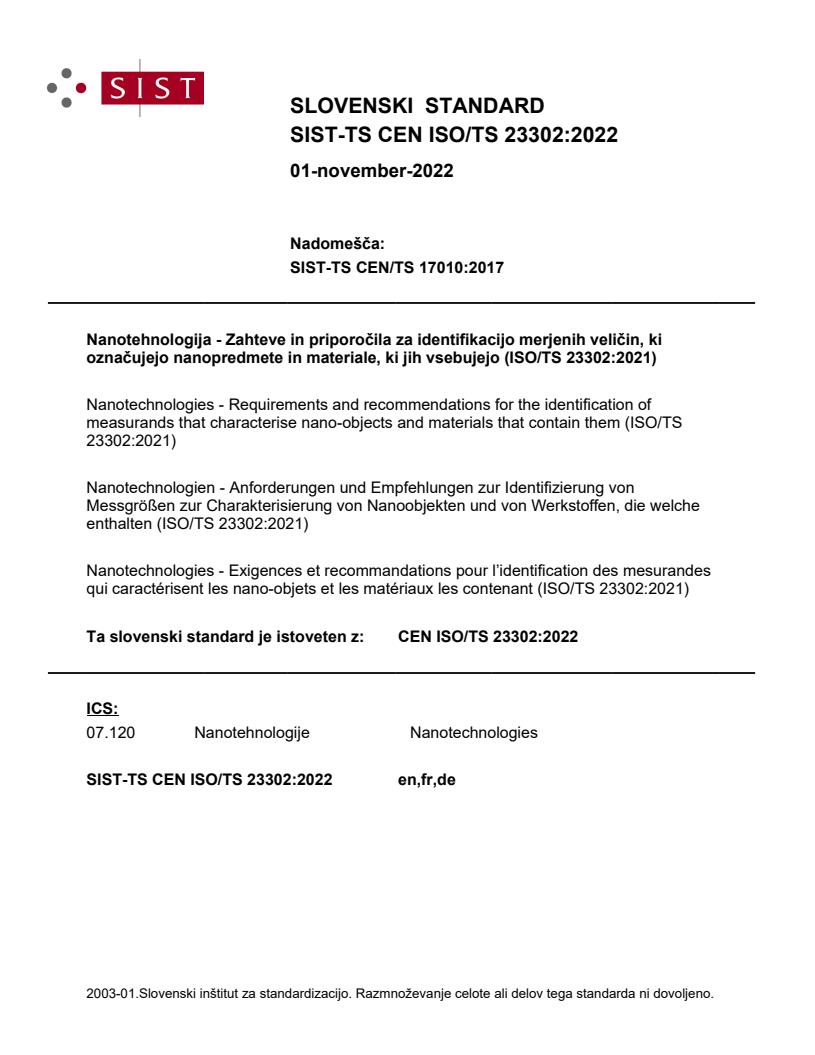
SLOVENSKI STANDARD
01-november-2022
Nadomešča:
SIST-TS CEN/TS 17010:2017
Nanotehnologija - Zahteve in priporočila za identifikacijo merjenih veličin, ki
označujejo nanopredmete in materiale, ki jih vsebujejo (ISO/TS 23302:2021)
Nanotechnologies - Requirements and recommendations for the identification of
measurands that characterise nano-objects and materials that contain them (ISO/TS
23302:2021)
Nanotechnologien - Anforderungen und Empfehlungen zur Identifizierung von
Messgrößen zur Charakterisierung von Nanoobjekten und von Werkstoffen, die welche
enthalten (ISO/TS 23302:2021)
Nanotechnologies - Exigences et recommandations pour l’identification des mesurandes
qui caractérisent les nano-objets et les matériaux les contenant (ISO/TS 23302:2021)
Ta slovenski standard je istoveten z: CEN ISO/TS 23302:2022
ICS:
07.120 Nanotehnologije Nanotechnologies
2003-01.Slovenski inštitut za standardizacijo. Razmnoževanje celote ali delov tega standarda ni dovoljeno.
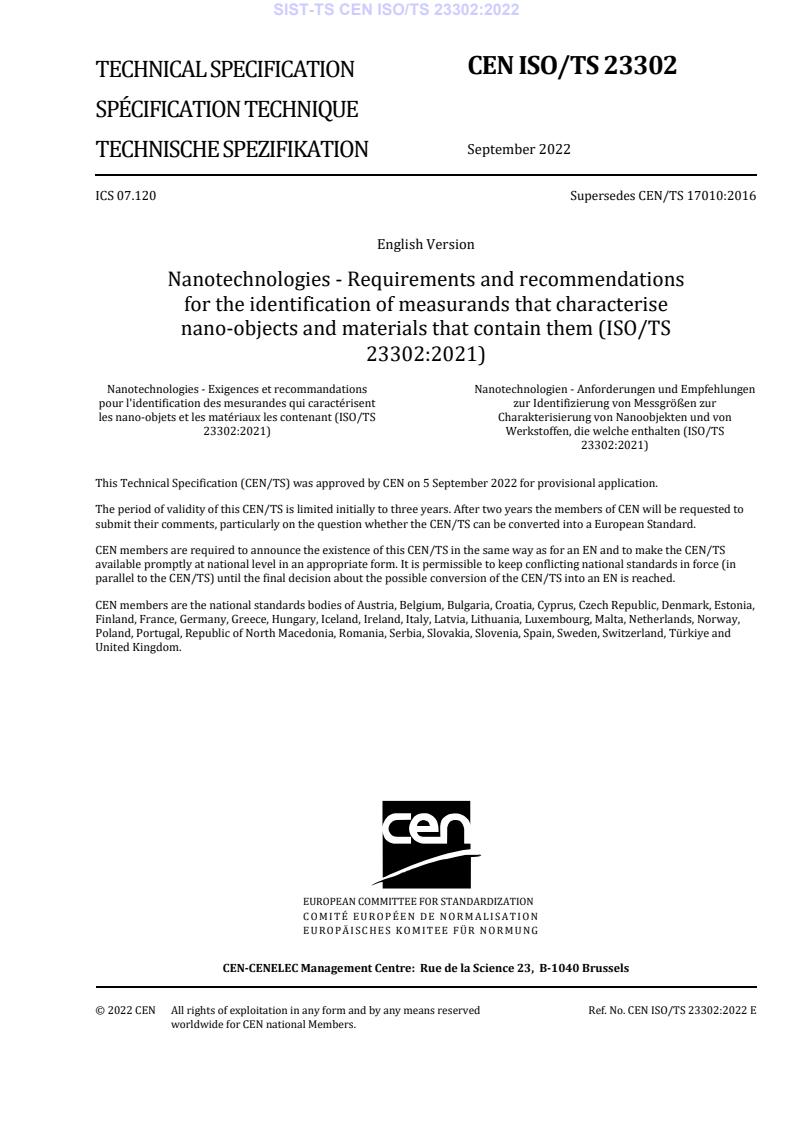
CEN ISO/TS 23302
TECHNICAL SPECIFICATION
SPÉCIFICATION TECHNIQUE
September 2022
TECHNISCHE SPEZIFIKATION
ICS 07.120 Supersedes CEN/TS 17010:2016
English Version
Nanotechnologies - Requirements and recommendations
for the identification of measurands that characterise
nano-objects and materials that contain them (ISO/TS
23302:2021)
Nanotechnologies - Exigences et recommandations Nanotechnologien - Anforderungen und Empfehlungen
pour l'identification des mesurandes qui caractérisent zur Identifizierung von Messgrößen zur
les nano-objets et les matériaux les contenant (ISO/TS Charakterisierung von Nanoobjekten und von
23302:2021) Werkstoffen, die welche enthalten (ISO/TS
23302:2021)
This Technical Specification (CEN/TS) was approved by CEN on 5 September 2022 for provisional application.
The period of validity of this CEN/TS is limited initially to three years. After two years the members of CEN will be requested to
submit their comments, particularly on the question whether the CEN/TS can be converted into a European Standard.
CEN members are required to announce the existence of this CEN/TS in the same way as for an EN and to make the CEN/TS
available promptly at national level in an appropriate form. It is permissible to keep conflicting national standards in force (in
parallel to the CEN/TS) until the final decision about the possible conversion of the CEN/TS into an EN is reached.
CEN members are the national standards bodies of Austria, Belgium, Bulgaria, Croatia, Cyprus, Czech Republic, Denmark, Estonia,
Finland, France, Germany, Greece, Hungary, Iceland, Ireland, Italy, Latvia, Lithuania, Luxembourg, Malta, Netherlands, Norway,
Poland, Portugal, Republic of North Macedonia, Romania, Serbia, Slovakia, Slovenia, Spain, Sweden, Switzerland, Türkiye and
United Kingdom.
EUROPEAN COMMITTEE FOR STANDARDIZATION
COMITÉ EUROPÉEN DE NORMALISATION
EUROPÄISCHES KOMITEE FÜR NORMUNG
CEN-CENELEC Management Centre: Rue de la Science 23, B-1040 Brussels
© 2022 CEN All rights of exploitation in any form and by any means reserved Ref. No. CEN ISO/TS 23302:2022 E
worldwide for CEN national Members.
Contents Page
European foreword . 3
European foreword
The text of ISO/TS 23302:2021 has been prepared by Technical Committee ISO/TC 299
"Nanotechnologies” of the International Organization for Standardization (ISO) and has been taken over
as CEN ISO/TS 23302:2022 by Technical Committee CEN/TC 352 “Nanotechnologies” the secretariat of
which is held by AFNOR.
Attention is drawn to the possibility that some of the elements of this document may be the subject of
patent rights. CEN shall not be held responsible for identifying any or all such patent rights.
This document supersedes CEN/TS 17010:2016.
Any feedback and questions on this document should be directed to the users’ national standards body.
A complete listing of these bodies can be found on the CEN website.
According to the CEN-CENELEC Internal Regulations, the national standards organizations of the
following countries are bound to implement this European Standard: Austria, Belgium, Bulgaria,
Croatia, Cyprus, Czech Republic, Denmark, Estonia, Finland, France, Germany, Greece, Hungary, Iceland,
Ireland, Italy, Latvia, Lithuania, Luxembourg, Malta, Netherlands, Norway, Poland, Portugal, Republic of
North Macedonia, Romania, Serbia, Slovakia, Slovenia, Spain, Sweden, Switzerland, Türkiye and the
United Kingdom.
Endorsement notice
The text of ISO/TS 23302:2021 has been approved by CEN as CEN ISO/TS 23302:2022 without any
modification.
TECHNICAL ISO/TS
SPECIFICATION 23302
First edition
2021-11
Nanotechnologies — Requirements
and recommendations for the
identification of measurands that
characterise nano-objects and
materials that contain them
Nanotechnologies – Exigences et recommandations pour
l’identification des mesurandes qui caractérisent les nano-objets et les
matériaux les contenant
Reference number
ISO/TS 23302:2021(E)
ISO/TS 23302:2021(E)
© ISO 2021
All rights reserved. Unless otherwise specified, or required in the context of its implementation, no part of this publication may
be reproduced or utilized otherwise in any form or by any means, electronic or mechanical, including photocopying, or posting on
the internet or an intranet, without prior written permission. Permission can be requested from either ISO at the address below
or ISO’s member body in the country of the requester.
ISO copyright office
CP 401 • Ch. de Blandonnet 8
CH-1214 Vernier, Geneva
Phone: +41 22 749 01 11
Email: copyright@iso.org
Website: www.iso.org
Published in Switzerland
ii
ISO/TS 23302:2021(E)
Contents Page
Foreword .vii
Introduction .viii
1 Scope . 1
2 Normative references . 1
3 Terms and definitions . 1
3.1 General core terms . 1
3.2 Measurand related terms. 3
4 Abbreviated terms . 6
5 Approaches to identify measurands to characterize nano-objects and their
agglomerates and aggregates, and materials containing nano-objects .9
5.1 Procedure . 9
5.2 Types of measurands . 10
5.3 State of nano-objects . 10
6 Measurands related to size and shape measurement of nano-objects and their
agglomerates and aggregates .11
6.1 General . 11
6.2 Measurands related to size and shape measurement. 11
6.2.1 Overview . 11
6.2.2 General relevant standards .12
6.3 Measurands related to size and shape measurement in aerosols .12
6.3.1 Overview . 12
6.3.2 General relevant standards . 13
6.3.3 Electrical low-pressure impaction . 13
6.3.4 Cascade impactors . 14
6.3.5 Differential mobility analysing system . 14
6.3.6 Relevant standards . 15
6.3.7 Optical particle counter .15
6.3.8 Relevant standards .15
6.3.9 Aerodynamic particle sizing . 15
6.3.10 TEM combined with TEM grid samplers . 15
6.3.11 Relevant standards . 16
6.3.12 Scanning electron microscopy . 16
6.3.13 Relevant standards . 17
6.4 Measurands related to size and shape measurement in powders . 17
6.4.1 Overview . 17
6.4.2 Relevant standards . 17
6.4.3 Scanning electron microscopy . 18
6.4.4 Relevant standards . 18
6.4.5 Gas adsorption, the BET method. 18
6.4.6 Relevant standard . 18
6.4.7 Laser diffraction . 18
6.4.8 Relevant standard . 19
6.4.9 X-ray diffraction . 19
6.4.10 Relevant standards . 19
6.4.11 Raman spectroscopy . 19
6.5 Measurands related to size and shape measurements of nano-objects in liquid
dispersions . 20
6.5.1 Overview . 20
6.5.2 Centrifugal liquid sedimentation . 21
6.5.3 Relevant standards . 21
6.5.4 Dynamic light scattering . 21
6.5.5 Relevant standards . 22
iii
ISO/TS 23302:2021(E)
6.5.6 Laser diffraction . 22
6.5.7 Relevant standard . 22
6.5.8 Small angle X-ray scattering . 22
6.5.9 Relevant standard .22
6.5.10 Particle tracking analysis . 22
6.5.11 Relevant standards .23
6.5.12 Electron microscopy .23
6.5.13 Field flow fractionation .23
6.5.14 Relevant standard . 24
6.5.15 Single particle ICP-MS . 24
6.5.16 Relevant standard .25
6.6 Measurands related to size and shape measurement on surfaces (microscopy
techniques) . 25
6.6.1 Overview . 25
6.6.2 Scanning electron microscopy . 25
6.6.3 Atomic force microscopy . 25
6.6.4 Relevant standards . 26
7 Measurands related to chemical analysis of nano-objects and their agglomerates
and aggregates .26
7.1 General . 26
7.2 Measurands related to surface chemical analysis of nano-objects and their
agglomerates and aggregates. 27
7.2.1 Measurands . 27
7.2.2 Auger electron spectroscopy .28
7.2.3 Relevant standards .28
7.2.4 Electron energy loss spectroscopy .28
7.2.5 Relevant standard .28
7.2.6 Secondary ion mass spectroscopy .28
7.2.7 Relevant standards .29
7.2.8 X-ray fluorescence spectroscopy .29
7.2.9 Relevant standards .30
7.2.10 X-ray diffraction . 30
7.2.11 Relevant standard .30
7.2.12 X-ray photoelectron spectroscopy .30
7.2.13 Relevant standards . 31
7.2.14 Energy dispersive X-ray spectroscopy . 31
7.2.15 Low energy ion scattering . 31
7.3 Measurands related to the chemical analysis of nano-objects as bulk samples . 31
7.3.1 Measurands . 31
7.3.2 Fourier transform infrared spectroscopy . 32
7.3.3 Relevant standards . 33
7.3.4 Thermal analysis with evolved gas analyser plus FTIR or QMS .33
7.3.5 Relevant standards .34
7.3.6 Ultraviolet–visible spectroscopy .34
7.3.7 Relevant standards .34
7.3.8 Raman spectroscopy .34
7.3.9 Inductively coupled plasma techniques .34
7.3.10 Relevant standards .34
7.3.11 Contact angle . 35
8 Measurands related to mass and density .35
8.1 General . 35
8.2 Aerosols . 35
8.2.1 Measurands . 35
8.2.2 Relevant standards . 35
8.2.3 Aerosol particle mass analyser . 36
8.2.4 Time of flight mass spectrometry .36
8.3 Powders . 36
iv
ISO/TS 23302:2021(E)
8.3.1 Measurands .36
8.3.2 Pycnometry .36
8.3.3 Relevant standards .36
8.4 Liquid dispersions . 37
8.4.1 Measurands . 37
8.4.2 Relevant standards . 37
8.4.3 Centrifugal liquid sedimentation (isopycnic method). 37
8.4.4 Static light scattering . 37
8.4.5 Resonant mass measurement .38
9 Measurands related to charge — Liquid dispersions .38
9.1 Measurands .38
9.2 Relevant standards .38
9.3 Electrophoretic light scattering .38
9.4 Electroacoustic phenomena measurements . 39
10 Measurands related to crystallinity .39
10.1 Measurands . 39
10.2 Small-angle/wide-angle X-ray scattering .40
10.3 X-ray diffraction .40
10.4 High-resolution transmission electron microscopy . 41
10.5 Electron backscattered diffraction . 41
10.6 Neutron diffraction . 41
10.7 Reflection high-energy electron diffraction and low-energy electron diffraction . 41
10.8 Differential scanning calorimetry. 41
10.9 Relevant standards . 42
10.10 Solid state nuclear magnetic resonance crystallography . 42
10.11 Raman crystallography . 42
10.12 Relevant standards . 42
11 Optical properties measurands .42
11.1 General . 42
11.2 Measurands . 43
11.3 Spectroscopy techniques . 43
11.4 Relevant standards .44
12 Electrical and electronic measurands . 44
12.1 Measurands .44
12.2 Techniques . 45
12.2.1 2- or 4-point conductance measurements . 45
12.2.2 Angle-resolved ultraviolet photoemission spectroscopy . 45
12.2.3 Scanning tunnelling microscopy . 45
12.2.4 Conductive atomic force microscopy . 45
12.2.5 Piezoforce microscopy .46
13 Magnetic measurands .46
13.1 General .46
13.2 Measurands .46
13.3 Techniques . 47
13.3.1 Superconducting quantum interference device . 47
13.3.2 Vibrating sample magnetometer .48
13.3.3 Mössbauer spectroscopy .48
13.3.4 Electron paramagnetic resonance spectroscopy .48
13.3.5 Magneto-optical Kerr-effect .48
13.3.6 Magnetic force microscopy .48
13.3.7 Scanning Hall effect microscopy .48
13.3.8 Spin-polarized scanning tunnelling microscopy .49
13.3.9 Relevant standards .49
14 Thermal measurands .49
14.1 Measurands .49
v
ISO/TS 23302:2021(E)
14.2 Techniques .49
14.2.1 Measurement of specific heat capacity .49
14.2.2 Scanning thermal microscopy .49
14.3 Relevant standard .50
15 Other performance related measurands .50
15.1 General .50
15.2 Powders — Dustiness . 50
15.2.1 Measurands .50
15.2.2 Relevant standards .50
15.3 Liquid dispersions . 51
15.3.1 Measurands . 51
15.3.2 Viscosity . 51
15.3.3 Dispersibility . 53
15.3.4 Relevant standard .53
15.3.5 Solubility and rate of dissolution . 53
15.3.6 Relevant standards .54
15.4 Mechanical properties .54
15.4.1 General .54
15.4.2 Measurement of elastic constants by static methods . 55
15.4.3 Relevant standards .55
15.4.4 Measurement of elastic constants by dynamic methods . 55
15.4.5 Relevant standards .56
15.4.6 Measurement of elastic and plastic properties by instrumented indentation
methods .56
15.4.7 Relevant standards .56
15.4.8 Measurement of surface properties and wear .56
15.4.9 Relevant standard . 57
Bibliography .58
vi
ISO/TS 23302:2021(E)
Foreword
ISO (the International Organization for Standardization) is a worldwide federation of national standards
bodies (ISO member bodies). The work of preparing International Standards is normally carried out
through ISO technical committees. Each member body interested in a subject for which a technical
committee has been established has the right to be represented on that committee. International
organizations, governmental and non-governmental, in liaison with ISO, also take part in the work.
ISO collaborates closely with the International Electrotechnical Commission (IEC) on all matters of
electrotechnical standardization.
The procedures used to develop this document and those intended for its further maintenance are
described in the ISO/IEC Directives, Part 1. In particular, the different approval criteria needed for the
different types of ISO documents should be noted. This document was drafted in accordance with the
editorial rules of the ISO/IEC Directives, Part 2 (see www.iso.org/directives).
Attention is drawn to the possibility that some of the elements of this document may be the subject of
patent rights. ISO shall not be held responsible for identifying any or all such patent rights. Details of
any patent rights identified during the development of the document will be in the Introduction and/or
on the ISO list of patent declarations received (see www.iso.org/patents).
Any trade name used in this document is information given for the convenience of users and does not
constitute an endorsement.
For an explanation of the voluntary nature of standards, the meaning of ISO specific terms and
expressions related to conformity assessment, as well as information about ISO's adherence to
the World Trade Organization (WTO) principles in the Technical Barriers to Trade (TBT), see
www.iso.org/iso/foreword.html.
This document was prepared by Technical Committee ISO/TC 229, Nanotechnologies, and IEC/TC 113,
Nanotechnology for electrotechnical products and systems.
Any feedback or questions on this document should be directed to the user’s national standards body. A
complete listing of these bodies can be found at www.iso.org/members.html.
vii
ISO/TS 23302:2021(E)
Introduction
The term “nano-object” applies to materials having one, two or three external dimensions in the
nanoscale (therefore in the range of approximately 1 nm to 100 nm). Specific size dependent properties
are usually exhibited in this size range, even if they do not disappear abruptly beyond these limits.
Nano-objects, either natural or manufactured, can be found in the form of nanoplates (one dimension
in the nanoscale), nanofibres (two dimensions, or the diameter, in the nanoscale), and nanoparticles
(three dimensions in the nanoscale). Nano-objects exhibit higher specific surface areas than larger
objects. They are particularly prone to aggregation and agglomeration phenomena due to attractive
interactions during their life cycle.
There is increasing use of nano-objects in research and development, industry and commercial
applications. Characterization of nano-objects, and their agglomerates and aggregates (NOAAs) plays
an essential role in basic and applied research, through process and product quality control and
commercialization to health and environmental protection. Characterization of nano-objects is key to
determine their physical and chemical properties, performance and lifetime. The methods available for
characterization of larger scale materials are often difficult to apply to nano-objects, sometimes due
to restrictions of the test systems (e.g. low sensitivity, inadequate resolution of equipment). This has
resulted in the development of new techniques and adaptation of existing ones.
The method selection is often strongly influenced by its initial cost and availab
...
Questions, Comments and Discussion
Ask us and Technical Secretary will try to provide an answer. You can facilitate discussion about the standard in here.
Loading comments...