


EN ISO/IEC 80079-49:2024
(Main)Explosive atmospheres - Part 49: Flame arresters - Performance requirements, test methods and limits for use (ISO/IEC 80079-49:2024)
General Information
- Abstract
This document specifies the requirements for flame arresters that prevent flame transmission when explosive gas-air or vapour-air mixtures are present. It establishes uniform principles for the classification, basic construction and information for use, including the marking of flame arresters, and specifies test methods to verify the safety requirements and determine safe limits of use. This document is applicable to pressures ranging from 80 kPa to 160 kPa and temperatures ranging from -20 °C to +200 °C. This document does not apply to the following: - external safety-related measurement and control equipment that might be required to keep the operational conditions within the established safe limits; - flame arresters used for explosive mixtures of vapours and gases, which tend to self-decompose (for example, acetylene) or which are chemically unstable; - flame arresters used for carbon disulfide, due to its special properties; - flame arresters whose intended use is for mixtures other than gas-air or vapour-air mixtures (for example, higher oxygen-nitrogen ratio, chlorine as oxidant); - flame arrester test procedures for reciprocating internal combustion engines; - fast acting valves, extinguishing systems and other explosion isolating systems; - Flame arresters used in gas detectors (those being covered for example, by IEC 60079‑29‑1 and IEC 62990‑1). This edition cancels and replaces ISO 16852:2016, which has been technically revised. This edition constitutes a technical revision. This edition includes the following significant technical changes with respect to ISO 16852:2016: a) adaptation of the relevant IEC TC 31 requirements on standards; b) modification of the upper limit of the temperature range from 150 °C to 200 °C under the condition that T0 shall be not larger than 80 % of the auto ignition temperature of the gas-air-mixture; c) change of the term "explosion group" to "equipment group" due to editorial requirements in IEC/TC 31; d) clarification of the conditions and requirements for flame arresters whose intended operating conditions are outside the atmospheric conditions in 7.3.4 and 7.3.5; e) clarification of the requirements on the information for use in Clause 12 f) concerning the burn time; f) addition of a permission to the construction requirements both in 7.1 and 14.1 to substitute visual inspection by performing a flow test; g) addition of a flow chart for the evaluation of test results as Annex D
- Status
- Published
- Publication Date
- 08-Oct-2024
- Current Stage
- 6060 - Definitive text made available (DAV) - Publishing
- Start Date
- 09-Oct-2024
- Completion Date
- 09-Oct-2024

Overview
ISO/IEC 80079-49:2024 (published as EN ISO/IEC 80079-49:2024) is the international standard that specifies performance requirements, test methods and limits for use of flame arresters intended to prevent flame transmission in gas‑air and vapour‑air explosive atmospheres. It replaces ISO 16852:2016 and provides uniform principles for classification, basic construction, marking and instructions for flame arresters used in potentially explosive atmospheres. The standard applies to pressures from 80 kPa to 160 kPa and temperatures from −20 °C to +200 °C (with the condition that T0 ≤ 80% of the mixture auto‑ignition temperature).
Key topics and technical requirements
- Scope and exclusions: Covers flame arresters for gas‑air and vapour‑air mixtures; excludes devices for chemically unstable gases (e.g., acetylene), carbon disulfide, engine‑specific test procedures, gas detector arresters (see IEC 60079‑29‑1 / IEC 62990‑1), fast‑acting valves and other explosion isolation systems.
- Classification and hazards: Defines flame transmission classes (deflagration, detonation, stabilized burning) and associated test indices.
- Construction and manufacturing: Requirements for prototype and production series, housings, joints, pressure and leak tests, and options to substitute visual inspection with flow tests.
- Test methods: Standardised procedures for:
- deflagration and detonation tests,
- short‑time and endurance burning tests,
- tests for static, dynamic (high‑velocity vent valves), hydraulic and liquid‑product detonation flame arresters,
- tests for arresters installed on gas‑conveying equipment.
- Measurement and instrumentation: Flow measurement procedures and requirements (Annex A) and a flow‑chart for evaluating test results (Annex D).
- Information, marking and instructions: Mandatory content and safety information to be supplied with each flame arrester; specific marking rules and warning labels.
- Regulatory alignment: Annex ZA maps clauses to Directive 2014/34/EU, supporting presumption of conformity within the standard’s scope.
Practical applications and who uses this standard
- Manufacturers designing and producing flame arresters to meet international safety and performance benchmarks.
- Test laboratories and certification bodies performing type tests and conformity assessments.
- Process safety and mechanical engineers specifying flame arresters for chemical, petrochemical, oil & gas, storage and transport systems.
- Plant operators and maintenance teams verifying safe limits, installation, marking and instructions.
- Regulatory and compliance professionals using the standard to demonstrate alignment with EU Directive 2014/34/EU.
Related standards (for reference)
- ISO/IEC 80079‑34 (quality systems for ex product manufacture)
- IEC 60079‑0, IEC 60079‑1 (equipment requirements)
- IEC 60079‑29‑1, IEC 62990‑1 (gas detectors - related exclusions)
Keywords: flame arresters, explosive atmospheres, ISO/IEC 80079‑49:2024, performance requirements, test methods, limits for use, deflagration, detonation, process safety, explosion protection.
Relations
- Effective Date
- 18-Jan-2023
- Effective Date
- 18-Mar-2026
- Effective Date
- 18-Mar-2026
- Refers
IEC 60079-1:2014 - Explosive atmospheres - Part 1: Equipment protection by flameproof enclosures "d" - Effective Date
- 09-Feb-2026
- Effective Date
- 28-Jan-2026
- Effective Date
- 28-Jan-2026
- Effective Date
- 10-Feb-2026
- Effective Date
- 28-Jan-2026
- Effective Date
- 28-Jan-2026
- Effective Date
- 28-Jan-2026
- Effective Date
- 28-Jan-2026
- Consolidated By
ISO/IEC 80079-49:2024 - Explosive atmospheres — Part 49: Flame arresters — Performance requirements, test methods and limits for use - Effective Date
- 12-Feb-2026
Get Certified
Connect with accredited certification bodies for this standard

CIS Institut d.o.o.
Personal Protective Equipment (PPE) certification body. Notified Body NB-2890 for EU Regulation 2016/425 PPE.

Kiwa BDA Testing
Building and construction product certification.
Kmetijski inštitut Slovenije
Agricultural Institute of Slovenia. Soil testing, plant health, agricultural product analysis.
Sponsored listings
Frequently Asked Questions
EN ISO/IEC 80079-49:2024 is a standard published by the European Committee for Standardization (CEN). Its full title is "Explosive atmospheres - Part 49: Flame arresters - Performance requirements, test methods and limits for use (ISO/IEC 80079-49:2024)". This standard covers: This document specifies the requirements for flame arresters that prevent flame transmission when explosive gas-air or vapour-air mixtures are present. It establishes uniform principles for the classification, basic construction and information for use, including the marking of flame arresters, and specifies test methods to verify the safety requirements and determine safe limits of use. This document is applicable to pressures ranging from 80 kPa to 160 kPa and temperatures ranging from -20 °C to +200 °C. This document does not apply to the following: - external safety-related measurement and control equipment that might be required to keep the operational conditions within the established safe limits; - flame arresters used for explosive mixtures of vapours and gases, which tend to self-decompose (for example, acetylene) or which are chemically unstable; - flame arresters used for carbon disulfide, due to its special properties; - flame arresters whose intended use is for mixtures other than gas-air or vapour-air mixtures (for example, higher oxygen-nitrogen ratio, chlorine as oxidant); - flame arrester test procedures for reciprocating internal combustion engines; - fast acting valves, extinguishing systems and other explosion isolating systems; - Flame arresters used in gas detectors (those being covered for example, by IEC 60079‑29‑1 and IEC 62990‑1). This edition cancels and replaces ISO 16852:2016, which has been technically revised. This edition constitutes a technical revision. This edition includes the following significant technical changes with respect to ISO 16852:2016: a) adaptation of the relevant IEC TC 31 requirements on standards; b) modification of the upper limit of the temperature range from 150 °C to 200 °C under the condition that T0 shall be not larger than 80 % of the auto ignition temperature of the gas-air-mixture; c) change of the term "explosion group" to "equipment group" due to editorial requirements in IEC/TC 31; d) clarification of the conditions and requirements for flame arresters whose intended operating conditions are outside the atmospheric conditions in 7.3.4 and 7.3.5; e) clarification of the requirements on the information for use in Clause 12 f) concerning the burn time; f) addition of a permission to the construction requirements both in 7.1 and 14.1 to substitute visual inspection by performing a flow test; g) addition of a flow chart for the evaluation of test results as Annex D
This document specifies the requirements for flame arresters that prevent flame transmission when explosive gas-air or vapour-air mixtures are present. It establishes uniform principles for the classification, basic construction and information for use, including the marking of flame arresters, and specifies test methods to verify the safety requirements and determine safe limits of use. This document is applicable to pressures ranging from 80 kPa to 160 kPa and temperatures ranging from -20 °C to +200 °C. This document does not apply to the following: - external safety-related measurement and control equipment that might be required to keep the operational conditions within the established safe limits; - flame arresters used for explosive mixtures of vapours and gases, which tend to self-decompose (for example, acetylene) or which are chemically unstable; - flame arresters used for carbon disulfide, due to its special properties; - flame arresters whose intended use is for mixtures other than gas-air or vapour-air mixtures (for example, higher oxygen-nitrogen ratio, chlorine as oxidant); - flame arrester test procedures for reciprocating internal combustion engines; - fast acting valves, extinguishing systems and other explosion isolating systems; - Flame arresters used in gas detectors (those being covered for example, by IEC 60079‑29‑1 and IEC 62990‑1). This edition cancels and replaces ISO 16852:2016, which has been technically revised. This edition constitutes a technical revision. This edition includes the following significant technical changes with respect to ISO 16852:2016: a) adaptation of the relevant IEC TC 31 requirements on standards; b) modification of the upper limit of the temperature range from 150 °C to 200 °C under the condition that T0 shall be not larger than 80 % of the auto ignition temperature of the gas-air-mixture; c) change of the term "explosion group" to "equipment group" due to editorial requirements in IEC/TC 31; d) clarification of the conditions and requirements for flame arresters whose intended operating conditions are outside the atmospheric conditions in 7.3.4 and 7.3.5; e) clarification of the requirements on the information for use in Clause 12 f) concerning the burn time; f) addition of a permission to the construction requirements both in 7.1 and 14.1 to substitute visual inspection by performing a flow test; g) addition of a flow chart for the evaluation of test results as Annex D
EN ISO/IEC 80079-49:2024 is classified under the following ICS (International Classification for Standards) categories: 13.220.20 - Fire protection. The ICS classification helps identify the subject area and facilitates finding related standards.
EN ISO/IEC 80079-49:2024 has the following relationships with other standards: It is inter standard links to EN ISO 16852:2016, ISO/IEC 80079-34:2018, IEC 60079-0:2017, IEC 60079-1:2014, EN ISO 24034:2020, EN ISO 15547-2:2005, EN 50465:2015, EN 14015:2004, EN 13617-1:2012, EN 14983:2007, EN 1127-1:2011, ISO/IEC 80079-49:2024. Understanding these relationships helps ensure you are using the most current and applicable version of the standard.
EN ISO/IEC 80079-49:2024 is associated with the following European legislation: EU Directives/Regulations: 2014/34/EU; Standardization Mandates: M/596, M/BC/CEN/92/46. When a standard is cited in the Official Journal of the European Union, products manufactured in conformity with it benefit from a presumption of conformity with the essential requirements of the corresponding EU directive or regulation.
EN ISO/IEC 80079-49:2024 is available in PDF format for immediate download after purchase. The document can be added to your cart and obtained through the secure checkout process. Digital delivery ensures instant access to the complete standard document.
Standards Content (Sample)
SLOVENSKI STANDARD
01-december-2024
Eksplozivne atmosfere - 49. del: Plamenske zapore - Zahtevane lastnosti,
preskusne metode in omejitve uporabe (ISO/IEC 80079-49:2024)
Explosive atmospheres - Part 49: Flame arresters - Performance requirements, test
methods and limits for use (ISO/IEC 80079-49:2024)
Explosive Atmosphären - Teil 49: Flammendurchschlagsicherungen -
Leistungsanforderungen, Prüfverfahren und Einsatzgrenzen (ISO/IEC 80079-49:2024)
Atmosphères explosives - Partie 49: Titre manque (ISO/IEC 80079-49:2024)
Ta slovenski standard je istoveten z: EN ISO/IEC 80079-49:2024
ICS:
13.220.20 Požarna zaščita Fire protection
13.230 Varstvo pred eksplozijo Explosion protection
29.260.20 Električni aparati za Electrical apparatus for
eksplozivna ozračja explosive atmospheres
2003-01.Slovenski inštitut za standardizacijo. Razmnoževanje celote ali delov tega standarda ni dovoljeno.
EN ISO/IEC 80079-49
EUROPEAN STANDARD
NORME EUROPÉENNE
October 2024
EUROPÄISCHE NORM
ICS 13.220.20 Supersedes EN ISO 16852:2016
English Version
Explosive atmospheres - Part 49: Flame arresters -
Performance requirements, test methods and limits for
use (ISO/IEC 80079-49:2024)
Atmosphères explosives - Partie 49: Arrête flammes - Explosive Atmosphären - Teil 49:
Exigences de performance, méthodes d'essai et limites Flammendurchschlagsicherungen -
d'utilisation (ISO/IEC 80079-49:2024) Leistungsanforderungen, Prüfverfahren und
Einsatzgrenzen (ISO/IEC 80079-49:2024)
This European Standard was approved by CEN on 5 February 2024.
CEN members are bound to comply with the CEN/CENELEC Internal Regulations which stipulate the conditions for giving this
European Standard the status of a national standard without any alteration. Up-to-date lists and bibliographical references
concerning such national standards may be obtained on application to the CEN-CENELEC Management Centre or to any CEN
member.
This European Standard exists in three official versions (English, French, German). A version in any other language made by
translation under the responsibility of a CEN member into its own language and notified to the CEN-CENELEC Management
Centre has the same status as the official versions.
CEN members are the national standards bodies of Austria, Belgium, Bulgaria, Croatia, Cyprus, Czech Republic, Denmark, Estonia,
Finland, France, Germany, Greece, Hungary, Iceland, Ireland, Italy, Latvia, Lithuania, Luxembourg, Malta, Netherlands, Norway,
Poland, Portugal, Republic of North Macedonia, Romania, Serbia, Slovakia, Slovenia, Spain, Sweden, Switzerland, Türkiye and
United Kingdom.
EUROPEAN COMMITTEE FOR STANDARDIZATION
COMITÉ EUROPÉEN DE NORMALISATION
EUROPÄISCHES KOMITEE FÜR NORMUNG
CEN-CENELEC Management Centre: Rue de la Science 23, B-1040 Brussels
© 2024 CEN All rights of exploitation in any form and by any means reserved Ref. No. EN ISO/IEC 80079-49:2024 E
worldwide for CEN national Members.
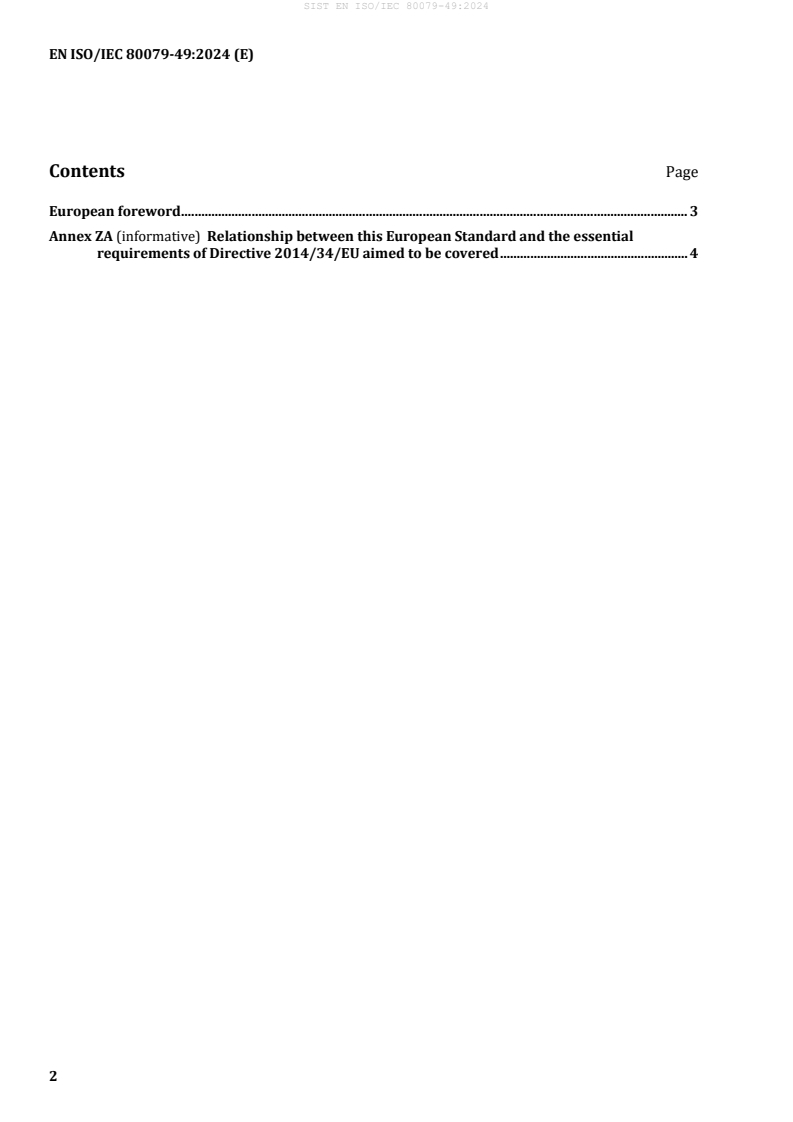
Contents Page
European foreword . 3
Annex ZA (informative) Relationship between this European Standard and the essential
requirements of Directive 2014/34/EU aimed to be covered . 4
European foreword
This document (EN ISO/IEC 80079-49:2024) has been prepared by Technical Committee ISO/TMB
"Technical Management Board - groups" in collaboration with Technical Committee CEN/TC 305
“Potentially explosive atmospheres - Explosion prevention and protection” the secretariat of which is
held by DIN.
This European Standard shall be given the status of a national standard, either by publication of an
identical text or by endorsement, at the latest by April 2025, and conflicting national standards shall be
withdrawn at the latest by October 2025.
Attention is drawn to the possibility that some of the elements of this document may be the subject of
patent rights. CEN shall not be held responsible for identifying any or all such patent rights.
This document supersedes EN ISO 16852:2016.
This document has been prepared under a standardization request addressed to CEN by the European
Commission. The Standing Committee of the EFTA States subsequently approves these requests for its
Member States.
For the relationship with EU Legislation, see informative Annex ZA, which is an integral part of this
document.
Any feedback and questions on this document should be directed to the users’ national standards
body/national committee. A complete listing of these bodies can be found on the CEN website.
According to the CEN-CENELEC Internal Regulations, the national standards organizations of the
following countries are bound to implement this European Standard: Austria, Belgium, Bulgaria,
Croatia, Cyprus, Czech Republic, Denmark, Estonia, Finland, France, Germany, Greece, Hungary, Iceland,
Ireland, Italy, Latvia, Lithuania, Luxembourg, Malta, Netherlands, Norway, Poland, Portugal, Republic of
North Macedonia, Romania, Serbia, Slovakia, Slovenia, Spain, Sweden, Switzerland, Türkiye and the
United Kingdom.
Endorsement notice
The text of ISO/IEC 80079-49:2024 has been approved by CEN as EN ISO/IEC 80079-49:2024 without
any modification.
Annex ZA
(informative)
Relationship between this European Standard and the essential
requirements of Directive 2014/34/EU aimed to be covered
This European Standard has been prepared under a Commission’s standardization request M/596 to
provide one voluntary means of conforming to essential requirements of Directive 2014/34/EU of the
European Parliament and of the Council of 26 February 2014 on the harmonisation of the laws of the
Member States relating to equipment and protective systems intended for use in potentially explosive
atmospheres (recast).
Once this standard is cited in the Official Journal of the European Union under that Directive,
compliance with the normative clauses of this standard given in Table ZA.1 confers, within the limits of
the scope of this standard, a presumption of conformity with the corresponding essential requirements
of that Directive, and associated EFTA regulations.
Table ZA.1 — Correspondence between this European Standard and Directive 2014/34/EU
Essential Requirements of Clause(s)/subclause(s) of this
Remarks/Notes
Directive 2014/34/EU EN
1.0.1 Principles of integrated Clause 5; 14.1; 14.2; 14.3;
explosion safety Annex E.1
1.0.2 Design and manufacture 7.1; 7.2; Clause 14; Annex C;
considerations Annex E.1
1.0.3 Special checking and Annex C; Clause 12
maintenance conditions
1.0.4 Surrounding area 14.1; Annex E.1
conditions
1.0.5 Marking Clause 13
1.0.6 Instructions Clause 12; Annex E
1.1.1 Operational stresses on 7.1; 14.1;Annex C; Annex E.1
material
1.1.2 Reaction of material 14.1;Annex C; Annex E.1
1.1.3 Wear of material 7.1; 14.1; Annex E.1
1.2.1 Design and construction 5.1; 14.1, Annex E.1; 14.2; 14.3;
for safe operation 14.4; 7.1
1.2.3 Enclosed structures and 14.5; 14.2
prevention of leaks
1.2.5 Additional means of Clause 12
protection
1.2.8 Overloading of equipment 7.3.4; 10.1; 11.1
Essential Requirements of Clause(s)/subclause(s) of this
Remarks/Notes
Directive 2014/34/EU EN
1.2.9 Flameproof enclosure 7.3; 14.2; 14.3
systems
1.3.1 Hazards arising from 14.1; Annex E.1
different ignition sources
1.3.2 Hazards arising from Annex B; Annex C
static electricity
1.4.1 External effects 14.1; Annex E.1
1.4.2 Mechanical, thermal and 14.1; Annex E.1
chemical stresses
1.6.4 Hazards arising from 14.3
connections
3.0.1 Dimensioning Clauses 6; 7; 8; 9; 10; 11
3.0.2 Design and position Clauses 6; 7; 8; 9; 10; 11
3.0.4 Outside interference 13.3
3.1.2 Shock waves 14.4; 7.3.3
Table ZA.2 — Applicable Standards to confer presumption of conformity as described in this
Annex ZA
Column 1 Column 2 Column 3 Column 4
Reference in International
Title Corresponding European
Clause 2 Standard Edition
Standard Edition
ISO/IEC 80079-34 ISO/IEC 80079- Explosive atmospheres – EN ISO/IEC 80079-34:2020
34:2020 Part 34: Application of
quality systems for ex
product manufacture
IEC 60079-0 IEC 60079-0:2017 Explosive atmospheres – EN IEC 60079-0:2018
Part 0: Equipment –
General requirements
IEC 60079-1 IEC 60079-1:2014 Explosive atmospheres –
EN 60079-1:2014
Part 1: Equipment
protection by flameproof
enclosures "d"
As impacted by EN IEC 60079-0:2018/AC:2020-02
As impacted by EN IEC 60079-1:2014/AC:2018-09
The documents listed in the Column 1 of Table ZA.2, in whole or in part, are normatively referenced in
this document, i.e. are indispensable for its application. The achievement of the presumption of
conformity is subject to the application of the edition of Standards as listed in Column 4 or, if no
European Standard Edition exists, the International Standard Edition given in Column 2 of Table ZA.2.
WARNING 1 — Presumption of conformity stays valid only as long as a reference to this European
Standard is maintained in the list published in the Official Journal of the European Union. Users of this
standard should consult frequently the latest list published in the Official Journal of the European
Union.
WARNING 2 — Other Union legislation may be applicable to the product(s) falling within the scope of
this standard.
ISO/IEC 80079-49
Edition 1.0 2024-05
INTERNATIONAL
STANDARD
Explosive atmospheres –
Part 49: Flame arresters – Performance requirements, test methods and limits
for use
INTERNATIONAL
ELECTROTECHNICAL
COMMISSION
ICS 13.220.10 ISBN 978-2-8322-8716-3
– 2 – ISO/IEC 80079-49:2024 © ISO/IEC 2024
CONTENTS
FOREWORD . 5
INTRODUCTION . 7
1 Scope . 8
2 Normative references . 9
3 Terms and definitions . 9
4 Abbreviated terms and symbols . 13
5 Hazards and flame arrester classifications . 14
5.1 Flame transmission classification: deflagration, stable and unstable
detonation . 14
5.2 Flame transmission classification: stabilized burning . 15
5.3 Index of tests . 15
6 General requirements . 16
6.1 Measuring instruments . 16
6.2 Flow measurement (air) . 17
6.3 Flame transmission test . 17
6.3.1 General . 17
6.3.2 Test mixtures . 17
7 Specific requirements for static flame arresters . 19
7.1 Construction requirements for prototype arresters . 19
7.2 Design series . 19
7.3 Flame transmission tests . 20
7.3.1 General . 20
7.3.2 Deflagration test . 21
7.3.3 Tests for detonation flame arresters . 24
7.3.4 Short time burning test . 30
7.3.5 Endurance burning test . 33
8 Specific requirements for liquid product detonation flame arresters . 34
8.1 Liquid seals . 34
8.2 Foot valves . 35
8.3 Flame transmission test . 36
9 Specific requirements for dynamic flame arresters (high velocity vent valves) . 37
9.1 General . 37
9.2 Flame transmission tests . 37
9.2.1 Low flow flame transmission test . 37
9.2.2 Flame transmission test by opening and closing . 39
9.2.3 Deflagration test . 40
9.2.4 Endurance burning test . 40
10 Specific requirements for hydraulic flame arresters . 41
10.1 Equipment . 41
10.2 Flame transmission tests . 41
10.2.1 General . 41
10.2.2 Short time burning test . 41
10.2.3 Deflagration test . 41
10.2.4 Detonation test . 42
11 Test of flame arresters installed on or within gas conveying equipment . 44
11.1 General . 44
ISO/IEC 80079-49:2024 © ISO/IEC 2024 – 3 –
11.2 Flame transmission tests . 44
11.2.1 General . 44
11.2.2 Test procedure for gas conveying equipment with inlet pressure
> 600 hPa . 46
11.2.3 Test procedure for gas conveying equipment with inlet pressure
≤ 600 hPa . 47
12 Instructions . 47
13 Marking . 48
13.1 Location . 48
13.2 Flame arrester housing . 49
13.2.1 General information . 49
13.2.2 Warning markings . 49
13.2.3 Examples of marking . 50
13.3 Flame arrester element . 51
14 Manufacturing and production . 51
14.1 Construction . 51
14.2 Housing . 51
14.3 Joints . 51
14.4 Pressure test . 51
14.5 Leak test . 52
Annex A (normative) Flow measurement . 53
A.1 General . 53
A.2 In-line flame arresters . 54
A.3 End-of-line flame arrester . 54
A.3.1 General . 54
A.3.2 Special flow measurement for dynamic flame arresters . 55
A.4 Undamped oscillation tests of dynamic flame arrester (High velocity vent
valves) . 56
Annex B (informative) Information for selecting flame arresters . 58
Annex C (informative) Recommended practice . 59
Annex D (informative) Evaluation of test results . 60
Annex E (normative) Application . 62
E.1 General . 62
E.2 Limits for use for static flame arresters . 63
E.2.1 In-line flame arrester . 63
E.2.2 Pre-volume flame arrester . 63
E.2.3 Detonation flame arrester . 63
E.2.4 Short time burn flame arrester . 63
E.3 Limits for use for liquid detonation flame arresters . 64
E.4 Limits for use for dynamic flame arresters (high velocity vent valves) . 64
E.5 Limits for use for hydraulic flame arresters . 64
Annex F (informative) Significant changes between this document and EN ISO
16852:2016 . 67
Bibliography . 69
Figure 1 – Test apparatus for end-of-line flame arrester for deflagration test . 21
Figure 2 – Test apparatus for in-line flame arrester for deflagration test . 22
Figure 3 – Test apparatus for pre-volume flame arrester for deflagration test . 24
– 4 – ISO/IEC 80079-49:2024 © ISO/IEC 2024
Figure 4 – Test apparatus for detonation flame arrester for detonation without
restriction. 26
Figure 5 – Test apparatus for detonation flame arrester for detonation with restriction . 28
Figure 6 – Test apparatus for short time burning test . 31
Figure 7 – Test apparatus for endurance burning test . 33
Figure 8 – Liquid product detonation flame arrester . 35
Figure 9 – End-of-line flame arrester incorporating a non-return valve (foot valve) . 35
Figure 10 – Test apparatus for liquid product detonation flame arresters . 36
Figure 11 – Test apparatus for determining the non-hammering conditions for dynamic
flame arresters. 39
Figure 12 – Test apparatus for hydraulic flame arresters. 43
Figure 13 – Test apparatus for the flame transmission test of flame arresters installed
on or within gas conveying equipment . 45
Figure 14 – Example of marking plate, burn rating "a" . 50
Figure 15 – Example of marking plate, burn rating "b" . 50
Figure A.1 – Test apparatus for recording the pressure drop/flow rate curve for in-line
flame arresters. 54
Figure A.2 – Test apparatus for recording the pressure drop/flow rate curve for end-of-
line flame arresters with or without integrated pressure/vacuum valve . 56
Figure A.3 – Test apparatus for determining the non-oscillating conditions for dynamic
flame arresters. 57
Figure D.1 – Decision process for stable detonation arrester (DET3 and DET4) . 60
Figure D.2 – Decision process for unstable detonation arrester (DET1 and DET2) . 61
Figure E.1 – Test apparatus for hydraulic flame arresters . 66
Table 1 – Flame arrester classification for deflagration, stable and unstable detonation . 15
Table 2 – Summary of tests to be conducted . 16
Table 3 – Specification of gas-air mixtures for deflagration and detonation tests . 18
Table 4 – Specification of gas-air mixtures for short time burning tests and burning
tests of dynamic flame arresters . 18
Table 5 – Specification of gas-air or vapour-air mixtures for endurance burning tests of
static flame arresters . 19
Table 6 – Design series . 20
Table 7 – Ratio p /p . 27
md TB
Table 8 – Number of the individual tests and test parameters for the flame
transmission test of flame arresters installed on or within gas conveying equipment
with inlet pressures > 600 hPa . 46
Table 9 – Number of the individual tests and test parameters for the flame
transmission test of flame arresters installed on or within gas conveying equipment
with inlet pressures ≤ 600 hPa . 47
Table B.1 – Information for selecting flame arresters . 58
Table F.1 – Significant changes with respect to EN ISO 16852:2016 . 67
ISO/IEC 80079-49:2024 © ISO/IEC 2024 – 5 –
EXPLOSIVE ATMOSPHERES –
Part 49: Flame arresters –
Performance requirements, test methods and limits for use
FOREWORD
1) ISO (the International Organization for Standardization) and IEC (the International Electrotechnical Commission)
form the specialized system for worldwide standardization. National bodies that are members of ISO or IEC
participate in the development of International Standards through technical committees established by the
respective organization to deal with particular fields of technical activity. ISO and IEC technical committees
collaborate in fields of mutual interest. Other international organizations, governmental and non-governmental,
in liaison with ISO and IEC, also take part in the work.
2) The formal decisions or agreements of IEC and ISO on technical matters express, as nearly as possible, an
international consensus of opinion on the relevant subjects since each technical committee has representation
from all interested IEC and ISO National bodies.
3) IEC and ISO documents have the form of recommendations for international use and are accepted by IEC and
ISO National bodies in that sense. While all reasonable efforts are made to ensure that the technical content of
IEC and ISO documents is accurate, IEC and ISO cannot be held responsible for the way in which they are used
or for any misinterpretation by any end user.
4) In order to promote international uniformity, IEC and ISO National bodies undertake to apply IEC and ISO
documents transparently to the maximum extent possible in their national and regional publications. Any
divergence between any IEC and ISO document and the corresponding national or regional publication shall be
clearly indicated in the latter.
5) IEC and ISO do not provide any attestation of conformity. Independent certification bodies provide conformity
assessment services and, in some areas, access to IEC and ISO marks of conformity. IEC and ISO are not
responsible for any services carried out by independent certification bodies.
6) All users should ensure that they have the latest edition of this document.
7) No liability shall attach to IEC and ISO or their directors, employees, servants or agents including individual
experts and members of its technical committees and IEC and ISO National bodies for any personal injury,
property damage or other damage of any nature whatsoever, whether direct or indirect, or for costs (including
legal fees) and expenses arising out of the publication, use of, or reliance upon, this ISO/IEC document or any
other IEC and ISO documents.
8) Attention is drawn to the Normative references cited in this document. Use of the referenced publications is
indispensable for the correct application of this document.
9) IEC and ISO draw attention to the possibility that the implementation of this document may involve the use of (a)
patent(s). IEC and ISO take no position concerning the evidence, validity or applicability of any claimed patent
rights in respect thereof. As of the date of publication of this document, IEC and ISO had not received notice of
(a) patent(s), which may be required to implement this document. However, implementers are cautioned that this
may not represent the latest information, which may be obtained from the patent database available at
https://patents.iec.ch and www.iso.org/patents. IEC and ISO shall not be held responsible for identifying any or
all such patent rights.
ISO/IEC 80079-49 has been prepared by subcommittee 31M: Non-electrical equipment and
protective systems for explosive atmospheres, of ISO/IEC joint technical committee 1:
Information technology.
This edition cancels and replaces ISO 16852:2016, which has been technically revised. This
edition constitutes a technical revision.
This edition includes the following significant technical changes with respect to
ISO 16852:2016:
a) adaptation of the relevant IEC TC 31 requirements on standards;
b) modification of the upper limit of the temperature range from 150 °C to 200 °C under the
condition that T shall be not larger than 80 % of the auto ignition temperature of the gas-
air-mixture;
c) change of the term "explosion group" to "equipment group" due to editorial requirements in
IEC/TC 31;
d) clarification of the conditions and requirements for flame arresters whose intended operating
conditions are outside the atmospheric conditions in 7.3.4 and 7.3.5;
– 6 – ISO/IEC 80079-49:2024 © ISO/IEC 2024
e) clarification of the requirements on the information for use in Clause 12 f) concerning the
burn time;
f) addition of a permission to the construction requirements both in 7.1 and 14.1 to substitute
visual inspection by performing a flow test;
g) addition of a flow chart for the evaluation of test results as Annex D.
The text of this International Standard is based on the following documents:
Draft Report on voting
31M/212/FDIS 31M/223/RVD
Full information on the voting for its approval can be found in the report on voting indicated in
the above table.
The language used for the development of this International Standard is English.
A list of all parts in the ISO/IEC 80079 series, published under the general title Explosive
atmospheres, can be found on the IEC website.
NOTE The following print types are used:
• Words in italic font in the text are defined in Clause 3.
This document was drafted in accordance with ISO/IEC Directives, Part 2, and developed in
accordance with ISO/IEC Directives, Part 1, available at www.iec.ch/members_experts/refdocs
and www.iso.org/directives.
ISO/IEC 80079-49:2024 © ISO/IEC 2024 – 7 –
INTRODUCTION
Flame arresters are protective systems fitted to openings of enclosures or to pipe work and are
intended to allow fluid flow but prevent flame transmission if a flammable mixture is ignited.
They have widely been used for decades in the chemical and oil industry, and a variety of
national standards is available. This document was prepared with an aim to establish an
international basis by harmonizing and incorporating recent national developments and
standards as far as reasonable.
This document addresses performance requirements and test methods, as well as limits for use
for flame arresters.
Only the minimum safety requirements for flame arresters to prevent flame transmission are
specified.
The hazard identification of common applications found in industry leads to the specification of
the test methods. These test methods reflect standard practical situations and, as such, form
the heart of this document because they also allow classification of the various types of flame
arresters and then determination of the limits of use.
A considerable number of test methods and test conditions had to be taken into account for two
main reasons.
a) Different types of flame arresters are covered with respect to the operating principle (static,
hydraulic, liquid, dynamic) and each type clearly needs its specific test set-up and test
procedure.
b) It is necessary to adapt flame arresters to the special conditions of application (gas,
installation) because of the conflicting demands of high flame quenching capability and low
pressure loss. This situation is completely different from the otherwise similar principle of
protection by flameproof enclosure, for example for electrical equipment, where the
importance of process gas flow through any gaps is negligible and importance is placed on
the flame quenching effect of the gap.
Consequently, in this document, the testing and classification related to Equipment Groups and
installation conditions have been subdivided more than is usually the case in other parts of the
ISO/IEC 80079 and IEC 60079 series of standards. In particular,
– Equipment Group IIA is subdivided into sub-groups IIA1 and IIA,
– Equipment Group IIB is subdivided into sub-groups IIB1, IIB2, IIB3 and IIB, and
– the type "detonation arrester" is divided into four sub-types, which take into account specific
installation situations.
The test conditions lead to the limits for use which are most important for the user. This
document specifies this safety relevant information and its dissemination through the
manufacturer's written instructions for use and the marking of the flame arresters.
The limits for use are also a link to more general (operational) safety considerations and
regulations, which remain the responsibility the user and regulators. Annex B and Annex C offer
some guidance on these aspects.
– 8 – ISO/IEC 80079-49:2024 © ISO/IEC 2024
EXPLOSIVE ATMOSPHERES –
Part 49: Flame arresters –
Performance requirements, test methods and limits for use
1 Scope
This document specifies the requirements for flame arresters that prevent flame transmission
when explosive gas-air or vapour-air mixtures are present. It establishes uniform principles for
the classification, basic construction and information for use, including the marking of flame
arresters, and specifies test methods to verify the safety requirements and determine safe limits
of use.
This document is applicable to pressures ranging from 80 kPa to 160 kPa and temperatures
ranging from −20 °C to +200 °C.
NOTE 1 For flame arresters with operational conditions inside the scope, but outside atmospheric conditions,
see Annex E.
NOTE 2 In designing and testing flame arresters for operation under conditions other than those specified above,
this document can be used as a guide. This document can also be used to design any additional testing related to
the specific conditions of use. This is particularly important when high temperatures and pressures are applied. The
test mixtures might need to be modified in these cases.
This document does not apply to the following:
– external safety-related measurement and control equipment that might be required to keep
the operational conditions within the established safe limits;
NOTE 3 Integrated measurement and control equipment, such as integrated temperature and flame sensors as
well as parts which, for example, intentionally melt (retaining pin), burn away (weather hoods) or bend (bimetallic
strips), are within the scope of this document.
– flame arresters used for explosive mixtures of vapours and gases, which tend to self-
decompose (for example, acetylene) or which are chemically unstable;
– flame arresters used for carbon disulfide, due to its special properties;
– flame arresters whose intended use is for mixtures other than gas-air or vapour-air mixtures
(for example, higher oxygen-nitrogen ratio, chlorine as oxidant);
– flame arrester test procedures for reciprocating internal combustion engines;
NOTE 4 Flame arresters for specific applications (e.g. reciprocating internal combustion engines) can use this
document as a guide for design but be subject to testing related to their specific use.
– fast acting valves, extinguishing systems and other explosion isolating systems;
– Flame arresters used in gas detectors (those being covered for example, by IEC 60079‑29‑1
and IEC 62990‑1).
ISO/IEC 80079-49:2024 © ISO/IEC 2024 – 9 –
2 Normative references
The following documents are referred to in the text in such a way that some or all of their content
constitutes requirements of this document. For dated references, only the edition cited applies.
For undated references, the latest edition of the referenced document (including any
amendments) applies.
IEC 60079-0, Explosive atmospheres – Part 0: Equipment – General requirements
IEC 60079-1, Explosive atmospheres – Part 1: Equipment protection by flameproof enclosures
"d"
ISO/IEC 80079-34, Explosive atmospheres – Part 34: Application of quality management
systems for Ex Product manufacture
3 Terms and definitions
For the purposes of this document, the terms and definitions given in IEC 60079-0 and the
following apply.
ISO and IEC maintain terminology databases for use in standardization at the following
addresses:
• IEC Electropedia: available at https://www.electropedia.org/
• ISO Online browsing platform: available at https://www.iso.org/obp
3.1
flame arrester
device fitted to the opening of an enclosure, or to the connecting pipe work of a system of
enclosures, and whose intended function is to allow flow but prevent the transmission of flame
3.2
housing
portion of a flame arrester (3.1) whose principal function is to provide a suitable enclosure for
the flame arrester element (3.3) and allow mechanical connections to other systems
3.3
flame arrester element
portion of a flame arrester (3.1) whose principal function is to prevent flame transmission
3.4
stabilized burning
steady burning of a flame stabilized at, or close to, the flame arrester element (3.3)
3.5
short time burning
stabilized burning (3.4) for a specified time
3.6
endurance burning
stabilized burning (3.4) for an unlimited time
– 10 – ISO/IEC 80079-49:2024 © ISO/IEC 2024
3.7
explosion
abrupt oxidation or decomposition reaction producing an increase in temperature, pressure, or
both simultaneously
[SOURCE: ISO 8421-1:1987, 1.13]
3.8
deflagration
explosion (3.7) propagating at subsonic velocity
[SOURCE: ISO 8421-1:1987, 1.11]
3.9
detonation
explosion (3.7) propagating at supersonic velocity and characterized by a shock wave
[SOURCE: ISO 8421-1:1987, 1.12]
3.10
stable detonation
detonation (3.9) progressing through a confined system without significant variation of velocity
and pressure characteristics
Note 1 to entry: For the atmospheric conditions, test mixtures and test procedures of this document, typical
velocities range between 1 600 m/s and 2 200 m/s.
3.11
unstable detonation
detonation (3.9) during the transition of a combustion process from a deflagration (3.8) into a
stable detonation (3.10)
Note 1 to entry: The transition occurs in a limited spatial zone, where the velocity of the combustion wave is not
constant and where the explosion pressure is significantly higher than in a stable detonation. The position of this
transition zone depends, amongst other factors, on pipe diameter, pipe configuration, test gas and explosion group.
Note 2 to entry: An unstable detonation presents a higher level of hazard than a stable detonation due to higher
flame speeds and pressures.
3.12
characteristic safety data of explosive mixtures
3.12.1
maximum experimental safe gap
MESG
maximum gap of a joint of 25 mm in width which prevents any transmission of an explosion
during tests made under the conditions specified in ISO/IEC 80079-20-1
[SOURCE: ISO/IEC 80079-20-1:2017, 3.4, modified – "in ISO/IEC 80079-20-1" added and
Note 1 to entry deleted.]
3.12.2
safe gap
maximum gap of a joint of 25 mm in width which prevents any transmission of an explosion
during tests made under the conditions specified in ISO/IEC 80079-20-1 for the specified
vapour/gas mixture
ISO/IEC 80079-49:2024 © ISO/IEC 2024 – 11 –
3.12.3
equipment grouping
classification system of equipment related to the explosive atmosphere for which they are
intended to be used
Note 1 to entry: In a large part of the safety equipment industry "explosion group" is used as an alternative term.
[SOURCE: ISO/IEC 80079-20-1:2017, 3.7, modified – Note 1 to entry replaced.]
3.13
bi-directional flame arrester
flame arrester (3.1) that prevents flame transmission from both sides
3.14
deflagration flame arrester
DEF
flame arrester (3.1) designed to prevent the transmission of a deflagration (3.8)
Note 1 to entry: It can be an end-of-line flame arrester (3.21) or an in-line flame arrester (3.22).
3.15
detonation flame arrester
DET
flame arrester (3.1) designed to prevent the transmission of a detonation
Note 1 to entry: It can be an end-of-line flame arrester (3.21) or an in-line flame arrester (3.22), and can be used
for both stable detonations (3.10) and unstable detonations (3.11).
3.16
endurance flame arrester
flame arrester (3.1) that prevents flame transmission during and after endurance burning (3.6)
3.17
static flame arrester
flame arrester (3.1) designed to prevent flame transmission by quenching gaps
3.17.1
measurable type
flame arrester (3.1) where the quenching gaps of the flame arrester element (3.3) can be
technically drawn, measured and controlled
3.17.2
non-measurable type
flame arrester (3.1) where the quenching gaps of the flame arrester element (3.3) cannot be
technically drawn, measured or controlled
EXAMPLE Random structures such as knitted mesh, sintered materials and gravel beds.
3.18
dynamic flame arrester
high velocity vent valve
deflagration proof (see 3.14) pressure relief valve designed always to have efflux velocities that
prevent the flame propagation against the flow direction
Note 1 to entry: It can be endurance burn proof (see 3.16).
– 12 – ISO/IEC 80079-49:2024 © ISO/IEC 2024
3.19
liquid product detonation flame arrester
flame arrester (3.1) in which the liquid product is used to form a liquid seal as a flame arrester
medium, in order to prevent flame transmission of a stable or unstable detonation without
restriction (type 4 or type 2)
Note 1 to entry: There are two types of liquid product detonation flame arrester for u
...