


FprEN ISO 80601-267
(Main)Medical electrical equipment - Part 2-67: Particular requirements for basic safety and essential performance of oxygen-conserving equipment (ISO/FDIS 80601-2-67:2025)
Medical electrical equipment - Part 2-67: Particular requirements for basic safety and essential performance of oxygen-conserving equipment (ISO/FDIS 80601-2-67:2025)
This document is applicable to the basic safety and essential performance of oxygen conserving equipment, hereafter referred to as ME equipment, in combination with its accessories intended to conserve supplemental oxygen by delivering gas intermittently and synchronized with the patient's inspiratory cycle, when used in the home healthcare environment. Oxygen conserving equipment is typically used by a lay operator.
NOTE 1 Conserving equipment can also be used in professional health care facilities.
This document is also applicable to conserving equipment that is incorporated with other equipment.
EXAMPLE Conserving equipment combined with a pressure regulator[2], an oxygen concentrator[7] or liquid oxygen equipment[4].
This document is also applicable to those accessories intended by their manufacturer to be connected to conserving equipment, where the characteristics of those accessories can affect the basic safety or essential performance of the conserving equipment.
This document is intended to clarify the difference in operation of various conserving equipment models, as well as between the operation of conserving equipment and continuous flow oxygen equipment, by requiring standardized performance testing and labelling.
This document is only applicable to active devices (e.g. pneumatically or electrically powered) and is not applicable to non-active devices (e.g. reservoir cannulas).
If a clause or subclause is specifically intended to be applicable to ME equipment only, or to ME systems only, the title and content of that clause or subclause will say so. If that is not the case, the clause or subclause applies both to ME equipment and to ME systems, as relevant.
Hazards inherent in the intended physiological function of ME equipment or ME systems within the scope of this document are not covered by specific requirements in this document except in IEC 60601-1:2005+AMD1:2012, 7.2.13 and 8.4.1.
NOTE 2 Additional information can be found in IEC 60601-1:2005+AMD1:2012, 4.2.
Medizinische elektrische Geräte - Teil 2-67: Besondere Festlegungen für die Sicherheit einschließlich der wesentlichen Leistungsmerkmale von Sauerstoff-Dosiergeräten (ISO/FDIS 80601 2 67:2025)
Appareils électromédicaux - Partie 2-67: Exigences particulières pour la sécurité de base et les performances essentielles des économiseurs d'oxygène (ISO/FDIS 80601-2-67:2025)
Le présent document s'applique à la sécurité de base et aux performances essentielles d'un économiseur d'oxygène, désigné ci-après sous le terme d'appareil EM, ainsi que de ses accessoires prévus pour économiser le supplément d'oxygène en délivrant du gaz de manière intermittente et synchronisée en suivant le cycle d'inspiration du patient, pour une utilisation dans l'environnement de soins à domicile. L'économiseur d'oxygène est habituellement utilisé par un opérateur non spécialiste.
NOTE 1 Un économiseur peut également être utilisé dans des établissements de santé.
Le présent document s'applique également aux économiseurs intégrés à d'autres appareils.
EXEMPLE Économiseur associé à un détendeur[2], un concentrateur d'oxygène[7] ou un appareil à oxygène liquide[4].
Le présent document s'applique également aux accessoires destinés par leur fabricant à être raccordés à un économiseur, du fait que les caractéristiques de ces accessoires peuvent avoir un impact sur la sécurité de base ou sur les performances essentielles de l'économiseur.
Le présent document vise à préciser les différences de fonctionnement entre différents modèles d'économiseurs, ainsi que les différences de fonctionnement entre économiseurs et appareils à oxygène à débit continu, en exigeant des essais de performance et un étiquetage normalisés.
Le présent document ne s'applique qu'aux dispositifs actifs (par exemple, dotés d'une alimentation pneumatique ou électrique) et ne s'applique pas aux dispositifs non actifs (par exemple, canules de réservoir).
Si un article ou un paragraphe est spécifiquement destiné à être appliqué uniquement aux appareils EM ou uniquement aux systèmes EM, le titre et le contenu dudit article ou paragraphe l'indiqueront. Si cela n'est pas le cas, l'article ou le paragraphe s'applique à la fois aux appareils EM et aux systèmes EM, selon le cas.
Les dangers inhérents à la fonction physiologique prévue des appareils EM ou des systèmes EM dans le cadre du domaine d'application du présent document ne sont pas couverts par des exigences spécifiques contenues dans le présent document, à l'exception de l'IEC 60601‑1:2005+AMD1:2012, 7.2.13 et 8.4.1.
NOTE 2 Des informations supplémentaires peuvent être trouvées dans l'IEC 60601‑1:2005+AMD1:2012, 4.2.
Medicinska električna oprema - 2-67. del: Posebne zahteve za osnovno varnost in bistvene lastnosti opreme za shranjevanje kisika (ISO/FDIS 80601-2-67:2025)
General Information
Relations
Standards Content (Sample)
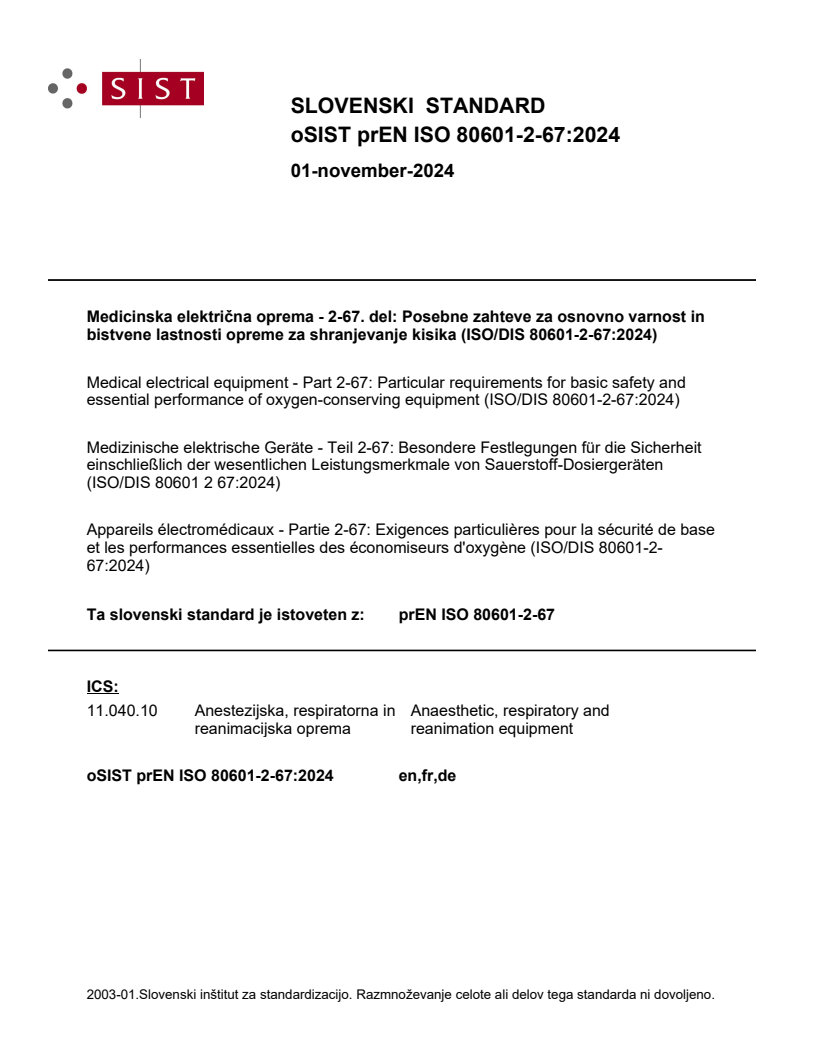
SLOVENSKI STANDARD
oSIST prEN ISO 80601-2-67:2024
01-november-2024
Medicinska električna oprema - 2-67. del: Posebne zahteve za osnovno varnost in
bistvene lastnosti opreme za shranjevanje kisika (ISO/DIS 80601-2-67:2024)
Medical electrical equipment - Part 2-67: Particular requirements for basic safety and
essential performance of oxygen-conserving equipment (ISO/DIS 80601-2-67:2024)
Medizinische elektrische Geräte - Teil 2-67: Besondere Festlegungen für die Sicherheit
einschließlich der wesentlichen Leistungsmerkmale von Sauerstoff-Dosiergeräten
(ISO/DIS 80601 2 67:2024)
Appareils électromédicaux - Partie 2-67: Exigences particulières pour la sécurité de base
et les performances essentielles des économiseurs d'oxygène (ISO/DIS 80601-2-
67:2024)
Ta slovenski standard je istoveten z: prEN ISO 80601-2-67
ICS:
11.040.10 Anestezijska, respiratorna in Anaesthetic, respiratory and
reanimacijska oprema reanimation equipment
oSIST prEN ISO 80601-2-67:2024 en,fr,de
2003-01.Slovenski inštitut za standardizacijo. Razmnoževanje celote ali delov tega standarda ni dovoljeno.
oSIST prEN ISO 80601-2-67:2024
oSIST prEN ISO 80601-2-67:2024
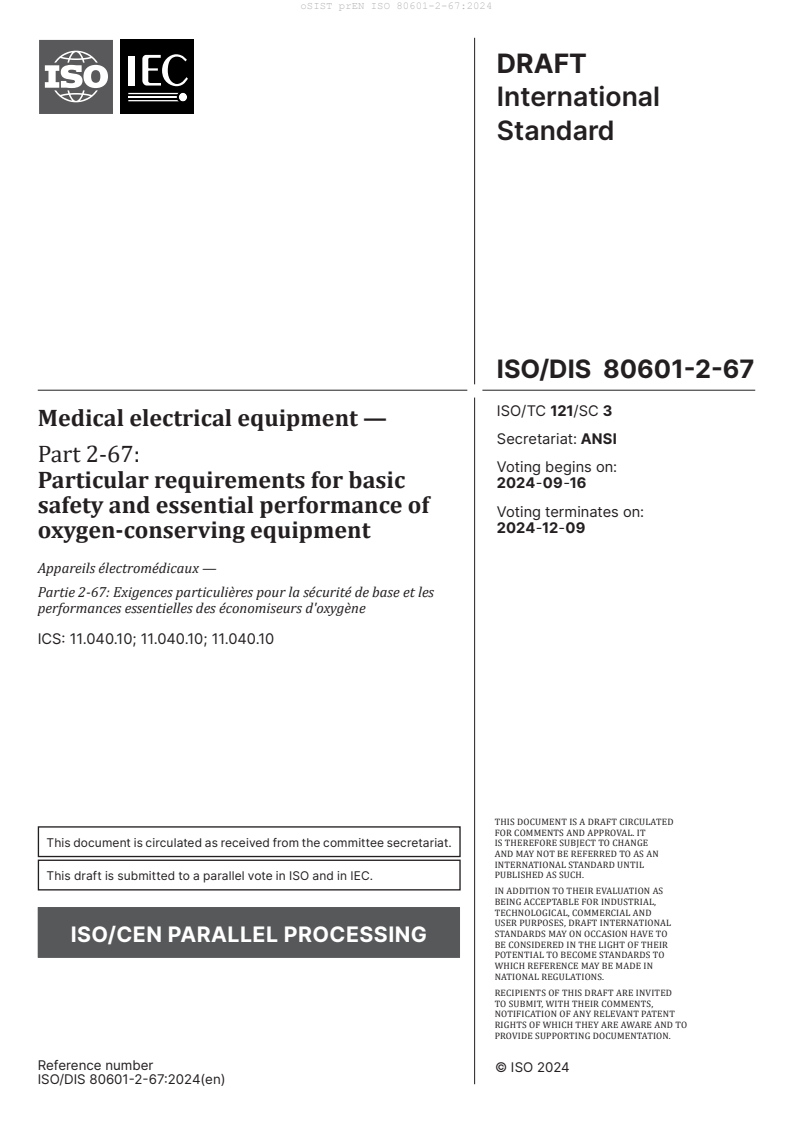
DRAFT
International
Standard
ISO/DIS 80601-2-67
ISO/TC 121/SC 3
Medical electrical equipment —
Secretariat: ANSI
Part 2-67:
Voting begins on:
Particular requirements for basic 2024-09-16
safety and essential performance of
Voting terminates on:
2024-12-09
oxygen-conserving equipment
Appareils électromédicaux —
Partie 2-67: Exigences particulières pour la sécurité de base et les
performances essentielles des économiseurs d'oxygène
ICS: 11.040.10; 11.040.10; 11.040.10
THIS DOCUMENT IS A DRAFT CIRCULATED
FOR COMMENTS AND APPROVAL. IT
This document is circulated as received from the committee secretariat. IS THEREFORE SUBJECT TO CHANGE
AND MAY NOT BE REFERRED TO AS AN
INTERNATIONAL STANDARD UNTIL
PUBLISHED AS SUCH.
This draft is submitted to a parallel vote in ISO and in IEC.
IN ADDITION TO THEIR EVALUATION AS
BEING ACCEPTABLE FOR INDUSTRIAL,
TECHNOLOGICAL, COMMERCIAL AND
USER PURPOSES, DRAFT INTERNATIONAL
STANDARDS MAY ON OCCASION HAVE TO
ISO/CEN PARALLEL PROCESSING
BE CONSIDERED IN THE LIGHT OF THEIR
POTENTIAL TO BECOME STANDARDS TO
WHICH REFERENCE MAY BE MADE IN
NATIONAL REGULATIONS.
RECIPIENTS OF THIS DRAFT ARE INVITED
TO SUBMIT, WITH THEIR COMMENTS,
NOTIFICATION OF ANY RELEVANT PATENT
RIGHTS OF WHICH THEY ARE AWARE AND TO
PROVIDE SUPPORTING DOCUMENTATION.
Reference number
ISO/DIS 80601-2-67:2024(en)
oSIST prEN ISO 80601-2-67:2024
DRAFT
ISO/DIS 80601-2-67:2024(en)
International
Standard
ISO/DIS 80601-2-67
ISO/TC 121/SC 3
Medical electrical equipment —
Secretariat: ANSI
Part 2-67:
Voting begins on:
Particular requirements for basic
safety and essential performance of
Voting terminates on:
oxygen-conserving equipment
Appareils électromédicaux —
Partie 2-67: Exigences particulières pour la sécurité de base et les
performances essentielles des économiseurs d'oxygène
ICS: 11.040.10; 11.040.10; 11.040.10
THIS DOCUMENT IS A DRAFT CIRCULATED
FOR COMMENTS AND APPROVAL. IT
IS THEREFORE SUBJECT TO CHANGE
This document is circulated as received from the committee secretariat.
AND MAY NOT BE REFERRED TO AS AN
INTERNATIONAL STANDARD UNTIL
PUBLISHED AS SUCH.
This draft is submitted to a parallel vote in ISO and in IEC.
IN ADDITION TO THEIR EVALUATION AS
BEING ACCEPTABLE FOR INDUSTRIAL,
© ISO 2024
TECHNOLOGICAL, COMMERCIAL AND
USER PURPOSES, DRAFT INTERNATIONAL
All rights reserved. Unless otherwise specified, or required in the context of its implementation, no part of this publication may
STANDARDS MAY ON OCCASION HAVE TO
ISO/CEN PARALLEL PROCESSING
be reproduced or utilized otherwise in any form or by any means, electronic or mechanical, including photocopying, or posting on
BE CONSIDERED IN THE LIGHT OF THEIR
the internet or an intranet, without prior written permission. Permission can be requested from either ISO at the address below
POTENTIAL TO BECOME STANDARDS TO
WHICH REFERENCE MAY BE MADE IN
or ISO’s member body in the country of the requester.
NATIONAL REGULATIONS.
ISO copyright office
RECIPIENTS OF THIS DRAFT ARE INVITED
CP 401 • Ch. de Blandonnet 8
TO SUBMIT, WITH THEIR COMMENTS,
CH-1214 Vernier, Geneva
NOTIFICATION OF ANY RELEVANT PATENT
Phone: +41 22 749 01 11
RIGHTS OF WHICH THEY ARE AWARE AND TO
PROVIDE SUPPORTING DOCUMENTATION.
Email: copyright@iso.org
Website: www.iso.org
Published in Switzerland Reference number
ISO/DIS 80601-2-67:2024(en)
ii
oSIST prEN ISO 80601-2-67:2024
ISO/DIS 80601-2-67:2024(en)
1 Contents Page
3 Foreword . iv
4 Introduction . vi
5 201.1 Scope, object and related standards . 1
6 201.2 Normative references . 3
7 201.3 Terms and definitions . 4
8 201.4 General requirements . 13
9 201.5 General requirements for testing of ME equipment . 16
10 201.6 Classification of ME equipment and ME systems . 17
11 201.7 ME equipment identification, marking and documents . 17
12 201.8 Protection against electrical hazards from ME equipment . 24
13 201.9 Protection against mechanical hazards of ME equipment and ME systems . 24
14 201.10 Protection against unwanted and excessive radiation hazards . 24
15 201.11 Protection against excessive temperatures and other hazards . 24
16 201.12 Accuracy of controls and instruments and protection against hazardous outputs . 26
17 201.13 Hazardous situations and fault conditions . 29
18 201.14 Programmable electrical medical systems (PEMS) . 29
19 201.15 Construction of ME equipment . 30
20 201.16 ME systems . 30
21 201.17 Electromagnetic compatibility of ME equipment and ME systems . 31
22 201.101 Gas connections. 31
23 201.102 Requirements for parts and accessories . 32
24 201.103 Oxygen pressure regulators . 33
25 202 Electromagnetic disturbances – Requirements and tests . 34
26 202.4.3.1 Configurations . 34
27 206 Usability . 34
28 Annex C (informative) Guide to marking and labelling requirements for ME equipment and
29 ME systems . 36
30 Annex D (informative) Symbols on marking . 41
31 Annex AA (informative) Particular guidance and rationale . 42
32 Annex BB (informative) Reference to the IMDRF essential principles and labelling
33 guidances . 51
34 Annex CC (informative) Terminology — Alphabetized index of defined terms . 55
35 Bibliography . 58
36 Table ZA.2 — Applicable Standards to confer presumption of conformity as described in
37 this Annex ZA . 62
iii
oSIST prEN ISO 80601-2-67:2024
ISO/DIS 80601-2-67:2024(en)
39 Foreword
40 ISO (the International Organization for Standardization) and IEC (the International Electrotechnical
41 Commission) form the specialized system for worldwide standardization. National bodies that are
42 members of ISO or IEC participate in the development of International Standards through technical
43 committees established by the respective organization to deal with particular fields of technical activity.
44 ISO and IEC technical committees collaborate in fields of mutual interest. Other international
45 organizations, governmental and non-governmental, in liaison with ISO and IEC, also take part in the
46 work.
47 The procedures used to develop this document and those intended for its further maintenance are
48 described in the ISO/IEC Directives, Part 1. In particular, the different approval criteria needed for the
49 different types of document should be noted. This document was drafted in accordance with the editorial
50 rules of the ISO/IEC Directives, Part 2 (see www.iso.org/directives or
51 www.iec.ch/members_experts/refdocs).
52 ISO and IEC draw attention to the possibility that the implementation of this document may involve the
53 use of (a) patent(s). ISO and IEC take no position concerning the evidence, validity or applicability of any
54 claimed patent rights in respect thereof. As of the date of publication of this document, ISO and IEC had
55 not received notice of (a) patent(s) which may be required to implement this document. However,
56 implementers are cautioned that this may not represent the latest information, which may be obtained
57 from the patent database available at www.iso.org/patents and https://patents.iec.ch. ISO and IEC shall
58 not be held responsible for identifying any or all such patent rights.
59 Any trade name used in this document is information given for the convenience of users and does not
60 constitute an endorsement.
61 For an explanation of the voluntary nature of standards, the meaning of ISO specific terms and
62 expressions related to conformity assessment, as well as information about ISO's adherence to the World
63 Trade Organization (WTO) principles in the Technical Barriers to Trade (TBT) see
64 www.iso.org/iso/foreword.html. In the IEC, see www.iec.ch/understanding-standards.
65 This document was prepared jointly by Technical Committee ISO/TC 121, Anaesthetic and respiratory
66 equipment, Subcommittee SC 3, Respiratory devices and related equipment used for patient care, and
67 Technical Committee IEC/TC 62, Medical equipment, software, and systems, Subcommittee SC D, Particular
68 medical equipment, software, and systems, in collaboration with the European Committee for
69 Standardization (CEN) Technical Committee CEN/TC 215, Respiratory and anaesthetic equipment, in
70 accordance with the Agreement on technical cooperation between ISO and CEN (Vienna Agreement).
71 This third edition cancels and replaces the second edition (ISO 80601-2-67:2020), which has been
72 technically revised.
73 The main changes are as follows:
74 — updated references, where appropriate;
75 — harmonization with ISO 20417, where appropriate;
76 — updated uncertainty of measurement requirements;
77 — added marking requirements for gas intake port, external gas sources and MR compatibility;
78 — requirements for processing of the enclosure;
iv
oSIST prEN ISO 80601-2-67:2024
ISO/DIS 80601-2-67:2024(en)
79 — added cybersecurity recommendations; and
80 — updated connector requirements.
81 A list of all parts in the ISO 80601 and IEC 80601 series can be found on the ISO and IEC websites.
82 Any feedback or questions on this document should be directed to the user’s national standards body. A
83 complete listing of these bodies can be found at www.iso.org/members.html and www.iec.ch/national-
84 committees.
v
oSIST prEN ISO 80601-2-67:2024
ISO/DIS 80601-2-67:2024(en)
85 Introduction
86 Long-term oxygen therapy has been demonstrated in randomized, controlled clinical trials to prolong
87 survival in patients with chronic respiratory disease and documented hypoxemia. Typical sources of
88 therapeutic long-term oxygen therapy include gaseous oxygen from cylinders or from liquid oxygen and
89 oxygen from an oxygen concentrator.
90 Most clinicians prescribe low flow oxygen therapy as continuous flow oxygen (CFO) delivery in l/min.
91 CFO systems deliver the flow of oxygen without regard for the patient’s breathing rate or pattern. Outside
92 of the institutional care setting, the provision of CFO therapy is often a significant expense and can limit
93 the mobility of a patient to the immediate vicinity of a stationary or fixed oxygen delivery system. To
94 support mobility, patients use CFO from portable liquid or compressed oxygen systems with a limited
95 storage capacity that can limit a patient’s time and activities while away from a stationary oxygen supply.
96 Conserving equipment that delivers supplemental oxygen as a bolus conserves usage while allowing
97 satisfactory patient arterial oxygen saturation (SaO ) to be maintained during daily activities. Conserving
98 equipment delivers supplemental oxygen unlike CFO in that the therapy gas flow is delivered only during
99 the inspiratory phase of the breathing cycle, when it is most likely to reach the alveoli. During both the
100 expiratory and pause phase of the breathing cycle, the flow of supplemental oxygen is stopped,
101 minimizing waste. Because flow over time produces a volume, the bolus delivered by the conserving
102 equipment is typically represented as a volume of gas. Therapy using conserving equipment versus CFO
103 results in lower operating costs and longer ambulatory times for patients using the same CFO storage
104 capacity.
105 Operation of conserving equipment from various manufacturers might differ in the dose delivery
106 mechanism resulting in variations in oxygen therapy to the patient. The use of CFO numerical markings
107 for dose settings on conserving equipment might not directly correlate with CFO settings and might lead
108 to misinterpretation of gas delivery rates and volumes for a particular patient. This might result in
109 incorrect patient setup and therapy delivery over all breathing rates and patterns versus CFO. Because of
110 the differences in delivery, settings, and markings versus CFO therapy, conserving equipment use has
111 requirements for patient titration to determine the proper setting(s) needed to provide adequate SaO
112 levels for the patient breathing patterns.
113 In this document, the following print types are used:
114 — requirements and definitions: roman type;
115 — terms defined in Clause 3 of the general standard, in this particular document or as noted: italic type;
116 and
117 — informative material appearing outside of tables, such as notes, examples and references: in smaller type.
118 Normative text of tables is also in a smaller type.
119 In referring to the structure of this document, the term.
120 — “clause” means one of the three numbered divisions within the table of contents, inclusive of all
121 subdivisions (e.g. Clause 201 includes subclauses 201.7, 201.8, etc.); and
122 — “subclause” means a numbered subdivision of a clause (e.g. 201.7, 201.8 and 201.9 are all subclauses
123 of Clause 201).
124 References to clauses within this document are preceded by the term “Clause” followed by the clause
125 number. References to subclauses within this particular document are by number only.
vi
oSIST prEN ISO 80601-2-67:2024
ISO/DIS 80601-2-67:2024(en)
126 In this document, the conjunctive “or” is used as an “inclusive or” so a statement is true if any combination
127 of the conditions is true.
128 For the purposes of this document, the auxiliary verb:
129 — “shall” indicates a requirement;
130 — "should” indicates a requirement or a test is recommendation;
131 — "may” indicates a permission;
132 — "can" is used to describe a possibility or capability; and
133 — "must" is used to express an external constraint.
134 Annex C contains a guide to the marking and labelling requirements in this document.
135 Annex D contains a summary of the symbols referenced in this document.
136 Requirements in this document have been decomposed so that each requirement is uniquely delineated.
137 This is done to support automated requirements tracking.
vii
oSIST prEN ISO 80601-2-67:2024
oSIST prEN ISO 80601-2-67:2024
DRAFT INTERNATIONAL STANDARD ISO/DIS 80601-2-67:2024(en)
140 Medical electrical equipment —
141 Part 2-67:
142 Particular requirements for basic safety and essential
143 performance of oxygen conserving equipment
144 201.1 Scope, object and related standards
145 NOTE There is guidance or rationale for this clause contained in Clause AA.2.
146 IEC 60601-1:2005+AMD1:2012+AMD2:2020, Clause 1 applies, except as follows:
147 NOTE The general standard is IEC 60601-1:2005+AMD1:2012+AMD2:2020.
148 201.1.1 Scope
149 IEC 60601-1:2005+AMD1:2012+AMD2:2020, 1.1 is replaced by:
150 This document is applicable to the basic safety and essential performance of oxygen conserving equipment,
151 hereafter referred to as ME equipment, in combination with its accessories intended to conserve
152 supplemental oxygen by delivering gas intermittently and synchronized with the patient's inspiratory
153 cycle, when used in the home healthcare environment. Oxygen conserving equipment is typically used by
154 a lay operator.
155 NOTE 1 Conserving equipment can also be used in professional health care facilities.
156 This document is also applicable to conserving equipment that is incorporated with other equipment.
[4] [12]
157 EXAMPLE Conserving equipment combined with a pressure regulator , an oxygen concentrator or liquid
[7]
158 oxygen equipment .
159 This document is also applicable to those accessories intended by their manufacturer to be connected to
160 conserving equipment, where the characteristics of those accessories can affect the basic safety or essential
161 performance of the conserving equipment.
162 This document is intended to clarify the difference in operation of various conserving equipment models,
163 as well as between the operation of conserving equipment and continuous flow oxygen equipment, by
164 requiring standardized performance testing and labelling.
165 This document is only applicable to active devices (e.g. pneumatically or electrically powered) and is not
166 applicable to non-active devices (e.g. reservoir cannulas).
167 If a clause or subclause is specifically intended to be applicable to ME equipment only, or to ME systems
168 only, the title and content of that clause or subclause will say so. If that is not the case, the clause or
169 subclause applies both to ME equipment and to ME systems, as relevant.
oSIST prEN ISO 80601-2-67:2024
ISO/DIS 80601-2-67:2024(en)
170 Hazards inherent in the intended physiological function of ME equipment or ME systems within the scope
171 of this document are not covered by specific requirements in this document except in
172 IEC 60601-1:2005+AMD1:2012+AMD2:2020, 7.2.13 and 8.4.1.
173 NOTE 2 Additional information can be found in IEC 60601-1:2005+AMD1:2012+AMD2:2020, 4.2.
174 201.1.2 Object
175 IEC 60601-1:2005+AMD1:2012+AMD2:2020, 1.2 is replaced by:
176 The object of this document is to establish particular basic safety and essential performance requirements
177 for conserving equipment [as defined in 201.3.207] and its accessories.
178 NOTE 1 Accessories are included because accessories can have a significant impact on the basic safety or essential
179 performance of conserving equipment.
[17]
180 NOTE 2 This document has been prepared to address the relevant essential principles and labelling
[18]
181 principles guidances of the International Medical Devices Regulators Forum (IMDRF) as indicated in Annex BB.
182 NOTE 3 This document has been prepared to address the relevant general safety and performance requirements
[16]
183 of European regulation (EU) 2017/745 .
184 201.1.3 Collateral standards
185 IEC 60601-1:2005+AMD1:2012+AMD2:2020, 1.3 applies with the following addition:
186 IEC 60601-1-2+AMD1:2020 and IEC 60601-1-6+AMD1:2013+AMD2:2020 apply as modified in Clauses
187 202 and 206 respectively. IEC 60601-1-3 and IEC 60601-1-9 do not apply. All other published collateral
188 standards in the IEC 60601-1 series apply as published.
189 201.1.4 Particular standards
190 Replacement:
191 In the IEC 60601 series, particular standards define basic safety and essential performance requirements,
192 and may modify, replace or delete requirements contained in the general standard and collateral
193 standards as appropriate for the particular ME equipment under consideration.
194 A requirement of a particular standard takes priority over the general standard.
195 For brevity, IEC 60601-1+AMD1:2012+AMD2:2020 is referred to in this document as the general
196 standard. Collateral standards are referred to by their document number.
197 The numbering of clauses and subclauses of this document corresponds to that of the general standard
198 with the prefix “201” (e.g. 201.1 in this document addresses the content of Clause 1 of the general
199 standard) or applicable collateral standard with the prefix “20x”, where x is the final digit(s) of the
200 collateral standard document number (e.g. 202.4 in this document addresses the content of Clause 4 of
201 the IEC 60601-1-2 collateral standard, 206.4 in this document addresses the content of Clause 4 of the
202 IEC 60601-1-6 collateral standard, etc.). The changes to the text of the general standard are specified by
203 the use of the following words:
204 "Replacement" means that the clause or subclause of the general standard or applicable collateral
205 standard is replaced completely by the text of this document.
oSIST prEN ISO 80601-2-67:2024
ISO/DIS 80601-2-67:2024(en)
206 "Addition" means that the text of this document is additional to the requirements of the general standard
207 or applicable collateral standard.
208 "Amendment" means that the clause or subclause of the general standard or applicable collateral
209 standard is amended as indicated by the text of this document.
210 Subclauses, figures or tables which are additional to those of the general standard are numbered starting
211 from 201.101. However, due to the fact that definitions in the general standard are numbered 3.1 through
212 3.154, additional definitions in this document are numbered beginning from 201.3.201. Additional
213 annexes are lettered AA, BB, etc., and additional items aa), bb), etc.
214 Subclauses, figures or tables which are additional to those of a collateral standard are numbered starting
215 from 20x, where “x” is the number of the collateral standard, e.g. 202 for IEC 60601-1-2, 206 for
216 IEC 60601-1-6, etc.
217 The term "this document" is used to make reference to the general standard, any applicable collateral
218 standards and this particular document taken together.
219 Where there is no corresponding clause or subclause in this document, the clause or subclause of the
220 general standard or applicable collateral standard, although possibly not relevant, applies without
221 modification; where it is intended that any part of the general standard or applicable collateral standard,
222 although possibly relevant, is not to be applied, a statement to that effect is given in this document.
223 201.2 Normative references
224 The following documents are referred to in the text in such a way that some or all of their content
225 constitutes requirements of this document. For dated references, only the edition cited applies. For
226 undated references, the latest edition of the referenced document (including any amendments) applies.
227 IEC 60601-1:2005+AMD1:2012+AMD2:2020, Clause 2 applies, except as follows:
228 Addition:
229 ISO 32:1977, Gas cylinders for medical use — Marking for identification of content
230 ISO 5359:2014+AMD1:2017, Low-pressure hose assemblies for use with medical gases
231 ISO 7396-1:2016+AMD1:2017, Medical gas pipeline systems — Part 1: Pipeline systems for compressed
232 medical gases and vacuum
233 ISO 10524-1:2018, Pressure regulators for use with medical gases — Part 1: Pressure regulators and
234 pressure regulators with flow-metering devices
235 ISO 10524-3:2019, Pressure regulators for use with medical gases — Part 3: Pressure regulators integrated
236 with cylinder valves (VIPRs)
237 ISO 14937:2009, Sterilization of health care products — General requirements for characterization of a
238 sterilizing agent and the development, validation and routine control of a sterilization process for medical
239 devices
240 ISO 17664-1:2021, Processing of health care products — Information to be provided by the medical device
241 manufacturer for the processing of medical devices — Part 1: Critical and semi-critical medical devices
oSIST prEN ISO 80601-2-67:2024
ISO/DIS 80601-2-67:2024(en)
242 ISO 17664-2:2021, Processing of health care products — Information to be provided by the medical device
243 manufacturer for the processing of medical devices — Part 2: Non-critical medical devices
244 ISO 18562-1:2024, Biocompatibility evaluation of breathing gas pathways in healthcare applications —
245 Part 1: Evaluation and testing within a risk management process
246 ISO 20417:2021, Medical devices — Information to be supplied by the manufacturer
247 ISO 80369-1:— , Small-bore connectors for liquids and gases in healthcare applications — Part 1: General
248 requirements
249 IEC 60601-1:2005+AMD1:2012+AMD2:2020, Medical electrical equipment — Part 1: General
250 requirements for basic safety and essential performance
251 IEC Guide 115:2023, Application of uncertainty of measurement to conformity assessment activities in the
252 electrotechnical sector
253 EN 13544-2:2002+AMD1:2009, Respiratory therapy equipment — Part 2: Tubing and connectors
254 201.3 Terms and definitions
255 For the purposes of this document, the terms and definitions given in
256 IEC 60601-1:2005+AMD1:2012+AMD2:2020 and the following apply.
257 ISO and IEC maintain terminological databases for use in standardization at the following addresses:
258 — ISO Online browsing platform: available at https://www.iso.org/obp
259 — IEC Electropedia: available at http://www.electropedia.org/
260 NOTE An alphabetized index of defined terms is found in Annex CC.
261 Addition:
262 201.3.201
263 accompanying information
264 information accompanying or marked on a medical device or accessory for the user or those accountable
265 for the installation, use, processing, maintenance, decommissioning and disposal of the medical device or
266 accessory, particularly regarding safe use
267 Note 1 to entry: The accompanying information shall be regarded as part of the medical device or accessory.
268 Note 2 to entry: The accompanying information can consist of the label, marking, instructions for use, technical
269 description, installation manual, quick reference guide, etc.
270 Note 3 to entry: Accompanying information is not necessarily a written or printed document but could involve
271 auditory, visual, or tactile materials and multiple media types (e.g., CD/DVD-ROM, USB stick, website).
272 [SOURCE: ISO 20417:2021, 3.2, modified — deleted note 4.]
Under preparation. Stage at the time of publication: ISO/FDIS 80369-1:2024.
oSIST prEN ISO 80601-2-67:2024
ISO/DIS 80601-2-67:2024(en)
273 201.3.202
274 alarm limit
275 threshold used by an alarm system to determine an alarm condition
276 [SOURCE: IEC 60601-1-8:2006+AMD1:2012+AMD2:2020, 3.3]
277 201.3.203
278 attack
279 attempt to destroy, expose, alter, disable, steal or gain unauthorized access to or make unauthorized use
280 of an asset
281 [SOURCE: IEC 81001-5-1:2021, 3.5]
282 201.3.204
283 biocompatibility
284 ability of a medical device, accessory or material to perform with an appropriate host response in a
285 specific application
286 Note 1 to entry: A medical device or accessory may produce some level of adverse effect, but that level may be
287 determined to be acceptable when considering the benefits provided by the medical device or accessory.
288 [SOURCE: ISO 18562-1:2024, 3.6]
289 201.3.205
290 cleaning
291 removal of contaminants to the extent necessary for further processing or for intended use
292 Note 1 to entry: Cleaning consists of the removal of adherent soil (e.g. blood, protein substances, and other debris)
293 from the surfaces, crevices, serrations, joints, and lumens of a medical device by a manual or automated process that
294 prepares the items for safe handling or further processing.
295 [SOURCE: ISO 17664-2:2021, 3.1, modified — replaced 'and/or' with 'or'.]
296 201.3.206
297 connector
298 fitting to join two or more components
299 EXAMPLE Connectors for low-pressure hose assembly are any of a range of mating components intended to
300 maintain gas specificity by the allocation of a set of different diameters to the mating connectors for each particular
301 gas.
302 [SOURCE: ISO 4135:2022, 3.1.4.5]
303 201.3.207
304 conserving equipment
305 ME equipment intended to conserve supplemental oxygen by delivering gas intermittently and
306 synchronized with the patient's inspiratory cycle
307 Note 1 to entry: Conserving equipment can be electrically or pneumatically powered.
oSIST prEN ISO 80601-2-67:2024
ISO/DIS 80601-2-67:2024(en)
308 201.3.208
309 conserving equipment with monitoring function
310 conserving equipment suitable for use with patients where monitoring of oxygen delivery via the
311 conserving equipment is indicated
312 201.3.209
313 cybersecurity
314 state where information and systems are protected from unauthorized activities, such as access, use,
315 disclosure, disruption, modification, or destruction to a degree that the related risks to violation of
316 confidentiality, integrity, and availability are maintained at an acceptable level throughout the life cycle
317 [SOURCE: IEC 81001-5-1:2021, 3.30]
318 201.3.210
319 disinfection
320 process to inactivate viable microorganisms to a level previously specified as being appropriate for a
321 defined purpose
322 [SOURCE: ISO 17664-2:2021, 3.5]
323 201.3.211
324 essential function
325 function or capability that is required to maintain basic safety, essential performance, a minimum of
326 clinical functionality as specified by the manufacturer, and operational availability for the medical device
327 Note 1 to entry: Essential functions include, but are not limited to, the safety instrumented function (basic safety and
328 essential performance), the control function and the availability of urgently needed functions and such allowing the
329 operator to view and manipulate the medical device safely with the most urgently needed performance (operational
330 availability). The loss of essential function is commonly termed loss of protection, loss of control and loss of view
331 respectively.
332 Note 2 to entry: The term is derived from IEC 62443-4-2:2019, 3.1.20, and has been refined for the purpose and
333 scope of this document.
334 [SOURCE: IEC/TR 60601-4-5:2021, 3.10]
335 201.3.212
336 essential principles
337 essential principles of safety and performance
338 fundamental high-level requirements that when complied with ensure a medical device is safe and
339 performs as intended
340 [SOURCE: ISO 16142-1:2016, 3.3]
341 201.3.213
342 exhaust port
343 port of the medical equipment or device from which gas is discharged to the atmosphere during normal
344 use, either directly or via an anaesthetic gas scavenging system
oSIST prEN ISO 80601-2-67:2024
ISO/DIS 80601-2-67:2024(en)
345 [SOURCE: ISO 19223:2019, 3.14.2]
346 201.3.214
347 firecall
348 method established to provide emergency access to a secure medical device
349 Note 1 to entry: In an emergency situation, unprivileged users can gain access to key systems to correct the
350 problem. When a firecall is used, there is usually a review process to ensure that the access was used properly to
351 correct a problem. These methods generally either provide a one-time use user identifier (ID) or one-time password
352 or other suitable measures.
353 Note 2 to entry: Also referred to as "break glass" feature.
354 [SOURCE: IEC/TR 60601-4-5:2021, 3.11]
355 201.3.215
356 flow-direction-sensitive component
357 component or accessory through which gas flow is in one direction only for proper functioning or patient
358 safety
359 [SOURCE: ISO 4135:2022, 3.1.4.15, modified — added ‘or accessory’ and replaced “has to be” with “is”.]
360 201.3.216
361 gas intake port
362 port through which gas is drawn for use by the patient
363 Note 1 to entry: Gas is drawn at a sub-ambient pressure at a gas intake port, in opposition to an inlet, at which gas
364 is provided by a medical gas supply system.
365 [SOURCE: ISO 4135:2022, 3.1.4.21, modified — replaced “apposition” with ”opposition”.]
366 201.3.217
367 gas pathway
368 interior surfaces, over which gases or liquids that can be inspired pass
369 EXAMPLE 1 The ventilator breathing system, inlet filter, gas mixer, blower and internal piping.
370 EXAMPLE 2 Enclosed chamber of an incubator including the mattress or the inner surface of an oxygen hood.
371 EXAMPLE 3 The inner surfaces of breathing tubes, tracheal tubes or masks and mouthpieces.
372 Note 1 to entry: The gas pathway is bounded by the ports through which gases or liquids enter the medical device.
373 This can include the patient interface or the interior surfaces of enclosures that are in contact with gases or liquids
374 that can be inspired.
375 Note 2 to entry: The gas pathway can include some surfaces in the expiratory pathway.
376 Note 3 to entry: Patient contact surfaces such as the outer surfaces of a tracheal tube or the cushion of a mask are
377 evaluated according to the ISO 10993 series.
378 [SOURCE: ISO 18562-1:2024, 3.11]
oSIST prEN ISO 80601-2-67:2024
ISO/DIS 80601-2-67:2024(en)
379 201.3.218
380 high-pressure inlet
381 inlet to which gas is supplied at a pressure exceeding 100 kPa above ambient
382 Note 1 to entry: The phrases ‘low-pressure’ and ‘high-pressure’ are used differently in various contexts, including
383 breathing system pressures (typically less than 10 kPa), terminal outlet pressures (less than 600 kPa), manifold
384 pressures (typically up to 3 000 kPa) and cylinder pressures (typically less than 30 000 kPa).
385 [SOURCE: ISO 4135:2022, 3.1.4.24]
386 201.3.219
387 home healthcare environment
388 dwelling place in which a patient lives or other places where patients are present, excluding professional
389 healthcare facility environments where operators with medical training are continually available when
390 patients are present
391 EXAMPLE In a car, bus, train, boat or plane, in a wheelchair or walking outdoors.
392 Note 1 to entry: Professional healthcare facilities include hospitals, physician offices, freestanding surgical centres,
393 dental offices, freestanding birthing centres, limited care facilities, first aid rooms or rescue rooms, multiple
394 treatment facilities and emergency medical services.
395 Note 2 to entry: Nursing homes are considered home healthcare environments.
396 Note 3 to entry: Other places where a patient is present include the outdoor environment, while working and in
397 vehicles.
398 [SOURCE: IEC 60601-1-11:2015+AMD1:2020, 3.1, modified — deleted “For the purpose of this collateral
399 standard,”.]
400 201.3.220
401 I:E ratio
402 ratio of the inspiratory time to the expiratory time in a respiratory cycle
403 [SOURCE: ISO 19223:2019, 3.4.19, modified — deleted notes.]
404 201.3.221
405 immunity
406 the ability of ME equipment or an ME system to perform without degradation in the presence of an
407 electromagnetic disturbance
408 [SOURCE: IEC 60601-1-2:2014+AMD1:2020, 3.8]
409 201.3.222
410 information supplied by the manufacturer
411 information related to the identification and use of a medical device or accessory, in whatever form
412 provided, intended to ensure the safe and effective use of the medical device or accessory
413 Note 1 to entry: For the purposes of this document, e-documentation is included in information supplied by the
414 manufacturer.
oSIST prEN ISO 80601-2-67:2024
ISO/DIS 80601-2-67:2024(en)
415 Note 2 to entry: For the purposes of this document, shipping documents and promotional material are excluded
416 from information supplied by the manufacturer. However, some authorities having jurisdiction can consider such
417 supplemental information as information supplied by the manufacturer.
418 Note 3 to entry: The primary purpose of information supplied by the manufacturer is to identify the medical device
419 and its manufacturer, and provide essential information about its safety, performance, and appropriate use to the
420 user or other relevant persons.
421 [SOURCE: ISO 20417:2021, 3.10, modified — deleted note 4.]
422 201.3.223
423 inlet
424 opening through which gas or other material is pushed by an elevated upstream pressure
425 [SOURCE: ISO 4135:2022, 3.1.4.26, modified — deleted note.]
426 201.3.224
427 inspiratory time
428 t
I
429 duration of an inflation phase or inspiratory phase
430 [SOURCE: ISO 19223:2019, 3.4.8, modified — deleted notes.]
431 201.3.225
432 instructions for use
433 IFU
434 portion of the accompanying information that is essential for the safe and effective use of a medical device
435 or accessory directed to the user of the medical device
436 Note 1 to entry: For the purposes of this document, a user can be either a lay user or professional user with relevant
437 specialized training.
438 Note 2 to entry: For the purposes of this document, instructions for the professional processing between uses of a
439 medical device or accessory can be included in the instructions for use.
440 Note 3 to entry: For the purposes of this document, information indicated on a graphical user interface (GUI) is
441 considered as appearing on the item.
442 Note 4 to entry: The instructions for use, or portions thereof, can be located on the display of a medical device or
443 accessory.
444 Note 5 to entry: Medical devices or accessories that can be used safely and effectively without instructions for use
445 are exempted from having instructions for use by some authorities having jurisdiction.
446 [SOURCE: ISO 20417:2021, 3.11, modified — deleted note 6.]
447 201.3.226
448 lay
449 lay person
450 term referring to non-professional or professional without relevant specialized training
451 EXAMPLE Lay operator, lay responsible organization.
oSIST prEN ISO 80601-2-67:2024
ISO/DIS 80601-2-67:2024(en)
452 [SOURCE: IEC 60601-1-11:2015+AMD1:2020, 3.2]
453 201.3.227
454 low-pressure hose assembly
455 assembly consisting of a flexible hose with permanently attached gas-specific inlet and outlet connectors
456 and designed to conduct a medical gas at pressures less than 1 400 kPa
457 Note 1 to entry: The phrases ‘low-pressure’ and ‘high-pressure’ are used differently in various contexts, including
458 breathing system pressures (typically less than 10 kPa), terminal outlet pressures (less than 1 400 kPa), manifold
459 pressures (typically up to 3 000 kPa) and cylinder pressures (typically less than 30 000 kPa).
460 [SOURCE: ISO 4135:2022, 3.2.3.1]
461 201.3.228
462 lung
463 each of the pair of compliant organs within the ribcage (thorax), bounded by the terminal bronchiole and
464 the visceral pleura, which during ventilation provide gas/blood interfaces that enable oxygen from the
465 gas to pass into the blood and carbon dioxide to be removed
466 [SOURCE: ISO 19223:2019, 3.1.16, modified — deleted notes.]
467 201.3.229
468 marking
469 information, in text or graphical format, durably affixed, printed, etched (or equivalent) to a medical
470 device or accessory
471 Note 1 to entry: For the purposes of this document, the term marked is used to designate the corresponding act.
472 Note 2 to entry: For the purposes of this document, marking is different from ‘direct marking’ as commonly
473 described in unique device identification (UDI) standards and regulations. A UDI ‘direct marking’ is a type of
474 marking.
475 [SOURCE: ISO 20417:2021, 3.16, modified — deleted note 3.]
476 201.3.230
477 mask
478 device which provides a non-invasive interface between the patient’s airway and a patient-connection
479 port or other connection to a source of respirable gas
480 [SOURCE: ISO 4135:2022, 3.8.6.4]
481 201.3.231
482 maximum limited pressure
483 P
Lim,max
484 highest airway pressure that can occur during normal use or under single fault condition
485 [SOURCE: ISO 19223:2019, 3.13.3, modified — deleted notes.]
oSIST prEN ISO 80601-2-67:2024
ISO/DIS 80601-2-67:2024(en)
486 201.3.232
487 medical gas pipeline system
488 combination of a supply system, monitoring and alarm system and a pipeline distribution system with
489 terminal units for provision
...
Questions, Comments and Discussion
Ask us and Technical Secretary will try to provide an answer. You can facilitate discussion about the standard in here.