


EN 16025-2:2013
(Main)Thermal and/ or sound insulating products in building construction - Bound EPS ballastings - Part 2: Processing of the factory premixed EPS dry plaster
General Information
- Abstract
This European Standard specifies the requirements for in-situ formed bound EPS products (BEPS) for the thermal insulation of buildings when applied to walls, ceilings, roofs and floors.
This document is a specification for the installed insulation products.
This document describes, when taken together with EN 16025-1, the product characteristics that are linked to the essential requirements of the EU Construction Products Directive. It also specifies the checks and tests to be used for the declaration made by the installer of the products.
This document does not specify the required level of all properties to be achieved by a product to demonstrate fitness for purpose in a particular application. The required levels are to be found in regulations or non-conflicting standards.
This document does not cover factory made bound EPS insulation products.
- Status
- Published
- Publication Date
- 30-Apr-2013
- Technical Committee
- CEN/TC 88 - Thermal insulating materials and products
- Drafting Committee
- CEN/TC 88/WG 15 - In situ formed insulation products
- Current Stage
- 9093 - Decision to confirm - Review Enquiry
- Start Date
- 20-May-2025
- Completion Date
- 23-Sep-2026
- Directive
- Harmonized Standard305/2011 - Regulation (eu) No 305/2011 of the European Parliament and of the Council of 9 march 2011 laying down harmonised conditions for the marketing of construction products and repealing council directive 89/106/eec
Not Harmonized89/106/EEC - Construction products

Overview
EN 16025-2:2013 (CEN) is the non‑harmonised part of the European standard package for in‑situ formed bound EPS ballastings (BEPS). Titled “Thermal and/ or sound insulating products in building construction - Bound EPS ballastings - Part 2: Processing of the factory premixed EPS dry plaster,” it defines the specification, checks and on‑site tests that installers must carry out for installed BEPS used for thermal and/or acoustic insulation of walls, ceilings, roofs and floors. This document is intended to be used together with EN 16025-1 (product requirements) and supports compliance with the EU Construction Products Directive (CPD) for installed products.
Key topics and technical requirements
- Scope: Applies to in‑situ formed bound EPS products (BEPS); does not cover factory‑made bound EPS items.
- Use with EN 16025‑1: EN 16025‑1 covers factory premixed EPS dry plaster - Part 2 covers processing and installed product declaration.
- Installer responsibilities:
- Inspect building suitability per manufacturer guidance and national rules.
- Use a BEPS product that complies with EN 16025‑1.
- On‑site measurements and records:
- Apparent density of fresh mortar: sample at least every 10 m3 (use a ≥5 l vessel); record density to 1 kg/m3 accuracy and keep records for 3 years.
- Declared installed thickness: measure at least five locations per 100 m2 using the pin‑plate method (EN 823); report mean value dN.
- Declared installed thermal resistance RD: calculate RD = d / λD (d in metres, λD from EN 16025‑1); round down to nearest 0.05 m2K/W.
- Declared installed BEPS density: sample every 100 m3 or at least once per site; specimen ≥3 l; retain specimens for six months.
- Readiness for covering: determine residual moisture per EN ISO 12570 and accessibility by applying 0.2 kN on a 50 cm2 support for 120 s (deformation must not exceed 3 mm).
- Installer’s declaration: Document installation date/place, declared thickness, RD, fresh mortar apparent density, volume supplied, and trade name/designation code.
Applications and users
- Practical for installers, specifiers, building contractors, architects, and compliance officers involved in in‑situ bound EPS thermal and sound insulation.
- Used when designing and verifying floor infill, roof or ceiling BEPS layers where on‑site processing from factory premixed EPS dry plaster is applied.
- Supports project documentation for compliance, quality control, and client handover.
Related standards
- EN 16025‑1:2013 - Requirements for factory premixed EPS dry plaster (harmonised part)
- EN 823:2013 - Determination of thickness (pin‑plate method)
- EN ISO 9229:2007 - Thermal insulation vocabulary
- EN ISO 12570 - Residual moisture determination
- EN ISO 6946 and EN ISO 10456 - Procedures for calculating thermal resistance and corrections
Keywords: EN 16025-2, bound EPS, BEPS, in‑situ bound EPS, factory premixed EPS dry plaster, thermal insulation, sound insulation, installer declaration, declared thermal resistance.
Relations
- Refers
EN 823:2013 - Thermal insulating products for building applications - Determination of thickness - Effective Date
- 28-Jan-2026
- Effective Date
- 28-Jan-2026
- Effective Date
- 28-Jan-2026
- Effective Date
- 28-Jan-2026
Get Certified
Connect with accredited certification bodies for this standard

DIBt (Deutsches Institut für Bautechnik)
German Institute for Building Technology.
DIN CERTCO
DIN Group product certification.

Aboma Certification B.V.
Specialized in construction, metal, and transport sectors.
Sponsored listings
Frequently Asked Questions
EN 16025-2:2013 is a standard published by the European Committee for Standardization (CEN). Its full title is "Thermal and/ or sound insulating products in building construction - Bound EPS ballastings - Part 2: Processing of the factory premixed EPS dry plaster". This standard covers: This European Standard specifies the requirements for in-situ formed bound EPS products (BEPS) for the thermal insulation of buildings when applied to walls, ceilings, roofs and floors. This document is a specification for the installed insulation products. This document describes, when taken together with EN 16025-1, the product characteristics that are linked to the essential requirements of the EU Construction Products Directive. It also specifies the checks and tests to be used for the declaration made by the installer of the products. This document does not specify the required level of all properties to be achieved by a product to demonstrate fitness for purpose in a particular application. The required levels are to be found in regulations or non-conflicting standards. This document does not cover factory made bound EPS insulation products.
This European Standard specifies the requirements for in-situ formed bound EPS products (BEPS) for the thermal insulation of buildings when applied to walls, ceilings, roofs and floors. This document is a specification for the installed insulation products. This document describes, when taken together with EN 16025-1, the product characteristics that are linked to the essential requirements of the EU Construction Products Directive. It also specifies the checks and tests to be used for the declaration made by the installer of the products. This document does not specify the required level of all properties to be achieved by a product to demonstrate fitness for purpose in a particular application. The required levels are to be found in regulations or non-conflicting standards. This document does not cover factory made bound EPS insulation products.
EN 16025-2:2013 is classified under the following ICS (International Classification for Standards) categories: 91.100.60 - Thermal and sound insulating materials. The ICS classification helps identify the subject area and facilitates finding related standards.
EN 16025-2:2013 has the following relationships with other standards: It is inter standard links to EN 823:2013, EN 16025-1:2013, EN ISO 9229:2007, EN ISO 12570:2000. Understanding these relationships helps ensure you are using the most current and applicable version of the standard.
EN 16025-2:2013 is associated with the following European legislation: EU Directives/Regulations: 305/2011, 89/106/EEC; Standardization Mandates: M/103. When a standard is cited in the Official Journal of the European Union, products manufactured in conformity with it benefit from a presumption of conformity with the essential requirements of the corresponding EU directive or regulation.
EN 16025-2:2013 is available in PDF format for immediate download after purchase. The document can be added to your cart and obtained through the secure checkout process. Digital delivery ensures instant access to the complete standard document.
Standards Content (Sample)
2003-01.Slovenski inštitut za standardizacijo. Razmnoževanje celote ali delov tega standarda ni dovoljeno.36Dämmstoffe für den Wärme- und/oder Schallschutz im Hochbau - Gebundene EPS-Schüttungen - Teil 2: Verarbeitung des werkmäßig vorgemischten EPS-TrockenmörtelsProduits isolants thermiques et/ou acoustiques utilisés dans la construction immobilière avec liant - Empierrements en PSE lié - Partie 2: Fabrication du pré-mélange plâtre sec PSEThemal and/ or sound insulating products in building construction - Bound EPS ballastings - Part 2: Processing of the factory premixed EPS dry plaster91.100.60Thermal and sound insulating materialsICS:Ta slovenski standard je istoveten z:EN 16025-2:2013SIST EN 16025-2:2013en,fr,de01-oktober-2013SIST EN 16025-2:2013SLOVENSKI
STANDARD
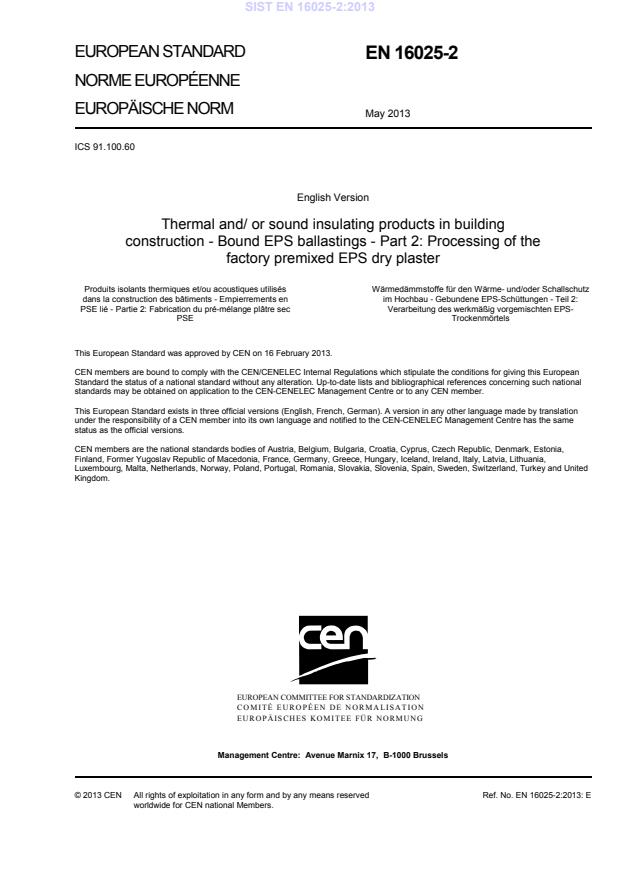
EUROPEAN STANDARD NORME EUROPÉENNE EUROPÄISCHE NORM
EN 16025-2
May 2013 ICS 91.100.60 English Version
Thermal and/ or sound insulating products in building construction - Bound EPS ballastings - Part 2: Processing of the factory premixed EPS dry plaster
Produits isolants thermiques et/ou acoustiques utilisés dans la construction des bâtiments - Empierrements en PSE lié - Partie 2: Fabrication du pré-mélange plâtre sec PSE
Wärmedämmstoffe für den Wärme- und/oder Schallschutz im Hochbau - Gebundene EPS-Schüttungen - Teil 2: Verarbeitung des werkmäßig vorgemischten EPS-Trockenmörtels This European Standard was approved by CEN on 16 February 2013.
CEN members are bound to comply with the CEN/CENELEC Internal Regulations which stipulate the conditions for giving this European Standard the status of a national standard without any alteration. Up-to-date lists and bibliographical references concerning such national standards may be obtained on application to the CEN-CENELEC Management Centre or to any CEN member.
This European Standard exists in three official versions (English, French, German). A version in any other language made by translation under the responsibility of a CEN member into its own language and notified to the CEN-CENELEC Management Centre has the same status as the official versions.
CEN members are the national standards bodies of Austria, Belgium, Bulgaria, Croatia, Cyprus, Czech Republic, Denmark, Estonia, Finland, Former Yugoslav Republic of Macedonia, France, Germany, Greece, Hungary, Iceland, Ireland, Italy, Latvia, Lithuania, Luxembourg, Malta, Netherlands, Norway, Poland, Portugal, Romania, Slovakia, Slovenia, Spain, Sweden, Switzerland, Turkey and United Kingdom.
EUROPEAN COMMITTEE FOR STANDARDIZATION
COMITÉ EUROPÉEN DE NORMALISATION EUROPÄISCHES KOMITEE FÜR NORMUNG
Management Centre:
Avenue Marnix 17,
B-1000 Brussels © 2013 CEN All rights of exploitation in any form and by any means reserved worldwide for CEN national Members. Ref. No. EN 16025-2:2013: ESIST EN 16025-2:2013
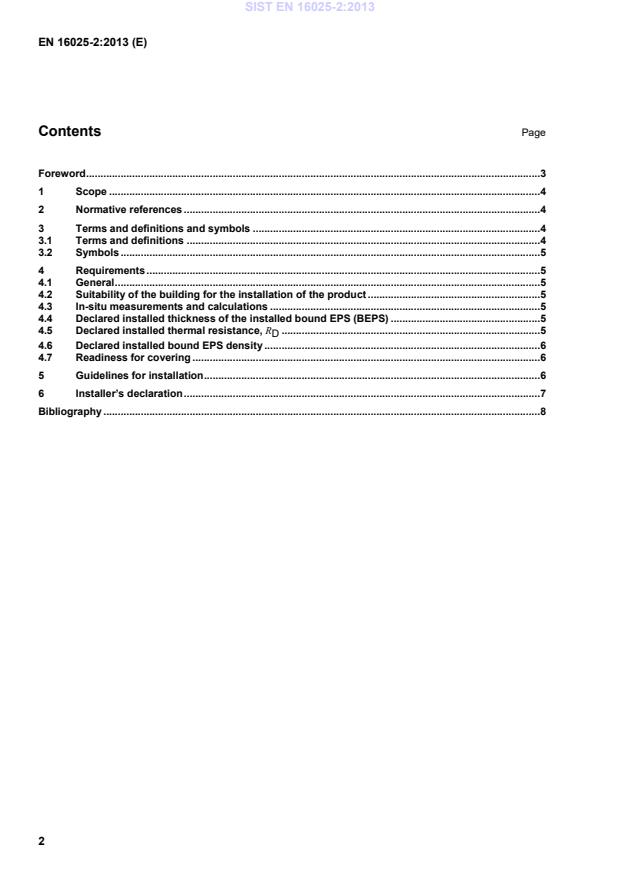
Foreword .3 1 Scope .4 2 Normative references .4 3 Terms and definitions and symbols .4 3.1 Terms and definitions .4 3.2 Symbols .5 4 Requirements .5 4.1 General .5 4.2 Suitability of the building for the installation of the product .5 4.3 In-situ measurements and calculations .5 4.4 Declared installed thickness of the installed bound EPS (BEPS) .5 4.5 Declared installed thermal resistance, RD .5 4.6 Declared installed bound EPS density .6 4.7 Readiness for covering .6 5 Guidelines for installation .6 6 Installer’s declaration .7 Bibliography .8
EN 16025-1, Thermal and/or sound insulating products in building construction — Bound EPS ballastings — Part 1: Requirements for factory premixed EPS dry plaster EN 16025-2, Thermal and/or sound insulating products in building construction — Bound EPS ballastings — Part 2: Processing of the factory premixed EPS dry plaster The first part is the harmonised part satisfying the mandate and the CPD and is the basis for the CE marking covering the products, which are placed on the market. The second part, which is the non-harmonised part, covers the specification for the installed products. Both parts need to be used for the application of the insulation product in the end-use applications covered by the standard. Attention is drawn to the need to take into account any complementary member state rules (e.g. installation rules) which together with this document ensure the fitness for purpose of the installed product. This document is one of a series for mineral wool, expanded clay, expanded perlite, exfoliated vermiculite, polyurethane/polyisocyanurate, cellulose, bound EPS and expanded polystyrene in-situ formed insulation products used in buildings, but this document may be used in other areas where appropriate. The reduction in energy used and emissions produced during the installed life of insulation products exceeds by far the energy used and emissions made during the production and disposal processes. According to the CEN-CENELEC Internal Regulations, the national standards organisations of the following countries are bound to implement this European Standard: Austria, Belgium, Bulgaria, Croatia, Cyprus, Czech Republic, Denmark, Estonia, Finland, Former Yugoslav Republic of Macedonia, France, Germany, Greece, Hungary, Iceland, Ireland, Italy, Latvia, Lithuania, Luxembourg, Malta, Netherlands, Norway, Poland, Portugal, Romania, Slovakia, Slovenia, Spain, Sweden, Switzerland, Turkey and the United Kingdom. SIST EN 16025-2:2013
...