


EN 14160:2001
(Main)Space engineering - Software
General Information
- Abstract
This European Standard defines the space software engineering process and its interfaces with the space project management standards (EN 13290) and space product assurance standards (EN 13291) and explains how they apply in the software engineering process.
This Standard is applicable to all the elements of a space system, including the space segment, the launch service segment and the ground segment.
This Standard covers all aspects of space software engineering including requirements definition, design, production, verification and validation, and transfer, operations and maintenance.
The scope of this Standard is the software developed as part of a space project, i.e. "Space system product software". It is not intended to cover software developments out of scope with the system of space standards. An example is the development of commercial software packages, where software is developed for a (large) volume market and not just for a single customer, and the main requirement analysis consists of market analysis, combined with a marketing strategy.
Other classes of software products not covered are: management information systems (e.g. finance, planning), technical information systems (e.g. CAD/CAM, analysis packages) and supporting software products for documentation systems, database systems, spreadsheets. These usually result from the procurement or adaptation of existing commercial products, and not part of the space system development. Such software products are, however, often part of a supporting infrastructure for space systems.
When viewed from the perspective of a specific project context, the requirements defined in this Standard should be tailored to match the genuine requirements of a particular profile and circumstances of a project.
- Status
- Withdrawn
- Publication Date
- 11-Dec-2001
- Withdrawal Date
- 16-Sep-2026
- Technical Committee
- CEN/SS T02 - Aerospace
- Drafting Committee
- CEN/SS T02 - Aerospace
- Current Stage
- 9960 - Withdrawal effective - Withdrawal
- Start Date
- 27-Aug-2014
- Completion Date
- 17-Sep-2026


Relations
- Effective Date
- 08-Jun-2022
- Effective Date
- 25-Aug-2026
- Effective Date
- 28-Jan-2026
- Effective Date
- 28-Jan-2026
- Effective Date
- 28-Jan-2026
- Refers
EN 13290-3:2001 - Space project management - General requirements - Part 3: Project organization - Effective Date
- 28-Jan-2026
- Effective Date
- 28-Jan-2026
- Effective Date
- 28-Jan-2026
- Effective Date
- 28-Jan-2026
- Refers
EN 13290-1:1999 - Space project management - General requirements - Part 1: Policy and principles - Effective Date
- 28-Jan-2026
- Refers
EN 13290-5:2001 - Space project management - General requirements - Part 5: Configuration management - Effective Date
- 28-Jan-2026
- Effective Date
- 28-Jan-2026
- Effective Date
- 28-Jan-2026
Get Certified
Connect with accredited certification bodies for this standard

BUREAU VERITAS Certification Germany
Bureau Veritas certification in Germany.

Element Materials Technology
Materials testing and product certification.

AQMS Ltd.
AQMS provides ISO certification to SMEs across the UK.
Sponsored listings
Frequently Asked Questions
EN 14160:2001 is a standard published by the European Committee for Standardization (CEN). Its full title is "Space engineering - Software". This standard covers: This European Standard defines the space software engineering process and its interfaces with the space project management standards (EN 13290) and space product assurance standards (EN 13291) and explains how they apply in the software engineering process. This Standard is applicable to all the elements of a space system, including the space segment, the launch service segment and the ground segment. This Standard covers all aspects of space software engineering including requirements definition, design, production, verification and validation, and transfer, operations and maintenance. The scope of this Standard is the software developed as part of a space project, i.e. "Space system product software". It is not intended to cover software developments out of scope with the system of space standards. An example is the development of commercial software packages, where software is developed for a (large) volume market and not just for a single customer, and the main requirement analysis consists of market analysis, combined with a marketing strategy. Other classes of software products not covered are: management information systems (e.g. finance, planning), technical information systems (e.g. CAD/CAM, analysis packages) and supporting software products for documentation systems, database systems, spreadsheets. These usually result from the procurement or adaptation of existing commercial products, and not part of the space system development. Such software products are, however, often part of a supporting infrastructure for space systems. When viewed from the perspective of a specific project context, the requirements defined in this Standard should be tailored to match the genuine requirements of a particular profile and circumstances of a project.
This European Standard defines the space software engineering process and its interfaces with the space project management standards (EN 13290) and space product assurance standards (EN 13291) and explains how they apply in the software engineering process. This Standard is applicable to all the elements of a space system, including the space segment, the launch service segment and the ground segment. This Standard covers all aspects of space software engineering including requirements definition, design, production, verification and validation, and transfer, operations and maintenance. The scope of this Standard is the software developed as part of a space project, i.e. "Space system product software". It is not intended to cover software developments out of scope with the system of space standards. An example is the development of commercial software packages, where software is developed for a (large) volume market and not just for a single customer, and the main requirement analysis consists of market analysis, combined with a marketing strategy. Other classes of software products not covered are: management information systems (e.g. finance, planning), technical information systems (e.g. CAD/CAM, analysis packages) and supporting software products for documentation systems, database systems, spreadsheets. These usually result from the procurement or adaptation of existing commercial products, and not part of the space system development. Such software products are, however, often part of a supporting infrastructure for space systems. When viewed from the perspective of a specific project context, the requirements defined in this Standard should be tailored to match the genuine requirements of a particular profile and circumstances of a project.
EN 14160:2001 is classified under the following ICS (International Classification for Standards) categories: 49.140 - Space systems and operations. The ICS classification helps identify the subject area and facilitates finding related standards.
EN 14160:2001 has the following relationships with other standards: It is inter standard links to EN 16603-40:2014, ISO 8402:1994, EN 13290-6:2001, EN 16601-00-01:2015, EN 13290-2:2001, EN 13290-3:2001, EN 10301:2003, EN 13290-4:2001, EN 13292:1999, EN 13290-1:1999, EN 13290-5:2001, EN 13290-7:2001, EN 14607-6:2004. Understanding these relationships helps ensure you are using the most current and applicable version of the standard.
EN 14160:2001 is associated with the following European legislation: Standardization Mandates: M/237. When a standard is cited in the Official Journal of the European Union, products manufactured in conformity with it benefit from a presumption of conformity with the essential requirements of the corresponding EU directive or regulation.
EN 14160:2001 is available in PDF format for immediate download after purchase. The document can be added to your cart and obtained through the secure checkout process. Digital delivery ensures instant access to the complete standard document.
Standards Content (Sample)
2003-01.Slovenski inštitut za standardizacijo. Razmnoževanje celote ali delov tega standarda ni dovoljeno.Space engineering - SoftwareRaumfahrttechnik - SoftwareIngéniérie spatiale - LogicielSpace engineering - Software49.140Vesoljski sistemi in operacijeSpace systems and operationsICS:Ta slovenski standard je istoveten z:EN 14160:2001SIST EN 14160:2004en01-maj-2004SIST EN 14160:2004SLOVENSKI
STANDARD
EUROPEAN STANDARDNORME EUROPÉENNEEUROPÄISCHE NORMEN 14160December 2001ICS 49.140English versionSpace engineering - SoftwareThis European Standard was approved by CEN on 11 November 2001.CEN members are bound to comply with the CEN/CENELEC Internal Regulations which stipulate the conditions for giving this EuropeanStandard the status of a national standard without any alteration. Up-to-date lists and bibliographical references concerning such nationalstandards may be obtained on application to the Management Centre or to any CEN member.This European Standard exists in three official versions (English, French, German). A version in any other language made by translationunder the responsibility of a CEN member into its own language and notified to the Management Centre has the same status as the officialversions.CEN members are the national standards bodies of Austria, Belgium, Czech Republic, Denmark, Finland, France, Germany, Greece,Iceland, Ireland, Italy, Luxembourg, Netherlands, Norway, Portugal, Spain, Sweden, Switzerland and United Kingdom.EUROPEAN COMMITTEE FOR STANDARDIZATIONCOMITÉ EUROPÉEN DE NORMALISATIONEUROPÄISCHES KOMITEE FÜR NORMUNGManagement Centre: rue de Stassart, 36
B-1050 Brussels© 2001 CENAll rights of exploitation in any form and by any means reservedworldwide for CEN national Members.Ref. No. EN 14160:2001 ESIST EN 14160:2004
(normative)
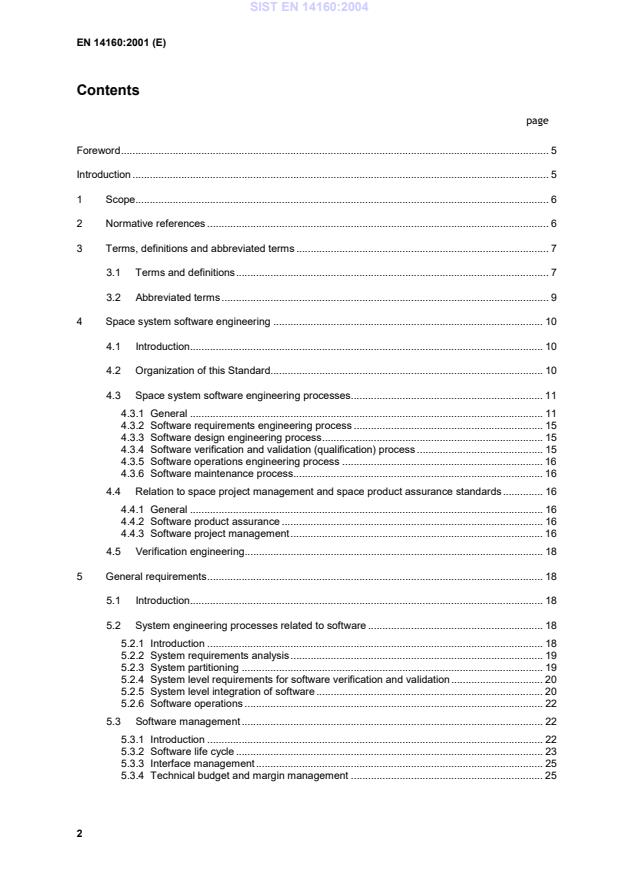
Software documentation.51A.1Introduction.51A.2The requirements baseline (RB).51A.2.1General.51A.2.2Requirements baseline contents at SRR.51A.2.3Interface requirements document (IRD).52A.3Technical specification (TS).53A.3.1General.53A.3.2Interface control document (ICD).54A.3.3Software maintenance plan.54A.3.4Operations manual.54A.4Design justification file (DJF).54A.5Design definition file (DDF).56A.6System level documentation.57A.6.1Introduction.57A.6.2Operations, maintenance, migration and retirement documentation.57Annex B (informative)
Requirement cross references.59Annex C (informative)
References to other space standards.61Bibliography.62FiguresFigure 1 — The recursive customer - supplier model.12Figure 2 — Overview of the software development processes.13Figure 3 — Process constraints.14Figure 4 — Accommodation of different software life cycles.14SIST EN 14160:2004
1) ECSS-E-40A.SIST EN 14160:2004
2) To be published.SIST EN 14160:2004
3) Software life cyclesThere is an abundant technical literature on the different types of software life cycles. This Standard does notrecommend any specific life cycle. Instead the requirements to be used in the choice of a life cycle for a givensoftware project are to be defined, such that the software life cycle remains consistent with the overall organizationand management of the space project organization and management, and that the life cycle outputs remainconsistent with the requirements of the space standard EN 13290. Commonly known classes of software life cyclesare:—the Waterfall life cycle,—the Incremental life cycle, and—the Evolutionary life cycle.This Standard has been verified for compatibility with these, but the choice is not limited to these three types.SIST EN 14160:2004
...