


prEN 13084-2
(Main)Free-standing chimneys - Part 2: Concrete chimneys
Free-standing chimneys - Part 2: Concrete chimneys
This document specifies particular requirements and performance criteria for the design and construction of cast-in situ concrete chimneys as well as prefabricated concrete chimneys. It identifies requirements to ensure the mechanical resistance and stability of concrete chimneys in accordance with the general requirements given in EN 13084-1:2025.
As for chimneys attached to buildings the criteria given in Clause 1 of EN 13084-1:2025 apply.
Unless otherwise stated in the following clauses the basic standard for the design of concrete structures, EN 1992-1-1:2023 applies.
Freistehende Schornsteine - Teil 2: Betonschornsteine
Dieses Dokument behandelt die besonderen Anforderungen und Leistungskriterien für die Bemessung und Ausführung von Ortbeton-Schornsteinen und Fertigteil-Schornsteinen. Es gibt Anforderungen an, die die mechanische Festigkeit und Standsicherheit von Betonschornsteinen nach den in EN 13084-1:2025 angegebenen allgemeinen Anforderungen sicherstellen.
Für an Gebäuden abgestützte Schornsteine gelten die in EN 13084-1:2025, Abschnitt 1, angegebenen Kriterien.
Sofern es in den folgenden Abschnitten nicht anders angegeben ist, gilt die Grundnorm für die Bemessung von Betontragwerken, EN 1992-1-1:2023.
Cheminées autoportantes - Partie 2 : Cheminées en béton
Le présent document spécifie les exigences particulières et les critères de performances relatifs à la conception et à la construction des cheminées en béton coulée sur place et en béton préfabriqué. I identifie les exigences permettant de garantir la résistance mécanique et la stabilité des cheminées en béton conformément aux exigences générales de l’EN 13084-1:2025.
En ce qui concerne les cheminées attachées aux bâtiments, les critères de l’Article 1 de l’EN 13084-1:2025 s’appliquent.
Sauf indication contraire dans les articles suivants, la norme de base relative à la conception des structures en béton, à savoir l’EN 1992-1-1:2023, s’applique.
Prostostoječi dimniki - 2. del: Betonski dimniki
General Information
- Status
- Not Published
- Publication Date
- 23-Sep-2026
- Technical Committee
- CEN/TC 297 - Free-standing industrial chimneys
- Drafting Committee
- CEN/TC 297 - Free-standing industrial chimneys
- Current Stage
- 4599 - Dispatch of FV draft to CMC - Finalization for Vote
- Start Date
- 10-Apr-2026
- Due Date
- 10-Aug-2026
- Completion Date
- 10-Apr-2026
Relations
- Effective Date
- 08-May-2024
Overview
prEN 13084-2:2025 - Free-standing chimneys, Part 2: Concrete chimneys (CEN) specifies the particular requirements and performance criteria for the design and construction of cast‑in‑situ and prefabricated concrete chimneys. It sets material, structural design and detailing rules to ensure mechanical resistance and stability in line with the general requirements of EN 13084-1:2025. Where not otherwise stated, EN 1992-1-1:2023 (Eurocode 2) applies as the basic concrete design standard.
Key topics and requirements
- Scope: Applies to free‑standing concrete chimneys (cast‑in‑situ and precast). Chimneys attached to buildings follow EN 13084-1:2025 clause 1.
- Materials:
- Minimum concrete strength for cast‑in‑situ: C25/30 (per prEN 206-1:2024).
- Rules for normal-weight and light-weight aggregate concretes for prefabricated elements (D1.2 density class and EN 1520 references).
- Mortar for bedding joints must match prefabricated element concrete strength.
- Reinforcing steel to follow EN 1992-1-1:2023.
- Material properties: Specific method for calculating mean tensile strength of concrete and adjustments for density, wall thickness and eccentricity.
- Structural design:
- Consideration of second‑order (P–Δ) effects in both horizontal and vertical sections.
- Use beam theory for most chimneys; apply shell theory for low‑slenderness, thin‑walled or heavily perforated sections.
- Account for creep, shrinkage and cracking when assessing stability.
- Partial safety factors recommended (examples included): permanent unfavourable γG = 1.35, wind γW = 1.5, thermal γT = 1.5, seismic γE = 1.0.
- Verification for Ultimate Limit State (ULS) and Serviceability Limit State (SLS).
- Detailing: Minimum vertical/horizontal reinforcement, reinforcement around openings, concrete cover, minimum wall thickness, splices, reinforcement ducts in prefabricated elements.
- Execution & quality: Workmanship, bedding joints, reinforcement ducts and quality control procedures; normative annexes on thermal stress analysis and crack‑width limits.
Applications and users
- Practical use cases:
- Design and construction of industrial and utility chimneys for power plants, incinerators and process plants.
- Fabrication and assembly of prefabricated concrete chimney segments and outer wall elements.
- Structural assessment, refurbishment and monitoring of existing free‑standing concrete chimneys.
- Primary users:
- Structural and civil engineers, chimney designers, precast manufacturers, contractors, building inspectors, certification bodies and owners/operators of industrial stacks.
Related standards
- EN 13084-1:2025 - Free‑standing chimneys - Part 1: General requirements
- EN 1992-1-1:2023 / EN 1992-1-2 - Eurocode 2 (concrete design and fire design)
- prEN 206-1:2024 - Concrete specification/performance
- EN 1520:2011 - Prefabricated lightweight aggregate concrete components
- EN 12446 - Chimney outer wall elements
This standard is essential for compliance and safe, durable design of concrete free‑standing chimneys in the European context.

Get Certified
Connect with accredited certification bodies for this standard

DIBt (Deutsches Institut für Bautechnik)
German Institute for Building Technology.
DIN CERTCO
DIN Group product certification.

Aboma Certification B.V.
Specialized in construction, metal, and transport sectors.
Sponsored listings
Frequently Asked Questions
prEN 13084-2 is a draft published by the European Committee for Standardization (CEN). Its full title is "Free-standing chimneys - Part 2: Concrete chimneys". This standard covers: This document specifies particular requirements and performance criteria for the design and construction of cast-in situ concrete chimneys as well as prefabricated concrete chimneys. It identifies requirements to ensure the mechanical resistance and stability of concrete chimneys in accordance with the general requirements given in EN 13084-1:2025. As for chimneys attached to buildings the criteria given in Clause 1 of EN 13084-1:2025 apply. Unless otherwise stated in the following clauses the basic standard for the design of concrete structures, EN 1992-1-1:2023 applies.
This document specifies particular requirements and performance criteria for the design and construction of cast-in situ concrete chimneys as well as prefabricated concrete chimneys. It identifies requirements to ensure the mechanical resistance and stability of concrete chimneys in accordance with the general requirements given in EN 13084-1:2025. As for chimneys attached to buildings the criteria given in Clause 1 of EN 13084-1:2025 apply. Unless otherwise stated in the following clauses the basic standard for the design of concrete structures, EN 1992-1-1:2023 applies.
prEN 13084-2 is classified under the following ICS (International Classification for Standards) categories: 91.060.40 - Chimneys, shafts, ducts. The ICS classification helps identify the subject area and facilitates finding related standards.
prEN 13084-2 has the following relationships with other standards: It is inter standard links to EN 13084-2:2007. Understanding these relationships helps ensure you are using the most current and applicable version of the standard.
prEN 13084-2 is associated with the following European legislation: EU Directives/Regulations: 305/2011; Standardization Mandates: M/105. When a standard is cited in the Official Journal of the European Union, products manufactured in conformity with it benefit from a presumption of conformity with the essential requirements of the corresponding EU directive or regulation.
prEN 13084-2 is available in PDF format for immediate download after purchase. The document can be added to your cart and obtained through the secure checkout process. Digital delivery ensures instant access to the complete standard document.
Standards Content (Sample)
SLOVENSKI STANDARD
01-oktober-2025
Prostostoječi dimniki - 2. del: Betonski dimniki
Free-standing chimneys - Part 2: Concrete chimneys
Freistehende Schornsteine - Teil 2: Betonschornsteine
Cheminées autoportantes - Partie 2 : Cheminées en béton
Ta slovenski standard je istoveten z: prEN 13084-2
ICS:
91.060.40 Dimniki, jaški, kanali Chimneys, shafts, ducts
91.100.30 Beton in betonski izdelki Concrete and concrete
products
2003-01.Slovenski inštitut za standardizacijo. Razmnoževanje celote ali delov tega standarda ni dovoljeno.
DRAFT
EUROPEAN STANDARD
NORME EUROPÉENNE
EUROPÄISCHE NORM
July 2025
ICS 91.060.40 Will supersede EN 13084-2:2007
English Version
Free-standing chimneys - Part 2: Concrete chimneys
Cheminées autoportantes - Partie 2 : Cheminées en Freistehende Schornsteine - Teil 2: Betonschornsteine
béton
This draft European Standard is submitted to CEN members for enquiry. It has been drawn up by the Technical Committee
CEN/TC 297.
If this draft becomes a European Standard, CEN members are bound to comply with the CEN/CENELEC Internal Regulations
which stipulate the conditions for giving this European Standard the status of a national standard without any alteration.
This draft European Standard was established by CEN in three official versions (English, French, German). A version in any other
language made by translation under the responsibility of a CEN member into its own language and notified to the CEN-CENELEC
Management Centre has the same status as the official versions.
CEN members are the national standards bodies of Austria, Belgium, Bulgaria, Croatia, Cyprus, Czech Republic, Denmark, Estonia,
Finland, France, Germany, Greece, Hungary, Iceland, Ireland, Italy, Latvia, Lithuania, Luxembourg, Malta, Netherlands, Norway,
Poland, Portugal, Republic of North Macedonia, Romania, Serbia, Slovakia, Slovenia, Spain, Sweden, Switzerland, Türkiye and
United Kingdom.
Recipients of this draft are invited to submit, with their comments, notification of any relevant patent rights of which they are
aware and to provide supporting documentation.
Warning : This document is not a European Standard. It is distributed for review and comments. It is subject to change without
notice and shall not be referred to as a European Standard.
EUROPEAN COMMITTEE FOR STANDARDIZATION
COMITÉ EUROPÉEN DE NORMALISATION
EUROPÄISCHES KOMITEE FÜR NORMUNG
CEN-CENELEC Management Centre: Rue de la Science 23, B-1040 Brussels
© 2025 CEN All rights of exploitation in any form and by any means reserved Ref. No. prEN 13084-2:2025 E
worldwide for CEN national Members.
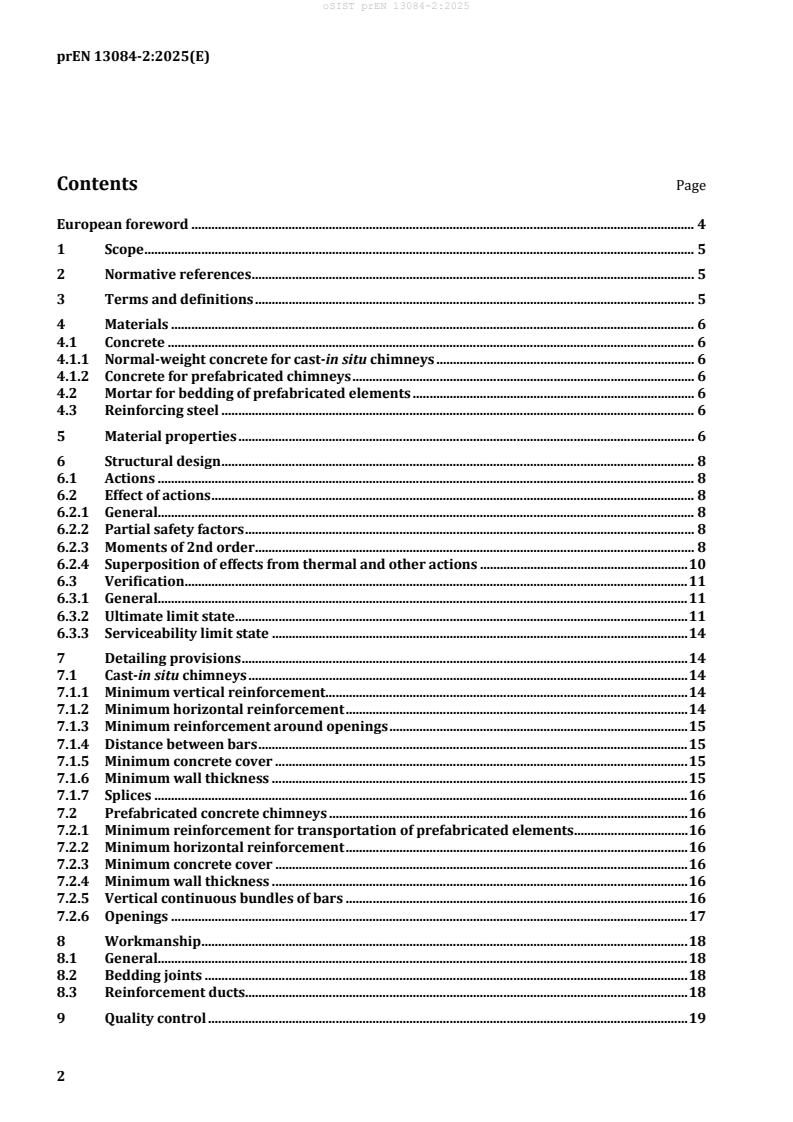
Contents Page
European foreword . 4
1 Scope . 5
2 Normative references . 5
3 Terms and definitions . 5
4 Materials . 6
4.1 Concrete . 6
4.1.1 Normal-weight concrete for cast-in situ chimneys . 6
4.1.2 Concrete for prefabricated chimneys . 6
4.2 Mortar for bedding of prefabricated elements . 6
4.3 Reinforcing steel . 6
5 Material properties . 6
6 Structural design . 8
6.1 Actions . 8
6.2 Effect of actions . 8
6.2.1 General. 8
6.2.2 Partial safety factors . 8
6.2.3 Moments of 2nd order . 8
6.2.4 Superposition of effects from thermal and other actions . 10
6.3 Verification . 11
6.3.1 General. 11
6.3.2 Ultimate limit state . 11
6.3.3 Serviceability limit state . 14
7 Detailing provisions . 14
7.1 Cast-in situ chimneys . 14
7.1.1 Minimum vertical reinforcement . 14
7.1.2 Minimum horizontal reinforcement . 14
7.1.3 Minimum reinforcement around openings . 15
7.1.4 Distance between bars . 15
7.1.5 Minimum concrete cover . 15
7.1.6 Minimum wall thickness . 15
7.1.7 Splices . 16
7.2 Prefabricated concrete chimneys . 16
7.2.1 Minimum reinforcement for transportation of prefabricated elements . 16
7.2.2 Minimum horizontal reinforcement . 16
7.2.3 Minimum concrete cover . 16
7.2.4 Minimum wall thickness . 16
7.2.5 Vertical continuous bundles of bars . 16
7.2.6 Openings . 17
8 Workmanship . 18
8.1 General. 18
8.2 Bedding joints . 18
8.3 Reinforcement ducts . 18
9 Quality control . 19
9.1 Cast-in situ chimneys . 19
9.2 Prefabricated chimneys . 19
Annex A (normative) Analysis of stresses due to thermal and other actions . 20
Annex B (normative) Limitations of crack widths . 24
Bibliography . 25
European foreword
This document (prEN 13084-2:2025) has been prepared by Technical Committee CEN/TC 297 “Free-
standing industrial chimneys”, the secretariat of which is held by AFNOR.
This document is currently submitted to the CEN Enquiry.
This document will supersede EN 13084-2:2007.
EN 13084-2:2007:
— the normative cross-references were adapted,
— requirements and areas of application have been revised,
— textual formulations and editorial changes for clarification were made and
— Formula (9) was corrected.
This document is part 2 of a series of standards as listed below:
— EN 13084-1, Free-standing chimneys — Part 1: General requirements
— EN 13084-2, Free-standing chimneys — Part 2: Concrete chimneys
— EN 13084-4, Free-standing chimneys — Part 4: Brick liners — Design and execution
— EN 13084-5, Free-standing chimneys — Part 5: Material for brick liners — Product specifications
— EN 13084-6, Free-standing chimneys — Part 6: Steel liners — Design and execution
— EN 13084-7, Free-standing chimneys — Part 7: Product specifications of cylindrical steel fabrications
for use in single wall steel chimneys and steel liners
— EN 13084-8, Free-standing chimneys — Part 8: Design and execution of mast construction with satellite
components
— EN 13084-9, Free-standing chimneys — Part 9: Monitoring, inspection, maintenance, remedial and
reporting; operations and actions required
Additionally applies:
— EN 1993-3-2, Eurocode 3: Design of steel structures – Part 3-2: Towers, masts and chimneys – Chimneys
This document has been prepared under a standardization request addressed to CEN by the European
Commission. The Standing Committee of the EFTA States subsequently approves these requests for its
Member States.
1 Scope
This document specifies particular requirements and performance criteria for the design and
construction of cast-in situ concrete chimneys as well as prefabricated concrete chimneys. It identifies
requirements to ensure the mechanical resistance and stability of concrete chimneys in accordance with
the general requirements given in EN 13084-1:2025.
As for chimneys attached to buildings the criteria given in Clause 1 of EN 13084-1:2025 apply.
Unless otherwise stated in the following clauses the basic standard for the design of concrete structures,
EN 1992-1-1:2023 applies.
2 Normative references
The following documents are referred to in the text in such a way that some or all of their content
constitutes requirements of this document. For dated references, only the edition cited applies. For
undated references, the latest edition of the referenced document (including any amendments) applies.
prEN 206-1:2024, Concrete — Specification, performance, production and conformity- Part 1: Performance
requirements factory production control and assessment criteria for individual values
EN 1520:2011, Prefabricated reinforced components of lightweight aggregate concrete with open structure
with structural or non-structural reinforcement
EN 1992-1-1:2023, Eurocode 2: Design of concrete structures — Part 1-1: General rules and rules for
buildings, bridges and civil engineering structures
EN 1992-1-2, Eurocode 2 - Design of concrete structures - Part 1-2: Structural fire design
EN 12446, Chimneys - Components - Concrete outer wall elements
EN 13084-1:2025, Free-standing chimneys - Part 1: General requirements
3 Terms and definitions
For the purposes of this document, the terms and definitions given in EN 13084-1:2025 and the following
apply.
ISO and IEC maintain terminology databases for use in standardization at the following addresses:
— ISO Online browsing platform: available at https://www.iso.org/obp/
— IEC Electropedia: available at https://www.electropedia.org/
3.1
prefabricated element
precast member of normal-weight or light-weight concrete, reinforced or not, which completely encloses
the flues of chimney stacks
3.2
reinforcement ducts
route for the continuous vertical reinforcement in prefabricated parts
4 Materials
4.1 Concrete
4.1.1 Normal-weight concrete for cast-in situ chimneys
The concrete strength classes given in prEN 206-1:2024 but not less than C25/30 can be used for cast-in
situ chimneys. For environmental conditions prEN 206-1:2024 applies.
4.1.2 Concrete for prefabricated chimneys
4.1.2.1 Normal-weight concrete
See 4.1.1.
4.1.2.2 Light-weight aggregate concrete
The light-weight aggregate concrete for prefabricated elements shall correspond to the density-
class D 1,2 or higher in accordance with Table 9 of prEN 206-1:2024
The light-weight aggregate concrete with closed structure for prefabricated elements shall correspond
to the strength classes given in prEN 206-1:2024. For environmental conditions prEN 206-1:2024
applies.
The light-weight aggregate concrete with open structure for prefabricated elements shall correspond to
the strength classes given in EN 1520:2011 but strength classes less than LAC 8 shall not be used. For
environmental conditions see EN 1520:2011, 5.8.2.
4.1.2.3 Reinforcement duct infill concrete
The reinforcement duct infill concrete shall have at least the same strength class as the prefabricated
elements, but not more than the next higher strength class. The flow class for consistence shall not be less
than F3 in accordance with Table 6 of prEN 206-1:2024 and the maximum size of aggregate shall not
be greater than 8 mm.
4.1.2.4 Outer wall elements
Prefabricated outer wall elements shall be in accordance with EN 12446.
4.2 Mortar for bedding of prefabricated elements
The mortar of bedding joints between prefabricated elements shall have the same strength class as the
concrete of the prefabricated elements.
4.3 Reinforcing steel
For reinforcing steel, the specifications given in EN 1992-1-1:2023 apply.
5 Material properties
The material properties of concrete and reinforcing steel for normal temperature design shall be taken
from EN 1992-1-1:2023 or EN 1520:2011 with the exception of the mean tensile strength of concrete,
f , which shall be calculated in accordance with Formula (1). The influence of elevated temperatures on
ctm
the mechanical and thermal properties of concrete and reinforcing steel shall be determined from
EN 1992-1-2.
0,67
f = c × c × c × c f (1)
ctm c β v η cm
where
c is the concrete density factor;
c
ρ
c = 0,4 + 0,6 (1a)
c
c is the concrete strength factor
β
c = 0,45 (1b)
β
c is the predamage factor
v
c = 0,85 - 0,2 x t (1c)
v
c is the eccentricity factor
η
06, +×6 c ×η
t
c = (1d)
η
1,0+×40 t
c is the wall thickness factor
t
2,6+ 24× t
cc= (1e)
t
1,0+×40 t
f is the mean compressive strength of concrete
cm
f = f + 8 in Newtons per square millimetres (N/mm ) (1f)
cm ck
f is the characteristic compressive strength (cylinders) of concrete in Newtons per square
ck
millimetres;
ρ is the density of concrete;
for normal-weight concrete;
ρ = 2200 kg/m
for light-weight concrete:
ρ is the design value of the density of concrete corresponding to the density class in
accordance with Table 11.1 of EN 1992-1-1:2023;
η is the eccentricity.
M
η= (1g)
Nt×
M is the design value of the bending moment in the cross-section concerned in Newton
metres;
N is the design value of the axial force in the cross-section concerned in Newtons;
t is the wall thickness of the cross-section concerned in metres.
For lightweight-aggregate concrete the symbols f , f and f shall be replaced by f , f and f
ctm cm ck lctm lcm lck
respectively.
6 Structural design
6.1 Actions
Actions to be considered are given in EN 13084-1:2025. For design values of actions and combination of
actions see EN 1990.
6.2 Effect of actions
6.2.1 General
The effect of actions in both horizontal and vertical cross-sections shall be calculated taking into account
moments of 2nd order.
The windshield should usually be treated in accordance with the beam theory being subjected to axial
forces, bending moments and thermal effects. For chimneys with very low slenderness and / or small
wall thickness and / or for areas with large openings additional calculations with shell theory shall be
executed.
If effects on the stability are expected, the influences from creep, shrinkage and cracking shall be taken
into account.
6.2.2 Partial safety factors
Partial safety factors for actions shall be applied.
The recommended partial safety factors for actions are:
a) permanent actions
— unfavourable effect γ = 1,35
G
— favourable effect γ = 1,0
G
b) wind actions γ = 1,5
W
c) thermal effects γ = 1,5
T
d) seismic actions γ = 1,0
E
NOTE The values of the partial safety factors for actions in the ultimate limit state for use in a country can be
found in its National Annex of the Eurocodes.
6.2.3 Moments of 2nd order
6.2.3.1 General
For the determination of moments of 2nd order the mean values of the material properties can be used.
In the concrete compression zone, the following linear material law shall be used:
σε = × (2)
E
cm
where
σ is the stress;
E is the modulus of elasticity of concrete;
cm
ɛ is the strain.
The stiffening effect of the concrete in the tension zone can be taken into account in chimneys with
continuous vertical reinforcement.
6.2.3.2 Approximate method
The approximation is based on the following assumptions:
— full utilization of the cross-sections with respect to the local load carrying capacity;
— consideration of the tension stiffening effects of the concrete;
— no consideration of deflection effects due to imperfections and rotation of the foundation;
— constant diameter and wall thickness or nearly linear reduction of one or both of them over the
chimney height.
The design value of the 2nd order moment may be calculated as follows:
— for windshields with continuous vertical reinforcement:
2,4
(85 - 0, 14 ×× h) z z
II I I α
(z) = (z) + (0) × × 1 + 2, 4 × × 1 - (3)
M MM
100 h h
— for windshields without continuous vertical reinforcement with the value of α according to
Formula (5) not exceeding 0,6:
II 2 I
(z) = (1 + κ × ) × (z) (4)
MMα
where
II
M (z) is the design value of the 2nd order bending moment at height z;
I
M (0) is the design value of the 1st order bending moment at the chimney base;
I
M (z) is the design value of the 1st order bending moment at height z;
z is the height at the considered cross-section above the top level of the foundation;
h is the height of chimney above the top level of the foundation.
N
α = h × (5)
× I
E
cm
κ = 0,5, if the horizontal joints do not open deeper than the centre of gravity;
κ = 0,75, if the horizontal joints open deeper than the centre of gravity;
N is the design value of the axial force at the chimney base;
E is the modulus of elasticity of concrete;
cm
l is the 2nd moment of area at the chimney base of the uncracked cross-section ignoring
reinforcement.
t
Id=π×× (5a)
m
d is the mean windshield diameter at the chimney base;
m
t is the wall thickness at the chimney base.
6.2.3.3 Rotation of foundation
Rotation of the foundation causes moments of 2nd order in the windshield.
For the determination of the angle of rotation θ, Formulae (6) or (7) apply:
— for a circular raft foundation if there is no uplift
1− v
( )
II
θ M× 0,54 (6)
ER×
( )
soil
— for a foundation on end bearing piles
II
M
θ= (7)
β xk×
∑
p p p
where
II
M is the design value of the 2nd order bending moment acting on the foundation referred
to underside of the foundation;
R is the radius of the circular raft foundation;
E is the modulus of elasticity of the soil;
soil
ν is the Poisson's ratio; ν = 0,5;
β is the factor for pile interference in a grid;
p
β = (7a)
p
d
p
1+×6
s
p
x is the distance of a pile to the axis of rotation;
p
k is the spring constant of an end bearing pile;
p
d is the pile diameter;
p
s is the minimum spacing between the piles.
p
6.2.4 Superposition of effects from thermal and other actions
The superposition of thermal stresses and stresses from other actions is particularly difficult due to the
highly nonlinear behaviour of the material. A calculation method to determine the bending moments and
reinforcement due to temperature differences between inner and outer surface of the concrete wall
superposed by other actions is given in Annex A. The influence of sun exposure on the effects of actions
need not be taken into account.
The calculation of thermal stresses is not necessary for chimneys made of prefabricated elements i
...
Questions, Comments and Discussion
Ask us and Technical Secretary will try to provide an answer. You can facilitate discussion about the standard in here.
Loading comments...