


ASTM D7694/D7694M-18
(Test Method)Standard Test Methods for Self-Adhesive Modified Bituminous Sheet Material
Standard Test Methods for Self-Adhesive Modified Bituminous Sheet Material
SIGNIFICANCE AND USE
3.1 These test methods are used to evaluate the properties of self-adhesive modified bituminous membranes. The results determine compliance with the applicable specifications, or they can be used for comparative analysis.
3.2 The test methods apply to “as manufactured” material and may not apply to material that has been weathered or is past the manufacturer’s recommended shelf life.
SCOPE
1.1 These test methods cover test procedures for prefabricated, reinforced, self-adhesive (SA) polymer-modified bituminous sheet materials designed for single- or multiple-ply application in roofing and waterproofing membranes.
1.2 These test methods specifically address the self-adhesive characteristics of modified bituminous sheet materials, and are intended as a supplement to those found in Test Methods D5147/D5147M.
1.3 The values stated in either SI units or inch-pound units are to be regarded separately as standard. The values stated in each system are not necessarily exact equivalents; therefore, to ensure conformance with the standard, each system shall be used independently of the other, and values from the two systems shall not be combined.
1.4 This standard may involve hazardous materials, operations, and equipment. This standard does not purport to address all of the safety concerns, if any, associated with its use. It is the responsibility of the user of this standard to establish appropriate safety, health, and environmental practices and determine the applicability of regulatory limitations prior to use.
1.5 This international standard was developed in accordance with internationally recognized principles on standardization established in the Decision on Principles for the Development of International Standards, Guides and Recommendations issued by the World Trade Organization Technical Barriers to Trade (TBT) Committee.
General Information
- Status
- Published
- Publication Date
- 30-Nov-2018
- Technical Committee
- D08 - Roofing and Waterproofing
- Drafting Committee
- D08.04 - Felts, Fabrics and Bituminous Sheet Materials
Relations
- Effective Date
- 01-May-2020
- Effective Date
- 15-Dec-2018
- Effective Date
- 15-Dec-2018
- Effective Date
- 01-Jul-2018
- Effective Date
- 01-Nov-2017
- Effective Date
- 01-Feb-2016
- Effective Date
- 01-May-2014
- Effective Date
- 01-Jan-2014
- Effective Date
- 01-May-2013
- Effective Date
- 01-May-2013
- Effective Date
- 01-Mar-2013
- Effective Date
- 01-Mar-2013
- Effective Date
- 01-Nov-2011
- Effective Date
- 01-May-2011
- Effective Date
- 01-Jan-2011
Overview
ASTM D7694/D7694M-18 is a standard developed by ASTM International to specify test methods for evaluating the properties of prefabricated, reinforced, self-adhesive (SA) polymer-modified bituminous sheet materials. These materials are commonly used in single- or multiple-ply applications for roofing and waterproofing membranes. The standard outlines procedures to ensure product quality and assess compliance with relevant specifications, focusing especially on the self-adhesive characteristics of modified bituminous sheets.
Key Topics
- Material Scope: The standard applies to "as manufactured" self-adhesive modified bituminous membranes intended for use in roofing and waterproofing. It does not cover weathered materials or products past the manufacturer’s recommended shelf life.
- Test Procedures: Provides detailed procedures for testing adhesion to substrates (such as plywood) and for evaluating the integrity of side lap seams under simulated service conditions.
- Sampling Methods: Specifies random sampling of rolls from shipments to serve as representative samples for testing and quality control.
- Self-Adhesive Performance: Supplements other relevant ASTM test methods by focusing on the unique self-adhesive attributes of these membrane products.
- Safety & Compliance: Reminds users to address any safety and environmental concerns linked to these test methods, and to conform to applicable regulations.
- Unit Consistency: Values and measurements are provided in both SI and inch-pound units, but systems are to be used independently and not combined.
Applications
The practical value of ASTM D7694/D7694M-18 lies in its support for the roofing and waterproofing industry, helping manufacturers, contractors, and inspectors:
- Quality Assurance: Ensure that self-adhesive bituminous sheet materials meet performance expectations in adhesion and seam integrity before installation.
- Product Comparison: Facilitate reliable comparative analysis between different materials or batches, aiding material selection and procurement decisions.
- Specification Compliance: Verify that materials comply with relevant industry standards for use in critical building envelope applications.
- Installation Guidance: Offer objective methods for assessing membrane installation quality, particularly regarding adhesion and water resistance at laps and seams.
- Regulatory Documentation: Provide essential test results and performance data necessary for certification, documentation, and project submittals.
Related Standards
ASTM D7694/D7694M-18 references and complements several other key standards relevant to roofing and waterproofing membranes:
- ASTM D5147/D5147M - Standard Test Methods for Sampling and Testing Modified Bituminous Sheet Material
- ASTM D146/D146M - Test Methods for Sampling and Testing Bitumen-Saturated Felts and Woven Fabrics
- ASTM D3167 - Test Method for Floating Roller Peel Resistance of Adhesives
- ASTM D1079 - Terminology Relating to Roofing and Waterproofing
- ASTM E177 - Practice for Use of the Terms Precision and Bias in ASTM Test Methods
- ASTM E691 - Practice for Conducting an Interlaboratory Study to Determine the Precision of a Test Method
Practical Value
Compliance with ASTM D7694/D7694M-18 ensures that polymer-modified, self-adhesive bituminous sheet membranes are robust, durable, and suitable for their intended applications in commercial and residential construction. Testing according to this standard improves the reliability and longevity of roofing and waterproofing systems by verifying crucial adhesive and barrier properties before installation.
Keywords: self-adhesive bituminous sheet, polymer-modified, roofing membranes, waterproofing, ASTM D7694, adhesion testing, side lap integrity, roofing standards, quality assurance, membrane compliance.
Get Certified
Connect with accredited certification bodies for this standard

ICC Evaluation Service
Building products evaluation and certification.

QAI Laboratories
Building and construction product testing and certification.

Aboma Certification B.V.
Specialized in construction, metal, and transport sectors.
Sponsored listings
Frequently Asked Questions
ASTM D7694/D7694M-18 is a standard published by ASTM International. Its full title is "Standard Test Methods for Self-Adhesive Modified Bituminous Sheet Material". This standard covers: SIGNIFICANCE AND USE 3.1 These test methods are used to evaluate the properties of self-adhesive modified bituminous membranes. The results determine compliance with the applicable specifications, or they can be used for comparative analysis. 3.2 The test methods apply to “as manufactured” material and may not apply to material that has been weathered or is past the manufacturer’s recommended shelf life. SCOPE 1.1 These test methods cover test procedures for prefabricated, reinforced, self-adhesive (SA) polymer-modified bituminous sheet materials designed for single- or multiple-ply application in roofing and waterproofing membranes. 1.2 These test methods specifically address the self-adhesive characteristics of modified bituminous sheet materials, and are intended as a supplement to those found in Test Methods D5147/D5147M. 1.3 The values stated in either SI units or inch-pound units are to be regarded separately as standard. The values stated in each system are not necessarily exact equivalents; therefore, to ensure conformance with the standard, each system shall be used independently of the other, and values from the two systems shall not be combined. 1.4 This standard may involve hazardous materials, operations, and equipment. This standard does not purport to address all of the safety concerns, if any, associated with its use. It is the responsibility of the user of this standard to establish appropriate safety, health, and environmental practices and determine the applicability of regulatory limitations prior to use. 1.5 This international standard was developed in accordance with internationally recognized principles on standardization established in the Decision on Principles for the Development of International Standards, Guides and Recommendations issued by the World Trade Organization Technical Barriers to Trade (TBT) Committee.
SIGNIFICANCE AND USE 3.1 These test methods are used to evaluate the properties of self-adhesive modified bituminous membranes. The results determine compliance with the applicable specifications, or they can be used for comparative analysis. 3.2 The test methods apply to “as manufactured” material and may not apply to material that has been weathered or is past the manufacturer’s recommended shelf life. SCOPE 1.1 These test methods cover test procedures for prefabricated, reinforced, self-adhesive (SA) polymer-modified bituminous sheet materials designed for single- or multiple-ply application in roofing and waterproofing membranes. 1.2 These test methods specifically address the self-adhesive characteristics of modified bituminous sheet materials, and are intended as a supplement to those found in Test Methods D5147/D5147M. 1.3 The values stated in either SI units or inch-pound units are to be regarded separately as standard. The values stated in each system are not necessarily exact equivalents; therefore, to ensure conformance with the standard, each system shall be used independently of the other, and values from the two systems shall not be combined. 1.4 This standard may involve hazardous materials, operations, and equipment. This standard does not purport to address all of the safety concerns, if any, associated with its use. It is the responsibility of the user of this standard to establish appropriate safety, health, and environmental practices and determine the applicability of regulatory limitations prior to use. 1.5 This international standard was developed in accordance with internationally recognized principles on standardization established in the Decision on Principles for the Development of International Standards, Guides and Recommendations issued by the World Trade Organization Technical Barriers to Trade (TBT) Committee.
ASTM D7694/D7694M-18 is classified under the following ICS (International Classification for Standards) categories: 91.100.50 - Binders. Sealing materials. The ICS classification helps identify the subject area and facilitates finding related standards.
ASTM D7694/D7694M-18 has the following relationships with other standards: It is inter standard links to ASTM D1079-20, ASTM D1079-18, ASTM D1079-18e1, ASTM D5147/D5147M-18, ASTM D3167-10(2017), ASTM D1079-16, ASTM E177-14, ASTM D5147/D5147M-14, ASTM E691-13, ASTM E177-13, ASTM D1079-13, ASTM D1079-13e1, ASTM E691-11, ASTM D5147/D5147M-11a, ASTM D5147/D5147M-11. Understanding these relationships helps ensure you are using the most current and applicable version of the standard.
ASTM D7694/D7694M-18 is available in PDF format for immediate download after purchase. The document can be added to your cart and obtained through the secure checkout process. Digital delivery ensures instant access to the complete standard document.
Standards Content (Sample)
This international standard was developed in accordance with internationally recognized principles on standardization established in the Decision on Principles for the
Development of International Standards, Guides and Recommendations issued by the World Trade Organization Technical Barriers to Trade (TBT) Committee.
Designation: D7694/D7694M − 18
Standard Test Methods for
Self-Adhesive Modified Bituminous Sheet Material
This standard is issued under the fixed designation D7694/D7694M; the number immediately following the designation indicates the
year of original adoption or, in the case of revision, the year of last revision. A number in parentheses indicates the year of last
reapproval. A superscript epsilon (´) indicates an editorial change since the last revision or reapproval.
1. Scope D3167 Test Method for Floating Roller Peel Resistance of
Adhesives
1.1 These test methods cover test procedures for
D1079 Terminology Relating to Roofing and Waterproofing
prefabricated, reinforced, self-adhesive (SA) polymer-modified
D5147/D5147M Test Methods for Sampling and Testing
bituminous sheet materials designed for single- or multiple-ply
Modified Bituminous Sheet Material
application in roofing and waterproofing membranes.
E177 Practice for Use of the Terms Precision and Bias in
1.2 These test methods specifically address the self-
ASTM Test Methods
adhesive characteristics of modified bituminous sheet
E691 Practice for Conducting an Interlaboratory Study to
materials, and are intended as a supplement to those found in
Determine the Precision of a Test Method
Test Methods D5147/D5147M.
3. Significance and Use
1.3 The values stated in either SI units or inch-pound units
3.1 These test methods are used to evaluate the properties of
are to be regarded separately as standard. The values stated in
each system are not necessarily exact equivalents; therefore, to self-adhesive modified bituminous membranes. The results
determine compliance with the applicable specifications, or
ensure conformance with the standard, each system shall be
they can be used for comparative analysis.
used independently of the other, and values from the two
systems shall not be combined.
3.2 The test methods apply to “as manufactured” material
1.4 This standard may involve hazardous materials, and may not apply to material that has been weathered or is
operations, and equipment. This standard does not purport to past the manufacturer’s recommended shelf life.
address all of the safety concerns, if any, associated with its
4. Sampling
use. It is the responsibility of the user of this standard to
establish appropriate safety, health, and environmental prac- 4.1 From each shipment or fraction thereof, select at random
tices and determine the applicability of regulatory limitations a number of rolls equal to one half the cube root of the total
prior to use. number rolls of the lot. If the calculated number is fractional,
1.5 This international standard was developed in accor-
express it as the next highest whole number. For convenience,
dance with internationally recognized principles on standard- a table showing the number of rolls to be selected from the lots
ization established in the Decision on Principles for the
of various sizes is given in Test Method D146/D146M.
Development of International Standards, Guides and Recom-
4.2 The minimum sample shall consist of five rolls. The
mendations issued by the World Trade Organization Technical
rolls so selected constitute the representative sample used for
Barriers to Trade (TBT) Committee.
all subsequent observations and tests pertaining to the lot of
material being tested.
2. Referenced Documents
4.3 When mutually agreed upon by the concerned parties,
2.1 ASTM Standards:
other sampling frequencies may be used and reported within
D146/D146M Test Methods for Sampling and Testing
the framework of these procedures.
Bitumen-Saturated Felts and Woven Fabrics for Roofing
and Waterproofing
5. Adhesion to Plywood
5.1 Scope—This test method covers the determination of the
adhesive properties of the product sheets to a standardized
These test methods are under the jurisdiction of ASTM Committee D08 on
Roofing and Waterproofing and are the direct responsibility of Subcommittee
plywood substrate, as set forth in Test Method D3167 except as
D08.04 on Felts, Fabrics and Bituminous Sheet Materials.
noted below. The method also allows for the evaluation of a
Current edition approved Dec. 1, 2018. Published January 2019. DOI: 10.1520/
membrane installation over the standardized substrate treated
D7694_D7694M-18.
For referenced ASTM standards, visit the ASTM website, www.astm.org, or with a primer.
contact ASTM Customer Service at service@astm.org. For Annual Book of ASTM
5.2 Conditioning—Testing and conditioning is to be per-
Standards volume information, refer to the standard’s Document Summary page on
the ASTM website. formed at test temperatures 23 6 2°C [73 6 4°F] and 4 6 1°C
Copyright © ASTM International, 100 Barr Harbor Drive, PO Box C700, West Conshohocken, PA 19428-2959. United States
D7694/D7694M − 18
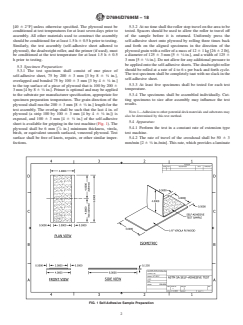
[40 6 2°F] unless otherwise specified. The plywood must be 5.3.2 At no time shall the roller stop travel on the area to be
conditioned at test temperatures for at least seven days prior to tested. Spacers should be used to allow the roller to travel off
assembly. All other materials used to construct the assembly of the sample before it is returned. Uniformly press the
should be conditioned for at least 1.5 h 6 0.5 h prior to testing. self-adhesive sheet onto plywood by rolling three times back
Similarly, the test assembly (self-adhesive sheet adhered to and forth on the aligned specimens in the direction of the
plywood), the deadweight roller, and the primer (if used), must plywood grain with a roller of a mass of 12 6 1 kg [26 6 2 lb],
be conditioned at the test temperature for at least 1.5 h 6 0.5 a diameter of 125 6 3 mm [5 6 ⁄8 in.], and a width of 125 6
h prior to testing. 3 mm [5 6 ⁄8 in.]. Do not allow for any additional pressure to
be applied onto the self-adhesive sheets. The deadweight roller
5.3 Specimen Preparation:
should be rolled at a rate of 4 to 6 s per back and forth cycle.
5.3.1 The test specimen shall consist of one piece of
The test specimen shall be completely taut with no slack in the
self-adhesive sheet, 75 by 200 6 3 mm [3 by 8 6 ⁄8 in.],
self-adhesive sheet.
overlapped and bonded 75 by 100 6 3 mm [3 by 4 6 ⁄8 in.]
5.3.3 At least five specimens shall be tested for each test
to the top surface of a piece of plywood that is 100 by 200 6
1 temperature.
3 mm [4 by 8 6 ⁄8 in.]. Primer is optional and may be applied
5.3.4 The specimens shall be assembled individually. Cut-
to the substrate per manufacturer specification, appropriate for
specimen preparation temperatures. The grain direction of the ting specimens to size after assembly may influence the test
results.
plywood shall run the 200 6 3 mm [8 6 ⁄8 in.] length for the
test assembly. The overlap shall be such that the last 4 in. of
NOTE 1—Adhesion to other potential deck materials and substrates may
plywood (a strip 100 by 100 6 3 mm [4 by 4 6 ⁄8 in.]) is
also be determined by this test method.
exposed, and 100 6 3 mm [4 6 ⁄8 in.] of the self-adhesive
5.4 Apparatus:
sheet is available for gripping in the test machine (Fig. 1). The
5.4.1 Perform the test in a constant rate of extension type
plywood shall be 6 mm [ ⁄4 in.] minimum thickness, virola,
test machine.
birch, or equivalent smooth surfaced, veneered plywood. Test
surface shall be free of knots, repairs, or other similar imper- 5.4.2 The rate of travel of the crosshead shall be 50 6 3
fections. mm/min [2 6 ⁄8 in./min]. This rate, which provides a laminate
FIG. 1 Self-Adhesive Sample Preparation
D7694/D7694M − 18
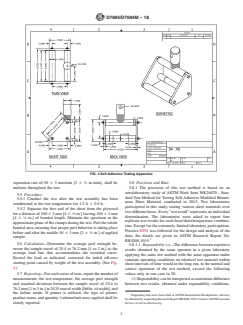
FIG. 2 Self-Adhesive Testing Apparatus
separation rate of 50 6 3 mm/min [2 6 ⁄8 in./min], shall be 5.8 Precision and Bias:
uniform throughout the test. 5.8.1 The precision of this test method is based on an
intralaboratory study of ASTM Work Item WK26070 – Stan-
5.5 Procedure:
dard Test Method for Testing Self-Adhesive Modified Bitumi-
5.5.1 Conduct the test after the test assembly has been
nous Sheet Material, conducted in 2015. Two laboratories
conditioned at the test temperature for 1.5 h 6 0.5 h.
participated in this study, testing various sheet materials over
5.5.2 Separate the free end of the sheet from the plywood
two different bases. Every “test result” represents an individual
for a distance of 100 6 3 mm [4 6 ⁄8 in.] leaving 100 6 3 mm
determination. The laboratories were asked to report four
[4 6 ⁄8 in.] of bonded length. Maintain the specimen in the
replicate test results for each base/sheet/temperature combina-
approximate plane of the clamps during the test. Peel the whole
tion. Except for the extremely limited laboratory participation,
bonded area, ensuring that proper peel behavior is taking place
Practice E691 was followed for the design and analysis of the
before and after the middle 50 6 3 mm [2 6 ⁄8 in.] of applied
data; the details are given in ASTM Resaerch Report No.
sample.
RR:D08-1019.
5.6 Calculation—Determine the average peel strength be-
5.8.1.1 Repeatability (r)—The difference between repetitive
tween the sample travel of 25.4 to 76.2 mm [1 to 3 in.] as the
results obtained by the same operator in a given laboratory
average load line that accommodates th
...
Questions, Comments and Discussion
Ask us and Technical Secretary will try to provide an answer. You can facilitate discussion about the standard in here.
Loading comments...