


SIST EN 50399:2022
(Main)Common test methods for cables under fire conditions - Heat release and smoke production measurement on cables during flame spread test - Test apparatus, procedures, results
Common test methods for cables under fire conditions - Heat release and smoke production measurement on cables during flame spread test - Test apparatus, procedures, results
This document specifies the apparatus and methods of test for the assessment of vertical flame spread, heat release, smoke production and occurrence of flaming droplets/particles of vertically mounted electric cables under defined conditions.
NOTE For the purpose of this document, the term “electric cable” covers all power, control and communication cables, including optical fibre cables and hybrid cables used for the conveyance of energy and/or signals.
This document details the apparatus for the fire propagation testing and the arrangement and calibration of the instrumentation to be installed to measure the heat release and the smoke production during the test. The combustion gases are collected in a hood above the test chamber and conveyed through an exhaust system, which allows the measurement of heat release rate and smoke production. Test procedures to be used for type approval testing for classification of cables in classes [2, 7] B1ca, B2ca, Cca and Dca are given. Cable installation on the test ladder and the volume of air passing through the chamber are in accordance with the Commission Decision 2006/751/EC [6], which is reflected in the requirements of this document.
Allgemeine Prüfverfahren für das Verhalten von Kabeln und isolierten Leitungen im Brandfall - Messung der Wärmefreisetzung und Raucherzeugung während der Prüfung der Flammenausbreitung - Prüfeinrichtung, Prüfverfahren und Prüfergebnis
Méthodes d'essai communes aux câbles soumis au feu - Mesure de la chaleur et de la fumée dégagées par les câbles au cours de l'essai de propagation de la flamme - Appareillage d'essai, procédure et résultats
Le présent document spécifie l’appareillage et les méthodes d’essai pour l’évaluation de la propagation de flamme verticale, du dégagement de chaleur, de l’émission de fumée et de la production de gouttelettes/particules enflammées, avec des câbles électriques montés en position verticale et dans des conditions définies.
NOTE Pour les besoins du présent document, le terme "câble électrique" couvre tous les câbles de puissance, de commande et de communication, y compris les câbles à fibres optiques et les câbles hybrides utilisés pour le transport d’énergie et/ou de signaux.
Le présent document précise l’appareillage pour les essais de propagation du feu, ainsi que la disposition et l’étalonnage des instruments à installer pour mesurer le dégagement de chaleur et l’émission de fumée au cours de l’essai. Les gaz de combustion sont collectés dans une hotte au-dessus de la chambre d’essai et sont dirigés vers un système d’extraction, ce qui permet de mesurer le débit calorifique et l’émission de fumée. Les procédures d’essai à utiliser pour les essais d’homologation de type pour la classification des câbles dans les Classes [2, 7] B1ca, B2ca, Cca et Dca sont indiquées. L’installation des câbles sur l’échelle d’essai et le volume d’air circulant à travers la chambre sont conformes à la Décision 2006/751/CE de la Commission [6], dont les exigences du présent document sont le reflet.
Skupne preskusne metode za ognjevzdržnost kablov - Meritve oddajanja toplote in nastajanja dima na kablih med preskusom z razpršenim plamenom - Preskusna naprava, postopki, rezultati
Standard EN 50399 določa naprave in preskusne metode za ocenjevanje navpičnega širjenja plamena, oddajanja toplote, nastajanja dima in pojava gorečih kapljic/delcev na navpično napeljanih električnih kablih v določenih razmerah.
OPOMBA: V tem evropskem standardu izraz »električni kabel« zajema vse napajalne, krmilne in komunikacijske kable, vključno z optičnimi kabli in hibridnimi kabli, ki se uporabljajo za prenos energije in/ali signalov.
EN 50399 podrobno opisuje naprave za preskušanje širjenja ognja ter razporeditev in umerjanje instrumentov, ki se namestijo za namene merjenja oddajanja toplote in nastajanja dima med preskusom. Zgorevalni plini se zbirajo v pokrovu nad preskusno komoro in prehajajo skozi izpušni sistem, ki omogoča merjenje stopnje oddajanja toplote in nastajanja dima. Podani so preskusni postopki za homologacijsko preskušanje pri razvrščanju kablov v razrede [2, 6] B1ca, B2ca, Cca in Dca. Namestitev kablov na preskusno lestev in prostornina zraka, ki prehaja skozi komoro, sta v skladu z odločbo Komisije 2006/751/ES [5], kar se odraža v zahtevah tega standarda.
General Information
- Status
- Published
- Public Enquiry End Date
- 04-Jun-2020
- Publication Date
- 28-Sep-2022
- Technical Committee
- IEKA - Electric cables
- Current Stage
- 6060 - National Implementation/Publication (Adopted Project)
- Start Date
- 22-Sep-2022
- Due Date
- 27-Nov-2022
- Completion Date
- 29-Sep-2022
Relations
- Effective Date
- 20-Sep-2022
- Effective Date
- 20-Sep-2022
- Effective Date
- 01-Oct-2019
Overview
EN 50399:2022 (CLC) defines common test methods for evaluating the behaviour of electric cables under fire conditions. The standard specifies the test apparatus, procedures and required results to measure vertical flame spread, heat release and smoke production of vertically mounted cables during a flame spread test. It applies to all power, control and communication cables (including optical-fibre and hybrid cables) and supports type-approval testing for cable classifications B1ca, B2ca, Cca and Dca under Commission Decision 2006/751/EC.
Keywords: EN 50399:2022, cable fire testing, flame spread test, heat release, smoke production, cable classification.
Key topics and technical requirements
- Test objectives: Measure vertical flame spread, heat release rate (HRR), smoke production rate (SPR) and occurrence of flaming droplets/particles.
- Test apparatus: Requirements for the test chamber, hood and exhaust duct, burner and ignition source, ladder mounting for cables, inlet air supply, extracting ventilator and effluent cleaning.
- Instrumentation: Arrangement and calibration of gas analysers, smoke measurement equipment (optical and volumetric), mass flow controllers and sampling systems.
- Calibration & qualification: Commissioning calibrations, routine calibration, sampling delay time, flow distribution checks and performance checks of the full test system.
- Measured parameters & calculations: Calculation of HRR, SPR, averaged values (HRRav, SPRav) and derived indices such as FIGRA (Fire Growth Rate Index) with normative annexes providing calculation methods.
- Procedures: Sample conditioning, mounting on ladder, burner flow rates, exhaust volume flow, flame application time and required observations during testing.
- Reporting: Prescribed contents for test reports to support classification and regulatory compliance.
Practical applications and users
- Cable manufacturers: product development, material selection and compliance testing for market access.
- Accredited test laboratories: implementing standardized test rigs and producing certification test reports.
- Certification and conformity bodies: evaluating cable performance against EU cable reaction-to-fire classes (B1ca–Dca).
- Specifiers, OEMs and safety engineers: selecting appropriate cables for buildings, transport and industrial installations where fire performance and low smoke/heat emission are critical.
- Regulators and code authorities: referencing EN 50399:2022 for harmonized test methods in national standards and safety rules.
Related standards and context
- Replaces EN 50399:2011 and its 2016 amendment.
- Aligns with Commission Decision 2006/751/EC for cable installation and air-flow requirements.
- Works alongside other reaction-to-fire standards used in European cable classification schemes.
Using EN 50399:2022 ensures consistent, repeatable measurement of heat release, smoke production and flame spread for reliable cable classification and safer installations.



Frequently Asked Questions
SIST EN 50399:2022 is a standard published by the Slovenian Institute for Standardization (SIST). Its full title is "Common test methods for cables under fire conditions - Heat release and smoke production measurement on cables during flame spread test - Test apparatus, procedures, results". This standard covers: This document specifies the apparatus and methods of test for the assessment of vertical flame spread, heat release, smoke production and occurrence of flaming droplets/particles of vertically mounted electric cables under defined conditions. NOTE For the purpose of this document, the term “electric cable” covers all power, control and communication cables, including optical fibre cables and hybrid cables used for the conveyance of energy and/or signals. This document details the apparatus for the fire propagation testing and the arrangement and calibration of the instrumentation to be installed to measure the heat release and the smoke production during the test. The combustion gases are collected in a hood above the test chamber and conveyed through an exhaust system, which allows the measurement of heat release rate and smoke production. Test procedures to be used for type approval testing for classification of cables in classes [2, 7] B1ca, B2ca, Cca and Dca are given. Cable installation on the test ladder and the volume of air passing through the chamber are in accordance with the Commission Decision 2006/751/EC [6], which is reflected in the requirements of this document.
This document specifies the apparatus and methods of test for the assessment of vertical flame spread, heat release, smoke production and occurrence of flaming droplets/particles of vertically mounted electric cables under defined conditions. NOTE For the purpose of this document, the term “electric cable” covers all power, control and communication cables, including optical fibre cables and hybrid cables used for the conveyance of energy and/or signals. This document details the apparatus for the fire propagation testing and the arrangement and calibration of the instrumentation to be installed to measure the heat release and the smoke production during the test. The combustion gases are collected in a hood above the test chamber and conveyed through an exhaust system, which allows the measurement of heat release rate and smoke production. Test procedures to be used for type approval testing for classification of cables in classes [2, 7] B1ca, B2ca, Cca and Dca are given. Cable installation on the test ladder and the volume of air passing through the chamber are in accordance with the Commission Decision 2006/751/EC [6], which is reflected in the requirements of this document.
SIST EN 50399:2022 is classified under the following ICS (International Classification for Standards) categories: 13.220.40 - Ignitability and burning behaviour of materials and products; 29.060.20 - Cables. The ICS classification helps identify the subject area and facilitates finding related standards.
SIST EN 50399:2022 has the following relationships with other standards: It is inter standard links to SIST EN 50399:2011, SIST EN 50399:2011/A1:2016, SIST EN 50399:2011/A1:2016. Understanding these relationships helps ensure you are using the most current and applicable version of the standard.
SIST EN 50399:2022 is available in PDF format for immediate download after purchase. The document can be added to your cart and obtained through the secure checkout process. Digital delivery ensures instant access to the complete standard document.
Standards Content (Sample)
SLOVENSKI STANDARD
01-november-2022
Nadomešča:
SIST EN 50399:2011
SIST EN 50399:2011/A1:2016
Skupne preskusne metode za ognjevzdržnost kablov - Meritve oddajanja toplote in
nastajanja dima na kablih med preskusom z razpršenim plamenom - Preskusna
naprava, postopki, rezultati
Common test methods for cables under fire conditions - Heat release and smoke
production measurement on cables during flame spread test - Test apparatus,
procedures, results
Allgemeine Prüfverfahren für das Verhalten von Kabeln und isolierten Leitungen im
Brandfall - Messung der Wärmefreisetzung und Raucherzeugung während der Prüfung
der Flammenausbreitung - Prüfeinrichtung, Prüfverfahren und Prüfergebnis
Méthodes d'essai communes aux câbles soumis au feu - Mesure de la chaleur et de la
fumée dégagées par les câbles au cours de l'essai de propagation de la flamme -
Appareillage d'essai, procédure et résultats
Ta slovenski standard je istoveten z: EN 50399:2022
ICS:
13.220.40 Sposobnost vžiga in Ignitability and burning
obnašanje materialov in behaviour of materials and
proizvodov pri gorenju products
29.060.20 Kabli Cables
2003-01.Slovenski inštitut za standardizacijo. Razmnoževanje celote ali delov tega standarda ni dovoljeno.
EUROPEAN STANDARD EN 50399
NORME EUROPÉENNE
EUROPÄISCHE NORM September 2022
ICS 13.220.40; 29.060.20 Supersedes EN 50399:2011; EN 50399:2011/A1:2016
English Version
Common test methods for cables under fire conditions - Heat
release and smoke production measurement on cables during
flame spread test - Test apparatus, procedures, results
Méthodes d'essai communes aux câbles soumis au feu - Allgemeine Prüfverfahren für das Verhalten von Kabeln und
Mesure de la chaleur et de la fumée dégagées par les isolierten Leitungen im Brandfall - Messung der
câbles au cours de l'essai de propagation de la flamme - Wärmefreisetzung und Raucherzeugung während der
Appareillage d'essai, procédure et résultats Prüfung der Flammenausbreitung - Prüfeinrichtung,
Prüfverfahren und Prüfergebnis
This European Standard was approved by CENELEC on 2022-08-08. CENELEC members are bound to comply with the CEN/CENELEC
Internal Regulations which stipulate the conditions for giving this European Standard the status of a national standard without any alteration.
Up-to-date lists and bibliographical references concerning such national standards may be obtained on application to the CEN-CENELEC
Management Centre or to any CENELEC member.
This European Standard exists in three official versions (English, French, German). A version in any other language made by translation
under the responsibility of a CENELEC member into its own language and notified to the CEN-CENELEC Management Centre has the
same status as the official versions.
CENELEC members are the national electrotechnical committees of Austria, Belgium, Bulgaria, Croatia, Cyprus, the Czech Republic,
Denmark, Estonia, Finland, France, Germany, Greece, Hungary, Iceland, Ireland, Italy, Latvia, Lithuania, Luxembourg, Malta, the
Netherlands, Norway, Poland, Portugal, Republic of North Macedonia, Romania, Serbia, Slovakia, Slovenia, Spain, Sweden, Switzerland,
Türkiye and the United Kingdom.
European Committee for Electrotechnical Standardization
Comité Européen de Normalisation Electrotechnique
Europäisches Komitee für Elektrotechnische Normung
CEN-CENELEC Management Centre: Rue de la Science 23, B-1040 Brussels
© 2022 CENELEC All rights of exploitation in any form and by any means reserved worldwide for CENELEC Members.
Ref. No. EN 50399:2022 E
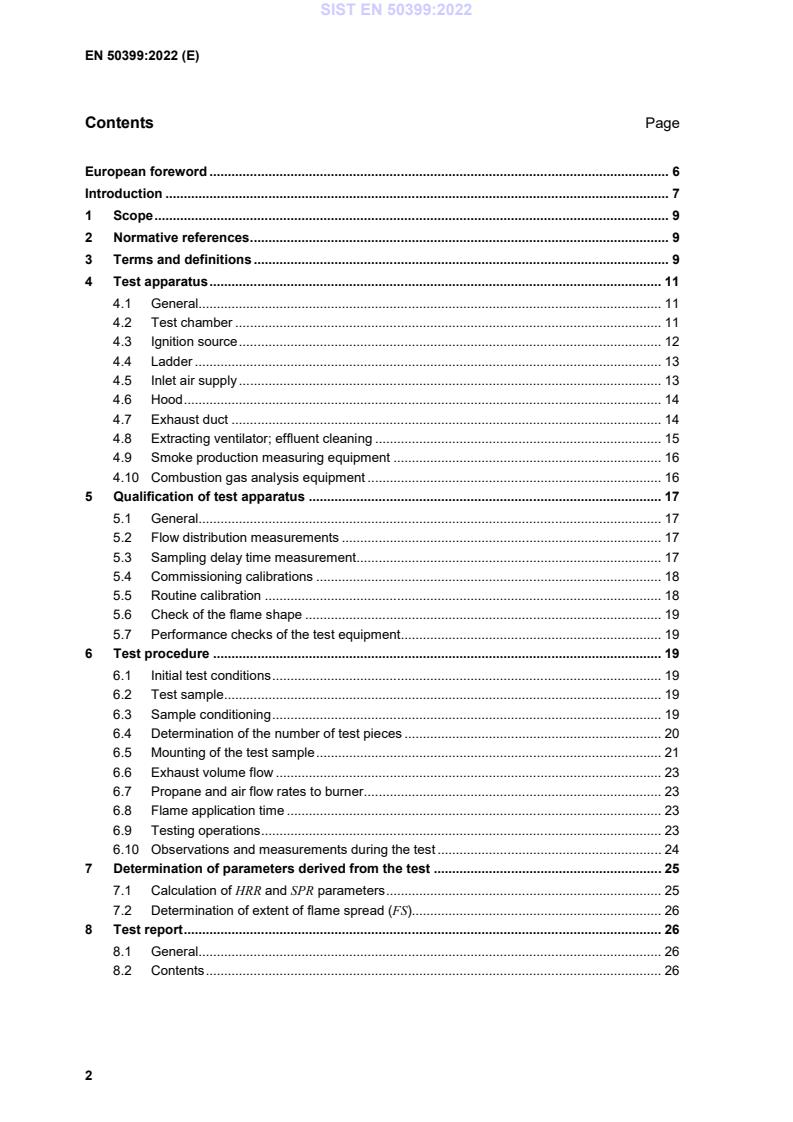
Contents Page
European foreword . 6
Introduction . 7
1 Scope . 9
2 Normative references . 9
3 Terms and definitions . 9
4 Test apparatus . 11
4.1 General. 11
4.2 Test chamber . 11
4.3 Ignition source . 12
4.4 Ladder . 13
4.5 Inlet air supply . 13
4.6 Hood . 14
4.7 Exhaust duct . 14
4.8 Extracting ventilator; effluent cleaning . 15
4.9 Smoke production measuring equipment . 16
4.10 Combustion gas analysis equipment . 16
5 Qualification of test apparatus . 17
5.1 General. 17
5.2 Flow distribution measurements . 17
5.3 Sampling delay time measurement . 17
5.4 Commissioning calibrations . 18
5.5 Routine calibration . 18
5.6 Check of the flame shape . 19
5.7 Performance checks of the test equipment. 19
6 Test procedure . 19
6.1 Initial test conditions . 19
6.2 Test sample . 19
6.3 Sample conditioning . 19
6.4 Determination of the number of test pieces . 20
6.5 Mounting of the test sample . 21
6.6 Exhaust volume flow . 23
6.7 Propane and air flow rates to burner . 23
6.8 Flame application time . 23
6.9 Testing operations . 23
6.10 Observations and measurements during the test . 24
7 Determination of parameters derived from the test . 25
7.1 Calculation of HRR and SPR parameters . 25
7.2 Determination of extent of flame spread (FS). 26
8 Test report . 26
8.1 General. 26
8.2 Contents . 26
Annex A (normative) Calculation of heat release . 46
A.1 Volume flow . 46
A.2 Generated heat effect . 46
A.2.1 Heat release from the ignition source . 46
A.2.2 Heat release from a tested product . 47
A.3 Calculation of the mole fraction of water vapour in the air . 48
Annex B (normative) Smoke production . 49
Annex C (informative) Additional information on Reynolds number in Figure 13 . 50
Annex D (normative) Flow distribution inside the duct . 51
D.1 General . 51
D.2 Velocity profile factor kc . 51
D.2.1 General . 51
D.2.2 Measurement specifications . 51
D.2.3 Actions . 52
D.2.4 Calculation of kc . 52
D.2.5 Measurement report . 53
Annex E (normative) Commissioning calibrations . 54
E.1 General procedures for separate pieces of equipment . 54
E.2 Gas analyser calibrations . 54
E.2.1 General . 54
E.2.2 Oxygen analyser adjustment . 54
E.2.3 Oxygen analyser output noise and drift . 54
E.2.4 Carbon dioxide analyser adjustment . 55
E.3 HRR calibrations . 55
E.3.1 General . 55
E.3.2 HRR calibration by means of the burner . 55
E.3.3 HRR calibration by means of burning a flammable liquid . 57
E.3.4 Commissioning factor k used for HRR calculations . 58
t
E.4 Smoke measurement system calibration . 59
E.4.1 General . 59
E.4.2 Stability check . 59
E.4.3 Optical filter check for white light systems . 59
E.4.4 Smoke calibration by means of burning a flammable liquid . 59
Annex F (informative) Guidance on calibration procedures for specific measuring equipment
..................................................................................................................................................... 62
F.1 General procedures for separate pieces of equipment . 62
F.2 Gas analyser calibrations . 62
F.2.1 Oxygen analyser adjustment . 62
F.2.2 Carbon dioxide analyser adjustment . 62
F.3 Check of propane mass flow controller . 62
F.3.1 General . 62
F.3.2 Actions . 63
F.3.3 Criterion . 63
F.4 Optical filter check for white light systems . 63
F.4.1 General . 63
F.4.2 Actions . 63
F.4.3 Criterion . 63
Annex G (normative) Calculation of HRRav, SPRav and FIGRA . 64
G.1 Calculation of HRR . 64
av
G.2 Calculation of SPRav . 65
G.3 Calculation of the Fire Growth Rate Index (FIGRA) . 66
Annex H (informative) Guidance on the choice of test equipment . 68
H.1 General . 68
H.2 Burner and venturi mixer . 68
H.3 Mass flow controllers . 68
H.4 Backing board . 68
Annex I (normative) Guidance on the file format for data from the test . 69
Annex J (normative) Rounding of numbers . 73
Annex K (informative) Check of the flame shape for nominal heat output of 20,5 kW . 74
K.1 Introduction. 74
K.2 Preparation of the wooden boards . 74
K.3 Procedure (to be performed in duplicate) . 75
K.4 Evaluation . 76
K.5 Flame shape analysis . 79
Annex L (informative) Guidance on conducting performance checks of the test equipment . 82
L.1 Introduction. 82
L.2 Fire test cable . 82
L.3 Performance of the fire test cable . 83
L.4 Procedure to check the performance of the test equipment . 83
L.5 Use of an alternative cable . 84
Bibliography . 85
Figures
Figure 1 — General arrangement of test apparatus . 28
Figure 2 — Test chamber — dimensions . 29
Figure 3 —Test chamber — schematic side elevation and air inlet arrangement . 30
Figure 4 — Thermal insulation of back- and sidewalls of the test chamber . 31
Figure 5 — Positioning of burner and typical arrangement of test sample on ladder . 32
Figure 6 — Burner configuration . 33
Figure 7 — Arrangement of holes for burners . 34
Figure 8 — Schematic diagram of a burner control system using Mass Flow Controllers . 35
Figure 9 — Tubular steel ladder for EN 50399 cable test . 36
Figure 10 — Schematic drawing of a hood . 37
Figure 11 — Typical guide vanes . 38
Figure 12 — Bidirectional probe . 39
Figure 13 — Probe response versus Reynolds number . 40
Figure 14 — Sampling probe . 41
Figure 15 — Schematic diagram of sampling line . 42
Figure 16 — Schematic drawing of smoke production measuring system . 43
Figure 17 — Mounting of bundles . 44
Figure 18 — Backboard mounting arrangement for Class B1ca . 45
Figure D.1 — Section of the exhaust duct – Positions for measurement of the gas velocity . 52
Figure E.1 — Overview of commissioning calibrations . 61
Figure K.1 — Shape and dimensions of the wooden board . 75
Figure K.2 — Positioning of the wooden board at the centre of the burner . 76
Figure K.3 — Examples of a flame shape on a wooden board (flame profile = dotted line; flame
tip = X) . 78
Figure K.4 — Envelope of acceptable flame profiles . 79
Figure L.1 — Illustration of the recommended fire test cable . 83
Tables
Table 1 — Mounting as a function of cable dimension . 22
Table E.1 — Burner ignition times and HRR levels . 56
Table E.2 — Example of determination of commissioning k factor . 58
t
Table I.1 — Example of the required raw data file format . 70
Table K.1 — Coordinates for the flame profile envelope (see Figure K.4) . 80
Table K.2 — Coordinates for the minimum of the flame tip (see Figure K.4) . 81
European foreword
This document (EN 50399:2022) has been prepared by CLC/TC 20, “Electric cables”.
The following dates are fixed:
• latest date by which this document has to be (dop) 2023-08-08
implemented at national level by publication of
an identical national standard or by
endorsement
• latest date by which the national standards (dow) 2025-08-08
conflicting with this document have to be
withdrawn
This document supersedes EN 50399:2011 and all of its amendments and corrigenda (if any).
— inclusion of the detailed description of the test apparatus in this document, rather than by reference to
EN 60332-3-10 (see 4.1).
— improvements in the test apparatus (see 4.2 to 4.7), including the mandatory use of mass flow
controllers for the supply of gases to the burner.
— several improvements of the qualification of the test equipment, including guidance for a check of the
flame shape (5.6) and a performance check of the test equipment (5.7).
— additions for testing of flat cables including mounting (see 6.4 and 6.5).
— new informative Annex K (Check of the flame shape for nominal heat output of 20,5 kW).
— new informative Annex L (Guidance on conducting performance checks of the test equipment).
Attention is drawn to the possibility that some of the elements of this document may be the subject of patent
rights. CENELEC shall not be held responsible for identifying any or all such patent rights.
Any feedback and questions on this document should be directed to the users’ national committee. A
complete listing of these bodies can be found on the CENELEC website.
Introduction
EN 50399 specifies the test apparatus and test procedures for the assessment of the reaction to fire
performance of cables to enable classification under the Construction Products Regulation [1, 2] to be
achieved.
EN 50399 describes an intermediate scale fire test of multiple cables mounted on a vertical cable ladder
and is carried out with a specified ignition source to evaluate the burning behaviour of such cables and
enable a direct declaration of performance. The test provides data for the early stages of a cable fire from
ignition of cables. It addresses the hazard of propagation of flames along the cable, the potential, by the
measurement of the heat release rate, for the fire to affect areas adjacent to the compartment of origin, and
the hazard, by the measurement of production of light obstructing smoke, of reduced visibility in the room
of origin and surrounding enclosures.
The following parameters may be determined under defined conditions during the test:
a) flame spread.
b) heat release rate.
c) total heat release.
d) smoke production rate.
e) total smoke production.
f) fire growth rate index.
g) occurrence of flaming droplets/particles.
The apparatus is derived from that of EN 60332-3-10 [3, 4] but with modifications and with additional
instrumentation to measure heat release and smoke production during the test. It has been demonstrated
[5] that the utilization of these additional measurement techniques, proven for other standard tests e.g. for
other building products, are appropriate for assessing the reaction to fire performance of electric cables.
These techniques include heat release and smoke production measurements. Compared with the test
methods described in the EN 60332-3 series, they enable a more comprehensive assessment system,
which is both more precise and sensitive, and enables a wider range of fire performance levels.
Care should be exercised in relating the parameters measured to different safety levels in actual cable
installations as the actual installed configuration of the cables could be a major determinant in the level of
flame spread, heat release and smoke production occurring in an actual fire. These parameters depend
upon several features, such as:
a) the volume of combustible material exposed to the fire and to any flaming or heat which could be
produced by the combustion of the cables.
b) the geometrical configuration of the cables and their relationship to an enclosure.
c) the temperature at which it is possible to ignite the gases emitted from the cables.
d) the quantity of combustible gas released from the cables for a given temperature rise.
e) the volume of air passing through the cable installation.
f) the construction of the cable e.g. armoured or unarmoured, multi- or single core.
All the foregoing assumes that the cables can be ignited when involved in an external fire.
The conditions of cable mounting, including volume of material exposed and geometrical configuration of
the cables on the test ladder, and volume of airflow through the chamber have been chosen to be in
accordance with that required by the Commission Decision 2006/751/EC [6]. CENELEC has not been
involved in the definition of these parameters. These standardized conditions provide the basis for
classification, as detailed in EN 13501-6 [7] and EN 50575 [2], but do not necessarily correspond to
conditions found in a particular cable installation.
EN 50399 gives the detailed description of the test apparatus and details of the test procedures, which are
used.
1 Scope
This document specifies the apparatus and methods of test for the assessment of vertical flame spread,
heat release, smoke production and occurrence of flaming droplets/particles of vertically mounted electric
cables under defined conditions.
NOTE For the purpose of this document, the term “electric cable” covers all power, control and communication
cables, including optical fibre cables and hybrid cables used for the conveyance of energy and/or signals.
This document details the apparatus for the fire propagation testing and the arrangement and calibration of
the instrumentation to be installed to measure the heat release and the smoke production during the test.
The combustion gases are collected in a hood above the test chamber and conveyed through an exhaust
system, which allows the measurement of heat release rate and smoke production. Test procedures to be
used for type approval testing for classification of cables in classes [2, 7] B1ca, B2ca, Cca and Dca are given.
Cable installation on the test ladder and the volume of air passing through the chamber are in accordance
with the Commission Decision 2006/751/EC [6], which is reflected in the requirements of this document.
2 Normative references
The following documents are referred to in the text in such a way that some or all of their content constitutes
requirements of this document. For dated references, only the edition cited applies. For undated references,
the latest edition of the referenced document (including any amendments) applies.
EN 60584-1, Thermocouples - Part 1: EMF specifications and tolerances (IEC 60584-1)
EN 60811-203, Electric and optical fibre cables - Test methods for non-metallic materials - Part 203:
General tests - Measurement of overall dimensions (IEC 60811-203)
EN ISO 13943, Fire safety - Vocabulary (ISO 13943)
3 Terms and definitions
For this document, the terms and definitions given in EN ISO 13943 and the following apply.
ISO and IEC maintain terminological databases for use in standardization at the following addresses:
— IEC Electropedia: available at https://www.electropedia.org/
— ISO Online browsing platform: available at https://www.iso.org/obp
3.1
heat release rate
HRR
thermal energy released per unit time by an item during combustion under specified conditions
3.2
total heat release
THR
integrated value of the heat release rate over a defined period
3.3
smoke production rate
SPR
smoke production per unit time
3.4
total smoke production
TSP
integrated value of the smoke production rate over a defined period
3.5
flame spread
FS
propagation of a flame front
Note 1 to entry: In this document the extent of flame spread is determined as the extent of damage measured by the
onset of char.
3.6
fire growth rate index
FIGRA
highest value of the quotient between HRR and time
Note 1 to entry: In this document FIGRA is expressed in W/s.
Note 2 to entry: Details of the calculation of FIGRA are given in Annex G.
3.7
flaming droplet
flaming particle
material separating from the specimen during the test and continuing to flame for a minimum period as
described in this test method
3.8
E'-value
heat release per unit volume of oxygen consumed
3.9
electric cable
all power, control and communication cables, including optical fibre cables and hybrid cables which are a
combination of two or more of these cable types
3.10
non-circular cable
cables are considered non-circular if the measured difference between any two values of the overall
diameter of the cable at the same cross-section exceeds 15 % of the largest overall diameter
Note 1 to entry: So-called figure of 8 cables, consisting of two exactly identical circular cables connected together
with a very small, extruded interconnecting link are considered to be non-circular cables.
4 Test apparatus
4.1 General
The test apparatus, as represented in Figure 1, is derived from the equipment defined in IEC 60332-3-10
[3]. It shall be installed inside a building fully protected from the possible influences of the elements (such
as wind, temperature and rain). The test shall not be carried out if the ambient temperature in the test
chamber and in the building where the test chamber is located is below 5 °C or above 40 °C. The ambient
temperature is measured (0,30 ± 0,05) m from an outer sidewall of the test chamber at a location
(0,5 ± 0,1) m below the top of the chamber. In addition, prior to the start of a test the back wall temperature
inside the test chamber, measured at a point on the back wall (1,50 ± 0,05) m from the floor and
(0,50 ± 0,05) m from a sidewall (so centred on the backwall), shall be below 40 °C.
The size of the room where the test apparatus is located shall be large enough to sustain an ambient
temperature between 5 °C and 40 °C and a stable flow of the air through the test equipment during the
entire duration of the test.
Other equipment having an influence on the oxygen and carbon dioxide concentration levels and/or the
airflow in the test room shall not be operated simultaneously with the EN 50399 equipment as that could
affect the test.
The test apparatus shall consist of the test chamber, ladder, ignition source (burner), air supply equipment,
hood, exhaust duct, extracting ventilator, smoke measuring equipment and combustion gas equipment to
determine heat release; these parts are specified in the following paragraphs. A fire extinguishing system
may also be present in the test apparatus.
WARNING — Care should be taken in monitoring and extinguishing cable fires once the test specimen has
started to propagate fire. Some specimens could generate high heat release rates that could damage the
test equipment and instrumentation. It is important that testing staff are sufficiently trained in dealing with
such fires and have adequate firefighting facilities at their disposal during testing.
4.2 Test chamber
The test chamber (see Figures 2 and 4) shall have an internal width of (1 000 ± 100) mm, an internal depth
of (2 000 ± 100) mm and an internal height of (4 000 ± 100) mm; the floor of the chamber shall be raised
above ground level. The test chamber shall be airtight along its sides, air being admitted at the base of the
test chamber through an aperture of (800 ± 20) mm × (400 ± 10) mm situated (150 ± 10) mm from the
internal face of the front wall of the test chamber and centred relative to the width of the chamber.
An outlet (300 ± 30) mm × (1 000 ± 100) mm shall be made at the rear edge of the top of the test chamber.
The rear edge of this outlet can extend up to 60 mm forward of the rear wall of the chamber.
The back, sides and door of the test chamber shall be thermally insulated to give a coefficient of heat
–2 –1
transfer of approximately 0,7 W·m ·K . For example, a steel plate 1,5 mm to 2,0 mm thick covered with
65 mm of mineral wool with a suitable external cladding is satisfactory (see Figure 4 showing only the back-
and sidewalls, but doors shall be properly insulated as well). The distance between the ladder and the
internal face of the rear wall of the chamber is (150 ± 10) mm, and between the bottom rung of the ladder
and the floor is (400 ± 5) mm (see Figure 5).
A heat-resisting glass window(s) covering a minimum surface area of 0,09 m to observe flaming droplets
and the fire propagation shall be mounted in the door. The door of the test chamber shall be closed
throughout the test.
All openings in the test chamber through the chamber walls, for example openings needed to feed the gas
supply tube(s) to the burner, shall be carefully sealed. Any leakage such as insufficient sealing of the
chamber door shall be avoided.
NOTE The tightness of the door sealing can easily be checked during operation by using a “candle” flame (on the
outside of the chamber) as a sensor for an air flow into or out of the chamber through the door sealing. A flame which
bends towards or away from the door gap indicates insufficient sealing. The candle flame check is performed with the
exhaust air flow set at (1 ± 0,05) m /s, the inlet air flow into the chamber set to (8 000 ± 400) l/min and the burner set
at 20,5 kW.
Additional installations in the chamber, other than those required by this document, are not allowed since
they can influence especially the distribution of the air flow. Therefore, for instance protective layers for the
backwall and covers on top of the burner (to avoid material falling down on the burner during the test) shall
be avoided. The flow around the ladder shall not be substantially affected by brackets, rails or bars used
for positioning ladders or reinforcement of the chamber. The size of the support of the burner and an
optional fire extinguishing system shall be kept small to minimize the influence on the distribution of the air
flow.
4.3 Ignition source
4.3.1 Type
The ignition source shall be a ribbon-type propane gas burner complete with a venturi mixer, and a set of
mass flow controllers. The distance between venturi mixer and burner shall be between 0,15 m and 5,0 m.
Bends between venturi mixer and burner shall be minimized. When the venturi is mounted inside the
chamber the inner diameter of the tubing (piping or braided flexible hose) between the venturi mixer and
burner shall be at least equal to 20 mm. When the venturi is mounted outside of the chamber, the inner
diameter of all the tubing (piping or braided flexible hose) supplying gases to the burner inside the chamber
shall be at least equal to 20 mm. The propane gas shall have a purity of at least 95 %. The flame-producing
surface of the burner shall consist of a flat metal plate through which 242 holes of 1,32 mm in diameter are
drilled on 3,2 mm centres in three staggered rows of 81, 80 and 81 holes each to form an array having the
nominal dimensions 257 mm × 4,5 mm.
NOTE Burners with 243 holes (arranged in 3 rows of 81 holes) are also found in the market and give equal results.
As the burner plate may be drilled without the use of a drilling jig, the spacing of the holes could vary slightly.
Additionally, a row of small holes is drilled on each side of the burner plate to serve as pilot holes with the
function of keeping the flame burning.
In order to minimize clogging of the pilot holes the burner may be run for 5 minutes with a propane flow of
approximately 442 mg/s and an air flow of approximately 4200 mg/s (or as high as possible if this cannot
be achieved), after or separate from a test.
The diameter of the main burner holes has an influence on the burner flame. Thus the main burner holes
need to be measured and inspected on a regular basis and they shall be kept free from any obstructions.
Cleaning with a brass brush or a 1,2 mm drill bit held in a pin vice is recommended; care should be taken
that the holes do not change shape or size. The diameter of the burner holes shall be between 1,30 mm
and 1,40 mm. In case the diameter of the holes in the burner are measured to be outside this range the
burner needs to be replaced.
A schematic drawing of the burner is shown in Figure 6, and the arrangement of the burner holes is shown
in Figure 7.
To ensure reproducibility between results from different testing equipment, a burner, which is readily
available, shall be used; for details, see Annex H. If a burner is used which is different from the one
prescribed in Annex H, the laboratory shall demonstrate full equivalence. The correct performance of the
burner can be checked using the procedures described in Annexes K and L.
The burner shall be fitted with suitable accurate mass flow controllers for both propane and air. It is
recommended to use digital mass flow controllers with an accuracy (including linearity) of ± 0,5 % of reading
plus ± 0,1 % of full scale. Mass flow controllers having a display or data output (so the gas consumption
can be seen in real time) are recommended.
The mass flow controllers shall be designed to be used at the operating pressures; their calibration shall
be conducted at the operating pressure.
Figure 8 shows an example of a burner control system.
The calibration of the mass flow controllers for the propane and air flows can be checked by weighing the
gas consumption over a given time at operating flow rates. For checking the propane flow, weigh the
propane using a balance having a scale resolution of 1 g, and a time of at least 20 min. For the check of
the air flow, a 10 litre air bottle and a time of no more than 5 min is advised as problems caused by
condensation and/or ice formation are then avoided.
The accuracy of the mass flow controllers shall be determined at the initial commissioning stage, after
replacement and at least every year by weighing the gas consumption. The data should be recorded.
Rotameter-type flow meters can additionally be installed but are optional and only for visualization of the
flow of the gases during a test.
The piping between the mass flow controllers and the burner shall be checked regularly for leakages.
Special care shall be taken when checking for leaks from the propane supply line as part of that line can
be under negative pressure due to the venturi mixer.
For the purposes of this test, the air shall have a dewpoint not higher than 0 °C.
The flow rates for the test shall be as given in 6.7.
WARNING — The following precautions are recommended to ensure safe operation of the ignition source:
— the gas supply system should be equipped with flashback arresters.
— a flame failure protection device should be used.
— safe sequencing of the propane and air supply should be employed during ignition and extinguishing.
4.3.2 Positioning
For the test, the burner shall be arranged horizontally at a distance of (75 ± 5) mm from the front surface of
the cable sample, (600 ± 5) mm above the floor of the test chamber and symmetrical with the vertical axis
of the ladder. The point of application of the burner flame shall lie approximately midway between two rungs
of the ladder (see Figure 4 and Figure 5).
An auxiliary template may be used to place the burner in the correct position relative to the front surface of
the cable sample.
Adjustment of air and gas flows prior to the test may be carried out away from the test position.
4.4 Ladder
A steel ladder of (500 ± 5) mm width shall be used; details of the ladder are given in Figure 9.
4.5 Inlet air supply
A means of supplying a controlled air flow through the chamber shall be used. Air shall be introduced to
the test chamber through a plenum box (air inlet box) fitted directly underneath, and of approximately the
same dimensions as, the air inlet aperture. The depth of the plenum box shall be (150 ± 10) mm measured
from the grid downwards. Air shall be blown into the plenum box from a suitable fan through a rectangular
straight section of duct of constant cross section of (300 ± 10) mm width and (80 ± 5) mm height and a
minimum length of 800 mm, which shall be parallel to the floor and along the burner centre line as shown
in Figure 2 and Figure 3. The ducting between the fan and the rectangular straight section of duct shall
enter from the rear of the chamber. The duct shall be arranged to inlet air through the plenum box aperture
that is in its longest side and closest to the rear of the chamber. A grid shall be fitted in the air inlet aperture
to achieve uniform flow of the air. The grid shall be constructed of steel plate approximately 2 mm thick with
holes of approximately 5 mm diameter drilled at approximately 8 mm spacing between centres.
A grille may be placed over the air inlet aperture underneath or on top of the st
...
Questions, Comments and Discussion
Ask us and Technical Secretary will try to provide an answer. You can facilitate discussion about the standard in here.
Loading comments...