


SIST EN 50499:2021
(Main)Procedure for the assessment of the exposure of workers to electromagnetic fields
Procedure for the assessment of the exposure of workers to electromagnetic fields
The scope of this document is to provide a general procedure for the assessment of workers’ exposure to electric, magnetic and electromagnetic fields in a workplace in order to determine compliance with exposure limit values and/or action levels as stated in European Directive 2013/35/EU.
The purpose of this document is to
— specify how to perform an initial assessment of the levels of workers' exposure to electromagnetic fields (EMF), if necessary, including specific exposure assessment of such levels by measurements and/or calculations,
— determine whether it is necessary to carry out a detailed risk assessment of EMF exposure.
This document can be used by employers for the risk assessment and, where required, measurement and/or calculation of the exposure of workers. Based on specific workplace and other standards, it can be determined whether preventive measures/actions have to be taken to comply with the provisions of the Directive.
The frequencies covered are from 0 Hz to 300 GHz.
NOTE 1 This document relates to the exposure limits as specified in the Directive 2013/35/EU. It is intended to protect workers from risks to their health and safety arising or likely to arise from exposure to electromagnetic fields (0 Hz to 300 GHz) during their work. However, this and other Directives can include additional measures for the protection of specific groups of workers and/or specific workplaces for which the employer is required to investigate other protective measures as a part of the overall risk assessment. See Annex A.
NOTE 2 Directive 2013/35/EU has been transposed into national legislation in all the EU member countries. It is intended that users of this standard consult the national legislation related to this transposition in order to identify the national regulations and requirements. These national regulations and requirements can have additional requirements that are not covered by this standard.
Verfahren für die Beurteilung der Exposition von Arbeitnehmern gegenüber elektromagnetischen Feldern
Procédure pour l'évaluation de l'exposition des travailleurs aux champs électromagnétiques
L’objet de la présente Norme européenne est de fournir une procédure générale d’évaluation de l’exposition des travailleurs aux champs électriques, magnétiques et électromagnétiques sur un lieu de travail pour établir la conformité aux valeurs limites d’exposition et/ou aux valeurs déclenchant l’action de la directive européenne 2013/35/UE.
L’objet de cette Norme européenne est de
— spécifier comment réaliser une évaluation initiale des niveaux de l'exposition des travailleurs aux champs électromagnétiques (EMF - electromagnetic field), en incluant si nécessaire une évaluation de l'exposition spécifique de tels niveaux par des mesurages et/ou des calculs,
— déterminer s’il est nécessaire de mener une évaluation détaillée du risque pour l’exposition aux EMF.
La présente Norme européenne peut être utilisée par les employeurs pour l’évaluation du risque et, si exigé, pour les mesurages et/ou calculs de l’exposition des travailleurs. En se fondant sur les normes spécifiques au lieu de travail et d’autres normes, il est possible de déterminer si des mesures/actions préventives doivent être prises pour se conformer aux dispositions de la directive.
Les fréquences couvertes sont comprises entre 0 Hz et 300 GHz.
NOTE 1 La présente Norme européenne a été élaborée dans le cadre du Mandat M/351 et se rapporte aux limites d'exposition spécifiées dans la directive 2013/35/UE. Elle est destinée à la protection des travailleurs contre les risques pour la santé et la sécurité pouvant résulter de l'exposition aux champs électromagnétiques (0 Hz à 300 GHz) pendant leur activité professionnelle. Cependant, cette directive ainsi que d’autres peuvent contenir d’autres mesures de protection pour des catégories spécifiques de travailleurs et/ou pour des lieux de travail spécifiques pour lesquels il est exigé de l’employeur qu’il recherche d’autres mesures de protection au titre de l’évaluation complète du risque. Voir l’Annexe A.
NOTE 2 La directive 2013/35/UE a été transposée dans les législations nationales de tous les pays membres de l'Union européenne. Il est prévu que les utilisateurs de la présente norme consultent leur législation nationale résultant de cette transposition afin d’identifier les règlementations et exigences nationales. Les règlementations et exigences nationales peuvent inclure des exigences complémentaires qui ne sont pas couvertes par la présente norme.
Postopki ocenjevanja izpostavljenosti delavcev elektromagnetnim sevanjem
General Information
- Status
- Published
- Publication Date
- 22-Apr-2021
- Technical Committee
- INIR - Electromagnetic fields in human enviornment
- Current Stage
- 6060 - National Implementation/Publication (Adopted Project)
- Start Date
- 15-Apr-2021
- Due Date
- 20-Jun-2021
- Completion Date
- 23-Apr-2021
Relations
- Effective Date
- 08-Oct-2019
- Effective Date
- 27-Sep-2016
Overview
EN 50499:2019 - Procedure for the assessment of the exposure of workers to electromagnetic fields (EMF) - is a CENELEC/CLC European standard that provides a practical, step‑by‑step procedure for assessing worker exposure to electric, magnetic and electromagnetic fields from 0 Hz to 300 GHz. It supports compliance with the exposure limit values (ELVs) and action levels (ALs) set out in Directive 2013/35/EU and is intended for use by employers, health & safety professionals and EMF assessors.
Key topics and requirements
- Scope and purpose: Specifies how to perform an initial assessment and, where necessary, a detailed risk assessment using measurements and/or calculations to demonstrate compliance with Directive 2013/35/EU.
- Assessment methodologies:
- Initial screening to identify workplaces likely to require further assessment.
- Detailed assessment procedures by comparison with action levels (ALs) and exposure limit values (ELVs).
- Measurement and calculation methods consistent with EN 50413 and related measurement standards.
- Multiple-source and multi-frequency exposure: Guidance on combining exposures (Total Exposure Ratio - TER) and addressing simultaneous exposure to multiple frequencies and sources.
- Uncertainty and documentation: Advice on treating uncertainty in measurements/calculations and templates (Annex B) for documenting risk assessments.
- Indirect effects and vulnerable workers: Annex A addresses indirect risks (e.g., interaction with medical devices, equipment interference, pregnant workers) and protective measures.
- Zoning and mitigation: Annexes include zoning approaches (Annex E) and procedures for implementing protective measures and corrective actions.
- Use of product information: Guidance on using CE-marking and equipment-specific compliance data (Annex C).
Practical applications and users
Who uses EN 50499:2019:
- Employers and safety managers who must assess workplace EMF exposure and demonstrate compliance with national transpositions of Directive 2013/35/EU.
- Occupational health and safety professionals, EMF consultants, radiation protection officers, and technical staff in sectors such as power generation/transmission, broadcasting, telecommunications, medical MRI, industrial welding and manufacturing. Practical use cases:
- Initial workplace screening and decision on whether detailed measurements/calculations are required.
- Performing and documenting EMF risk assessments, selecting measurement strategies, and defining exclusion/zoning areas.
- Determining necessity and form of preventive measures to reduce exposure or manage indirect risks.
Related standards
Relevant related documents cited in EN 50499:2019 include:
- EN 50413 (measurement & calculation procedures), EN 50647 (broadcast site assessment), EN 50663 / EN 50664 (equipment assessment), EN 62232 (base station evaluation), EN 62479, EN IEC 62311, EN 62822 series (welding equipment).
EN 50499:2019 is a practical compliance tool for employers and professionals working to control occupational EMF exposure and meet EU regulatory requirements.


Frequently Asked Questions
SIST EN 50499:2021 is a standard published by the Slovenian Institute for Standardization (SIST). Its full title is "Procedure for the assessment of the exposure of workers to electromagnetic fields". This standard covers: The scope of this document is to provide a general procedure for the assessment of workers’ exposure to electric, magnetic and electromagnetic fields in a workplace in order to determine compliance with exposure limit values and/or action levels as stated in European Directive 2013/35/EU. The purpose of this document is to — specify how to perform an initial assessment of the levels of workers' exposure to electromagnetic fields (EMF), if necessary, including specific exposure assessment of such levels by measurements and/or calculations, — determine whether it is necessary to carry out a detailed risk assessment of EMF exposure. This document can be used by employers for the risk assessment and, where required, measurement and/or calculation of the exposure of workers. Based on specific workplace and other standards, it can be determined whether preventive measures/actions have to be taken to comply with the provisions of the Directive. The frequencies covered are from 0 Hz to 300 GHz. NOTE 1 This document relates to the exposure limits as specified in the Directive 2013/35/EU. It is intended to protect workers from risks to their health and safety arising or likely to arise from exposure to electromagnetic fields (0 Hz to 300 GHz) during their work. However, this and other Directives can include additional measures for the protection of specific groups of workers and/or specific workplaces for which the employer is required to investigate other protective measures as a part of the overall risk assessment. See Annex A. NOTE 2 Directive 2013/35/EU has been transposed into national legislation in all the EU member countries. It is intended that users of this standard consult the national legislation related to this transposition in order to identify the national regulations and requirements. These national regulations and requirements can have additional requirements that are not covered by this standard.
The scope of this document is to provide a general procedure for the assessment of workers’ exposure to electric, magnetic and electromagnetic fields in a workplace in order to determine compliance with exposure limit values and/or action levels as stated in European Directive 2013/35/EU. The purpose of this document is to — specify how to perform an initial assessment of the levels of workers' exposure to electromagnetic fields (EMF), if necessary, including specific exposure assessment of such levels by measurements and/or calculations, — determine whether it is necessary to carry out a detailed risk assessment of EMF exposure. This document can be used by employers for the risk assessment and, where required, measurement and/or calculation of the exposure of workers. Based on specific workplace and other standards, it can be determined whether preventive measures/actions have to be taken to comply with the provisions of the Directive. The frequencies covered are from 0 Hz to 300 GHz. NOTE 1 This document relates to the exposure limits as specified in the Directive 2013/35/EU. It is intended to protect workers from risks to their health and safety arising or likely to arise from exposure to electromagnetic fields (0 Hz to 300 GHz) during their work. However, this and other Directives can include additional measures for the protection of specific groups of workers and/or specific workplaces for which the employer is required to investigate other protective measures as a part of the overall risk assessment. See Annex A. NOTE 2 Directive 2013/35/EU has been transposed into national legislation in all the EU member countries. It is intended that users of this standard consult the national legislation related to this transposition in order to identify the national regulations and requirements. These national regulations and requirements can have additional requirements that are not covered by this standard.
SIST EN 50499:2021 is classified under the following ICS (International Classification for Standards) categories: 13.280 - Radiation protection; 17.240 - Radiation measurements. The ICS classification helps identify the subject area and facilitates finding related standards.
SIST EN 50499:2021 has the following relationships with other standards: It is inter standard links to SIST EN 50499:2009, SIST EN 50499:2009. Understanding these relationships helps ensure you are using the most current and applicable version of the standard.
SIST EN 50499:2021 is associated with the following European legislation: EU Directives/Regulations: 2013/35/EU; Standardization Mandates: M/351. When a standard is cited in the Official Journal of the European Union, products manufactured in conformity with it benefit from a presumption of conformity with the essential requirements of the corresponding EU directive or regulation.
SIST EN 50499:2021 is available in PDF format for immediate download after purchase. The document can be added to your cart and obtained through the secure checkout process. Digital delivery ensures instant access to the complete standard document.
Standards Content (Sample)
SLOVENSKI STANDARD
01-junij-2021
Nadomešča:
SIST EN 50499:2009
Postopki ocenjevanja izpostavljenosti delavcev elektromagnetnim sevanjem
Procedure for the assessment of the exposure of workers to electromagnetic fields
Verfahren für die Beurteilung der Exposition von Arbeitnehmern gegenüber
elektromagnetischen Feldern
Procédure pour l'évaluation de l'exposition des travailleurs aux champs
électromagnétiques
Ta slovenski standard je istoveten z: EN 50499:2019
ICS:
13.280 Varstvo pred sevanjem Radiation protection
17.240 Merjenje sevanja Radiation measurements
2003-01.Slovenski inštitut za standardizacijo. Razmnoževanje celote ali delov tega standarda ni dovoljeno.
EUROPEAN STANDARD EN 50499
NORME EUROPÉENNE
EUROPÄISCHE NORM
October 2019
ICS 17.240 Supersedes EN 50499:2008 and all of its amendments
and corrigenda (if any)
English Version
Procedure for the assessment of the exposure of workers to
electromagnetic fields
Procédure pour l'évaluation de l'exposition des travailleurs Verfahren für die Beurteilung der Exposition von
aux champs électromagnétiques Arbeitnehmern gegenüber elektromagnetischen Feldern
This European Standard was approved by CENELEC on 2019-08-20. CENELEC members are bound to comply with the CEN/CENELEC
Internal Regulations which stipulate the conditions for giving this European Standard the status of a national standard without any alteration.
Up-to-date lists and bibliographical references concerning such national standards may be obtained on application to the CEN-CENELEC
Management Centre or to any CENELEC member.
This European Standard exists in three official versions (English, French, German). A version in any other language made by translation
under the responsibility of a CENELEC member into its own language and notified to the CEN-CENELEC Management Centre has the
same status as the official versions.
CENELEC members are the national electrotechnical committees of Austria, Belgium, Bulgaria, Croatia, Cyprus, the Czech Republic,
Denmark, Estonia, Finland, France, Germany, Greece, Hungary, Iceland, Ireland, Italy, Latvia, Lithuania, Luxembourg, Malta, the
Netherlands, Norway, Poland, Portugal, Republic of North Macedonia, Romania, Serbia, Slovakia, Slovenia, Spain, Sweden, Switzerland,
Turkey and the United Kingdom.
European Committee for Electrotechnical Standardization
Comité Européen de Normalisation Electrotechnique
Europäisches Komitee für Elektrotechnische Normung
CEN-CENELEC Management Centre: Rue de la Science 23, B-1040 Brussels
© 2019 CENELEC All rights of exploitation in any form and by any means reserved worldwide for CENELEC Members.
Ref. No. EN 50499:2019 E
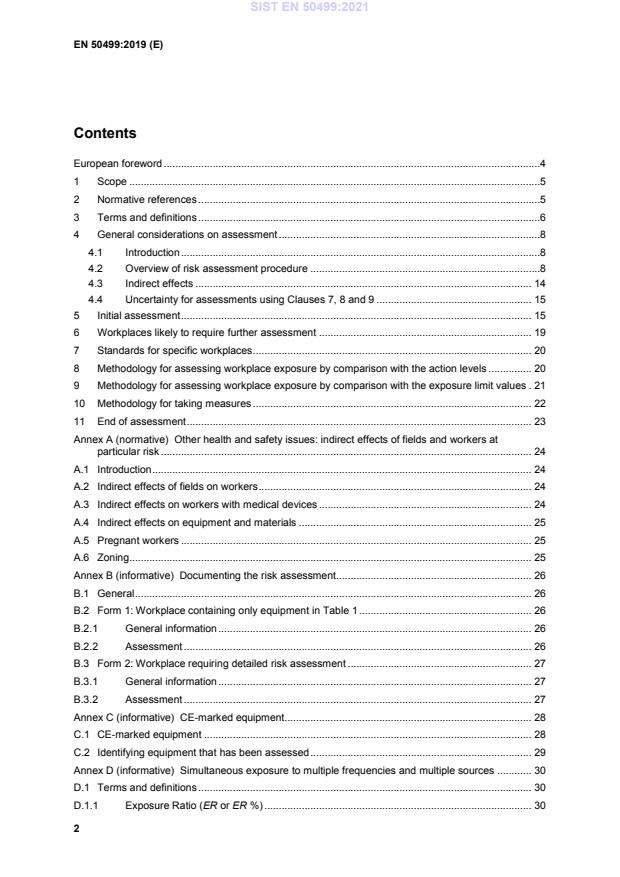
Contents
European foreword .4
1 Scope .5
2 Normative references .5
3 Terms and definitions .6
4 General considerations on assessment .8
4.1 Introduction .8
4.2 Overview of risk assessment procedure .8
4.3 Indirect effects . 14
4.4 Uncertainty for assessments using Clauses 7, 8 and 9 . 15
5 Initial assessment . 15
6 Workplaces likely to require further assessment . 19
7 Standards for specific workplaces . 20
8 Methodology for assessing workplace exposure by comparison with the action levels . 20
9 Methodology for assessing workplace exposure by comparison with the exposure limit values . 21
10 Methodology for taking measures . 22
11 End of assessment . 23
Annex A (normative) Other health and safety issues: indirect effects of fields and workers at
particular risk . 24
A.1 Introduction . 24
A.2 Indirect effects of fields on workers . 24
A.3 Indirect effects on workers with medical devices . 24
A.4 Indirect effects on equipment and materials . 25
A.5 Pregnant workers . 25
A.6 Zoning. 25
Annex B (informative) Documenting the risk assessment . 26
B.1 General . 26
B.2 Form 1: Workplace containing only equipment in Table 1 . 26
B.2.1 General information . 26
B.2.2 Assessment . 26
B.3 Form 2: Workplace requiring detailed risk assessment . 27
B.3.1 General information . 27
B.3.2 Assessment . 27
Annex C (informative) CE-marked equipment. 28
C.1 CE-marked equipment . 28
C.2 Identifying equipment that has been assessed . 29
Annex D (informative) Simultaneous exposure to multiple frequencies and multiple sources . 30
D.1 Terms and definitions . 30
D.1.1 Exposure Ratio (ER or ER %) . 30
D.1.2 Total Exposure Ratio (TER or TER %) . 30
D.2 The TER approach . 30
D.2.1 Explanation . 30
D.2.2 ER for a single item of equipment . 31
D.2.2.1 Obtaining or calculating the ER for a single item of equipment . 31
D.2.2.2 Calculating single equipment ER from measured emission or exposure levels for non-
thermal effects (below 10 MHz) . 31
D.2.2.2.1 Simultaneous exposure to multiple frequency fields . 31
D.2.2.2.2 Weighted peak method in time domain . 31
D.2.2.3 Calculating single equipment ER from measured emission or exposure levels for
thermal effects (above 100 kHz) . 32
D.2.3 Combining the separate equipment ERs into a TER . 33
D.2.3.1 Simple assessment of the TER . 33
D.2.3.2 Assessment of low frequency (non-thermal effects) . 33
D.2.3.3 Assessment of high frequency (thermal effects) . 33
D.2.3.4 Assessment of intermediate frequencies 100 kHz to 10 MHz, or if the applicable
frequency of measurement assessments covers both the stimulation effects and thermal
effects, or is unknown . 34
D.3 Example of multiple exposure using separate TER assessments . 34
Annex E (informative) Zoning . 35
E.1 Introduction . 35
E.2 Workplace zones . 35
E.3 Implementation of zoning . 35
Bibliography . 37
European foreword
This document (EN 50499:2019) has been prepared by CLC/TC 106X, “Electromagnetic fields in the human
environment”.
The following dates are fixed:
• latest date by which this document has (dop) 2020-08-20
to be implemented at national level by
publication of an identical national
standard or by endorsement
• latest date by which the national (dow) 2022-08-20
standards conflicting with this document
have to be withdrawn
This document supersedes EN 50499:2008 and all of its amendments and corrigenda (if any).
— the replacement of directive 2004/40/EC by directive 2013/35/UE. The requirements in the document
were modified accordingly, as for example the assessment process.
The latest editions of standards of basic and generic standards was also taken into account, for example in
the annex D for multiple frequencies
This standard is intended to be a standard under which other standards related to the assessment of a
workplace can be used.
The approaches outlined in this standard, are intended to be simple, allowing most employers to make an
assessment with the minimum of technical knowledge and effort.
Attention is drawn to the possibility that some of the elements of this document may be the subject of patent
rights. CENELEC shall not be held responsible for identifying any or all such patent rights.
This document has been prepared under a mandate given to CENELEC by the European Commission and
the European Free Trade Association.
1 Scope
The scope of this document is to provide a general procedure for the assessment of workers’ exposure to
electric, magnetic and electromagnetic fields in a workplace in order to determine compliance with exposure
limit values and/or action levels as stated in European Directive 2013/35/EU.
The purpose of this document is to
— specify how to perform an initial assessment of the levels of workers' exposure to electromagnetic fields
(EMF), if necessary, including specific exposure assessment of such levels by measurements and/or
calculations,
— determine whether it is necessary to carry out a detailed risk assessment of EMF exposure.
This document can be used by employers for the risk assessment and, where required, measurement and/or
calculation of the exposure of workers. Based on specific workplace and other standards, it can be
determined whether preventive measures/actions have to be taken to comply with the provisions of the
Directive.
The frequencies covered are from 0 Hz to 300 GHz.
NOTE 1 This document relates to the exposure limits as specified in the Directive 2013/35/EU. It is intended to protect
workers from risks to their health and safety arising or likely to arise from exposure to electromagnetic fields (0 Hz to
300 GHz) during their work. However, this and other Directives can include additional measures for the protection of
specific groups of workers and/or specific workplaces for which the employer is required to investigate other protective
measures as a part of the overall risk assessment. See Annex A.
NOTE 2 Directive 2013/35/EU has been transposed into national legislation in all the EU member countries. It is
intended that users of this standard consult the national legislation related to this transposition in order to identify the
national regulations and requirements. These national regulations and requirements can have additional requirements
that are not covered by this standard.
2 Normative references
The following documents are referred to in the text in such a way that some or all of their content constitutes
requirements of this document. For dated references, only the edition cited applies. For undated references,
the latest edition of the referenced document (including any amendments) applies.
Council Recommendation 1999/519/EC of 12 July 1999, on the limitation of exposure of the general public
to electromagnetic fields (0 Hz to 300 GHz), Official Journal, L199, of 1999-7-30, p.59-70
Directive 2013/35/EU of 26 June 2013, on the minimum health and safety requirements regarding the
exposure of workers to the risks arising from physical agents (electromagnetic fields). Official Journal, L179,
of 2013-6-29, p. 1–21
EN 50413:—, Basic standard on measurement and calculation procedures for human exposure to electric,
magnetic and electromagnetic fields (0 Hz - 300 GHz)
EN 50496, Determination of workers’ exposure to electromagnetic fields and assessment of risk at a
broadcast site
EN 50647:2017, Basic standard for the evaluation of workers’ exposure to electric and magnetic fields from
equipment and installations for the production, transmission and distribution of electricity
EN 50663:2017, Generic standard for assessment of low power electronic and electrical equipment related
to human exposure restrictions for electromagnetic fields (10 MHz - 300 GHz)
Under preparation. Stage at the time of publication: FprEN 50413:2019.
EN 50664:2017, Generic standard to demonstrate the compliance of equipment used by workers with limits
on exposure to electromagnetic fields (0 Hz - 300 GHz), when put into service or in situ
EN 60601-2-33:2010/A2:2015, Medical electrical equipment – Part 2-33: Particular requirements for the
basic safety and essential performance of magnetic resonance equipment for medical diagnosis
(IEC 60601-2-33:2010/A2:2015)
EN 62232:2017, Determination of the RF field strength, power density and SAR in the vicinity of
radiocommunication base stations for the purpose of evaluating human exposure (IEC 62232)
EN IEC 62311:—, Assessment of electronic and electrical equipment related to human exposure restrictions
for electromagnetic fields (0 Hz - 300 GHz) (IEC 62311)
EN 62479:2010, Assessment of the compliance of low power electronic and electrical equipment with the
basic restrictions related to human exposure to electromagnetic fields (10 MHz to 300 GHz) (IEC 62479)
EN 62822-2:2016, Electric welding equipment – Assessment of restrictions related to human exposure to
electromagnetic fields (0 Hz to 300 GHz) – Part 2: Arc welding equipment
EN IEC 62822-3:2018, Electric welding equipment – Assessment of restrictions related to human exposure
to electromagnetic fields (0 Hz to 300 GHz) – Part 3: Resistance welding equipment
3 Terms and definitions
For the purposes of this document, the following terms and definitions apply.
ISO and IEC maintain terminological databases for use in standardization at the following addresses:
• IEC Electropedia: available at http://www.electropedia.org/
• ISO Online browsing platform: available at http://www.iso.org/obp
3.1
action levels
ALs
operational levels of directly measurable parameters provided in terms of electric field strength (E), magnetic
field strength (H), magnetic flux density (B) and power density (S), contact current and limb induced current
established for the purpose of simplifying the process of demonstrating the compliance with relevant ELVs
or, where appropriate, to take relevant protection or prevention measures specified in Directive 2013/35/EU
3.1.1
low ALs
action levels which relate to the specific protection or prevention measures specified in
Directive 2013/35/EU
action levels which relate to the sensory effects ELVs
Note 1 to entry: the values of the low ALs are given in Table B.1 o Directive f2013/35/EU for electric field.
Note 2 to entry: The Low AL for external electric field is based both on limiting the internal electric field below ELVs and
on limiting spark discharges in the working environment.
Note 3 to entry: the values of the low ALs are given in Table B.2 for magnetic field.
Under preparation. Stage at the time of publication: FprEN IEC 62311:2019.
3.1.2
high ALs
action levels which relate to the specific protection or prevention measures specified in
Directive 2013/35/EU
action levels which relate to the health effects ELVs
Note 1 to entry: the values of the high ALs are given in Table B.1 of Directive 2013/35/EU for electric field.
Note 2 to entry: Below the High AL, the internal electric field does not exceed ELVs and annoying spark discharges are
prevented, provided that the relevant protection measures are taken.
Note 3 to entry: the values of the high ALs are given in Table B.2 for magnetic field.
3.2
duty factor
ratio of pulse duration to the pulse period of a periodic pulse train
Note 1 to entry: A duty factor can also be considered as a measure of the temporal transmission characteristic of an
intermittently transmitting RF source such as a paging antenna by dividing average transmission duration by the average
period for transmissions.
Note 2 to entry: A duty factor of 1,0 corresponds to continuous operation.
[SOURCE: EN IEC 62311:—]
3.3
electromagnetic fields
static electric, static magnetic and time-varying electric, magnetic and electromagnetic fields with frequencies
up to 300 GHz
[SOURCE: Directive 2013/35/EU]
3.4
employer
natural or legal person who has an employment relationship with the worker and has responsibility for the
undertaking and/or establishment
[SOURCE: Directive 89/391/EEC]
3.5
equipment
source of electromagnetic emission, including devices, products, instrumentation, installations and
prototypes under development
3.6
exposure
phenomenon occurring whenever and wherever a person is subjected to external electromagnetic fields or
to contact current
3.7
exposure limits
guideline or restriction values on exposure that are given in international or national standards, guidelines or
directives on human exposure to electromagnetic fields
Note 1 to entry: For Directive 2013/35/EU the exposure limits are the action levels and the exposure limit values and
also the other specific requirements in that directive to avoid other risks related to workplace exposure to electromagnetic
fields.
3.8
exposure limit values
ELVs
limits on exposure to electromagnetic fields which are based on biophysical and biological considerations, in
particular on the basis of scientifically well-established short-term and acute direct effects, i.e. thermal effects
and non-thermal effects such as electrical stimulation of tissues
Note 1 to entry: Compliance with these limits will ensure that workers exposed to electromagnetic fields are protected
against known adverse health effects (from Directive 2013/35/EU).
3.8.1
health effects ELVs
ELVs above which workers might be subject to adverse health effects, such as thermal heating or stimulation
of nerve and muscle tissue
[SOURCE: Directive 2013/35/EU]
3.8.2
sensory effects ELVs
ELVs above which workers might be subject to transient disturbed sensory perceptions and minor changes
in brain functions
[SOURCE: Directive 2013/35/EU]
3.9
risk assessment
process of determining compliance of a workplace environment with the limits set in the Directive 2013/35/EU
by performing the actions stated in Article 4 of the Directive 2013/35/EU
3.10
workplace
location where workers have access as part of their duties
3.11
worker
person employed by an employer, including trainees and apprentices but excluding domestic servants
[SOURCE: Directive 89/391/EEC]
4 General considerations on assessment
4.1 Introduction
This clause describes the general concept of an initial assessment of a workplace, how to compare
assessment results with the action levels and exposure limits, and further actions if needed.
The exposure to be assessed is at the workplace(s) where a worker is permitted or reasonably expected to
be present. Workplace exposure level is assessed at locations to which a worker would have access as part
of their duties, and its contributors are emissions from equipment affecting that location.
Other health and safety issues covered by the Directive, in particular workers with active implanted medical
devices (AIMDs), pregnant workers, and indirect effects shall be addressed as outlined in Annex A.
4.2 Overview of risk assessment procedure
The flowchart presented in Figure 1 shows graphically the assessment process. Prior to commencing the
assessment process, and in order to determine what level of workplace assessment, if any, is necessary the
workplace shall first be characterized. This requires the employer to establish what electromagnetic field-
emitting electrical equipment exists in the workplace.
As a preliminary step, the employer shall assess if there are workers exposed to indirect effects or workers
at particular risks and address them as described in Annex A.
The first decision box of Figure 1 relates to compliant equipment. Most workplaces will contain only electrical
equipment which do not produce electromagnetic fields at levels above general public exposure limits. These
workplaces will require no further assessment. Clause 5 defines which electrical equipment can be excluded
from detailed exposure assessment. Table 1 defined in Clause 5 provides examples of such equipment. It
includes in particular any equipment which has been placed on the European market in compliance with the
relevant product performance Directives and tested against general public limits using an EMF harmonized
standard. Examples of EMF related harmonized standards are listed in Annex C.
When assessing the compliance of equipment, the zoning concepts presented in Annex E may be used.
Table 2 in Clause 6 gives a non-exhaustive list of equipment which is likely to require further assessment. In
preparation for this, the employer should identify the type of equipment in the workplace, characteristics (e.g.
frequency, emitted power, duty factor) and its conditions of use (e.g. normal position of operator, position of
other workers than the operator, time spent at normal position, operations or maintenance or repair at
distances from the emitting equipment closer than normal etc.). See Clause 6.
The term “normal” covers the intended use, the use as specified in the employer’s instructions to the workers,
the installation(s) used, the instructions from the employer on how maintenance and repair shall be
performed, situations of foreseeable incidents. Wilful behaviour of the worker against instructions of the
employer or safety instructions of device manufacturers is not required to be covered by the term „normal”.
Situations with simultaneous exposure to multiple sources and/or multiple frequencies shall be addressed
according to EN IEC 62311:—. The employer may optionally use alternative appropriate methods such as
those described in Annex D, which may include additional overestimation, but other scientifically proven and
validated exposure evaluation procedures can be applied, provided that they lead to approximately
equivalent and comparable results.
Optional measures to reduce exposure may be introduced at any point of the assessment in order to achieve
compliance.
Figure 1 — Assessment process
If derogations under Article 10 of Directive 2013/35/EU (“Derogations”) are applicable, then the exposure
limit values may be exceeded provided that all the applicable conditions in Article 10 are met.
If a specific standard is applicable to the working environment or type of workplace, then this shall be used
for the assessment unless employer considers it unsuitable, in which case a justification for its unsuitability
shall be included in the assessment report (see Clause 7). If this specific workplace standard contains other
exposure limits than those stated in Directive 2013/35/EU then the exposure limits from Directive 2013/35/EU
shall be applied.
If no such standard exists or if the employer considers it unsuitable then a detailed exposure assessment
shall be performed using the process defined in Figure 2 for exposure to magnetic fields between 1 Hz and
10 MHz, Figure 3 for exposure to electric fields between 1 Hz and 10 MHz, Figure 4 for exposure to
electromagnetic fields between 100 kHz and 300 GHz and Figure 5 for exposure to magnetic field between
0 Hz and 1 Hz. In Figure 2 and Figure 3, sensory effects ELVs are relevant only between 1 Hz and 400 Hz.
The exposure assessment is then performed either against action levels (see Clause 8) or directly against
exposure limit values (see Clause 9) using procedures from other European basic, generic or product EMF
standards. There are only ELVs between 0 Hz and 1 Hz.
For some equipment considered in the assessment of the workplace, it may be appropriate to undertake an
assessment against the exposure limit values directly, and specific assessment standards for that equipment
will indicate how that should be done. Other equipment in the same workplace may be assessed by
comparison with the action levels.
Figure 2 — Detailed assessment process for exposure to magnetic field between 1 Hz and 10 MHz
Figure 3 — Detailed assessment process for exposure to electric field between 1 Hz and 10 MHz
Figure 4 — Detailed assessment process for exposure to electromagnetic field between 100 kHz
and 300 GHz
Figure 5 — Detailed assessment process for exposure to static magnetic flux density (B ) between
0 Hz and 1 Hz
In general time-averaging can be applied to assessments made against limits based on thermal effects
(Annex III of the Directive) but cannot be applied to assessments made against limits based on non-thermal
effects (Annex II of the Directive). This is described in more details in EN IEC 62311:—. In case of time-
averaging, in evaluating compliance to action levels or exposure limit values, it may be appropriate to take
into account the duration of exposure under normal working conditions, and also the duty factor of the
emission(s) from the equipment in the workplace.
When measurements or calculations are used for a detailed exposure assessment, uncertainty analysis shall
be performed according to the specific assessment method or standard applied.
If the assessment indicates that exposure in the workplace does not meet the exposure limit values of the
Directive, then measures shall be taken to reduce the exposure (see Clause 10) and the assessment process
repeated until compliance is attained.
4.3 Indirect effects
The employer shall give particular attention, when carrying out the risk assessment, to any indirect effects
as defined in Article 2, Clause (c) of Directive 2013/35/EU. Information about the specific standards dealing
with indirect effects can be found in Annex A.
4.4 Uncertainty for assessments using Clauses 7, 8 and 9
As a part of the assessment process measurements and/or calculations shall be associated with an
uncertainty evaluation. Assessment uncertainty shall be reported (see Annex B) and it shall be taken into
account when performing compliance evaluation according to national regulation in relation to the
implementation of the Directive. If national regulation does not specify how to address uncertainty, then it
shall be incorporated into the assessment using the “shared risk” approach, i.e the result of the measurement
or calculation shall be compared directly to the limit without first adding the uncertainty, provided that the
uncertainty is within the range permitted for the assessment procedure as specified in the technical standard
which was applied. Guidance on maximum permissible uncertainties are given for example in
EN IEC 62311:— or EN 62369-1:2009. If the uncertainty is not within this range, then it shall be added to
the result of the assessment before a comparison is made with the limit.
5 Initial assessment
If the workplace contains or is affected only by equipment listed in Table 1 that workplace is deemed to
comply with this standard without further assessment. This is valid regardless of the number of items of
electrical equipment present at the workplace.
Table 1 is applicable to workers which are not at particular risk. For workers at particular risk, see Annex A.
To be considered within this initial assessment the equipment shall have been installed and used in
accordance with the manufacturers´ instructions. Exposure situations during maintenance and production of
equipment may be different from the exposure during intended use of the equipment and should be assessed
separately. In some situations, a reassessment of exposure may be necessary after
maintenance/repair/modification of equipment.
Low power equipment that can be shown to comply with general public exposure limits using EN 50663, see
note, is covered by Table 1 even if it is not CE-marked.
NOTE EN 50663 limits the frequency range to 10 MHz – 300 GHz and the transmitted power to 20 mW average
and 20 W peak for compliance with general public exposure limits.
If all the electrical devices in the workplace are covered by Table 1, this can be recorded as the conclusion
of the assessment, see Clause 11.
Table 1 — A priori compliant workplaces and equipment
Item Type of equipment Remarks
Compliant for the public
Workplaces open to the public and in
compliance with the exposure limits given
T.1.1 Workplaces open to the public
in the European Council recommendation
1999/519/EC are deemed to comply.
CE-marked equipment which has been assessed as Equipment shall be installed and used in
T.1.2 suitable for general public use using EMF related accordance with the manufacturer’s
harmonized standards (see examples in Annex C) instructions.
Equipment placed on the European market in compliance Some equipment placed on the European
with the European Recommendation 1999/519/EC as market may also be compliant with the
required by the relevant Directives for placing products on European recommendation 1999/519/EC
T.1.3
the market, in particular those in compliance with their although they have not received the CE
related harmonized standards listed in the OJEU. Examples marking, for example if it is part of an
are provided in Annex C. installation.
Wireless communications
T.1.4 Mobile phones and cordless phones Covered by T.1.2
Only types covered by T.1.2 or with time-
T.1.5 Two-way radios
averaged emitted power less than 20 mW.
Base stations for DECT cordless phones and WLAN (e.g. Limited to equipment intended for use by
Wi-Fi) the general public.
T.1.6
Office
Where such equipment contains WiFi or
other radio connectivity, examples are:
WLAN (e.g. Wi-Fi), WMAN (e.g. WiMAX),
Bluetooth and similar technologies., or
inductive charging capabilities and is
T.1.7 Computer and IT equipment
suitable for general public use it will be
covered by T.1.2
Limited to equipment intended for use by
the general public.
Tape erasers may need further
T.1.8 Office equipment
assessment.
T.1.9 Non - wireless communication equipment and networks Including wire phones
Special types using radio-transmitters
T.1.10 Audio and video equipment typically used by the broadcast industry
may need further assessment.
T.1.11 Electric fans
T.1.12 Electric fan heaters
Infrastructure (building and ground)
Excluding specialized RF energized
T.1.13 Lighting equipment
lighting.
T.1.14 Electrically operated garden appliances
Microwave heaters are excluded from this
T.1.15 Electrical room heating equipment
table.
Item Type of equipment Remarks
Professional appliances such as cookers,
laundry machines, microwave ovens etc.
used in restaurants, shops etc. are also
included in this table.
T.1.16 Household appliances
Professional inductive cooking equipment
is excluded from this table and needs
further assessment.
Further assessment is only relevant if
workers need to get closer to the antenna
than the defined compliance distance in
T.1.17 Base stations antennas
relation to the public exposure limits as
part of their duty. Covered by
EN 62232:2017
T1.18 Alarm systems
Electrical supply
Electricity supply networks (50 Hz) in the workplace and
electricity distribution and transmission circuits passing
through or over the workplace. The magnetic and electric
field exposure are considered separately.
For magnetic field exposures the following are compliant:
any electrical installation, or individual circuit with a phase
current rating of 100 A or less;
any circuit where the distance between the conductors is
significantly smaller than the distance to the workplace and
having a net (i.e. residual) current of 100 A or less;
The criteria given here for demonstrating
all components of the networks satisfying the criteria above
compliance with workplace exposure limits
are covered, (including the wiring, switchgear, transformers
are based on demonstrating that the
etc.);
exposures are lower than the lower limits
any overhead bare conductors in substations of any of the EC Recommendation (1999) of EMF
T.1.19
voltage. exposures for the general public. These
criteria are sufficient for demonstrating
compliance in the majority of workplaces.
For electric fields exposures the following are compliant:
More specific advice on particular
any underground or insulated cable circuit, rated at any
situations is given in EN 50647
voltage,
any overhead uninsulated conductor in rated at a voltage up
to 110 kV or any overhead line up to 150 kV above the
workplace
any overhead lines at any voltage over-sailing the
workplace building where the workplace is indoors
if no part of the line where it passes over the workplace has
a clearance to ground that is less than 16 m (291 kV to
420 kV lines), 11 m (226 kV to 290 kV lines), 9 m (151 kV to
225 kV
Light industry
e.g. covered by the scope of
EN 60745-1:2009 and EN 61029-1:2009
T.1.20 Electric hand-held and transportable tools
see bibliography
e.g. covered by the scope of
EN 60335-2-45:2002 (e.g. glue guns, heat
guns)
T.1.21 Portable heating tools
See bibliography.
Induction heating tools and dielectric
heating tools are excluded from this table.
Portable battery powered equipment not including radio
T.1.22
frequency transmitters
Item Type of equipment Remarks
T.1.23 Instrumentation, measurement and control equipment
T.1.24 Coating and painting equipment
T.1.25 Hydraulic ramps
Medical workplaces
All medical equipment not using intentional radiation with
T.1.26
exposure to electromagnetic fields or application of currents
Miscellaneous
Covered by the scope of
EN 60335-2-29:2004. The scope covers
chargers for normal household use and
chargers intended for use in garages,
shops, light industry and on farms, and
T.1.27 Battery chargers
excludes chargers used in electric
vehicles. Wireless chargers for mobile
phones are included
See bibliography.
Permanent magnets which are powerful
enough to create a projectile risk (see
T.1.28 All non-electrical equipment
directive Table B4) are excluded from this
table
Limited to equipment intended for use by
T.1.29 Battery driven transmitters
the general public.
6 Workplaces likely to require further assessment
Table 2 is a non-exhaustive list of equipment which is likely to produce exposures of workers requiring further
assessment. If further assessment is required, all equipment listed in Table 1 can be excluded from this
assessment.
Table 2 — Examples of equipment likely to require further assessment
Item Type of equipment Remarks
Infrastructure (building and ground)
Further assessment is only relevant if workers
need to get closer to the antenna than the
T.2.1 Base station antennas defined compliance distance in relation to the
public exposure limits as part of their duty.
Covered by EN 62232:2017
T.2.2 Specialized RF energized lighting
Electrical supply
Electricity supply networks in the workplace
and electricity distribution and transmission
T.2.3 Covered by EN 50647:2017
circuits passing over the workplace that does
not satisfy the criteria given in Table 1.
Light industry
T.2.4 Dielectric heating
T.2.5 Dielectric welding
T.2.6 Induction heating
T.2.7 Induction soldering
T.2.8 Induction sealing equipment
T.2.9 Magnetic particle inspection Electric crack detector system
T.2.10 Industrial magnetizer/demagnetizers Including tape erasers.
T.2.11 Industrial microwave heating and drying
T.2.12 RF plasma devices Including vacuum deposition and sputtering.
Including inverter and capacitor discharge
T.2.13 Manual resistance welding
equipment (spot, seam, stud. welding)
T.2.14 Manual arc welding processes Including MIG, MAG and TIG
T.2.15 Corona surface treatment equipment
T.2.16 Electrostatic painting equipment
Heavy industry
T.2.17 Industrial electrolysis Both AC and DC types
T.2.18 Arc melting furnaces
Construction
T.2.19 Microwave drying in construction industry
Medical
All medical treatment or diagnosis equipment
T.2.20 Diathermy using time averaged emitted high power
(>100 mW) RF sources.
All medical equipment using intentional
T.2.21 radiation with electromagnetic exposure or
application of currents
Transport
T.2.22 Electrically driven transport: trains and trams
Typically air traffic control, military, weather
radars and long range radars.
T.2.23 Radars
Typically more than 100 mW average power or
100 W peak.
Miscellaneous
T.2.23 Wireless power transfer system Including wireless battery chargers
Permanent magnets which are powerful
T.2.24 (see directive Table B4)
enough to create a projectile risk
T.2.25 Professional inductive cooking equipment
T.2.26 Metal detectors
7 Standards for specific workplaces
If a specific standard is applicable to the working environment, type of workplace, then this shall be used for
the assessment unless the employer considers it unsuitable, in which case a justification for its unsuitability
shall be included in the assessment report. If this specific workplace standard contains other exposure limits
than those stated in the Directive 2013/35/EU then the exposure limits from Directive 2013/35/EU shall be
applied.
If no such standard exists or if the employer considers it unsuitable then an exposure assessment shall be
performed either against action levels (see Clause 8) or directly against exposure limit values (see Clause 9)
using procedures from other European basic or product EMF standards.
This list of standards for specific workplaces is meant as separate documents to be used under this standard:
— EN 50496
— EN 50647
— EN 60601-2-33:2010/A2:2015
8 Methodology for assessing workplace exposure by comparison with the action
levels
This assessment shall be based on
— EITHER: the methods given in the generic or basic standards EN 62479:2010, EN IEC 62311:— or
EN 50413:—
— OR methods given in another EMF assessment standard for the technology used in the equipment in
the workplace for example EN 50664:2017, EN 62822-2:2016, EN IEC 62822-3:2018, EN 62232:2017
— OR other scientifically proven and validated exposure evaluation procedures, provided that they lead to
approximately equivalent and comparable results
— AND/OR data derived from manufacturers’ information.
The assessment can be performed if necessary either by measurements or calculations.
When a standard is used to assess compliance with the action levels, then this shall be done using only the
parts of the standard that apply to such an assessment.
If the exposure at the assessed workplace is below the action levels then the exposures in the workplace
shall be deemed to be in compliance with the relevant ELVs and this can be recorded as the conclusion of
the assessment, see Clause 11.
In the case of frequency between 1 Hz and
...
Questions, Comments and Discussion
Ask us and Technical Secretary will try to provide an answer. You can facilitate discussion about the standard in here.
Loading comments...