


oSIST prEN 15301:2005
Surfaces for sports areas - Determination of rotational resistance
Surfaces for sports areas - Determination of rotational resistance
This European standard specifies methods for determining the shear strength of natural turf, synthetic turf and unbound mineral sports surfaces.
Method 1 is intended to be carried out on site. Method 2 is intended to be carried out in the laboratory but is applicable only to unbound mineral sports surfaces.
Sportböden - Bestimmung des Drehwiderstandes
Sols sportifs - Détermination de la résistance en rotation
Le présent document spécifie les méthodes de détermination de la résistance au cisaillement des gazons naturels, gazons synthétiques et surfaces minérales non liées pour terrains de sport.
La Méthode 1 est destinée à être appliquée sur site. La Méthode 2 est destinée à être appliquée en laboratoire mais ne s'applique qu'aux surfaces minérales non liées pour terrains de sport.
Podloge za športne dejavnosti – Ugotavljanje odpornosti proti vrtenju
General Information
- Status
- Not Published
- Technical Committee
- SPO - Sports
- Current Stage
- 98 - Abandoned project (Adopted Project)
- Start Date
- 04-Nov-2020
- Due Date
- 09-Nov-2020
- Completion Date
- 04-Nov-2020


Relations
- Split Into
SIST EN 15301-1:2007 - Surfaces for sports areas - Part 1: Determination of rotational resistance - Effective Date
- 07-Mar-2023
- Effective Date
- 07-Mar-2023
- Child
SIST EN 15301-1:2007 - Surfaces for sports areas - Part 1: Determination of rotational resistance - Effective Date
- 22-Dec-2008
- Effective Date
- 22-Dec-2008
Overview
oSIST prEN 15301:2005: Surfaces for sports areas - Determination of rotational resistance is a European pre-standard developed by SIST and overseen by CEN/TC 217. It specifies standardized methods for measuring the shear strength (rotational resistance) of natural turf, synthetic turf, and unbound mineral surfaces in sports environments. This standard underpins the evaluation of playing surfaces to ensure safety, performance, and surface durability for various sports.
Two distinct methods are included:
- Method 1: On-site determination for natural or synthetic turf and unbound mineral surfaces.
- Method 2: Laboratory-based method, specifically for unbound mineral sports surfaces.
Key Topics
- Shear Strength Measurement: The primary objective is to determine the force required to initiate rotational movement (shearing) of a studded or spiked apparatus on sport surfaces.
- Surface Types Covered:
- Natural turf
- Synthetic turf
- Unbound mineral sports surfaces
- On-site Testing (Method 1): Utilizes specified apparatus to measure resistance directly on the sports surface, providing practical data about real-world field conditions.
- Laboratory Testing (Method 2): Employs a standardized compaction and shear process for unbound mineral materials, supporting quality control and surface consistency.
- Reporting Requirements: Clear documentation of test conditions, results, surface identification, and any deviations from the procedure to facilitate traceability and comparison.
Applications
Implementing oSIST prEN 15301:2005 brings practical benefits to stakeholders in sports facility management, construction, and maintenance:
- Sports Field Safety: Quantifies the rotational resistance, aiding in the prevention of player injuries due to excessive or insufficient surface grip.
- Performance Assessment: Assists facility managers and sports clubs in maintaining optimal playing conditions, balancing player comfort and performance needs.
- Surface Specification and Quality Control: Standardizes assessment methods for new constructions or renovations, ensuring compliance with international benchmarks.
- Product Development: Useful for turf and surface manufacturers to validate and refine artificial and natural surface products.
- Maintenance Planning: Informs maintenance strategies by identifying surfaces with deteriorating shear resistance, allowing targeted interventions.
Related Standards
- EN 15330: Surfaces for sports areas - Synthetic turf and needle-punched surfaces primarily for outdoor use - Specification.
- EN 12235: Surfaces for sports areas - Determination of vertical deformation.
- EN 14836: Surfaces for sports areas - Exposure to artificial weathering - Xenon arc lamp method.
These related standards support a comprehensive approach to the evaluation and management of sports surfaces, covering factors such as durability, deformation, and weathering.
Adopting oSIST prEN 15301:2005 ensures that sports surfaces meet international expectations for safety, quality, and performance. By providing clear, reproducible methods for determining shear strength and rotational resistance, this standard is a cornerstone reference for the construction, certification, and ongoing assessment of surfaces in sports facilities throughout Europe. For optimal results, use this standard in conjunction with related specifications and cross-reference reporting for holistic surface management.
Frequently Asked Questions
oSIST prEN 15301:2005 is a draft published by the Slovenian Institute for Standardization (SIST). Its full title is "Surfaces for sports areas - Determination of rotational resistance". This standard covers: This European standard specifies methods for determining the shear strength of natural turf, synthetic turf and unbound mineral sports surfaces. Method 1 is intended to be carried out on site. Method 2 is intended to be carried out in the laboratory but is applicable only to unbound mineral sports surfaces.
This European standard specifies methods for determining the shear strength of natural turf, synthetic turf and unbound mineral sports surfaces. Method 1 is intended to be carried out on site. Method 2 is intended to be carried out in the laboratory but is applicable only to unbound mineral sports surfaces.
oSIST prEN 15301:2005 is classified under the following ICS (International Classification for Standards) categories: 97.220.10 - Sports facilities. The ICS classification helps identify the subject area and facilitates finding related standards.
oSIST prEN 15301:2005 has the following relationships with other standards: It is inter standard links to SIST EN 15301-1:2007, SIST EN 15301-2:2007; is excused to SIST EN 15301-1:2007, SIST EN 15301-2:2007. Understanding these relationships helps ensure you are using the most current and applicable version of the standard.
oSIST prEN 15301:2005 is available in PDF format for immediate download after purchase. The document can be added to your cart and obtained through the secure checkout process. Digital delivery ensures instant access to the complete standard document.
Standards Content (Sample)
SLOVENSKI oSIST prEN 15301:2005
PREDSTANDARD
september 2005
Podloge za športne dejavnosti – Ugotavljanje odpornosti proti vrtenju
Surfaces for sports areas – Determination of rotational resistance
ICS 97.220.10 Referenčna številka
© Standard je založil in izdal Slovenski inštitut za standardizacijo. Razmnoževanje ali kopiranje celote ali delov tega dokumenta ni dovoljeno
EUROPEAN STANDARD
DRAFT
NORME EUROPÉENNE
EUROPÄISCHE NORM
July 2005
ICS
English Version
Surfaces for sports areas - Determination of rotational
resistance
This draft European Standard is submitted to CEN members for enquiry. It has been drawn up by the Technical Committee CEN/TC 217.
If this draft becomes a European Standard, CEN members are bound to comply with the CEN/CENELEC Internal Regulations which
stipulate the conditions for giving this European Standard the status of a national standard without any alteration.
This draft European Standard was established by CEN in three official versions (English, French, German). A version in any other language
made by translation under the responsibility of a CEN member into its own language and notified to the Management Centre has the same
status as the official versions.
CEN members are the national standards bodies of Austria, Belgium, Cyprus, Czech Republic, Denmark, Estonia, Finland, France,
Germany, Greece, Hungary, Iceland, Ireland, Italy, Latvia, Lithuania, Luxembourg, Malta, Netherlands, Norway, Poland, Portugal, Slovakia,
Slovenia, Spain, Sweden, Switzerland and United Kingdom.
Recipients of this draft are invited to submit, with their comments, notification of any relevant patent rights of which they are aware and to
provide supporting documentation.
Warning : This document is not a European Standard. It is distributed for review and comments. It is subject to change without notice and
shall not be referred to as a European Standard.
EUROPEAN COMMITTEE FOR STANDARDIZATION
COMITÉ EUROPÉEN DE NORMALISATION
EUROPÄISCHES KOMITEE FÜR NORMUNG
Management Centre: rue de Stassart, 36 B-1050 Brussels
© 2005 CEN All rights of exploitation in any form and by any means reserved Ref. No. prEN 15301:2005: E
worldwide for CEN national Members.
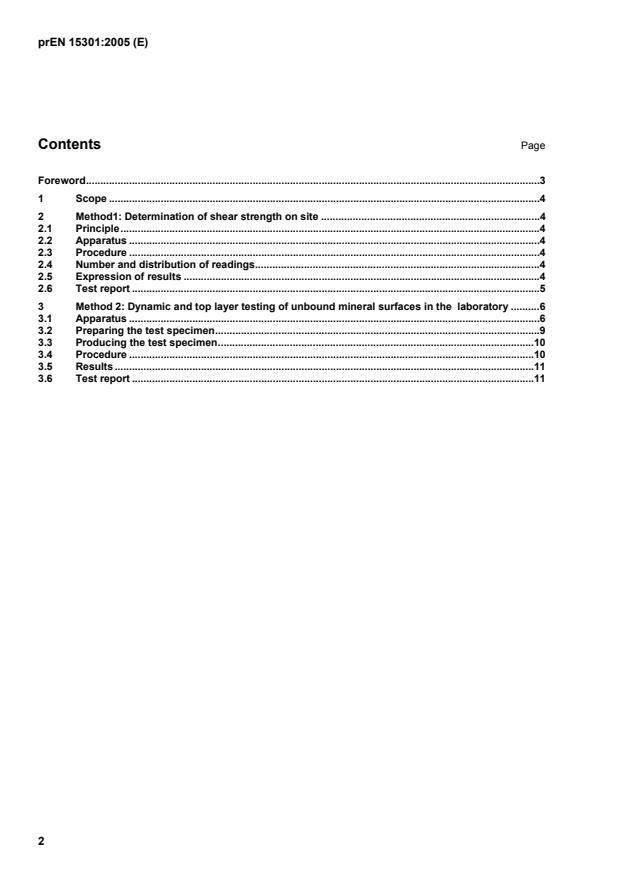
Contents Page
Foreword.3
1 Scope .4
2 Method1: Determination of shear strength on site .4
2.1 Principle.4
2.2 Apparatus .4
2.3 Procedure .4
2.4 Number and distribution of readings.4
2.5 Expression of results .4
2.6 Test report .5
3 Method 2: Dynamic and top layer testing of unbound mineral surfaces in the laboratory .6
3.1 Apparatus .6
3.2 Preparing the test specimen.9
3.3 Producing the test specimen.10
3.4 Procedure .10
3.5 Results .11
3.6 Test report .11
Foreword
This document (prEN 15301:2005) has been prepared by Technical Committee CEN/TC 217 “Surfaces for
sports areas”, the secretariat of which is held by BSI.
This document is currently submitted to the CEN Enquiry.
1 Scope
This European standard specifies methods for determining the shear strength of natural turf, synthetic turf and
unbound mineral sports surfaces.
Method 1 is intended to be carried out on site. Method 2 is intended to be carried out in the laboratory but is
applicable only to unbound mineral sports surfaces.
2 Method1: Determination of shear strength on site
2.1 Principle
The force required to initiate rotational movement of a studded or spiked disc in contact with the sports
surface being tested is measured
2.2 Apparatus
The apparatus shall comprise the following components (see Figure 1).
a) Mild steel disc (145 ± 1) mm in diameter and (12 ± 2) mm thick, with its centre drilled and, if testing natural
or synthetic turf, with six football studs (15 ± 1) mm long and 12 mm in diameter arranged on the bottom
surface, each being set (46 ± 1) mm from the centre of the disc. If testing unbound mineral surfaces,
spikes with dimensions as shown in Figure 2 shall be used instead of football studs.
b) Shaft (800 ± 25) mm long with attached lifting handles which threads into the centre of the studded disc.
c) Set of annular weights which rest centrally on a bearing on the upper surface of the studded disc allowing
free movement of the disc beneath the weights.
d) Two-handled torque wrench with a scale up to 80 N which attaches to the top of the steel shaft.
The total mass of the apparatus, including the torque wrench, shall be (46 ± 1) kg.
2.3 Procedure
Assemble the apparatus and ensure that the bearing is operating correctly to allow free movement of the disc
below the weights. Set the torque wrench indicator needle to zero, then drop the apparatus from a height of
(60 ± 10) mm onto the surface, ensuring that the studs penetrate the surface. Without placing any vertical
pressure on the torque wrench, turn the apparatus until movement of the studded disc occurs and it has
rotated through an angle of at least 45°. Record the value displayed on the torque wrench to the nearest
Newton-metre. Before conducting the next test, move the apparatus to a new position and clear the disc and
studs cleared of any soil, turf or particulate and debris. Six readings shall be taken within each test area.
2.4 Number and distribution of readings
Unless otherwise specified, take at least six readings, at random, on
...