


SIST EN 12255-3:2024
(Main)Wastewater treatment plants - Part 3: Preliminary treatment
Wastewater treatment plants - Part 3: Preliminary treatment
This document specifies design principles and performance requirements for preliminary wastewater treatment using screens with a mesh size above 50 μm, at plants serving more than 50 PT. It also includes grit removal and grease separation.
NOTE 1 For micro-screens with a mesh size below 50 microns see EN 12255-16.
NOTE 2 The primary application of this document is for wastewater treatment plants designed for the treatment of domestic and municipal wastewater. However, it contains information that can also be useful for commercial and industrial wastewater pretreatment and for combined sewer overflows (CSO).
This document applies in combination with EN 12255-1 and EN 12255-10.
Kläranlagen - Teil 3: Abwasservorreinigung
Dieses Dokument legt Planungsgrundsätze und Leistungsanforderungen für die Vorreinigung von Abwasser mithilfe von Feinrechen oder sieben mit einer Maschenweite über 50 Mikrometer in Kläranlagen mit einem EW über 50 fest.
ANMERKUNG 1 Für Mikrosiebe mit einer Maschenweite unter 50 Mikrometer siehe EN 12255-16.
ANMERKUNG 2 Vorrangig gilt dieses Dokument für Kläranlagen, die zur Behandlung von häuslichem und kommunalem Abwasser ausgelegt sind. Es enthält jedoch auch Informationen, die für die Vorreinigung von gewerblichem und industriellem Abwasser und für Mischwasserüberläufe (en: combined sewer overflows, CSO) von Nutzen sein können.
Dieses Dokument gilt gemeinsam mit EN 12255-1 und EN 12255-10.
Stations d’épuration - Partie 3 : Prétraitements
Le présent document spécifie les principes de conception et les prescriptions de performance pour le traitement préliminaire des eaux usées au moyen de dégrilleurs ayant une taille de dégrillage supérieure à 50 μm, au niveau de stations desservant plus de 50 EH. Il inclut également le rendement de dessablage et la séparation des graisses.
NOTE 1 Pour les micro-dégrilleurs de taille de dégrillage inférieure à 50 microns, voir l’EN 12255-16.
NOTE 2 Le présent document s’applique principalement aux stations d’épuration conçues pour le traitement des eaux usées domestiques et municipales. Toutefois, il contient des informations qui peuvent également être utiles pour le prétraitement des eaux résiduaires industrielles et commerciales et pour les déversoirs d’orage.
Le présent document s’applique conjointement à l’EN 12255-1 et à l’EN 12255-10.
Čistilne naprave za odpadno vodo - 3. del: Predhodna obdelava
Ta dokument določa načela načrtovanja in zahteve za predhodno obdelavo odpadne vode s siti z velikostjo mreže več kot 50 mikronov v čistilnih napravah za odpadno vodo za več kot 50 populacijskih ekvivalentov.
OPOMBA 1: Za mikro sita z velikostjo mreže, manjšo od 50 mikronov, glej standard EN 12255-16.
OPOMBA 2: Ta dokument se v prvi vrsti uporablja za čistilne naprave za odpadne vode, ki so zasnovane za čiščenje gospodinjske in komunalne odpadne vode. Vseeno pa vsebuje informacije, ki so lahko prav tako uporabne za predhodno obdelavo komercialne in industrijske odpadne vode in za zadrževalnike odpadne vode (CSO).
Ta dokument se uporablja v kombinaciji s standardom EN 12255-1 in standardom EN 12255-10.
General Information
- Status
- Published
- Public Enquiry End Date
- 22-Feb-2022
- Publication Date
- 07-Mar-2024
- Technical Committee
- IOVO - Water supply and waste water engineering
- Current Stage
- 6060 - National Implementation/Publication (Adopted Project)
- Start Date
- 06-Mar-2024
- Due Date
- 11-May-2024
- Completion Date
- 08-Mar-2024
Relations
- Effective Date
- 01-Apr-2024
- Effective Date
- 01-Apr-2024
Overview
EN 12255-3:2024 - "Wastewater treatment plants - Part 3: Preliminary treatment" (CEN) specifies design principles and performance requirements for the preliminary treatment stage of wastewater treatment plants serving more than 50 population equivalents (PT). The standard covers screening (mesh size above 50 μm), grit removal and grit treatment, and grease/oil separation. It is intended primarily for domestic and municipal wastewater but also provides guidance relevant to commercial, industrial pretreatment and combined sewer overflows (CSO). EN 12255-3:2024 supersedes the 2000 edition and includes comprehensive revisions, updated design recommendations and testing guidance.
Key topics and technical requirements
- Scope and applicability: Preliminary treatment for plants >50 PT; micro-screens (<50 μm) are addressed in EN 12255‑16. Applied together with EN 12255‑1 (general principles) and EN 12255‑10 (safety).
- Planning: Guidance on process selection, sizing for flow and load variations (separate vs combined systems), and impacts on downstream units.
- Screening: Requirements for bar screens, mesh and perforated plate screens, screen geometry, hydraulic criteria, cleaning cycles and blocking factors; structural design considerations for screen installations.
- Screenings treatment: Dewatering, washing, compaction and disposal provisions; equipment and structural design requirements, and testing of wash-press performance (normative Annex A).
- Grit removal and treatment: Design and performance of grit chambers, channels, aerated grit separators, grit classifiers, washers and slurry handling; testing procedures in informative Annex B.
- Grease and oil separation: Design considerations where FOG is significant to protect downstream processes.
- Flow balancing and splitting: Provisions for flow distribution and bypass arrangements.
- Materials, control & automation, O&M, health & safety: Requirements for construction materials, automation and control strategy, maintenance routines and operator safety.
Practical applications and users
Who benefits from EN 12255-3:2024:
- Design engineers and consulting firms sizing headworks, screens, grit and grease units
- Wastewater treatment plant owners and operators seeking consistent performance and easier operations
- Equipment manufacturers (screens, wash-presses, grit washers) for compliance and product specification
- Regulators and project managers assessing tender specifications and asset procurement
- Urban drainage and CSO planners who need pretreatment guidance for combined systems
Typical uses:
- Preparing technical specifications and tender documents for preliminary treatment systems
- Selecting and sizing screening equipment, grit separators and grit treatment lines
- Defining testing protocols for screenings washing performance and grit quality
Related standards
- EN 12255‑1 (General construction principles)
- EN 12255‑10 (Safety principles)
- EN 12255‑16 (Physical/Mechanical filtration - micro-screens <50 μm)
- EN 16323 (Glossary of wastewater engineering terms)
- EN 752 / EN 16932 (pumping installations and sewer system management)

Frequently Asked Questions
SIST EN 12255-3:2024 is a standard published by the Slovenian Institute for Standardization (SIST). Its full title is "Wastewater treatment plants - Part 3: Preliminary treatment". This standard covers: This document specifies design principles and performance requirements for preliminary wastewater treatment using screens with a mesh size above 50 μm, at plants serving more than 50 PT. It also includes grit removal and grease separation. NOTE 1 For micro-screens with a mesh size below 50 microns see EN 12255-16. NOTE 2 The primary application of this document is for wastewater treatment plants designed for the treatment of domestic and municipal wastewater. However, it contains information that can also be useful for commercial and industrial wastewater pretreatment and for combined sewer overflows (CSO). This document applies in combination with EN 12255-1 and EN 12255-10.
This document specifies design principles and performance requirements for preliminary wastewater treatment using screens with a mesh size above 50 μm, at plants serving more than 50 PT. It also includes grit removal and grease separation. NOTE 1 For micro-screens with a mesh size below 50 microns see EN 12255-16. NOTE 2 The primary application of this document is for wastewater treatment plants designed for the treatment of domestic and municipal wastewater. However, it contains information that can also be useful for commercial and industrial wastewater pretreatment and for combined sewer overflows (CSO). This document applies in combination with EN 12255-1 and EN 12255-10.
SIST EN 12255-3:2024 is classified under the following ICS (International Classification for Standards) categories: 13.060.30 - Sewage water. The ICS classification helps identify the subject area and facilitates finding related standards.
SIST EN 12255-3:2024 has the following relationships with other standards: It is inter standard links to SIST EN 12255-3:2001/AC:2001, SIST EN 12255-3:2001. Understanding these relationships helps ensure you are using the most current and applicable version of the standard.
SIST EN 12255-3:2024 is available in PDF format for immediate download after purchase. The document can be added to your cart and obtained through the secure checkout process. Digital delivery ensures instant access to the complete standard document.
Standards Content (Sample)
SLOVENSKI STANDARD
01-april-2024
Nadomešča:
SIST EN 12255-3:2001
SIST EN 12255-3:2001/AC:2001
Čistilne naprave za odpadno vodo - 3. del: Predhodna obdelava
Wastewater treatment plants - Part 3: Preliminary treatment
Kläranlagen - Teil 3: Abwasservorreinigung
Stations d’épuration - Partie 3 : Prétraitements
Ta slovenski standard je istoveten z: EN 12255-3:2024
ICS:
13.060.30 Odpadna voda Sewage water
2003-01.Slovenski inštitut za standardizacijo. Razmnoževanje celote ali delov tega standarda ni dovoljeno.
EN 12255-3
EUROPEAN STANDARD
NORME EUROPÉENNE
January 2024
EUROPÄISCHE NORM
ICS 13.060.30 Supersedes EN 12255-3:2000
English Version
Wastewater treatment plants - Part 3: Preliminary
treatment
Stations d'épuration - Partie 3 : Prétraitements Kläranlagen - Teil 3: Abwasservorreinigung
This European Standard was approved by CEN on 3 December 2023.
CEN members are bound to comply with the CEN/CENELEC Internal Regulations which stipulate the conditions for giving this
European Standard the status of a national standard without any alteration. Up-to-date lists and bibliographical references
concerning such national standards may be obtained on application to the CEN-CENELEC Management Centre or to any CEN
member.
This European Standard exists in three official versions (English, French, German). A version in any other language made by
translation under the responsibility of a CEN member into its own language and notified to the CEN-CENELEC Management
Centre has the same status as the official versions.
CEN members are the national standards bodies of Austria, Belgium, Bulgaria, Croatia, Cyprus, Czech Republic, Denmark, Estonia,
Finland, France, Germany, Greece, Hungary, Iceland, Ireland, Italy, Latvia, Lithuania, Luxembourg, Malta, Netherlands, Norway,
Poland, Portugal, Republic of North Macedonia, Romania, Serbia, Slovakia, Slovenia, Spain, Sweden, Switzerland, Türkiye and
United Kingdom.
EUROPEAN COMMITTEE FOR STANDARDIZATION
COMITÉ EUROPÉEN DE NORMALISATION
EUROPÄISCHES KOMITEE FÜR NORMUNG
CEN-CENELEC Management Centre: Rue de la Science 23, B-1040 Brussels
© 2024 CEN All rights of exploitation in any form and by any means reserved Ref. No. EN 12255-3:2024 E
worldwide for CEN national Members.
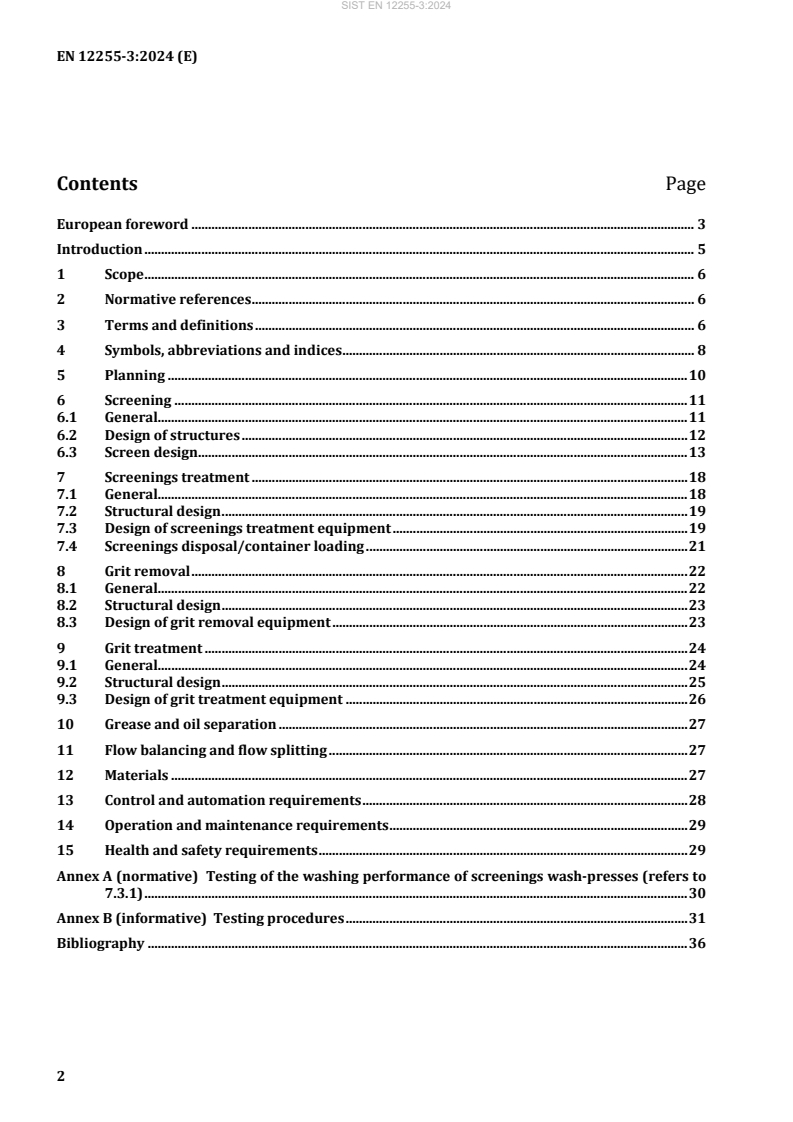
Contents Page
European foreword . 3
Introduction . 5
1 Scope . 6
2 Normative references . 6
3 Terms and definitions . 6
4 Symbols, abbreviations and indices . 8
5 Planning . 10
6 Screening . 11
6.1 General. 11
6.2 Design of structures . 12
6.3 Screen design . 13
7 Screenings treatment . 18
7.1 General. 18
7.2 Structural design . 19
7.3 Design of screenings treatment equipment . 19
7.4 Screenings disposal/container loading . 21
8 Grit removal . 22
8.1 General. 22
8.2 Structural design . 23
8.3 Design of grit removal equipment . 23
9 Grit treatment . 24
9.1 General. 24
9.2 Structural design . 25
9.3 Design of grit treatment equipment . 26
10 Grease and oil separation . 27
11 Flow balancing and flow splitting . 27
12 Materials . 27
13 Control and automation requirements . 28
14 Operation and maintenance requirements . 29
15 Health and safety requirements . 29
Annex A (normative) Testing of the washing performance of screenings wash-presses (refers to
7.3.1) . 30
Annex B (informative) Testing procedures . 31
Bibliography . 36
European foreword
This document (EN 12255-3:2024) has been prepared by Technical Committee CEN/TC 165 “Waste
water engineering”, the secretariat of which is held by DIN.
This European Standard shall be given the status of a national standard, either by publication of an
identical text or by endorsement, at the latest by July 2024, and conflicting national standards shall be
withdrawn at the latest by July 2024.
Attention is drawn to the possibility that some of the elements of this document may be the subject of
patent rights. CEN shall not be held responsible for identifying any or all such patent rights.
This document supersedes EN 12255-3:2000.
3:2000:
a) comprehensive revision and additions in all sections;
b) the addition of design recommendations;
c) adaptation to the current state of the art;
d) updating of the Normative references;
e) editorial revision.
It is the third part prepared by Working Group CEN/TC 165/WG 40 relating to the general
requirements and processes for treatment plants for a total number of inhabitants and population
equivalents (PT) over 50. EN 12255 with the generic title “Wastewater treatment plants” consists of the
following Parts:
— Part 1: General design and construction principles
— Part 2: Storm water management systems
— Part 3: Preliminary treatment
— Part 4: Primary treatment
— Part 5: Lagooning processes
— Part 6: Activated sludge process
— Part 7: Biological fixed-film reactors
— Part 8: Sludge treatment and storage
— Part 9: Odour control and ventilation
— Part 10: Safety principles
— Part 11: General data required
— Part 12: Control and automation
— Part 13: Chemical treatment — Treatment of wastewater by precipitation/flocculation
— Part 14: Disinfection
— Part 15: Measurement of the oxygen transfer in clean water in aeration tanks of activated sludge
plants
— Part 16: Physical (mechanical) filtration
NOTE 1 Part 2 is under preparation.
NOTE 2 For requirements on pumping installations at wastewater treatment plants see EN 752 “Drain and
sewer systems outside buildings — Sewer system management” and EN 16932 (all parts) “Drain and sewer
systems outside buildings — Pumping systems”.
Any feedback and questions on this document should be directed to the users’ national standards body.
A complete listing of these bodies can be found on the CEN website.
According to the CEN-CENELEC Internal Regulations, the national standards organisations of the
following countries are bound to implement this European Standard: Austria, Belgium, Bulgaria,
Croatia, Cyprus, Czech Republic, Denmark, Estonia, Finland, France, Germany, Greece, Hungary, Iceland,
Ireland, Italy, Latvia, Lithuania, Luxembourg, Malta, Netherlands, Norway, Poland, Portugal, Republic of
North Macedonia, Romania, Serbia, Slovakia, Slovenia, Spain, Sweden, Switzerland, Türkiye and the
United Kingdom.
Introduction
Differences in wastewater treatment throughout Europe have led to a variety of systems being
developed. This document gives fundamental information about the systems; this document has not
attempted to specify all available systems. A generic arrangement of wastewater treatment plants is
illustrated in Figure 1:
Key
1 preliminary treatment
2 primary treatment
3 secondary treatment
4 tertiary treatment
5 additional treatment (e.g. disinfection or removal of micropollutants)
6 sludge treatment
7 lagoons (as an alternative)
A raw wastewater
B effluent for re-use (e.g. irrigation)
C discharged effluent
D screenings and grit
E primary sludge
F secondary sludge
G tertiary sludge
H digested sludge
I digester gas
J returned water from dewatering
Figure 1 — Schematic diagram of wastewater treatment plants
Detailed information additional to that contained in this document can be obtained by referring to the
bibliography.
1 Scope
This document specifies design principles and performance requirements for preliminary wastewater
treatment using screens with a mesh size above 50 μm, at plants serving more than 50 PT. It also
includes grit removal and grease separation.
NOTE 1 For micro-screens with a mesh size below 50 microns see EN 12255-16.
NOTE 2 The primary application of this document is for wastewater treatment plants designed for the
treatment of domestic and municipal wastewater. However, it contains information that can also be useful for
commercial and industrial wastewater pretreatment and for combined sewer overflows (CSO).
This document applies in combination with EN 12255-1 and EN 12255-10.
2 Normative references
The following documents are referred to in the text in such a way that some or all of their content
constitutes requirements of this document. For dated references, only the edition cited applies. For
undated references, the latest edition of the referenced document (including any amendments) applies.
EN 12255-1, Wastewater treatment plants — Part 1: General construction principles
EN 12255-10, Wastewater treatment plants — Part 10: Safety principles
EN 16323, Glossary of wastewater engineering terms
3 Terms and definitions
For the purposes of this document, the terms and definitions given in EN 16323 and the following apply.
ISO and IEC maintain terminology databases for use in standardization at the following addresses:
— ISO Online browsing platform: available at https://www.iso.org/obp/
— IEC Electropedia: available at https://www.electropedia.org/
3.1
aerated grit separator
structure for separating sand and other mineral matter from wastewater, using air to induce circulation
[SOURCE: Modified from EN 16323:2014, term number 2.3.9.1 “aerated grit chamber”, to recognize that
not all separators are chambers]
3.2
bar screen
device comprising bars to separate objects from fluids
3.3
blocking factor
f
B
ratio of the area of a screen being blocked by withheld matter, to the open area of the clean screen
3.4
grit chamber
grit separating trap with a circular or rectangular footprint
3.5
grit channel
grit separating tank with a rectangular footprint
3.6
grit classifier
equipment for draining water from grit
3.7
grit slurry
wet mineral and organic matter removed from a grit separator
3.8
grit separator
device to separate grit, sand or similar mineral material from wastewater
[SOURCE: EN 16323:2014, term number 2.3.2.4]
3.9
grit treatment
separation of organic matter from grit
3.10
grit washer
equipment for removal of organic matter and water from grit
3.11
mesh screens
screen with a mesh woven from filamentous material
Note 1 to entry: E.g. stainless-steel wires or plastic fibres.
3.12
perforated plate screen
screen with perforated plates containing holes through which the wastewater flows
3.13
screen cycle time
t
C
period between the start of a screen’s cleaning cycle and the start of the next cleaning cycle during
continuous screen operation
3.14
screen medium
element of a screen retaining solids and permeable to fluids
3.15
screenings
matter retained by a screen or a sieve
[SOURCE: EN 16323:2014, term number 2.3.2.14]
3.16
screenings treatment
dewatering and compaction of screenings with or without prior washing
3.17
separation medium
element in a screenings press separating screening from draining water
4 Symbols, abbreviations and indices
Symbols Units Definitions
A area
m
A immersed upstream area of a clean screen medium of
m
perforated plate or mesh screens; for straight screen media
(A = W ⋅ h / sin α)
1 1
A immersed downstream area of a clean screen medium of bar
m
screens; for straight screen media (A = W ⋅ h / sin α)
2 2
C concentration of x
kg/m or mg/l
x
d mm or μm diameter of sand or grit
DSR % dry solids ratio
e mm slot width at its narrowest point
f — blocking factor
B
f — ratio of the screen’s permeable open area to the cross section of
o
the upstream flow
(to be specified by the screen manufacturer)
2 2
g
m/s gravitational acceleration (9,81 m/s )
h m water level height above the channel floor
h m water level height upstream of a screen
h m water level height downstream of a screen
Δh m head loss (Δh = h – h )
1 2
2 2
h m
energy head loss [h = Δh + v /(2 g) – v /(2 g)]
EL
EL 1 2
L kg/h load of x
x
m kg mass of x
x
Q flow of x
m /s or l/s
x
— regression value
R
s mm bar width at its widest point
t s time
Symbols Units Definitions
t s cycling time for screen cleaning
C
Δt s duration
V volume
m or l
v m/s upstream velocity [v = Q / (W ⋅ h )]
1 1 1
v m/s downstream velocity [v = Q / (W ⋅ h )]
2 2 2
v m/s maximum velocity in slots or perforations of a clean screen
max
v m/s minimum velocity in a channel upstream of a screen
min
W m width of the channel
WP mg/g washing performance
α ° angle of a screen medium relative to the horizontal
β — hydraulic form factor for flow between bars (see Figure 2)
η % removal ratio
μ — outflow factor of perforations (for sharp edged perforations
≈ 0,6)
ρ density
kg/m
Abbreviations Definitions
ATEX ATEX Directive of the European Union (FR: ATmosphères EXplosibles)
BOD biochemical oxygen demand
COD chemical oxygen demand
DS dried solids
FOG fat, oil and grease
Indices Definitions
COD chemical oxygen demand
Dr Droste formula
Dos dosage
DW dry weather conditions
end after treatment
Fr fraction
GS grit separator
GT grit treatment
GST grit separation and treatment system
Indices Definitions
Ki modified Kirschmer formula
max maximum
min minimum
Pr probe or sample of grit separator testing
raw before treatment
rem removed
true true result of grit separator testing
5 Planning
Wastewater pretreatment is essential to prevent operational issues in subsequent treatment units.
Pretreatment is typically designed to remove coarse solids, grit and (where required) fat, oil and grease
(FOG). FOG separation can be required where the raw wastewater contains substantial amounts of fats,
oil or grease.
Flow variations depend on the kind of the sewer system, i.e. separate or combined systems. Combined
systems have a wider flow and load variation than separate systems. Pretreatment units shall be
designed for maximum flows and loads. Combined sewer systems usually include
storage/sedimentation tanks and sewer overflows. Storage tanks and overflows (bypasses) may also be
provided at the headworks of wastewater treatment plants (preferably after screening).
Planning of the wastewater pretreatment shall begin with consideration of the various processes which
could achieve the performance requirements. Selection of processes shall be based on raw wastewater
characteristics, on the maximum flow to be treated, on the maximum coarse solids and grit loads to be
expected, as well as on the technical and economic consequences for subsequent processes.
Planning of pretreatment systems shall include the following considerations:
— effects of flow and load variations on all treatment units;
— effects of flow velocity in the sedimentation of particles upstream or downstream of the treatment
units;
— avoidance of anaerobic processes resulting from excessive retention times;
— overall concept of preliminary and primary treatment;
— selection of fine or very fine screens and their effects on sludge treatment;
— required screenings treatment, e.g. through washing and compaction, and options for screenings
disposal;
— need for FOG removal;
— requirements on grit removal and treatment (e.g. grit washing);
— options for grit disposal or recycling;
— reliability of the treatment processes;
— structural requirements (e.g. housing, heating and ventilation, odour control);
— ATEX requirements.
When the performance requirements have been established, requirements on the location shall be
determined.
A lay-out plan shall be provided.
Further general requirements are specified in EN 12255-1, EN 12255-9, EN 12255-10 and EN 12255-
12.
6 Screening
6.1 General
Screens are distinguished depending on:
a) their screen medium:
— bars;
— perforated plates;
— mesh;
b) their screen medium’s orifices:
— coarse screens with a slot width of 20 mm or greater, serving to avoid blockage of subsequent
equipment;
— medium screens with a slot or perforation diameter between 8 mm and < 20 mm, preventing
clogging of subsequent equipment;
— fine screens with a slot or perforation diameter between 1 mm and < 8 mm, avoiding cording in
subsequent processes (e.g. sludge treatment);
— very fine screens with a perforation diameter between 0,05 mm and < 1 mm, serving to reduce
the BOD and COD load;
NOTE 1 Very fine screens remove solids, COD and BOD, e.g. upstream of river and sea outfalls. Their
removal effectiveness can be increased by addition of precipitants and coagulants (e.g. ferric chloride) and
polymeric flocculants.
NOTE 2 Very fine screens can be used instead of primary clarifiers (see EN 12255-4) after coarse screens.
Their screenings have the characteristics of primary sludge and are forwarded and treated as such.
NOTE 3 Fine or very fine screens are recommended prior to bio-membrane reactors for biological
wastewater treatment.
c) the shape of their screening elements:
— straight screens;
— curved screens;
— step screens;
— drum screens;
— belt screens;
— disc screens;
d) their installation:
— in a channel;
— in a container;
— at a structure for combined sewer overflows;
— in a pumping station;
e) their screen medium’s cleaning mechanism:
— co-current rakes (bar screens);
— counter-current rakes (bar screens);
— scrapers (e.g. perforated plate screen);
— brushes (e.g. perforated plate screen);
— spray nozzles (e.g. perforated plate, belt or disk screens);
f) their screening treatment:
— without integrated screening treatment (treatment in separate press or wash-press);
— integrated screenings press;
— integrated screenings wash-press.
6.2 Design of structures
The following factors shall be considered in the structural design:
a) It must generally be assumed that an explosive atmosphere could be generated in headworks. This
requires an assessment of explosion safety.
b) At treatment plants serving a total population of more than 10 000, stand-by screens should be
provided. At smaller plants, a bypass including a manually operated coarse screen can be sufficient.
It shall be possible to take each screen out of service for maintenance and repair.
c) To permit maintenance, repair and replacement of screens, upstream and (where necessary)
downstream isolation means shall be provided.
d) Upstream of screens a separator for the removal of stones, pebbles and other heavy debris shall be
provided where necessary.
e) The width of new channels for screen installation shall be a multiple of 0,1 m (up to 0,8 m) or a
multiple of 0,2 m for wider channels.
f) Freeboards upstream of screens shall be specified because they limit the maximum upstream
wastewater level.
g) The geometry of channels or tanks for screens shall be specified. Recesses in channel floors should
be avoided to prevent grit sedimentation in the recesses and subsequent operational problems [1].
The wastewater velocity in channels upstream of screens v should not be below 0,3 m/s at
min
minimum flow.
h) Means, such as baffle plates, downstream of screens can be needed to raise h and reduce v (see
2 max
6.3.2).
i) The room height of headworks as well as the space around equipment shall be sufficient for
operation, maintenance, repair and replacement of the equipment and its elements.
j) The structure shall be such that the equipment and its components can easily and without hazard
be delivered, installed, operated, maintained, repaired and cleaned. Assembly openings and
provisions for the use of lifting gear (e.g. crane or rail or hook for pulleys) can be required.
k) Headworks shall be sufficiently ventilated. Heating can be necessary. Ventilation requirements are
usually lower where screens are covered or enclosed. Odour control can be required.
l) Cold weather operation of equipment shall be guaranteed, e.g. by housing or thermal insulation and
electrical heating.
m) Service water connections are required.
n) Sufficiently enclosed spray nozzles may be operated with process water or treated wastewater. The
quality, flow and pressure of the water shall be agreed between designer and equipment supplier.
See EN 12255-1 for general requirements and EN 12255-10 for health and safety requirements.
6.3 Screen design
6.3.1 General
Selection of a screen’s type and the geometry of its orifices depend on requirements on subsequent
processes and from sludge treatment and disposal. Fine or very fine screens should be provided.
Upstream coarse or medium screens can be useful to reduce the solids load on fine or very fine screens.
Operator health and safety shall be considered when equipment is selected (in particular for screenings
treatment). Equipment should be enclosed. Further information can be found in EN 12255-1 and
EN 12255-10.
Both hydraulic loads and mechanical loads shall be considered. Mechanical loads are exerted by the up-
and downstream water level difference and during screenings removal, transport and treatment.
The structural design of screens shall ensure that they are capable of withstanding a hydraulic head
difference of at least 0,5 m.
The flow rate through screening orifices v shall not exceed 1,2 m/s at maximum flow through the
max
clean screen (a downstream baffle can be required for level and velocity control).
The screen cycle time of a bar screen should not exceed 2 min. Where this is not possible (e.g. in deep
channels) the screen’s design shall be adapted to higher screening load, water level difference and
freeboard.
The weight of the wet screenings on rakes shall be 1 kN per m width and for narrow screens a minimum
of 0,6 kN.
Drives shall be designed for intermittent and continuous operation and shall be capable of removing the
maximum screenings load. Raking and driving elements shall be protected against mechanical and/or
electrical overload.
National or local regulations or the relevant authority can have requirements concerning the disposal of
screenings.
Unless otherwise specified, the design service life of screens shall be Class 3 (see EN 12255-1).
Where screens are installed in a tank, the tank shall have an emergency bypass. When a certain
maximum upstream water level is exceeded, an alarm shall be triggered.
Some screens have all drives and drive elements located above the maximum water level. The water
protection class of motors, gears and drive shall comply with EN 12255-1. However, there are screens
that have driving elements, e.g. chains, which submerge into the water. Such drive elements including
their bearings shall be water resistant. All elements that are immersed in water shall be maintenance-
free within the interval of planned renewal, except where they can be easily removed or isolated and
accessed for maintenance.
Provision should be made for conditions which cause rakes to become stuck. Typically, this is done by
reversing their movement when excessive resistance is detected then moving them forward again. After
a low number of back and forth movements they shall be stopped and an alarm shall be given. Overload
protection shall be provided.
Emissions of spray water, aerosols and odour can be reduced by enclosing or covering screens. Means
for ventilation and odour control may be required.
The selection and design of screens depends on their operation conditions. The following data shall be
specified:
a) the maximum (design) flow Q in m /s or l/s;
max
b) maximum and minimum flows during dry weather conditions (Q and ) in m /s or
max,DW Qmin,DW
l/s;
c) the maximum water level h upstream of the screen;
1,max
d) maximum and minimal water levels h and h downstream of the screen;
2,max 2,min
e) maximum water (or sludge) velocity v in the slots or perforations of the clean screen medium
max
(e.g. 1,2 m/s);
f) minimum velocity v in the channel upstream of the clean screen required to minimize fouling
min
and or settlement (e.g. 0,3 m/s);
g) characteristics of the screenings if they are unusual;
— maximum raw screenings load L within 15 min in kg (a mass of 1 kg may be assumed to
raw,max
be equivalent to a volume of 1 l);
— type of screen;
— geometry and size of the screen medium’s orifices (in mm for bar and perforated plates
screens; in microns for mesh screens).
6.3.2 Hydraulic design
At maximum flow Q and in clean screen conditions the velocity in the screen medium’s orifices v
max max
should not exceed 1,2 m/s. If the screen is used for sludge screening, v should not exceed 0,6 m/s.
max
The smaller the size of the orifices, the lower should be v .
max
At minimum daily dry weather flow and clean screen conditions, v in the channel upstream of the
min
screen should not be lower than 0,3 m/s. At maximum dry weather flow and clean screen conditions
v should not be lower than 0,5 m/s.
min
The maximum blocking factor f is not only dependent on the screenings load, but also on the size of
Bmax
the screen medium’s orifices and the minimal screen cycle time t [1]. The minimum screen cycle
Cmin
time t depends on the type of screen (and for climber screens also on the level difference from the
Cmin
channel floor to their discharge point).
For any screen type, the blocking factor f increases where finer screens are used. Accordingly, the
Bmax
cycle time t [1] should be reduced for finer screens. The screen supplier shall supply the
Cmin
performance data for the maximum blocking factor and the minimum cycle time appropriate for the
screen being supplied, in the simultaneous conditions of maximum flow Q and maximum raw
max
screenings load L .
raw,max
The hydraulic design calculations for bar screens and perforated plate and mesh screens are different.
The flow through a bar screen is calculated with a modified Kirschmer formula and the water level is
lowest between the bars; the flow through perforations is calculated with the Droste Formula (5) for
the outflow through orifices.
NOTE Both formulae are only an approximation to reality.
The velocity v of bar screens is calculated with the open area of the permeated screen medium
max
which depends on the downstream water level h and the angle α of the screen medium relative to the
horizontal (see Figure 2).
However, the velocity v of perforated plate screens is calculated with the open area of the permeated
max
screen medium which depends on the upstream water level h and the angle α of the screen medium
relative to the horizontal.
Curved screen media have a larger area and α is a function of level h.
In some instances, a combination of coarse or medium screens with subsequent fine or very fine
screens can be a good solution [1].
Emergency bypasses shall be equipped with a manually operated coarse screen. They shall be designed
and operated such that the wastewater does not overflow into the environment. This means that the
coarse screen shall be continuously cleaned manually when the flow or load is high.
Key
1 upstream water level
2 downstream water level
3 screen medium
Symbols are explained in the text below.
Figure 2 — Water and energy levels up- and downstream of a screen [2]
For straight bar screens the following modified formula of Kirschmer [3] should be used:
4 3
s
+ f
B
Q 1
e
∆h=−=hh β⋅ ⋅ sinα⋅ ⋅
(1)
K 1 2
12− f Wh⋅⋅ g
B2
For curved screen media Formula (2) and Formula (3) apply:
43/
s
+ f
B
Q 1
e
∆h=−=hh β⋅ ⋅ ⋅
(2)
K 1 2
12−⋅f Ag
B 2
with
h
W
(3)
A ⋅ dh
∫
sinα
Figure 3 shows hydraulic form factors β for various bar profiles.
=
Figure 3 — Hydraulic form factors of various bar shapes [DIN 19569-2]
The form factor β depend on the slot width e and the velocity in the slots v . However, Formula (1) is
max
on the safe side [8].
The blocking factor f shall be specified by the designer, e.g. between 35 % and 50 %.
B
For perforated plate and mesh screens Δh should be calculated with the Droste [6] Formula (4):
1 Q 11
∆h=−=hh ⋅ ⋅ −
(4)
D 1 2
2⋅⋅g µ Wh
Af⋅ ⋅−1 f
( )
1
1 o B
Because h and A are both input and output parameters of Formula (4), Δh and h shall be calculated
1 1 D 1
iteratively.
Suppliers shall state in their quotes:
a) the maximum blocking factor f ;
B,max
b) the minimum screen cycle time t ;
C,min
c) the permeable area A (for bar screens) or the permeable area A (for perforated plate
2,max 1,max
screens);
d) the upstream water level h at the maximum flow Q and the maximum blocking factor f .
1,max max B,max
6.3.3 Mechanical design
Functional performance of screens depends on their flow and load handling performance and on their
capability to avoid blocking. These characteristics depend on operational conditions and design. To
permit screen manufacturers to design and offer suitable and economical screens, all foreseeable
operational conditions shall be described and specified by the designer of the plant.
The following main loads shall be applied for rakes and drives:
— maximum screenings mass;
— mass of the moving elements;
— forces generated by movement of these elements;
— friction forces generated by movement of the elements.
All rake and drive elements shall be capable of sustaining the applied loads over the design service life
as defined in EN 12255-1. They shall be protected against overload which can be achieved by
mechanical or electrical overload system.
Wear of cleaning elements is also dependent on the screen cycle time t . Cleaning cycles are controlled
C
by the upstream water level h or the water level difference Δh. An overriding cycle time control should
be added to prevent screenings remaining too long on the screenings medium.
The maximum output of raw screenings L shall be specified. It shall be considered that L
raw,max raw,max
is several times the average output, particularly where combined sewer systems are used.
NOTE The maximum output is usually specified by the designer.
There are screens whose drive elements (e.g. motors, gears, cogwheels, chains and ropes.) are all
located above the maximum water level. Drive elements which become immersed in wastewater shall
be protected (e.g. within a motor or gearbox housing) or shall be resistant to the wastewater.
Axles, shafts, beams, runners and pinions are force transmitting elements and shall withstand the
applied forces and corrosion for the design life. The design service life, as defined in EN 12255-1, shall
be specified.
Rolling or sliding bearings (also those of hinges), chains, rope and belt drives, clutches and brakes are
typical machinery elements and shall withstand the design service life as defined in EN 12255-1. Unless
otherwise specified the design service life of these machinery elements shall be Class 3.
Pinions, wear plates and runners are wear parts. Their expected minimum life shall be stated.
The load bearing length of the rakes shall be specified.
Bar screens with rakes shall be protected against damage from overload. When overload is detected the
movement of the rake shall stop and an alarm shall be triggered.
There are screens with reversible cleaning elements reversing their motion if their movement is
blocked in order to try removal of the blockage. After a low number of unsuccessful reversals, the
screen shall be shut off and an alarm shall operate. Safety means shall be provided to prevent any
damage arising from reversals. The reverse operation shall be clearly and understandably described in
the documentation.
Covered or housed screens prevent emission of odour and aerosols, which can be generated during
cleaning of screen media with spray water. Ventilation of housing containers can be required.
Wear parts shall be easily replaceable.
Unless the specification asks for a higher design service life of screens, it shall be Class 3 (see EN 12255-
1).
7 Screenings treatment
7.1 General
Equipment for screenings treatment forms a functional unit with preceding screens and preceding or
subsequent transport and storage equipment. Operation of all equipment shall be coordinated such that
an operational fault of one part does not impair other parts (e.g. shutting-off screens if screenings
treatment fails, activation of a bypass, activating an alarm).
a) According to their function, equipment for screenings treatment can be distinguished as
— screenings presses and
— screenings wash-presses.
b) According to their design they can be distinguished as
— screw presses or
— piston presses.
The need for stand-by screenings treatment equipment shall be considered in combination with the
redundancy of screens. Where only a single unit is installed, means shall be provided to permit further
operation of screen(s). This can be done by disposal of untreated screening into a separate container or
bypassing of the unit.
Effluent of the wastewater treatment plant is usually sufficient as wash water for wash-presses. The
quality, maximum flow and pressure of the wash water shall be specified.
7.2 Structural design
The equipment shall be protected against frost, preferably by installation in a building. Adequate means
for odour and noise control shall be provided.
Structures shall be designed such that screenings presses or wash-presses can be delivered, installed,
operated, maintained, repaired or exchanged easily and without hazard. Especially where several
presses are to be installed, easy accessibility of all equipment and its components shall be provided.
The floor space for containers receiving and storing the treated screenings shall be sufficient. Easy and
safe access for lorries shall be provided.
Drainage for the water from presses, wash-presses is required and shall be designed to minimize
blockage risk.
7.3 Design of screenings treatment equipment
7.3.1 General
The designer shall specify the following data:
a) type of press (e.g. screw or piston press, press with prior or internal washing);
b) type and fineness of the screen(s) and the separation medium;
c) maximum mass or volume of raw screenings m within 15 min (1 l of raw screenings may be
raw,max
assumed to be 1 kg) in kg/min or l/min;
d) dry solids ratio DSR of the raw screenings in percent;
raw
e) required dry solids ratio DSR of the treated screenings in percent;
end
f) required quality of washed and pressed screenings (determined by evaluation of the treated
screenings and expressed as the ratio of g COD per g of treated screenings solids, see Annex A);
g) requirements in regard to redundancy and bypassing (e.g. number of screens, presses and
containers);
h) type of conveyors for the transport of raw screenings from screens to presses (e.g. they drop over a
chute from the screen discharge into a trough of the press, belt conveyor, screw conveyor, flushing
through a launder channel);
i) floor plan and equipment lay-out;
j) level of the screen discharge above the floor;
k) length of the discharge pipe and level of its upper end above the floor.
NOTE 1 The dry solids ratio DSR of the treated solids depends on the quality of the raw screening and thus
end
on the fineness of the separation medium and on the type of screenings press. It is higher for wash-presses and
depends on the washing quality.
NOTE 2 There are wash-presses with an agitated laundry container into which wash water is fed. For agitation
a fast-rotating pump impeller is used. Such laundry wash-presses are typically used in combination with a launder
channel for feeding the raw screening into the laundry container. Washing performance is optimized and thus
DSR maximized and discharge costs minimized.
end
NOTE 3 The washing quality can be determined by eluating the treated screenings, analysing the COD in the
eluate m and referring it to the mass of the mass of dry solids m in the screenings after their elution. A result
COD DS
below 50 mg COD per kg DS can be achieved at least during dry weather conditions. A testing method is described
in the normative Annex A.
7.3.2 Mechanical design
The maximum forces in presses are calculated from the maximum momentum of a screw press drive or
the maximum piston force in piston presses for the case that a press or its output pipe should be
blocked.
Screenings presses shall be capable of treating all solids that are permitted to enter the sewer system
and all solids that are reasonably foreseeable (e.g. leaves, wet wipes, plastic wrappers etc.).
The following information shall be provided in offers for the equipment:
1) type of press or wash-press and description of its structural features;
2) maximum raw screenings load of the press or wash-press in kg/h or m /h;
3) diameter of the screw or piston in mm;
4) perforation diameter or slot width of the separation medium in mm;
5) clean open area of the separation medium;
6) rotational speed of the screw in rpm;
7) material of the screw or piston and of the separation medium;
8) cleaning mechanism for the separation medium;
9) type of wear protection on the screw flight and within the press port (e.g. choice of material or
armour);
10) required water quality, maximum water consumption in m /h, and pressure in Pa;
11) nominal power of motors in kW;
12) maximum momentum of all drives in Nm.
Screening presses shall comply with the following design principles:
a) sufficiently large and steep feeding funnels to prevent bridging and deposits;
b) self-cleansing of the separation medium by brushes (preferable where fine screenings are treated
or their fat content is high) or by the screw’s flight (preferable where coarse screenings are treated
or their fat content is low);
c) all working points shall be accessible easily and without hazard;
d) wear parts (e.g. brushes) shall be readily replaceable;
e) easy disassembly of all components prone to clogging (e.g. screen element, press port and drain
lines;
f) the press shall push the treated screenings through a discharge pipe;
g) the length, slope and rise of the discharge pipe shall be such that the created pressure is sufficient
to eject the screenings.
Bypassing of screenings presses shall be performed by:
i. pivoting chutes;
ii. gates;
iii. reversible conveyor screws or belts; or
iv. swivelling conveyor screws or belts.
Unless otherwise required in the specifications, the design service life of screenings presses shall be
Class 3 (see EN 12255-1).
7.4 Screenings disposal/container loading
The size and type of loading of the containers shall be adapted to the expected screenings qua
...
Questions, Comments and Discussion
Ask us and Technical Secretary will try to provide an answer. You can facilitate discussion about the standard in here.
Loading comments...