


SIST EN 50173-10:2025
(Main)Information technology - Generic cabling systems - Part 10: Single pair cabling
Information technology - Generic cabling systems - Part 10: Single pair cabling
This document specifies 1-pair cabling and can be used in conjunction with all the space-specific standards of the EN 50173 series but especially EN 50173-3 and EN 50173-6.
NOTE 1-pair cabling for EN 50173-2, EN 50173-4 and EN 50173-5 is for further study.
It delivers 1-pair cabling specifications to extend generic cabling systems according to the EN 50173 series.
This document specifies the:
- structure and minimum configuration for extension of generic cabling by 1-pair cabling;
- interfaces at the service outlet (SO/TO);
- performance requirements for cabling links and channels;
- implementation requirements and options;
- performance requirements for cabling components;
- conformance requirements and verification procedures.
This document takes into account the requirements specified in application standards listed in Annex C.
Informationstechnik - Anwendungsneutrale Kommunikationskabelanlagen - Teil 10: Einpaarige Verkabelung
Technologies de l'information - Systèmes de câblage générique - Partie 10: Câblage mono-paire
Le présent document spécifie le câblage à 1 paire et peut être utilisé conjointement avec les normes spécifiques aux différents espaces de la série EN 50173, et plus particulièrement l’EN 50173-3 et l’EN 50173-6.
NOTE Le câblage à 1 paire destiné aux espaces couverts par l’EN 50173-2, l’EN 50173-4 et l’EN 50173-5 est soumis à étude ultérieure.
Il donne des spécifications de câblage à 1 paire afin d’étendre le domaine d’application des systèmes de câblage générique conformément à la série EN 50173.
Le présent document spécifie:
- la structure et la configuration minimale pour étendre le domaine d’application du câblage générique à l’aide du câblage à 1 paire;
- les interfaces au niveau de la prise de service (prise de services (SO, Service Outlet)/prise de télécommunication (TO, Telecommunications Outlet));
- les exigences de performances concernant les liaisons et canaux de câblage;
- les exigences et les options de mise en œuvre;
- les exigences de performances concernant les composants du câblage;
- les exigences de conformité et les procédures de vérification.
Le présent document tient compte des exigences spécifiées dans les normes d’application énumérées à l’Annexe C.
Informacijska tehnologija - Generični kabelski sistemi - 10. del: Enoparično okablenje
Ta dokument določa enoparične kable in ga je mogoče uporabljati skupaj z vsemi standardi iz skupine standardov EN 50173, ki obravnavajo določene prostore, zlasti pa s standardoma EN 50173-3 in EN 50173-6. OPOMBA: Enoparične kable za standarde EN 50173-2, EN 50173-4 in EN 50173-5 je treba dodatno preučiti. Zagotavlja specifikacije za enoparične kable za razširitev osnovnih kabelskih sistemov v skladu s skupino standardov EN 50173. Ta dokument določa: – strukturo in minimalno konfiguracijo za razširitev osnovnih kablov z enoparičnimi kabli; – vmesnike na servisni vtičnici (SO/TO); – zahteve za zmogljivost kabelskih povezav in kanalov; – zahteve in možnosti za izvedbo; – zahteve za zmogljivost kabelskih komponent; – zahteve za skladnost in postopke preverjanja. Ta dokument upošteva zahteve, določene v standardih za uporabo iz dodatka C.
General Information
- Status
- Published
- Public Enquiry End Date
- 30-Jan-2025
- Publication Date
- 16-Jul-2025
- Technical Committee
- ELI - Electrical and communication installations
- Current Stage
- 6060 - National Implementation/Publication (Adopted Project)
- Start Date
- 30-Jun-2025
- Due Date
- 04-Sep-2025
- Completion Date
- 17-Jul-2025
Overview
EN 50173-10:2025 - Information technology: Generic cabling systems - Part 10: Single pair cabling defines requirements for 1‑pair (single pair) balanced cabling as an extension of the EN 50173 generic cabling family. It specifies structure, interfaces, performance, implementation options and verification procedures for single pair links and channels (including 100 m reach and beyond). The document supports remote power delivery and is intended for industrial automation and intelligent buildings while complementing - not replacing - existing 4‑pair systems.
Key topics and technical requirements
The standard covers these core technical areas:
- Cabling structure and hierarchy: functional elements, channel and link definitions, service outlet interfaces (SO/TO).
- Transmission and environmental performance: balanced single‑pair channel and link performance (return loss, insertion loss/attenuation, propagation delay).
- Electrical parameters: DC loop resistance, DC resistance unbalance and current carrying capacity.
- Signal integrity and interference: unbalance attenuation (near/far end), coupling attenuation and alien crosstalk metrics (PSANEXT, PSAACR‑F).
- Component and hardware requirements: cable specifications, connecting hardware performance, cords/jumpers, markings and environmental considerations.
- Implementation guidance: reference implementations, dimensions, cable sharing strategies and practical guidance for mixed systems.
- Conformance and verification: test interfaces and procedures for verification and compliance, with Annexes listing supported applications and length‑calculation guidance.
The standard references IEC 61156 series and EN IEC 63171 series as foundational component and connector requirements.
Practical applications and users
EN 50173‑10:2025 is useful for:
- Network designers and system architects planning single pair cabling for sensors, actuators, controllers and low‑speed/low‑power devices.
- Installers and integrators deploying structured cabling in industrial automation and intelligent building projects.
- Manufacturers of single pair cables, connectors (e.g., IEC/EN 63171 related products) and passive components seeking compliance criteria.
- Test and certification labs performing channel/link verification and conformance testing.
- Facility managers and specifiers who need to integrate single pair media into existing EN 50173 generic cabling infrastructures (noting special relevance to EN 50173‑3 and EN 50173‑6).
Related standards
- EN 50173 series (generic cabling family) - especially EN 50173‑1, EN 50173‑3 and EN 50173‑6
- IEC 61156 series (cable performance)
- EN IEC 63171 series (single‑pair connector requirements)
EN 50173‑10:2025 provides a standardized framework to add reliable, verified single pair cabling to modern networked industrial and building systems, enabling interoperability, power delivery and predictable performance.


Frequently Asked Questions
SIST EN 50173-10:2025 is a standard published by the Slovenian Institute for Standardization (SIST). Its full title is "Information technology - Generic cabling systems - Part 10: Single pair cabling". This standard covers: This document specifies 1-pair cabling and can be used in conjunction with all the space-specific standards of the EN 50173 series but especially EN 50173-3 and EN 50173-6. NOTE 1-pair cabling for EN 50173-2, EN 50173-4 and EN 50173-5 is for further study. It delivers 1-pair cabling specifications to extend generic cabling systems according to the EN 50173 series. This document specifies the: - structure and minimum configuration for extension of generic cabling by 1-pair cabling; - interfaces at the service outlet (SO/TO); - performance requirements for cabling links and channels; - implementation requirements and options; - performance requirements for cabling components; - conformance requirements and verification procedures. This document takes into account the requirements specified in application standards listed in Annex C.
This document specifies 1-pair cabling and can be used in conjunction with all the space-specific standards of the EN 50173 series but especially EN 50173-3 and EN 50173-6. NOTE 1-pair cabling for EN 50173-2, EN 50173-4 and EN 50173-5 is for further study. It delivers 1-pair cabling specifications to extend generic cabling systems according to the EN 50173 series. This document specifies the: - structure and minimum configuration for extension of generic cabling by 1-pair cabling; - interfaces at the service outlet (SO/TO); - performance requirements for cabling links and channels; - implementation requirements and options; - performance requirements for cabling components; - conformance requirements and verification procedures. This document takes into account the requirements specified in application standards listed in Annex C.
SIST EN 50173-10:2025 is classified under the following ICS (International Classification for Standards) categories: 33.040.50 - Lines, connections and circuits; 35.110 - Networking. The ICS classification helps identify the subject area and facilitates finding related standards.
SIST EN 50173-10:2025 is available in PDF format for immediate download after purchase. The document can be added to your cart and obtained through the secure checkout process. Digital delivery ensures instant access to the complete standard document.
Standards Content (Sample)
SLOVENSKI STANDARD
01-september-2025
Informacijska tehnologija - Generični kabelski sistemi - 10. del: Enoparično
okablenje
Information technology - Generic cabling systems - Part 10: Single pair cabling
Informationstechnik - Anwendungsneutrale Kommunikationskabelanlagen - Teil 10:
Einpaarige Verkabelung
Technologies de l'information - Systèmes de câblage générique - Partie 10: Câblage
mono-paire
Ta slovenski standard je istoveten z: EN 50173-10:2025
ICS:
33.040.50 Vodi, zveze in tokokrogi Lines, connections and
circuits
35.110 Omreževanje Networking
2003-01.Slovenski inštitut za standardizacijo. Razmnoževanje celote ali delov tega standarda ni dovoljeno.
EUROPEAN STANDARD EN 50173-10
NORME EUROPÉENNE
EUROPÄISCHE NORM June 2025
ICS 35.110
English Version
Information technology - Generic cabling systems - Part 10:
Single pair cabling
Technologies de l'information - Systèmes de câblage Informationstechnik - Anwendungsneutrale
générique - Partie 10: Câblage mono-paire Kommunikationskabelanlagen - Teil 10: Einpaarige
Verkabelung
This European Standard was approved by CENELEC on 2025-05-02. CENELEC members are bound to comply with the CEN/CENELEC
Internal Regulations which stipulate the conditions for giving this European Standard the status of a national standard without any alteration.
Up-to-date lists and bibliographical references concerning such national standards may be obtained on application to the CEN-CENELEC
Management Centre or to any CENELEC member.
This European Standard exists in three official versions (English, French, German). A version in any other language made by translation
under the responsibility of a CENELEC member into its own language and notified to the CEN-CENELEC Management Centre has the
same status as the official versions.
CENELEC members are the national electrotechnical committees of Austria, Belgium, Bulgaria, Croatia, Cyprus, the Czech Republic,
Denmark, Estonia, Finland, France, Germany, Greece, Hungary, Iceland, Ireland, Italy, Latvia, Lithuania, Luxembourg, Malta, the
Netherlands, Norway, Poland, Portugal, Republic of North Macedonia, Romania, Serbia, Slovakia, Slovenia, Spain, Sweden, Switzerland,
Türkiye and the United Kingdom.
European Committee for Electrotechnical Standardization
Comité Européen de Normalisation Electrotechnique
Europäisches Komitee für Elektrotechnische Normung
CEN-CENELEC Management Centre: Rue de la Science 23, B-1040 Brussels
© 2025 CENELEC All rights of exploitation in any form and by any means reserved worldwide for CENELEC Members.
Ref. No. EN 50173-10:2025 E
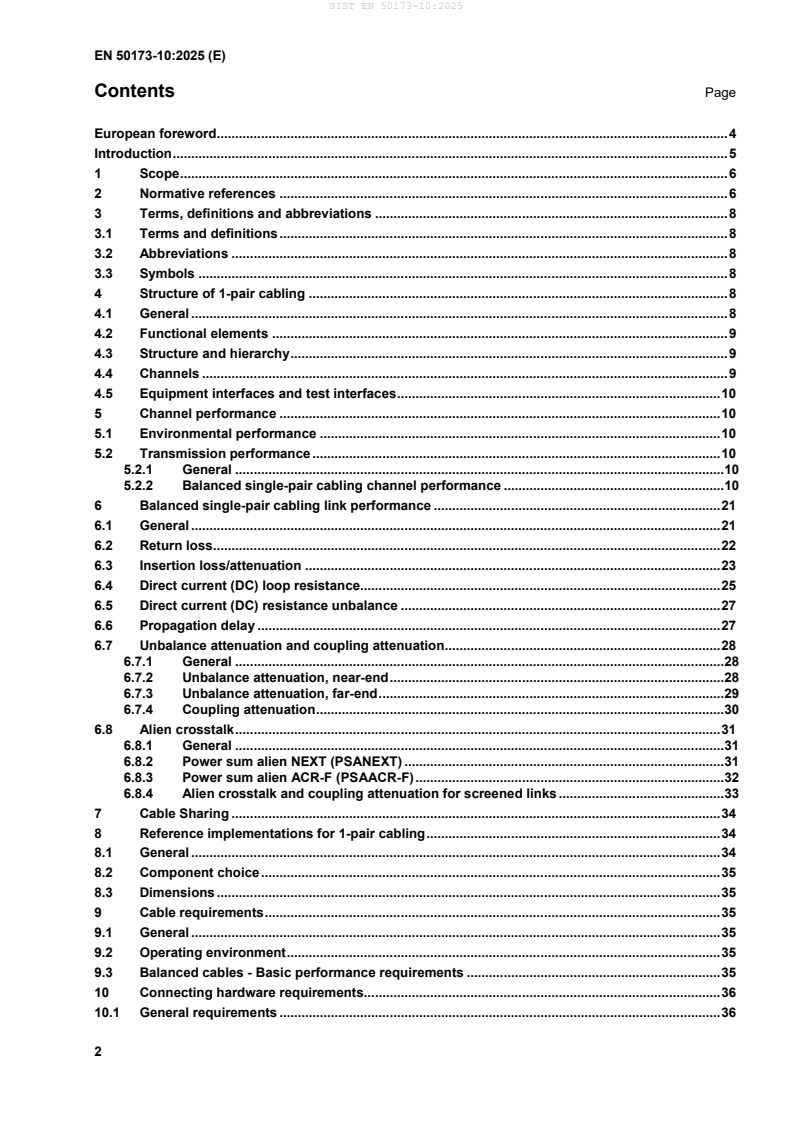
Contents Page
European foreword . 4
Introduction . 5
1 Scope . 6
2 Normative references . 6
3 Terms, definitions and abbreviations . 8
3.1 Terms and definitions . 8
3.2 Abbreviations . 8
3.3 Symbols . 8
4 Structure of 1-pair cabling . 8
4.1 General . 8
4.2 Functional elements . 9
4.3 Structure and hierarchy . 9
4.4 Channels . 9
4.5 Equipment interfaces and test interfaces . 10
5 Channel performance . 10
5.1 Environmental performance . 10
5.2 Transmission performance . 10
5.2.1 General . 10
5.2.2 Balanced single-pair cabling channel performance . 10
6 Balanced single-pair cabling link performance . 21
6.1 General . 21
6.2 Return loss . 22
6.3 Insertion loss/attenuation . 23
6.4 Direct current (DC) loop resistance. 25
6.5 Direct current (DC) resistance unbalance . 27
6.6 Propagation delay . 27
6.7 Unbalance attenuation and coupling attenuation . 28
6.7.1 General . 28
6.7.2 Unbalance attenuation, near-end . 28
6.7.3 Unbalance attenuation, far-end . 29
6.7.4 Coupling attenuation . 30
6.8 Alien crosstalk . 31
6.8.1 General . 31
6.8.2 Power sum alien NEXT (PSANEXT) . 31
6.8.3 Power sum alien ACR-F (PSAACR-F) . 32
6.8.4 Alien crosstalk and coupling attenuation for screened links . 33
7 Cable Sharing . 34
8 Reference implementations for 1-pair cabling . 34
8.1 General . 34
8.2 Component choice . 35
8.3 Dimensions . 35
9 Cable requirements . 35
9.1 General . 35
9.2 Operating environment . 35
9.3 Balanced cables - Basic performance requirements . 35
10 Connecting hardware requirements. 36
10.1 General requirements . 36
10.1.1 Overview . 36
10.1.2 Location . 37
10.1.3 Design . 37
10.1.4 Operating environment . 37
10.2 Connecting hardware . 37
10.2.1 General . 37
10.2.2 Performance marking . 39
10.2.3 Electrical, mechanical and environmental performance . 39
10.2.4 Connecting hardware in accordance with EN IEC 63171-1 . 39
10.2.5 Connecting hardware in accordance with IEC 63171-6 . 39
10.3 Performance marking . 40
11 Requirements for cords and jumpers . 40
11.1 General . 40
11.2 Identification . 40
11.3 Operating requirement . 40
11.4 Return Loss . 41
Annex A (informative) Relationship of EN 50173-10 to other documents and practical
considerations . 42
Annex B (informative) Cable sharing . 44
B.1 General . 44
B.2 Simultaneous operation of multiple single pair applications within a system that
includes 4-pair cabling components according to EN 50173-1 . 44
B.2.1 General . 44
B.2.2 Creation of single pair cabling channels . 45
B.3 Evaluation of the parameters that need to be fulfilled by the shared 4-pair SCP link . 45
B.3.1 General . 45
B.3.2 T1-20 and T1-20A. 45
B.3.3 T1-600 . 47
B.4 Guidance . 47
B.4.1 General . 47
B.4.2 Frequency range . 48
B.4.3 Return loss . 48
B.4.4 Insertion loss . 48
B.4.5 Direct current (DC) Loop resistance . 48
B.4.6 Direct current (DC) resistance unbalance . 49
B.4.7 Current carrying capacity . 49
B.4.8 Dielectric withstand voltage . 49
B.4.9 Propagation delay . 49
B.4.10 Unbalance attenuation (TCL and ELTCTL) . 49
B.4.11 Coupling attenuation . 49
B.4.12 Alien crosstalk (PSANEXT and PSAACR-F) . 49
B.4.13 Different disturbers . 49
Annex C (informative) Supported applications for single pair balanced cabling. 50
Annex D (informative) Determination of application specific channel or link lengths . 52
D.1 General . 52
D.2 Length calculation. 52
D.3 Example . 52
D.4 Other length limiting factors . 52
Bibliography . 53
European foreword
This document (EN 50173-10:2025) has been prepared by CLC/TC 215 “Electrotechnical aspects of
telecommunication equipment”.
The following dates are fixed:
• latest date by which this document has to be (dop) 2026-06-30
implemented at national level by publication of
an identical national standard or by
endorsement
• latest date by which the national standards (dow) 2028-06-30
conflicting with this document have to be
withdrawn
Attention is drawn to the possibility that some of the elements of this document may be the subject of patent
rights. CENELEC shall not be held responsible for identifying any or all such patent rights.
Any feedback and questions on this document should be directed to the users’ national committee. A complete
listing of these bodies can be found on the CENELEC website.
Introduction
This document contains general requirements for generic 1-pair balanced cabling and supports the generic
cabling approach of EN 50173-1.
It contains a compilation of balanced single pair channel requirements for 100 m reach and beyond together
with the supporting cable and connecting hardware requirements based on:
— IEC 61156 series (ffs);
— EN IEC 63171 series.
For the mentioned balanced single pair channels remote power supply services are specified.
Balanced single pair channels and links specified in this document are not a replacement for the generic 4-pair
channels in EN 50173-1. They are an additional media type intended for use in industrial automation networks
(e.g. for sensors, actuators and controllers) and “intelligent buildings”.
Figure 1 — Schematic relationship between the EN 50173 series and other relevant standards
1 Scope
This document specifies 1-pair cabling and can be used in conjunction with all the space-specific standards of
the EN 50173 series but especially EN 50173-3 and EN 50173-6.
NOTE 1-pair cabling for EN 50173-2, EN 50173-4 and EN 50173-5 is for further study.
It delivers 1-pair cabling specifications to extend generic cabling systems according to the EN 50173 series.
This document specifies the:
— structure and minimum configuration for extension of generic cabling by 1-pair cabling;
— interfaces at the service outlet (SO/TO);
— performance requirements for cabling links and channels;
— implementation requirements and options;
— performance requirements for cabling components;
— conformance requirements and verification procedures.
This document takes into account the requirements specified in application standards listed in Annex C.
2 Normative references
The following documents are referred to in the text in such a way that some or all of their content constitutes
requirements of this document. For dated references, only the edition cited applies. For undated references,
the latest edition of the referenced document (including any amendments) applies.
EN 50173-1:2018, Information technology - Generic cabling systems - Part 1: General requirements
EN 50173-3, Information technology - Generic cabling systems - Part 3: Industrial spaces
EN 50173-6, Information technology - Generic cabling systems - Part 6: Distributed building services
EN 50174-1, Information technology - Cabling installation - Part 1: Installation specification and quality
assurance
EN 50174-2, Information technology - Cabling installation - Part 2: Installation planning and practices inside
buildings
EN 50288 (all parts), Multi-element metallic cables used in analogue and digital communication and control
EN 60512-4-1, Connectors for electronic equipment - Tests and measurements - Part 4-1: Voltage stress tests
- Test 4a: Voltage proof (IEC 60512-4-1)
EN 60512-4-2, Connectors for electronic equipment - Tests and measurements - Part 4-2: Voltage stress tests
- Test 4b: Partial discharge (IEC 60512-4-2)
EN 60512-6-2, Connectors for electronic equipment - Tests and measurements - Part 6-2: Dynamic stress tests
- Test 6b: Bump (IEC 60512-6-2)
EN 60512-6-3, Connectors for electronic equipment - Tests and measurements - Part 6-3: Dynamic stress tests
- Test 6c: Shock (IEC 60512-6-3)
EN 60512-6-4, Connectors for electronic equipment - Tests and measurements - Part 6-4: Dynamic stress tests
- Test 6d: Vibration (sinusoidal) (IEC 60512-6-4)
EN 60512-11-4, Connectors for electronic equipment - Tests and measurements - Part 11-4: Climatic tests -
Test 11d: Rapid change of temperature (IEC 60512-11-4)
EN 60512-11-7, Connectors for electronic equipment - Tests and measurements - Part 11- 7: Climatic tests -
Test 11g: Flowing mixed gas corrosion test (IEC 60512-11-7)
EN 60512-11-9, Connectors for electronic equipment - Tests and measurements - Part 11-9: Climatic tests -
Test 11i: Dry heat (IEC 60512-11-9)
EN 60512-11-10, Connectors for electronic equipment - Tests and measurements - Part 11-10: Climatic tests
- Test 11j: Cold (IEC 60512-11-10)
EN 60512-11-12, Connectors for electronic equipment - Tests and measurements - Part 11-12: Climatic tests
- Test 11m: Damp heat, cyclic (IEC 60512-11-12)
EN 60512-16-4, Connectors for electronic equipment - Tests and measurements - Part 16-4: Mechanical tests
on contacts and terminations - Test 16d: Tensile strength (crimped connections) (IEC 60512-16-4)
EN 60512-17-2, Connectors for electronic equipment - Tests and measurements - Part 17-2: Cable clamping
tests - Test 17b: Cable clamp resistance to cable rotation (IEC 60512-17-12)
EN 60512-17-4, Connectors for electronic equipment - Tests and measurements - Part 17-4: Cable clamping
tests - Test 17d: Cable clamp resistance to cable torsion (IEC 60512-17-4)
EN 60512-19-3, Electromechanical components for electronic equipment - Basic testing procedures and
measuring methods - Part 19: Chemical resistance tests - Section 3: Test 19c - Fluid resistance (IEC 60512-
19-3)
EN IEC 60512-23-3, Connectors for electrical and electronic equipment - Tests and measurements - Part 23-
3: Screening and filtering tests - Test 23c: Shielding effectiveness of connectors and accessories - Line injection
method (IEC 60512-23-3)
EN 60529, Degrees of protection provided by enclosures (IP Code) (IEC 60529)
EN 61935-2, Specification for the testing of balanced and coaxial information technology cabling - Part 2: Cords
as specified in ISO/IEC 11801 and related standards (IEC 61935-2)
EN IEC 61935-4 , Specification for the testing of balanced and coaxial information technology cabling - Part 4:
Installed balanced single-pair cabling as specified in ISO/IEC 11801-1 and related standards (IEC 61935-4)
EN 62012-1, Multicore and symmetrical pair/quad cables for digital communications to be used in harsh
environments - Part 1: Generic specification (IEC 62012-1)
EN IEC 63171:2025, Connectors for electrical and electronic equipment - Shielded or unshielded free and fixed
connectors for balanced single-pair data transmission with current-carrying capacity - General requirements
and tests (IEC 63171:2025)
EN IEC 63171-1, Connectors for electrical and electronic equipment - Part 1: Detail specification for two-way,
shielded or unshielded, free and fixed connectors - Mechanical mating information, pin assignment and
additional requirements for Type 1 copper LC style (IEC 63171-1)
IEC 63171-6, Connectors for electrical and electronic equipment - Part 6: Detail specification for 2-way and 4-
way (data/power), shielded, free and fixed connectors for power and data transmission with frequencies up to
600 MHz
Under preparation. Stage at the time of publication: prEN IEC 61935-4:2023.
IEC 61156-11, Multicore and symmetrical pair/quad cables for digital communications – Part 11: Symmetrical
single pair cables with transmission characteristics up to 1,25 GHz – Horizontal floor wiring – Sectional
specification
IEC 61156-12, Multicore and symmetrical pair/quad cables for digital communications - Part 12: Symmetrical
single pair cables with transmission characteristics up to 600 MHz - Work area wiring - Sectional specification
IEC 61156-13, Multicore and symmetrical pair/quad cables for digital communications – Part 13: Symmetrical
single pair cables with transmission characteristics up to 20 MHz - Horizontal floor wiring - Sectional
specification
IEC 61156-14 , Multicore and symmetrical pair/quad cables for digital communications – Part 14: (work area
cables related to Part 13: Cables for 10 Mb/s over one pair – Sectional specification)
IEC 61935-1, Specification for the testing of balanced and coaxial information technology cabling - Part 1:
Installed balanced cabling as specified in ISO/IEC 11801-1 and related standards
IEC 61935-2-X (all parts), Testing of balanced communication cabling in accordance with ISO/IEC 11801
3 Terms, definitions and abbreviations
3.1 Terms and definitions
For the purposes of this document, the terms and definitions given in EN 50173-1 and EN 50174-1 apply.
ISO and IEC maintain terminological databases for use in standardization at the following addresses:
— IEC Electropedia: available at https://www.electropedia.org/
— ISO Online browsing platform: available at https://www.iso.org/obp
3.2 Abbreviations
For the purposes of this document, the abbreviations given in EN 50173-1, EN 50173-6 and the following apply:
AO Automation Outlet
ED Edge Distributor
PoDL Power over data line
SPE Single Pair Ethernet
3.3 Symbols
For the purposes of this document, the symbols given in EN 50173-1 apply.
4 Structure of 1-pair cabling
4.1 General
This clause identifies the structure and hierarchy of 1-pair cabling, describes how they are connected to form
horizontal cabling sub systems using 1-pair cabling at their ends and identifies the interfaces at which
application-specific components are connected to the generic cabling.
Under preparation. Stage at the time of publication: IEC/CDV 61156-14:2025.
1-pair transmission channels and links, created by connecting application-specific cabling components to the
generic cabling, are used to support specific applications. Applications listed in Annex C are supported by
connecting active equipment at the distributors.
4.2 Functional elements
The 1-pair cabling system described in this document is an extension of the generic cabling system according
to EN 50173 series using the functional elements described in EN 50173-1 up to EN 50173-6. The following
functional elements are relevant for 1-pair cabling systems:
a) Intermediate Distributor (ID), which can become an IID (see EN 50173-3);
b) Edge Distributor (ED), which offers a possible medium change from 4-pair or 2-pair cable to 1-pair cable;
c) Telecommunication Outlet (TO), which become an AO (see EN 50173-3);
d) Service Concentration Point (SCP);
e) Service Outlet (SO).
4.3 Structure and hierarchy
1-pair cabling systems consist of 1-pair cables, 1-pair connectors, and 1-pair connection cords. The 1-pair
cabling systems are connected to distributors or other functional elements to create together with the generic
cabling system an end-to-end cabling solution according to the scope of EN 50173 series. The general structure
is shown in Figure 2.
Figure 2 — General structure of 1-pair cabling in EN 50173-10
4.4 Channels
This document specifies 1-pair cabling channels to support data and power transmission for Single Pair
Ethernet and other services to extend generic cabling according EN 50173 series or other appropriate
infrastructures and implementations.
a) T1-20: 1-pair cabling up to 20 MHz; designed for 10 Mbit/s transmission up to 100 m and current carrying
capacity of minimum 0,75 A per conductor.
b) T1-20A: 1-pair cabling up to 20 MHz; designed for 10 Mbit/s transmission up to 230 m and current carrying
capacity of minimum 0,25 A per conductor.
c) T1-600: 1-pair cabling up to 600 MHz; designed for 1 Gbit/s transmission up to 100 m and current carrying
capacity of minimum 0,75 A per conductor.
d) P1-20: 1-pair cabling up to 20 MHz; designed for 10 Mbit/s transmission up to 100 m and current carrying
capacity of minimum 2 A per conductor.
e) P1-20A: 1-pair cabling up to 60 MHz; designed for 10 Mbit/s transmission up to 300 m and current carrying
capacity of minimum 0,75 A per conductor.
f) P1-20B: 1-pair cabling up to 20 MHz; designed for 10 Mbit/s transmission up to 1 000 m and current
carrying capacity of minimum 0,25 A per conductor.
For further information, see Annex A.
4.5 Equipment interfaces and test interfaces
Equipment and test interfaces are specified in EN 50173-3:2018, 4.7.1.
5 Channel performance
5.1 Environmental performance
The environmental performance shall comply with EN 50173-1:2018, Table 3.
5.2 Transmission performance
5.2.1 General
The required transmission performance Class of this clause shall be met for all environmental classifications
specified for the channel. The transmission performance is specified at 20°C
5.2.2 Balanced single-pair cabling channel performance
5.2.2.1 General
This document specifies the following Classes for single-pair balanced cabling:
a) Class T1-20: specified up to 20 MHz and 100 m; current carrying capacity of minimum 0,75 A, 4
connections;
b) Class T1-20A: specified up to 20 MHz and 230 m; current carrying capacity of minimum 0,25 A, 4
connections;
c) Class T1-600: specified up to 600 MHz and 100 m; current carrying capacity of minimum 0,75 A, 4
connections;
d) Class P1-20: specified up to 20 MHz and 100 m; current carrying capacity of minimum 2 A, 4 connections;
e) Class P1-20A: specified up to 20 MHz and 300 m; current carrying capacity of minimum 0,75 A, 4
connections;
f) Class P1-20B: specified up to 20 MHz and 1000 m; current carrying capacity of minimum 0,25 A, 10
connections.
The 100 m channels are backward compatible.
Annex C lists balanced cabling applications by Class.
NOTE For the length determination of application specific channels or links see Annex D.
The parameters specified in this subclause apply to channels with screened or unscreened cable elements,
with or without an overall screen, unless explicitly stated otherwise.
The nominal impedance of channels is 100 Ω. This is achieved by suitable design, and appropriate choice of
cabling components (irrespective of their nominal impedance).
The requirements in 5.2 are given by limits computed to one decimal place, using the equation for a defined
frequency range. The limits for the propagation delay are computed to three decimal places. The informative
tables show the calculated values derived from the relevant equation at key frequencies. Many specifications
in 5.2 have a plateau in the specified requirement. These plateaus do not accurately depict the system
performance. They have been added for measurement purposes.
5.2.2.2 Return loss
The variation of the input impedance of a channel is characterised by the return loss (RL).
The RL parameter is applicable to all Classes. The RL shall meet the limits computed, to one decimal place,
using the formulae of Table 1. The limits shown in Table 2 are derived from the formulae at key frequencies
only.
Values of RL at frequencies for which the measured channel insertion loss is below 3,0 dB are for information
only.
When required, the RL shall be measured according to IEC 61935-1. Terminations of 100 Ω shall be connected
to the cabling elements under test at the remote end of the channel. The return loss requirements shall be met
at both ends of the cabling.
Table 1 — Formulae for RL limits for a channel
Frequency Minimum RL
Class
MHz dB
9+×10 f
0,1 ≤ f ≤1
T1-20 1 < f ≤ 10 19,0
T1-20A 10 < f ≤ 20 24−×5 lg f
( )
9+×10 f
0,1 ≤ f ≤1
1 < f ≤ 10 19,0
24−×5 lg f
10 < f ≤ 40
( )
T1-600 40 < f ≤ 130 16,0
130 < f ≤ 400 37−×10 lg f
( )
400 < f ≤ 600 11,0
9+×10 f
P1-20 0,1 ≤ f ≤ 1
19,0
P1-20A 1 < f ≤ 10
P1-20B 10 < f ≤ 20 24−×5 lg f
( )
Table 2 — RL limits for a channel at key frequencies (dB)
Class Frequency
MHz
0,1 1,0 20,0 100,0 250,0 500,0 600,0
T1-20, T1-20A 10,0 19,0 17,5 N/A N/A N/A N/A
T1-600 10,0 19,0 17,5 16,0 13,0 11,0 11,0
P1-20, P1-20A 10,0 19 17,5 N/A N/A N/A N/A
P1-20B
5.2.2.3 Insertion loss
The insertion loss (IL) α of a channel shall meet the limits computed, to one decimal place, using the formulae
of Table 3. The limits shown in Table 4 are derived from the formulae at key frequencies only.
For a given Class, the requirement shall be met for all operating temperatures to which the channel is intended
to be subjected. In case of doubt, de-rating factors shall be employed.
When required, the IL of the channel shall be measured according to IEC 61935-1.
The IL of a channel shall meet the requirements in Table 3 when measured at or corrected to 20 °C.
Table 3 — Formulae for IL limits for a channel at 20°C
a)
Frequency Maximum IL
Class
MHz
dB
0, 25
b)
1,05×1,82× f + 0,009 1× f+ +×4 0,02× f
T1-20 0,1 ≤ f ≤ 20
f
0, 25
b)
0,1 ≤ f ≤ 20 2,35×1,82× f + 0,009 1× f+ +×4 0,02× f
T1-20A
f
0, 25
b)
1,,05× 1 8× f + 0,005× f+ +×4 0,02× f
0,1 ≤ f ≤ 600
T1-600
f
02,
c)
1× 1,,23× ff+ 0 01× + +×4 0,02× f
0,1 ≤ f ≤ 20
P1-20
f
02,
c)
3×1,,23× ff+ 0 01× + +×4 0,02× f
0,1 ≤ f ≤ 20
P1-20A
f
02,
c)
10×1,,23× ff+ 0 01×+ + 10× 0,02× f
0,1 ≤ f ≤ 20
P1-20B
f
For operating temperatures above 20 °C, lL shall be increased by:
1) 0,2 % per °C for screened balanced cables up to 60 °C;
2) 0,4 % per °C for unscreened balanced cables up to 40 °C;
3) 0,6 % per °C for unscreened balanced cables between 40 °C and 60 °C.
a)
Insertion loss at frequencies that correspond to calculated values of less than 3,0 dB shall revert to a maximum
requirement of 3,0 dB.
b)
10 m of 50% de-rated (based on construction) cord cable is assumed in the equation.
c)
Cord cable used in the channel is expected to have no de-rating based on construction.
Table 4 — IL limits for a channel at key frequencies (dB)
Frequency
MHz
Class
0,1 1,0 20,0 100,0 250,0 500,0 600,0
T1-20 3,0 3,0 9,1 N/A N/A N/A N/A
T1-20A 3,2 5,0 20,0 N/A N/A N/A N/A
T1-600 3,0 3,0 9,0 20,3 32,5 46,7 51,4
P1-20 3,0 3,0 6,1 N/A N/A N/A N/A
P1-20A 3,1 4,4 17,6 N/A N/A N/A N/A
P1-20B 10,3 14,6 58,3 N/A N/A N/A N/A
5.2.2.4 Direct current loop resistance
The direct current loop resistance (DCLR) parameter is applicable to all Classes. The DCLR of a channel shall
meet the limits given in Table 5. When required, the d.c. loop resistance shall be measured according to
IEC 61935-1.
The DC loop resistance of a channel shall meet the requirements in Table 5 when measured at or corrected to
20 °C.
Table 5 — DCLR limits for a channel at 20°C
Maximum DCLR
Class
Ω
a)
T1-20 17,7
a)
T1-20A 38,5
b)
T1-600 16,4
c)
P1-20 5,0
c)
14,2
P1-20A
c)
47,0
P1-20B
a)
The maximum DC loop resistance at 20 °C of the cable pair (excluding connections) within a
link, used in a channel shall be 0,16 Ω/m. This shall be achieved by an appropriate design. 10
m of de-rated cords (based on IEC/TR 61156-1-6, 0,29 Ω/m) is assumed in the equations.
b)
The maximum DC loop resistance at 20 °C of the cable pair (excluding connections) within a
link, used in a channel shall be 0,145 Ω/m. This shall be achieved by an appropriate design.
10 m of de-rated cords (based on IEC/TR 61156-1-6, 0,29 Ω/m) is assumed in the equations.
c)
The maximum DC loop resistance at 20 °C of the cable pair (excluding connections) within a
link, used in a channel shall be 0,046 Ω/m. This shall be achieved by an appropriate design.
To correct DC loop resistance to a different temperature, the conversion is as follows:
R R 1+α TT−
( )
ref ref
Where
R = Conductor resistance at temperature T in Ω;
R = Conductor resistance at reference temperature T , usually 20 °C, in Ω;
ref ref
α = Temperature coefficient of resistance for the conductor material (Copper = 0,00393) per °C;
T = Conductor temperature in °C;
T = Reference temperature that α is specified at for the conductor material in °C.
ref
=
5.2.2.5 Direct current resistance unbalance
The direct current resistance unbalance parameter is applicable to all Classes. The DC resistance unbalance
between the two conductors of the channel shall not exceed 3 % or 200 mΩ, whichever is greater.
NOTE For the purposes of field measurements, calculations that provide values of less than 200 mΩ revert to 200 mΩ.
5.2.2.6 Direct current carrying capacity
For the direct current carrying capacity the following requirements shall be applied.
a) Each conductor within a T1-20 or T1-600 (installed) channel shall have a minimum DC current carrying
capacity under continuous operation of 0,75 A at 60 ºC.
b) Each conductor within a T1-20A (installed) channel shall have a minimum DC current carrying capacity
under continuous operation of 0,25 A at 60 ºC.
c) Each conductor within a P1-20 (installed) channel shall have a minimum DC current carrying capacity
under continuous operation of 2,0 A at 60 ºC.
d) Each conductor within a P1-20A (installed) channel shall have a minimum DC current carrying capacity
under continuous operation of 0,75 A at 60 ºC.
e) Each conductor within a P1-20B (installed) channel shall have a minimum DC current carrying capacity
under continuous operation of 0,25 A at 60 ºC.
When using multi-pair cabling components within a single pair channel, the resulting channel is limited to the
current carrying capacity of the multi-pair component.
For information on DC current carrying capacity in respect to installation conditions and applications using
remote power supplied over these Classes of single pair balanced cabling, see EN 50174-1, EN 50174-2,
CLC/TR 50174-99-1 and ISO/IEC TS 29125.
5.2.2.7 Dielectric withstand voltage
The dielectric withstand voltage parameter is applicable to all Classes.
Channels shall have a minimum dielectric withstand voltage of DC 1 000 V conductor-to-conductor and DC
1 000 V conductor-to-screen or conductor to earth (if a screen is not present).
This requirement shall be met by design.
5.2.2.8 Propagation delay
The propagation delay parameter is applicable to all Classes. The propagation delay of a channel shall meet
the limits computed, to three decimal places, using the formulae of Table 6. The limits shown in Table 7 are
derived from the formulae at key frequencies only.
When required, the propagation delay shall be measured according to IEC 61935-1.
Table 6 — Formulae for propagation delay limits for a channel
Frequency Maximum propagation delay
Class
MHz μs
0,036
2,,3x 0 534+ +×4 0,0025
T1-20A 1 ≤ f ≤ 20
f
0,036
0,,534+ +×4 0 0025
T1-600 0,1 ≤ f ≤ 600
f
0,036
0,,534+ +×4 0 0025
P1-20, T1-20 0,1 ≤ f ≤ 20
f
0,036
3x0,,534+ +×4 0 0025
P1-20A 0,1 ≤ f ≤ 20
f
0,036
10x0,,534+ +×10 0 0025
P1-20B 0,1 ≤ f ≤ 20
f
Table 7 — Propagation delay limits for a channel at key frequencies in µs
Frequency
MHz
Class
0,1 1,0 20,0 100,0 250,0 500,0 600,0
T1-20A 1,500 1,231 1,257 N/A N/A N/A N/A
T1-600 0,658 0,580 0,552 0,548 0,546 0,546 0,545
P1-20, T1-20 0,658 0,580 0,552 N/A N/A N/A N/A
P1-20A 1,954 1,720 1,636 N/A N/A N/A N/A
P1-20B 6,503 5,725 5,445 N/A N/A N/A N/A
5.2.2.9 Transverse conversion loss
Transverse conversion (TCL) is specified for unscreened systems. Coupling attenuation is specified for
screened systems.
The TCL of a channel that is intended to be subjected to an environmental classification E shall meet the limits
x
computed, to one decimal place, using the formulae of Table 8. The limits shown in Table 9 are derived from
the formulae at key frequencies only.
The TCL requirements shall be met at both ends of the cabling.
Table 8 — Formulae for TCL limits for a cabling channel
MICE classification (electromagnetic)
a) a)
E E E
Frequency
1 2 3
Class
MHz
b)
Minimum TCL
dB
f f f
50−×20 lg 60−×20 lg 70−×20 lg
T1-600 0,1 ≤ f ≤ 600
10 10 10
T1-20
T1-20A 0,1 ≤ f ≤ 10 50 50 60
P1-20
f f f
P1-20A
50−×20 lg 50−×20 lg 60−×20 lg
10 ≤ f ≤ 20
P1-20B
10 10 10
a)
Reference implementation does not ensure channel compliance for E or E .
2 3
b)
Calculated values of greater than 50 dB shall revert to a minimum requirement of 50 dB.
Table 9 — TCL limits for a cabling channel at key frequencies
Minimum TCL
dB
Frequency
0,1 1,0 20,0 100,0 250,0 500,0 600,0
MHz
E
50,0 50,0 44,0 30,0 22,0 16,0 14,4
E
T1-600 50,0 50,0 50,0 40,0 32,0 26,0 24,4
E
50,0 50,0 50,0 50,0 42,0 36,0 34,4
T1-20
E
T1-20A 50,0 50,0 44,0 N/A N/A N/A N/A
P1-20
E
P1-20A 50,0 50,0 44,0 N/A N/A N/A N/A
E
P1-20B 50,0 50,0 50,0 N/A N/A N/A N/A
5.2.2.10 Equal level transverse conversion transfer loss
The equal level transverse conversion transfer loss (ELTCTL) is specified for unscreened systems. Coupling
attenuation is specified for screened systems.
The ELTCTL of a channel that is intended to be subjected to an environmental classification E shall meet the
x
limits computed, to one decimal place, using the formulae of Table 10. The limits shown in Table 11 are derived
from the formulae at key frequencies only.
The ELTCTL requirements shall be met at both ends of the cabling.
Table 10 — Formulae for ELTCTL limits for an unscreened cabling channel
MICE classification (electromagnetic)
E E E
Frequenc
1 2 3
Class
y MHz
a),b),c)
Minimum ELTCTL
dB
T1-20
T1-20A
0,1 ≤ f ≤
P1-20 34−×20 lg f 42−×20 lg f 50−×20 lg f
( ) ( ) ( )
P1-20A
P1-20B
0,1 ≤ f ≤
34−×20 lg f 42−×20 lg f 50−×20 lg f
T1-600
( ) ( ) ( )
a)
ELTCTL at frequencies that correspond to measured TCTL values of greater than 80,0 dB shall be for information only.
b)
Calculated values of greater than 50 dB shall revert to a minimum requirement of 50 dB.
c)
Calculated values of less than 3 dB shall revert to a requirement of 3 dB.
Table 11 — ELTCTL limits for a cabling channel at key frequencies
Minimum ELTCL
dB
Frequency
0,1 1,0 20,0 100,0 250,0 500,0 600,0
MHz
T1-20 E
50,0 34,0 8,0 N/A N/A N/A N/A
T1-20A
E
50,0 42,0 16,0 N/A N/A N/A N/A
P1-20
P1-20A
E
50,0 50,0 24 N/A N/A N/A N/A
P1-20B
E
50,0 34,0 8,0 3,0 3,0 3,0 3,0
E
T1-600 50,0 42,0 16,0 3,0 3,0 3,0 3,0
E
50,0 50,
...
SLOVENSKI STANDARD
01-september-2025
Informacijska tehnologija - Osnovni kabelski sistemi - 10. del: Enoparični kabli
Information technology - Generic cabling systems - Part 10: Single pair cabling
Informationstechnik - Anwendungsneutrale Kommunikationskabelanlagen - Teil 10:
Einpaarige Verkabelung
Technologies de l'information - Systèmes de câblage générique - Partie 10: Câblage
mono-paire
Ta slovenski standard je istoveten z: EN 50173-10:2025
ICS:
33.040.50 Vodi, zveze in tokokrogi Lines, connections and
circuits
35.110 Omreževanje Networking
2003-01.Slovenski inštitut za standardizacijo. Razmnoževanje celote ali delov tega standarda ni dovoljeno.
EUROPEAN STANDARD EN 50173-10
NORME EUROPÉENNE
EUROPÄISCHE NORM June 2025
ICS 35.110
English Version
Information technology - Generic cabling systems - Part 10:
Single pair cabling
Technologies de l'information - Systèmes de câblage Informationstechnik - Anwendungsneutrale
générique - Partie 10: Câblage mono-paire Kommunikationskabelanlagen - Teil 10: Einpaarige
Verkabelung
This European Standard was approved by CENELEC on 2025-05-02. CENELEC members are bound to comply with the CEN/CENELEC
Internal Regulations which stipulate the conditions for giving this European Standard the status of a national standard without any alteration.
Up-to-date lists and bibliographical references concerning such national standards may be obtained on application to the CEN-CENELEC
Management Centre or to any CENELEC member.
This European Standard exists in three official versions (English, French, German). A version in any other language made by translation
under the responsibility of a CENELEC member into its own language and notified to the CEN-CENELEC Management Centre has the
same status as the official versions.
CENELEC members are the national electrotechnical committees of Austria, Belgium, Bulgaria, Croatia, Cyprus, the Czech Republic,
Denmark, Estonia, Finland, France, Germany, Greece, Hungary, Iceland, Ireland, Italy, Latvia, Lithuania, Luxembourg, Malta, the
Netherlands, Norway, Poland, Portugal, Republic of North Macedonia, Romania, Serbia, Slovakia, Slovenia, Spain, Sweden, Switzerland,
Türkiye and the United Kingdom.
European Committee for Electrotechnical Standardization
Comité Européen de Normalisation Electrotechnique
Europäisches Komitee für Elektrotechnische Normung
CEN-CENELEC Management Centre: Rue de la Science 23, B-1040 Brussels
© 2025 CENELEC All rights of exploitation in any form and by any means reserved worldwide for CENELEC Members.
Ref. No. EN 50173-10:2025 E
Contents Page
European foreword . 4
Introduction . 5
1 Scope . 6
2 Normative references . 6
3 Terms, definitions and abbreviations . 8
3.1 Terms and definitions . 8
3.2 Abbreviations . 8
3.3 Symbols . 8
4 Structure of 1-pair cabling . 8
4.1 General . 8
4.2 Functional elements . 9
4.3 Structure and hierarchy . 9
4.4 Channels . 9
4.5 Equipment interfaces and test interfaces . 10
5 Channel performance . 10
5.1 Environmental performance . 10
5.2 Transmission performance . 10
5.2.1 General . 10
5.2.2 Balanced single-pair cabling channel performance . 10
6 Balanced single-pair cabling link performance . 21
6.1 General . 21
6.2 Return loss . 22
6.3 Insertion loss/attenuation . 23
6.4 Direct current (DC) loop resistance. 25
6.5 Direct current (DC) resistance unbalance . 27
6.6 Propagation delay . 27
6.7 Unbalance attenuation and coupling attenuation . 28
6.7.1 General . 28
6.7.2 Unbalance attenuation, near-end . 28
6.7.3 Unbalance attenuation, far-end . 29
6.7.4 Coupling attenuation . 30
6.8 Alien crosstalk . 31
6.8.1 General . 31
6.8.2 Power sum alien NEXT (PSANEXT) . 31
6.8.3 Power sum alien ACR-F (PSAACR-F) . 32
6.8.4 Alien crosstalk and coupling attenuation for screened links . 33
7 Cable Sharing . 34
8 Reference implementations for 1-pair cabling . 34
8.1 General . 34
8.2 Component choice . 35
8.3 Dimensions . 35
9 Cable requirements . 35
9.1 General . 35
9.2 Operating environment . 35
9.3 Balanced cables - Basic performance requirements . 35
10 Connecting hardware requirements. 36
10.1 General requirements . 36
10.1.1 Overview . 36
10.1.2 Location . 37
10.1.3 Design . 37
10.1.4 Operating environment . 37
10.2 Connecting hardware . 37
10.2.1 General . 37
10.2.2 Performance marking . 39
10.2.3 Electrical, mechanical and environmental performance . 39
10.2.4 Connecting hardware in accordance with EN IEC 63171-1 . 39
10.2.5 Connecting hardware in accordance with IEC 63171-6 . 39
10.3 Performance marking . 40
11 Requirements for cords and jumpers . 40
11.1 General . 40
11.2 Identification . 40
11.3 Operating requirement . 40
11.4 Return Loss . 41
Annex A (informative) Relationship of EN 50173-10 to other documents and practical
considerations . 42
Annex B (informative) Cable sharing . 44
B.1 General . 44
B.2 Simultaneous operation of multiple single pair applications within a system that
includes 4-pair cabling components according to EN 50173-1 . 44
B.2.1 General . 44
B.2.2 Creation of single pair cabling channels . 45
B.3 Evaluation of the parameters that need to be fulfilled by the shared 4-pair SCP link . 45
B.3.1 General . 45
B.3.2 T1-20 and T1-20A. 45
B.3.3 T1-600 . 47
B.4 Guidance . 47
B.4.1 General . 47
B.4.2 Frequency range . 48
B.4.3 Return loss . 48
B.4.4 Insertion loss . 48
B.4.5 Direct current (DC) Loop resistance . 48
B.4.6 Direct current (DC) resistance unbalance . 49
B.4.7 Current carrying capacity . 49
B.4.8 Dielectric withstand voltage . 49
B.4.9 Propagation delay . 49
B.4.10 Unbalance attenuation (TCL and ELTCTL) . 49
B.4.11 Coupling attenuation . 49
B.4.12 Alien crosstalk (PSANEXT and PSAACR-F) . 49
B.4.13 Different disturbers . 49
Annex C (informative) Supported applications for single pair balanced cabling. 50
Annex D (informative) Determination of application specific channel or link lengths . 52
D.1 General . 52
D.2 Length calculation. 52
D.3 Example . 52
D.4 Other length limiting factors . 52
Bibliography . 53
European foreword
This document (EN 50173-10:2025) has been prepared by CLC/TC 215 “Electrotechnical aspects of
telecommunication equipment”.
The following dates are fixed:
• latest date by which this document has to be (dop) 2026-06-30
implemented at national level by publication of
an identical national standard or by
endorsement
• latest date by which the national standards (dow) 2028-06-30
conflicting with this document have to be
withdrawn
Attention is drawn to the possibility that some of the elements of this document may be the subject of patent
rights. CENELEC shall not be held responsible for identifying any or all such patent rights.
Any feedback and questions on this document should be directed to the users’ national committee. A complete
listing of these bodies can be found on the CENELEC website.
Introduction
This document contains general requirements for generic 1-pair balanced cabling and supports the generic
cabling approach of EN 50173-1.
It contains a compilation of balanced single pair channel requirements for 100 m reach and beyond together
with the supporting cable and connecting hardware requirements based on:
— IEC 61156 series (ffs);
— EN IEC 63171 series.
For the mentioned balanced single pair channels remote power supply services are specified.
Balanced single pair channels and links specified in this document are not a replacement for the generic 4-pair
channels in EN 50173-1. They are an additional media type intended for use in industrial automation networks
(e.g. for sensors, actuators and controllers) and “intelligent buildings”.
Figure 1 — Schematic relationship between the EN 50173 series and other relevant standards
1 Scope
This document specifies 1-pair cabling and can be used in conjunction with all the space-specific standards of
the EN 50173 series but especially EN 50173-3 and EN 50173-6.
NOTE 1-pair cabling for EN 50173-2, EN 50173-4 and EN 50173-5 is for further study.
It delivers 1-pair cabling specifications to extend generic cabling systems according to the EN 50173 series.
This document specifies the:
— structure and minimum configuration for extension of generic cabling by 1-pair cabling;
— interfaces at the service outlet (SO/TO);
— performance requirements for cabling links and channels;
— implementation requirements and options;
— performance requirements for cabling components;
— conformance requirements and verification procedures.
This document takes into account the requirements specified in application standards listed in Annex C.
2 Normative references
The following documents are referred to in the text in such a way that some or all of their content constitutes
requirements of this document. For dated references, only the edition cited applies. For undated references,
the latest edition of the referenced document (including any amendments) applies.
EN 50173-1:2018, Information technology - Generic cabling systems - Part 1: General requirements
EN 50173-3, Information technology - Generic cabling systems - Part 3: Industrial spaces
EN 50173-6, Information technology - Generic cabling systems - Part 6: Distributed building services
EN 50174-1, Information technology - Cabling installation - Part 1: Installation specification and quality
assurance
EN 50174-2, Information technology - Cabling installation - Part 2: Installation planning and practices inside
buildings
EN 50288 (all parts), Multi-element metallic cables used in analogue and digital communication and control
EN 60512-4-1, Connectors for electronic equipment - Tests and measurements - Part 4-1: Voltage stress tests
- Test 4a: Voltage proof (IEC 60512-4-1)
EN 60512-4-2, Connectors for electronic equipment - Tests and measurements - Part 4-2: Voltage stress tests
- Test 4b: Partial discharge (IEC 60512-4-2)
EN 60512-6-2, Connectors for electronic equipment - Tests and measurements - Part 6-2: Dynamic stress tests
- Test 6b: Bump (IEC 60512-6-2)
EN 60512-6-3, Connectors for electronic equipment - Tests and measurements - Part 6-3: Dynamic stress tests
- Test 6c: Shock (IEC 60512-6-3)
EN 60512-6-4, Connectors for electronic equipment - Tests and measurements - Part 6-4: Dynamic stress tests
- Test 6d: Vibration (sinusoidal) (IEC 60512-6-4)
EN 60512-11-4, Connectors for electronic equipment - Tests and measurements - Part 11-4: Climatic tests -
Test 11d: Rapid change of temperature (IEC 60512-11-4)
EN 60512-11-7, Connectors for electronic equipment - Tests and measurements - Part 11- 7: Climatic tests -
Test 11g: Flowing mixed gas corrosion test (IEC 60512-11-7)
EN 60512-11-9, Connectors for electronic equipment - Tests and measurements - Part 11-9: Climatic tests -
Test 11i: Dry heat (IEC 60512-11-9)
EN 60512-11-10, Connectors for electronic equipment - Tests and measurements - Part 11-10: Climatic tests
- Test 11j: Cold (IEC 60512-11-10)
EN 60512-11-12, Connectors for electronic equipment - Tests and measurements - Part 11-12: Climatic tests
- Test 11m: Damp heat, cyclic (IEC 60512-11-12)
EN 60512-16-4, Connectors for electronic equipment - Tests and measurements - Part 16-4: Mechanical tests
on contacts and terminations - Test 16d: Tensile strength (crimped connections) (IEC 60512-16-4)
EN 60512-17-2, Connectors for electronic equipment - Tests and measurements - Part 17-2: Cable clamping
tests - Test 17b: Cable clamp resistance to cable rotation (IEC 60512-17-12)
EN 60512-17-4, Connectors for electronic equipment - Tests and measurements - Part 17-4: Cable clamping
tests - Test 17d: Cable clamp resistance to cable torsion (IEC 60512-17-4)
EN 60512-19-3, Electromechanical components for electronic equipment - Basic testing procedures and
measuring methods - Part 19: Chemical resistance tests - Section 3: Test 19c - Fluid resistance (IEC 60512-
19-3)
EN IEC 60512-23-3, Connectors for electrical and electronic equipment - Tests and measurements - Part 23-
3: Screening and filtering tests - Test 23c: Shielding effectiveness of connectors and accessories - Line injection
method (IEC 60512-23-3)
EN 60529, Degrees of protection provided by enclosures (IP Code) (IEC 60529)
EN 61935-2, Specification for the testing of balanced and coaxial information technology cabling - Part 2: Cords
as specified in ISO/IEC 11801 and related standards (IEC 61935-2)
EN IEC 61935-4 , Specification for the testing of balanced and coaxial information technology cabling - Part 4:
Installed balanced single-pair cabling as specified in ISO/IEC 11801-1 and related standards (IEC 61935-4)
EN 62012-1, Multicore and symmetrical pair/quad cables for digital communications to be used in harsh
environments - Part 1: Generic specification (IEC 62012-1)
EN IEC 63171:2025, Connectors for electrical and electronic equipment - Shielded or unshielded free and fixed
connectors for balanced single-pair data transmission with current-carrying capacity - General requirements
and tests (IEC 63171:2025)
EN IEC 63171-1, Connectors for electrical and electronic equipment - Part 1: Detail specification for two-way,
shielded or unshielded, free and fixed connectors - Mechanical mating information, pin assignment and
additional requirements for Type 1 copper LC style (IEC 63171-1)
IEC 63171-6, Connectors for electrical and electronic equipment - Part 6: Detail specification for 2-way and 4-
way (data/power), shielded, free and fixed connectors for power and data transmission with frequencies up to
600 MHz
Under preparation. Stage at the time of publication: prEN IEC 61935-4:2023.
IEC 61156-11, Multicore and symmetrical pair/quad cables for digital communications – Part 11: Symmetrical
single pair cables with transmission characteristics up to 1,25 GHz – Horizontal floor wiring – Sectional
specification
IEC 61156-12, Multicore and symmetrical pair/quad cables for digital communications - Part 12: Symmetrical
single pair cables with transmission characteristics up to 600 MHz - Work area wiring - Sectional specification
IEC 61156-13, Multicore and symmetrical pair/quad cables for digital communications – Part 13: Symmetrical
single pair cables with transmission characteristics up to 20 MHz - Horizontal floor wiring - Sectional
specification
IEC 61156-14 , Multicore and symmetrical pair/quad cables for digital communications – Part 14: (work area
cables related to Part 13: Cables for 10 Mb/s over one pair – Sectional specification)
IEC 61935-1, Specification for the testing of balanced and coaxial information technology cabling - Part 1:
Installed balanced cabling as specified in ISO/IEC 11801-1 and related standards
IEC 61935-2-X (all parts), Testing of balanced communication cabling in accordance with ISO/IEC 11801
3 Terms, definitions and abbreviations
3.1 Terms and definitions
For the purposes of this document, the terms and definitions given in EN 50173-1 and EN 50174-1 apply.
ISO and IEC maintain terminological databases for use in standardization at the following addresses:
— IEC Electropedia: available at https://www.electropedia.org/
— ISO Online browsing platform: available at https://www.iso.org/obp
3.2 Abbreviations
For the purposes of this document, the abbreviations given in EN 50173-1, EN 50173-6 and the following apply:
AO Automation Outlet
ED Edge Distributor
PoDL Power over data line
SPE Single Pair Ethernet
3.3 Symbols
For the purposes of this document, the symbols given in EN 50173-1 apply.
4 Structure of 1-pair cabling
4.1 General
This clause identifies the structure and hierarchy of 1-pair cabling, describes how they are connected to form
horizontal cabling sub systems using 1-pair cabling at their ends and identifies the interfaces at which
application-specific components are connected to the generic cabling.
Under preparation. Stage at the time of publication: IEC/CDV 61156-14:2025.
1-pair transmission channels and links, created by connecting application-specific cabling components to the
generic cabling, are used to support specific applications. Applications listed in Annex C are supported by
connecting active equipment at the distributors.
4.2 Functional elements
The 1-pair cabling system described in this document is an extension of the generic cabling system according
to EN 50173 series using the functional elements described in EN 50173-1 up to EN 50173-6. The following
functional elements are relevant for 1-pair cabling systems:
a) Intermediate Distributor (ID), which can become an IID (see EN 50173-3);
b) Edge Distributor (ED), which offers a possible medium change from 4-pair or 2-pair cable to 1-pair cable;
c) Telecommunication Outlet (TO), which become an AO (see EN 50173-3);
d) Service Concentration Point (SCP);
e) Service Outlet (SO).
4.3 Structure and hierarchy
1-pair cabling systems consist of 1-pair cables, 1-pair connectors, and 1-pair connection cords. The 1-pair
cabling systems are connected to distributors or other functional elements to create together with the generic
cabling system an end-to-end cabling solution according to the scope of EN 50173 series. The general structure
is shown in Figure 2.
Figure 2 — General structure of 1-pair cabling in EN 50173-10
4.4 Channels
This document specifies 1-pair cabling channels to support data and power transmission for Single Pair
Ethernet and other services to extend generic cabling according EN 50173 series or other appropriate
infrastructures and implementations.
a) T1-20: 1-pair cabling up to 20 MHz; designed for 10 Mbit/s transmission up to 100 m and current carrying
capacity of minimum 0,75 A per conductor.
b) T1-20A: 1-pair cabling up to 20 MHz; designed for 10 Mbit/s transmission up to 230 m and current carrying
capacity of minimum 0,25 A per conductor.
c) T1-600: 1-pair cabling up to 600 MHz; designed for 1 Gbit/s transmission up to 100 m and current carrying
capacity of minimum 0,75 A per conductor.
d) P1-20: 1-pair cabling up to 20 MHz; designed for 10 Mbit/s transmission up to 100 m and current carrying
capacity of minimum 2 A per conductor.
e) P1-20A: 1-pair cabling up to 60 MHz; designed for 10 Mbit/s transmission up to 300 m and current carrying
capacity of minimum 0,75 A per conductor.
f) P1-20B: 1-pair cabling up to 20 MHz; designed for 10 Mbit/s transmission up to 1 000 m and current
carrying capacity of minimum 0,25 A per conductor.
For further information, see Annex A.
4.5 Equipment interfaces and test interfaces
Equipment and test interfaces are specified in EN 50173-3:2018, 4.7.1.
5 Channel performance
5.1 Environmental performance
The environmental performance shall comply with EN 50173-1:2018, Table 3.
5.2 Transmission performance
5.2.1 General
The required transmission performance Class of this clause shall be met for all environmental classifications
specified for the channel. The transmission performance is specified at 20°C
5.2.2 Balanced single-pair cabling channel performance
5.2.2.1 General
This document specifies the following Classes for single-pair balanced cabling:
a) Class T1-20: specified up to 20 MHz and 100 m; current carrying capacity of minimum 0,75 A, 4
connections;
b) Class T1-20A: specified up to 20 MHz and 230 m; current carrying capacity of minimum 0,25 A, 4
connections;
c) Class T1-600: specified up to 600 MHz and 100 m; current carrying capacity of minimum 0,75 A, 4
connections;
d) Class P1-20: specified up to 20 MHz and 100 m; current carrying capacity of minimum 2 A, 4 connections;
e) Class P1-20A: specified up to 20 MHz and 300 m; current carrying capacity of minimum 0,75 A, 4
connections;
f) Class P1-20B: specified up to 20 MHz and 1000 m; current carrying capacity of minimum 0,25 A, 10
connections.
The 100 m channels are backward compatible.
Annex C lists balanced cabling applications by Class.
NOTE For the length determination of application specific channels or links see Annex D.
The parameters specified in this subclause apply to channels with screened or unscreened cable elements,
with or without an overall screen, unless explicitly stated otherwise.
The nominal impedance of channels is 100 Ω. This is achieved by suitable design, and appropriate choice of
cabling components (irrespective of their nominal impedance).
The requirements in 5.2 are given by limits computed to one decimal place, using the equation for a defined
frequency range. The limits for the propagation delay are computed to three decimal places. The informative
tables show the calculated values derived from the relevant equation at key frequencies. Many specifications
in 5.2 have a plateau in the specified requirement. These plateaus do not accurately depict the system
performance. They have been added for measurement purposes.
5.2.2.2 Return loss
The variation of the input impedance of a channel is characterised by the return loss (RL).
The RL parameter is applicable to all Classes. The RL shall meet the limits computed, to one decimal place,
using the formulae of Table 1. The limits shown in Table 2 are derived from the formulae at key frequencies
only.
Values of RL at frequencies for which the measured channel insertion loss is below 3,0 dB are for information
only.
When required, the RL shall be measured according to IEC 61935-1. Terminations of 100 Ω shall be connected
to the cabling elements under test at the remote end of the channel. The return loss requirements shall be met
at both ends of the cabling.
Table 1 — Formulae for RL limits for a channel
Frequency Minimum RL
Class
MHz dB
9+×10 f
0,1 ≤ f ≤1
T1-20 1 < f ≤ 10 19,0
T1-20A 10 < f ≤ 20 24−×5 lg f
( )
9+×10 f
0,1 ≤ f ≤1
1 < f ≤ 10 19,0
24−×5 lg f
10 < f ≤ 40
( )
T1-600 40 < f ≤ 130 16,0
130 < f ≤ 400 37−×10 lg f
( )
400 < f ≤ 600 11,0
9+×10 f
P1-20 0,1 ≤ f ≤ 1
19,0
P1-20A 1 < f ≤ 10
P1-20B 10 < f ≤ 20 24−×5 lg f
( )
Table 2 — RL limits for a channel at key frequencies (dB)
Class Frequency
MHz
0,1 1,0 20,0 100,0 250,0 500,0 600,0
T1-20, T1-20A 10,0 19,0 17,5 N/A N/A N/A N/A
T1-600 10,0 19,0 17,5 16,0 13,0 11,0 11,0
P1-20, P1-20A 10,0 19 17,5 N/A N/A N/A N/A
P1-20B
5.2.2.3 Insertion loss
The insertion loss (IL) α of a channel shall meet the limits computed, to one decimal place, using the formulae
of Table 3. The limits shown in Table 4 are derived from the formulae at key frequencies only.
For a given Class, the requirement shall be met for all operating temperatures to which the channel is intended
to be subjected. In case of doubt, de-rating factors shall be employed.
When required, the IL of the channel shall be measured according to IEC 61935-1.
The IL of a channel shall meet the requirements in Table 3 when measured at or corrected to 20 °C.
Table 3 — Formulae for IL limits for a channel at 20°C
a)
Frequency Maximum IL
Class
MHz
dB
0, 25
b)
1,05×1,82× f + 0,009 1× f+ +×4 0,02× f
T1-20 0,1 ≤ f ≤ 20
f
0, 25
b)
0,1 ≤ f ≤ 20 2,35×1,82× f + 0,009 1× f+ +×4 0,02× f
T1-20A
f
0, 25
b)
1,,05× 1 8× f + 0,005× f+ +×4 0,02× f
0,1 ≤ f ≤ 600
T1-600
f
02,
c)
1× 1,,23× ff+ 0 01× + +×4 0,02× f
0,1 ≤ f ≤ 20
P1-20
f
02,
c)
3×1,,23× ff+ 0 01× + +×4 0,02× f
0,1 ≤ f ≤ 20
P1-20A
f
02,
c)
10×1,,23× ff+ 0 01×+ + 10× 0,02× f
0,1 ≤ f ≤ 20
P1-20B
f
For operating temperatures above 20 °C, lL shall be increased by:
1) 0,2 % per °C for screened balanced cables up to 60 °C;
2) 0,4 % per °C for unscreened balanced cables up to 40 °C;
3) 0,6 % per °C for unscreened balanced cables between 40 °C and 60 °C.
a)
Insertion loss at frequencies that correspond to calculated values of less than 3,0 dB shall revert to a maximum
requirement of 3,0 dB.
b)
10 m of 50% de-rated (based on construction) cord cable is assumed in the equation.
c)
Cord cable used in the channel is expected to have no de-rating based on construction.
Table 4 — IL limits for a channel at key frequencies (dB)
Frequency
MHz
Class
0,1 1,0 20,0 100,0 250,0 500,0 600,0
T1-20 3,0 3,0 9,1 N/A N/A N/A N/A
T1-20A 3,2 5,0 20,0 N/A N/A N/A N/A
T1-600 3,0 3,0 9,0 20,3 32,5 46,7 51,4
P1-20 3,0 3,0 6,1 N/A N/A N/A N/A
P1-20A 3,1 4,4 17,6 N/A N/A N/A N/A
P1-20B 10,3 14,6 58,3 N/A N/A N/A N/A
5.2.2.4 Direct current loop resistance
The direct current loop resistance (DCLR) parameter is applicable to all Classes. The DCLR of a channel shall
meet the limits given in Table 5. When required, the d.c. loop resistance shall be measured according to
IEC 61935-1.
The DC loop resistance of a channel shall meet the requirements in Table 5 when measured at or corrected to
20 °C.
Table 5 — DCLR limits for a channel at 20°C
Maximum DCLR
Class
Ω
a)
T1-20 17,7
a)
T1-20A 38,5
b)
T1-600 16,4
c)
P1-20 5,0
c)
14,2
P1-20A
c)
47,0
P1-20B
a)
The maximum DC loop resistance at 20 °C of the cable pair (excluding connections) within a
link, used in a channel shall be 0,16 Ω/m. This shall be achieved by an appropriate design. 10
m of de-rated cords (based on IEC/TR 61156-1-6, 0,29 Ω/m) is assumed in the equations.
b)
The maximum DC loop resistance at 20 °C of the cable pair (excluding connections) within a
link, used in a channel shall be 0,145 Ω/m. This shall be achieved by an appropriate design.
10 m of de-rated cords (based on IEC/TR 61156-1-6, 0,29 Ω/m) is assumed in the equations.
c)
The maximum DC loop resistance at 20 °C of the cable pair (excluding connections) within a
link, used in a channel shall be 0,046 Ω/m. This shall be achieved by an appropriate design.
To correct DC loop resistance to a different temperature, the conversion is as follows:
R R 1+α TT−
( )
ref ref
Where
R = Conductor resistance at temperature T in Ω;
R = Conductor resistance at reference temperature T , usually 20 °C, in Ω;
ref ref
α = Temperature coefficient of resistance for the conductor material (Copper = 0,00393) per °C;
T = Conductor temperature in °C;
T = Reference temperature that α is specified at for the conductor material in °C.
ref
=
5.2.2.5 Direct current resistance unbalance
The direct current resistance unbalance parameter is applicable to all Classes. The DC resistance unbalance
between the two conductors of the channel shall not exceed 3 % or 200 mΩ, whichever is greater.
NOTE For the purposes of field measurements, calculations that provide values of less than 200 mΩ revert to 200 mΩ.
5.2.2.6 Direct current carrying capacity
For the direct current carrying capacity the following requirements shall be applied.
a) Each conductor within a T1-20 or T1-600 (installed) channel shall have a minimum DC current carrying
capacity under continuous operation of 0,75 A at 60 ºC.
b) Each conductor within a T1-20A (installed) channel shall have a minimum DC current carrying capacity
under continuous operation of 0,25 A at 60 ºC.
c) Each conductor within a P1-20 (installed) channel shall have a minimum DC current carrying capacity
under continuous operation of 2,0 A at 60 ºC.
d) Each conductor within a P1-20A (installed) channel shall have a minimum DC current carrying capacity
under continuous operation of 0,75 A at 60 ºC.
e) Each conductor within a P1-20B (installed) channel shall have a minimum DC current carrying capacity
under continuous operation of 0,25 A at 60 ºC.
When using multi-pair cabling components within a single pair channel, the resulting channel is limited to the
current carrying capacity of the multi-pair component.
For information on DC current carrying capacity in respect to installation conditions and applications using
remote power supplied over these Classes of single pair balanced cabling, see EN 50174-1, EN 50174-2,
CLC/TR 50174-99-1 and ISO/IEC TS 29125.
5.2.2.7 Dielectric withstand voltage
The dielectric withstand voltage parameter is applicable to all Classes.
Channels shall have a minimum dielectric withstand voltage of DC 1 000 V conductor-to-conductor and DC
1 000 V conductor-to-screen or conductor to earth (if a screen is not present).
This requirement shall be met by design.
5.2.2.8 Propagation delay
The propagation delay parameter is applicable to all Classes. The propagation delay of a channel shall meet
the limits computed, to three decimal places, using the formulae of Table 6. The limits shown in Table 7 are
derived from the formulae at key frequencies only.
When required, the propagation delay shall be measured according to IEC 61935-1.
Table 6 — Formulae for propagation delay limits for a channel
Frequency Maximum propagation delay
Class
MHz μs
0,036
2,,3x 0 534+ +×4 0,0025
T1-20A 1 ≤ f ≤ 20
f
0,036
0,,534+ +×4 0 0025
T1-600 0,1 ≤ f ≤ 600
f
0,036
0,,534+ +×4 0 0025
P1-20, T1-20 0,1 ≤ f ≤ 20
f
0,036
3x0,,534+ +×4 0 0025
P1-20A 0,1 ≤ f ≤ 20
f
0,036
10x0,,534+ +×10 0 0025
P1-20B 0,1 ≤ f ≤ 20
f
Table 7 — Propagation delay limits for a channel at key frequencies in µs
Frequency
MHz
Class
0,1 1,0 20,0 100,0 250,0 500,0 600,0
T1-20A 1,500 1,231 1,257 N/A N/A N/A N/A
T1-600 0,658 0,580 0,552 0,548 0,546 0,546 0,545
P1-20, T1-20 0,658 0,580 0,552 N/A N/A N/A N/A
P1-20A 1,954 1,720 1,636 N/A N/A N/A N/A
P1-20B 6,503 5,725 5,445 N/A N/A N/A N/A
5.2.2.9 Transverse conversion loss
Transverse conversion (TCL) is specified for unscreened systems. Coupling attenuation is specified for
screened systems.
The TCL of a channel that is intended to be subjected to an environmental classification E shall meet the limits
x
computed, to one decimal place, using the formulae of Table 8. The limits shown in Table 9 are derived from
the formulae at key frequencies only.
The TCL requirements shall be met at both ends of the cabling.
Table 8 — Formulae for TCL limits for a cabling channel
MICE classification (electromagnetic)
a) a)
E E E
Frequency
1 2 3
Class
MHz
b)
Minimum TCL
dB
f f f
50−×20 lg 60−×20 lg 70−×20 lg
T1-600 0,1 ≤ f ≤ 600
10 10 10
T1-20
T1-20A 0,1 ≤ f ≤ 10 50 50 60
P1-20
f f f
P1-20A
50−×20 lg 50−×20 lg 60−×20 lg
10 ≤ f ≤ 20
P1-20B
10 10 10
a)
Reference implementation does not ensure channel compliance for E or E .
2 3
b)
Calculated values of greater than 50 dB shall revert to a minimum requirement of 50 dB.
Table 9 — TCL limits for a cabling channel at key frequencies
Minimum TCL
dB
Frequency
0,1 1,0 20,0 100,0 250,0 500,0 600,0
MHz
E
50,0 50,0 44,0 30,0 22,0 16,0 14,4
E
T1-600 50,0 50,0 50,0 40,0 32,0 26,0 24,4
E
50,0 50,0 50,0 50,0 42,0 36,0 34,4
T1-20
E
T1-20A 50,0 50,0 44,0 N/A N/A N/A N/A
P1-20
E
P1-20A 50,0 50,0 44,0 N/A N/A N/A N/A
E
P1-20B 50,0 50,0 50,0 N/A N/A N/A N/A
5.2.2.10 Equal level transverse conversion transfer loss
The equal level transverse conversion transfer loss (ELTCTL) is specified for unscreened systems. Coupling
attenuation is specified for screened systems.
The ELTCTL of a channel that is intended to be subjected to an environmental classification E shall meet the
x
limits computed, to one decimal place, using the formulae of Table 10. The limits shown in Table 11 are derived
from the formulae at key frequencies only.
The ELTCTL requirements shall be met at both ends of the cabling.
Table 10 — Formulae for ELTCTL limits for an unscreened cabling channel
MICE classification (electromagnetic)
E E E
Frequenc
1 2 3
Class
y MHz
a),b),c)
Minimum ELTCTL
dB
T1-20
T1-20A
0,1 ≤ f ≤
P1-20 34−×20 lg f 42−×20 lg f 50−×20 lg f
( ) ( ) ( )
P1-20A
P1-20B
0,1 ≤ f ≤
34−×20 lg f 42−×20 lg f 50−×20 lg f
T1-600
( ) ( ) ( )
a)
ELTCTL at frequencies that correspond to measured TCTL values of greater than 80,0 dB shall be for information only.
b)
Calculated values of greater than 50 dB shall revert to a minimum requirement of 50 dB.
c)
Calculated values of less than 3 dB shall revert to a requirement of 3 dB.
Table 11 — ELTCTL limits for a cabling channel at key frequencies
Minimum ELTCL
dB
Frequency
0,1 1,0 20,0 100,0 250,0 500,0 600,0
MHz
T1-20 E
50,0 34,0 8,0 N/A N/A N/A N/A
T1-20A
E
50,0 42,0 16,0 N/A N/A N/A N/A
P1-20
P1-20A
E
50,0 50,0 24 N/A N/A N/A N/A
P1-20B
E
50,0 34,0 8,0 3,0 3,0 3,0 3,0
E
T1-600 50,0 42,0 16,0 3,0 3,0 3,0 3,0
E
50,0 50,0 24,0
...
Questions, Comments and Discussion
Ask us and Technical Secretary will try to provide an answer. You can facilitate discussion about the standard in here.
Loading comments...