


SIST-TP CEN/TR 14745:2004
(Main)Solid Recovered Fuels
Solid Recovered Fuels
This technical report considers the production of solid recovered fuels from selected, non-hazardous, mono- and mixed-wastes.
Trdna biogoriva
General Information
- Status
- Published
- Publication Date
- 31-Aug-2004
- Technical Committee
- AGO - Refuse derived fuel
- Current Stage
- 6060 - National Implementation/Publication (Adopted Project)
- Start Date
- 01-Sep-2004
- Due Date
- 01-Sep-2004
- Completion Date
- 01-Sep-2004
- Ref Project
CEN/TR 14745:2003 - Solid Recovered Fuels
Overview
CEN/TR 14745:2003 - "Solid Recovered Fuels" (CEN) is a Technical Report that reviews the production, market, terminology and standardization needs for solid recovered fuels (SRF) produced from selected, non‑hazardous mono- and mixed‑wastes. Published by CEN in 2003 after work by Task Force 118, the report surveys processing methods, fuel properties, environmental considerations and market drivers, and recommends a work programme for creating formal standards to support trade and environmental protection in the waste‑to‑energy sector.
Key facts:
- Focus: production and use of SRF from non‑hazardous wastes.
- Purpose: inform and justify the establishment of CEN standardization work for SRF.
- Market context: estimated EU production ~1.4 Mt in 2000 with projected growth (noted projection to 13 Mt in 2005) as landfill diversion increases.
Key Topics
The report covers practical and technical subjects relevant to recovered fuel standards:
- Scope & Definitions: proposed working definitions for Solid Recovered Fuel to create a common terminology for industry and regulators.
- Quality assurance: need for dedicated QA systems and public, user‑oriented specifications for consistency of SRF.
- Fuel properties & classification: preliminary ideas for classifying fuels by essential properties and a Fuel Identification (FID) system.
- Processing methods: overview of mechanical and treatment routes to produce SRF from different waste streams.
- Sampling & analysis: review of existing methods, laboratory testing and the importance of reproducible analytical protocols.
- Environmental & policy drivers: EU legislation (e.g., incineration and waste directives), IPPC and climate considerations (Kyoto) shaping SRF use.
- Market and cost‑benefit analysis: assessment of producers, users, barriers, and economic drivers for SRF deployment.
Applications
Who uses CEN/TR 14745:2003 and how:
- Waste processors & SRF producers - guidance on feedstock selection, processing routes and QA needs.
- Energy utilities & industrial energy users - understanding fuel specs, handling and substitution potential for primary fossil fuels.
- Waste‑to‑energy project developers & consultants - market and regulatory context for project planning and feasibility.
- Standards bodies & test laboratories - baseline for developing harmonized sampling, analysis and classification standards.
- Policy makers & regulators - evidence on market potential, environmental impacts and regulatory interfaces for SRF.
Related Standards
CEN/TR 14745 situates SRF work relative to existing activities:
- CEN/TC 335 - Solid Biofuels (scope separation clarified)
- CEN/TC 292 - Characterisation of waste
- EU directives (incineration/WID 2000/76/EC, packaging and waste legislation) and IPPC guidance
- Ongoing ISO and national standards referenced in annexes
This Technical Report is a foundational reference for standardizing recovered fuel quality, sampling and classification to enable safe, efficient waste‑to‑energy applications and cross‑border trade.

Frequently Asked Questions
SIST-TP CEN/TR 14745:2004 is a technical report published by the Slovenian Institute for Standardization (SIST). Its full title is "Solid Recovered Fuels". This standard covers: This technical report considers the production of solid recovered fuels from selected, non-hazardous, mono- and mixed-wastes.
This technical report considers the production of solid recovered fuels from selected, non-hazardous, mono- and mixed-wastes.
SIST-TP CEN/TR 14745:2004 is classified under the following ICS (International Classification for Standards) categories: 75.160.40 - Biofuels. The ICS classification helps identify the subject area and facilitates finding related standards.
SIST-TP CEN/TR 14745:2004 is available in PDF format for immediate download after purchase. The document can be added to your cart and obtained through the secure checkout process. Digital delivery ensures instant access to the complete standard document.
Standards Content (Sample)
SLOVENSKI STANDARD
01-september-2004
Trdna biogoriva
Solid Recovered Fuels
Ta slovenski standard je istoveten z: CEN/TR 14745:2003
ICS:
75.160.10 Trda goriva Solid fuels
2003-01.Slovenski inštitut za standardizacijo. Razmnoževanje celote ali delov tega standarda ni dovoljeno.
TECHNICAL REPORT
CEN/TR 14745
RAPPORT TECHNIQUE
TECHNISCHER BERICHT
October 2003
ICS 13.030.40; 75.160.10
English version
Solid Recovered Fuels
This Technical Report was approved by CEN on 18 july 2003. It has been drawn up by the Technical Committee CEN/TC 2.
CEN members are the national standards bodies of Austria, Belgium, Czech Republic, Denmark, Finland, France, Germany, Greece,
Hungary, Iceland, Ireland, Italy, Luxembourg, Malta, Netherlands, Norway, Portugal, Slovakia, Spain, Sweden, Switzerland and United
Kingdom.
EUROPEAN COMMITTEE FOR STANDARDIZATION
COMITÉ EUROPÉEN DE NORMALISATION
EUROPÄISCHES KOMITEE FÜR NORMUNG
Management Centre: rue de Stassart, 36 B-1050 Brussels
© 2003 CEN All rights of exploitation in any form and by any means reserved Ref. No. CEN/TR 14745:2003 E
worldwide for CEN national Members.
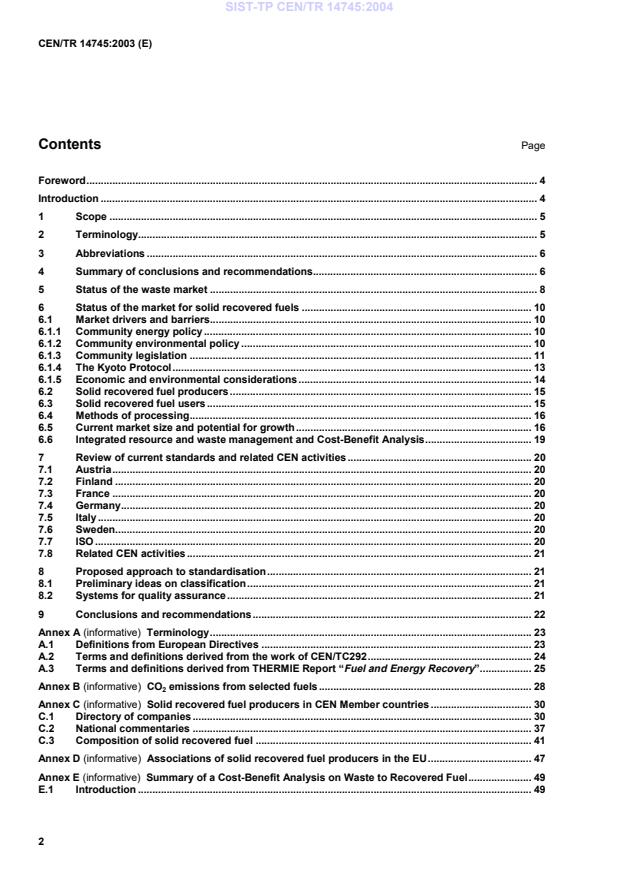
Contents Page
Foreword. 4
Introduction . 4
1 Scope . 5
2 Terminology. 5
3 Abbreviations . 6
4 Summary of conclusions and recommendations. 6
5 Status of the waste market . 8
6 Status of the market for solid recovered fuels . 10
6.1 Market drivers and barriers. 10
6.1.1 Community energy policy. 10
6.1.2 Community environmental policy . 10
6.1.3 Community legislation . 11
6.1.4 The Kyoto Protocol. 13
6.1.5 Economic and environmental considerations. 14
6.2 Solid recovered fuel producers. 15
6.3 Solid recovered fuel users. 15
6.4 Methods of processing. 16
6.5 Current market size and potential for growth. 16
6.6 Integrated resource and waste management and Cost-Benefit Analysis. 19
7 Review of current standards and related CEN activities . 20
7.1 Austria. 20
7.2 Finland . 20
7.3 France . 20
7.4 Germany. 20
7.5 Italy. 20
7.6 Sweden. 20
7.7 ISO . 20
7.8 Related CEN activities . 21
8 Proposed approach to standardisation. 21
8.1 Preliminary ideas on classification. 21
8.2 Systems for quality assurance. 21
9 Conclusions and recommendations. 22
Annex A (informative) Terminology. 23
A.1 Definitions from European Directives . 23
A.2 Terms and definitions derived from the work of CEN/TC292. 24
A.3 Terms and definitions derived from THERMIE Report “Fuel and Energy Recovery”. 25
Annex B (informative) CO emissions from selected fuels. 28
Annex C (informative) Solid recovered fuel producers in CEN Member countries . 30
C.1 Directory of companies . 30
C.2 National commentaries . 37
C.3 Composition of solid recovered fuel . 41
Annex D (informative) Associations of solid recovered fuel producers in the EU. 47
Annex E (informative) Summary of a Cost-Benefit Analysis on Waste to Recovered Fuel. 49
E.1 Introduction . 49
E.2 Cost-Benefit Analysis.49
E.3 Basic assumptions and scenarios.50
E.4 Results.51
E.5 Conclusions .53
E.6 Discussion.53
Annex F (informative) Standards for solid recovered fuels.55
Annex G (informative) Preliminary ideas on classification and identification systems .58
G.1 Background and objective.58
G.2 Terms and definitions .59
G.3 Purpose and use of classification .60
G.4 Preliminary ideas on Classification and Identification Systems .61
G.5 Fuel classification by essential fuel properties.61
G.6 A Fuel Identification system (FID).62
G.7 Example .62
G.8 Templates for Data sheet and Specifications.62
Annex H (informative) Survey on solid recovered fuels in CEN Member Countries.63
H.1 Introduction.63
H.2 Evaluation of documentation sheets.64
H.2.1 General .64
H.2.2 Plant data.65
H.2.3 Sampling data .65
H.2.4 Digestion .66
H.2.5 Analytical data .66
H.2.6 Applied standards in Europe.66
H.2.7 Discussion.67
H.3 Conclusions and recommendations.68
H.4 Documentation Sheet.69
H.5 Evaluation tables .77
H.5.1 Sampling, reduction, digestion and analytical methods.77
H.5.2 Analysis .79
H.5.3 Standards .81
Bibliography.85
Foreword
This document CEN/TR 14745:2003 has been prepared by Technical Committee CEN/SS NO2 "Solid fuels",
CMC
the secretariat of which is held by
This European Standard shall be given the status of a national standard, either by publication of an identical
text or by endorsement, at the latest by April 2004, and conflicting national standards shall be withdrawn at the
latest by April 2004.
According to the CEN/CENELEC Internal Regulations, the national standards organizations of the following
countries are bound to implement this European Standard: Austria, Belgium, Czech Republic, Denmark,
Finland, France, Germany, Greece, Hungary, Iceland, Ireland, Italy, Luxembourg, Malta, Netherlands,
Norway, Portugal, Slovakia, Spain, Sweden, Switzerland and the United Kingdom
This technical report considers the production of solid recovered fuels from selected, non-hazardous, mono-
and mixed-wastes and has been prepared by members of the CEN Task Force 118 “Solid Recovered Fuels”.
Solid recovered fuels can be derived from a wide range of waste streams and are processed into different
physical forms for the (partial) substitution of primary fuels in various combustion technologies.
The estimated quantity of solid recovered fuels produced in the European Union in 2000 was 1.4 million
tonnes (0.7 Mtoe). That figure is expected to rise to 13 million tonnes (6.5 Mtoe) in 2005 and to continue to
grow as combustible waste that is not suitable for material recovery is diverted from landfill in accordance with
the Council Directive on the landfill of waste.
This report aims to present sufficient information about the production, use and environmental considerations
of solid recovered fuels to justify the establishment of a Technical Committee for solid recovered fuels by the
CEN Technical Board, with the approval of the relevant services of the European Commission (EC).
The preparation of the report was supported financially by Contract NNE5-1999-00533 “Waste to Recovered
Fuel” awarded through the ENERGIE Programme of the European Commission’s Fifth Framework
Programme for research.
Annex H of the report was prepared by the European Commission’s Joint Research Centre at Ispra, which
has participated in the CEN Task Force on behalf of DG Environment Unit A.2 and provides an additional
survey of solid recovered fuels in CEN Member Countries, including data on fuel properties and composition,
sampling techniques and analytical methods.
Introduction
CEN Task Force 118 “Solid Recovered Fuels” was created by BT Resolution C64/2000 in April 2000. Its aims
are to initiate the drafting of a CEN Report to describe solid recovered fuels and their use, and also to develop
a Work Programme for drafting relevant Standards. The Work Programme will provide the basis for a CEN
Technical Committee to work on Standards for solid recovered fuels.
CEN/TF118 was established as a consequence of previous CEN activity in the field of solid biofuels. During
the pre-normative work undertaken by CEN Working Group 108 “Solid Biofuels” in 1999/2000 it was decided
that the scope of a future Technical Committee should not include fuels comprising waste materials that would
be subject to the forthcoming Council Directive for the incineration of waste. In due course, that limitation was
applied to the scope of CEN/TC335 “Solid Biofuels” which was established in April 2000, and CEN/TF118 took
on the responsibility for investigations into solid recovered fuels. CEN/TF118 maintains a close working
relationship with CEN/TC335, to avoid any duplication of effort.
This report is concerned with the current and potential market for solid recovered fuels made from non-
hazardous, mono- and mixed-wastes, excluding those fuels which are included in the scope of CEN/TC335.
The point at which Standards can be applied to solid recovered fuels in the transformation from waste to
useful thermal and electrical energy is illustrated in Figure 1 below. It is intended that Standards should be
used to promote trade in solid recovered fuels and to improve environmental protection.
Figure 1 — The application of standards to solid recovered fuels
1 Scope
This technical report considers the production of solid recovered fuels from selected, non-hazardous, mono-
and mixed-wastes.
2 Terminology
The terminology used in this report is explained in detail in Annex A. It takes account of terms and definitions
derived from European legislation (such as Council Directives), the ongoing work of CEN Technical
Committees (such as CEN/TC292 “Characterisation of waste”) and published technical reports. In cases
where definitions conflict, those set out in legislation must take precedence.
It is not the aim of this report to introduce standardised terminology and definitions; that will be the task of an
expert Working Group within a CEN Technical Committee. The terminology and definitions presented are
simply a means to assist the discussion of the topic of solid recovered fuels and to reduce ambiguity by
providing a common point of reference for all participants in the debate.
At present, there is no clear definition of Solid Recovered Fuel that can claim general acceptance. However,
as a first step, the following definition (based on the term defined in the report “Fuel and Energy Recovery”
produced under Contract DIS-1375-97-FI of the European Commission’s THERMIE Programme) is offered:
Solid Recovered Fuel is a solid fuel of uniform quality which meets public user-oriented specifications. It is
prepared from selected pre- and post-use, non-hazardous combustible waste in a dedicated process applying
a quality assurance system.
NOTE Note: Combustible wastes fall within the scope of European Directive 2000/76/EC on the incineration of waste
(WID). Plants incinerating only the following wastes are excluded from the scope of the WID. These wastes are included in
the scope of work of CEN/TC335 Solid Biofuels:
i) vegetable waste from agriculture and forestry,
ii) vegetable waste from the food processing industry, if the heat generated is recovered,
iii) fibrous vegetable waste from virgin pulp production and from production of paper from pulp, if it is co-
incinerated at the place of production and the heat generated is recovered,
iv) wood waste with the exception of wood waste which may contain halogenated organic compounds or
heavy metals as a result of treatment with wood-preservatives or coating, and includes in particular such
wood waste originating from construction and demolition waste,
v) cork waste.
It will be a clear priority for a future CEN Technical Committee to establish an acceptable definition as a sound
basis for the rest of its work.
3 Abbreviations
Abbreviations used in this report are listed below:
CFB Circulating-fluidised-bed (combustor)
IPPC Integrated Pollution Prevention and Control
IRWM Integrated Resource and Waste Management
kt kilotonne (1,000 tonnes)
MSW Municipal Solid Waste
Mt Megatonne (1,000,000 tonnes)
Mtoe Million tonnes of oil equivalent
PPWD Packaging and Packaging Waste Directive
toe tonne of oil equivalent
WD Waste Directive
WID Waste Incineration Directive
4 Summary of conclusions and recommendations
The following conclusions can be drawn from the information presented in the report:
1) Solid recovered fuels can be derived from household waste, commercial waste, industrial waste and
other non-hazardous, combustible waste streams.
2) European Standards for solid recovered fuels are important for:
the facilitation of trans-boundary shipments (in accordance with the European Regulation
259/93 and the OECD Green List or Appendix B of the Basel Treaty)
access to permits for the use of recovered fuels
cost savings for co-incineration plants as a result of reduced measurements (e.g. for heavy
metals)
the rationalisation of design criteria for combustion units, and the cost savings for equipment
manufacturers that go with it
guaranteeing the quality of fuel for energy producers.
3) The estimated quantity of solid recovered fuel produced in 2000 was 1,000 kt/a, corresponding to
500 ktoe/a. That figure is expected to rise to 10,000 kt/a in 2005, corresponding to 5,000 ktoe/a. The
main market drivers are economic, resulting from the implementation of instruments within the
framework of European policy on environmental protection.
4) Solid recovered fuels are already used to substitute fossil fuels in cement kilns, power stations and
industrial boilers. Their use in co-incineration and incineration plants is expected to increase.
5) The cost-benefit analysis presented in Annex E shows that, for the three model regions considered,
energy recovery scenarios lead to a significant reduction of greenhouse gas emissions (carbon
dioxide and methane) compared to the baseline scenario of landfilling. The reduction is proportionate
to the diversion of combustible waste from landfill and the yield of recovered fuel (that substitutes
fossil fuel).
6) Fuel recovery is suited to sparsely populated regions where relatively small, de-centralised fuel-
production plants can deliver recovered fuel to existing power stations or plants for the production of
material products. However, this is subject to the granting of appropriate permits in accordance with
the applicable legislation.
7) For larger cities or regions, the production of recovered fuel on the one hand and direct incineration
with energy recovery on the other hand may be an appropriate solution.
8) A survey of solid recovered fuel producers in 2001 has concluded that:
there is a large variation in the standards applied for the sampling, digestion and analysis of
solid recovered fuels and harmonisation is required urgently
the wide ranges in the analytical results reported justify the need for a fuel standard with
limit values
more detailed information is required about the waste input to the production process
there is sufficient information available to justify the drafting of a Standardisation Mandate to
be issued to CEN by the European Commission for developing European standards for
solid recovered fuels (RDF, etc.)
It is strongly recommended that a CEN Technical Committee should be established as soon as possible, with
a view to producing relevant European Standards by the end of 2003.
5 Status of the waste market
It must be said that it is very difficult to obtain accurate, up-to date information about waste generation and
recovery/disposal routes in the European Union. One of the greatest obstacles is the lack of consistency
among the Member States in the definition of waste categories such as Domestic Waste and Municipal Solid
Waste. The data for Member States in the two tables below are based on the report from the Commission to
the Council and the European Parliament on the implementation of Community waste legislation for the period
th
1995 to 1997 (COM (1999) 752 final of 10 January 2000), unless stated differently in the notes following the
table.
Table 1 — Solid waste generation in Europe
State Domestic Waste/MSW Other Waste (kt/a) Other Waste that is incinerated
(kt/a) (kt/a)
Austria 2 775 42 950 1 940
Belgium (1997) 4 633 42 253 2 261
Denmark (1996) 2 767 (1996) 9 876 867
Finland (1997) 980 (1997) 65 787 4 779
France (1998) 27 000 (1998) 600 000 3 600
Germany (1997) 39 068 N/r N/r
Greece (1992) 3 197 N/r N/r
Ireland (1995) 1 503 (1995) 4 888 36
Italy (1995) 25 400 N/r N/r
Luxembourg (1997) 208 (1997) 2 520 0
Netherlands (1997) 7 945 (1997) 44 740 2 925
Norway 2 794 4 698 N/r
Portugal (1994) 3 480 N/r N/r
Spain (1994) 14 296 N/r N/r
Sweden (1994/95) 3 200 N/r N/r
Switzerland (1999) 2 600
UK (1995/96) 26 500 (1994/95) 221 915 N/r
Total 168 346
NOTE kt/a = 1,000 tonnes per year
(1995) = source-year for data
N/r = not reported
Domestic Waste = Household Waste
Data for France come from ADEME (French Agency for Environment and Energy Management). The figure for Other
Waste that is incinerated does not include the biomass waste that is incinerated.
Data for Norway come from the Norwegian Council for Building Standardisation
Data for Switzerland come from the Swiss Agency for the Environment, Forests and Landscape
The figures in this table are only indicative as they do not correspond to the same harmonized definition throughout
the European Union.
The term “Other Waste” in Table 1 (as it is applied to the figures for EU Member States with the exception of
France) covers a multitude of waste materials such as sludge, industrial waste, waste from energy and water
supply, mining waste, agricultural waste and construction waste. A proportion of Other Waste is combustible,
as can be seen from the last column of Table 1. The total quantity of combustible waste other than
Domestic/MSW could be estimated at 30 to 50% of the Domestic/MSW total i.e. 50 to 80 Mt/a.
Table 2 —Domestic Waste/MSW management options applied in Europe
State Recycling Incineration (kt/a) Landfill Other
(kt/a) With energy Without energy (kt/a) (kt/a)
recovery recovery
Austria 1 263 431 0 1 261 0
Belgium (1997) 1 828 1 089 235 1 481 0
Denmark (1996) 777 1 545 N/r 428 16
Finland (1997) 170 32 0 560 218
France (1998) 2 204 7 900 1 800 13 700 1 400
Germany (1997) 11 562 8 992 0 17 904 N/r
Greece (1992) 226 1 2 970 N/r
Ireland (1995) 118 N/r N/r 1 383 N/r
Italy N/r 1400 24 000 N/r
Luxembourg (1997) 15 116 N/r 77 N/r
Netherlands (1997) 3 520 3 220 130 1 205 N/r
Norway 480 391 84 1 676 168
Portugal (1994) N/r N/r N/r 3 060 420
Spain (1994) N/r 625 11 901 1 770
Sweden (1994) 500 1 300 N/r 1 200 200
Switzerland (1999) 2 000 486 0 114
UK (1995/96) 1 868 1 217 1 099 22 080 236
Total 26 531 105 000
NOTE kt/a = 1,000 tonnes per year
(1995) = source-year for data
N/r = not reported
Domestic waste = Household Waste
Data for France come from ADEME (French Agency for Environment and Energy Management).
Data for Norway come from the Norwegian Council for Building Standardisation
Data for Switzerland come from the Swiss Agency for the Environment, Forests and Landscape
In the Netherlands, the GEVUDO plant still has two incinerators without energy recovery
The figures in this table are only indicative as they do not correspond to the same harmonised definition throughout
the European Union.
The total installed capacity for waste incineration in the EU Member States in 2000 has been estimated at 45
Mt/a (according to a European Incineration Profile compiled by the Juniper Consultancy in October 2000).
6 Status of the market for solid recovered fuels
6.1 Market drivers and barriers
6.1.1 Community energy policy
The EU’s main energy policy targets include:
Meeting Kyoto objectives (through 8% reduction in CO emissions between 2008 and 2012 compared to
1990)
Doubling the share of renewable energy sources (from 6% to 12% of gross inland energy consumption)
Improving energy efficiency (increase it by 18% until 2010 compared to 1995)
Maintaining security of supply.
The tools for the EU’s strategy for renewable energy are:
White Paper on Energy (1995)
White Paper on Renewable Energy Sources (RES) (1997), including the Action Plan and Campaign for
Take-Off
Draft Directive on RES (2000)
The use of biomass and waste accounted for 44.8 Mtoe in 1995. Its projected contribution in 2010 is135 Mtoe,
of which about a third will come from waste.
6.1.2 Community environmental policy
th
The European Commission has proposed a new action programme for the environment (the 6 EU
Environment Action Programme). The Programme focuses on areas where more action is needed. It sets out
objectives for the next ten years and beyond. It suggests that the key to our long-term welfare is sustainable
development; finding ways of improving our quality of life without causing harm to the environment.
One of the main areas where new effort and impetus is needed is ”Preserve natural resources and manage
waste”. The Commission proposes to the European Parliament and the Council to agree the following aims:
The Programme aims at stabilising the atmospheric concentration of greenhouse gases at a level that will not
cause unnatural variations of the earth’s climate. (3)
The Programme aims at protecting and restoring the functioning of natural systems and halting the loss of bio-
diversity. (4)
The Programme aims at an environment where levels of man-made contaminants do not give rise to
significant impacts on, or unacceptable risks to, human health. (5)
The Programme aims at better resource efficiency and resource and waste management (6)
The Programme shall stimulate the development of a global partnership for environment and contribute to a
sustainable development (9)
The Programme shall ensure that the Community’s environmental policy-making is undertaken in an
integrated way (10)
6.1.3 Community legislation
The Waste Directive, WD (75/442/EEC and its amendments)
gives a wide definition of waste. The definition does not distinguish between well-controlled industrial
residues (pre-use waste, by-products) and mixed Municipal Solid Waste, MSW
does not give a practical definition of recovery process but refers to a list of operations as they occur in
practice
does not take a position on when and how a waste that has entered a recovery operation becomes a non-
waste product that freely can enter the eco-cycle (= market).
th
The Waste Strategy (Council Resolution of 24 February 1997)
th
The first waste strategy dates from 18 September 1989. The Commission produced a revision after some
st th
years. On 1 August 1996 the revision was presented to the Council, who accepted it on 24 February 1997
(397Y0311(01)).
In the draft resolution (paragraph 20) the Commission confirms the principal hierarchy (established in the
document from 1989), which gives preference first to waste prevention, then to waste recovery (which
includes reuse, recycling and energy recovery, with preference being given to material recovery), and lastly to
waste disposal (which includes incineration without energy recovery and landfilling). The hierarchy must be
applied in a flexible way. The realisation of the hierarchy must be guided by the best solution for the
environment with regard to economic and social costs.
In the resolution the Council
(21) INSISTS on the need for promoting waste recovery with a view to reducing the quantity of waste for
disposal and saving natural resources, in particular by reuse, recycling, composting and recovering energy
from waste,
(22) RECOGNIZES, as regards recovery operations, that the choice of option in any particular case must
have regard to environmental and economic effects, but considers that at present, and until scientific and
technological progress is made and life-cycle analyses are further developed, reuse and material recovery
should be considered preferable where and insofar as they are the best environmental options, and
(27) IDENTIFIES the importance of Community criteria concerning the use of waste, in particular as a fuel or
other source of energy.
The Directive on Packaging and Packaging Waste, PPWD (94/62/EC)
defines energy recovery as “direct incineration of waste …. With recovery of the heat”
sets limits on the contents of four heavy metals in packaging allowed on the internal market.
The Landfill Directive (1999/31/EC)
sets binding targets for the diversion of biodegradable waste from landfill.
NOTE 1 Some Member States do not, or will not, allow combustible waste in landfill; others do the same for untreated
waste.
NOTE 2 Combustible waste is often of biogenic origin but will not pass the test on biodegradability as developed by
CEN under Mandate M 200 rev.3 for the PPWD.
NOTE 3 Some Member States have introduced a Landfill Tax to encourage diversion of wastes from landfill.
The Waste Incineration Directive, WID (2000/76/EC)
sets emission limit values for incineration and co-incineration of all wastes
excludes plants that incinerate only certain types of waste from its scope
requires continuous measurements of several emission components, and dioxin and heavy metal
measurements twice a year.
NOTE 1 Plants treating only the following wastes are excluded from the scope of the WID:
i) vegetable waste from agriculture and forestry,
ii) vegetable waste from the food processing industry, if the heat generated is recovered,
iii) fibrous vegetable waste from virgin pulp production and from production of paper from pulp, if it is co-
incinerated at the place of production and the heat generated is recovered,
iv) wood waste with the exception of wood waste which may contain halogenated organic compounds or
heavy metals as a result of treatment with wood-preservatives or coating, and includes in particular such
wood waste originating from construction and demolition waste,
v) cork waste,
vi) radioactive waste,
vii) animal carcasses as regulated by Directive 90/667/EEC without prejudice to its future amendments,
viii) waste resulting from the exploration for, and the exploitation of, oil and gas resources from off-shore
installations and incinerated on board the installation.
NOTE 2 The emission measurement costs can be substantial enough, in some cases, to make an economic barrier for
some combustion plants.
NOTE 3 The introduction of the Directive states that “(21) Criteria for certain combustible fraction of non-hazardous
waste not suitable for recycling, should be developed in order to allow the authorisation of the reduction of the frequency
of periodical measurements”. Periodic measurements of HCl, HF and SO instead of continuous measuring may be
authorised if the operator can prove that the emissions of those pollutants can under no circumstances be higher than the
prescribed emission limit values. The reduction of the frequency of the periodic measurements for heavy metals, dioxins
and furans may be authorised provided that the emissions are below 50% of the relevant emission limit values and
provided that criteria for the requirements to be met (to be developed in a Technical Adaptation Committee) are available.
Until 1 January 2005, the reduction of the frequency may be authorised even if no such criteria are available provided that:
the waste consists only of certain sorted combustible fractions of non-hazardous waste not suitable for recycling and
presenting certain characteristics
national quality criteria, which have been reported to the Commission, are available for these wastes
co-incineration and incineration of these wastes is in line with the relevant waste management plans
the operator can prove that the emissions are under all circumstances significantly below the relevant emission limit
values
the quality criteria and the new period for the periodic measurements are specified in the permit
all decisions on the frequency of measurements and information on the amount and quality of the waste concerned
shall be communicated to the Commission.
The Draft Directive on Large Combustion Plants (88/609 Directive on the limitation of emissions of certain
th
pollutants into the air from large combustion plants, Common Position 52/2000 of 28 December 2000,
nd
and text approved by the Conciliation Committee on 2 August 2001)
Defines fuel as any solid, liquid or gaseous combustible material used to fire the combustion plant with
the exception of waste covered by Council Directive 89/369/EEC of 8 June 1989 on the prevention of air
pollution from new municipal waste incineration plants, Council Directive 89/429/EEC of 21 June 1989 on
the reduction of air pollution from existing municipal waste incineration plants and Council Directive
94/67/EC of 16 December 1994 concerning the incineration of hazardous waste, or any subsequent
Community act repealing and replacing one or more of these Directives.
The Directive on Integrated Pollution Prevention and Control (IPPC) (96/61)
IPPC sets the requirement for installations to use best available technologies (BAT). “Integrated” means
that the permits must take into account the whole environmental performance of the plant i.e. emissions
to air, water and land, generation of waste, use of raw materials, energy efficiency, noise, prevention of
accidents, risk management, etc.
The Directive on the promotion of electricity produced from renewable energy sources in the internal
electricity market (RES-E) (2001/77/EC)
The Directive and its position will affect the market for solid recovered fuels. It states that “Where they use
waste as an energy source, Member States must comply with current Community legislation on waste
management. The application of this Directive is without prejudice to the definitions set out in Annex 2a
and 2b to Council Directive 75/442/EEC of 15 July 1975 on waste. Support for renewable energy sources
should be consistent with other Community objectives, in particular respect for the waste treatment
hierarchy. Therefore, the incineration of non-separated municipal waste should not be promoted under a
future support system for renewable energy sources, if such promotion were to undermine the hierarchy.”
NOTE 1 Some Member States classify the biodegradable share or the whole amount of energy from MSW as
renewable energy. A brief review of the legal definitions of waste as a source of energy is presented in 6.1.4.
NOTE 2 The Rapporteur to the European Parliament has proposed to ask the Commission to draft a separate Directive
on the promotion of energy from waste.
nd
Working Document on the biological treatment of biowaste (2 draft, 12 February 2001)
The Working Document and its position will affect the market for solid recovered fuels.
6.1.4 The Kyoto Protocol
The Kyoto Protocol sets binding targets for different countries for six different greenhouse gas emissions.
Member States have different practices for calculating the reductions of greenhouse gas emissions from
energy generation through the incineration of waste and combustion of waste-derived fuels. A summary of
those practices is given below.
The Austrian strategy for climate protection acknowledges the high potential of an optimisation of the waste
management sector for the reduction of greenhouse gases by the application of thermal treatment instead of
landfilling (according to a climate strategy paper by the Federal Ministry of the Environment, 2000).
In Belgium, the AMPERE Commission has estimated that 65% of MSW is biogenic.
NOTE Commissie AMPERE, October 2000. Rapport van de Commissie voor de Analyse van de Productiemiddelen
van Elektriciteit en de Reorientatie van de Energievectoren.
In the Danish air emission inventory, the emission of CO from plastic in municipal waste is included in the
total CO emission. The Danish Environmental agency has estimated the content of plastic in municipality
waste to be 6.4 w/w%.
In Finland, the IPPC methodology is applied in calculating the emissions of MSW (CO /MJ). At present (2000)
the reporting is based on analysis made of MSW at the incinerator in Turku. In a detailed analysis, 80% of the
MSW energy content was considered to be of biomass origin, which percentage is used as CO neutral in
official reporting for the Kyoto Protocol. The percentage used in reporting can be changed when the MSW
composition changes.
The French position is to count biogas and the biodegradable fraction of municipal waste as sources of
renewable energy.
In the German renewable energy law (EEG), MSW is not counted as a renewable energy source.
In Italy, waste and waste fuels (both municipal and industrial waste) are considered as a renewable energy
source. Their use is strictly regulated by the law, and the energy produced from these wastes can be admitted
under the law to incentives such as “green certificates”.
In the Netherlands it has been estimated that the amount of biogenic waste contributes 71% to the total mass
of municipal solid waste; however, it is responsible for 62% of the energy production from the incineration of
MSW (see Notes 1 and 2). 60% of bulky household waste is regarded as being biogenic, as is 65% of
household waste and 58% of commercial waste. The Dutch government recognises 50% of MSW to be
biogenic and thus contributing to the production of renewable energy; this assumption appears somewhat
conservative when compared to the information above. The assumptions made by the Dutch government are
staed in the “Protocol Monitoring Duurzame Energie” (see Note 3).
NOTE 1 GAVE, December 1999. Beschikbaarheid van afval en biomassa voor energieopwekking in Nederland. Project
number 356198/3020.
NOTE 2 In the Netherlands, MSW is understood to include household waste and similar commercial and industrial
waste.
NOTE 3 Novem, September 1999. Protocol Monitoring Duurzame Energie.
Swedish reporting for the incineration of MSW is based on emission factors (CO /MJ). These factors are
based on an estimate of fossil fuel content in MSW and will be revised according to new estimates. The
percentage of biogenic origin can be roughly calculated by comparing emission factors for MSW with factors
for wood and residual fuel oil. The result of such a calculation is that the biogenic share is 60 to 70%
In the United Kingdom, electricity from renewable sources is defined in the Utilities Act 2000, Part 4, Section
62. “Renewable sources” means “sources of energy other than fossil fuel or nuclear fuel, but includes waste of
which not more than a specified proportion is waste which is, or is derived from, fossil fuel”. The primary
legislation does not proceed to specify the acceptable proportion of waste which is, or is derived from, fossil
fuel. That will be set out later in secondary legislation (an Order rather than an Act) in which an obligation (the
Renewables Obligation) will be placed on all suppliers of electricity to purchase a percentage of their
electricity from renewable energy sources. The Order for the Renewables Obligation is expected to be laid
before Parliament in February 2002.
6.1.5 Economic and environmental considerations
Some economic and environmental considerations related to solid recovered fuels are set out below:
the most important greenhouse gases are methane and carbon dioxide
methane leaks from the excavation of fossil energy sources and from disposal of biogenic waste in landfill
carbon dioxide is the combustion product of the carbon content in organic materials. The higher the
hydrogen to carbon ratio of a hydrocarbon is, the lower is the emission of carbon dioxide per released
energy unit (see Annex B)
a high energy conversion efficiency is the best means to reduce emissions for a given energy production
and to improve sustainability
overall effects should be considered in a concept of Integrated Resource and Waste Management
(IRWM)
dedicated MSW incineration requires an investment cost of Euro 500-700 per tonne of annual capacity
and is
...
Questions, Comments and Discussion
Ask us and Technical Secretary will try to provide an answer. You can facilitate discussion about the standard in here.
Loading comments...