


SIST EN 415-11:2021
(Main)Safety of packaging machines - Part 11: Determination of efficiency and availability
Safety of packaging machines - Part 11: Determination of efficiency and availability
This document is applicable to packaging machines falling within the scope of EN 415 1, referred to in the following as “machine systems”. This document can also be applied by analogy to other related processing machines. This document specifies
— a time model,
— an output model derived from this time model,
— general key figures,
— technical key figures, and
— a methodology for system acceptance
for describing the operating behaviour of packaging machines and packaging lines.
This document does not contain safety requirements.
Sicherheit von Verpackungsmaschinen - Teil 11: Ermittlung von Effizienz und Verfügbarkeit
Dieses Dokument gilt für Verpackungsmaschinen die in den Anwendungsbereich von DIN EN 415-1 fallen, nachfolgend vereinfacht Maschinensystem genannt. Dieses Dokument ist sinngemäß auch auf andere technisch verwandte Verarbeitungsmaschinen anwendbar. Dieses Dokument spezifiziert
- ein Zeitmodell
- ein Mengenmodell abgeleitet von diesem Zeitmodell
- allgemeine Kennzahlen
- maschinentechnische Kennzahlen, und
- eine Methodik zur Systemabnahme
zur Beschreibung des Betriebsverhaltens von Verpackungsmaschinen und Verpackungslinien.
Dieses Dokument enthält keine Festlegungen zu Sicherheitsanforderungen.
Sécurité des machines d'emballage - Partie 11 : Détermination de l'efficacité et de la disponibilité
Le présent document est applicable aux machines d’emballage entrant dans le domaine d'application de l’EN 415 1, ci-après désignées les “systèmes de machines”. Le présent document peut également être appliqué par analogie à d'autres machines de traitement connexes. Le présent document spécifie :
— un modèle temporel ;
— un modèle de production dérivé de ce modèle temporel ;
— des chiffres clés généraux ;
— des chiffres clés techniques, et
— une méthodologie pour l’acceptation du système.
pour décrire le comportement de fonctionnement des machines et des lignes d'emballage.
Le présent document ne contient pas d’exigences.
Varnost pakirnih naprav - 11. del: Ugotavljanje učinkovitosti in razpoložljivosti
General Information
- Status
- Published
- Public Enquiry End Date
- 30-Oct-2020
- Publication Date
- 11-Nov-2021
- Technical Committee
- DTN - Lift and transport appliances
- Current Stage
- 6060 - National Implementation/Publication (Adopted Project)
- Start Date
- 27-Oct-2021
- Due Date
- 01-Jan-2022
- Completion Date
- 12-Nov-2021
Overview
EN 415-11:2021 - "Safety of packaging machines - Part 11: Determination of efficiency and availability" (CEN) defines a standardized approach for describing and measuring the operating behaviour of packaging machines and packaging lines. Although part of the EN 415 series on safety, EN 415-11:2021 does not contain safety requirements; instead it provides a uniform methodology to determine efficiency, availability, output and related key figures using agreed time and output models.
Key topics and technical requirements
- Time model and output model: Normative Annexes (A and B) establish a time-structure (theoretically available time, machine working time, operating time, running time, scheduled/unplanned downtime, quality and scrap times) and a derived output model (scheduled, manufactured, quality output and output losses).
- General and technical key figures: Definitions and formulas for performance indicators such as quality time, loss time, performance loss, nominal/set performance and output-related metrics used to characterise machine-system behaviour.
- System boundaries and attribution: Procedures to distinguish system-related vs non-system-related disruptions, and how to allocate time- and output-losses to the machine system under test.
- System acceptance methodology: Requirements and modalities for acceptance testing, including acceptance period, acceptance test documentation and minimum points to agree prior to testing (see Annex C and informative Annex D for an acceptance protocol template).
- Root-cause clarification: Guidance on incident classification as a prerequisite for correct calculation of key figures (informative Annex E includes a worked example - filling line for beer cans).
- No normative references: The document contains its own definitions and models; it is self-contained for the stated scope.
Practical applications and target users
EN 415-11:2021 is designed for practical use by:
- Packaging machine manufacturers and OEMs - to define and demonstrate machine performance during commissioning and contractual acceptance tests.
- System integrators and line builders - to set shared acceptance criteria for multi-machine lines.
- Production, maintenance and quality managers - to monitor availability, identify loss causes and prioritise improvements.
- Procurement and contract managers - to specify agreed output and acceptance test conditions in supply contracts.
- Test laboratories and certification bodies - to provide consistent measurement and reporting of efficiency and availability. The standard can also be applied by analogy to other processing machines beyond packaging.
Related standards
- EN 415 series (relevant parts): Part 1 (terminology and classification) and Parts 2–10 (machine-specific safety and measurement methods). EN 415-11 is intended to be used alongside EN 415-1 for defining machine-system scope and terms.
Keywords: EN 415-11:2021, safety of packaging machines, efficiency and availability, time model, output model, key figures, system acceptance, packaging lines, acceptance test.



Frequently Asked Questions
SIST EN 415-11:2021 is a standard published by the Slovenian Institute for Standardization (SIST). Its full title is "Safety of packaging machines - Part 11: Determination of efficiency and availability". This standard covers: This document is applicable to packaging machines falling within the scope of EN 415 1, referred to in the following as “machine systems”. This document can also be applied by analogy to other related processing machines. This document specifies — a time model, — an output model derived from this time model, — general key figures, — technical key figures, and — a methodology for system acceptance for describing the operating behaviour of packaging machines and packaging lines. This document does not contain safety requirements.
This document is applicable to packaging machines falling within the scope of EN 415 1, referred to in the following as “machine systems”. This document can also be applied by analogy to other related processing machines. This document specifies — a time model, — an output model derived from this time model, — general key figures, — technical key figures, and — a methodology for system acceptance for describing the operating behaviour of packaging machines and packaging lines. This document does not contain safety requirements.
SIST EN 415-11:2021 is classified under the following ICS (International Classification for Standards) categories: 55.200 - Packaging machinery. The ICS classification helps identify the subject area and facilitates finding related standards.
SIST EN 415-11:2021 is available in PDF format for immediate download after purchase. The document can be added to your cart and obtained through the secure checkout process. Digital delivery ensures instant access to the complete standard document.
Standards Content (Sample)
SLOVENSKI STANDARD
01-december-2021
Varnost pakirnih naprav - 11. del: Ugotavljanje učinkovitosti in razpoložljivosti
Safety of packaging machines - Part 11: Determination of efficiency and availability
Sicherheit von Verpackungsmaschinen - Teil 11: Ermittlung von Effizienz und
Verfügbarkeit
Sécurité des machines d'emballage - Partie 11 : Détermination de l'efficacité et de la
disponibilité
Ta slovenski standard je istoveten z: EN 415-11:2021
ICS:
55.200 Pakirni stroji Packaging machinery
2003-01.Slovenski inštitut za standardizacijo. Razmnoževanje celote ali delov tega standarda ni dovoljeno.
EN 415-11
EUROPEAN STANDARD
NORME EUROPÉENNE
October 2021
EUROPÄISCHE NORM
ICS 55.200
English Version
Safety of packaging machines - Part 11: Determination of
efficiency and availability
Sécurité des machines d'emballage - Partie 11 : Sicherheit von Verpackungsmaschinen - Teil 11:
Détermination de l'efficacité et de la disponibilité Ermittlung von Effizienz und Verfügbarkeit
This European Standard was approved by CEN on 23 August 2021.
CEN members are bound to comply with the CEN/CENELEC Internal Regulations which stipulate the conditions for giving this
European Standard the status of a national standard without any alteration. Up-to-date lists and bibliographical references
concerning such national standards may be obtained on application to the CEN-CENELEC Management Centre or to any CEN
member.
This European Standard exists in three official versions (English, French, German). A version in any other language made by
translation under the responsibility of a CEN member into its own language and notified to the CEN-CENELEC Management
Centre has the same status as the official versions.
CEN members are the national standards bodies of Austria, Belgium, Bulgaria, Croatia, Cyprus, Czech Republic, Denmark, Estonia,
Finland, France, Germany, Greece, Hungary, Iceland, Ireland, Italy, Latvia, Lithuania, Luxembourg, Malta, Netherlands, Norway,
Poland, Portugal, Republic of North Macedonia, Romania, Serbia, Slovakia, Slovenia, Spain, Sweden, Switzerland, Turkey and
United Kingdom.
EUROPEAN COMMITTEE FOR STANDARDIZATION
COMITÉ EUROPÉEN DE NORMALISATION
EUROPÄISCHES KOMITEE FÜR NORMUNG
CEN-CENELEC Management Centre: Rue de la Science 23, B-1040 Brussels
© 2021 CEN All rights of exploitation in any form and by any means reserved Ref. No. EN 415-11:2021 E
worldwide for CEN national Members.
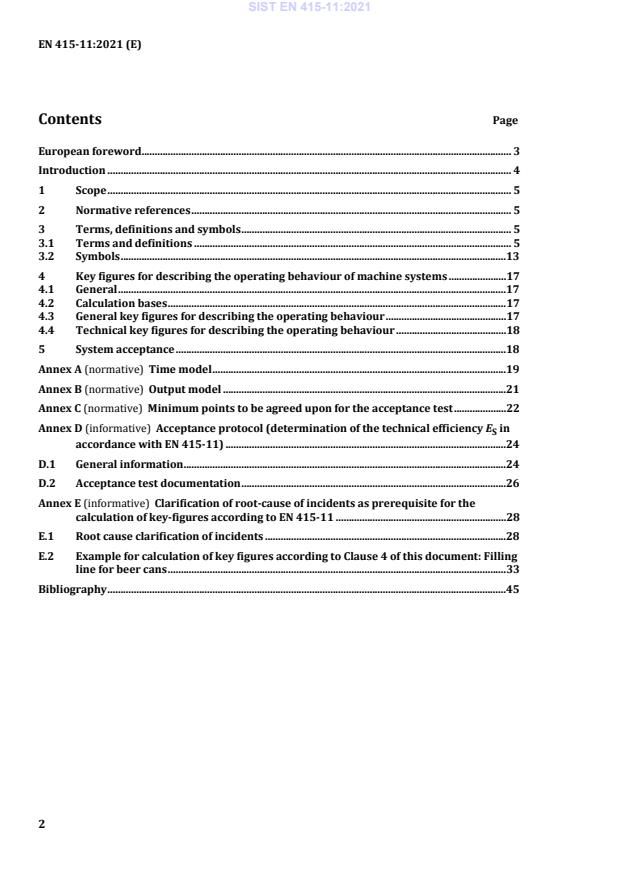
Contents Page
European foreword . 3
Introduction . 4
1 Scope . 5
2 Normative references . 5
3 Terms, definitions and symbols . 5
3.1 Terms and definitions . 5
3.2 Symbols .13
4 Key figures for describing the operating behaviour of machine systems .17
4.1 General .17
4.2 Calculation bases .17
4.3 General key figures for describing the operating behaviour .17
4.4 Technical key figures for describing the operating behaviour .18
5 System acceptance .18
Annex A (normative) Time model .19
Annex B (normative) Output model .21
Annex C (normative) Minimum points to be agreed upon for the acceptance test .22
Annex D (informative) Acceptance protocol (determination of the technical efficiency E in
S
accordance with EN 415-11) .24
D.1 General information .24
D.2 Acceptance test documentation .26
Annex E (informative) Clarification of root-cause of incidents as prerequisite for the
calculation of key-figures according to EN 415-11 .28
E.1 Root cause clarification of incidents .28
E.2 Example for calculation of key figures according to Clause 4 of this document: Filling
line for beer cans .33
Bibliography .45
European foreword
This document (EN 415-11:2021) has been prepared by Technical Committee CEN/TC 146 “Packaging
machines - Safety”, the secretariat of which is held by UNI.
This European Standard shall be given the status of a national standard, either by publication of an
identical text or by endorsement, at the latest by April 2022, and conflicting national standards shall be
withdrawn at the latest by April 2022.
Attention is drawn to the possibility that some of the elements of this document may be the subject of
patent rights. CEN shall not be held responsible for identifying any or all such patent rights.
EN 415, Safety of packaging machines consists of the following parts:
— Part 1: Terminology and classification of packaging machines and associated equipment;
— Part 2: Pre-formed rigid container packaging machines;
— Part 3: Form, fill and seal machines;
— Part 4: Palletisers and depalletisers;
— Part 5: Wrapping machines;
— Part 6: Pallet wrapping machines;
— Part 7: Group and secondary packaging machines;
— Part 8: Strapping machines;
— Part 9: Noise measurement methods for packaging machines, packaging lines and auxiliary equipment,
grade of accuracy 2 and 3;
— Part 10: General requirements.
Any feedback and questions on this document should be directed to the users’ national standards body.
A complete listing of these bodies can be found on the CEN website.
According to the CEN-CENELEC Internal Regulations, the national standards organisations of the
following countries are bound to implement this European Standard: Austria, Belgium, Bulgaria, Croatia,
Cyprus, Czech Republic, Denmark, Estonia, Finland, France, Germany, Greece, Hungary, Iceland, Ireland,
Italy, Latvia, Lithuania, Luxembourg, Malta, Netherlands, Norway, Poland, Portugal, Republic of North
Macedonia, Romania, Serbia, Slovakia, Slovenia, Spain, Sweden, Switzerland, Turkey and the United
Kingdom.
Introduction
The operation of packaging machines and packaging lines is subject to numerous influences on the part
of the machines and linking devices themselves, the upstream and downstream systems, the contents of
the packaging, the packaging, the auxiliary packaging, the production organization, the service and
maintenance personnel and the ambient conditions at the installation site. As a result, the packaging
process is not disruption-free. During the operation of the packaging machine or packaging line, periods
in which production takes place according to plan and to the required standard of quality stochastically
interchange with periods in which disruptions lead to losses (e.g. due to scrap or production stoppages).
This operating behaviour of a packaging machine or packaging line can be characterized by key figures,
established from partial times on the basis of the structure of the machine working time and the output
produced, or producible, during these periods.
This document defines a time model and an output model derived from this time model. These can be
used to define general key figures and technical key figures for describing the operating behaviour of
packaging machines and packaging lines. For this purpose, the technical key figures only take into
consideration lost time and output losses that can be attributed to each packaging machine or packaging
line examined.
Technical key figures are often based on agreed characteristics that are checked as part of an acceptance
test. In practice, the system boundaries forming the basis of the acceptance test and that of the
organizational and technical boundary conditions clearly influence the value determined for each key
figure. This document specifies requirements for the proper performance of an acceptance test, the
modalities of which should be agreed by the participating parties prior to the acceptance test being
carried out.
The competence of the personnel responsible for the management of the packaging process plays an
essential role.
Personnel (operators, maintenance people, quality staff) should be properly trained and be aware of the
instruction provided by the manufacturer of the machine.
This document aims to promote mutual understanding between manufacturers and users of packaging
machines and packaging lines with the respect to the use of terms and symbols (also referred as
indicators) for the description of a packaging process.
The standard intends to enable the user of the standard to conduct a suitable test in which the operating
conditions are correctly interpreted and attributed to shared causes.
For this reason, informative Annex D is offered which can be used with or without modifications in
contractual specifications.
1 Scope
This document is applicable to packaging machines falling within the scope of EN 415-1, referred to in
the following as “machine systems”. This document can also be applied by analogy to other related
processing machines. This document specifies
— a time model,
— an output model derived from this time model,
— general key figures,
— technical key figures, and
— a methodology for system acceptance
for describing the operating behaviour of packaging machines and packaging lines.
This document does not contain safety requirements.
2 Normative references
There are no normative references in this document.
3 Terms, definitions and symbols
3.1 Terms and definitions
For the purposes of this document, the following terms and definitions apply.
ISO and IEC maintain terminological databases for use in standardization at the following addresses:
— IEC Electropedia: available at https://www.electropedia.org/
— ISO Online browsing platform: available at https://www.iso.org/obp
3.1.1
machine system
system
machines and lines with specified system boundaries regarding introduction of processing materials,
operating materials, the release of output units, waste or scrap
3.1.2
processing material
referring to packaging machines: contents of the packaging, packaging, auxiliary packaging or package
3.1.3
output unit
processing material after passing through the machine system
Note 1 to entry: A packaging process consists of sub-processes in accordance with the basic tasks of packaging (i.e.
forming, filling, sealing, wrapping) as well as the sub-tasks such as the cleaning of the packaging or labelling. In the
context of this document, the packaging process comprises the respective machine system with the specified system
boundaries. An output unit can be an intermediate product of the packaging process, a package or a loading unit.
3.1.4
acceptance
recognition of fulfilment of agreed characteristics of the machine system
3.1.5
acceptance test
test production to determine selected characteristics of the machine system
3.1.6
acceptance period
agreed duration of an acceptance test
3.1.7
disruption
unplanned event that compromises or interrupts the production of quality output units
3.1.7.1
system related disruption
disruption that can be attributed to the machine system considered
3.1.7.2
disruption not related to system
disruption that cannot be attributed to the machine system considered
3.1.8
start-up time
time period from the start of the loading of the first element in the machine system to the point in time
when the first output unit leaves the final element of the machine system
3.1.9
emptying time
time period from the initiation of the production end of the machine system to the point in time when the
last output unit leaves the final element of the machine system
3.1.10
time category
summary of time periods with the same specified use characteristics for the considered machine system
3.1.10.1
theoretically available time
t
T
theoretically available time
Note 1 to entry: 24 h for seven days of the week.
3.1.10.2
idle time
t
I
time period in which the machine system cannot be scheduled for production
3.1.10.3
machine working time
t
W
time period in which the machine system is scheduled for production
3.1.10.4
scheduled down time
t
D
scheduled time without the production of output units (e.g. for scheduled cleaning, maintenance, repair,
equipping or adjustment of the machine system as well as product exchange)
Note 1 to entry: This is the difference between machine working time and operating time.
3.1.10.5
operating time
t
O
time period scheduled for the production of output units by the machine system
3.1.10.6
unplanned down time
t
F
unplanned time without the production of output units due to a disruption
Note 1 to entry: Unplanned down time can be determined automatically or manually.
3.1.10.6.1
system related unplanned down time
t
FS
sum of all system related unplanned down times
3.1.10.6.2
unplanned down time not related to system
t
FE
sum of all non-system related unplanned down times
3.1.10.7
running time
t
R
time period in which the machine system produces
Note 1 to entry: The machine system can produce scrap during running time.
3.1.10.8
scrap time
t
LQ
sum of the times in which the machine system does not produce in a manner conforming to the required
standard of quality
Note 1 to entry: Mathematical variable.
3.1.10.9
performance loss time
t
LP
running time minus the sum of quality time and scrap time
Note 1 to entry: Mathematical variable.
Note 2 to entry: All loss times that cannot be attributed to the time categories t and t are attributed to t .
LQ F LP
Note 3 to entry: This time category includes calculated loss times due to a reduced working speed as compared
with the set performance as well as scheduled and unscheduled times without performance that are not attributable
to disruptions (e.g. due to start-up or emptying times or supply of processing materials (contents of packaging,
packaging or auxiliary packaging)).
3.1.10.10
quality time
t
Q
time period in which the machine system produces in a manner conforming to the required standard of
quality
Note 1 to entry: Mathematical variable.
3.1.10.11
loss time
t
L
sum of unplanned down time, scrap time and performance loss time
Note 1 to entry: Mathematical variable.
3.1.10.11.1
loss time caused by machine system
t
LS
sum of loss times that can be attributed to the machine system
3.1.10.11.2
loss time not caused by machine system
t
LE
sum of loss times that cannot be attributed to the machine system
Note 1 to entry: The reasons can be of a technical nature (e.g. effects of upstream or downstream systems, technical
disruptions due to operating errors or packaging that does not comply with specifications) or of an organizational
nature (internal or external organizational causes). Organizational causes include e.g. a shortage of product or
packaging, unavailability of service or maintenance personnel, performance losses due to packaging or product
qualities that do not comply with specifications, power failures, shortages of supply media.
3.1.11
output
sum of all output units in a specified time period
3.1.11.1
quality output
q
Q
output of output units conforming to quality produced in the operating time
Note 1 to entry: q is referring to the output that can be produced in quality time.
Q
3.1.11.2
scheduled output
q
O
scheduled quality output
Note 1 to entry: Planning variable.
Note 2 to entry: q is referring to the output that can be produced in operating time.
O
3.1.11.3
agreed output
q
OA
agreed output of output units conforming to quality in a specified time period
3.1.11.4
manufactured output
q
M
actual output of produced output units including scrap
3.1.11.5
output losses
q
L
difference between scheduled output and quality output
Note 1 to entry: Mathematical variable.
3.1.11.5.1
output losses caused by machine system
q
LS
output losses that can be attributed to the machine system
3.1.11.5.2
output losses not caused by machine system
q
LE
output losses that cannot be attributed to the machine system
3.1.11.5.3
scrap output
q
LQ
output of produced output units that do not comply with the specified quality requirements
Note 1 to entry: Product of good quality withdrawn for a quality check is not counted as scrap.
3.1.11.5.4
performance losses
q
LP
difference between scheduled output and manufactured output
3.1.12
performance
output units per time unit
3.1.12.1
nominal performance
p
n
performance for which the machine system has been calculated and designed for specified processing
materials
Note 1 to entry: The nominal performance depends on the processing materials. Consequently, the machine
system can exhibit different nominal performances.
3.1.12.2
set performance
p
s
theoretical performance achievable at a set working speed of the machine system
3.1.13
key figure
figure for the characterization of the use of a machine system
Note 1 to entry: Developed on the basis of use times, loss times and output losses that have been determined
empirically or by simulation.
3.1.13.1
general key figure
key figure for the calculation of which all relevant loss times and output losses are taken into
consideration
Note 1 to entry: No differentiation is made as to whether the determined loss times have been caused by the
considered machine system itself or by factors external to the system.
3.1.13.1.1
quality performance
p
Q
quality output related to operating time
3.1.13.1.2
quality factor
Q
ratio of quality output to manufactured output
Note 1 to entry: The quality factor is determined based on output and can be converted to a time-based variable.
3.1.13.1.3
running time factor
R
ratio of running time to operating time
3.1.13.1.4
performance factor
P
ratio of manufactured output to scheduled output
Note 1 to entry: The performance factor is determined based on output and can be converted to a time-based
variable.
3.1.13.1.5
availability
A
ratio of operating time to machine working time
Note 1 to entry: For technical availability see 3.1.13.2.2.
3.1.13.1.6
loading factor
L
ratio of machine working time to theoretically available time
Note 1 to entry: L not used in this document, but useful when the standard is used in link with OEE model.
3.1.13.1.7
overall equipment effectiveness
OEE
ratio of quality time to machine working time
Note 1 to entry: Scheduled down time is taken into consideration.
3.1.13.1.8
efficiency
E
ratio of quality output to scheduled output at a constant set performance at the level of the nominal
performance of the considered machine system
Note 1 to entry: Scheduled down time is not taken into consideration.
Note 2 to entry: Unplanned down time and performance loss times are taken into consideration.
Note 3 to entry: E ≤ 1.
3.1.13.1.9
mean time to repair
MTTR
mean duration of disruption-related down time of the machine system within the operating time
Note 1 to entry: Key figure for the evaluation of the system stability based on empirical data.
Note 2 to entry: Determination of a safe mean value for MTTR is not possible within an implementable acceptance
period.
3.1.13.1.10
mean time between failures
MTBF
mean time elapsed between disruption-related down times of the machine system (time from the end of
the previous disruption to the start of the subsequent disruption) within the operating time
Note 1 to entry: Key figure for the evaluation of the system stability based on empirical data.
Note 2 to entry: Determination of a safe mean value for MTBF is not possible in the framework of an implementable
acceptance period.
3.1.13.2
technical key figure
key figure in the calculation of which output losses and loss times external to the system are not taken
into consideration
3.1.13.2.1
technical quality performance
p
QS
ratio of quality output to operating time adjusted for loss time not caused by machine system
3.1.13.2.2
technical availability
technical running time factor
R
S
ratio of running time to operating time adjusted for unplanned down time not related to system
Note 1 to entry: R ≥ E .
S S
Note 2 to entry: R = E for t = 0 and t = 0.
S S LP LQ
Note 3 to entry: The technical availability takes into consideration neither performance losses nor scrap output.
3.1.13.2.3
technical efficiency
E
S
ratio of quality output to scheduled output adjusted for output losses not attributable to the machine
system at a constant set performance at the level of the nominal performance of the considered machine
system
Note 1 to entry: Corresponds to the previous key figure “technical availability”.
Note 2 to entry: Due to its definition, the technical efficiency is always ≤ 1.
Note 3 to entry: E refers to the processing materials specified to determine p .
S n
3.1.13.2.4
delivery efficiency
technical delivery efficiency
D
S
ratio of the quality output to the agreed output adjusted for output losses not attributable to the machine
system
Note 1 to entry: Corresponds to the key figure “delivery efficiency” according to DIN 8782:1984–05 [2].
Note 2 to entry: The manufactured output can be higher than the agreed output. As a result the delivery efficiency
can be > 1.
Note 3 to entry: This is a “further key figure”, see 4.3.
3.1.13.2.5
technical mean time to repair
MTTR
s
mean period of a down time of the machine system due to system related disruptions during the
operating time
Note 1 to entry: Key figure for the evaluation of the system stability based on empirical data.
Note 2 to entry: The determination of a safe mean value for MTTR is not possible within an implementable
S
acceptance period.
Note 3 to entry: This is a “further key figure”, see 4.3.
3.1.13.2.6
technical mean time between failures
MTBF
S
mean time elapsed between down times of the machine system due to system related disruptions during
the operating time
Note 1 to entry: Key figure for the evaluation of the system stability based on empirical data.
Note 2 to entry: The determination of a safe mean value for MTBF is not possible within an implementable
S
acceptance period.
Note 3 to entry: This is a “further key figure”, see 4.3.
3.2 Symbols
Commonly used
unit, output
Term
Rule for calculation
Symbol designation or
(if applicable)
(en)
formats (if
applicable)
Theoretically
t
d; h; min
T
available time
t
Idle time d; h; min
I
Commonly used
unit, output
Term
Rule for calculation
Symbol designation or
(if applicable)
(en)
formats (if
applicable)
Machine working
t t = t – t
d; h; min
W W T I
time
Scheduled down
t
d; h; min
D
time
t t = t – t
Operating time d; h; min
O O W D
Unplanned down
t
d; h; min
F
time
System related
t
unplanned down d; h; min
FS
time
Unplanned down
t
time not related to d; h; min
FE
system
t t = t – t
Running time d; h; min
R R O F
t t = t (q / q )
Scrap time d; h; min
LQ LQ O LQ O
Performance loss
t t = t – t – t
d; h; min
LP LP R Q LQ
time
t t = (q / q ) ⋅ t
Quality time d; h; min
Q Q Q O O
t = t + t + t
L F LP LQ
t
Loss time d; h; min
L
= t + t
LS LE
Loss time caused by
t
d; h; min
LS
system
Loss time not caused
t
by machine system d; h; min
LE
system
unit
q
Scheduled output l
O
kg, t
unit
q
Agreed output l
OA
kg, t
unit
Manufactured
q
l
M
output
kg, t
Commonly used
unit, output
Term
Rule for calculation
Symbol designation or
(if applicable)
(en)
formats (if
applicable)
unit
q q = q – q
Quality output l
Q Q M LQ
kg, t
q = q – q
L O Q
unit
q = q + q
Output losses l
L LS LE
kg, t
= q + q
LP LQ
unit
q
Scrap l
LQ
kg, t
unit
q q = q – q
Performance losses l
LP LP O M
kg, t
unit
Output losses caused
q q = q – q
l
LS LS L LE
by machine system
kg, t
unit
Output losses not
q q = q – q
caused by machine l
LE LE L LS
system
kg, t
unit/min.
Nominal
p
l/min.
n
performance
kg/min.
unit/min.
p
Set performance l/min.
s
kg/min.
unit/min.
p p = q / t
Quality performance l/min.
Q Q Q O
kg/min.
unit/min.
Technical quality
p p = q / (t – t )
l/min.
QS QS Q O LE
performance
kg/min.
Q = q / (q + q )
Q Q LQ
= q / q
Q Quality factor
Q M
= t / (t + t )
Q Q LQ
R = t / t
R Running time factor
R O
Commonly used
unit, output
Term
Rule for calculation
Symbol designation or
(if applicable)
(en)
formats (if
applicable)
Technical availability
R R = t / (t – t )
S S R O FE Technical running
time factor
P = q / q
M O
P Performance factor
= (t + t ) / t
Q LQ O
A = t / t
A Availability
O W
L = t / t
L Loading factor
W T
OEE = t / t
Q W Overall Equipment
OEE
Effectiveness
= Q ⋅ P ⋅ A
E = q / q = Q ⋅ P,
Q O
where
E Efficiency
q = p ⋅ t and
O n O
p ≤ p
s n
E = q / (q – q ),
S Q O LE
where
E
Technical efficiency
S
q = p ⋅ t and
O n O
p ≤ p
s n
Delivery efficiency
D D = q / (q – q )
S S Q OA LE Technical delivery
efficiency
MTTR = t / f
F
f: total number of the
MTTR Mean time to repair
recorded down times
of the machine system
due to disruptions
MTTR = t / f
S FS S
where
f : total number of the
S
Technical mean time
MTTR
S
recorded down times
to repair
of the machine system
due to system related
disruptions
Commonly used
unit, output
Term
Rule for calculation
Symbol designation or
(if applicable)
(en)
formats (if
applicable)
MTBF = t / f
R
where
Mean time between
f: total number of the
MTBF
failures
recorded down times
of the machine system
due to disruptions
MTBF = t / f
S R S
where
f : total number of the
S
Technical mean time
MTBF
S
recorded down times
between failures
of the machine system
due to system related
disruptions
NOTE The abbreviation ”d” stands for the English word “day” and designates full days.
4 Key figures for describing the operating behaviour of machine systems
4.1 General
Key figures characterize the use of the machine system. The key figures given here are appropriate for
describing the operating behaviour of the machine system during the operating time when used as
intended. The key figures are established on the basis of time and output losses that have been
determined empirically or in simulations. This document differentiates between general key figures and
technical key figures. General key figures describe the operating behaviour without having to distinguish,
when establishing loss outputs or loss times, whether their causes lie in the machine system itself or
outside of the considered machine system, i.e. external to the machine system. In contrast to this, output
losses and loss times caused external to the machine system are not taken into consideration for technical
key figures. Thus, to establish technical key figures, it is necessary that when determining output losses
and loss times their causes are also clarified. In practice this involves additional effort as, for instance,
displayed disruptions of the machine system can be caused by technical disruptions of upstream or
downstream machine systems, by operating errors or by the flawed quality of the processing materials.
4.2 Calculation bases
For the calculation of the general key figures and the technical key figures, the rules for calculation
presented in 3.2 as well as the time model given in Annex A and the output model given in Annex B shall
be used.
4.3 General key figures for describing the operating behaviour
To describe the operating behaviour of machine systems at least the following general key figures shall
be determined:
— Quality performance p
Q
— Efficiency E, where E = Q ⋅ P
The determination of further general key figures shall be agreed separately, if necessary.
NOTE 1 These key figures refer to the operating time. They take into consideration disruptions of the machine
system as well as performance and quality losses. Here, no distinction is made as to whether disruptions in the
machine system or performance or quality losses have been caused by the machine system itself or the causes lie
outside of the considered machine system.
NOTE 2 Disruptions that result in the machine system no longer being able to go into production during
operating time are not taken into consideration. These are included in key Figure A (availability) and OEE.
4.4 Technical key figures for describing the operating behaviour
To describe the operating behaviour of machine systems at least the following technical key figures shall
be determined:
— technical quality performance p ;
QS
— technical efficiency E ;
S
— technical availability R .
S
The determination of additional technical key figures shall be agreed separately, if necessary.
NOTE These key figures refer to the operating time. They take into consideration disruptions to the machine
system as well as performance and quality losses provided their causes do not lie outside of the considered machine
system. Disruptions that result in the machine system no longer being able to go into production during operating
time are not taken into consideration.
5 System acceptance
For the system acceptance, the key figures given in 4.4 shall be determined in an acceptance test in
accordance with Annex C. Lack of agreement regarding individual points requiring mutual agreement in
accordance with Annex C is itself not a reason for a deferral of the acceptance test, nor is it a reason to
call into question the validity of the acceptance test.
As a deviation from the above, acceptance of systems without constant set performance that are product
output controlled, or otherwise externally controlled, may be performed as follows, with all points
requiring to be fulfilled:
1) determination of technical quality performance at specified nominal performance (short-term test
run under specified conditions), and
2) acceptance test subject to the requirements described in Annex C only for determining the technical
availability, also taking into account scrap time caused by the machine system.
NOTE An example for this exemption is given in E.2.5.
Annex A
(normative)
Time model
Theoretically available time (24 h, 7 days a week) t
T
Machine working time t Idle time t
W‘ I
Operating time t Scheduled down time t
O D
Scheduled time without
Running time t Unplanned down
output,
R
time t
F e.g. for
Quality time t Scrap time t Performance loss time t
Q LQ LP
Unplanned times — cleaning
All loss times not attributable to the time
without output due
— maintenance
categories t and t are attributed to
LQ F
to disruptions
— repair
t . Scheduled or unscheduled times, e.g.
LP
— equipping or
due to start-up or emptying times or
adjustment
supply of processing materials
(of the machine)
— product exchange
Loss time t
L
— Loss times caused by machine system (attributable to the machine system) t
LS
— Loss times not caused by machine system (not attributable to the machine system)
t
LE
NOTE Fields for calculated variables are shaded grey and those for directly determinable variables have a white background. The time model is read from top
to bottom (or vice-versa). For this purpose, the variables are compiled from the fields bordering them from below (or above).
EXAMPLE The theoretically available time includes the machine working time and the idle time; the machine working time includes the operating time and
the scheduled down time; the operating time includes, amongst others, the running time, etc.
EN 415-11:2020 (E)
Annex B
(normative)
Output model
Performance losses
q
LP
Scrap
q
Scheduled output LQ
q
O Manufactured output
q
M Quality output
q
Q
NOTE 1 q refers to the operating time t .
O O
NOTE 2 The manufactured output q can be higher than the scheduled output q
M O.
NOTE 3 Performance losses and scrap can be caused both by the considered machine system (output losses
caused by the machine system q ) and by factors external to the machine system (output losses not caused by the
LS
machine system q ).
LE
EN 415-11:2020 (E)
Annex C
(normative)
Minimum points to be agreed upon for the acceptance test
1. Specification of processing materials
The processing materials for the acceptance test shall be specified and agreed upon.
NOTE The specified processing materials determine the associated nominal performance of
the machine system.
2. Interfaces of the machine system
The interface(s) of the machine system should be clarified in advance of the acceptance test, e.g.
for:
a) upstream machine systems;
b) downstream machine systems;
c) supply of contents of packaging;
d) supply of packaging and auxiliary packaging;
e) energy supply;
f) supply of operating materials;
g) supply of auxiliary and operating equipment;
h) release of quality output units;
i) disposal of production and packaging wastes;
j) disposal of scrap;
k) lost samples; and
l) upstream, downstream and superordinate information processing systems.
3. Acceptance period
The acceptance period shall be agreed upon in advance of the acceptance test of a machine
system. Depending on the machine system it should not fall short of 2 h and not exceed 8 h. The
acceptance period may be modified during the acceptance test when agreed upon (e.g. in order
to compensate for potential disruptions occurring external to the system during the acceptance
test).
4. Number and tasks of service personnel
The number and tasks of the qualified operators required for the acceptance test shall be agreed
upon. It shall be agreed whether personnel of the user, of the supplier or external personnel will
be employed. Qualified personnel shall be provided by the user, unless otherwise agreed. If it is
determined that operators are not suitable, they may be exchanged or replaced by personnel
from the supplier.
5. Treatment of scheduled theoretical performance loss time
If scheduled performance loss times occur during the acceptance period, the attributed losses
shall, unless otherwise agreed, be treated as loss time not related to the machine system t .
LE
EN 415-11:2020 (E)
6. Prerequisites for readiness for acceptance
At least the following acceptance conditions shall be ensured as prerequisites for readiness for
acceptance:
a) supply of energy and supply media in the amount and quality to be specified;
b) operating personnel available;
c) clarification of type, scope and implementation of information collection;
d) clarification of type, scope and implementation of evaluation;
e) specification of the output unit to be determined, including the quality criteria to be fulfilled;
f) processing materials available in specified quality and in a sufficient amount;
g) machine system cleaned (if necessary) and set up for the processing materials to be specified
for the acceptance test;
h) considered machine system ready for operation;
i) upstream and downstream machine systems ready for operation;
j) machine system completely loaded and in stable operating condition.
Additional aspects shall be agreed upon, if necessary.
The readiness for acceptance shall be ensured by the participants.
In advance of the start of the acceptance test, the readiness for acceptance shall be declared by
the participants.
7. Procedure in the case of the termination of the acceptance test
Serious violations of the acceptance conditions lead to termination of the acceptance test. The
acceptance test ends in this case with the event triggering the termination. In this case, the
period of the acceptance test may be modified by mutual agreement in accordance with item 3.
8. Documentation of the acceptance test and its evaluation
The acceptance test and its evaluation shall be documented in a suitable form and to the
appropriate extent and shall be confirmed by the participants. An example for the acceptance
protocol is given in Annex D.
EN 415-11:2020 (E)
Annex D
(informative)
Acceptance protocol (determination of the technical efficiency E in
S
accordance with EN 415-11)
D.1 Introduction
Reproduction of the form is permitted to the user of this form without prejudice to rights to the entirety
of the document.
D.2 General information
Machine system: Designation:
Tracking number:
Supplier:
Customer:
Date of the
acceptance test:
Content(s) of
packaging:
Packaging:
Auxiliary packaging:
Personnel o provided by supplier in sufficient quantity: ____ Persons
(sufficiently
o provided by customer in sufficient quantity: ____ Persons
qualified):
o provided by assigned (neutral) third party in sufficient quantity:
____ Persons
Name of the assigned third party:
Comment:
EN 415-11:2020 (E)
Clarified interface(s) o upstream machine systems
of the machine
o downstream machine systems
system for:
o supply of contents of packaging
o supply of packaging and auxiliary packaging
o energy supply
o supply of operating materials
o supply of auxiliary and operating equipment
o release of quality output units
o disposal of production and packaging wastes
o disposal of scrap
o lost samples
o upstream, downstream and superordinate information-processing
systems
o _____________________________________________________
Clarification of o supply of energy and supply media in the amount and quality to be
readiness for specified
acceptance:
o operating personnel available
o clarification of type, scope and implementation of information
collection
o clarification of type, scope and implementation of evaluation
o specification of the output unit to be determined, including the quality
criteria to be fulfilled
o processing materials available in specified quality and in sufficient
quantity (contents of packaging, packaging, auxiliary packaging)
o machine system cleaned (if necessary) and set up for the processing
materials to be specified for the acceptance test
o considered machine system ready for operation
o upstream and downstream machine systems ready for operation
o machine system completely loaded and in stable operating condition
EN 415-11:2020 (E)
D.3 Acceptance test documentation
Designation Value Common unit, Comments
output designation
or formats (if
applicable)
Measurable or
determinable variables
Acceptance period: Acceptance h
t period: ___
O
Start:
_______
time of day
Finish:
_______ time of day
Set performance: (according to The nominal performance p
n
p ≤ p agreement):
s n results from the processing
______
materials specified for the
acceptance test
Manufactured output: unit
q
M
Quality output (calculated unit
or measured variable):
q = q – q
Q M LQ
Scrap: unit
q
LQ
Unplanned down time: min. List of individual values and causes,
t see document ___________
F
Unplanned down time not min. List of individual values and causes,
related to system: see document ___________
t
FE
scrap not caused by the unit
machine system:
q
LQE
performance losses not unit
caused by the machine
system:
q
LPE
EN 415-11:2020 (E)
Designation Value Common unit, Comments
output designation
or formats (if
applicable)
Variables determined
entirely mathematically
Maximum output:
q = p ⋅ t
O s O
Quality loss time not
caused by the machine
system (t = q ⋅
LQE LQE
q /t )
O O
Performance loss time not
caused by the machine
system (t = q ⋅
LPE LPE
q /t )
O O
Loss time not caused by
machine system:
t = t + t + t
LE FE LPE LQE
Output loss:
q = q - q
L O Q
Output losses not caused unit The precise determination of q
LE
by machine system:
requires that the performance
q = (t / t ) ⋅ q
losses q can be attributed to each
LE LE O O
LP
respective triggering event.
Running time: min.
t = t – t
R O F
Key figures
Technical efficiency
E = q /(q – q )
S Q O LE
Technical availability:
R = t / (t – t )
S R O FE
Technical quality
performance:
p = q / (t – t )
QS Q O LE
Place: ____________________ Date: _________________________
Name of supplier’s representative: ____________________ Signature:_________________________
Name of customer’s representative: ____________________ Signature______________________
...
Questions, Comments and Discussion
Ask us and Technical Secretary will try to provide an answer. You can facilitate discussion about the standard in here.
Loading comments...