


SIST ISO 7905-3:2020
Plain bearings - Bearing fatigue - Part 3: Test on plain strips of a metallic multilayer bearing material
Plain bearings - Bearing fatigue - Part 3: Test on plain strips of a metallic multilayer bearing material
This document specifies a method for the determination of the endurance limit in fatigue of plain strips of multilayer bearing materials. Additionally, it provides the opportunity of studying the influence on the strips of hydraulic pressure and variable temperature.
Paliers lisses - Fatigue des paliers - Partie 3: Essai sur éprouvettes plates en matériau antifriction métallique multicouche
Drsni ležaji - Utrujanje ležaja - 3. del: Preskušanje materiala večslojnih kovinskih trakov za ležaje
General Information
- Status
- Published
- Publication Date
- 23-Sep-2020
- Technical Committee
- ISEL - Mechanical elements
- Current Stage
- 6060 - National Implementation/Publication (Adopted Project)
- Start Date
- 23-Sep-2020
- Due Date
- 28-Nov-2020
- Completion Date
- 24-Sep-2020
Buy Documents



ISO 7905-3:2019 - Plain bearings -- Bearing fatigue
ISO 7905-3:2019 - Plain bearings — Bearing fatigue — Part 3: Test on plain strips of a metallic multilayer bearing material/9/2019
Relations
- Effective Date
- 23-Apr-2020
Overview
SIST ISO 7905-3:2020, titled Plain bearings - Bearing fatigue - Part 3: Test on plain strips of a metallic multilayer bearing material, is an international standard published by SIST (Slovenian Institute for Standardization). This document specifies a standardized method for determining the endurance limit in fatigue for plain strips made from multilayer bearing materials. It also facilitates the study of how variable hydraulic pressure and temperature affect these materials.
Plain bearings are essential components in many machines, and understanding their fatigue resistance is critical for product reliability and performance. The methods outlined in this standard are designed to be reliable, repeatable, and suitable for both industry and research settings.
Key Topics
- Fatigue Testing of Plain Bearings: Describes the procedures to assess how metallic multilayer bearing strips resist repeated stress cycles typical in operational environments.
- Specimen Preparation: Outlines the requirements for preparing test specimens, ensuring dimensions, surface finish, and layer representation are consistent with actual bearing conditions.
- Test Methodology: Details the process where strips are clamped and subjected to fluctuating loads, simulating real-world operating conditions. Provides for optional prestressing to study mean stress dependency and variable environmental conditions.
- Instrumentation and Evaluation: Instructs on the use of strain gauges for stress measurement, and the presentation of endurance limits using σ-N curves (stress-cycle charts) at controlled temperatures.
- Crack Detection: Specifies use of non-destructive testing methods like dye penetrant or microscopic inspection to detect material failure.
- Statistical Analysis: Emphasizes evaluation of results using statistical methods due to the inherent variability in fatigue testing.
Applications
SIST ISO 7905-3 finds practical application across several industries that rely on high-performance, durable plain bearings, including:
- Automotive Manufacturing: Predicting bearing life and optimizing materials for engines, transmissions, and chassis.
- Aerospace Engineering: Ensuring reliability of bearings in critical flight components under variable pressure and temperature.
- Heavy Machinery and Industrial Equipment: Extending the service life of components subject to cyclical loads.
- Material Development: Supporting R&D efforts in improving the fatigue resistance of multilayer bearing materials.
- Quality Assurance and Certification: Providing a standardized method for suppliers and manufacturers to verify the fatigue performance of bearing strips.
Engineers, quality control personnel, and researchers depend on this standard to benchmark material performance, compare alternatives, and certify products to international requirements.
Related Standards
For a comprehensive approach to plain bearing testing and material characterization, consider these related standards:
- ISO 3548-1: Plain bearings - Thin-walled half bearings with or without flange - Part 1: Tolerances, design features and methods of test
- ISO 4378-1: Plain bearings - Terms, definitions, classification and symbols - Part 1: Design, bearing materials and their properties
Adhering to SIST ISO 7905-3:2020 ensures compatibility with other international testing procedures and supports global trade and quality assurance in bearing manufacturing.
Keywords: plain bearings, bearing fatigue, multilayer bearing materials, endurance limit, fatigue testing, SIST ISO 7905-3, standard test method, metallurgical strip testing, hydraulic pressure effects, temperature effects on bearings, material evaluation standard.
Buy Documents
ISO 7905-3:2019 - Plain bearings -- Bearing fatigue
ISO 7905-3:2019 - Plain bearings — Bearing fatigue — Part 3: Test on plain strips of a metallic multilayer bearing material/9/2019
Frequently Asked Questions
SIST ISO 7905-3:2020 is a standard published by the Slovenian Institute for Standardization (SIST). Its full title is "Plain bearings - Bearing fatigue - Part 3: Test on plain strips of a metallic multilayer bearing material". This standard covers: This document specifies a method for the determination of the endurance limit in fatigue of plain strips of multilayer bearing materials. Additionally, it provides the opportunity of studying the influence on the strips of hydraulic pressure and variable temperature.
This document specifies a method for the determination of the endurance limit in fatigue of plain strips of multilayer bearing materials. Additionally, it provides the opportunity of studying the influence on the strips of hydraulic pressure and variable temperature.
SIST ISO 7905-3:2020 is classified under the following ICS (International Classification for Standards) categories: 21.100.10 - Plain bearings. The ICS classification helps identify the subject area and facilitates finding related standards.
SIST ISO 7905-3:2020 has the following relationships with other standards: It is inter standard links to SIST ISO 7905-3:2002. Understanding these relationships helps ensure you are using the most current and applicable version of the standard.
SIST ISO 7905-3:2020 is available in PDF format for immediate download after purchase. The document can be added to your cart and obtained through the secure checkout process. Digital delivery ensures instant access to the complete standard document.
Standards Content (Sample)
SLOVENSKI STANDARD
01-november-2020
Drsni ležaji - Utrujanje ležaja - 3. del: Preskušanje materiala večslojnih kovinskih
trakov za ležaje
Plain bearings - Bearing fatigue - Part 3: Test on plain strips of a metallic multilayer
bearing material
Paliers lisses - Fatigue des paliers - Partie 3: Essai sur éprouvettes plates en matériau
antifriction métallique multicouche
Ta slovenski standard je istoveten z: ISO 7905-3:2019
ICS:
21.100.10 Drsni ležaji Plain bearings
2003-01.Slovenski inštitut za standardizacijo. Razmnoževanje celote ali delov tega standarda ni dovoljeno.
INTERNATIONAL ISO
STANDARD 7905-3
Second edition
2019-04
Plain bearings — Bearing fatigue —
Part 3:
Test on plain strips of a metallic
multilayer bearing material
Paliers lisses — Fatigue des paliers —
Partie 3: Essai sur éprouvettes plates en matériau antifriction
métallique multicouche
Reference number
©
ISO 2019
© ISO 2019
All rights reserved. Unless otherwise specified, or required in the context of its implementation, no part of this publication may
be reproduced or utilized otherwise in any form or by any means, electronic or mechanical, including photocopying, or posting
on the internet or an intranet, without prior written permission. Permission can be requested from either ISO at the address
below or ISO’s member body in the country of the requester.
ISO copyright office
CP 401 • Ch. de Blandonnet 8
CH-1214 Vernier, Geneva
Phone: +41 22 749 01 11
Fax: +41 22 749 09 47
Email: copyright@iso.org
Website: www.iso.org
Published in Switzerland
ii © ISO 2019 – All rights reserved
Contents Page
Foreword .iv
1 Scope . 1
2 Normative references . 1
3 Terms and definitions . 1
4 Test specimens. 1
5 Test method . 2
6 Evaluation and presentation of test results . 3
Bibliography . 5
Foreword
ISO (the International Organization for Standardization) is a worldwide federation of national standards
bodies (ISO member bodies). The work of preparing International Standards is normally carried out
through ISO technical committees. Each member body interested in a subject for which a technical
committee has been established has the right to be represented on that committee. International
organizations, governmental and non-governmental, in liaison with ISO, also take part in the work.
ISO collaborates closely with the International Electrotechnical Commission (IEC) on all matters of
electrotechnical standardization.
The procedures used to develop this document and those intended for its further maintenance are
described in the ISO/IEC Directives, Part 1. In particular, the different approval criteria needed for the
different types of ISO documents should be noted. This document was drafted in accordance with the
editorial rules of the ISO/IEC Directives, Part 2 (see www .iso .org/directives).
Attention is drawn to the possibility that some of the elements of this document may be the subject of
patent rights. ISO shall not be held responsible for identifying any or all such patent rights. Details of
any patent rights identified during the development of the document will be in the Introduction and/or
on the ISO list of patent declarations received (see www .iso .org/patents).
Any trade name used in this document is information given for the convenience of users and does not
constitute an endorsement.
For an explanation of the voluntary nature of standards, the meaning of ISO specific terms and
expressions related to conformity assessment, as well as information about ISO's adherence to the
World Trade Organization (WTO) principles in the Technical Barriers to Trade (TBT) see www .iso
.org/iso/foreword .html.
This document was prepared by Technical Committee ISO/TC 123, Plain bearing, Subcommittee SC 2,
Material and lubricants, their properties, characteri
...
INTERNATIONAL ISO
STANDARD 7905-3
Second edition
2019-04
Plain bearings — Bearing fatigue —
Part 3:
Test on plain strips of a metallic
multilayer bearing material
Paliers lisses — Fatigue des paliers —
Partie 3: Essai sur éprouvettes plates en matériau antifriction
métallique multicouche
Reference number
©
ISO 2019
© ISO 2019
All rights reserved. Unless otherwise specified, or required in the context of its implementation, no part of this publication may
be reproduced or utilized otherwise in any form or by any means, electronic or mechanical, including photocopying, or posting
on the internet or an intranet, without prior written permission. Permission can be requested from either ISO at the address
below or ISO’s member body in the country of the requester.
ISO copyright office
CP 401 • Ch. de Blandonnet 8
CH-1214 Vernier, Geneva
Phone: +41 22 749 01 11
Fax: +41 22 749 09 47
Email: copyright@iso.org
Website: www.iso.org
Published in Switzerland
ii © ISO 2019 – All rights reserved
Contents Page
Foreword .iv
1 Scope . 1
2 Normative references . 1
3 Terms and definitions . 1
4 Test specimens. 1
5 Test method . 2
6 Evaluation and presentation of test results . 3
Bibliography . 5
Foreword
ISO (the International Organization for Standardization) is a worldwide federation of national standards
bodies (ISO member bodies). The work of preparing International Standards is normally carried out
through ISO technical committees. Each member body interested in a subject for which a technical
committee has been established has the right to be represented on that committee. International
organizations, governmental and non-governmental, in liaison with ISO, also take part in the work.
ISO collaborates closely with the International Electrotechnical Commission (IEC) on all matters of
electrotechnical standardization.
The procedures used to develop this document and those intended for its further maintenance are
described in the ISO/IEC Directives, Part 1. In particular, the different approval criteria needed for the
different types of ISO documents should be noted. This document was drafted in accordance with the
editorial rules of the ISO/IEC Directives, Part 2 (see www .iso .org/directives).
Attention is drawn to the possibility that some of the elements of this document may be the subject of
patent rights. ISO shall not be held responsible for identifying any or all such patent rights. Details of
any patent rights identified during the development of the document will be in the Introduction and/or
on the ISO list of patent declarations received (see www .iso .org/patents).
Any trade name used in this document is information given for the convenience of users and does not
constitute an endorsement.
For an explanation of the voluntary nature of standards, the meaning of ISO specific terms and
expressions related to conformity assessment, as well as information about ISO's adherence to the
World Trade Organization (WTO) principles in the Technical Barriers to Trade (TBT) see www .iso
.org/iso/foreword .html.
This document was prepared by Technical Committee ISO/TC 123, Plain bearing, Subcommittee SC 2,
Material and lubricants, their properties, characteristics, test methods and testing conditions.
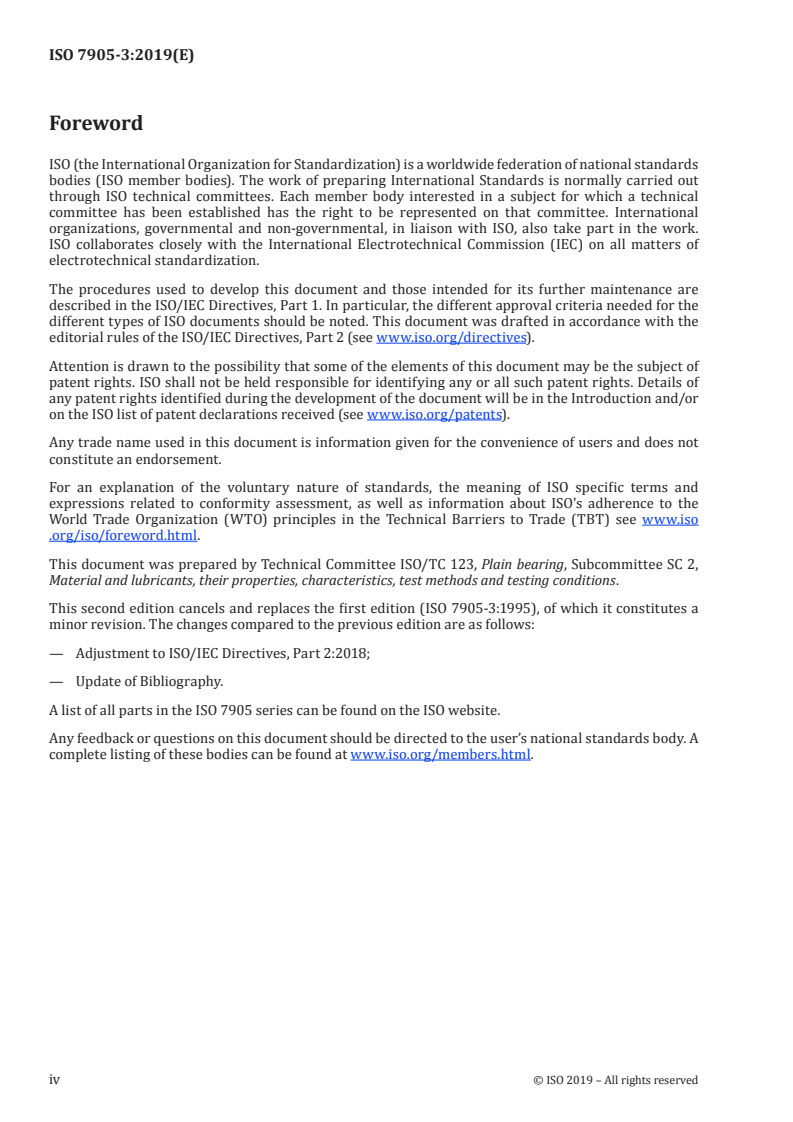
This second edition cancels and replaces the first edition (ISO 7905-3:1995), of which it constitutes a
minor revision. The changes compared to the previous edition are as follows:
— Adjustment to ISO/IEC Directives, Part 2:2018;
— Update of Bibliography.
A list of all parts in the ISO 7905 series can be found on the ISO website.
Any feedback or questions on this document should be directed to the u
...
INTERNATIONAL ISO
STANDARD 7905-3
Second edition
2019-04
Plain bearings — Bearing fatigue —
Part 3:
Test on plain strips of a metallic
multilayer bearing material
Paliers lisses — Fatigue des paliers —
Partie 3: Essai sur éprouvettes plates en matériau antifriction
métallique multicouche
Reference number
©
ISO 2019
© ISO 2019
All rights reserved. Unless otherwise specified, or required in the context of its implementation, no part of this publication may
be reproduced or utilized otherwise in any form or by any means, electronic or mechanical, including photocopying, or posting
on the internet or an intranet, without prior written permission. Permission can be requested from either ISO at the address
below or ISO’s member body in the country of the requester.
ISO copyright office
CP 401 • Ch. de Blandonnet 8
CH-1214 Vernier, Geneva
Phone: +41 22 749 01 11
Fax: +41 22 749 09 47
Email: copyright@iso.org
Website: www.iso.org
Published in Switzerland
ii © ISO 2019 – All rights reserved
Contents Page
Foreword .iv
1 Scope . 1
2 Normative references . 1
3 Terms and definitions . 1
4 Test specimens. 1
5 Test method . 2
6 Evaluation and presentation of test results . 3
Bibliography . 5
Foreword
ISO (the International Organization for Standardization) is a worldwide federation of national standards
bodies (ISO member bodies). The work of preparing International Standards is normally carried out
through ISO technical committees. Each member body interested in a subject for which a technical
committee has been established has the right to be represented on that committee. International
organizations, governmental and non-governmental, in liaison with ISO, also take part in the work.
ISO collaborates closely with the International Electrotechnical Commission (IEC) on all matters of
electrotechnical standardization.
The procedures used to develop this document and those intended for its further maintenance are
described in the ISO/IEC Directives, Part 1. In particular, the different approval criteria needed for the
different types of ISO documents should be noted. This document was drafted in accordance with the
editorial rules of the ISO/IEC Directives, Part 2 (see www .iso .org/directives).
Attention is drawn to the possibility that some of the elements of this document may be the subject of
patent rights. ISO shall not be held responsible for identifying any or all such patent rights. Details of
any patent rights identified during the development of the document will be in the Introduction and/or
on the ISO list of patent declarations received (see www .iso .org/patents).
Any trade name used in this document is information given for the convenience of users and does not
constitute an endorsement.
For an explanation of the voluntary nature of standards, the meaning of ISO specific terms and
expressions related to conformity assessment, as well as information about ISO's adherence to the
World Trade Organization (WTO) principles in the Technical Barriers to Trade (TBT) see www .iso
.org/iso/foreword .html.
This document was prepared by Technical Committee ISO/TC 123, Plain bearing, Subcommittee SC 2,
Material and lubricants, their properties, characteristics, test methods and testing conditions.
This second edition cancels and replaces the first edition (ISO 7905-3:1995), of which it constitutes a
minor revision. The changes compared to the previous edition are as follows:
— Adjustment to ISO/IEC Directives, Part 2:2018;
— Update of Bibliography.
A list of all parts in the ISO 7905 series can be found on the ISO website.
Any feedback or questions on this document should be directed to the u
...