


oSIST prEN IEC 62282-2-400:2026
(Main)Fuel cell technologies - Part 2-400: Fuel cell modules - Calculation of rated power and power density of a PEM stack and PEM module
General Information
- Abstract
- Status
- Not Published
- Public Enquiry End Date
- 30-Sep-2026
- Technical Committee
- I09 - Imaginarni 09
- Current Stage
- 4020 - Public enquire (PE) (Adopted Project)
- Start Date
- 04-Aug-2026
- Due Date
- 22-Dec-2026

Overview
oSIST prEN IEC 62282-2-400:2026 establishes standardized methods for determining the rated power and power density of proton exchange membrane (PEM) fuel cell stacks and PEM fuel cell modules. Developed by SIST in alignment with IEC standards, this document covers procedures to harmonize the calculation and reporting of key performance metrics for PEM fuel cell technologies. Standardizing the definition and measurement of rated power and power density ensures consistent, fair, and valid evaluation and comparison of different fuel cell stacks and modules, supporting market transparency and aiding system integrators and manufacturers.
Key Topics
Rated Power Calculation
The standard defines rated power as the maximum continuous electric power output a PEM fuel cell stack or module can achieve under normal operating conditions, as specified by the manufacturer. The calculation and verification require stabilized operation tests to ensure the mean output power meets or exceeds the declared rated power.Power Density Determination
Power density metrics are crucial for benchmarking PEM fuel cell performance. The standard covers:- Mass Power Density: The ratio of power (rated or maximum) to the dry mass of the stack or module.
- Volume Power Density: The ratio of power (rated or maximum) to the determined volume of the stack or module.
Test Preparation and Measurement Uncertainty
Proper test planning is emphasized, including documentation of test objects, operating conditions, data acquisition, and acceptance criteria. Measurement uncertainties are tightly controlled with clear tolerances for electrical, thermal, and flow variables to ensure data reliability.Standardized Test Conditions
Laboratory and operational environment parameters (temperature, humidity, pressure) are specified. The fuel (hydrogen) and oxidant (air) quality requirements, along with coolant conditions, must align with established standards and manufacturer specifications.Terminology and Symbols
The standard provides clear definitions for key terms-such as compressed cell row assembly, fuel cell stack, fuel cell module, rated power, maximum power, efficiency, and various power density indicators-supported by a comprehensive list of symbols and their meanings.
Applications
oSIST prEN IEC 62282-2-400:2026 applies to all PEM fuel cell stacks and modules, regardless of their specific technology type, including high-temperature PEM systems. Its calculation and test methods serve the following practical applications:
Performance Benchmarking:
Enables precise and comparable assessment of fuel cell stack and module performance, supporting procurement, R&D, and product positioning.System Integration:
Facilitates informed selection and integration of PEM fuel cell modules into diverse power system architectures by providing standardized power and density metrics.Certification and Compliance:
Provides a baseline for validating manufacturer claims in product datasheets, aiding regulatory compliance and certification processes.Manufacturing and Design Optimization:
Supports engineers and designers in the optimization of stack and module architecture by quantifying the impact of design changes on mass and volume power densities.
While the standard explicitly excludes fuel cell road vehicle applications, it can be adopted for most other stationary or portable fuel cell use cases as it addresses the core stack and module characteristics independently of specific end uses.
Related Standards
For comprehensive evaluation and integration of PEM fuel cells, consider these closely associated international standards:
- IEC 62282-2-100: General requirements for fuel cell modules, specifying safety, performance, and interface criteria.
- IEC 60050-485: International Electrotechnical Vocabulary-Fuel cell technologies.
- ISO 14687: Hydrogen fuel quality-Product specification.
- ISO 1183-1: Plastics-Methods for determining the density of non-cellular plastics, referenced for determining volume via immersion method.
- ISO 10303-42 / ISO 10360: Standards related to product data representation and coordinate measuring machine specifications, referenced for volume and dimensional verification.
- ISO TR 15916: Basic considerations for hydrogen handling in test preparation.
These standards, in conjunction with oSIST prEN IEC 62282-2-400:2026, form a robust framework for the standardized evaluation, certification, and deployment of PEM fuel cell technologies.
Keywords: fuel cell technologies, PEM stack, PEM module, rated power calculation, power density, mass power density, volume power density, fuel cell standard, SIST, IEC 62282-2-400, test method, performance benchmark, hydrogen energy, standardization.
Get Certified
Connect with accredited certification bodies for this standard

DNV
DNV is an independent assurance and risk management provider.

Lloyd's Register
Lloyd's Register is a global professional services organisation specialising in engineering and technology.
DNV Energy Systems
Energy and renewable energy certification.
Sponsored listings
Frequently Asked Questions
oSIST prEN IEC 62282-2-400:2026 is a draft published by the Slovenian Institute for Standardization (SIST). Its full title is "Fuel cell technologies - Part 2-400: Fuel cell modules - Calculation of rated power and power density of a PEM stack and PEM module". This standard covers: Fuel cell technologies - Part 2-400: Fuel cell modules - Calculation of rated power and power density of a PEM stack and PEM module
Fuel cell technologies - Part 2-400: Fuel cell modules - Calculation of rated power and power density of a PEM stack and PEM module
oSIST prEN IEC 62282-2-400:2026 is classified under the following ICS (International Classification for Standards) categories: 27.070 - Fuel cells. The ICS classification helps identify the subject area and facilitates finding related standards.
oSIST prEN IEC 62282-2-400:2026 is available in PDF format for immediate download after purchase. The document can be added to your cart and obtained through the secure checkout process. Digital delivery ensures instant access to the complete standard document.
Standards Content (Sample)
SLOVENSKI STANDARD
01-september-2026
Tehnologije gorivnih celic - 2-400. del: Moduli gorivnih celic - Izračun nazivne moči
in gostote moči sklopa PEM in modula PEM
Fuel cell technologies - Part 2-400: Fuel cell modules - Calculation of rated power and
power density of a PEM stack and PEM module
Ta slovenski standard je istoveten z: prEN IEC 62282-2-400:2026
ICS:
27.070 Gorilne celice Fuel cells
2003-01.Slovenski inštitut za standardizacijo. Razmnoževanje celote ali delov tega standarda ni dovoljeno.
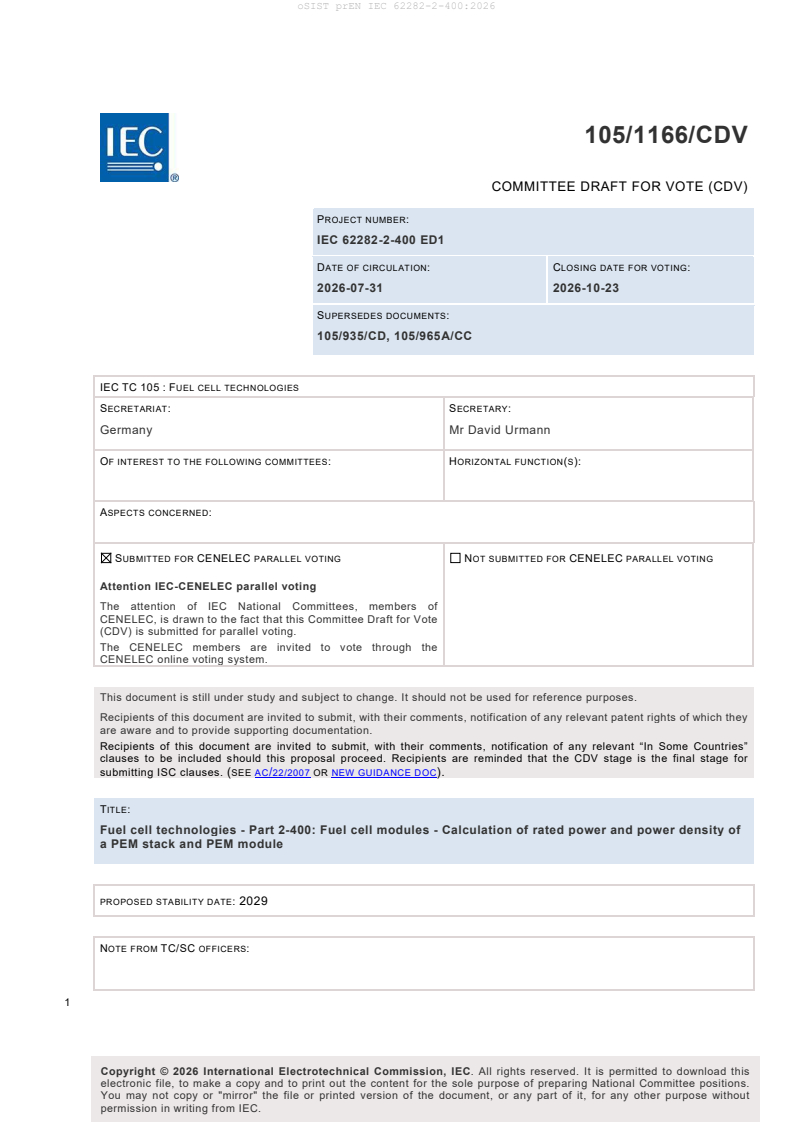
105/1166/CDV
COMMITTEE DRAFT FOR VOTE (CDV)
PROJECT NUMBER:
IEC 62282-2-400 ED1
DATE OF CIRCULATION: CLOSING DATE FOR VOTING:
2026-07-31 2026-10-23
SUPERSEDES DOCUMENTS:
105/935/CD, 105/965A/CC
IEC TC 105 : FUEL CELL TECHNOLOGIES
SECRETARIAT: SECRETARY:
Germany Mr David Urmann
OF INTEREST TO THE FOLLOWING COMMITTEES: HORIZONTAL FUNCTION(S):
ASPECTS CONCERNED:
SUBMITTED FOR CENELEC PARALLEL VOTING NOT SUBMITTED FOR CENELEC PARALLEL VOTING
Attention IEC-CENELEC parallel voting
The attention of IEC National Committees, members of
CENELEC, is drawn to the fact that this Committee Draft for Vote
(CDV) is submitted for parallel voting.
The CENELEC members are invited to vote through the
CENELEC online voting system.
This document is still under study and subject to change. It should not be used for reference purposes.
Recipients of this document are invited to submit, with their comments, notification of any relevant patent rights of which they
are aware and to provide supporting documentation.
Recipients of this document are invited to submit, with their comments, notification of any relevant “In Some Countries”
clauses to be included should this proposal proceed. Recipients are reminded that the CDV stage is the final stage for
submitting ISC clauses. (SEE AC/22/2007 OR NEW GUIDANCE DOC).
TITLE:
Fuel cell technologies - Part 2-400: Fuel cell modules - Calculation of rated power and power density of
a PEM stack and PEM module
PROPOSED STABILITY DATE: 2029
NOTE FROM TC/SC OFFICERS:
electronic file, to make a copy and to print out the content for the sole purpose of preparing National Committee positions.
You may not copy or "mirror" the file or printed version of the document, or any part of it, for any other purpose without
permission in writing from IEC.
IEC CDV 62282-2-400 © IEC 2026 105/1166/CDV
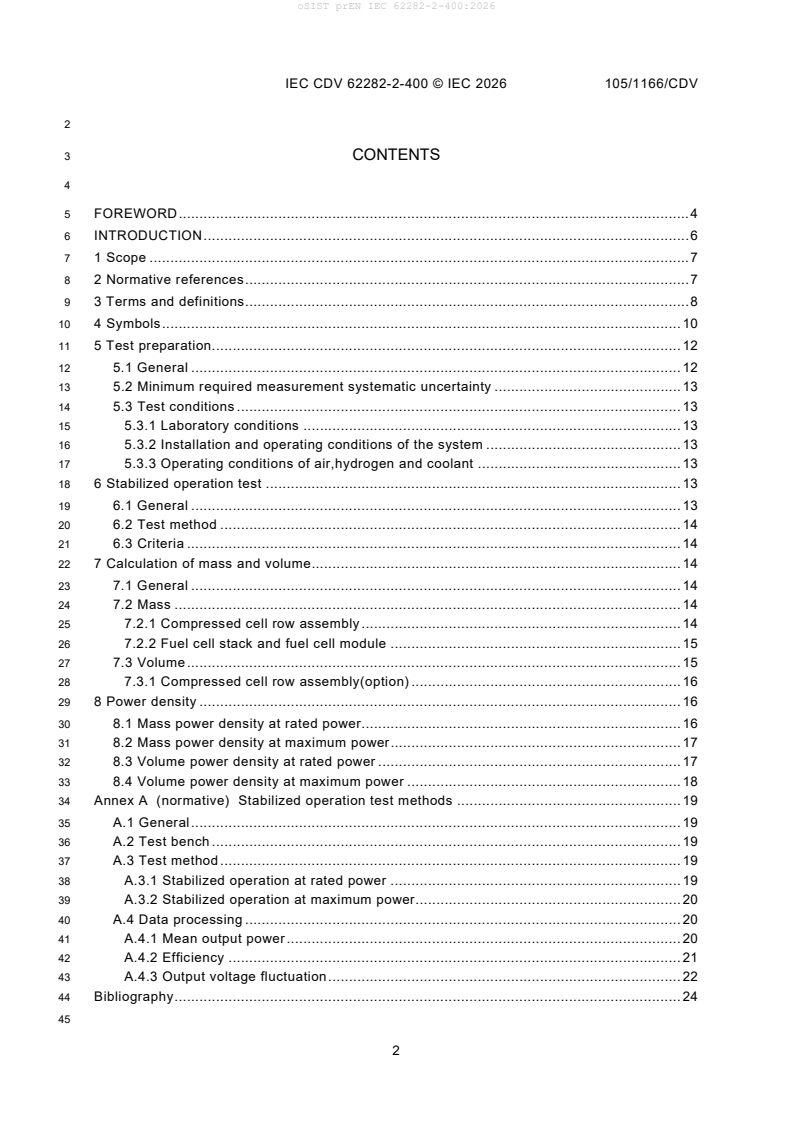
3 CONTENTS
5 FOREWORD . 4
6 INTRODUCTION . 6
7 1 Scope . 7
8 2 Normative references . 7
9 3 Terms and definitions . 8
10 4 Symbols . 10
11 5 Test preparation. 12
12 5.1 General . 12
13 5.2 Minimum required measurement systematic uncertainty . 13
14 5.3 Test conditions . 13
15 5.3.1 Laboratory conditions . 13
16 5.3.2 Installation and operating conditions of the system . 13
17 5.3.3 Operating conditions of air,hydrogen and coolant . 13
18 6 Stabilized operation test . 13
19 6.1 General . 13
20 6.2 Test method . 14
21 6.3 Criteria . 14
22 7 Calculation of mass and volume . 14
23 7.1 General . 14
24 7.2 Mass . 14
25 7.2.1 Compressed cell row assembly . 14
26 7.2.2 Fuel cell stack and fuel cell module . 15
27 7.3 Volume . 15
28 7.3.1 Compressed cell row assembly(option) . 16
29 8 Power density . 16
30 8.1 Mass power density at rated power. 16
31 8.2 Mass power density at maximum power . 17
32 8.3 Volume power density at rated power . 17
33 8.4 Volume power density at maximum power . 18
34 Annex A (normative) Stabilized operation test methods . 19
35 A.1 General . 19
36 A.2 Test bench . 19
37 A.3 Test method . 19
38 A.3.1 Stabilized operation at rated power . 19
39 A.3.2 Stabilized operation at maximum power . 20
40 A.4 Data processing . 20
41 A.4.1 Mean output power . 20
42 A.4.2 Efficiency . 21
43 A.4.3 Output voltage fluctuation . 22
44 Bibliography . 24
105/1066/CDV IEC CDV 62282-2-400 © IEC 2026
46 Figure 1 – Fuel cell power system components . 7
47 Figure 2 – Examples of a start-up and go operational test . 15
48 Figure 3 – Exploded view of cell area . 15
49 Figure A.1 – Example of a test station setup for fuel cell stack or fuel cell module . 19
51 Table 1 – Symbols and their meanings. 10
52 Table A.1 – High dynamic standard load profile . 20
IEC CDV 62282-2-400 © IEC 2026 105/1166/CDV
54 INTERNATIONAL ELECTROTECHNICAL COMMISSION
55 ____________
57 FUEL CELL TECHNOLOGIES – Part 2-400: Fuel cell modules –
58 Calculation of Rated Power and Power Density of a PEM stack and PEM
59 module
61 FOREWORD
62 1) The International Electrotechnical Commission (IEC) is a worldwide organization for standardization comprising
63 all national electrotechnical committees (IEC National Committees). The object of IEC is to promote international
64 co-operation on all questions concerning standardization in the electrical and electronic fields. To this end and
65 in addition to other activities, IEC publishes International Standards, Technical Specifications, Technical Reports,
66 Publicly Available Specifications (PAS) and Guides (hereafter referred to as "IEC Publication(s)"). Their
67 preparation is entrusted to technical committees; any IEC National Committee interested in the subject dealt with
68 may participate in this preparatory work. International, governmental and non-governmental organizations liaising
69 with the IEC also participate in this preparation. IEC collaborates closely with the International Organization for
70 Standardization (ISO) in accordance with conditions determined by agreement between the two organizations.
71 2) The formal decisions or agreements of IEC on technical matters express, as nearly as possible, an international
72 consensus of opinion on the relevant subjects since each technical committee has representation from all
73 interested IEC National Committees.
74 3) IEC Publications have the form of recommendations for international use and are accepted by IEC National
75 Committees in that sense. While all reasonable efforts are made to ensure that the technical content of IEC
76 Publications is accurate, IEC cannot be held responsible for the way in which they are used or for any
77 misinterpretation by any end user.
78 4) In order to promote international uniformity, IEC National Committees undertake to apply IEC Publications
79 transparently to the maximum extent possible in their national and regional publications. Any divergence between
80 any IEC Publication and the corresponding national or regional publication shall be clearly indicated in the latter.
81 5) IEC itself does not provide any attestation of conformity. Independent certification bodies provide conformity
82 assessment services and, in some areas, access to IEC marks of conformity. IEC is not responsible for any
83 services carried out by independent certification bodies.
84 6) All users should ensure that they have the latest edition of this publication.
85 7) No liability shall attach to IEC or its directors, employees, servants or agents including individual experts and
86 members of its technical committees and IEC National Committees for any personal injury, property damage or
87 other damage of any nature whatsoever, whether direct or indirect, or for costs (including legal fees) and
88 expenses arising out of the publication, use of, or reliance upon, this IEC Publication or any other IEC
89 Publications.
90 8) Attention is drawn to the Normative references cited in this publication. Use of the referenced publications is
91 indispensable for the correct application of this publication.
92 9) IEC draws attention to the possibility that the implementation of this document may involve the use of (a)
93 patent(s). IEC takes no position concerning the evidence, validity or applicability of any claimed patent rights in
94 respect thereof. As of the date of publication of this document, IEC had not received notice of (a) patent(s), which
95 may be required to implement this document. However, implementers are cautioned that this may not represent
96 the latest information, which may be obtained from the patent database available at https://patents.iec.ch. IEC
97 shall not be held responsible for identifying any or all such patent rights.
98 IEC 62282-4-200 has been prepared by IEC Technical Committee 105: Fuel cell technologies.
99 It is an International Standard.
100 The text of this International Standard is based on the following documents:
Draft Report on voting
105/XX/FDIS 105/XX/RVD
102 Full information on the voting for its approval can be found in the report on voting indicated in
103 the above table.
104 The language used for the development of this International Standard is English.
105/1066/CDV IEC CDV 62282-2-400 © IEC 2026
105 This document was drafted in accordance with ISO/IEC Directives, Part 2, and developed in
106 accordance with ISO/IEC Directives, Part 1 and ISO/IEC Directives, IEC Supplement, available
107 at www.iec.ch/members_experts/refdocs. The main document types developed by IEC are
108 described in greater detail at www.iec.ch/publications.
109 A list of all parts in the IEC 62282 series, published under the general title FUEL CELL
110 TECHNOLOGIES can be found on the IEC website.
111 The committee has decided that the contents of this document will remain unchanged until the
112 stability date indicated on the IEC website under webstore.iec.ch in the data related to the
113 specific document. At this date, the document will be
114 • reconfirmed,
115 • withdrawn, or
116 • revised.
IEC CDV 62282-2-400 © IEC 2026 105/1166/CDV
118 INTRODUCTION
119 It is essential to define the rated power of fuel cell stacks and modules, as well as to calculate
120 their volume and mass. This ensures complete and rigorous definition of system boundaries,
121 thereby avoiding unreasonable calculation practices such as adopting maximum power output
122 values paired with minimum stack volume parameters.
123 For this reason, harmonised definitions of rated power and volume/mass power density are
124 highly market-relevant. Such harmonisation facilitates a better understanding of stack and
125 module performance and enables fair, valid comparative evaluation, which is particularly
126 beneficial for system integrators.
127 The purpose of this document is to harmonise the calculation methods for the rated power and
128 power density of PEM fuel cell stacks and modules. It applies exclusively to proton exchange
129 membrane (PEM) fuel cell stacks and modules.
130 Although this document excludes fuel cell road vehicle applications, this standard may be
131 applicable to all other fuel cell applications, as it solely addresses stack and module
132 performance irrespective of the intended use case.
133 This document is not intended to restrict technological development. Any appliance using
134 materials or construction methods different from those specified herein may be assessed and
135 tested against the intent of these requirements. Where substantial equivalence is demonstrated,
136 the appliance shall be deemed compliant with this document.
105/1066/CDV IEC CDV 62282-2-400 © IEC 2026
137 FUEL CELL TECHNOLOGIES – Part 2-400: Fuel cell modules –
138 Calculation of Rated Power and Power Density of a PEM stack and PEM
139 module
141 1 Scope
142 This document specifies methods for calculating the rated power and power density of PEM fuel cell
143 stacks and modules.
144 To supply power to an application, the stack or module shall be integrated within a fuel cell
145 power system, as illustrated in Figure 1 in accordance with IEC 62282-2-100:2020.
146 This document applies to all PEM fuel cells, irrespective of their application and PEM technology
147 type, including high-temperature PEM fuel cells.
149 Figure 1 – Fuel cell power system components
150 Fuel cell modules may be fitted with or without enclosures, and can operate at substantial
151 pressurisation levels or near ambient pressure.
152 Since peripheral devices affect the net power output of the fuel cell power system, this standard
153 focuses on the stack and module in their standalone state prior to such peripheral influences,
154 as illustrated in Figure 1.
155 This document excludes the storage and delivery of fuel and oxidant to the fuel cell module.
156 2 Normative references
157 The following documents are referred to in the text in such a way that some or all of their content
158 constitutes requirements of this document. For dated references, only the edition cited applies.
IEC CDV 62282-2-400 © IEC 2026 105/1166/CDV
159 For undated references, the latest edition of the referenced document (including any
160 amendments) applies.
161 ISO1183-1,Plastics — Methods for determining the density of non-cellular plastics 一 Plastics —
162 Methods for determining the density of non-cellular plastics
163 ISO 10303-42,Industrial automation systems and integration — Product data representation and
164 exchange - Part 42: Integrated generic resource: Geometric and topological representation
165 ISO 10360 (all part),Geometrical product specifications(GPS) - Acceptance and reverification tests for
166 coordinate measuring machines(CMM)
167 ISO 14687:2025 ,Hydrogen fuel quality - Product specification
168 3 Terms and definitions
169 For the purposes of this document, the following terms and definitions apply.
170 ISO and IEC maintain terminology databases for use in standardization at the following
171 addresses:
172 • IEC Electropedia: available at http://www.electropedia.org/
173 • ISO Online browsing platform: available at http://www.iso.org/obp
174 3.1
175 Compressed cell row assembly
176 assembly of all successive MEAs and bipolar plates(include gas seal) compressed in the fuel cell
177 stack
178 Note 1 to entry: The compressed cell row assembly includes all dummy cell in the fuel cell stack.
179 Note 2 to entry: See figure 2.
180 3.2
181 fuel cell stack
182 assembly of cells, separators, cooling plates, manifolds and a supporting structure that
183 electrochemically converts, typically, hydrogen-rich gas and air reactants to DC power, heat
184 and other reaction products
185 [SOURCE: IEC 60050-485:2020, 485-06-01]
186 3.3
187 fuel cell module
188 assembly incorporating one or more fuel cell stacks and, if applicable, additional components,
189 that is intended to be integrated into a power system or a vehicle
190 Note 1 to entry: A fuel cell module comprises the following main components: one or more fuel cell stack(s), a
191 piping system for conveying fuels, oxidants and exhausts, electric connections for the power delivered by the
192 stack(s), and means for monitoring, control or both. Additionally, a fuel cell module can comprise: means for
193 conveying additional fluids (e.g. cooling media, inert gas), means for detecting normal and abnormal operating
194 conditions, enclosures or pressure vessels and module ventilation systems, and the required electronic
195 components for module operation and power conditioning.
196 [SOURCE: IEC 60050-485:2020, 485-09-03]
197 3.4
198 Rated power
199 maximum continuous electric power output that a fuel cell stack or a fuel cell module is designed
200 to achieve under normal operating conditions specified by the manufacturer
201 Note 1 to entry: The rated power is expressed in W.
105/1066/CDV IEC CDV 62282-2-400 © IEC 2026
202 [SOURCE: IEC 60050-485:2020, 485-09-01, modified – “a fuel cell power system”has been
203 replaced with“a fuel cell stack or a fuel cell module]
204 3.5
205 Rated current
206 maximum continuous electric current as specified by the manufacturer, at which the fuel cell
207 stack or the fuel cell module has been designed to operate
208 Note 1 to entry: the rated current is expressed in A.
209 [SOURCE: IEC 60050-485:2020, 485-12-02, modified –“a fuel cell power system”has been
210 replaced with“a fuel cell stack or a fuel cell module]
211 3.6
212 Maximum power
213 maximum electric power output that a fuel cell stack or a fuel cell module can be operated
214 specified by the manufacturer
215 Note 1 to entry: Maximum power can be higher than rated power.
216 [SOURCE: IEC 63341-3:2025, 3.1.7, modified –“a fuel cell power system”has been replaced
217 with“a fuel cell stack or a fuel cell module;” specified by the manufacturer”has been added.]
218 3.7
219 Maximum current
220 maximum electric current output that a fuel cell stack or a fuel cell module can be operated
221 specified by the manufacturer
222 Note 1 to entry: Maximum current can be higher than rated current.
223 3.8
224 Output power
225 power generated by the fuel cell stack or the fuel cell module and available for external use
226 [SOURCE: IEC 63341-3:2025, 3.1.9, modified –“the fuel cell power system”has been replaced
227 with“the fuel cell stack or the fuel cell module;The note 1 to entry has been deleted;The note 2
228 to entry has been deleted.]
229 3.9
230 Efficiency
231 ratio of the mean single cell output voltage of a fuel cell stack or a fuel cell module to 1.254.
232 3.10
233 Mass power density
234 ratio of the rated power or maximum power to the dry mass of a compressed cell row assembly,
235 fuel cell stack or fuel cell module
236 3.11
237 Volume power density
238 ratio of the rated power or maximum power to the volume of a compressed cell row assembly,
239 a fuel cell stack or a fuel cell module
240 3.12
241 Steady state
242 state of a physical system in which the relevant characteristics remain constant with time
243 [SOURCE: IEC 60050-485:2020, 485-21-05]
IEC CDV 62282-2-400 © IEC 2026 105/1166/CDV
244 3.13
245 Cell area
246 outer contour projected area of a single cell perpendicular to the direction of current flow
247 Note 1 to entry: See Figure 3.
248 [SOURCE: IEC 60050-485:2020, 485-05-04, modified –”outer contour” has been add before
249 “Geometric”;The note 1 to entry has been deleted]
250 3.14
251 conditioning
252 preliminary step that is required to properly operate a fuel cell to achieve a desired performance
253 following a protocol specified by the manufacturer
254 Note 1 to entry: The conditioning can include reversible processes, or irreversible processes, or both depending on
255 the cell technology.
256 [SOURCE: IEC 60050-485:2020, 485-11-08]
257 4 Symbols
258 Table 1 lists the symbols and their meanings used in this document to represent the electrical
259 performance in the appropriate units.
260 Table 1 – Symbols and their meanings
Symbols Definition Unit
mass of compressed cell row assembly
M kg
RCA
quantity of bipolar plate included in compressed cell row assembly
n
mass of a bipolar plat
M kg
BP
quantity of MEA included dummy cell in compressed cell row assembly
m
mass of a MEA
M kg
GS
volume of compressed cell row assembly
V L
RCA
cell area 2
S dm
CA
distance between the two end plates of fuel cell stack
dm
L
EP
mass power density of compressed cell row assembly at rated power
PD W/kg
m,Rated,RCA
mass power density of fuel cell stack at rated power
PD W/kg
m,Rated,FCS
mass power density of fuel cell module at rated power
PD W/kg
m,Rated,FCM
rated power of fuel cell stack
P W
rated,FCS
rated power of fuel cell module
P W
rated,FCM
mass of fuel cell stack
M kg
FCS
mass of fuel cell module
M kg
FCM
mass power density of compressed cell row assembly at maximum power
PD W/kg
m,max,RCA
105/1066/CDV IEC CDV 62282-2-400 © IEC 2026
Symbols Definition Unit
mass power density of fuel cell stack at maximum power
PD
W/kg
m,max,FCS
mass power density of fuel cell module at maximum power
PD
W/kg
m,max,FCM
maximum power of fuel cell stack
P
W
max,FCS
maximum power of fuel cell module
P
W
max,FCM
volume power density of compressed cell row assembly at rated power
PD
W/L
v,Rated,RCA
volume power de
...