


SIST EN 17122:2020+A1:2025
(Main)Chemical disinfectants and antiseptics - Quantitative non-porous surface test for the evaluation of virucidal activity of chemical disinfectants and antiseptics used in the veterinary area - Test method and requirements - Phase2, step2
Chemical disinfectants and antiseptics - Quantitative non-porous surface test for the evaluation of virucidal activity of chemical disinfectants and antiseptics used in the veterinary area - Test method and requirements - Phase2, step2
This European Standard specifies a test method and the minimum requirements for virucidal activity of chemical disinfectant and antiseptic products that form a homogeneous physically stable preparation when diluted with hard water, or - in the case of ready-to-use-products - with water.
This European Standard applies to products that are used in the veterinary area on non-porous surfaces without mechanical action i.e. in the breeding, husbandry, production, veterinary care facilities, transport and disposal of all animals except when in the food chain following death and entry to the processing industry.
EN 14885 specifies in detail the relationship of the various tests to one another and to "use recommendations".
NOTE 1 The method described is intended to determine the activity of commercial formulations or active substances under the conditions in which they are used.
NOTE 2 This method corresponds to a Phase 2 Step 2 test.
NOTE 3 Using this European Standard, it is possible to determine the virucidal activity of the undiluted product.
NOTE 4 This standard uses Porcine Parvovirus because Bovine Enterovirus Type 1 (ECBO) virus used in the suspension test EN 14675 cannot be used for surface testing because of its loss of titre during drying. Porcine
Parvovirus has comparable resistance to ECBO virus.
Chemische Desinfektionsmittel und Antiseptika - Quantitativer Oberflächenversuch zur Bestimmung der viruziden Wirkung chemischer Desinfektionsmittel und Antiseptika für den Veterinärbereich auf nicht-porösen Oberflächen - Prüfverfahren und Anforderungen - Phase 2, Stufe 2
Dieses Dokument legt ein Prüfverfahren für und die Mindestanforderungen an die viruzide Wirkung von chemischen Desinfektionsmitteln fest, die bei Verdünnung mit Wasser standardisierter Härte oder – im Falle gebrauchsfertiger Produkte – mit Wasser als homogene und physikalisch stabile Zubereitung vorliegen.
Dieses Dokument ist anwendbar für Produkte, die ohne mechanische Einwirkung zur Desinfektion von nicht porösen Oberflächen im Veterinärbereich verwendet werden, d. h. bei der Aufzucht, Haltung, Produktion, in veterinärmedizinischen Gesundheitseinrichtungen und beim Transport von Tieren sowie bei der Tierkörperbeseitigung, außer wenn die Tiere nach der Tötung durch Zuführung in die weiterverarbeitende Industrie in die Lebensmittelkette gelangen.
EN 14885 legt im Einzelnen die Beziehung der verschiedenen Prüfungen untereinander sowie zu den „Anwendungsempfehlungen“ fest.
ANMERKUNG 1 Das beschriebene Verfahren ist zur Bestimmung der Wirkung von handelsüblichen Zubereitungen oder Wirkstoffen unter deren Anwendungsbedingungen vorgesehen.
ANMERKUNG 2 Dieses Verfahren entspricht einer Prüfung der Phase 2, Stufe 2.
ANMERKUNG 3 Bei Anwendung dieses Dokuments ist es möglich, die viruzide Wirkung des unverdünnten Produkts zu bestimmen.
ANMERKUNG 4 Für dieses Dokument wird das Porzine Parvovirus verwendet, da das für den Suspensionsversuch EN 14675 eingesetzte Bovine Enterovirus E [(früher Bovine Enterovirus Typ 1 (ECBO)] aufgrund der Abnahme des Virentiters beim Trocknen nicht für Oberflächenprüfungen verwendet werden kann. Das Porzine Parvovirus und das ECBO-Virus weisen eine vergleichbare Resistenz auf.
Antiseptiques et désinfectants chimiques - Essai quantitatif de surfaces non poreuses pour l'évaluation de l'activité virucide des désinfectants et antiseptiques chimiques utilisés dans le domaine vétérinaire - Méthode d'essai et prescriptions - Phase 2, étape 2
Kemična razkužila in antiseptiki - Kvantitativni preskus na neporoznih površinah za vrednotenje virucidnega delovanja kemičnih razkužil in antiseptikov v veterini - Preskusna metoda in zahteve (faza 2, stopnja 2) (vključno z dopolnilom A1)
Ta dokument določa preskusno metodo in minimalne zahteve za virucidno delovanje kemičnih razkužil, ki tvorijo homogen, fizikalno stabilen pripravek, če so razredčena s trdo vodo oziroma z vodo pri izdelkih, ki so pripravljeni za uporabo.
Ta dokument se uporablja za izdelke, ki se v veterini uporabljajo za razkuževanje neporoznih površin brez mehanskega delovanja, tj. pri vzreji, živinoreji, proizvodnji, v veterinarskih ambulantah, pri prevozu in odstranjevanju vseh živali, razen če so v prehrambeni verigi po smrti in so del predelovalne industrije.
Standard EN 14885 podrobno določa razmerje med različnimi preskusi in priporočili za uporabo.
OPOMBA 1: Opisana metoda je namenjena določevanju dejavnosti komercialnih oblik ali aktivnih snovi pod pogoji, v katerih se uporabljajo.
OPOMBA 2: Ta metoda ustreza 2. stopnji preskusa faze 2.
OPOMBA 3: S tem dokumentom je mogoče določiti virucidno delovanje kemičnih razkužil pri nerazredčenem izdelku.
OPOMBA 4: V tem dokumentu je uporabljen prašičji parvovirus, saj govejega enterovirusa E (prejšnji goveji enterovirus tipa 1 (ECBO)), ki je uporabljen v preskusu suspenzije v okviru standarda EN 14675, ni mogoče uporabiti za površinsko preskušanje zaradi izgube titra med sušenjem. Prašičji parvovirus ima primerljivo odpornost na goveji enterovirus tipa 1.
General Information
- Status
- Published
- Publication Date
- 28-Jan-2025
- Technical Committee
- KDS - Cosmetics, chemical disinfectants and surface active agents
- Current Stage
- 6060 - National Implementation/Publication (Adopted Project)
- Start Date
- 28-Jan-2025
- Due Date
- 04-Apr-2025
- Completion Date
- 29-Jan-2025
Relations
- Effective Date
- 01-Mar-2025
- Effective Date
- 01-Mar-2025
Overview
EN 17122:2019+A1:2024 is a CEN European Standard that specifies a quantitative non‑porous surface test (Phase 2, Step 2) to evaluate the virucidal activity of chemical disinfectants and antiseptics used in the veterinary area. The method simulates practical application on non‑porous surfaces (without mechanical action) in settings such as breeding, husbandry, production, veterinary care, transport and disposal of animals (excluding carcasses entering the food‑processing chain). The standard includes Amendment A1 (2024) that harmonises terminology and clarifies methods without changing test outcomes.
Key topics and technical requirements
- Scope: Products that form a homogeneous, physically stable preparation when diluted with hard water or ready‑to‑use products diluted with water.
- Test organisms:
- Porcine Parvovirus (strain NADL2) - non‑enveloped DNA virus (used because ECBO loses titre on drying).
- Feline Coronavirus (strain Munich) - enveloped RNA virus.
- Minimum efficacy: At least a 3 log10 (≥99.9%) reduction in virus titre for both parvovirus and coronavirus under defined test conditions.
- Test conditions:
- Temperatures: minimum 10 °C ±1 °C; additional options 4 °C, 20 °C, 40 °C.
- Contact times: minimum 1 min (±5 s); other times include 5, 15, 30, 60 min (and up to 120 min max).
- Interfering substances (soiling): low level - 3.0 g/L bovine albumin; high level - 10 g/L yeast extract + 10 g/L bovine albumin.
- Method outline: Inoculate surface with virus + interfering substance, dry, apply product to cover film, maintain specified temperature/time, neutralize immediately by transfer to maintenance medium, and determine residual virus titre. Compare to hard‑water control to calculate log reduction.
- Additional: The method can determine activity of undiluted products and allows testing at extra conditions or with additional viruses for specific uses.
Applications and users
This standard is essential for:
- Disinfectant manufacturers validating virucidal claims for veterinary formulations.
- Independent testing laboratories performing regulatory and product performance testing.
- Veterinary hygiene officers, farm managers, and infection control teams selecting effective surface disinfectants for animal facilities.
- Regulatory authorities and procurement specialists assessing compliance with European test methods and use recommendations.
Practical benefits include reproducible, comparable surface efficacy data that reflect realistic use conditions (temperature, soiling, contact time).
Related standards
- EN 14675 - Quantitative suspension test for virucidal activity (Phase 2, Step 1)
- EN 14885 - Application of European Standards for chemical disinfectants and antiseptics (use recommendations)
- EN 12353 - Preservation of test organisms
- EN 10088 series - Stainless steels (materials for apparatus)
Keywords: EN 17122:2019+A1:2024, chemical disinfectants, antiseptics, virucidal activity, veterinary surface test, Phase 2 Step 2, Porcine Parvovirus, Feline Coronavirus.

Frequently Asked Questions
SIST EN 17122:2020+A1:2025 is a standard published by the Slovenian Institute for Standardization (SIST). Its full title is "Chemical disinfectants and antiseptics - Quantitative non-porous surface test for the evaluation of virucidal activity of chemical disinfectants and antiseptics used in the veterinary area - Test method and requirements - Phase2, step2". This standard covers: This European Standard specifies a test method and the minimum requirements for virucidal activity of chemical disinfectant and antiseptic products that form a homogeneous physically stable preparation when diluted with hard water, or - in the case of ready-to-use-products - with water. This European Standard applies to products that are used in the veterinary area on non-porous surfaces without mechanical action i.e. in the breeding, husbandry, production, veterinary care facilities, transport and disposal of all animals except when in the food chain following death and entry to the processing industry. EN 14885 specifies in detail the relationship of the various tests to one another and to "use recommendations". NOTE 1 The method described is intended to determine the activity of commercial formulations or active substances under the conditions in which they are used. NOTE 2 This method corresponds to a Phase 2 Step 2 test. NOTE 3 Using this European Standard, it is possible to determine the virucidal activity of the undiluted product. NOTE 4 This standard uses Porcine Parvovirus because Bovine Enterovirus Type 1 (ECBO) virus used in the suspension test EN 14675 cannot be used for surface testing because of its loss of titre during drying. Porcine Parvovirus has comparable resistance to ECBO virus.
This European Standard specifies a test method and the minimum requirements for virucidal activity of chemical disinfectant and antiseptic products that form a homogeneous physically stable preparation when diluted with hard water, or - in the case of ready-to-use-products - with water. This European Standard applies to products that are used in the veterinary area on non-porous surfaces without mechanical action i.e. in the breeding, husbandry, production, veterinary care facilities, transport and disposal of all animals except when in the food chain following death and entry to the processing industry. EN 14885 specifies in detail the relationship of the various tests to one another and to "use recommendations". NOTE 1 The method described is intended to determine the activity of commercial formulations or active substances under the conditions in which they are used. NOTE 2 This method corresponds to a Phase 2 Step 2 test. NOTE 3 Using this European Standard, it is possible to determine the virucidal activity of the undiluted product. NOTE 4 This standard uses Porcine Parvovirus because Bovine Enterovirus Type 1 (ECBO) virus used in the suspension test EN 14675 cannot be used for surface testing because of its loss of titre during drying. Porcine Parvovirus has comparable resistance to ECBO virus.
SIST EN 17122:2020+A1:2025 is classified under the following ICS (International Classification for Standards) categories: 11.080.20 - Disinfectants and antiseptics; 11.220 - Veterinary medicine. The ICS classification helps identify the subject area and facilitates finding related standards.
SIST EN 17122:2020+A1:2025 has the following relationships with other standards: It is inter standard links to SIST EN 17122:2020, SIST EN 17122:2020/kFprA1:2024. Understanding these relationships helps ensure you are using the most current and applicable version of the standard.
SIST EN 17122:2020+A1:2025 is available in PDF format for immediate download after purchase. The document can be added to your cart and obtained through the secure checkout process. Digital delivery ensures instant access to the complete standard document.
Standards Content (Sample)
SLOVENSKI STANDARD
01-marec-2025
Nadomešča:
SIST EN 17122:2020
Kemična razkužila in antiseptiki - Kvantitativni preskus na neporoznih površinah
za vrednotenje virucidnega delovanja kemičnih razkužil in antiseptikov v veterini -
Preskusna metoda in zahteve (faza 2, stopnja 2) (vključno z dopolnilom A1)
Chemical disinfectants and antiseptics - Quantitative non-porous surface test for the
evaluation of virucidal activity of chemical disinfectants and antiseptics used in the
veterinary area - Test method and requirements - Phase2, step2
Chemische Desinfektionsmittel und Antiseptika - Quantitativer Oberflächenversuch zur
Bestimmung der viruziden Wirkung chemischer Desinfektionsmittel und Antiseptika für
den Veterinärbereich auf nicht-porösen Oberflächen - Prüfverfahren und Anforderungen
- Phase 2, Stufe 2
Antiseptiques et désinfectants chimiques - Essai quantitatif de surfaces non poreuses
pour l'évaluation de l'activité virucide des désinfectants et antiseptiques chimiques
utilisés dans le domaine vétérinaire - Méthode d'essai et prescriptions - Phase 2, étape 2
Ta slovenski standard je istoveten z: EN 17122:2019+A1:2024
ICS:
11.080.20 Dezinfektanti in antiseptiki Disinfectants and antiseptics
11.220 Veterinarstvo Veterinary medicine
2003-01.Slovenski inštitut za standardizacijo. Razmnoževanje celote ali delov tega standarda ni dovoljeno.
EN 17122:2019+A1
EUROPEAN STANDARD
NORME EUROPÉENNE
December 2024
EUROPÄISCHE NORM
ICS 11.080.20 Supersedes EN 17122:2019
English Version
Chemical disinfectants and antiseptics - Quantitative non-
porous surface test for the evaluation of virucidal activity
of chemical disinfectants and antiseptics used in the
veterinary area - Test method and requirements - Phase2,
step2
Antiseptiques et désinfectants chimiques - Essai Chemische Desinfektionsmittel und Antiseptika -
quantitatif de surfaces non poreuses pour l'évaluation Quantitativer Oberflächenversuch zur Bestimmung der
de l'activité virucide des désinfectants et antiseptiques viruziden Wirkung chemischer Desinfektionsmittel
chimiques utilisés dans le domaine vétérinaire - und Antiseptika für den Veterinärbereich auf nicht-
Méthode d'essai et prescriptions - Phase 2, étape 2 porösen Oberflächen - Prüfverfahren und
Anforderungen - Phase 2, Stufe 2
This European Standard was approved by CEN on 23 September 2019 and includes Amendment 1 approved by CEN on 25
November 2024.
CEN members are bound to comply with the CEN/CENELEC Internal Regulations which stipulate the conditions for giving this
European Standard the status of a national standard without any alteration. Up-to-date lists and bibliographical references
concerning such national standards may be obtained on application to the CEN-CENELEC Management Centre or to any CEN
member.
This European Standard exists in three official versions (English, French, German). A version in any other language made by
translation under the responsibility of a CEN member into its own language and notified to the CEN-CENELEC Management
Centre has the same status as the official versions.
CEN members are the national standards bodies of Austria, Belgium, Bulgaria, Croatia, Cyprus, Czech Republic, Denmark, Estonia,
Finland, France, Germany, Greece, Hungary, Iceland, Ireland, Italy, Latvia, Lithuania, Luxembourg, Malta, Netherlands, Norway,
Poland, Portugal, Republic of North Macedonia, Romania, Serbia, Slovakia, Slovenia, Spain, Sweden, Switzerland, Türkiye and
United Kingdom.
EUROPEAN COMMITTEE FOR STANDARDIZATION
COMITÉ EUROPÉEN DE NORMALISATION
EUROPÄISCHES KOMITEE FÜR NORMUNG
CEN-CENELEC Management Centre: Rue de la Science 23, B-1040 Brussels
© 2024 CEN All rights of exploitation in any form and by any means reserved Ref. No. EN 17122:2019+A1:2024 E
worldwide for CEN national Members.
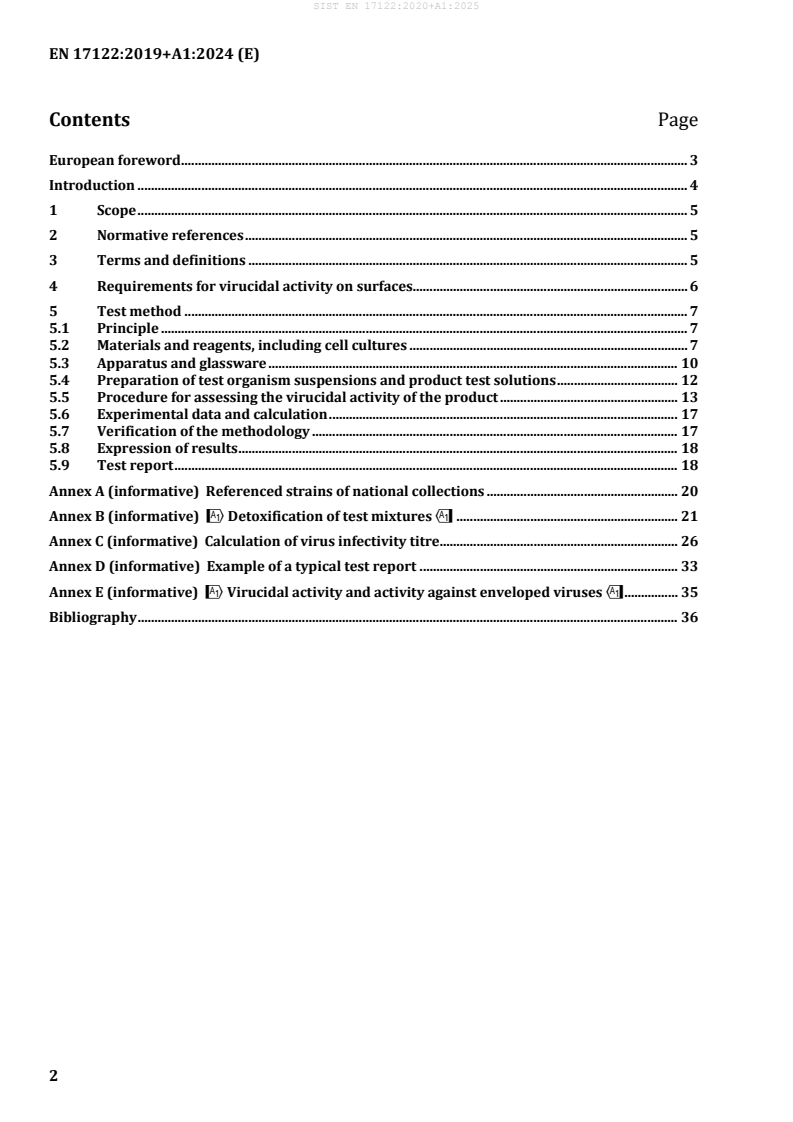
Contents Page
European foreword . 3
Introduction . 4
1 Scope . 5
2 Normative references . 5
3 Terms and definitions . 5
4 Requirements for virucidal activity on surfaces. 6
5 Test method . 7
5.1 Principle . 7
5.2 Materials and reagents, including cell cultures . 7
5.3 Apparatus and glassware . 10
5.4 Preparation of test organism suspensions and product test solutions . 12
5.5 Procedure for assessing the virucidal activity of the product . 13
5.6 Experimental data and calculation . 17
5.7 Verification of the methodology . 17
5.8 Expression of results . 18
5.9 Test report . 18
Annex A (informative) Referenced strains of national collections . 20
Annex B (informative) !Detoxification of test mixtures" . 21
Annex C (informative) Calculation of virus infectivity titre . 26
Annex D (informative) Example of a typical test report . 33
Annex E (informative) !Virucidal activity and activity against enveloped viruses" . 35
Bibliography . 36
European foreword
This document (EN 17122:2019+A1:2024) has been prepared by Technical Committee CEN/TC 216
“Chemical disinfectants and antiseptics”, the secretariat of which is held by AFNOR.
This European Standard shall be given the status of a national standard, either by publication of an
identical text or by endorsement, at the latest by June 2025, and conflicting national standards shall be
withdrawn at the latest by June 2025.
Attention is drawn to the possibility that some of the elements of this document may be the subject of
patent rights. CEN shall not be held responsible for identifying any or all such patent rights.
This document includes Amendment 1 approved by CEN on 25 November 2024.
This document supersedes !EN 17122:2019".
The start and finish of text introduced or altered by amendment is indicated in the text by tags !".
!This document has been amended to harmonise the terminology and methods with those adopted
recently for other similar European standards and to make minor editorial changes to improve clarity. A
minor technical error has also been corrected. The changes detailed above have no impact on the test
results obtained using the previous version. Those results are still valid."
Any feedback and questions on this document should be directed to the users’ national standards body.
A complete listing of these bodies can be found on the CEN website.
According to the CEN-CENELEC Internal Regulations, the national standards organisations of the
following countries are bound to implement this European Standard: Austria, Belgium, Bulgaria, Croatia,
Cyprus, Czech Republic, Denmark, Estonia, Finland, France, Germany, Greece, Hungary, Iceland, Ireland,
Italy, Latvia, Lithuania, Luxembourg, Malta, Netherlands, Norway, Poland, Portugal, Republic of North
Macedonia, Romania, Serbia, Slovakia, Slovenia, Spain, Sweden, Switzerland, Türkiye and the United
Kingdom.
Introduction
This document describes a surface test method for establishing whether a product proposed as a
disinfectant in the fields described in Clause 1 has or does not have virucidal activity on non-porous
surfaces.
The laboratory test closely simulates practical conditions of application. Chosen conditions (contact time,
temperature, organisms on surfaces etc.) reflect parameters which are found in practical situations
including conditions which may influence the action of disinfectants. Each use concentration found from
this test corresponds to defined experimental conditions.
The conditions are intended to cover general purposes and to allow reference between laboratories and
product types. Each utilization concentration of the chemical disinfectant found by this test corresponds
to defined experimental conditions.
However, for special applications the recommendations for use of a product can differ and therefore
additional test conditions might be needed, which cannot be covered by this document.
1 Scope
This document specifies a test method and the minimum requirements for virucidal activity of chemical
disinfectants that form a homogeneous physically stable preparation when diluted with hard water, or –
in the case of ready-to-use-products – with water.
This document applies to products that are used for disinfecting without mechanical action non-porous
surfaces in the veterinary area - i.e. in the breeding, husbandry, production, veterinary care facilities,
transport and disposal of all animals except when in the food chain following death and entry to the
processing industry.
EN 14885 specifies in detail the relationship of the various tests to one another and to “use
recommendations”.
NOTE 1 The method described is intended to determine the activity of commercial formulations or active
substances under the conditions in which they are used.
NOTE 2 This method corresponds to a Phase 2 Step 2 test.
NOTE 3 Using this document, it is possible to determine the virucidal activity of the undiluted product.
NOTE 4 This document uses Porcine Parvovirus because Bovine Enterovirus E (former Bovine Enterovirus Type
1 (ECBO)) virus used in the suspension test EN 14675 cannot be used for surface testing because of its loss of titre
during drying. Porcine Parvovirus has comparable resistance to ECBO virus.
2 Normative references
The following documents are referred to in the text in such a way that some or all of their content
constitutes requirements of this document. For dated references, only the edition cited applies. For
undated references, the latest edition of the referenced document (including any amendments) applies.
EN 12353, Chemical disinfectants and antiseptics — Preservation of test organisms used for the
determination of bactericidal (including Legionella), mycobactericidal, sporicidal, fungicidal and virucidal
(including bacteriophages) activity
EN 14675, Chemical disinfectants and antiseptics - Quantitative suspension test for the evaluation of
virucidal activity of chemical disinfectants and antiseptics used in the veterinary area – Test method and
requirements (Phase 2, step 1)
EN 14885, Chemical disinfectants and antiseptics — Application of European Standards for chemical
disinfectants and antiseptics
!EN 10088-1, Stainless steels — Part 1: List of stainless steels"
EN 10088-2, Stainless steels — Part 2: Technical delivery conditions for sheet/plate and strip of corrosion
resisting steels for general purposes
3 Terms and definitions
For the purposes of this document, the terms and definitions given in EN 14675 and EN 14885 apply.
ISO and IEC maintain terminological databases for use in standardization at the following addresses:
• IEC Electropedia: available at http://www.electropedia.org/
• ISO Online browsing platform: available at https://www.iso.org/obp
4 Requirements for virucidal activity on surfaces
The product shall demonstrate at least a decimal log (lg) reduction of 3 in virus titre of the parvovirus
and coronavirus test strains when tested in accordance with Table 1 and Clause 5. To claim virucidal
activity against enveloped viruses the product shall pass this standard with the coronavirus test strain
and to claim !deleted word" virucidal activity the product shall pass both EN 14675 with the bovine
enterovirus test strain and this standard with the porcine parvovirus test strain.
NOTE See Annex E for further information on the appropriateness of claims of virucidal activity against
enveloped viruses and !deleted word" virucidal activity
Table 1 — Minimum and additional test conditions
Minimum spectrum of test !deleted word" Virucidal activity
organisms
Porcine Parvovirus, Strain NADL2
Virucidal activity against enveloped viruses
Feline Coronavirus, Strain Munich
Test temperature 10 °C ± 1 °C
Additional temperatures 4 °C ± 1 °C; 20 °C ± 1 °C; 40 °C ± 1 °C
a
Contact time The contact time(s) shall be selected from the values given below
Minimum contact time 1min ± 5 s
Other contact times 5min ± 10 s, 15 min ± 10 s, 30 min ± 10 s, 60 min ± 10 s
Maximum contact time 120 min ± 10 s
Interfering substances - low 3,0 g/l bovine albumin
level soiling
Interfering substances - high 10 g/l yeast extract and 10 g/l bovine albumin
level soiling
b
Additional conditions Further contact time(s), interfering substance(s) or virus(es)
a
The contact times for surface disinfectants stated in this table are chosen on the basis of the practical
conditions of the product. The recommended contact time for the use of the product is within the responsibility
of the manufacturer.
b
Where appropriate (specific purposes), additional specific virucidal activity shall be determined under other
conditions of time, temperature, and interfering substances (see 5.2.2.8) in accordance with 5.5, in order to take
into account intended specific use conditions. Additional virus(es) can be tested, if relevant. For the additional
conditions, the concentration defined as a result can be lower than the one obtained under the minimum test
conditions.
The determined virucidal concentration of the test product is suggested as being suitable for practical
situations of use.
5 Test method
5.1 Principle
5.1.1 Outline
A test suspension of viruses in a solution of interfering substances is inoculated onto a test surface and
dried. A prepared sample of the product under test is applied in a manner which covers the dried film.
The test surface is maintained at a specified temperature for a defined period of time. The test surface is
transferred to cell maintenance medium so that the action of the disinfectant is immediately neutralized.
The titre of the virus recovered from the test surface is determined.
The titre of the inoculum on a test surface treated with hard water in place of the disinfectant is also
determined and the reduction in virus titre attributed to the product is calculated by difference.
5.1.2 Test Organisms
The test is performed using the test organisms as specified in Clause 4, Table 1.
5.1.3 Variations
Other contact times and temperatures within the limits specified in Clause 4, Table 1 may be used.
Additional interfering substances and test organisms may be used.
5.2 Materials and reagents, including cell cultures
5.2.1 Test organisms
The virucidal activity shall be evaluated using the following strains as test organisms selected according
to Clause 4, Table 1
a) Non-enveloped DNA virus
Porcine Parvovirus strain NADL2 (PPV)
b) Enveloped RNA virus
Feline Coronavirus, strain Munich (FeCoV)
NOTE Virus strains can be obtained from a national or international culture collection. PPV and FeCoV can be
obtained from the Friedrich-Loeffler-Insitut, Bundesforschungsinstitut für Tiergesundheit, Hauptsitz Insel Riems
Südufer 10, 17493, Greifswald-Insel Riems .
The required incubation temperature for these test organisms is (36 ± 1) °C or (37 ± 1) °C (5.3.2.12). The
same temperature (either 36 °C or 37 °C) shall be used for all incubations performed during a test and its
control and validation.
If additional test organisms are used, they shall be kept and used under optimum growth conditions
(temperature, time, atmosphere, media) noted in the test report. If these additional test organisms are
not classified at a reference centre, their identification characteristics shall be stated. In addition, they
shall be held by the testing laboratory or national culture collection under a reference for five years.
This information is given for the convenience of users of this standard and does not constitute an endorsement by
CEN of this institute.
5.2.2 Culture media, reagents and cell cultures
5.2.2.1 General
All weights of chemical substances given in this document refer to the anhydrous salts. Hydrated forms
may be used as an alternative, but the weights required shall be adjusted to allow for consequent
molecular weight differences.
The reagents shall be of analytical grade and/or appropriate for microbiological purposes. They shall be
free from substances that are toxic or inhibitory to the test organisms.
To improve reproducibility, it is recommended that commercially available – dehydrated if appropriate
- material is used for the preparation of culture media. The manufacturer's instructions relating to the
preparation of these products should be rigorously followed.
For each culture medium and reagent, a time limitation for use should be fixed.
All specified pH values are measured at (20 ± 1) °C.
5.2.2.2 Water
The water shall be freshly glass-distilled water and not demineralized water. If distilled water of adequate
quality is not available, water for injections (see bibliographic reference [1]) may be used.
Sterilize in the autoclave [5.3.2.1 a]. Sterilization is not necessary if the water is used e.g. for preparation
of culture media and subsequently sterilized.
See 5.2.2.7 for the procedure to prepare hard water.
5.2.2.3 Phosphate buffered saline (PBS)
Sodium chloride (NaCl) 8,00 g
Potassium chloride (KCl) 0,20 g
Disodium hydrogen phosphate, 12-hydrate (Na HPO x 12H O) 2,89 g
2 4 2
Potassium phosphate, monobasic (KH PO ) 0,20 g
2 4
Water (5.2.2.2) to 1000,0 ml
5.2.2.4 Neutral Red (1:1000 solution)
Prepare neutral red (Sigma N7005) stock solution at 0,1 mg/ml in water (5.2.2.2). Filter through a
!0,45 µm" pore size filter and store at 4 °C in the dark.
5.2.2.5 Foetal calf serum (FCS)
FCS shall be certified free of viruses and mycoplasma. Extraneous viruses and mycoplasma may interfere
with cell and virus growth resulting in false results.
5.2.2.6 Trichloroacetic acid (10 % solution) (TCA)
Dissolve 10 g of TCA crystals in 80 ml of water (5.2.2.2), and then adjust the volume to 100 ml with water.
Stir to complete solution.
Sigma N 7005 is an example of a suitable product available commercially. This information is given for the
convenience of users of this standard and does not constitute an endorsement by CEN of this product.
5.2.2.7 Hard water for dilution of products
For the preparation of 1 l of hard water, the procedure is as follows:
— prepare solution A: dissolve 19,84 g magnesium chloride (MgCl ) and 46,24 g calcium chloride
(CaCl ) in water (5.2.2.2) and dilute to 1 000 ml. Sterilize by membrane filtration (5.3.2.1 c) or in the
autoclave [5.3.2.1 a]. Autoclaving – if used - may cause a loss of liquid. In this case make up to 1 000 ml
with water (5.2.2.2) under aseptic conditions. Store the solution in the refrigerator (5.3.2.6) for no
longer than one month;
— prepare solution B: dissolve 35,02 g sodium bicarbonate (NaHCO ) in water (5.2.2.2) and dilute to
1000 ml. Sterilize by membrane filtration (5.3.2.1 c). Store the solution in the refrigerator (5.3.2.6)
for no longer than one week;
— place 600 ml to 700 ml of water (5.2.2.2) in a 1000 ml volumetric flask (5.3.2.9) and add 6,0 ml of
solution A, then 8,0 ml of solution B. Mix and dilute to 1000 ml with water (5.2.2.2). The pH (5.3.2.4)
of the hard water shall be 7,0 ± 0,2. If necessary, adjust the pH by using a solution of approximately
40 g/l (about 1 mol/l) of sodium hydroxide (NaOH) or approximately 36,5 g/l (about 1 mol/l) of
hydrochloric acid (HCl).
The hard water shall be freshly prepared under aseptic conditions and used within 12 h.
NOTE When preparing the product test solutions (5.4.2), the addition of the product to the hard water
produces different final water hardness in each test tube. In any case, the final hardness in the test tube expressed
as calcium carbonate (CaCO ) is lower than 375 mg/l.
5.2.2.8 Interfering substance
5.2.2.8.1 General
The interfering substance shall be chosen according to the conditions of use laid down for the product.
The interfering substance shall be sterile and prepared at 10 times its final concentration in the test.
The ionic composition (e.g. pH, calcium and/or magnesium hardness) and chemical composition (e.g.
mineral substances, protein, carbohydrates, lipids and detergents) shall be defined.
“Diluent” is generally used in the other European Standards in the veterinary area to prepare the
interfering substance. Since there is no experience in virucidal testing with diluent, water (5.2.2.2) is used
instead.
NOTE The term “interfering substance” is used even if it contains more than one substance.
5.2.2.8.2 Low level soiling (Bovine albumin solution)
Bovine serum albumin shall be used as commercially available or shall be prepared as follows:
Dissolve 3 g of bovine albumin fraction V (suitable for microbiological purposes) in 90 ml of water
(5.2.2.2) in a 100 ml volumetric flask (5.3.2.9). Make up to the mark with water (5.2.2.2).
Sterilize by membrane filtration (5.3.2.1 c). Keep in a refrigerator (5.3.2.6) and use within one month.
The final concentration of bovine albumin in the test procedure (5.5) is 3 g/l.
5.2.2.8.3 High level soiling (mixture of bovine albumin solution with yeast extract)
Dissolve 50 g yeast extract powder in 150 ml of water (5.2.2.2) in a 250 ml volumetric flask (5.3.2.9) and
allow foam to collapse. Make up to the mark with water (5.2.2.2). Transfer to a clean dry bottle and
sterilize in the autoclave (5.3.2.1 a). Allow to cool to 20 °C ± 1 °C.
Pipette 25 ml of this solution into a 50 ml volumetric flask (5.3.2.9) and add 10 ml of water (5.2.2.2).
Dissolve 5 g of bovine albumin fraction V (suitable for microbiological purposes) in the solution with
shaking and allow foam to collapse. Make up to the mark with water (5.2.2.2), sterilize by membrane
filtration (5.3.2.1 c), keep in a refrigerator (at 2 °C to 8 °C) (5.3.2.6) and use within one month.
The final concentration in the test procedure (5.5) is 10 g/l yeast extract and 10 g/l bovine albumin.
5.2.2.9 Medium for cell cultures
Eagle’s minimal essential medium (MEM) or equivalent, supplemented with FCS (5.2.2.5), antibiotics, and
other growth factors as needed shall be used.
a) A growth medium for cell multiplication is supplemented with 10 % FCS. Add 10 parts of FCS (5.2.2.5)
to 90 parts of MEM.
b) A maintenance medium to maintain the cell culture metabolism without stimulation of cell
proliferation is supplemented with 2 % FCS. Add 2 parts of FCS (5.2.2.5) to 98 parts of MEM.
Other media may be used if appropriate for certain cell lines.
See also bibliographic reference [2], EN 14675 and EN 12353 for more detailed descriptions.
5.2.2.10 Cell cultures
Cell monolayers shall be > 90 % confluent before inoculation. Cell lines are selected in accordance with
their sensitivity to the test organisms (5.2.1). Cells for virus titration, if used as suspensions in quantal
tests, shall be added to the dilutions of the test mixture (5.5.2) in such a density as to enable the formation
of a monolayer no longer than 2 days in the cell control. Cell cultures can be used as cell monolayers or
in suspensions for quantal tests. For details of cell lines see 5.5.1 e).
5.3 Apparatus and glassware
5.3.1 General
Sterilize all glassware and parts of the apparatus that will come into contact with the culture media and
reagents or the sample, except those which are supplied sterile, by one of the following methods:
a) by moist heat, in the autoclave [5.3.2.1 a];
b) by dry heat, in the hot air oven [5.3.2.1 b].
5.3.2 Usual microbiological laboratory equipment
And, in particular, the following:
5.3.2.1 Apparatus for sterilization (moist and dry heat)
+3
a) For moist heat sterilization, an autoclave capable of being maintained at ( 121 ) °C for a minimum
holding time of 15 min;
+5
b) for dry heat sterilization, a hot air oven capable of being maintained at ( 180 ) °C for a minimum
+5 +5
holding time of 30 min, at ( 170 ) °C for a minimum holding time of 1 h or at ( 160 ) °C for a
0 0
minimum holding time of 2 h.
Disposable sterile equipment is an acceptable alternative to reusable glassware.
c) for media sterilization, use suitable membrane filtration apparatus with filters of diameter 47 mm to
50 mm and membranes with 0,22 μm pore size.
5.3.2.2 Water baths, capable of being controlled at (20 ± 1) °C, and at additional test
temperatures ± 1 °C (5.5.1).
5.3.2.3 Inverted microscope for reading cell cultures microscopically
5.3.2.4 pH meter, having an accuracy of calibration of 0,1 pH units at 20 °C.
5.3.2.5 Stopwatch
5.3.2.6 Refrigerator, capable of being controlled at 2 °C to 8 °C.
® 4
5.3.2.7 Electromechanical agitator e.g. Vortex mixer
5.3.2.8 Containers: Petri plates, sterile test tubes, culture bottles or flasks of suitable capacity.
5.3.2.9 Volumetric flasks, calibrated at 20 °C.
5.3.2.10 Microtitre plates or tubes, petri dishes and flasks for cell culture use.
5.3.2.11 Membrane filtration apparatus for filtration
5.3.2.12 CO incubator (95 % air, 5 % CO ), capable of being controlled at (36 ± 1) °C, for incubation
2 2
of cell cultures. An incubator at (37 ± 1) °C may be used if an incubator at (36 ± 1) °C is not available.
5.3.2.13 Graduated sterile pipettes of nominal capacities 10 ml and 1 ml and 0,1 ml.
NOTE Calibrated automatic pipettes can be used.
5.3.2.14 Magnetic stirrer for keeping cells in suspension before seeding
5.3.2.15 Ice producing machine or commercially available ice to cool the cell maintenance medium
and the reaction mixtures during the test (see 5.5.2 and 5.5.4)
5.3.2.16 Basin as ice bath with ice and water
5.3.2.17 Mechanical shaker
5.3.2.18 Centrifuge
5.3.2.19 Biological safety cabinet, class II
5.3.2.20 Freezer, −70 °C or less
5.3.2.21 Temperature controlled cabinet, capable of being controlled at 10 °C ± 1 °C
5.3.2.22 Vacuum Diaphragm Pump (e.g. throughput max. 3,8 m /h final vacuum < 75 mbar)
4 ®
Vortex is an example of a suitable product available commercially. This information is given for the convenience
of users of this standard and does not constitute an endorsement by CEN of this product.
5.3.2.23 Cryotubes
5.3.3 Test surface
These shall be 1.4301 (EN 10088-1) stainless steel discs (2 cm diameter discs) with Grade 2 B finish on
both sides, in accordance with the requirements of EN 10088-2. The discs shall be as flat as possible and
this is best achieved by using stainless steel of a gauge of 1,2 mm or 1,5 mm. The discs shall be handled
only with forceps and used only once.
Prior to use the discs shall be placed in a container with an appropriate quantity of 5 % per volume Decon ®
90 , or of 1 % Blanisol-Pur for 60 min, in a manner so that they do not stick together and the surface is
not damaged. Rinse the discs with running freshly distilled water (5.2.2.2) or demineralized water for
10 s, preventing them from drying to any extent.
Rinse the discs with water (5.2.2.2) for a further 10 s to ensure complete removal of the surfactant. To
supply a satisfactory flow of water, a sterilized fluid dispensing pressure vessel with suitable hose and
connectors or other suitable method can be used and regulated to supply approximately 2000 ml per
min. Dip the disc in a bath containing isopropanol (IPA) for 15 min. Remove the discs and rinse them with
water (5.2.2.2) for at least 10 s. Sterilize by autoclaving.
NOTE Suitable stainless steel discs can usually be purchased from local engineering companies.
5.4 Preparation of test organism suspensions and product test solutions
5.4.1 Test organism suspensions (test virus suspension)
The test organisms and their stock cultures shall be prepared and kept in accordance with EN 12353.
The stock virus suspension is multiplied in an appropriate cell line that produces high titres of infectious
viruses. The cell debris is separated by centrifugation (400 g for 15 min). This preparation is called the
N
“test virus suspension”.
It is suggested that the minimum titre of the virus suspension - determined by a quantal test [5.5.2 a] or
by a plaque test [5.5.2 b) - is at least 10 TCID /ml. In any case, it shall be sufficiently high to enable at
least a titre reduction of 3 lg to verify the method.
If necessary the test suspension may be concentrated by appropriate methods (e.g. ultracentrifugation).
The test suspension is kept in small volumes below −70 °C or preferably between −135 °C and −196 °C in
liquid nitrogen vapor phase or liquid nitrogen (with suitable tight cryotubes, 5.3.2.23).
Due to safety reasons, and – in some cases – to avoid the possibility of genetic mutations, only 10 passages
from the original seed (e.g. virus from culture collection) are allowed.
The test suspension is used undiluted for the test procedure (5.5.2 or 5.5.3).
5.4.2 Product test solution
Detailed sample information of the product, as received from the producer or from any other source, shall
be recorded.
Product test solutions shall be prepared in hard water (5.2.2.7) at a minimum of three different
concentrations to include one concentration in the active range and one concentration in the non-active
range. The product, as received, may be used as one of the product test solutions.
5 ®
Decon 90 and Blanisol-Pur are examples of suitable products available commercially. This information is given
for the convenience of users of this standard and does not constitute an endorsement by CEN of those products.
Dilutions of ready-to-use products, i.e. products which are not diluted when applied, shall be prepared in
water (5.2.2.2).
For solid products, dissolve the product as received by weighing at least 1,0 g ± 10 mg of the product in a
volumetric flask and filling up with hard water (5.2.2.7). Subsequent dilutions (= lower concentrations)
shall be prepared in volumetric flasks (5.3.2.9) on a volume/volume basis in hard water (5.2.2.7).
For liquid products, dilutions of the product shall be prepared with hard water on a volume/volume basis
using volumetric flasks (5.3.2.9).
The product test solutions shall be prepared freshly and used in the test within 2 h. They shall give a
physically homogeneous preparation, stable during the whole procedure. If during the procedure a
visible inhomogeneity appears due to the formation of a precipitate or flocculant for example through the
addition of the interfering substance, it shall be recorded in the test report.
The concentration of the product stated in the test report shall be the desired test concentration. Record
the test concentration in terms of mass per volume or volume per volume and details of the product
sample as received.
5.5 Procedure for assessing the virucidal activity of the product
5.5.1 Experimental conditions
Besides the obligatory temperature, contact time, interfering substances and test organisms, additional
experimental conditions and test organisms can be selected according to the practical use considered for
the product (Clause 4) as follows:
a) temperature (in °C):
The obligatory and additional test temperatures are specified in Clause 4, Table 1; the allowed
deviation for each chosen temperature is ±1 °C. The temperatures chosen shall be reported in the
test report (5.9)
b) contact time t (in min):
The defined contact times that shall be tested are specified in Clause 4, Table 1; the allowed deviation
for each chosen contact time is 10 s, except for 1 min for which it is 5 s. Additional times may be
chosen and the times chosen shall be reported in the test report (5.9).
c) test organisms (5.2.1):
Virus strains shall be as specified in Clause 4, Table 1. The obligatory test organism for !deleted
word" virucidal activity is Porcine Parvovirus. The obligatory test organism for virucidal activity
against enveloped viruses is Feline Coronavirus.
Additional strains may be chosen and the strains used shall be reported in the test report (5.9).
d) interfering substance:
The obligatory interfering substance to be tested is 3,0 g/l bovine albumin (5.2.2.8.2) for low level
soiling or 10 g/l bovine albumin plus 10 g/l yeast extract (5.2.2.8.3) for high level soiling, according
to practical applications. Additional interfering substances can be selected and the interfering
substances used shall be reported in the test report (5.9).
e) Cell line(s):
Porcine parvovirus is multiplied in the porcine kidney cell line pK15 or other cell lines of appropriate
sensitivity.
Feline coronavirus is multiplied in the feline kidney cell line CRFK or other cell lines of appropriate
sensitivity.
5.5.2 Test procedure
Equilibrate the reagents (product test solution (5.4.2), hard water (5.2.2.7)) to the test temperature using
a temperature controlled cabinet and/or water bath and check that the temperature of the reagents is
stabilized at the chosen temperature.
Nine volumes of test virus suspension (5.4.1) are mixed with one volume of interfering substance solution
(5.2.2.8) not longer than 2 min before inoculation of the carriers.
For each test organism, for each concentration of the product and for each contact time prepare 2 test
surfaces plus 2 test surfaces for the water control (5.5.5). The 2 test surfaces shall be used in the same
working session, in parallel. Place the test surfaces in a sterile Petri dish under the laminar air flow and
ensure that the dish is in a horizontal position. Prepare the test surfaces in a biological safety cabinet
(5.3.2.19) by inoculating 50 μl of the virus suspension plus interfering substance onto each test surface,
paying attention to deliver the suspension in the centre of the test surface (5.3.3) (avoiding touching the
test surface edges). Dry the surfaces until they are visibly dry.
It is understood that drying of the test surfaces will occur at different rates due to the ambient conditions
of the laboratory and the design of the laminar air flow cabinet. For this reason no time duration is given
and the minimum required time for the surfaces to become visibly dry should be established for each
laboratory. The drying time should not exceed 60 min and if it does, alternative drying conditions shall
be used. Allow the test surfaces to equilibrate with the chosen test temperature.
Use the test surfaces within 60 min, to avoid virus inactivation with time.
Immediately after drying, carefully pick up each test surface and place it, inoculated side up, in a sterile
Petri plate, place it in a temperature controlled cabinet (5.3.2.21) and ensure that the test surface is in a
horizontal position. Equilibrate the inoculated and dried stainless steel discs to the chosen temperature.
Carefully cover the dried inoculum on the test surfaces with 100 µl of the test solution. Care shall be taken
not to touch the pipette tip on the carrier. For the water control, place 100 µl of hard water (5.2.2.7), or
water (5.2.2.2), if the product has been diluted in water, onto the other test surfaces ensuring that the
dried inoculum is totally covered by the liquid.
After the chosen contact time at the chosen test temperature immediately transfer each of the test
surfaces to a separate container (flat bottom between 4 cm and 5 cm at the base, with cap) and add 0,9 ml
of ice-cold cell culture medium without FCS e.g. Eagle's minimal essential medium (MEM). Mix (5.3.2.7)
each container for 60 s (or for as long as no dried inoculum can be seen) to re-suspend the virus.
Immediately after elution, prepare a series of ten-fold dilutions of the virus suspension in ice-cold
maintenance medium (MEM + 2 % FCS). Pipette tips shall be changed after each dilution to avoid carry-
over of viruses.
The dilutions are inoculated on cell culture. After incubation the titre of virus is calculated.
Reduction of virus titre is calculated from titre differences between those treated with disinfectant and
those treated with hard water.
After treatment with the product or water, the infectivity is tested with one of the following procedures:
a) !Quantal tests (end point titration) – [the procedures 1) and 2) are alternatives]"
1) Virus titration on cells in suspension on microtitre plates:
Transfer 0,1 ml of each dilution into six or eight wells of a microtitre plate (5.3.2.10), beginning
with the highest dilution. Add 0,1 ml of cell culture suspension (5.2.2.9) in such a density as to
enable the formation of a monolayer (> 90 %) in no longer than 2 days in the cell control. In
parallel six or eight wells do not receive any viral suspension and will serve as the cell control.
The viral cytopathic effect (CPE) is read by using an inverted microscope after the appropriate
incubation time (48 h to 7 days).
2) Virus titration on monolayers of cells on microtitre plates:
Transfer 0,1 ml of each dilution into six or eight wells of a microtitre plate (5.3.2.10) containing
a confluent (> 90 %) cell monolayer (5.2.2.9) without any medium. The last row of six or eight
wells receive 0,1 ml of culture medium (5.2.2.10 b) and serve as the cell control. After 1 h of
incubation at 37 °C, 0,1 ml of cell culture medium (5.2.2.10 a) is added to each well. Change
pipettes for tubes or wells when adding medium.
The viral cytopathic effect (CPE) is read by using an inverted microscope after the appropriate
incubation time (48 h to 7 days).
b) Plaque assay
Plastic tray wells (surface diameter 30 mm to 35 mm) with confluent cell monolayers are washed
once with phosphate buffered saline (PBS) (5.2.2.3) and inoculated with 0,2 ml of serial dilutions of
virus in MEM + 2 % FCS. Six to eight wells are generally used per dilution. After an absorption period
of 1 h at (37 ± 1) °C, during which the cell monolayers are kept moist by tilting the dishes every 8 min
to 10 min, the inoculum is removed and the cell monolayers are washed once with PBS. Subsequently,
the wells are overlaid with 3 ml of a mixture consisting of 2 % melted agarose or another appropriate
semisolid medium and 2 times concentrated MEM with 4 % FCS. The cultures are incubated for 5 to
6 days at 37 ± 1 °C in a CO incubator (5.3.2.12). Plaques can be counted after addition of 2 ml of a
second overlay with the same composition of the first and also containing 5 % of a 1:1000 solution
of neutral red (5.2.2.4) and further incubation (in the dark) at 37 ± 1 °C for 24 h to 48 h in a CO
incubator (5.3.2.12). Counting can be performed also after addition of crystal violet. The cell
monolayers are fixed by adding 2 ml of 10 % trichloroacetic acid (TCA) (5.2.2.6) over the agar overlay
for 10 min to 15 min at room temperature. The agar overlay is then removed and 2 ml of 0,1 % crystal
violet in 20 % ethanol are added. After 10 min to 15 min at room temperature, the wells are
extensively washed with water and the plaques (white spots) are counted.
NOTE Determination of CPE can be used as an alternative to plaque assay.
5.5.3 Cytotoxicity caused by product solutions
5.5.3.1 Cytotoxic effect
To check for possible morphological alteration of cells by the disinfectant, mix 45 µl MEM + 2 % FCS + 5 µl
of interfering substance, inoculate on a carrier and dry. Add 100 µl of product (at the dilutions used in
the test) and leave for 5 min at test temperature. Elute with 0,9 ml MEM + 2 % FCS and mix for 30 s
(5.3.2.7). Serial dilutions (dilution step: 1:10) are prepared in the culture medium and are inoculated into
cell cultures (monolayers or suspended cells). This shall be done in parallel with the test. Any microscopic
changes in the cells are recorded when reading the tests for CPE (2 test surfaces).
5.5.3.2 Interference control – control of cell susceptibility
The aim of the interference control is to verify that the susceptibility of the cells for the virus infection is
not influenced negatively by the treatment with the disinfectant.
Comparative virus titrations are performed on cells that have or have not been treated with disinfectants
to check the reduction of the sensitivity to viruses as follows:
Treatment of cells:
a) monolayers: 0,1 ml of the lowest apparently non-cytotoxic dilution (no microscopic alteration) of the
product test solution (5.4.2) or PBS (5.2.2.3) and 0,1 ml of culture medium are distributed onto each
of 6 established cell cultures in microtitre plates with 96 wells (5.3.2.10). After 1 h at 37 °C the
supernatant is discarded;
b) suspension cells: a volume of the lowest apparently non-cytotoxic dilution of the product or PBS
(5.2.2.3) is added to a volume of double concentrated cell suspension. After 1 h at 37 °C the cells are
centrifuged and resuspended in culture medium [5.2.2.10].
Comparative titration of viruses:
−1 −10
The virus is diluted from 1
...
Questions, Comments and Discussion
Ask us and Technical Secretary will try to provide an answer. You can facilitate discussion about the standard in here.
Loading comments...