


SIST EN ISO 105-X08:1999
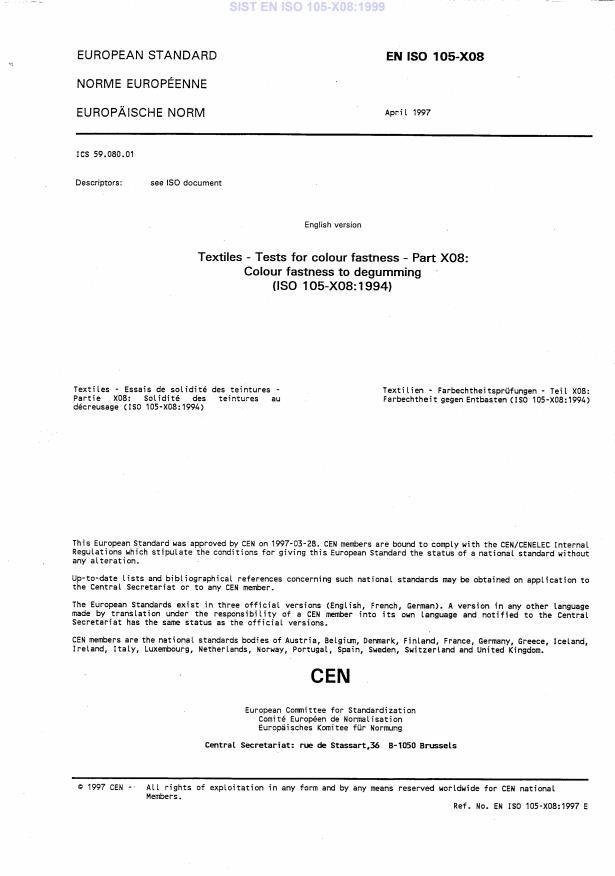
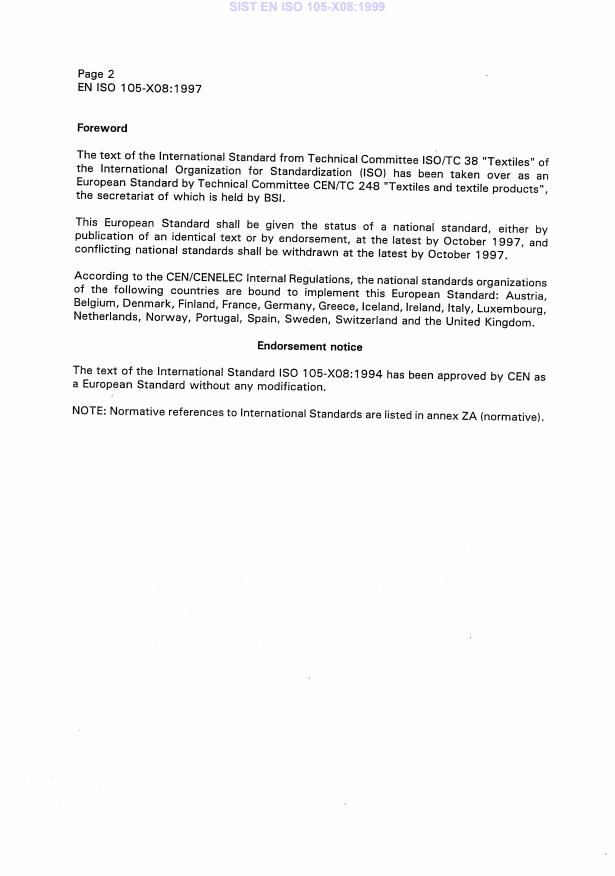
(Main)Textiles - Tests for colour fastness - Part X08: Colour fastness to degumming (ISO 105-X08:1994)
Textiles - Tests for colour fastness - Part X08: Colour fastness to degumming (ISO 105-X08:1994)
Describes a method for determining the resistance of the colour of textiles of all kinds, except loose fibre, to the action of soap solutions such as those used in degumming raw silk. A specimen of the textile in contact with adjacent fabrics is treated with a soap solution, then rinsed and dried. The change in colour of the specimen and the staining of the adjacent fabrics are assessed with the grey scales.
Textilien - Farbechtheitsprüfungen - Teil X08: Farbechtheit gegen Entbasten (ISO 105-X08:1994)
Textiles - Essais de solidité des teintures - Partie X08: Solidité des teintures au décreusage (ISO 105-X08:1994)
La présente partie de l'ISO 105 prescrit une méthode pour la détermination de la résistance des teintures sur les textiles de toute nature, à l'exception de la fibre en bourre, à l'action des solutions savonneuses telles qu'on les utilise pour décreuser la soie grège.
Tekstilije - Preskušanje barvne obstojnosti - Del X08: Barvna obstojnost proti degumiranju (ISO 105-X08:1994)
General Information
- Status
- Published
- Publication Date
- 28-Feb-1999
- Technical Committee
- ITEK - Textile and textile products
- Current Stage
- 6060 - National Implementation/Publication (Adopted Project)
- Start Date
- 01-Mar-1999
- Due Date
- 01-Mar-1999
- Completion Date
- 01-Mar-1999

Relations
- Effective Date
- 28-Jan-2026
Overview
SIST EN ISO 105-X08:1999 outlines an essential method for evaluating colour fastness to degumming in textiles. Developed by the Slovenian Institute for Standardization (SIST) and based on ISO 105-X08:1994, this standard is crucial for textile manufacturers, laboratories, and quality assurance professionals. It describes a procedure for determining how resistant the colour of various textiles is to soap solutions commonly used in the degumming of raw silk. The process involves exposing textile specimens to a soap solution, rinsing, drying, and measuring the resultant colour change and staining using grey scales. This ensures products maintain their appearance and performance throughout processing and usage, which are key quality indicators in the textiles industry.
Key Topics
- Colour fastness: Focuses on the ability of dyed or printed textiles to retain their original colour during and after exposure to soap solutions used in degumming processes.
- Scope: Applies to all textile types except loose fibres, making it a comprehensive method for fabrics and yarns.
- Degumming: Involves the removal of sericin (the natural gum) from raw silk using soap solutions, a critical step in silk processing.
- Testing Method:
- Attachment of textile specimens to adjacent fabrics (raw silk and similar material)
- Treatment with a specified soap solution under controlled conditions
- Rinsing and drying the specimen
- Assessment of colour change and fabric staining using grey scales
- Assessment Tools: Utilizes standardized grey scales for both colour change and staining evaluation.
- Reporting Requirements: Precise documentation of specimen identity, test conditions, and results is mandatory for compliance and reproducibility.
Applications
This standard is widely used in the textile industry for a variety of practical purposes:
- Quality Control: Ensures that finished textile products, especially silk fabrics and blends, maintain colour integrity throughout processing.
- Product Development: Textile designers and manufacturers apply this test to select dyes and processes that offer optimal colour retention.
- Regulatory Compliance: Helps manufacturers meet international market requirements for colour fastness, supporting export and trade by adhering to recognized standards.
- Research and Development: Assists in evaluating the impact of new degumming agents or dyeing processes on textile durability and appearance.
- Third-party Testing: Laboratories and certification bodies use this method for independent assessment of textile colour fastness to verify manufacturer's claims.
Related Standards
SIST EN ISO 105-X08:1999 is part of the broader ISO 105 series on colour fastness testing in textiles. Related standards include:
- ISO 105-A01: General principles of textile colour fastness testing
- ISO 105-A02: Grey scale for assessing colour change
- ISO 105-A03: Grey scale for assessing staining
- ISO 105-F: Specifications for standard adjacent fabrics used in testing
These standards collectively support a robust framework for textile quality assurance, providing consistency and reliability across the global supply chain.
Keywords: textiles, colour fastness, degumming, silk, soap solution, grey scale, textile standards, ISO 105, SIST EN ISO 105-X08, textile testing, quality control
Get Certified
Connect with accredited certification bodies for this standard

Control Union Certifications
Global certification for agriculture and sustainability.

Hohenstein Institut
Textile testing and certification.

Bureau Veritas Bangladesh
Bureau Veritas certification services in Bangladesh.
Sponsored listings
Frequently Asked Questions
SIST EN ISO 105-X08:1999 is a standard published by the Slovenian Institute for Standardization (SIST). Its full title is "Textiles - Tests for colour fastness - Part X08: Colour fastness to degumming (ISO 105-X08:1994)". This standard covers: Describes a method for determining the resistance of the colour of textiles of all kinds, except loose fibre, to the action of soap solutions such as those used in degumming raw silk. A specimen of the textile in contact with adjacent fabrics is treated with a soap solution, then rinsed and dried. The change in colour of the specimen and the staining of the adjacent fabrics are assessed with the grey scales.
Describes a method for determining the resistance of the colour of textiles of all kinds, except loose fibre, to the action of soap solutions such as those used in degumming raw silk. A specimen of the textile in contact with adjacent fabrics is treated with a soap solution, then rinsed and dried. The change in colour of the specimen and the staining of the adjacent fabrics are assessed with the grey scales.
SIST EN ISO 105-X08:1999 is classified under the following ICS (International Classification for Standards) categories: 59.080.01 - Textiles in general. The ICS classification helps identify the subject area and facilitates finding related standards.
SIST EN ISO 105-X08:1999 has the following relationships with other standards: It is inter standard links to SIST EN 340:2004. Understanding these relationships helps ensure you are using the most current and applicable version of the standard.
SIST EN ISO 105-X08:1999 is available in PDF format for immediate download after purchase. The document can be added to your cart and obtained through the secure checkout process. Digital delivery ensures instant access to the complete standard document.
Standards Content (Sample)
SLOVENSKI STANDARD
01-marec-1999
Tekstilije - Preskušanje barvne obstojnosti - Del X08: Barvna obstojnost proti
degumiranju (ISO 105-X08:1994)
Textiles - Tests for colour fastness - Part X08: Colour fastness to degumming (ISO 105-
X08:1994)
Textilien - Farbechtheitsprüfungen - Teil X08: Farbechtheit gegen Entbasten (ISO 105-
X08:1994)
Textiles - Essais de solidité des teintures - Partie X08: Solidité des teintures au
décreusage (ISO 105-X08:1994)
Ta slovenski standard je istoveten z: EN ISO 105-X08:1997
ICS:
59.080.01 Tekstilije na splošno Textiles in general
2003-01.Slovenski inštitut za standardizacijo. Razmnoževanje celote ali delov tega standarda ni dovoljeno.
INTERNATIONAL ISO
STANDARD 105-X08
Fourth edition
1994-09-01
Textiles - Tests for colour fastness -
Part X08:
Colour fastness to degumming
Textiles - Essais de soliditb des teintures -
Partie XO8: Soliditg des teintures au dkreusage
Reference number
ISO 105-X08: 1994(E)
ISO 105-X08:1994(E)
Foreword
ISO (the International Organization for Standardization) is a worldwide
federation of national Standards bodies (ISO member bodies). The work
of preparing International Standards is normally carried out through ISO
technical committees. Esch member body interested in a subject for
which a technical committee has been established has the right to be re-
presented on that committee. International organizations, governmental
and non-governmental, in liaison with ISO, also take part in the work. ISO
collaborates closely with the International Electrotechnical Commission
(IEC) on all matters of electrotechnical standardization.
Draft International Standards adopted by the technical committees are
circulated to the member bodies for voting. Publication as an International
Standard requires approval by at least 75 % of the member bodies casting
a vote.
International Standard ISO 105-X08 was prepared by Technical Committee
lSO/TC 38, Textiles, Subcommittee SC 1, Tests for coloured textiles and
coloran ts.
This fourth edition cancels and replaces the third edition
(ISO 105-XO8:1987), of which it constitutes a technical revision.
ISO 105 was previously published in thirteen “parts ”, each designated by
a letter (e.g. “Part A ”), with publication dates between 1978 and 1985.
Esch part contained a series of “sections ”, each designated by the re-
spective part letter and by a two-digit serial number (e.g. “Section AO1 “).
These sections are now being republished as separate documents, them-
selves designated “Parts” but retaining their earlier alphanumeric desig-
nations. A complete list of these Parts is given in ISO 105-AOI .
0 ISO 1994
All rights reserved. Unless otherwise specified, no part of this publication may be reproduced
or utilized in any form or by any means, electronie or mechanical, including photocopying and
microfilm, without Permission in writing from the publisher.
International Organization for Standardization
Case Postale 56 l CH-l 211 Geneve 20 l Switzerland
Printed in Switzerland
ii
INTERNATIONAL STANDARD 0 ISO ISO 105-X08:1994(E)
- Tests for colour fastness -
Textiles
Part X08:
Colour fastness to degumming
fabrics is treated with a soap Solution, then rinsed and
1 Scope
dried. The Change in colour of the specimen and the
staining of the adjacent fabrics are assessed by com-
This part of ISO 105 specifies a method for deter-
parison with the grey scales.
mining the resistance of the colour of textiles of all
kinds, except loose fibre, to the action of soap sol
...