


SIST EN 1459-1:2025
(Main)Rough-terrain trucks - Safety requirements and verification - Part 1: Variable-reach trucks
Rough-terrain trucks - Safety requirements and verification - Part 1: Variable-reach trucks
This document specifies the safety requirements of self-propelled rough-terrain variable-reach trucks (hereafter referred to as trucks), intended to handle loads, equipped with a telescopic lifting means (pivoted boom), on which a load handling device (e.g. carriage and fork arms) is fitted.
For the purpose of this document, rough-terrain variable-reach trucks are designed to transport, lift and place loads and can be driven on unimproved terrain.
Fork arms are considered to be part of the truck. Trucks can also be equipped with a variety of attachments (e.g. bale spikes, mowers, sweepers).
This document deals with all the significant hazards, hazardous situations and events relevant to the trucks when they are used as intended and under conditions of misuse which are reasonably foreseeable by the manufacturer (see Annex A).
This document does not apply to:
— slewing rough-terrain variable-reach trucks covered by EN 1459 2:2015+A1:2018;
— rough terrain variable-reach tractors covered by CEN/TS1459-8;
— industrial variable reach trucks covered by EN ISO 3691 2:2016;
— lorry-mounted variable-reach trucks covered by ISO 20297 1:2017;
— variable-reach trucks fitted with tilting or elevating operator position;
— mobile cranes covered by EN 13000:2010+A1:2014;
— machines designed primarily for earth moving, even if their buckets and blades are replaced with forks (see EN 474 series);
— trucks designed primarily with variable length load suspension elements (e.g. chain, ropes) from which the load may swing freely in all directions;
— trucks designed primarily for container handling;
— trucks on tracks;
— trucks with articulated chassis;
— attachments.
This document does not address sound power level.
This document does not address hazards linked to:
— operation of the truck from a position other than the normal operating position or the remote control;
— hybrid power systems;
— gas power systems;
— gasoline engine systems;
— battery power systems.
This document does not address hazards which may occur:
a) when handling suspended loads which may swing freely (additional requirements are given in EN 1459 4: 2020);
b) when using trucks on public roads;
c) when operating in potentially explosive atmospheres (additional requirements are given in EN 1755:2015);
d) when operating underground;
e) when towing trailers;
f) when fitted with a personnel work platform (additional requirements are given in EN 1459 3:2015 and EN 1459 9:2021);
g) when using systems capable of controlling the speed of the truck as set by the operator (cruise-control).
This document does not provide a method of calculation for fatigue and strength of material.
This document is not applicable to trucks manufactured before the date of its publication.
Geländegängige Stapler - Sicherheitstechnische Anforderungen und Verifizierung - Teil 1: Stapler mit veränderlicher Reichweite
Dieses Dokument legt die sicherheitstechnischen Anforderungen an kraftbetriebene geländegängige Stapler mit veränderlicher Reichweite (nachfolgend als Stapler bezeichnet) fest, welche zur Handhabung von Lasten vorgesehen sind, ausgestattet mit einer teleskopierbaren Hebevorrichtung (drehbarer Hubarm), an der eine Lastaufnahmeeinrichtung (z. B. Gabelträger und Gabelzinken) angebracht ist.
Für die Anwendung dieses Dokuments werden geländegängige Stapler mit veränderlicher Reichweite als Fahrzeuge ausgeführt, welche Lasten transportieren, heben und absetzen, sowie auf unbefestigten Untergründen fahren können.
Gabelzinken gelten als Teile des Staplers. Stapler können auch mit einer Vielzahl Zusatzeinrichtungen (z. B. Ballenspieße, Mäher, Räumgeräte) ausgestattet sein.
Dieses Dokument behandelt die für die Stapler zutreffenden signifikanten Gefährdungen, Gefährdungssituationen und ereignisse, wenn die Stapler bestimmungsgemäß und unter Bedingungen, die vom Hersteller als Fehlanwendung vernünftigerweise vorhersehbar sind, verwendet werden (siehe Anhang A).
Dieses Dokument ist nicht anwendbar für:
von EN 1459 2:2015+A1:2018 abgedeckte geländegängige schwenkbare Stapler mit veränderlicher Reichweite;
geländegängige Traktoren mit veränderlicher Reichweite, die in CEN/TS 1459 8 behandelt werden;
Flurförderzeuge mit veränderlicher Reichweite, die in EN ISO 3691 2:2023 behandelt werden;
Mitnehmstapler mit veränderlicher Reichweite, die in ISO 20297 1:2017 behandelt werden;
Stapler mit veränderlicher Reichweite, die mit neigbarem oder hebbarem Bedienerplatz ausgestattet sind;
Mobilkräne, die in EN 13000:2010+A1:2014 behandelt werden;
Maschinen, die in erster Linie für Erdbewegungen ausgelegt sind, auch wenn deren Schaufeln und Planierschilde durch Gabelzinken ersetzt wurden (siehe Normenreihe EN 474);
Stapler, die in erster Linie mit Lastaufnahmeelementen veränderlicher Länge (z. B. Kette, Seile) ausgestattet sind, bei denen die Last in alle Richtungen frei pendeln kann;
Stapler, die in erster Linie für die Handhabung von Containern ausgelegt sind;
schienengebundene Stapler;
Stapler mit Knicklenkung;
Zusatzeinrichtungen.
Die Bestimmung und Angabe von Schallleistungspegeln werden in diesem Dokument nicht behandelt.
Dieses Dokument behandelt keine Verkaufsunterlagen.
Dieses Dokument befasst sich nicht mit Gefährdungen in Verbindung mit:
Betrieb des Staplers aus einer anderen Position als der normalen Bedienposition oder durch Fernsteuerung;
hybridbetriebenen Systemen;
gasbetriebenen Systemen;
benzinbetriebenen Systemen;
batteriebetriebenen Systemen.
Dieses Dokument befasst sich nicht mit Gefährdungen, die vorkommen können:
a) durch Befördern hängender Lasten, die frei pendeln können (zusätzliche Anforderungen sind in EN 1459 4:2020+A1:2025 gegeben);
b) durch Benutzung von Staplern auf öffentlichen Straßen;
c) beim Betrieb in explosionsfähigen Atmosphären (weitere Anforderungen werden in EN 1755:2024 angegeben);
d) beim Betrieb unter Tage;
e) beim Schleppen von Anhängern;
f) beim Anbringen einer Arbeitsbühne (zusätzliche Anforderungen sind in EN 1459 3:2015 und EN 1459 9:2021 gegeben);
g) bei Verwendung eines Systems, das in der Lage ist, die Geschwindigkeit des Staplers nach den Vorgaben des Bedieners zu steuern (Geschwindigkeitsregelung).
Dieses Dokument stellt keine Verfahren zur Berechnung von Werkstoffermüdung und festigkeit zur Verfügung.
Dieses Dokument gilt nicht für Stapler, die vor Veröffentlichung dieser EN hergestellt wurden.
Chariots tout-terrain - Prescriptions de sécurité et vérification - Partie 1 : Chariots à portée variable
Vozila za talni transport - Terenska vozila - Varnostne zahteve in preverjanje - 1. del: Vozila z mehanizmom za dviganje s spremenljivim dosegom
Ta dokument določa varnostne zahteve za terenska vozila z lastnim pogonom in mehanizmom za dviganje s spremenljivim dosegom (v nadaljnjem besedilu: »vozila«), namenjena za ravnanje s tovorom, ki so opremljena s teleskopskim dvižnim mehanizmom (vrtljivo roko), na katerem je pritrjena naprava za ravnanje s tovorom (npr. nosilec in vilice). Za namene tega dokumenta so terenska vozila z mehanizmom za dviganje s spremenljivim dosegom zasnovana za prevoz, dvigovanje in nameščanje tovora ter jih je mogoče voziti po neobdelanem terenu. Vilice se obravnavajo kot del vozila. Vozila so lahko opremljena tudi z različnimi priključki (npr. vilice za bale, kosilnica, priključek za pometanje). Ta dokument obravnava vse večje nevarnosti, nevarne situacije in dogodke v zvezi z vozili, kadar se uporabljajo v skladu s predvidenim namenom in pod pogoji pričakovane nepravilne uporabe, ki jih določa proizvajalec (glej dodatek A). Ta dokument se ne uporablja za: – terenska vozila z vrtljivim mehanizmom za dviganje s spremenljivim dosegom, ki so zajeta v standardu EN 1459-2:2015+A1:2018; – traktorje z mehanizmom s spremenljivim dosegom, ki so zajeti v standardu CEN/TS 1459-8; – vozila za talni transport s spremenljivim dosegom, ki so zajeta v standardu EN ISO 3691-2:2016; – vozila z dvigalom in spremenljivim dosegom, ki so zajeta v standardu ISO 20297-1:2017; – vozila s spremenljivim dosegom, opremljena z nagibnim ali dvižnim položajem upravljavca; – mobilne žerjave, ki so zajeti v standardu EN 13000:2010+A1:2014; – stroje, ki so zasnovani predvsem za zemeljska dela, tudi če imajo namesto žlic in rezil vilice (glej skupino standardov EN 474); – vozila, ki so zasnovana predvsem z elementi spremenljive dolžine za dvig tovora (verige, vrvi itd.), na katerih lahko tovor prosto niha v vseh smereh; – vozila, ki so zasnovana predvsem za delo z zabojniki; – vozila na tirih; – viličarje z zgibnim ohišjem; – priključke. Ta dokument ne obravnava ravni zvočne moči. Ta dokument ne obravnava nevarnosti v zvezi z naslednjim: – upravljanjem vozila v položaju, ki ni običajni delovni položaj, ali z upravljalnikom na daljavo; – hibridnimi pogonskimi sistemi; – plinskimi pogonskimi sistemi; – sistemi z bencinskim motorjem; – sistemi z baterijskim pogonom. Ta dokument ne obravnava nevarnosti, ki se lahko pojavijo pri: a) dvigovanju visečih bremen, ki lahko prosto nihajo (dodatne zahteve so podane v standardu EN 1459-4: 2020); b) uporabi vozil na javnih cestah; c) upravljanju v potencialno eksplozivnih okoljih (dodatne zahteve so podane v standardu EN 1755:2015); d) upravljanju pod zemljo; e) vleki prikolic; f) vozilih, opremljenih s ploščadmi za osebje/delovnimi ploščadmi (dodatne zahteve so podane v standardih EN 1459-3:2015 in EN 1459-9:2021); g) uporabi sistemov, ki lahko nadzorujejo hitrost vozila, kot jo nastavi upravljavec (tempomat). Ta dokument ne določa metode za izračun utrujenosti in trdnosti materiala. Ta dokument se ne uporablja za vozila, ki so bila izdelana pred datumom njegove objave.
General Information
- Status
- Published
- Public Enquiry End Date
- 29-Jun-2023
- Publication Date
- 09-Oct-2025
- Technical Committee
- DTN - Lift and transport appliances
- Current Stage
- 6060 - National Implementation/Publication (Adopted Project)
- Start Date
- 24-Apr-2025
- Due Date
- 29-Jun-2025
- Completion Date
- 10-Oct-2025
Relations
- Effective Date
- 04-May-2022
Overview
EN 1459-1:2025 - published by CEN - is the European safety standard for rough‑terrain variable‑reach trucks (commonly called telehandlers or variable‑reach trucks). It specifies safety requirements and verification for self‑propelled machines equipped with a telescopic, pivoted boom and load‑handling devices (e.g., carriage and fork arms). The standard covers design, protective measures, verification tests and user information for machines intended to lift, transport and place loads on unimproved terrain, and addresses hazards arising from normal use and reasonably foreseeable misuse (see Annex A).
Key topics and technical requirements
EN 1459-1:2025 addresses a comprehensive set of safety topics, including:
- General machine safety: sharp edges, stored energy, unauthorized starting, stopping and unintended motion
- Braking and travel systems: brake performance, parking brake activation and failure modes
- Electrical/electronic systems: degree of protection, safety‑related control parts, wiring identification and battery considerations
- Operator controls and station: ergonomic layout, steering, load‑handling and multi‑function controls, operator seat, access and visibility
- Lifting and hydraulic systems: chains/wire ropes, hydraulic system safety, stroke limitation, load‑lowering speed and fork arm requirements
- Stability and structural verification: static and dynamic structural tests, stability requirements and load‑holding verification
- Protective devices: ROPS/FOPS, guards against crushing/shearing, hot-part protection, audible warnings, lighting and fire protection
- Maintenance and information: maintenance access, boom support devices, operator manual storage, graphical symbols and warning information
The standard specifies verification methods: functional checks, structural static and dynamic tests, load‑holding verification and test loads for conformity assessment.
Practical applications - who uses this standard
EN 1459-1:2025 is used by:
- Manufacturers and designers - to design compliant telehandlers and attachments and prepare technical files for CE marking
- Safety and R&D engineers - to implement protective measures and verify systems (brakes, hydraulics, ROPS/FOPS)
- Test laboratories and conformity assessors - to perform structural, static and dynamic verification tests
- Fleet managers, procurement and maintenance teams - to specify safe machines and maintain operator information and service procedures
- Regulators and certification bodies - to assess compliance with European machinery safety requirements
Practical uses include product design validation, type‑approval testing, risk assessments, preparing manuals and operator training materials.
Related standards
Relevant complementary documents include:
- EN 1459-2:2015+A1:2018 (slewing variable‑reach trucks)
- EN 1459-3:2015 and EN 1459-9:2021 (personnel work platforms)
- EN 1459-4:2020 (suspended load handling)
- EN ISO 3691-2:2016 (industrial variable‑reach trucks)
- EN 13000:2010+A1:2014 (mobile cranes)
- EN 1755:2015 (explosive atmospheres)
- EN 474 series (earth‑moving machines)
- ISO 20297-1:2017 and CEN/TS1459-8
Keywords: EN 1459-1:2025, rough‑terrain variable‑reach trucks, telehandler safety standard, CEN, safety requirements, verification, stability, ROPS/FOPS.

Frequently Asked Questions
SIST EN 1459-1:2025 is a standard published by the Slovenian Institute for Standardization (SIST). Its full title is "Rough-terrain trucks - Safety requirements and verification - Part 1: Variable-reach trucks". This standard covers: This document specifies the safety requirements of self-propelled rough-terrain variable-reach trucks (hereafter referred to as trucks), intended to handle loads, equipped with a telescopic lifting means (pivoted boom), on which a load handling device (e.g. carriage and fork arms) is fitted. For the purpose of this document, rough-terrain variable-reach trucks are designed to transport, lift and place loads and can be driven on unimproved terrain. Fork arms are considered to be part of the truck. Trucks can also be equipped with a variety of attachments (e.g. bale spikes, mowers, sweepers). This document deals with all the significant hazards, hazardous situations and events relevant to the trucks when they are used as intended and under conditions of misuse which are reasonably foreseeable by the manufacturer (see Annex A). This document does not apply to: — slewing rough-terrain variable-reach trucks covered by EN 1459 2:2015+A1:2018; — rough terrain variable-reach tractors covered by CEN/TS1459-8; — industrial variable reach trucks covered by EN ISO 3691 2:2016; — lorry-mounted variable-reach trucks covered by ISO 20297 1:2017; — variable-reach trucks fitted with tilting or elevating operator position; — mobile cranes covered by EN 13000:2010+A1:2014; — machines designed primarily for earth moving, even if their buckets and blades are replaced with forks (see EN 474 series); — trucks designed primarily with variable length load suspension elements (e.g. chain, ropes) from which the load may swing freely in all directions; — trucks designed primarily for container handling; — trucks on tracks; — trucks with articulated chassis; — attachments. This document does not address sound power level. This document does not address hazards linked to: — operation of the truck from a position other than the normal operating position or the remote control; — hybrid power systems; — gas power systems; — gasoline engine systems; — battery power systems. This document does not address hazards which may occur: a) when handling suspended loads which may swing freely (additional requirements are given in EN 1459 4: 2020); b) when using trucks on public roads; c) when operating in potentially explosive atmospheres (additional requirements are given in EN 1755:2015); d) when operating underground; e) when towing trailers; f) when fitted with a personnel work platform (additional requirements are given in EN 1459 3:2015 and EN 1459 9:2021); g) when using systems capable of controlling the speed of the truck as set by the operator (cruise-control). This document does not provide a method of calculation for fatigue and strength of material. This document is not applicable to trucks manufactured before the date of its publication.
This document specifies the safety requirements of self-propelled rough-terrain variable-reach trucks (hereafter referred to as trucks), intended to handle loads, equipped with a telescopic lifting means (pivoted boom), on which a load handling device (e.g. carriage and fork arms) is fitted. For the purpose of this document, rough-terrain variable-reach trucks are designed to transport, lift and place loads and can be driven on unimproved terrain. Fork arms are considered to be part of the truck. Trucks can also be equipped with a variety of attachments (e.g. bale spikes, mowers, sweepers). This document deals with all the significant hazards, hazardous situations and events relevant to the trucks when they are used as intended and under conditions of misuse which are reasonably foreseeable by the manufacturer (see Annex A). This document does not apply to: — slewing rough-terrain variable-reach trucks covered by EN 1459 2:2015+A1:2018; — rough terrain variable-reach tractors covered by CEN/TS1459-8; — industrial variable reach trucks covered by EN ISO 3691 2:2016; — lorry-mounted variable-reach trucks covered by ISO 20297 1:2017; — variable-reach trucks fitted with tilting or elevating operator position; — mobile cranes covered by EN 13000:2010+A1:2014; — machines designed primarily for earth moving, even if their buckets and blades are replaced with forks (see EN 474 series); — trucks designed primarily with variable length load suspension elements (e.g. chain, ropes) from which the load may swing freely in all directions; — trucks designed primarily for container handling; — trucks on tracks; — trucks with articulated chassis; — attachments. This document does not address sound power level. This document does not address hazards linked to: — operation of the truck from a position other than the normal operating position or the remote control; — hybrid power systems; — gas power systems; — gasoline engine systems; — battery power systems. This document does not address hazards which may occur: a) when handling suspended loads which may swing freely (additional requirements are given in EN 1459 4: 2020); b) when using trucks on public roads; c) when operating in potentially explosive atmospheres (additional requirements are given in EN 1755:2015); d) when operating underground; e) when towing trailers; f) when fitted with a personnel work platform (additional requirements are given in EN 1459 3:2015 and EN 1459 9:2021); g) when using systems capable of controlling the speed of the truck as set by the operator (cruise-control). This document does not provide a method of calculation for fatigue and strength of material. This document is not applicable to trucks manufactured before the date of its publication.
SIST EN 1459-1:2025 is classified under the following ICS (International Classification for Standards) categories: 53.060 - Industrial trucks. The ICS classification helps identify the subject area and facilitates finding related standards.
SIST EN 1459-1:2025 has the following relationships with other standards: It is inter standard links to SIST EN 1459-1:2018+A1:2020. Understanding these relationships helps ensure you are using the most current and applicable version of the standard.
SIST EN 1459-1:2025 is associated with the following European legislation: EU Directives/Regulations: 2006/42/EC; Standardization Mandates: M/396. When a standard is cited in the Official Journal of the European Union, products manufactured in conformity with it benefit from a presumption of conformity with the essential requirements of the corresponding EU directive or regulation.
SIST EN 1459-1:2025 is available in PDF format for immediate download after purchase. The document can be added to your cart and obtained through the secure checkout process. Digital delivery ensures instant access to the complete standard document.
Standards Content (Sample)
SLOVENSKI STANDARD
01-november-2025
Nadomešča:
SIST EN 1459-1:2018+A1:2020
Vozila za talni transport - Terenska vozila - Varnostne zahteve in preverjanje - 1.
del: Vozila z mehanizmom za dviganje s spremenljivim dosegom
Rough-terrain trucks - Safety requirements and verification - Part 1: Variable-reach
trucks
Geländegängige Stapler - Sicherheitstechnische Anforderungen und Verifizierung - Teil
1: Stapler mit veränderlicher Reichweite
Chariots tout-terrain - Prescriptions de sécurité et vérification - Partie 1 : Chariots à
portée variable
Ta slovenski standard je istoveten z: EN 1459-1:2025
ICS:
53.060 Industrijski tovornjaki Industrial trucks
2003-01.Slovenski inštitut za standardizacijo. Razmnoževanje celote ali delov tega standarda ni dovoljeno.
EN 1459-1
EUROPEAN STANDARD
NORME EUROPÉENNE
April 2025
EUROPÄISCHE NORM
ICS 53.060 Supersedes EN 1459-1:2017+A1:2020
English Version
Rough-terrain trucks - Safety requirements and
verification - Part 1: Variable-reach trucks
Chariots tout-terrain - Prescriptions de sécurité et Geländegängige Stapler - Sicherheitstechnische
vérification - Partie 1 : Chariots à portée variable Anforderungen und Verifizierung - Teil 1: Stapler mit
veränderlicher Reichweite
This European Standard was approved by CEN on 2 March 2025.
CEN members are bound to comply with the CEN/CENELEC Internal Regulations which stipulate the conditions for giving this
European Standard the status of a national standard without any alteration. Up-to-date lists and bibliographical references
concerning such national standards may be obtained on application to the CEN-CENELEC Management Centre or to any CEN
member.
This European Standard exists in three official versions (English, French, German). A version in any other language made by
translation under the responsibility of a CEN member into its own language and notified to the CEN-CENELEC Management
Centre has the same status as the official versions.
CEN members are the national standards bodies of Austria, Belgium, Bulgaria, Croatia, Cyprus, Czech Republic, Denmark, Estonia,
Finland, France, Germany, Greece, Hungary, Iceland, Ireland, Italy, Latvia, Lithuania, Luxembourg, Malta, Netherlands, Norway,
Poland, Portugal, Republic of North Macedonia, Romania, Serbia, Slovakia, Slovenia, Spain, Sweden, Switzerland, Türkiye and
United Kingdom.
EUROPEAN COMMITTEE FOR STANDARDIZATION
COMITÉ EUROPÉEN DE NORMALISATION
EUROPÄISCHES KOMITEE FÜR NORMUNG
CEN-CENELEC Management Centre: Rue de la Science 23, B-1040 Brussels
© 2025 CEN All rights of exploitation in any form and by any means reserved Ref. No. EN 1459-1:2025 E
worldwide for CEN national Members.
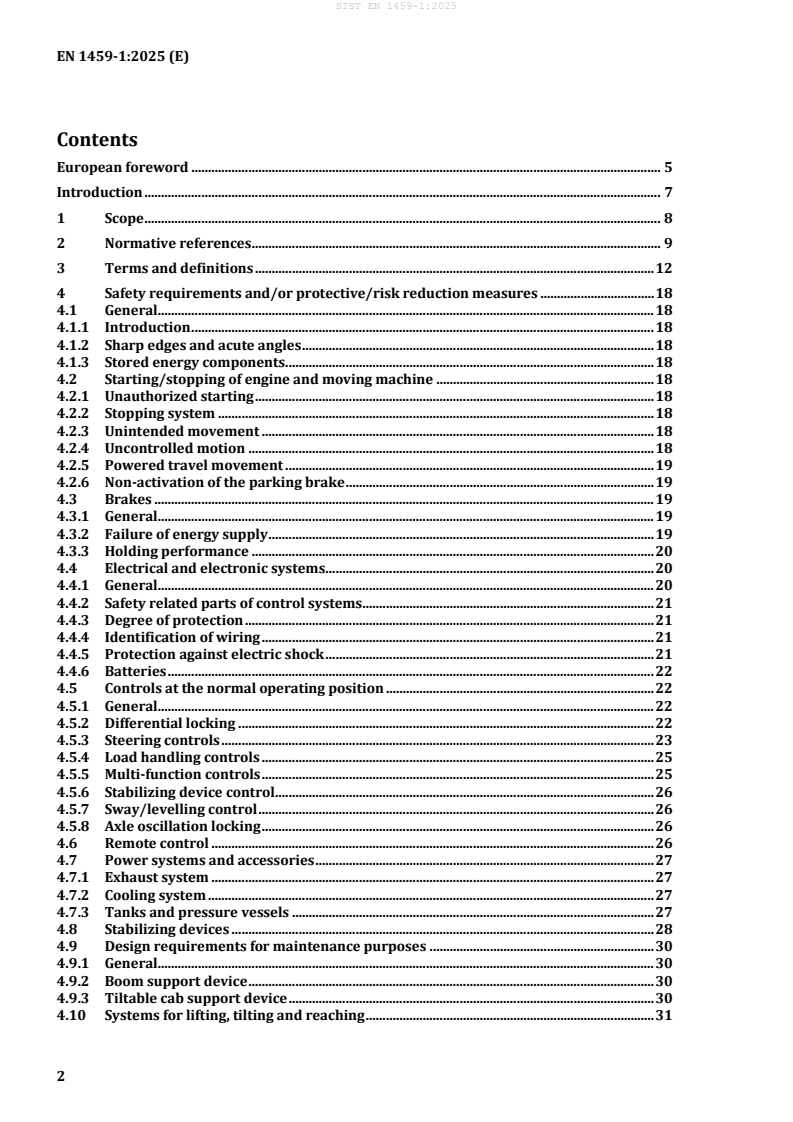
Contents
European foreword . 5
Introduction . 7
1 Scope . 8
2 Normative references . 9
3 Terms and definitions . 12
4 Safety requirements and/or protective/risk reduction measures . 18
4.1 General. 18
4.1.1 Introduction . 18
4.1.2 Sharp edges and acute angles . 18
4.1.3 Stored energy components . 18
4.2 Starting/stopping of engine and moving machine . 18
4.2.1 Unauthorized starting . 18
4.2.2 Stopping system . 18
4.2.3 Unintended movement . 18
4.2.4 Uncontrolled motion . 18
4.2.5 Powered travel movement . 19
4.2.6 Non-activation of the parking brake . 19
4.3 Brakes . 19
4.3.1 General. 19
4.3.2 Failure of energy supply . 19
4.3.3 Holding performance . 20
4.4 Electrical and electronic systems . 20
4.4.1 General. 20
4.4.2 Safety related parts of control systems . 21
4.4.3 Degree of protection . 21
4.4.4 Identification of wiring . 21
4.4.5 Protection against electric shock . 21
4.4.6 Batteries . 22
4.5 Controls at the normal operating position . 22
4.5.1 General. 22
4.5.2 Differential locking . 22
4.5.3 Steering controls . 23
4.5.4 Load handling controls . 25
4.5.5 Multi-function controls . 25
4.5.6 Stabilizing device control . 26
4.5.7 Sway/levelling control . 26
4.5.8 Axle oscillation locking . 26
4.6 Remote control . 26
4.7 Power systems and accessories . 27
4.7.1 Exhaust system . 27
4.7.2 Cooling system . 27
4.7.3 Tanks and pressure vessels . 27
4.8 Stabilizing devices . 28
4.9 Design requirements for maintenance purposes . 30
4.9.1 General. 30
4.9.2 Boom support device . 30
4.9.3 Tiltable cab support device . 30
4.10 Systems for lifting, tilting and reaching . 31
4.10.1 Chains and wire ropes . 31
4.10.2 Hydraulic system . 32
4.10.3 Maximum load lowering speed . 33
4.10.4 Limitation of stroke . 33
4.10.5 Fork arms . 33
4.10.6 Attachment interface . 33
4.11 Operator’s station . 34
4.11.1 General requirements . 34
4.11.2 Operator’s manual storage . 34
4.11.3 Pipes and hoses . 34
4.11.4 Operator's station . 34
4.11.5 Operator's seat . 37
4.11.6 Control panels, and symbols on displays . 38
4.12 Operator access . 39
4.12.1 General requirements . 39
4.12.2 Operator’s station openings . 39
4.13 Protective measures and devices . 40
4.13.1 Hot parts . 40
4.13.2 Protection against crushing, shearing and trapping . 40
4.13.3 Guards . 40
4.13.4 Engine compartment . 40
4.13.5 Fenders . 41
4.13.6 ROPS and FOPS . 41
4.13.7 Audible warning devices . 41
4.14 Stability requirements . 41
4.15 Visibility . 41
4.16 Lighting . 41
4.17 Fire protection . 42
4.17.1 Fire resistance . 42
4.17.2 Fire extinguisher . 42
4.18 Retrieval, transportation and lifting . 42
4.18.1 General . 42
4.18.2 Retrieval . 42
4.18.3 Tying-down . 42
4.18.4 Lifting . 42
4.19 Noise . 42
4.19.1 Noise emission reduction . 42
4.19.2 Emission sound pressure level at the operator's station . 43
4.20 Electromagnetic radiation . 43
4.20.1 Electromagnetic emissions . 43
4.20.2 Electromagnetic immunity . 43
5 Verification of safety requirements and/or protective/risk reduction measures . 44
5.1 General . 44
5.2 Functional verification . 44
5.3 Structural verification . 44
5.3.1 Test loads . 44
5.3.2 Static test . 44
5.3.3 Dynamic tests . 45
5.4 Load holding verification . 45
6 Information for use . 45
6.1 General . 45
6.2 Graphical symbols and warning . 46
6.2.1 Safety Signs and graphical symbols . 46
6.2.2 Graphical symbol of lift points . 46
6.2.3 Graphical symbol of tie-down points . 46
6.2.4 Graphical symbol of retrieval points . 47
6.2.5 Graphical symbol for pneumatic tyre inflation pressures . 47
6.2.6 Graphical symbol for fuel filling points . 47
6.2.7 Graphical symbol for hydraulic fluid filling points . 48
6.2.8 Graphical symbols for stored energy components . 48
6.2.9 Graphical symbol for brake fluid filling points . 49
6.2.10 Graphical symbol for battery disconnection . 50
6.2.11 Warnings . 50
6.3 Instruction handbook. 50
6.3.1 General. 50
6.3.2 Operating and maintenance instructions . 51
6.4 Marking . 54
6.5 Load chart . 55
Annex A (informative) List of significant hazards . 57
Annex B (informative) Consistency of motions . 63
Annex C (normative) Rules for the construction and layout of pedals . 65
C.1 Terms and definitions . 65
C.2 Requirements . 65
C.2.1 General. 65
C.2.2 Service brake pedal . 66
C.2.3 Clutch pedal . 66
C.2.4 Accelerator pedal . 66
C.2.5 Inching pedal . 66
C.3 Design and manufacture . 66
Annex ZA (informative) Relationship between this European Standard and the essential
requirements of Directive 2006/42/EC aimed to be covered . 68
Bibliography . 72
European foreword
This document (EN 1459-1:2025) has been prepared by Technical Committee CEN/TC 150 “Industrial
Trucks - Safety”, the secretariat of which is held by BSI.
This European Standard shall be given the status of a national standard, either by publication of an
identical text or by endorsement, at the latest by October 2025, and conflicting national standards shall
be withdrawn at the latest by October 2025.
Attention is drawn to the possibility that some of the elements of this document may be the subject of
patent rights. CEN shall not be held responsible for identifying any or all such patent rights.
This document supersedes EN 1459-1:2017+A1:2020.
In comparison with the previous edition, the following technical modifications have been made:
— requirements for trucks not fitted with an enclosed cab;
— update of normative references;
— other minor changes, mainly editorial clarifications of existing requirements.
EN 1459 consists of the following parts, under the general title Rough-terrain trucks — Safety
requirements and verification:
— Part 1: Variable-reach trucks
— Part 2: Slewing variable-reach trucks
— Part 3: Interface between the variable-reach truck and the work platform
— Part 4: Additional requirements for variable-reach trucks handling suspended loads
— Part 5: Attachment interface
— Part 6: Application of EN ISO 13849-1 to slewing and non-slewing variable-reach rough-terrain truck
(technical report)
— Part 8: Variable-reach tractors
— Part 9: Variable-reach trucks equipped with work platforms having a frontguard that can be opened
This document has been prepared under a standardization request given to CEN by the European
Commission. The Standing Committee of the EFTA States subsequently approves these requests for its
Member States.
For the relationship with EU Legislation, see informative Annex ZA, which is an integral part of this
document.
Any feedback and questions on this document should be directed to the users’ national standards body.
A complete listing of these bodies can be found on the CEN website.
According to the CEN-CENELEC Internal Regulations, the national standards organisations of the
following countries are bound to implement this European Standard: Austria, Belgium, Bulgaria, Croatia,
Cyprus, Czech Republic, Denmark, Estonia, Finland, France, Germany, Greece, Hungary, Iceland, Ireland,
Italy, Latvia, Lithuania, Luxembourg, Malta, Netherlands, Norway, Poland, Portugal, Republic of North
Macedonia, Romania, Serbia, Slovakia, Slovenia, Spain, Sweden, Switzerland, Türkiye and the United
Kingdom.
Introduction
This document covers general safety requirements and the means for verification of these requirements
for rough-terrain variable-reach trucks.
All quantities are in SI units, and this includes metric units.
This document is a type C standard as stated in EN ISO 12100:2010.
This document is of relevance, in particular, for the following stakeholder groups representing the market
players with regard to machinery safety:
— machine manufacturers (small, medium and large enterprises);
— health and safety bodies (regulators, accident prevention organizations, market surveillance etc.).
Others can be affected by the level of machinery safety achieved with the means of the document by the
above-mentioned stakeholder groups:
— machine users/employers (small, medium and large enterprises);
— machine users/employees (e.g. trade unions, organizations for people with special needs);
— service providers, e.g. for maintenance (small, medium and large enterprises);
— consumers (in case of machinery intended for use by consumers).
The above-mentioned stakeholder groups have been given the possibility to participate at the drafting
process of this document.
The machinery concerned and the extent to which hazards, hazardous situations or hazardous events are
covered are indicated in the scope of this document.
When provisions of this type C standard are different from those which are stated in type A or B
standards, the provisions of this type C standard take precedence over the provisions of the other
standards, for machines that have been designed and built according to the provisions of this type C
standard.
1 Scope
This document specifies the safety requirements of self-propelled rough-terrain variable-reach trucks
(hereafter referred to as trucks), intended to handle loads, equipped with a telescopic lifting means
(pivoted boom), on which a load handling device (e.g. carriage and fork arms) is fitted.
For the purpose of this document, rough-terrain variable-reach trucks are designed to transport, lift and
place loads and can be driven on unimproved terrain.
Fork arms are considered to be part of the truck. Trucks can also be equipped with a variety of
attachments (e.g. bale spikes, mowers, sweepers).
This document deals with all the significant hazards, hazardous situations and events relevant to the
trucks when they are used as intended and under conditions of misuse which are reasonably foreseeable
by the manufacturer (see Annex A).
This document does not apply to:
— slewing rough-terrain variable-reach trucks covered by EN 1459-2:2015+A1:2018;
— rough-terrain variable-reach tractors covered by CEN/TS 1459-8;
— industrial variable reach trucks covered by EN ISO 3691-2:2023;
— lorry-mounted variable-reach trucks covered by ISO 20297-1:2017;
— variable-reach trucks fitted with tilting or elevating operator position;
— mobile cranes covered by EN 13000:2010+A1:2014;
— machines designed primarily for earth moving, even if their buckets and blades are replaced with
forks (see EN 474 series);
— trucks designed primarily with variable length load suspension elements (e.g. chain, ropes) from
which the load may swing freely in all directions;
— trucks designed primarily for container handling;
— trucks on tracks;
— trucks with articulated chassis;
— attachments.
Determination and declaration of sound power level is not addressed by this document.
This document does not cover sales literature.
This document does not address hazards linked to:
— operation of the truck from a position other than the normal operating position or the remote
control;
— hybrid power systems;
— gas power systems;
— gasoline engine systems;
— battery power systems.
This document does not address hazards which may occur:
a) when handling suspended loads which may swing freely (additional requirements are given in
EN 1459-4:2020+A1:2025);
b) when using trucks on public roads;
c) when operating in potentially explosive atmospheres (additional requirements are given in
EN 1755:2024);
d) when operating underground;
e) when towing trailers;
f) when fitted with a personnel work platform (additional requirements are given in EN 1459-3:2015
and EN 1459-9:2021);
g) when using system capable of controlling the speed of the truck as set by the operator (cruise-
control).
This document does not provide a method of calculation for fatigue and strength of material.
This document is not applicable to trucks manufactured before the date of its publication.
2 Normative references
The following documents are referred to in the text in such a way that some or all of their content
constitutes requirements of this document. For dated references, only the edition cited applies. For
undated references, the latest edition of the referenced document (including any amendments) applies.
EN 1459-5:2020+A1:2025, Rough-terrain trucks - Safety requirements and verification - Part 5:
Attachment interface
EN 12053:2001+A1:2008, Safety of industrial trucks - Test methods for measuring noise emissions
EN 12895:2015+A1:2019, Industrial trucks - Electromagnetic compatibility
EN 13059:2002+A1:2008, Safety of industrial trucks - Test methods for measuring vibration
EN 15000:2008, Safety of industrial trucks - Self propelled variable reach trucks - Specification,
performance and test requirements for longitudinal load moment indicators and longitudinal load moment
limiters
EN 15830:2012, Rough-terrain variable reach trucks - Visibility - Test methods and verification
EN 17314:2020, Industrial trucks - Specifications and test methods - Operator restraint systems other than
lap-type seat belts
EN 60529:1991, Degrees of protection provided by enclosures (IP Code) (IEC 60529:1989)
Document impacted by EN 60529:1991/A1:2000 and EN 60529:1991/A2:2013.
EN IEC 62061:2021, Safety of machinery - Functional safety of safety-related control systems
(IEC 62061:2021)
EN ISO 2860:2008, Earth-moving machinery - Minimum access dimensions (ISO 2860:1992)
EN ISO 2867:2011, Earth-moving machinery - Access systems (ISO 2867:2011)
EN ISO 3411:2007, Earth-moving machinery - Physical dimensions of operators and minimum operator
space envelope (ISO 3411:2007)
EN ISO 3449:2008, Earth-moving machinery - Falling-object protective structures - Laboratory tests and
performance requirements (ISO 3449:2005)
EN ISO 3457:2008, Earth-moving machinery - Guards - Definitions and requirements (ISO 3457:2003)
EN ISO 3471:2008, Earth-moving machinery - Roll-over protective structures - Laboratory tests and
performance requirements (ISO 3471:2008)
EN ISO 4413:2010, Hydraulic fluid power - General rules and safety requirements for systems and their
components (ISO 4413:2010)
EN ISO 5353:1998, Earth-moving machinery, and tractors and machinery for agriculture and forestry - Seat
index point (ISO 5353:1995)
EN ISO 6682:2008, Earth-moving machinery - Zones of comfort and reach for controls (ISO 6682:1986,
including Amd 1:1989)
EN ISO 6683:2008, Earth-moving machinery - Seat belts and seat belt anchorages - Performance
requirements and tests (ISO 6683:2005)
EN ISO 7096:2020, Earth-moving machinery - Laboratory evaluation of operator seat vibration (ISO
7096:2020)
EN ISO 11688-1:2009, Acoustics - Recommended practice for the design of low-noise machinery and
equipment - Part 1: Planning (ISO/TR 11688-1:1995)
EN ISO 12100:2010, Safety of machinery - General principles for design - Risk assessment and risk reduction
(ISO 12100:2010)
EN ISO 13766-1:2018, Earth-moving and building construction machinery - Electromagnetic compatibility
(EMC) of machines with internal electrical power supply - Part 1: General EMC requirements under typical
electromagnetic environmental conditions (ISO 13766-1:2018)
EN ISO 13849-1:2023, Safety of machinery - Safety-related parts of control systems - Part 1: General
principles for design (ISO 13849-1:2023)
EN ISO 13850:2015, Safety of machinery - Emergency stop function - Principles for design (ISO 13850:2015)
EN ISO 13857:2019, Safety of machinery - Safety distances to prevent hazard zones being reached by upper
and lower limbs (ISO 13857:2019)
ISO 2328:2011, Fork-lift trucks — Hook-on type fork arms and fork arm carriages — Mounting dimensions
ISO 2330:2002, Fork-lift trucks — Fork arms — Technical characteristics and testing
ISO 3767-1:2016, Tractors, machinery for agriculture and forestry, powered lawn and garden equipment
— Symbols for operator controls and other displays — Part 1: Common symbols
ISO 3795:1989, Road vehicles, and tractors and machinery for agriculture and forestry — Determination of
burning behaviour of interior materials
ISO 3864-1:2011, Graphical symbols — Safety colours and safety signs — Part 1: Design principles for safety
signs and safety markings
ISO 3864-2:2016, Graphical symbols — Safety colours and safety signs — Part 2: Design principles for
product safety labels
ISO 3864-3:2024, Graphical symbols — Safety colours and safety signs — Part 3: Design principles for
graphical symbols for use in safety signs
ISO 3864-4:2011, Graphical symbols — Safety colours and safety signs — Part 4: Colorimetric and
photometric properties of safety sign materials
ISO 5053-1:2020, Industrial trucks — Vocabulary — Part 1: Types of industrial trucks
ISO 6011:2023, Earth-moving machinery — Visual display of machine operation
ISO 6292:2020, Powered industrial trucks and tractors — Brake performance and component strength
ISO 7000:2019, Graphical symbols for use on equipment — Registered symbols
ISO 9244:2008, Earth-moving machinery — Machine safety labels — General principles
ISO 9533:2010, Earth-moving machinery — Machine-mounted audible travel alarms and forward horns —
Test methods and performance criteria
ISO 10263-2:2009, Earth-moving machinery — Operator enclosure environment — Part 2: Air filter
element test method
ISO 10263-3:2009, Earth-moving machinery — Operator enclosure environment — Part 3: Pressurization
test method
ISO 10263-4:2009, Earth-moving machinery — Operator enclosure environment — Part 4: Heating,
ventilating and air conditioning (HVAC) test method and performance
ISO 11112:1995, Earth-moving machinery - Operator’s seat - Dimensions and requirements
ISO 12508:1994, Earth-moving machinery — Operator station and maintenance areas — Bluntness of
edges
ISO 12509:2023, Earth-moving machinery and rough-terrain trucks — Lighting, signalling and marking
lights, and reflex reflectors
ISO 13333:1994, Earth-moving machinery — Dumper body support and operator's cab tilt support devices
Document impacted by ISO 9244:2008/A1:2016.
Document impacted by ISO 11112:1995/A1:2001.
ISO 15817:2012, Earth-moving machinery — Safety requirements for remote operator control systems
ISO 15818:2017, Earth-moving machinery — Lifting and tying-down attachment points — Performance
requirements
ISO 15870:2000, Powered industrial trucks — Safety signs and hazard pictorials — General principles
ISO 16528-1:2007, Boilers and pressure vessels — Part 1: Performance requirements
ISO 16528-2:2007, Boilers and pressure vessels — Part 2: Procedures for fulfilling the requirements of ISO
16528-1
ISO 21507:2010, Earth-moving machinery — Performance requirements for non-metallic fuel tanks
ISO 22915-10:2023, Industrial trucks — Verification of stability — Part 10: Additional stability test for
trucks operating in the special condition of stacking with load laterally displaced by powered devices
ISO 22915-14:2010, Industrial trucks — Verification of stability — Part 14: Rough-terrain variable-reach
trucks
ISO 22915-20:2023, Industrial trucks — Verification of stability — Part 20: Additional stability test for
trucks operating in the special condition of offset load, offset by utilization
3 Terms and definitions
For the purposes of this document, the terms and definitions given in EN ISO 12100:2010,
ISO 5053-1:2020 and the following apply.
ISO and IEC maintain terminological databases for use in standardization at the following addresses:
• IEC Electropedia: available at http://www.electropedia.org/
• ISO Online browsing platform: available at http://www.iso.org/obp
3.1
rough-terrain variable-reach truck
variable-reach truck intended primarily for operation on unimproved natural terrain and on the
disturbed terrain of, for example, construction site
[SOURCE: ISO 5053-1:2020, 3.21]
3.2
variable-reach truck
lift truck fitted with one or more articulated arms, telescopic or not, non-slewing or having a slewing
movement of not more than 5° either side of the longitudinal axis of the truck used for stacking loads
[SOURCE: ISO 5053-1:2020, 3.20]
Note 1 to entry: See Figure 1.
Figure 1 — Variable-reach truck
3.3
compact truck
truck having a maximum height in normal travel mode of 2 150 mm and at least one of the following
conditions:
— a maximum operating mass of 7 000 kg;
— a maximum width in normal travel mode of 2 000 mm
Note 1 to entry: These dimensions do not include equipment such as working lights, mirrors, etc.
3.4
actual capacity
Q
maximum load, established by the manufacturer based on components strength and truck stability, that
the truck can carry, lift and stack to a specified height, at a specified standard load centre distance and
reach, in normal operating conditions
Note 1 to entry: The actual capacity depends on the configuration of the truck in terms of such variables as:
— lift height;
— reach of the boom;
— standard load centre distance;
— load handling device (fork arms or attachment fitted);
— stabilizing devices.
Note 2 to entry: This actual capacity defines the load handling ability of the particular truck as equipped. Additional
actual capacity ratings with removable attachments may also be established where permitted by the appropriate
stability test or by calculation verified by empirical data.
3.5
rated capacity
Q1
maximum load permitted by the manufacturer at the standard load centre distance (D) that the truck is
capable of lifting and transporting on fork arms in normal conditions with the boom fully retracted
3.6
reach
d
distance between two vertical parallel planes, one plane tangent to the front of the outside diameter of
the front tyres, the other plane described by the vertical projection of the centre-of-gravity of the load to
the ground
Note 1 to entry: The centre-of-gravity of the load (G) is defined in Table 1.
Note 2 to entry: See Figure 2 for examples of reach.
Note 3 to entry: For practical matters, d can be measured referring to point g, being g the vertical projection of the
centre-of-gravity (G) of the load onto the plane of the top surface of the fork arms.
Key
d Reach
D standard load centre distance
G centre of gravity of the load
g the vertical projection of the centre-of-gravity (G) of the load onto the plane of the top surface of the fork
arms
H height of the load
Q actual capacity
Q1 rated capacity
Q2 actual capacity at maximum height or elevation
Q3 actual capacity at maximum reach
Figure 2 — Parameters for the designation of the actual capacity of the truck with fork
3.7
lift height
H
vertical distance between the upper face of the fork arms and the ground
Note 1 to entry: See Figure 2.
3.8
standard load centre distance
D
distance from the centre of gravity (G) of the load measured horizontally back to the front of the fork
shanks and vertically down to the upper faces of the fork arms, as specified in Table 1
Note 1 to entry: See Figure 2, for example.
Note 2 to entry: Typical standard load centre distances are given in Table 1. Trucks may be rated for special
applications with load centres related to those applications which may be different from those listed in Table 1.
Table 1 — Typical standard load centre distance
Rated capacity Q in kg Standard load centre distance D in mm
400 500 600 900 1 200
0 < 1 000 X
≥ 1 000 < 5 000 X
≥ 5 000 ≤ 10 000 X
> 10 000 < 20 000 X X X
≥ 20 000 < 25 000 X X
≥ 25 000 X
3.9
axle oscillation lock
mechanism designed to prevent oscillation of an axle to improve truck stability
3.10
stabilising devices
extendable and/or pivoting mechanical supports used to improve stability of a truck when stationary
3.11
lateral levelling
changing the lateral inclination angle between the chassis and the ground to ensure the boom operates
in a vertical plane even when the truck is positioned on a side slope
3.12
forks
device comprising two or more solid fork arms, each consisting of a shank (vertical portion) and blade,
which is hook- or shaft-mounted, fitted on the carriage and usually adjusted manually
3.13
boom
pivoting support member that permits horizontal and vertical positioning of the load or attachment
3.14
crab steering mode
steering mode where all wheels of the truck steer in the same direction
3.15
normal operating position
position specified by the manufacturer in which the operator is able to control the truck operations,
including load handling functions
3.16
attachment bracket
device fitted at the end of the boom to mount interchangeable attachments to facilitate quick interchange
of attachment
3.17
boom float
operating mode that uses gravity to allow an attachment at the end of the boom to follow a contour (e.g.
the ground)
3.18
maximum working pressure
maximum pressure in the hydraulic circuit during normal operation
Note 1 to entry: This definition is derived from ISO 10972-3:2003, 3.2.
3.19
level ground
ground with a gradient of (0 ± 2) %
3.20
operating mass
mass of the truck equipped with forks, unladen, and with the operator (75 kg), full fuel tank and all fluid
systems (i.e. hydraulic oil, transmission oil, engine oil, engine coolant) at the levels specified by the
manufacturer
3.21
technically permissible maximum operating mass
operating mass without the forks and including the heaviest permitted attachment without load
3.22
operator’s station
part of the machine which surrounds the normal operating position
3.23
enclosed cab
cab where door(s) or windows are fitted to all openings
3.24
open cab
cab which is not an enclosed cab
...
Questions, Comments and Discussion
Ask us and Technical Secretary will try to provide an answer. You can facilitate discussion about the standard in here.
Loading comments...