


oSIST prEN 415-2:2022
(Main)Safety of packaging machines - Part 2: Packaging machines for pre-formed rigid containers
Safety of packaging machines - Part 2: Packaging machines for pre-formed rigid containers
This document applies to the following machines and to machines which incorporate more than one function as listed below. The document also applies to partly completed machinery as far as conformity is claimed for certain essential health and safety requirements.
This document deals with the following machines handling rigid containers including:
- unscrambling machines;
- cap removing machines;
- cleaning machines;
- sanitizing machines;
- filling machines;
- capping, closing and sealing machines;
- closure securing machines;
- inspection machines;
- labelling machines;
- decorating machines;
- heating- and cooling machines for packed product, working at atmospheric pressure;
- sterilizing machines (others than heat treatment)
with one or more of the following functions: cleaning, sanitizing, pasteurizing, filling, labelling, closing, sealing or inspecting and handling pre-formed rigid containers including their closures.
This document also deals with equipment when it is part of a machine listed above:
- conveyors;
- vacuum or magnetic transfer conveyors;
- dispose or eject devices (pushers);
- keg stopping devices;
- keg lift and inverting machines;
- extraction or ventilation system or blowers;
- hoppers;
- rotary mechanisms;
- coding and marking equipment incorporated in a packaging machine;
- hot foil coders;
- laser coders;
- ink jet coders;
- emboss coders.
The individual machines are described in 3.2.
This document deals with safety requirements and their verification for machine design, construction and information applicable to installation, commissioning, operation, adjustment, maintenance, cleaning, dismantling of packaging machines for pre-formed rigid containers.
The extent to which hazards, hazardous situations and events are covered is indicated in Annex B.
NOTE The hazards on a specific machine can vary depending on its working principle; the type, size and mass of the product; the packaging material; auxiliary equipment attached to the machine and the environment in which the machine is used. If the machine presents hazards that are not covered by this document or EN 415-10, the manufacturer can assess these hazards and take measures by using the principles detailed in EN ISO 12100:2010.
Exclusions
This document is not applicable to the following machines:
- machines that were manufactured before the date of publication of this document by CEN;
- machines for cups or trays or tubs made of a foil of plastic, aluminium or paper, which are the subject of EN 415-3;
- aerosol filling and sealing machines;
- filling machines for gas;
- autoclaves;
- conveyors which link packaging machines but are not integrated in packaging machines or part of packaging machines;
- blow moulding machines;
NOTE See EN 422:2009:
- sleeve label removing machines.
This document does not consider the following hazards:
- the use of packaging machines in potentially explosive atmospheres not generated by the machine itself;
- hazards associated with packing explosives;
- hazards arising from ancillary equipment, which is not part of the machine, e.g. equipment for evacuating gases, for cooling or refrigeration, for the supply of steam, energy or product.
Sicherheit von Verpackungsmaschinen - Teil 2: Verpackungsmaschinen für vorgefertigte formstabile Packmittel
Dieses Dokument gilt für die folgenden Maschinen und für Maschinen, die mehr als eine der unten aufgeführten Funktionen aufweisen. Das Dokument gilt auch für unvollständige Maschinen, soweit die Konformität mit bestimmten grundlegenden Sicherheits- und Gesundheitsschutzanforderungen geltend gemacht wird.
Dieses Dokument behandelt die folgenden Maschinen, die formstabile Packmittel handhaben, einschließlich:
- Vereinzelungs- und Aufrichtmaschinen;
- Kappenentfernungsmaschinen;
- Reinigungsmaschinen;
- Entkeimungsmaschinen;
- Füllmaschinen;
- Kappen-, Deckelverschließ- und Versiegelungsmaschinen;
- Verschlusssicherungsmaschinen;
- Inspektionsmaschinen;
- Etikettiermaschinen;
- Dekoriermaschinen;
- Heiz- und Kühlmaschinen für verpackte Produkte, die bei atmosphärischem Druck arbeiten;
- Sterilisiermaschinen (außer Wärmebehandlungsmaschinen)
mit einer oder mehreren der folgenden Funktionen: Reinigen, Entkeimen, Pasteurisieren, Abfüllen, Etikettieren, Verschließen, Versiegeln oder Kontrollieren und Handhaben vorgefertigter formstabiler Packmittel einschließlich ihrer Verschlüsse.
Dieses Dokument behandelt auch Ausrüstungen, die Teil einer der oben genannten Maschinen sind:
- Fördereinrichtungen;
- Vakuum- oder magnetische Transferförderer;
- Verteil- oder Ausstoßeinrichtungen (Schieber);
- KEG-Stoppeinrichtungen;
- KEG-Hebe- und -Kippmaschinen;
- Absaug- oder Lüftungsanlage oder Ventilatoren;
- Trichter;
- Rundläufermechanismen;
- Codier- und Markiereinrichtung, die in eine Verpackungsmaschine integriert ist;
- Heißfoliencodierer;
- Lasercodierer;
- Tintenstrahlcodierer;
- Prägecodierer.
Die einzelnen Maschinen sind in 3.2 beschrieben.
Dieses Dokument befasst sich mit den Sicherheitsanforderungen und deren Verifizierung für die Konstruktion und den Bau von Maschinen sowie mit Informationen, die für die Installation, die Inbetriebnahme, den Betrieb, die Einstellung, die Wartung, die Reinigung und die Demontage von Verpackungsmaschinen für vorgefertigte formstabile Packmittel gelten.
Der Umfang, in dem Gefährdungen, Gefährdungssituationen und Ereignisse abgedeckt sind, ist in Anhang B angegeben.
ANMERKUNG Die Gefährdungen an einer bestimmten Maschine können je nach deren Funktionsprinzip; dem Typ, Größe und Masse des Produkts; dem Verpackungsmaterial, den an der Maschine angebrachten Hilfseinrichtungen und der Umgebung, in der die Maschine eingesetzt wird, variieren. Wenn von der Maschine Gefährdungen ausgehen, die nicht von diesem Dokument oder EN 415 10 abgedeckt sind, kann der Hersteller diese Gefährdungen bewerten und Maßnahmen nach den in EN ISO 12100:2010 angegebenen Grundsätzen ergreifen.
Ausschlüsse
Dieses Dokument gilt nicht für die folgenden Maschinen:
- Maschinen, die vor dem Datum der Veröffentlichung dieses Dokuments durch CEN hergestellt wurden;
- Maschinen für Becher oder Schalen oder Kübel aus Kunststofffolie, Aluminium oder Papier, die unter von EN 415 3 fallen;
- Aerosolabfüll- und Versiegelungsmaschinen;
- Füllmaschinen für Gas;
- Autoklaven;
- Fördereinrichtungen, die Verpackungsmaschinen verbinden, aber nicht in Verpackungsmaschinen integriert oder Teil von Verpackungsmaschinen sind;
- Blasformmaschinen;
ANMERKUNG Siehe EN 422:2009:
- Maschinen zum Entfernen von Banderolen.
In diesem Dokument werden die folgenden Gefährdungen nicht berücksichtigt:
- die Verwendung von Verpackungsmaschinen in explosionsgefährdeten Atmosphären, die nicht von der Maschine selbst erzeugt werden;
- Gefährdungen im Zusammenhang mit der Verpackung von Explosivstoffen;
- Gefährdungen, die von Hilfseinrichtungen ausgehen, die nicht Teil der Maschine sind, z. B. Einrichtungen zum Ableiten von Gasen, zur Kühlung, zur Dampf-, Energie- oder Produktversorgung.
Sécurité des machines d'emballage - Partie 2: Machines d'emballage pour contenants rigides préformés
Le présent document s'applique aux machines suivantes et aux machines qui comportent plus d’une fonction telles qu’indiquées ci-dessous. Le document s’applique également aux quasi machines dans la mesure où la conformité à certaines exigences essentielles de santé et de sécurité est réclamée.
Le présent document traite des machines suivantes manipulant des contenants rigides parmi lesquels :
- arrangeuses ;
- décapsuleuses ;
- machines de nettoyage ;
- machines de désinfection ;
- remplisseuses ;
- capsuleuses, fermeuses et scelleuses ;
- machines à sécuriser les fermetures ;
- machines de contrôle (vérificateurs) ;
- étiqueteuses ;
- décoreuses ;
- chauffeuses et refroidisseurs de produits emballés, fonctionnant à la pression atmosphérique ;
- machines de stérilisation (autres que par traitement thermique)
disposant d’une ou de plusieurs des fonctions suivantes : nettoyage, désinfection, pasteurisation, remplissage, fermeture, étanchéité ou contrôle et manipulation de contenants rigides préformés, y compris leurs fermetures.
Le présent document traitement également des équipements lorsque ceux-ci font partie d’une des machines citées ci-dessus :
- convoyeurs ;
- convoyeurs sous vide ou à bande magnétique ;
- dispositifs d’éjection ou d’élimination (poussoirs) ;
- dispositifs d'arrêt de fûts ;
- machines de levage et de retournement de fûts ;
- système d’extraction ou de ventilation ou souffleurs ;
- trémies ;
- mécanismes rotatifs ;
- équipement de codage et marquage incorporés dans une machine d’emballage ;
- codeuses de feuille à chaud ;
- codeuses à laser ;
- codeuses à jet d'encre ;
- codeuses en relief.
Chaque machine est décrite en 3.2.
Le présent document traite des prescriptions de sécurité et leur vérification pour la conception, la construction de machines et les informations applicables à l’installation, la mise en service, le fonctionnement, le réglage, la maintenance, le nettoyage, le démontage de machines d'emballage pour contenants rigides préformés.
L'étendue des phénomènes dangereux, situations et évènements dangereux couverts est indiquée en Annexe B.
NOTE Les phénomènes dangereux associés à une machine spécifique peuvent varier en fonction de son principe de travail ; le type, la taille et la masse du produit ; le matériau d’emballage ; l’équipement auxiliaire relié à la machine et l’environnement dans lequel la machine est utilisée. Si la machine présente des phénomènes dangereux non couverts par le présent document ou l’EN 415-10, le fabricant peut apprécier ces phénomènes dangereux et prendre des mesures à l’aide des principes détaillés dans l’EN ISO 12100:2010.
Exclusions
Le présent document ne s’applique pas aux machines suivantes :
- machines fabriquées avant la date de publication du présent document par le CEN ;
- machines fabricant des godets, des plateaux ou des tubes en feuille de plastique, d’aluminium ou de papier et soumises à l’EN 415-3 ;
- machines à remplir et à sceller les aérosols ;
- remplisseuses de gaz ;
- autoclaves ;
- convoyeurs qui relient les machines d’emballage mais ne sont pas intégrés aux machines d’emballage ou à une partie d’entre elles ;
- machines de soufflage ;
NOTE Voir l’EN 422-2009 :
- machines à retirer les manchons.
Le présent document ne prend pas en considération les phénomènes dangereux suivants :
- l'utilisation de machines d'emballage dans des atmosphères explosives non générées par la machine elle-même ;
- les phénomènes dangereux associés à l'emballage d'explosifs ;
- les phénomènes dangereux engendrés par les équipements auxiliaires, qui ne font pas partie de la machine, par exemple, les équipements pour l’évacuation des gaz, le refroidissement ou la réfrigération, l’alimentation en vapeur, en énergie ou en produit.
Varnost pakirnih strojev - 2. del: Pakirni stroji za vlaganje v pripravljeno predoblikovano embalažo
General Information
- Status
- Not Published
- Public Enquiry End Date
- 29-Apr-2022
- Technical Committee
- DTN - Lift and transport appliances
- Current Stage
- 4020 - Public enquire (PE) (Adopted Project)
- Start Date
- 23-Feb-2022
- Due Date
- 13-Jul-2022
- Completion Date
- 06-May-2022
- Directive
- Harmonized Standard2006/42/EC - Directive 2006/42/EC of the European Parliament and of the Council of 17 May 2006 on machinery, and amending Directive 95/16/EC (recast)
Not Harmonized98/37/EC - Machinery

Relations
- Effective Date
- 28-Jan-2026
- Effective Date
- 28-Jan-2026
- Referred By
SIST EN 3264:2010 - Aerospace series - Pipe coupling 8°30' in titanium alloy - Thrust wire nuts - Effective Date
- 28-Jan-2026
- Effective Date
- 28-Jan-2026
- Referred By
SIST EN 3789:2002 - Aerospace series - Pipe coupling 8°30' - Protective plugs with external threads - Effective Date
- 28-Jan-2026
- Effective Date
- 28-Jan-2026
- Effective Date
- 28-Jan-2026
- Effective Date
- 28-Jan-2026
- Effective Date
- 28-Jan-2026
- Effective Date
- 28-Jan-2026
- Effective Date
- 28-Jan-2026
- Referred By
SIST EN 4029:2002 - Aerospace series - Pipe coupling 8°30' in titanium alloy - Tees bulkhead branch - Effective Date
- 28-Jan-2026
- Effective Date
- 28-Jan-2026
- Effective Date
- 28-Jan-2026
- Effective Date
- 28-Jan-2026
Overview
oSIST prEN 415-2:2022 is a draft European standard developed by the Slovenski inštitut za standardizacijo (SIST), outlining safety requirements for packaging machines that handle pre-formed rigid containers. This standard applies to a broad range of machinery, including those used for unscrambling, cleaning, filling, sealing, labelling, and inspecting rigid containers such as bottles, cans, jars, and kegs. It aims to ensure that packaging machines meet essential health and safety requirements throughout their lifecycle, covering installation, commissioning, operation, maintenance, and dismantling.
Key Topics
Scope of Machinery Covered
- Unscrambling, cleaning, sanitizing, and filling machines for rigid containers
- Capping, closing, sealing, and closure securing machines
- Inspection, labelling, and decorating machines
- Heating, cooling, and non-heat sterilizing machines for packed products
- Associated equipment such as conveyors, ejectors, coding and marking equipment (hot foil, laser, inkjet, emboss coders), ventilation systems, and rotary mechanisms
Core Safety Requirements
- Inherently safe design to eliminate or minimize mechanical hazards
- Use of fixed and interlocking guards, and electro-sensitive protection equipment where necessary
- Detailed verification of safety measures, including risk assessments, visual inspections, and measurements
- Clear instructions for safe operation, maintenance, cleaning, and dismantling
Machine Lifecycle and Risk Management
- Comprehensive consideration of hazards based on machine type, product handled, packaging material, auxiliary attachments, and operating environment
- Application of risk reduction principles in line with EN ISO 12100:2010 for hazards not explicitly covered
Exclusions and Limitations
- Not applicable to machines produced before publication date, machines for cups/trays/tubs per EN 415-3, aerosol and gas filling machines, autoclaves, non-integrated conveyors, blow moulding machines, sleeve label removers, and machines in explosive atmospheres not caused by the machinery itself
Applications
Industrial Relevance
- Used in sectors where the packaging of products into rigid containers is essential, including food and beverages, pharmaceuticals, cosmetics, and chemicals
- Enhances operator and consumer safety by defining requirements for machine construction, operator interfaces, and hygienic design-crucial in food and beverage industries
Practical Value
- Helps manufacturers comply with EU Machinery Directive 2006/42/EC and other regulations
- Supports machinery designers and integrators in selecting and configuring safe packaging lines
- Enables user companies to assess and verify safety when installing or upgrading packaging machines with rigid containers
Benefits for Stakeholders
- Manufacturers: Facilitates market access and regulatory compliance for new and updated machinery
- Users and Service Providers: Ensures safe operation, reduces workplace incidents, and standardizes safety measures for maintenance and cleaning
- Health and Safety Regulators: Provides clear reference points for inspection and conformity assessment
Related Standards
This standard is part of the broader EN 415 series, which covers safety for packaging machinery:
- EN 415-1: Terminology and classification of packaging machines and equipment
- EN 415-3: Packaging machines for cups, trays, or tubs made of foil (plastic, aluminium, or paper)
- EN 415-9: Noise measurement methods for packaging machines and lines
- EN 415-10: General safety requirements for packaging machines
Other referenced standards include:
- EN ISO 12100: Safety of machinery - General risk assessment principles
- EN 1672-2: Food processing machinery - Hygiene and cleanability requirements
- EN ISO 14120: Machinery guards - Design and construction requirements
Conclusion
oSIST prEN 415-2:2022 provides a comprehensive framework for the safety of packaging machines handling pre-formed rigid containers. By addressing a wide range of functions and equipment, and focusing on risk assessment, machine lifecycle, and compliance with European legislation, this standard is vital to ensuring robust safety across the packaging machinery sector. Adopting this standard not only mitigates occupational hazards but also supports regulatory adherence and operational efficiency in packaging processes.
Get Certified
Connect with accredited certification bodies for this standard

BRCGS (Brand Reputation Compliance Global Standards)
Global food safety and quality standards owner.
Sponsored listings
Frequently Asked Questions
oSIST prEN 415-2:2022 is a draft published by the Slovenian Institute for Standardization (SIST). Its full title is "Safety of packaging machines - Part 2: Packaging machines for pre-formed rigid containers". This standard covers: This document applies to the following machines and to machines which incorporate more than one function as listed below. The document also applies to partly completed machinery as far as conformity is claimed for certain essential health and safety requirements. This document deals with the following machines handling rigid containers including: - unscrambling machines; - cap removing machines; - cleaning machines; - sanitizing machines; - filling machines; - capping, closing and sealing machines; - closure securing machines; - inspection machines; - labelling machines; - decorating machines; - heating- and cooling machines for packed product, working at atmospheric pressure; - sterilizing machines (others than heat treatment) with one or more of the following functions: cleaning, sanitizing, pasteurizing, filling, labelling, closing, sealing or inspecting and handling pre-formed rigid containers including their closures. This document also deals with equipment when it is part of a machine listed above: - conveyors; - vacuum or magnetic transfer conveyors; - dispose or eject devices (pushers); - keg stopping devices; - keg lift and inverting machines; - extraction or ventilation system or blowers; - hoppers; - rotary mechanisms; - coding and marking equipment incorporated in a packaging machine; - hot foil coders; - laser coders; - ink jet coders; - emboss coders. The individual machines are described in 3.2. This document deals with safety requirements and their verification for machine design, construction and information applicable to installation, commissioning, operation, adjustment, maintenance, cleaning, dismantling of packaging machines for pre-formed rigid containers. The extent to which hazards, hazardous situations and events are covered is indicated in Annex B. NOTE The hazards on a specific machine can vary depending on its working principle; the type, size and mass of the product; the packaging material; auxiliary equipment attached to the machine and the environment in which the machine is used. If the machine presents hazards that are not covered by this document or EN 415-10, the manufacturer can assess these hazards and take measures by using the principles detailed in EN ISO 12100:2010. Exclusions This document is not applicable to the following machines: - machines that were manufactured before the date of publication of this document by CEN; - machines for cups or trays or tubs made of a foil of plastic, aluminium or paper, which are the subject of EN 415-3; - aerosol filling and sealing machines; - filling machines for gas; - autoclaves; - conveyors which link packaging machines but are not integrated in packaging machines or part of packaging machines; - blow moulding machines; NOTE See EN 422:2009: - sleeve label removing machines. This document does not consider the following hazards: - the use of packaging machines in potentially explosive atmospheres not generated by the machine itself; - hazards associated with packing explosives; - hazards arising from ancillary equipment, which is not part of the machine, e.g. equipment for evacuating gases, for cooling or refrigeration, for the supply of steam, energy or product.
This document applies to the following machines and to machines which incorporate more than one function as listed below. The document also applies to partly completed machinery as far as conformity is claimed for certain essential health and safety requirements. This document deals with the following machines handling rigid containers including: - unscrambling machines; - cap removing machines; - cleaning machines; - sanitizing machines; - filling machines; - capping, closing and sealing machines; - closure securing machines; - inspection machines; - labelling machines; - decorating machines; - heating- and cooling machines for packed product, working at atmospheric pressure; - sterilizing machines (others than heat treatment) with one or more of the following functions: cleaning, sanitizing, pasteurizing, filling, labelling, closing, sealing or inspecting and handling pre-formed rigid containers including their closures. This document also deals with equipment when it is part of a machine listed above: - conveyors; - vacuum or magnetic transfer conveyors; - dispose or eject devices (pushers); - keg stopping devices; - keg lift and inverting machines; - extraction or ventilation system or blowers; - hoppers; - rotary mechanisms; - coding and marking equipment incorporated in a packaging machine; - hot foil coders; - laser coders; - ink jet coders; - emboss coders. The individual machines are described in 3.2. This document deals with safety requirements and their verification for machine design, construction and information applicable to installation, commissioning, operation, adjustment, maintenance, cleaning, dismantling of packaging machines for pre-formed rigid containers. The extent to which hazards, hazardous situations and events are covered is indicated in Annex B. NOTE The hazards on a specific machine can vary depending on its working principle; the type, size and mass of the product; the packaging material; auxiliary equipment attached to the machine and the environment in which the machine is used. If the machine presents hazards that are not covered by this document or EN 415-10, the manufacturer can assess these hazards and take measures by using the principles detailed in EN ISO 12100:2010. Exclusions This document is not applicable to the following machines: - machines that were manufactured before the date of publication of this document by CEN; - machines for cups or trays or tubs made of a foil of plastic, aluminium or paper, which are the subject of EN 415-3; - aerosol filling and sealing machines; - filling machines for gas; - autoclaves; - conveyors which link packaging machines but are not integrated in packaging machines or part of packaging machines; - blow moulding machines; NOTE See EN 422:2009: - sleeve label removing machines. This document does not consider the following hazards: - the use of packaging machines in potentially explosive atmospheres not generated by the machine itself; - hazards associated with packing explosives; - hazards arising from ancillary equipment, which is not part of the machine, e.g. equipment for evacuating gases, for cooling or refrigeration, for the supply of steam, energy or product.
oSIST prEN 415-2:2022 is classified under the following ICS (International Classification for Standards) categories: 55.200 - Packaging machinery. The ICS classification helps identify the subject area and facilitates finding related standards.
oSIST prEN 415-2:2022 has the following relationships with other standards: It is inter standard links to SIST EN 4192:2004, SIST EN 4018:2009, SIST EN 3264:2010, SIST EN 3852:2004, SIST EN 3789:2002, SIST EN 3856:2004, SIST EN 4610:2006, SIST EN 4027:2002, SIST EN 4510:2018, SIST EN 3275:2019, SIST EN 4022:2004, SIST EN 4029:2002, SIST EN 4028:2004, SIST EN 4026:2002, SIST EN 4024:2009. Understanding these relationships helps ensure you are using the most current and applicable version of the standard.
oSIST prEN 415-2:2022 is associated with the following European legislation: EU Directives/Regulations: 2006/42/EC, 98/37/EC; Standardization Mandates: M/079, M/396, M/BC/CEN/88/13. When a standard is cited in the Official Journal of the European Union, products manufactured in conformity with it benefit from a presumption of conformity with the essential requirements of the corresponding EU directive or regulation.
oSIST prEN 415-2:2022 is available in PDF format for immediate download after purchase. The document can be added to your cart and obtained through the secure checkout process. Digital delivery ensures instant access to the complete standard document.
Standards Content (Sample)
SLOVENSKI STANDARD
01-april-2022
Varnost pakirnih naprav - 2. del: Pakirni stroji za vlaganje v pripravljeno
predoblikovano embalažo
Safety of packaging machines - Part 2: Packaging machines for pre-formed rigid
containers
Sicherheit von Verpackungsmaschinen - Teil 2: Verpackungsmaschinen für vorgefertigte
formstabile Packmittel
Sécurité des machines d'emballage - Partie 2: Machines d'emballage pour contenants
rigides préformés
Ta slovenski standard je istoveten z: prEN 415-2
ICS:
55.200 Pakirni stroji Packaging machinery
2003-01.Slovenski inštitut za standardizacijo. Razmnoževanje celote ali delov tega standarda ni dovoljeno.
DRAFT
EUROPEAN STANDARD
NORME EUROPÉENNE
EUROPÄISCHE NORM
February 2022
ICS 55.200 Will supersede EN 415-2:1999
English Version
Safety of packaging machines - Part 2: Packaging machines
for pre-formed rigid containers
Sécurité des machines d'emballage - Partie 2: Machines Sicherheit von Verpackungsmaschinen - Teil 2:
d'emballage pour contenants rigides préformés Verpackungsmaschinen für vorgefertigte formstabile
Packmittel
This draft European Standard is submitted to CEN members for enquiry. It has been drawn up by the Technical Committee
CEN/TC 146.
If this draft becomes a European Standard, CEN members are bound to comply with the CEN/CENELEC Internal Regulations
which stipulate the conditions for giving this European Standard the status of a national standard without any alteration.
This draft European Standard was established by CEN in three official versions (English, French, German). A version in any other
language made by translation under the responsibility of a CEN member into its own language and notified to the CEN-CENELEC
Management Centre has the same status as the official versions.
CEN members are the national standards bodies of Austria, Belgium, Bulgaria, Croatia, Cyprus, Czech Republic, Denmark, Estonia,
Finland, France, Germany, Greece, Hungary, Iceland, Ireland, Italy, Latvia, Lithuania, Luxembourg, Malta, Netherlands, Norway,
Poland, Portugal, Republic of North Macedonia, Romania, Serbia, Slovakia, Slovenia, Spain, Sweden, Switzerland, Turkey and
United Kingdom.
Recipients of this draft are invited to submit, with their comments, notification of any relevant patent rights of which they are
aware and to provide supporting documentation.
Warning : This document is not a European Standard. It is distributed for review and comments. It is subject to change without
notice and shall not be referred to as a European Standard.
EUROPEAN COMMITTEE FOR STANDARDIZATION
COMITÉ EUROPÉEN DE NORMALISATION
EUROPÄISCHES KOMITEE FÜR NORMUNG
CEN-CENELEC Management Centre: Rue de la Science 23, B-1040 Brussels
© 2022 CEN All rights of exploitation in any form and by any means reserved Ref. No. prEN 415-2:2022 E
worldwide for CEN national Members.
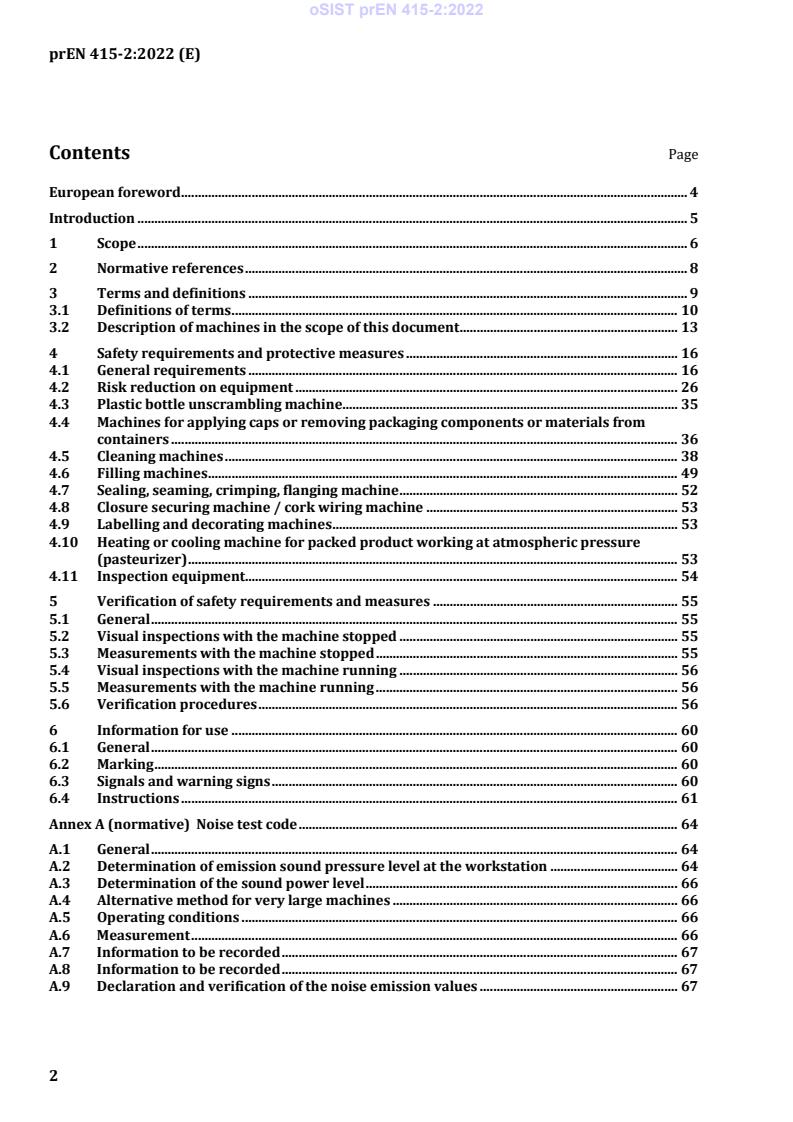
Contents Page
European foreword . 4
Introduction . 5
1 Scope . 6
2 Normative references . 8
3 Terms and definitions . 9
3.1 Definitions of terms . 10
3.2 Description of machines in the scope of this document . 13
4 Safety requirements and protective measures . 16
4.1 General requirements . 16
4.2 Risk reduction on equipment . 26
4.3 Plastic bottle unscrambling machine. 35
4.4 Machines for applying caps or removing packaging components or materials from
containers . 36
4.5 Cleaning machines . 38
4.6 Filling machines . 49
4.7 Sealing, seaming, crimping, flanging machine . 52
4.8 Closure securing machine / cork wiring machine . 53
4.9 Labelling and decorating machines . 53
4.10 Heating or cooling machine for packed product working at atmospheric pressure
(pasteurizer) . 53
4.11 Inspection equipment. 54
5 Verification of safety requirements and measures . 55
5.1 General . 55
5.2 Visual inspections with the machine stopped . 55
5.3 Measurements with the machine stopped . 55
5.4 Visual inspections with the machine running . 56
5.5 Measurements with the machine running . 56
5.6 Verification procedures . 56
6 Information for use . 60
6.1 General . 60
6.2 Marking . 60
6.3 Signals and warning signs . 60
6.4 Instructions . 61
Annex A (normative) Noise test code . 64
A.1 General . 64
A.2 Determination of emission sound pressure level at the workstation . 64
A.3 Determination of the sound power level . 66
A.4 Alternative method for very large machines . 66
A.5 Operating conditions . 66
A.6 Measurement . 66
A.7 Information to be recorded . 67
A.8 Information to be recorded . 67
A.9 Declaration and verification of the noise emission values . 67
Annex B (informative) List of significant hazards . 68
B.1 General . 68
B.2 Hazards that occur on most machines in the scope of this document . 69
B.3 Components and equipment. 72
B.4 Plastic bottle unscrambling machine . 89
B.5 Machines for applying caps or removing packaging components or materials from
containers . 91
B.6 Cleaning machines. 94
B.7 Filling machines . 110
B.8 Sealing, seaming, crimping, flanging machine . 115
B.9 Closure securing machine / cork wiring machine . 118
B.10 Labelling and decorating machines . 119
B.11 Heating or cooling machine for packed product working at atmospheric pressure
(Pasteurizer) . 122
B.12 Inspection machines . 124
Annex ZA (informative) Relationship between this European Standard and the Essential
Requirements of EU Directive 2006/42/EC . 126
Bibliography . 130
European foreword
This document (prEN 415-2:2022) has been prepared by Technical Committee CEN/TC 146 “Safety of
packaging machines”, the secretariat of which is held by UNI.
This document is currently submitted to the CEN Enquiry.
This document will supersede EN 415-2:1999.
This document has been prepared under a Standardization Request given to CEN by the European
Commission and the European Free Trade Association and supports essential requirements of
EU Directive(s) / Regulation(s).
For relationship with EU Directive(s) / Regulation(s), see informative Annex ZA, which is an integral
part of this document.
The following significant changes have been made:
— Packing and unpacking machines have been removed from the Scope;
— Description of hazards has been extended and the order of their presentation is hazard-based;
— Safety requirements have been rewritten so they are in line with EN 415-10:2014;
— Noise test code has been rewritten to be in line with EN 415-9:2009;
— Normative references have been changed to reflect the many changes that have been made to B1
and B2 standards.
EN 415, Safety of packaging machines consists of the following parts:
— Part 1: Terminology and classification of packaging machines and associated equipment;
— Part 2: Pre-formed rigid container packaging machines;
— Part 4: Palletizers and depalletizers;
— Part 5: Wrapping machines;
— Part 6: Pallet wrapping machines;
;
— Part 7: Group and secondary packaging machines
— Part 8: Strapping machines;
— Part 9: Noise measurement methods for packaging machines, packaging lines and auxiliary
equipment, grade of accuracy 2 and 3;
— Part 10: General requirements.
EN 415-7:2006+A1:2008 is currently being revised with a new title: “Cartooning and Case-packing machines”.
Introduction
This document is of relevance, in particular, for the following stakeholder groups representing the
market players with regard to machinery safety:
— machine manufacturers (small, medium and large enterprises);
— health and safety bodies (regulators, accident prevention organizations, market surveillance, etc.).
Others can be affected by the level of machinery safety achieved with the means of the document by the
abovementioned stakeholder groups:
— machine users/employers (small, medium and large enterprises);
— machine users/employees (e.g. trade unions, organizations for people with special needs);
— service providers, e.g. for maintenance (small, medium and large enterprises).
The above-mentioned stakeholder groups have been given the possibility to participate at the drafting
process of this document.
This document is a type-C standard as stated in EN ISO 12100:2010.
The machinery concerned and the extent to which hazards, hazardous situations or hazardous events
are covered are indicated in the Scope of this document.
When requirements of this type-C standard are different from those which are stated in type-A or type-
B standards, the requirements of this type-C standard take precedence over the requirements of the
other standards for machines that have been designed and built according to the requirements of this
type-C standard.
The full set of requirements for machines in the Scope of this document is composed by those given in
this document in conjunction with the relevant requirements of EN 415-10:2014.
The Annex ZA of this document will not list the EHSR which are not relevant for these kinds of machines
or are not covered for any other reason.
When an assembly of machinery or partly completed machinery (multi-functional machine) contains a
function which is covered by another standard the risk assessment and measures for that function
should comply with the relevant standard. In addition, the risks presented by the combination of
functions or mechanisms – which is not covered by one of the standards - should be considered.
NOTE EN ISO 11161:2007 provides guidance for combinations of machines.
1 Scope
This document applies to the following machines and to machines which incorporate more than one
function as listed below. The document also applies to partly completed machinery as far as conformity
is claimed for certain essential health and safety requirements.
This document deals with the following machines handling rigid containers including:
— unscrambling machines;
— cap removing machines;
— cleaning machines;
— sanitizing machines;
— filling machines;
— capping, closing and sealing machines;
— closure securing machines;
— inspection machines;
— labelling machines;
— decorating machines;
— heating- and cooling machines for packed product, working at atmospheric pressure;
— sterilizing machines (others than heat treatment)
with one or more of the following functions: cleaning, sanitizing, pasteurizing, filling, labelling, closing,
sealing or inspecting and handling pre-formed rigid containers including their closures.
This document also deals with equipment when it is part of a machine listed above:
— conveyors;
— vacuum or magnetic transfer conveyors;
— dispose or eject devices (pushers);
— keg stopping devices;
— keg lift and inverting machines;
— extraction or ventilation system or blowers;
— hoppers;
— rotary mechanisms;
— coding and marking equipment incorporated in a packaging machine;
— hot foil coders;
— laser coders;
— ink jet coders;
— emboss coders.
The individual machines are described in 3.2.
This document deals with safety requirements and their verification for machine design, construction
and information applicable to installation, commissioning, operation, adjustment, maintenance,
cleaning, dismantling of packaging machines for pre-formed rigid containers.
The extent to which hazards, hazardous situations and events are covered is indicated in Annex B.
NOTE The hazards on a specific machine can vary depending on its working principle; the type, size and mass
of the product; the packaging material; auxiliary equipment attached to the machine and the environment in
which the machine is used. If the machine presents hazards that are not covered by this document or EN 415-10,
the manufacturer can assess these hazards and take measures by using the principles detailed in
EN ISO 12100:2010.
Exclusions
This document is not applicable to the following machines:
— machines that were manufactured before the date of publication of this document by CEN;
— machines for cups or trays or tubs made of a foil of plastic, aluminium or paper, which are the
subject of EN 415-3;
— aerosol filling and sealing machines;
— filling machines for gas;
— autoclaves;
— conveyors which link packaging machines but are not integrated in packaging machines or part of
packaging machines;
— blow moulding machines;
NOTE See EN 422:2009:
— sleeve label removing machines.
This document does not consider the following hazards:
— the use of packaging machines in potentially explosive atmospheres not generated by the machine
itself;
— hazards associated with packing explosives;
— hazards arising from ancillary equipment, which is not part of the machine, e.g. equipment for
evacuating gases, for cooling or refrigeration, for the supply of steam, energy or product.
2 Normative references
The following documents are referred to in the text in such a way that some or all of their content
constitutes requirements of this document. For dated references, only the edition cited applies. For
undated references, the latest edition of the referenced document (including any amendments) applies.
EN 415-1:2014, Safety of packaging machines - Part 1: Terminology and classification of packaging
machines and associated equipment
EN 415-9:2009, Safety of packaging machines - Part 9: Noise measurement methods for packaging
machines, packaging lines and associated equipment, grade of accuracy 2 and 3
EN 415-10:2014, Safety of packaging machines - Part 10: General requirements
EN 1005-2:2003+A1:2008, Safety of machinery - Human physical performance - Part 2: Manual handling
of machinery and component parts of machinery
EN 1672-2:2020, Food processing machinery - Basic concepts - Part 2: Hygiene and cleanability
requirements
EN 12198-1:2000+A1:2008, Safety of machinery - Assessment and reduction of risks arising from
radiation emitted by machinery - Part 1: General principles
EN 60204-1:2018, Safety of machinery - Electrical equipment of machines - Part 1: General requirements
EN 60825-1:2014, Safety of laser products - Part 1: Equipment classification and requirements
EN 60825-4:2006 , Safety of laser products - Part 4: Laser guards
EN 61310-3:2008, Safety of machinery - Indication, marking and actuation - Part 3: Requirements for the
location and operation of actuators
EN ISO 4413:2010, Hydraulic fluid power - General rules and safety requirements for systems and their
components (ISO 4413:2010)
EN ISO 4414:2010, Pneumatic fluid power - General rules and safety requirements for systems and their
components (ISO 4414:2010)
EN ISO 7010:2020, Graphical symbols - Safety colours and safety signs - Registered safety signs (ISO
7010:2019, Corrected version 2020-06)
EN ISO 11204:2010, Acoustics - Noise emitted by machinery and equipment - Determination of emission
sound pressure levels at a work station and at other specified positions applying accurate environmental
corrections (ISO 11204:2010)
EN ISO 11553-1:2020, Safety of machinery - Laser processing machines - Part 1: Laser safety
requirements
EN ISO 11688-1:2009, Acoustics - Recommended practice for the design of low-noise machinery and
equipment - Part 1: Planning (ISO/TR 11688-1:1995)
As impacted by EN 60825-4:2006/A1:2008 and EN 60825-4:2006/A2:2011.
EN ISO 11688-2:2000, Acoustics - Recommended practice for the design of low-noise machinery and
equipment - Part 2: Introduction to the physics of low-noise design (ISO/TR 11688-2:1998)
EN ISO 12001:2009, Acoustics - Noise emitted by machinery and equipment - Rules for the drafting and
presentation of a noise test code (ISO 12001:1996)
EN ISO 12100:2010, Safety of machinery - General principles for design - Risk assessment and risk
reduction (ISO 12100:2010)
EN ISO 13732-1:2008, Ergonomic of the thermal environment - Methods for the assessment of human
responses to contact with surfaces - Part 1: Hot surfaces (ISO 13732-1:2006)
EN ISO 13732-3:2008, Ergonomic of the thermal environment - Methods for the assessment of human
responses to contact with surfaces - Part 3: Cold surfaces (ISO 13732-3:2005)
EN ISO 13849-1:2015, Safety of machinery – Safety-related parts of control systems - Part 1: General
principles for design (ISO 13849-1:2015)
EN ISO 13851:2019, Safety of machinery - Two-hand control devices - Principles for design and selection
(ISO 13851:2019)
EN ISO 13854:2019, Safety of machinery - Minimum gaps to avoid crushing of parts of the human body
(ISO 13854:2017)
EN ISO 13855:2010, Safety of machinery - Positioning of safeguards with respect to the approach speeds
of parts of the human body (ISO 13855:2010)
EN ISO 14119:2013, Safety of machinery - Interlocking devices associated with guards - Principles for
design and selection (ISO 14119:2013)
EN ISO 14120:2015, Safety of machinery - Guards - General requirements for the design and construction
of fixed and movable guards (ISO 14120:2015)
EN ISO 14122-2:2016, Safety of machinery - Permanent means of access to machinery - Part 2: Working
platforms and walkways (ISO 14122-2:2016)
EN ISO 14122-3:2016, Safety of machinery - Permanent means of access to machinery - Part 3: Stairs,
stepladders and guard-rails (ISO 14122-3:2016)
EN ISO 20607:2019, Safety of machinery - Instruction handbook - General drafting principles (ISO
20607:2019)
ISO/TS 15066:2016, Robots and robotic devices - Collaborative robots
3 Terms and definitions
For the purposes of this document, the terms and definitions given in EN 415-1:2014, EN 415-10:2014,
EN ISO 12100:2010 and EN ISO 12001:2009 and the following apply.
Where definitions of this document differ from those in the standards listed above the definitions of this
document have precedence over the definitions of those listed in the standards above for purposes of
this document.
ISO and IEC maintain terminological databases for use in standardization at the following addresses:
— IEC Electropedia: available at https://www.electropedia.org/
— ISO Online browsing platform: available at https://www.iso.org/obp
3.1 Definitions of terms
3.1.1
pre-formed rigid container
rigid container that had been formed to its final shape before it is handled by the packaging machine
Note 1 to entry: Examples of preformed rigid containers are: bottles, cans, jars, pots, ampoules, vials or kegs,
made of e.g. glass, metal, plastics, fibreboard, wood, ceramic material or composite materials
3.1.2
carousel
rotating machine element which locates and transports containers through one or more processes in a
packaging machine
3.1.3
counter pressure filling
container filling where the container is presented to a filling nozzle and first filled with gas (usually
carbon dioxide or nitrogen) under pressure, and the gas is then displaced by the product being filled
3.1.4
keg
rigid container typically with a capacity between 5 l and 60 l, equipped with a fitting through which it
can be filled, cleaned and emptied
3.1.5
cleaning
removal of soils
Note 1 to entry: See EN 1672-2:2020.
3.1.6
soil
any matter which can make food unsafe; including but not limited to product residues, micro-
organisms, residual detergent, chemicals or disinfecting agents, except substances migrating (or
released metallic ions) from food contact materials into the food
Note 1 to entry: See EN 1672-2:2020.
3.1.7
sanitizing
physical or chemical germ reduction procedure to reduce germs on product, containers, closures or
other packaging means to specified levels
Note 1 to entry: This germ reduction typically is performed with:
— liquid agents, e.g. peracetic acid or
— gaseous agents, e.g. H O or
2 2
— radiation, e.g. ultraviolet rays or
— heat or
— a combination of some of these methods
Note 2 to entry: Examples are:
— immersion bath in the sterilizing agent with drying by means of germ-reduced hot air and/or UV light.
— dry germ reduction procedure and dilution of the sterilizing agent with germ-reduced water.
Note 3 to entry: These germ reduction procedures can be used for:
— packaging materials (bottles, cans, kegs, containers, closures).
— machine surfaces in the food industry, splash area.
— conveyor area of germ-reduced packaging.
3.1.7.1
disinfection
sanitizing process for inactivation of all pathogenic and product-damaging microbes to a level that
complies with the respective hygiene requirements
3.1.7.2
sterilization
sanitizing process for destruction of microorganisms, including bacterial spores present in products or
on the surfaces of materials and products
Note 1 to entry: In difference to disinfection, the target of the sterilization process is killing / deactivation of all
microorganisms and spores.
3.1.7.3
pasteurizing
sanitizing process of heat treatment of packaged product to reduce the quantity of product-damaging
microbes to an acceptable limit, in order to obtain a microbiological stable product within the chosen
minimum shelf life
3.1.8
aseptic filling
filling of a germ reduced product in a germ reduced package with the aim of avoiding recontamination
of the product
3.1.9
star wheel
star shaped component with pockets fitting to the shape of containers for spacing them whilst they are
transported in a circular arc
3.1.10
air conveyor
machine or functional unit that conveys containers or components by the means of air flow along a
guide rail
3.1.11
neck gripper conveyor
machine or functional unit which transports containers, usually plastic bottles, by the means of gripping
devices fixed on a driven chain or belt
3.1.12
walking beam conveyor
machine or functional unit which transports containers step by step by a reciprocating motion of one or
more bars
Note 1 to entry: Commonly used on in-line keg cleaning or filling machines. See also Figure B.22.
3.1.13
gripper chain conveyor
machine or functional unit which transports containers or crates by friction applied laterally by parallel
running chains fitted with rubber grippers
Note 1 to entry: Gripper chain conveyors typically are used to convey containers or to invert containers or to
feed crate cleaning machines with high level in-feed or to invert containers or crates.
3.1.14
magnetic belt conveyor
machine or functional unit which transports components or containers by applying magnetic force to
increase the friction
3.1.15
cascaded pusher
machine or functional unit which positions conveyed crates or containers to different lanes using a row
of pushers moving in a sequence
3.1.16
in-line machine
generic configuration of machine in which processing operations on a container are performed whilst
the container is transported through the machine in a straight line
Note 1 to entry: Spacing of containers usually is done by a screw or a star-wheel.
3.1.17
carousel type machine
generic configuration of a machine in which processing operations on a container are performed whilst
the container is transported through the machine in a circular path
Note 1 to entry: Machine parts transporting containers through a rotary type machine are treated as a
functional unit (see B.3.9 and Figure B.13).
3.1.18
oscillating label magazine
label magazine which oscillates from side to side during machine operation
3.1.19
multi-functional machine
machine which combines several functional units which are arranged and controlled as an integral
whole
Note 1 to entry: Examples of typical multi-functional machines are:
— filling – capping machines
— rinsing – filling – capping machines
— aseptic machines with sterilizing – filling- capping
— blowing moulding – filling – capping machine
— filling – capping – labelling machine
Note 2 to entry: Some functional units of multi-functional machines may be covered by other standards.
3.1.20
workstation
position defined by the manufacturer, in the vicinity of the machine, which is intended to be assumed by
the operator
Note 1 to entry: A list of the usual workstations is given in A.2.
3.2 Description of machines in the scope of this document
3.2.1
bottle unscrambling machine
machine which accepts a bulk supply of randomly oriented bottles and dispenses the containers in a
predetermined orientation
Note 1 to entry: Figure B.15 shows an example of a plastic bottle unscrambling machine.
3.2.2
cap removing machine
machine which removes a cap from a container
Note 1 to entry: Figure B.16 and Figure B.17 show examples of cap removing machines.
3.2.3
cleaning and sanitizing machines
3.2.3.1
bottle washing machine
machine which cleans the inside and outside of rigid containers, usually with water and detergent
Note 1 to entry: Can also remove labels.
Note 2 to entry: Figure B.18 shows an example of a bottle washing machine.
3.2.3.2
cleaning machine for kegs
machine in which kegs are sprayed inside or outside or dipped into different cleaning media
Note 1 to entry: Figure B.19, Figure B.20 and Figure B.21 show examples of a keg cleaning machines
3.2.3.3
crate washing machine
machine which cleans crates, usually with water and detergent
Note 1 to entry: This document deals with washing machines for crates for re-usable bottles or other rigid
containers. The requirements can also be used for machines which clean crates used in the food industry which
are similar in material and size.
Note 2 to entry: Figure B.24 shows an example of a crate washing machine.
3.2.3.4
rinsing machine
machine which cleans the inside of a rigid container by injecting a liquid or gas into the inverted
container
Note 1 to entry: Figure B.27 shows an example of a carousel type rinsing, filling and capping machine.
3.2.3.5
closure sanitizing machine
machine in which closures are fed through and treated with radiation or agents
Note 1 to entry: Agents can be water, clean air and ionized air. Vaporized agents (e.g. H O or peracetic acid) can
2 2
be applied for sanitation. There are also examples which transport the caps through a dipping bath.
Note 2 to entry: Figure B.25 and Figure B.26 show examples of a closure sanitizing machine.
3.2.4
filling machines
3.2.4.1
filling machines for bottles, jars or cans
machine in which bottles, jars or cans are filled with a product
Note 1 to entry: The filling machine is usually combined with a closing machine.
Note 2 to entry: Products are usually liquid or paste-like.
Note 3 to entry: Figure B.27 shows an example of a carousel type rinsing, filling and closing machine.
Figure B.28 shows an example of an in-line filling machine.
3.2.4.2
Keg fill and seal machine
machine in which kegs are first filled with a product and then closed
Note 1 to entry: Figure B.20 shows an example of an in-line keg cleaning and filling machine. Figure B.23 shows
an example of a semi-automatic keg cleaning and filling machine.
3.2.5
capping, closing and sealing machines
3.2.5.1
crown capping machine
closing machine which places a pre-formed metal or plastic (or combined) cap over the mouth of a rigid
container, before crimping the edges of the cap to secure it to the container
3.2.5.2
plugging machine
closing machine which pushes a plug or cork into the mouth of a rigid container
Note 1 to entry: The plug can be made from plastic, cork, artificial cork, plastic covered glass, etc.
3.2.5.3
screw capping machine
closing machine which applies a threaded cap or lid to a rigid container
Note 1 to entry: The working principle is similar to a screw cap removing machine.
Note 2 to entry: Figure B.16 shows an example of capping machine.
3.2.5.4
roll-on capping machine
closing machine which places a deformable closure over the mouth of a rigid container, before rolling
the closure to form a thread and securing the closure to the container
3.2.5.5
foil sealing machine
machine which applies a reel fed foil or plastic cover to a rigid container, sealing it to the container by
the application of heat
Note 1 to entry: The foil can be made of plastic, aluminium, etc. The sealing method can be e.g. ultrasonic,
thermal or gluing.
Note 2 to entry: Often a cap is applied after foil sealing. The foil can also be part of the cap. In this case it is
sealed by induction after the cap is applied.
3.2.5.6
can seaming machine
closing machine which places a pre-formed lid onto the mouth of a can and rolls their edges together to
form a seam
Note 1 to entry: Figure B.30 shows an example of a can seaming mechanism.
3.2.6
closure securing machine
machine which places a securing element, e.g. wire-hood, cord, sleeve or fibre filament, over a bottle
and the closure and then secures it e.g. by twisting (wire) or shrinking (capsule)
Note 1 to entry: Figure B.32 shows an example of a cork wiring machine.
3.2.7
labelling or decorating machine
machine which applies labels or tags onto containers
Note 1 to entry: Figure B.33, Figure B.34 and Figure B.35 show examples of labelling machines.
3.2.8
coding equipment
equipment to apply a code to a container or packaging component
Note 1 to entry: The code can also be a symbol. It can be applied in different ways (see 3.3.3 of EN 415-1:2014).
3.2.9
heating or cooling machine for packed product working at atmospheric pressure
heating machine/cooling machine that applies heat/cold to filled containers under controlled
conditions while the containers are conveyed or in batch mode
Note 1 to entry: This includes pasteurizing machines. For hygiene risks on pasteurizers, EN 285:2015+A1:2021
might be helpful.
Note 2 to entry: Figure B.36 shows an example of a pasteurizer.
3.2.10
inspection machine
machine which inspects containers for some attribute
Note 1 to entry: Attributes can be e.g. size, wall thickness or cleanliness. The inspection can be done, e.g. by
light, radiation, high frequency, camera systems.
4 Safety requirements and protective measures
4.1 General requirements
4.1.1 General
All machines in the scope of this document shall comply with the requirements of 4.1 to 4.11 of this
document where the equivalent hazard exists.
All the machines in the scope of this document shall comply with the safety requirements and
protective or risk reduction measures in 4.1 and the relevant machine specific measures in 4.2 to 4.11,
where the equivalent hazard exists. In addition, machines shall comply with the relevant clauses of
EN 415-10:2014 where they are specifically referenced in this document.
Where a machine has hazards, which are not described in Annex B, because they are not significant on a
typical machine, the machine shall be designed according to relevant clauses of EN 415-10:2014. The
requirements in 4.2 to 4.11 take precedence over those in 4.1, and the requirements of this document
take precedence over those in EN 415-10:2014.
4.1.2 Inherently safe design
Inherently safe design measures shall be applied as far as possible to eliminate or reduce mechanical
risks. For elimination of hazards, the pressure and force limits of ISO/TS 15066:2016 shall apply for
contact of moving parts with human body.
4.1.3 Design of guards
Where inherently safe design measures are not practicable or not sufficient, access to hazardous
moving parts shall be prevented by fixed and/or interlocking guards and/or ESPE (electro-sensitive
protection equipment).
Where the guards comprise glove boxes, access to the gloves shall be safeguarded by interlocking
guards if mechanical hazards are within the safety distances given in 5.2.1.3.2 and Table 1 of
EN 415-10:2014. More specific requirements for safeguards for particular equipment and machines are
contained in subclauses 4.2 to 4.11 of this document.
Guards shall be fixed or interlocked and comply with EN ISO 14120:2015, EN 415-10:2014, 5.2.1.3 and
the additional requirements in 4.1.4 to 4.1.13 and 4.2 to 4.11 of this document.
Where access through a guard is foreseeable once per week or more often, this guard shall be
interlocked.
Type 3 switches according to EN ISO 14119:2013, 3.18 shall not be used for interlocking of guards.
Where a machine has more than five interlocking guards or ESPE, or where these guards are not easy to
reach, the control system shall signal which guard is open or is in a defective state.
Where guards are made of a transparent material and there is a risk of someone hitting the open
transparent guard since visibility is reduced, the guard shall be marked or fitted with features which
make the guard clearly visible when it is open.
If breaking of glass guards can lead to hazardous situations, e.g. undetected access to hazard zones,
release of hazardous substances or ejecting of objects or contamination of product by shards, these
guards shall be made from laminated safety glass.
On tanks or other containers which contain hazardous liquids where no mechanical hazards are present
and no hazardous liquid is jetted or spilled, it is permissible to use movable lids without interlocking.
These lids shall be provided with a closure which requires the use of a tool to open it and which remains
open when fixings are not properly closed.
Further requirements for guards which result from other than mechanical hazards are stated in the
relevant clauses.
4.1.4 Reduction of mechanical risks
4.1.4.1 Reduction of risks from packaging material
When the process can lead to bursting of glass containers, resistant guards capable of retaining flying
shards shall be used. The instructions shall detail the procedure, tools and personal protective
equipment for removing shards from the machine.
4.1.4.2 Reduction of slip, trip or fall risks
5.2.2 of EN 415-10:2014 shall apply. Machine parts that are foreseeably used as steps, walkways or
platforms shall comply with EN ISO 14122-2:2016 and EN ISO 14122-3:2016.
Where there is a combination of a falling risk and of possible access to moving parts, e.g. rotary
mechanisms, from an elevated position, the requirements of 4.1.3 shall apply additionally to the
requirements of this subclause.
4.1.4.3 Reduction of risks from loss of stability
5.2.3 of EN 415-10:2014 shall apply.
4.1.4.4 Reduction of risks from pneumatic or hydraulic equipment
5.4 of EN 415-10:2014 shall apply.
4.1.5 Reduction of electrical risks
5.5 and 5.6 of EN 415-10:2014 shall apply.
4.1.6 Reduction of thermal risks
5.7 and 5.20.7 of EN 415-10:2014 and the following shall apply.
External surfaces of the machine which exceed the temperature thresholds given in
EN ISO 13732-1:2008 or EN ISO 13732-3:2008 and which can be touched unintentionally, e.g. while
passing by the machine or during intervention, shall be isolated or guarded.
NOTE Unintentional contact to surfaces which exceed the thresholds only temporarily can be prevented by a
deterring construction such as handrails.
The machine shall be designed to hold back splashes of hot liquid. Steam jets shall not be released to
traffic ways or working places, e.g. by pressure relief valves.
Hot liquid shall be ducted in pipes or other protected parts of the machine frame. When unintended
action can lead to the release of hot or cold fluid, this shall be prevented by, e.g. means that require two
different movements to be opened. Their outlet opening shall be positioned no higher than 1 200 mm
over access (foot) level and face downward.
Handles of machine parts or of piping shall be designed and mounted so that their temperature will be
between 0 °C and 48 °C.
The instructions shall detail how to prevent burn or scalding injuries, e.g. during cleaning or
interventions.
4.1.7 Reduction of risks from noise
For prevention of noise emission, the manufacturer shall follow the design principles given in
EN ISO 11688-1:2009 and EN ISO 11688-2:2000 and in 5.8 of EN 415-10:2014.
Measures to reduce noise include:
— fitting valves for gas releases with silencers;
— using low noise nozzles that shall be adjusted so that only the intended objects will be hit;
— reducing noise transmission using surfaces made from noise damping material, e.g. of multi-layer
sheet;
— avoiding acoustic vibrations by the fitment of reinforcements or noise reducing material to
surfaces;
— isolation of vibration sources, e.g. by damping.
Where collision of rigid containers, e.g. bottles or cans, is a significant source of noise, one or more of
the following requirements shall apply:
a) for the transport of containers or packaging components, low noise conveying systems like
(magnetic) belt conveyers have precedence over those using compressed air
...