


SIST EN 12259-15:2025
(Main)Fixed firefighting systems - Components for sprinkler and water spray systems - Part 15: Spray pattern sprinklers with a k-factor of at least K160, extended coverage sprinklers of at least K80 and control mode special application sprinklers
Fixed firefighting systems - Components for sprinkler and water spray systems - Part 15: Spray pattern sprinklers with a k-factor of at least K160, extended coverage sprinklers of at least K80 and control mode special application sprinklers
This document specifies requirements and test methods for spray pattern sprinklers with a k-factor of at least K160, extended coverage (EC) sprinklers of at least K80, extended coverage storage sprinklers of at least K200 and control mode special application (CMSA) sprinklers. This document only covers sprinkler types up to K360.
This document does not apply to concealed, conventional, flat spray, flush and recessed sprinklers.
Ortsfeste Brandbekämpfungsanlagen– Bauteile für Sprinkler- und Sprühwasseranlagen– Teil 15: Sprinkler mit einem k-Faktor von mindestens K160, Sprinkler mit erweiterter Reichweite von mindestens K80 und Sprinkler für spezielle Anwendungen im Regelbetrieb
Dieses Dokument legt Anforderungen und Prüfverfahren für Schirm-Sprinkler mit einem k-Faktor von mindestens K160, Weitwurf-Sprinkler (EC-Sprinkler, en: extended coverage) von mindestens K80, Weitwurf-Sprinkler für Lageranwendungen von mindestens K200 und Sprinkler für spezielle Anwendungen im Regelbetrieb (CMSA, en: control mode special application) fest. Dieses Dokument deckt nur Sprinklertypen bis K360 ab.
Dieses Dokument ist nicht anwendbar für verdeckte, Normal-, Flachschirm-, bündige und versenkte Sprinkler.
Installations fixes de lutte contre l’incendie - Composants des systèmes d’extinction du type sprinkleur et à pulvérisation d’eau - Partie 15 : Sprinkleurs de type spray avec un coefficient K d’au moins K160, sprinkleurs à couverture étendue d’au moins K80 et sprinkleurs en mode contrôle pour applications spécifiques
Le présent document spécifie les exigences et les méthodes d’essai relatives aux sprinkleurs de type spray avec un coefficient K d’au moins K160, aux sprinkleurs à couverture étendue (EC) d’au moins K80, aux sprinkleurs à couverture étendue pour stockage d’au moins K200 et aux sprinkleurs en mode contrôle pour applications spécifiques (CMSA). Le présent document couvre uniquement les types de sprinkleurs allant jusqu’à K360.
Le présent document ne s’applique pas aux sprinkleurs cachés, conventionnels, à diffusion plate, affleurants et encastrés.
Vgrajene naprave za gašenje - Sestavni deli sprinklerjev in sistemov s pršečo vodo - 15. del: Razpršilniki z razpršilnim vzorcem s faktorjem k najmanj K160, z razširjeno pokritostjo najmanj K80 in za posebno uporabo z nadzornim režimom
Ta dokument določa zahteve in preskusne metode za razpršilnike z razpršilnim vzorcem s faktorjem k najmanj K160, razpršilnike z razširjeno pokritostjo (EC) najmanj K80, razpršilnike za skladišča z razširjeno pokritostjo najmanj K200 in razpršilnike za posebno uporabo z nadzornim režimom (CMSA). Ta dokument zajema le tipe razpršilnikov do K360. Ta dokument se ne uporablja za zakrite, običajne, ploske, ugreznjene in vgradne razpršilnike.
General Information
- Status
- Published
- Public Enquiry End Date
- 01-Aug-2023
- Publication Date
- 13-May-2025
- Technical Committee
- POZ - Požarna varnost
- Current Stage
- 6060 - National Implementation/Publication (Adopted Project)
- Start Date
- 17-Apr-2025
- Due Date
- 22-Jun-2025
- Completion Date
- 14-May-2025
Overview
SIST EN 12259-15:2025 is the European standard that specifies requirements and test methods for a range of higher-capacity and special‑application sprinklers used in fixed firefighting systems. It covers spray pattern sprinklers with a minimum k‑factor K160, extended coverage (EC) sprinklers with at least K80, extended coverage storage sprinklers of K200 and larger, and control mode special application (CMSA) sprinklers - up to a maximum sprinkler size of K360. The standard excludes concealed, conventional, flat spray, flush and recessed sprinklers.
Keywords: SIST EN 12259-15:2025, spray pattern sprinklers, k-factor, extended coverage sprinklers, CMSA sprinklers, sprinkler testing, firefighting systems.
Key topics and technical requirements
SIST EN 12259-15:2025 defines assessment methods, acceptance criteria and tests that manufacturers and testing laboratories must apply. Major technical topics include:
- Scope and definitions - classification of EC and storage EC sprinklers and related terminology.
- Hydraulic performance - k‑factor limits (K80, K160, K200… up to K360) and discharge coefficient testing.
- Response and sensitivity - conductivity (C‑factor), response time index (RTI) and air‑oven sensitivity tests for sprinklers not suitable for plunge‑tunnel testing.
- Water distribution and actual delivered density (ADD) - methods to verify spray patterns and delivered water density across protected areas.
- Extinguishing performance - protocol and pass/fail criteria for fire performance tests (annexed).
- Mechanical and environmental robustness - tests for frame/deflector strength, release element strength (fusible link and bulb), water hammer, vibration, impact, freezing, high‑temperature exposure, thermal shock, corrosion and coating durability.
- Marking and documentation - mandatory marking and manufacturer installation instructions to support correct specification and installation.
- Normative references - cross‑references to EN 12259 (other parts), EN 12845, EN IEC 60751 and ISO 7‑1.
Practical applications and users
This standard is intended for stakeholders involved in design, manufacture, testing, specification and approval of sprinkler components for commercial, industrial and storage occupancies:
- Sprinkler manufacturers - to design and validate spray pattern, EC and CMSA products to harmonized tests.
- Test laboratories and certification bodies - to carry out performance, mechanical and environmental tests against EN 12259‑15 methods.
- System designers and consultants - to select appropriate K‑factor sprinklers for non‑storage and storage applications per EN 12845 guidance.
- Authorities having jurisdiction and facility owners - to evaluate product compliance for approvals and procurement.
Related standards
- EN 12259 series (other parts, e.g., Part 1: Sprinklers; Part 13: ESFR; Part 14: residential sprinklers)
- EN 12845 (automatic sprinkler systems design and installation)
- EN IEC 60751 (industrial platinum resistance thermometers)
- ISO 7-1 (pipe thread dimensions)
SIST EN 12259-15:2025 is essential reading for ensuring higher‑capacity and special‑application sprinklers meet consistent European performance, safety and durability requirements.

Frequently Asked Questions
SIST EN 12259-15:2025 is a standard published by the Slovenian Institute for Standardization (SIST). Its full title is "Fixed firefighting systems - Components for sprinkler and water spray systems - Part 15: Spray pattern sprinklers with a k-factor of at least K160, extended coverage sprinklers of at least K80 and control mode special application sprinklers". This standard covers: This document specifies requirements and test methods for spray pattern sprinklers with a k-factor of at least K160, extended coverage (EC) sprinklers of at least K80, extended coverage storage sprinklers of at least K200 and control mode special application (CMSA) sprinklers. This document only covers sprinkler types up to K360. This document does not apply to concealed, conventional, flat spray, flush and recessed sprinklers.
This document specifies requirements and test methods for spray pattern sprinklers with a k-factor of at least K160, extended coverage (EC) sprinklers of at least K80, extended coverage storage sprinklers of at least K200 and control mode special application (CMSA) sprinklers. This document only covers sprinkler types up to K360. This document does not apply to concealed, conventional, flat spray, flush and recessed sprinklers.
SIST EN 12259-15:2025 is classified under the following ICS (International Classification for Standards) categories: 13.220.10 - Fire-fighting; 13.220.20 - Fire protection. The ICS classification helps identify the subject area and facilitates finding related standards.
SIST EN 12259-15:2025 is available in PDF format for immediate download after purchase. The document can be added to your cart and obtained through the secure checkout process. Digital delivery ensures instant access to the complete standard document.
Standards Content (Sample)
SLOVENSKI STANDARD
01-junij-2025
Vgrajene naprave za gašenje - Sestavni deli sprinklerjev in sistemov s pršečo
vodo - 15. del: Razpršilniki z razpršilnim vzorcem s faktorjem k najmanj K160, z
razširjeno pokritostjo najmanj K80 in za posebno uporabo z nadzornim režimom
Fixed firefighting systems - Components for sprinkler and water spray systems - Part 15:
Spray pattern sprinklers with a k-factor of at least K160, extended coverage sprinklers of
at least K80 and control mode special application sprinklers
Ortsfeste Brandbekämpfungsanlagen– Bauteile für Sprinkler- und Sprühwasseranlagen–
Teil 15: Sprinkler mit einem k-Faktor von mindestens K160, Sprinkler mit erweiterter
Reichweite von mindestens K80 und Sprinkler für spezielle Anwendungen im
Regelbetrieb
Installations fixes de lutte contre l’incendie - Composants des systèmes d’extinction du
type sprinkleur et à pulvérisation d’eau - Partie 15 : Sprinkleurs de type spray avec un
coefficient K d’au moins K160, sprinkleurs à couverture étendue d’au moins K80 et
sprinkleurs en mode contrôle pour applications spécifiques
Ta slovenski standard je istoveten z: EN 12259-15:2025
ICS:
13.220.10 Gašenje požara Fire-fighting
2003-01.Slovenski inštitut za standardizacijo. Razmnoževanje celote ali delov tega standarda ni dovoljeno.
EN 12259-15
EUROPEAN STANDARD
NORME EUROPÉENNE
April 2025
EUROPÄISCHE NORM
ICS 13.220.20
English Version
Fixed firefighting systems - Components for sprinkler and
water spray systems - Part 15: Spray pattern sprinklers
with a k-factor of at least K160, extended coverage
sprinklers of at least K80 and control mode special
application sprinklers
Installations fixes de lutte contre l'incendie - Ortsfeste Brandbekämpfungsanlagen - Bauteile für
Composants des systèmes d'extinction du type Sprinkler- und Sprühwasseranlagen - Teil 15: Schirm-
sprinkleur et à pulvérisation d'eau - Partie 15 : Sprinkler mit einem k-Faktor von mindestens K160,
Sprinkleurs de type spray avec un coefficient K d'au Weitwurf-Sprinkler von mindestens K80 und Sprinkler
moins K160, sprinkleurs à couverture étendue d'au für spezielle Anwendungen im Regelbetrieb
moins K80 et sprinkleurs en mode contrôle pour
applications spécifiques
This European Standard was approved by CEN on 2 March 2025.
CEN members are bound to comply with the CEN/CENELEC Internal Regulations which stipulate the conditions for giving this
European Standard the status of a national standard without any alteration. Up-to-date lists and bibliographical references
concerning such national standards may be obtained on application to the CEN-CENELEC Management Centre or to any CEN
member.
This European Standard exists in three official versions (English, French, German). A version in any other language made by
translation under the responsibility of a CEN member into its own language and notified to the CEN-CENELEC Management
Centre has the same status as the official versions.
CEN members are the national standards bodies of Austria, Belgium, Bulgaria, Croatia, Cyprus, Czech Republic, Denmark, Estonia,
Finland, France, Germany, Greece, Hungary, Iceland, Ireland, Italy, Latvia, Lithuania, Luxembourg, Malta, Netherlands, Norway,
Poland, Portugal, Republic of North Macedonia, Romania, Serbia, Slovakia, Slovenia, Spain, Sweden, Switzerland, Türkiye and
United Kingdom.
EUROPEAN COMMITTEE FOR STANDARDIZATION
COMITÉ EUROPÉEN DE NORMALISATION
EUROPÄISCHES KOMITEE FÜR NORMUNG
CEN-CENELEC Management Centre: Rue de la Science 23, B-1040 Brussels
© 2025 CEN All rights of exploitation in any form and by any means reserved Ref. No. EN 12259-15:2025 E
worldwide for CEN national Members.
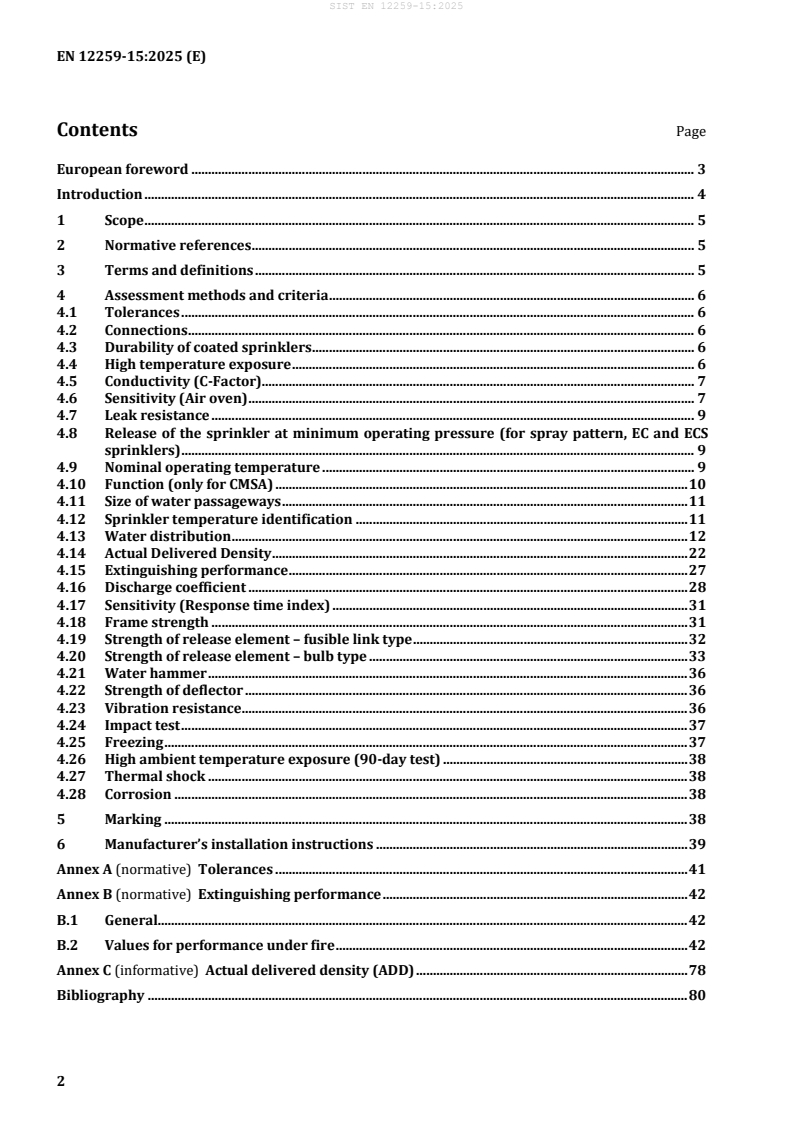
Contents Page
European foreword . 3
Introduction . 4
1 Scope . 5
2 Normative references . 5
3 Terms and definitions . 5
4 Assessment methods and criteria . 6
4.1 Tolerances . 6
4.2 Connections . 6
4.3 Durability of coated sprinklers . 6
4.4 High temperature exposure . 6
4.5 Conductivity (C-Factor). 7
4.6 Sensitivity (Air oven) . 7
4.7 Leak resistance . 9
4.8 Release of the sprinkler at minimum operating pressure (for spray pattern, EC and ECS
sprinklers) . 9
4.9 Nominal operating temperature . 9
4.10 Function (only for CMSA) . 10
4.11 Size of water passageways . 11
4.12 Sprinkler temperature identification . 11
4.13 Water distribution . 12
4.14 Actual Delivered Density . 22
4.15 Extinguishing performance . 27
4.16 Discharge coefficient . 28
4.17 Sensitivity (Response time index) . 31
4.18 Frame strength . 31
4.19 Strength of release element – fusible link type . 32
4.20 Strength of release element – bulb type . 33
4.21 Water hammer . 36
4.22 Strength of deflector . 36
4.23 Vibration resistance . 36
4.24 Impact test . 37
4.25 Freezing . 37
4.26 High ambient temperature exposure (90-day test) . 38
4.27 Thermal shock . 38
4.28 Corrosion . 38
5 Marking . 38
6 Manufacturer’s installation instructions . 39
Annex A (normative) Tolerances . 41
Annex B (normative) Extinguishing performance . 42
B.1 General. 42
B.2 Values for performance under fire . 42
Annex C (informative) Actual delivered density (ADD) . 78
Bibliography . 80
European foreword
This document (EN 12259-15:2025) has been prepared by Technical Committee CEN/TC 191 “Fixed
firefighting systems”, the secretariat of which is held by BSI.
This European Standard shall be given the status of a national standard, either by publication of an
identical text or by endorsement, at the latest by October 2025, and conflicting national standards shall
be withdrawn at the latest by October 2025.
Attention is drawn to the possibility that some of the elements of this document may be the subject of
patent rights. CEN shall not be held responsible for identifying any or all such patent rights.
EN 12259, Fixed firefighting systems — Components for sprinkler and water spray systems, consists of the
following parts:
— Part 1: Sprinklers;
— Part 2: Wet alarm valve assemblies;
— Part 3: Dry alarm valve assemblies;
— Part 4: Water motor alarms;
— Part 5: Water flow detectors;
— Part 9: Deluge alarm valves;
— Part 12: Pumps;
— Part 13: ESFR sprinklers;
— Part 14: Sprinklers for residential applications.
Any feedback and questions on this document should be directed to the users’ national standards body.
A complete listing of these bodies can be found on the CEN website.
According to the CEN-CENELEC Internal Regulations, the national standards organisations of the
following countries are bound to implement this European Standard: Austria, Belgium, Bulgaria, Croatia,
Cyprus, Czech Republic, Denmark, Estonia, Finland, France, Germany, Greece, Hungary, Iceland, Ireland,
Italy, Latvia, Lithuania, Luxembourg, Malta, Netherlands, Norway, Poland, Portugal, Republic of North
Macedonia, Romania, Serbia, Slovakia, Slovenia, Spain, Sweden, Switzerland, Türkiye and the United
Kingdom.
Introduction
The response characteristics of classic sprinklers (EN 12259-1 and EN 12259-15) is based on the
measurement of both sensitivity and conductivity (C-factor). For EN 12259-13 sprinkler type (ESFR)
their response characteristics are determined without reference to its conductivity.
1 Scope
This document specifies requirements and test methods for spray pattern sprinklers with a k-factor of at
least K160, extended coverage (EC) sprinklers of at least K80, extended coverage storage sprinklers of at
least K200 and control mode special application (CMSA) sprinklers. This document only covers sprinkler
types up to K360.
This document does not apply to concealed, conventional, flat spray, flush and recessed sprinklers.
2 Normative references
The following documents are referred to in the text in such a way that some or all of their content
constitutes requirements of this document. For dated references, only the edition cited applies. For
undated references, the latest edition of the referenced document (including any amendments) applies.
EN 12259 (all parts), Fixed firefighting systems — Components for sprinkler and water spray systems
EN 12259-1:1999+A1:2001, Fixed firefighting systems — Components for sprinkler and water spray
systems — Part 1: Sprinklers
EN 12845 (all parts), Fixed firefighting systems — Automatic sprinkler systems
EN IEC 60751, Industrial platinum resistance thermometers and platinum temperature sensors
(IEC 60751)
ISO 7-1, Pipe threads where pressure-tight joints are made on the threads — Part 1: Dimensions, tolerances
and designation
3 Terms and definitions
For the purposes of this document, the terms and definitions given in the EN 12845 series and the
EN 12259 series apply.
ISO and IEC maintain terminology databases for use in standardization at the following addresses:
— ISO Online browsing platform: available at https://www.iso.org/obp
— IEC Electropedia: available at https://www.electropedia.org/
3.1
extended coverage sprinkler
sprinkler with a k-factor of 80 to 200 intended to be installed in accordance with the EN 12845 series to
protect non-storage occupancies
3.2
extended coverage storage sprinkler
sprinkler with a k-factor of 200 and larger and intended to be installed in accordance with EN 12845-2
to protect storage occupancies
As impacted by EN 12259-1:1999+A1:2001/A2:2004 and EN 12259-1:1999+A1:2001/A3:2006.
This series is under development.
3.3
standard non-plastic commodity
commodity product that consists of three double-wall corrugated paper cartons
Note 1 to entry: Dimensions for the inner, middle and outer box are [(1 m ± 5 %) × (1 m ± 5 %) × (1 m ± 5 %)],
[(1 m ± 5 %) × (1 m ± 5 %) × (1 m ± 5 %)], and [(1 m ± 6 %) × (1 m ± 6 %) × (1 m ± 5 %)].
Note 2 to entry: The inside cartons have a five-sided sheet metal liner, representing a non-combustible content.
Note 3 to entry: The cartoned liner is supported on an ordinary, two-way, slatted deck, hardwood pallet, measuring
[(1,07 m ± 5 %) × (1,07 m ± 5 %) × (0,13 m ± 5 %)].
Note 4 to entry: The total combustible weight of the commodity is approximately 58 kg; the corrugated
containerboard weighs approximately 35,5 kg, and the pallet weighs approximately 22,5 kg.
4 Assessment methods and criteria
4.1 Tolerances
If not given differently in the specific clause below, the tolerances of Annex A shall be applied.
4.2 Connections
4.2.1 Assessment method
The sprinkler connection, e.g. the thread size, shall be assessed by measurements.
4.2.2 Criteria
The thread connections of the sprinkler shall be in accordance with ISO 7-1 or shall be grooved
connections. Alternative connection methods that have been tested and validated for use in fire sprinkler
systems also fulfil 4.2.2.
4.3 Durability of coated sprinklers
4.3.1 Assessment method
12 coated sprinklers shall be exposed for a period of 90 days in an oven at a temperature of 30 °C below
the nominal operating temperature. At intervals of 7 days, the sprinklers shall be removed from the oven,
allow to cool for 2 h to 4 h and the coating shall be inspected with the unaided eye, corrected for normal
vision if necessary. Then the sprinklers shall be returned to the oven. At the end of the exposure period,
remove the sprinklers from the oven, cool them again and re-examine the coating.
4.3.2 Criteria
The coating shall show no visible evidence of damage.
4.4 High temperature exposure
4.4.1 Assessment method
The assessment method given in EN 12259-1:1999+A1:2001, Annex O shall be applied for three samples.
4.4.2 Criteria
Sprinklers, less operating mechanisms, shall not show significant deformation, blistering, or fracture
following exposure to an elevated temperature as detailed below.
When surfaces of the orifice or frame exhibit significant deformation a discharge coefficient (k-factor),
(see 4.16) and/or water distribution tests (see 4.13) on exposed samples to validate compliance with
these requirements shall be conducted.
4.5 Conductivity (C-Factor)
4.5.1 Assessment method
The assessment method given in EN 12259-1:1999+A1:2001, N.2 shall be applied.
For sprinklers which could damage or cause problems in a plunge tunnel setup shall be allowed to be
tested in accordance with 4.6.
4.5.2 Criteria
The criteria given in EN 12259-1:1999+A1:2001, 4.15 shall be applied.
4.6 Sensitivity (Air oven)
4.6.1 Assessment method
This assessment shall only be applied for sprinklers which could damage or cause problems in a plunge
tunnel setup (see 4.5).
Ten previously untested sprinklers of each nominal temperature rating shall be individually operated in
an air oven with the inlet of the sprinkler pressurized to the minimum operating pressure in accordance
with 4.8. The rate-of-temperature-rise within the oven, starting from room temperature 22 °C ± 5 °C,
shall be controlled in accordance with Table 1.
Table 1 — Time vs. temperature points for air oven sprinkler sensitivity test
Time Temperature Time Temperature Time Temperature
min:sec °C min:sec °C min:sec °C
0:15 135 6:00 327 16:00 399
0:30 210 7:00 332 17:00 407
0:45 246 8:00 341 18:00 414
1:00 263 9:00 349 19:00 421
1:15 274 10:00 354 20:00 429
1:30 282 11:00 363 22:00 443
2:00 290 12:00 368 24:00 457
3:00 302 13:00 377 26:00 471
4:00 310 14:00 385 28:00 485
5:00 318 15:00 391 30:00 499
4.6.2 Criteria
New, uncoated sprinklers which cannot be tested in the plunge tunnel shall operate within a time limit
not exceeding the maximum permitted in Table 2 for the respective nominal temperature rating.
New sprinklers having corrosion resistant coatings (decorative, wax, etc.), which cannot be tested in the
plunge tunnel, shall operate within a time limit not exceeding the maximum permitted in Table 3 for the
respective nominal temperature rating.
Sprinklers having corrosion resistant coatings (decorative, wax, etc.), which cannot be tested in the
plunge tunnel, and have been subjected to environmental testing, shall operate within the limits stated in
Table 4.
Table 2 — Air oven sprinkler sensitivity for new, uncoated sprinklers utilizing the time vs.
temperature data
Sprinkler nominal Maximum operating Maximum
temperature rating temperature operating time
°C °C min:sec
57 to 76 274 1:15
79 to 107 288 1:45
121 to 149 302 3:00
163 to 191 319 5:00
204 to 246 338 7:30
260 to 302 391 15:00
Table 3 — Air oven sprinkler sensitivity for new sprinklers having corrosion resistant coating
utilizing the time vs. temperature data
Sprinkler nominal Maximum operating Maximum
temperature rating temperature operating time
°C °C min:sec
57 to 76 275 1:34
79 to 107 293 2:11
121 to 149 308 3:45
163 to 191 328 6:15
204 to 246 351 9:22
260 to 302 419 18:45
Table 4 — Air oven sprinkler sensitivity for aged or elevated temperature exposed sprinklers
having corrosion resistant coating utilizing the time vs. temperature data
Sprinkler nominal Maximum operating Maximum
temperature rating temperature operating time
°C °C min:sec
57 to 76 291 2:00
79 to 107 302 3:00
121 to 149 319 5:00
163 to 191 341 8:00
204 to 246 355 10:00
260 and more To be evaluated on a case-by-case basis.
4.7 Leak resistance
4.7.1 Assessment method
4 sprinklers shall be subjected to water pressure of (30 ± 1) bar at the inlet. Increase the pressure from
+1
0 to (30 ± 1) bar at a rate not exceeding 1 bar/s, maintain the pressure at (30 ± 1) bar for a period of 3
min and then allow it to fall to 0 bar. After the pressure has dropped to 0 bar, increase it to (0,5 ± 0,1) bar
+5
in not more than 5 s. Maintain this pressure for 15 s, and then increase it to (10 ± 0,5) bar at a rate not
+5
exceeding 1 bar/s and maintain it for s. Examine the sprinkler for evidence of leakage during the
test.
4.7.2 Criteria
The sprinklers shall not show any visible hydraulic leakage.
4.8 Release of the sprinkler at minimum operating pressure (for spray pattern, EC and
ECS sprinklers)
4.8.1 Assessment method
The assessment method given in EN 12259-1:1999+A1:2001, Annex E shall be applied.
4.8.2 Criteria
When tested in accordance with EN 12259-1:1999+A1:2001, E.1 the sprinkler shall open and within 5 s
of release of the thermally sensitive element shall operate satisfactorily. Any lodgement of released parts
shall be cleared within 60 s of the release of the thermally sensitive element.
4.9 Nominal operating temperature
4.9.1 Assessment method
4.9.1.1 Apparatus
Laboratory temperature measuring device having an accuracy of ± 0,25 % of the nominal rating,
calibrated to a depth of 40 mm immersion, for determining temperatures of liquids in bath tests and
operating temperatures shall be used. The thermally sensitive part of the sensor (e.g. bulb of a
thermometer) shall be held level with the centre of the sprinkler operating parts. To control the
temperature in the thermal bath, a PT100 sensor in accordance with EN IEC 60751 shall be used.
For sprinklers with a nominal operating temperature less than or equal to 80 °C a liquid bath of
demineralized water shall be used. For sprinklers with higher rated elements a liquid bath of glycerine,
vegetable oil or synthetic oil shall be used.
4.9.1.2 Procedure (liquid bath testing)
A total of 30 sprinklers shall be tested. Sprinklers shall be heated in a liquid bath from a temperature of
(20 ± 5) °C to an intermediate temperature of (20 ± 2) °C below their nominal operating temperature.
+2
The rate of temperature increase shall not exceed 20 °C per minute. Maintain the intermediate
+1
temperature for min. Then increase the temperature at a rate of (0,5 ± 0,1) °C per minute until the
sprinklers operate or up to 2,0 °C above the upper operating limit.
The sprinklers shall be located in the vertical position and totally covered by the liquid to a depth of at
least 5 mm. The geometric centre of the sprinkler operating parts shall be located not less than 35 mm
below the liquid surface and in alignment with the temperature sensing device. The temperature
deviation within the test zone should be within 0,25 °C. The preferred location of the geometric centre of
the sprinkler operating parts and temperature measuring device should be (40 ± 5) mm below the liquid
surface. If strutting occurs during the test the air bath test (see 4.9.1.3) shall be performed.
4.9.1.3 Air bath test
Fifty previously untested sprinklers shall be placed on their threaded inlets in a programmable oven
circulating air at ambient temperature. The temperature in the oven shall be steadily raised to
+01,
11,1 °C ± 1,1°C below the nominal temperature rating of the sprinklers over a 20 minute period. Once
this temperature is reached, the oven shall be maintained at constant temperature for a period of
60 min ± 5 min. The temperature shall then be raised at a constant rate of 0,5 °C ± 0,3 °C per minute until
the temperature reaches 22 °C ± 2,8 °C above the nominal temperature rating of the sprinklers.
4.9.2 Criteria
4.9.2.1 Liquid bath criteria
For sprinklers with a nominal temperature below 204 °C, full rupture of heat responsive element in liquid
bath (see 4.9.1.2) within a temperature range of t ± (0,035 t +0,62)] °C, where t is the nominal operating
temperature, resulting in sprinkler operation.
Sprinklers with nominal temperature ratings of 204 °C or greater shall meet the requirements stated
above, or shall have an actual operating temperature of t + (0,07 t +0,62) °C of the marked nominal
temperature rating.
4.9.2.2 Air bath criteria
When subjected to the air bath test no partial fracture of a glass bulb or no partial rupture of a fusible link
(i.e. strutting) shall occur.
4.10 Function (only for CMSA)
4.10.1 Assessment method
Samples for CMSA sprinklers shall be selected in accordance with Table 5. Samples shall be selected for
spray pattern sprinklers with a k-factor of at least K160, extended coverage sprinklers of at least K80 in
accordance with EN 12259-1:1999+A1:2001, Annex E. Both shall be individually installed in their
intended installation position, on a pipe manifold.
A typical example of the test apparatus is shown in EN 12259-1:1999+A1:2001, Figure E.1. Each sample
shall be subjected to an inlet water pressure in accordance with 4.8.2, operated using a suitable heat
source, and observed for complete and proper functioning.
Dry sprinklers shall be tested at both the minimum and maximum lengths, and may require a total sample
quantity of up to 200 sprinklers. The pipe manifold shall be modified by installing a plugged tee in place
of the elbow and may be modified further to accommodate long samples of dry sprinklers.
Table 5 — Lodgement
a
Pressure Number of samples
0,5 bar 10
1,7 bar 10
3,4 bar 10
5,2 bar 10
6,9 bar 10
8,6 bar 10
10,3 bar 10
12,1 bar 10
a
A tolerance of ±5 % applies to all pressures specified in the table.
4.10.2 Criteria
Upon activation of each sample, the discharge coefficient shall be measured to verify complete operation.
4.11 Size of water passageways
4.11.1 Assessment method
A sphere of diameter 8 mm shall be passed through each water passage in the sprinkler.
4.11.2 Criteria
The sphere passes freely through each water passage or the sprinkler.
4.12 Sprinkler temperature identification
4.12.1 Assessment method
4.12.1.1 Glass bulb sprinklers
Visual inspection shall be performed to determine the colour of the liquid inside the bulb.
4.12.1.2 Fusible link sprinklers
A visual inspection shall be performed to determine colour painted on frame arm surface. In addition, a
visual inspection shall be performed to ensure at least 50 % of frame arm surface is painted in the colour,
and that paint is visible from all directions. If the percentage of painted colour surface is in doubt, optical
measurement shall be applied.
4.12.2 Criteria
Sprinklers shall be in accordance with Table 6. In addition, fusible link sprinklers shall be painted for at
least 50 % of each frame arm surface and the paint shall be visible from all directions.
Table 6 — Nominal operating temperatures and colour codes
Glass bulb sprinklers Fusible link sprinklers
Nominal Liquid Yoke arms
Nominal operating
operating
colour code colour code
temperature within range
temperature
° C ° C
57 Orange 57 to 77 Uncoloured
68 Red 80 to 107 White
79 Yellow 121 to 149 Blue
93 Green 163 to 191 Red
100 green 204 to 246 Green
121 blue 260 to 302 Orange
141 blue 320 to 343 Black
163 mauve - -
182 mauve - -
204 black - -
227 black - -
260 black - -
286 black - -
343 black - -
4.13 Water distribution
4.13.1 General
Both test methods given in 4.13.2 and 4.13.3 can be used. It is not necessary to carry out both procedures.
4.13.2 Assessment method 1
4.13.2.1 General
+1 +1
In a test chamber m × m, sprinklers of the same type shall be mounted in a square arrangement
7 7
on a designated pipe. The arms of the sprinkler body shall be aligned parallel to the supply pipes. The
distance between the ceiling and the deflector of upright sprinklers shall be (50 ± 5) mm and of pendent
sprinklers (275 ± 5) mm.
The arrangement of the pipe network and the measuring containers for collecting the water can be seen
in Figure 1 to Figure 3. The water distribution is measured using measuring containers with an opening
area of (500 ± 10) mm × (500 ± 10) mm. The distance between the ceiling and the upper edge of the
containers shall be (2 700 ± 25) mm. The test is carried out according to the conditions met in the
following clauses and the water flowing from the sprinklers is collected until a complete measurement
result is obtained for the measurement area under consideration.
4.13.2.2 Assessment method for spray pattern sprinkler with at least K160
The test shall be carried out in accordance with the test procedure described 4.13.2.1 but in accordance
with the test arrangement shown in Figure 1.
Dimensions in mm
Key
1 waterflow
2 sprinkler
Figure 1 — Arrangement of the K160 / K200 sprinklers at the water distribution (9 m )
The parameters in Table 7 shall be applied for the assessment.
Table 7 — Assessment parameters for spray pattern sprinkler
Flow Measuring Sprinkler
rate area spacing
k-factor
l/min m m
160 112,5 9,00 3,0
160 270,0 9,00 3,0
200 270,0 9,00 3,0
4.13.2.3 Assessment method for extended coverage sidewall sprinklers with at least K80
In addition to the test procedure described in 4.13.2.1, extended coverage sidewall sprinklers shall be
tested according to Figure 2 with the following adjustments:
— the distance between the ceiling and the deflector shall be (150 ± 5) mm;
— the measurement with a measuring area of 19,5 m (3 m × 6,5 m) shall be carried out in two steps
(see Figure 3).
The parameters given in Table 8 shall be applied.
Table 8 — Water distribution requirements for individual extended coverage sidewall
sprinklers
Distance ceiling /
Flow rate Measuring area
measuring surface
mm l/min
m
1 500 126,5 20,25 (4,5 m × 4,5 m)
2 700 126,5 20,25 (4,5 m × 4,5 m)
4 100 138,6 20,25 (4,5 m × 4,5 m)
1 500 126,5 19,5 (3,0 m × 6,5 m)
2 700 126,5 19,5 (3,0 m × 6,5 m)
4 100 138,6 19,5 (3,0 m × 6,5 m)
Key
1 waterflow
2 sprinkler
Figure 2 — Layout of the test room for determining the water distribution of extended coverage
)
sidewall sprinklers (20,25 m
Dimensions in mm
Key
1 waterflow
2 sprinkler
Figure 3 — Layout of the test room for determining the water distribution of extended coverage
sidewall sprinklers (19,5 m )
4.13.2.4 Criteria for test method 1
4.13.2.4.1 Spray pattern sprinkler with at least K160
For sprinklers tested in accordance with 4.13.2.2 the number of containers in which the water volume is
less than 50 % of the water coverage specified in Table 9 shall not exceed the maximum number of
containers specified in Table 9.
Table 9 — Spray pattern sprinkler with at least K160 test criteria
k-factor Water coverage Maximum number of containers
with low water coverage
mm/min
160 12,5 3
160 30,0 3
200 30,0 3
4.13.2.4.2 Extended coverage sidewall sprinklers with at least K80
The nominal k-factor of extended coverage sidewall sprinklers shall be at least K80.
When tested in accordance with 4.13.2.3, a single extended coverage sidewall sprinkler shall meet the
water distribution requirements of Table 10.
With the exception of the measurements at the distance ceiling/measuring surface of 4 100 mm are not
necessary, if the manufacturer has specified the use of the extended coverage sidewall sprinklers in
rooms with a height up to maximum 2,8 m only.
Table 10 — Extended coverage sidewall sprinklers with at least K80 test criteria
Minimum number of Minimum number of Minimum number of
Measuring
containers with water containers with water containers with water
area in m
coverage ≥ 2,5 mm/min coverage ≥ 1,25 mm/min coverage ≥ 0,6 mm/min
41 65 73 20,25
(4,5 m × 4,5 m)
39 62 70 19,5
(3,0 m × 6,5 m)
4.13.3 Assessment method 2
4.13.3.1 Spray pattern sprinklers with at least K160
The appropriate number of previously untested samples shall be subjected to the distribution test
conditions detailed in Table 11 for the type of sprinkler under examination. All samples shall be provided
completely assembled. Prior to distribution testing, the sprinklers shall be operated, using a suitable heat
source, to remove the heat responsive assembly. In cases where adjustment of the distance between the
deflector and the ceiling or wall is possible (e.g. recessed type), the distribution tests shall be conducted
at both extremes of deflector position.
For upright and pendent sprinklers, the water discharge from four and six sprinklers shall be collected in
sixteen pans. They shall be placed in a 4 by 4 array with a pan size of
(305 mm ± 10 mm) × (305 mm ± 10 mm). Water shall be collected for a period of not less than three
minutes in accordance with the conditions detailed in Table 11.
Upright sprinklers shall be tested utilizing the branch lines and located below a suspended ceiling. All
pendent sprinklers shall be installed in their intended installation position utilizing a suspended ceiling
and supplied with water from branch lines located above the ceiling. In cases where adjustment of the
distance between the deflector and the ceiling is possible (e.g. recessed type), the distribution tests shall
be conducted at both extremes of deflector position. Sprinklers shall be installed such that their deflectors
are positioned 2,3 m from the top plane of the pan array. Sprinklers shall be randomly selected and
installed with the frame arms parallel to the branch line pipe. Repositioning of sprinklers, or placing
specific sprinklers in specific locations, is not permitted.
See Figures 4 to 7 for more details.
Key
1 30 cm × 30 cm pan
designated sprinkler location
Figure 4 — Standard coverage sprinkler water distribution test layout of the four-sprinkler test
Key
1 30 cm × 30 cm pan
designated sprinkler location
Figure 5 — Standard coverage sprinkler water distribution test layout of the six-sprinkler test
a) Piping configuration for upright standard coverage sprinkler water distribution test
b) Typical branch line for upright standard coverage sprinkler water distribution test
Key
1 suspended plywood ceiling 8 DN32 pipe
2 branch line number 3 9 DN32 quick connect
3 DN50 pipe 10 DN32 × DN25 reducing coupling
4 DN50 to supply 11 DN25 pipe
5 branch line number 2 12 DN25 coupling with plug
6 DN50 pipe 13 DN25 × DN15 or DN25 × DN20 tee
7 branch line number 1
Figure 6 — Typical branch line for piping configuration for upright sprinklers
a) Piping configuration for pendent standard coverage sprinkler water distribution test
b) Typical branch line for pendent standard coverage sprinkler water distribution test
Key
1 suspended plywood ceiling 10 flex hose to adjustable drops
2 branchline number 3 11 DN25 pipe
3 DN50 pipe 12 DN25 pipe
4 branchline number 2 13 DN25 coupling with plug
5 branchline number 1 14 DN50
6 DN100 typical pipe 15 DN25 tee
7 DN50 to supply 16 DN25 tee
8 DN32 × DN25 reducing coupling 17 ceiling (bottom)
9 DN25 pipe
Figure 7 — Typical branch line for piping configuration for pendent sprinklers
Table 11 — Distribution requirements
Average Minimum Minimum
Number
water flow average individual
Nominal
of
per sprinkler collection pan
k-factor
sprinklers
l/min mm/min mm/min
4 134,4 14,7 11,0
4 189,3 20,4 15,3
6 136,3 14,7 11,0
6 189,3 20,4 15,3
4 142,0 15,3 11,4
4 228,3 24,6 18,3
6 142,0 15,3 11,4
6 228,3 24,6 18,3
For upright sprinklers in the 6-sprinkler test, the requirements shall only apply to the two rows of pans
furthest from the pipe. The two middle rows shall be omitted from the collection results and are exempted
due to the unavoidable pipe shadow.
For sidewall sprinklers the floor collection shall be one hundred pans, each with a collection area
measuring 305 mm × 305 mm shall be arranged in a 3,05 m × 3,05 m square, centred between two
sidewall sprinklers installed 3,05 m apart. The pans shall cover an area 0,6 m to 3,7 m outward from the
wall. For vertical type sidewall sprinklers, the tops of the pans shall be located 2,03 m below the
deflectors. For horizontal type sidewall sprinklers, the tops of the pans shall be located 2,03 m below the
projected axial centreline of the orifice. For either type, the deflector shall be located 153 mm from the
wall and 100 mm from the ceiling. Each sprinkler shall flow water at a rate of 56,8 l/min and water shall
be collected for a period of not less than three minutes.
For back-wall collection and wetting during the floor collection test, a measurement of the quantity of
water being discharged onto the wall behind the sprinkler shall be made. Water shall be collected from
the area of the back wall between the two sprinklers by means of a single row of 51 mm wide collecting
pans, or other collection apparatus, such as a channel abutting the back wall. The opening in the top of
the collection apparatus shall be located not more than 457 mm above the floor. The back wall shall be
visually inspected for complete wetting in accordance with the criteria below.
4.13.3.2 Extended coverage sidewall sprinklers with at least K80
The collection pan array consists of water collection pans measuring 0,5 m × 0,5 m. For upright and
pendent sprinklers, water distribution shall be measured and recorded for one quadrant of the coverage
area. For sidewall sprinklers, water distribution shall be measured and recorded for one half of the
coverage area. If visual observation indicates a non-symmetrical distribution pattern, water distribution
shall be measured and recorded for the entire coverage area. Wall wetting shall be verified using a 1,2 m
high wall enclosing the coverage area and covered with paper as needed for visual verification. Water
shall be collected for a period of not less than 6 min.
In cases where adjustment of the distance between the deflector and the ceiling is possible, (i.e. recessed
type), distribution tests shall be conducted at both extremes of deflector position. The distribution test
conditions given in Table 12 and 13 shall be applied.
Table 12 — Distribution test conditions for upright and pendent extended coverage sprinklers
Nominal Coverage Deflector to Flow rate End head
k-factor area ceiling pressure
distance
m × m m l/min bar
4,9 × 4,9 0,10 100 1,5
80 5,5 × 5,5 0,10 125 2,4
6,1 × 6,1 0,10 150 3,5
4,9 × 4,9 0,10 100 0,8
115 5,5 × 5,5 0,10 125 1,2
6,1 × 6,1 0,10 150 1,7
4,9 × 4,9 0,10 115 0,5
160 5,5 × 5,5 0,10 125 0,6
6,1 × 6,1 0,10 150 0,9
4,9 × 4,9 0,10 139 0,5
200 5,5 × 5,5 0,10 139 0,5
6,1 × 6,1 0,10 150 0,5
Table 13 — Distribution test conditions for sidewall extended coverage sprinklers
Nominal Coverage Deflector to Flow rate End head
k-factor area ceiling pressure
distance
m × m m l/min bar
4,9 × 4,9 0,10 and 0,30 100 1,5
80 4,9 × 5,5 0,10 and 0,30 115 2,0
4,9 × 6,1 0,10 and 0,30 125 2,4
4,9 × 4,9 0,10 and 0,30 120 1,1
4,9 × 5,5 0,10 and 0,30 135 1,4
115 4,9 × 6,1 0,10 and 0,30 150 1,7
4,9 × 6,7 0,10 and 0,30 165 2,0
4,9 × 7,3 0,10 and 0,30 180 2,5
4.13.3.3 Criteria for test method 2
4.13.3.3.1 Spray pattern sprinklers with at least K160
Upright and pendent standard coverage sprinklers shall be capable of distributing water in a uniform
manner. Samples shall be tested as detailed in 4.13.3.1. and shall meet the requirements in Table 11 for
the appropriate nominal k-factor. For each test condition, not more than one individual pan shall have a
collection less than the minimum required. Dry pans (i.e. zero water collection) are not permitted.
For standard sidewall sprinklers (horizontal and vertical) the amount of water collected in any individual
pan shall not be less than 1,22 mm/min and the average collection shall not be less than 2,04 mm/min
for the area covered. With the exception of up to two non-adjacent pans which may have a collection less
than 1,22 mm/min. Dry pans (i.e. zero water collection) are not permitted. Sidewall sprinklers shall
provide a minimum of 3,5 % of the total discharge (i.e. at least 1,99 l/min in the 3,05 m span between
sprinklers) against the back wall and shall wet the back wall completely from the floor up to 1,2 m below
the deflector. No dry areas are allowed within that region.
Sprinklers with factory painted or decorative finishes, such as plating, shall comply with the same
performance criteria as those without such finishes.
When sprinklers are fitted with protective guards, such guards shall not degrade the average collection
by more than 20 %. Minimum average and individual pan requirements shall be ignored. However, dry
pans are not permitted.
For sprinklers with corrosion resistant coatings such as wax, prior to the distribution tests, the coated
samples shall be operated in the air oven (see 4.6.1) and exposed for the maximum operating time for the
appropriate temperature rating as stated in Table 3. The presence of a corrosion resistant coating shall
not degrade the average collection by more than 10 %. Minimum individual pan requirements shall be
ignored. However, dry pans are not permitted.
4.13.3.3.2 Extended coverage sidewall sprinklers with at least K80
When tested as detailed in 4.13.3.2 extended coverage sprinklers shall perform satisfactorily in all
coverage areas indicated. The distribution collection shall exhibit the following:
— no dry pans (i.e. zero water collection);
— not more than one pan with water collection less than 0,61 mm/min;
— average collection of all pans not less than 1,63 mm/min; and
— complete wall wetting up to 0,9 m from the floor on all walls. No dry areas shall be permitted within
this region.
4.14 Actual Delivered Density
The ADD assessment shall be performed for the following EC or CMSA sprinklers:
— CMSA sprinklers with a k-factor of K280 and K360;
— EC sprinklers with a k-factor of K160, K200, K280 and K360.
Actual delivered density (ADD) and pre-wetting density (PWD) measurements shall be taken using the
test app
...
Questions, Comments and Discussion
Ask us and Technical Secretary will try to provide an answer. You can facilitate discussion about the standard in here.
Loading comments...