


SIST EN 71-7:2026
(Main)Safety of toys - Part 7: Finger paints - Requirements and test methods
Safety of toys - Part 7: Finger paints - Requirements and test methods
This part of EN 71 specifies requirements for the substances and materials used in finger paints and applies to finger paints only.
Additional requirements are specified for markings, labelling and containers.
NOTE EN 71-3 and EN 71-12 specify requirements and test methods for finger paints for the migration of certain elements (see Clause F.4) and N-nitrosamines (see Clause F.9).
Sicherheit von Spielzeug - Teil 7: Fingermalfarben - Anforderungen und Prüfverfahren
Dieser Teil der EN 71 legt Anforderungen an die in Fingermalfarben verwendeten Stoffe und Materialien fest und gilt nur für Fingermalfarben.
Für Beschriftung, Kennzeichnung und Behälter sind zusätzliche Anforderungen festgelegt.
ANMERKUNG EN 71-3 und EN 71-12 legen Anforderungen und Prüfverfahren für Fingermalfarben bezüglich der Migration bestimmter Elemente (siehe F.4) und N-Nitrosaminen (siehe F.9) fest.
Sécurité des jouets - Partie 7: Peintures au doigt - Exigences et méthodes d'essai
La présente partie de l’EN 71 fixe des exigences relatives aux substances et produits utilisés dans les peintures au doigt et s’applique uniquement aux peintures au doigt.
Des exigences supplémentaires sont données pour le marquage, l’étiquetage et le récipient.
NOTE L’EN 71-3 et l’EN 71-12 spécifient des exigences et des méthodes d’essai applicables aux peintures au doigt en ce qui concerne la migration de certains éléments (voir Article F.4) et les N-nitrosamines (voir Article F.9).
Varnost igrač - 7. del: Prstne barve - Zahteve in preskusne metode
Ta del standarda EN 71 določa zahteve za snovi in materiale, ki se uporabljajo v prstnih barvah, ter se uporablja samo za prstne barve. Določene so tudi dodatne zahteve za označevanje, etiketiranje in embalažo. OPOMBA: Standarda EN 71-3 in EN 71-12 določata zahteve in preskusne metode za prstne barve glede migracije določenih elementov (glej točko F.4) in N-nitrozaminov (glej točko F.9).
General Information
- Status
- Published
- Public Enquiry End Date
- 02-Jan-2025
- Publication Date
- 14-Dec-2025
- Technical Committee
- OTR - Child use and care article
- Current Stage
- 6060 - National Implementation/Publication (Adopted Project)
- Start Date
- 09-Dec-2025
- Due Date
- 13-Feb-2026
- Completion Date
- 15-Dec-2025
Relations
- Replaces
SIST EN 71-7:2014+A3:2020 - Safety of toys - Part 7: Finger paints - Requirements and test methods - Effective Date
- 01-Jan-2026
- Effective Date
- 28-Jan-2026
- Effective Date
- 10-Feb-2026
Overview
SIST EN 71-7:2026 - Safety of toys, Part 7: Finger paints - Requirements and test methods is the Slovenian adoption of EN 71-7:2025. Approved by CEN (22 Sep 2025) and to be implemented nationally by April 2026, this standard specifies safety, composition and testing requirements that apply specifically to finger paints used by children. It focuses on the substances and materials in formulations and adds requirements for marking, labelling and containers to reduce foreseeable risks from normal and foreseeable use.
Key technical topics and requirements
- Scope and definitions: clear terms for colourant, pigment, dyestuff and the newly defined booster substances.
- Substance requirements: rules for colourants, preservatives, binding agents, extenders, humectants and surfactants used in finger paints.
- Impurities and contaminants:
- Limits for primary aromatic amines and other impurities (detection methods in Annex D).
- Requirements and methods for detection of hexachlorobenzene, PCBs and benzo[a]pyrene (Annex E).
- Organoleptic and chemical properties: criteria for taste and smell, pH-value (reference to EN ISO 19396-1:2025), and guidance on embittering agents.
- Micro-safety elements: provisions on preservatives (normative list in Annex B) and booster substances (new requirements).
- Packaging and labelling: mandatory information and marking on primary packaging and containers to inform users and caregivers.
- Test methods and reporting: normative analytical procedures (Annexes D and E), sampling, calculation, precision and reporting requirements.
- Informative background: Annex F explains rationale and relationships to other EN 71 parts.
Practical applications - who uses this standard
- Toy manufacturers and formulators of finger paints - to ensure product formulations comply with EU/CEN safety expectations.
- Quality and compliance teams - for product specifications, safety dossiers and CE marking alignment.
- Testing laboratories - to apply specified analytical methods for contaminants, pH and preservative verification.
- Regulators and market surveillance bodies - to assess conformity and enforce toy safety legislation (referenced relationship to Directive 2009/48/EC in Annex ZA).
- Purchasers and educators - to select safer finger-paint products for children’s use.
Related standards and cross-references
- Part of the EN 71 series (toy safety). Relevant linked standards:
- EN 71-3 (migration of certain elements) - applies to finger paints for element migration.
- EN 71-12 (N‑nitrosamines) - applies separately to finger paints.
- EN ISO 19396-1:2025 - referenced for pH determination.
- Consult Annex F for background and Annex ZA for legal alignment with EU toy safety rules.
This standard is essential for manufacturers, test labs and compliance professionals working with finger paints and other aqueous toy materials, helping manage chemical risks and ensure safe products for children.

Frequently Asked Questions
SIST EN 71-7:2026 is a standard published by the Slovenian Institute for Standardization (SIST). Its full title is "Safety of toys - Part 7: Finger paints - Requirements and test methods". This standard covers: This part of EN 71 specifies requirements for the substances and materials used in finger paints and applies to finger paints only. Additional requirements are specified for markings, labelling and containers. NOTE EN 71-3 and EN 71-12 specify requirements and test methods for finger paints for the migration of certain elements (see Clause F.4) and N-nitrosamines (see Clause F.9).
This part of EN 71 specifies requirements for the substances and materials used in finger paints and applies to finger paints only. Additional requirements are specified for markings, labelling and containers. NOTE EN 71-3 and EN 71-12 specify requirements and test methods for finger paints for the migration of certain elements (see Clause F.4) and N-nitrosamines (see Clause F.9).
SIST EN 71-7:2026 is classified under the following ICS (International Classification for Standards) categories: 97.200.50 - Toys. The ICS classification helps identify the subject area and facilitates finding related standards.
SIST EN 71-7:2026 has the following relationships with other standards: It is inter standard links to SIST EN 71-7:2014+A3:2020, SIST EN ISO 19396-1:2025, SIST-V CEN/CLC Guide 14:2009. Understanding these relationships helps ensure you are using the most current and applicable version of the standard.
SIST EN 71-7:2026 is associated with the following European legislation: EU Directives/Regulations: 2009/48/EC; Standardization Mandates: M/589. When a standard is cited in the Official Journal of the European Union, products manufactured in conformity with it benefit from a presumption of conformity with the essential requirements of the corresponding EU directive or regulation.
SIST EN 71-7:2026 is available in PDF format for immediate download after purchase. The document can be added to your cart and obtained through the secure checkout process. Digital delivery ensures instant access to the complete standard document.
Standards Content (Sample)
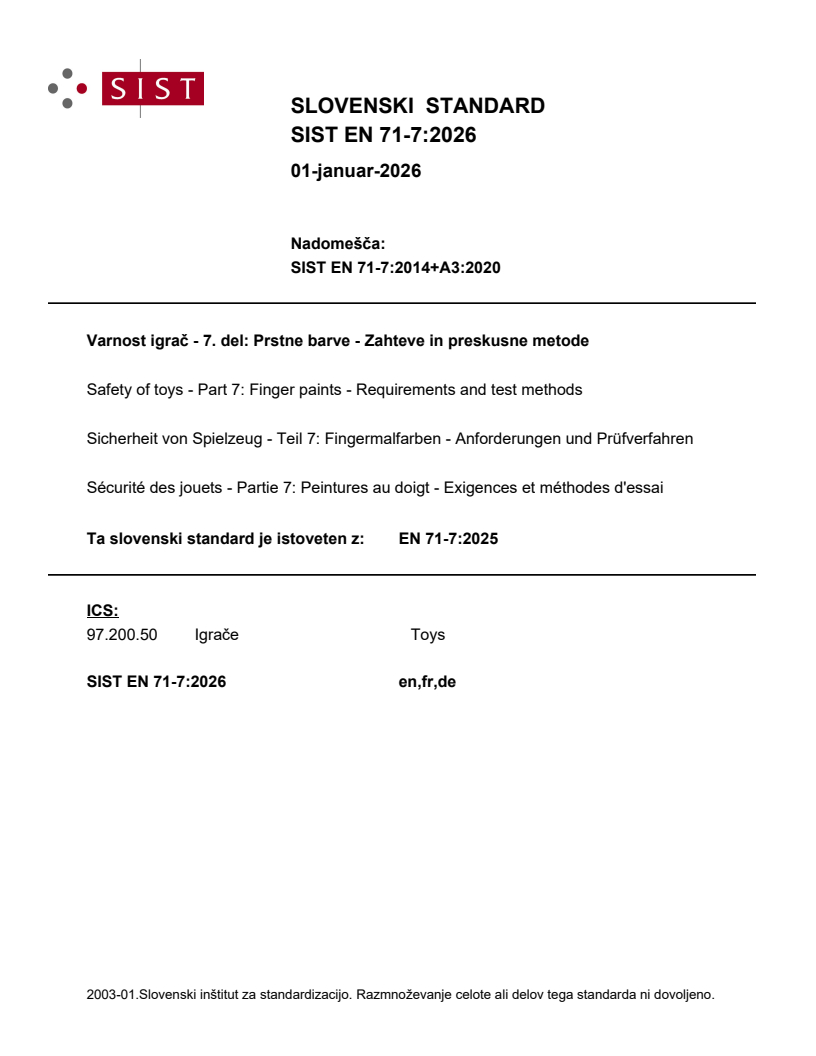
SLOVENSKI STANDARD
01-januar-2026
Nadomešča:
SIST EN 71-7:2014+A3:2020
Varnost igrač - 7. del: Prstne barve - Zahteve in preskusne metode
Safety of toys - Part 7: Finger paints - Requirements and test methods
Sicherheit von Spielzeug - Teil 7: Fingermalfarben - Anforderungen und Prüfverfahren
Sécurité des jouets - Partie 7: Peintures au doigt - Exigences et méthodes d'essai
Ta slovenski standard je istoveten z: EN 71-7:2025
ICS:
97.200.50 Igrače Toys
2003-01.Slovenski inštitut za standardizacijo. Razmnoževanje celote ali delov tega standarda ni dovoljeno.
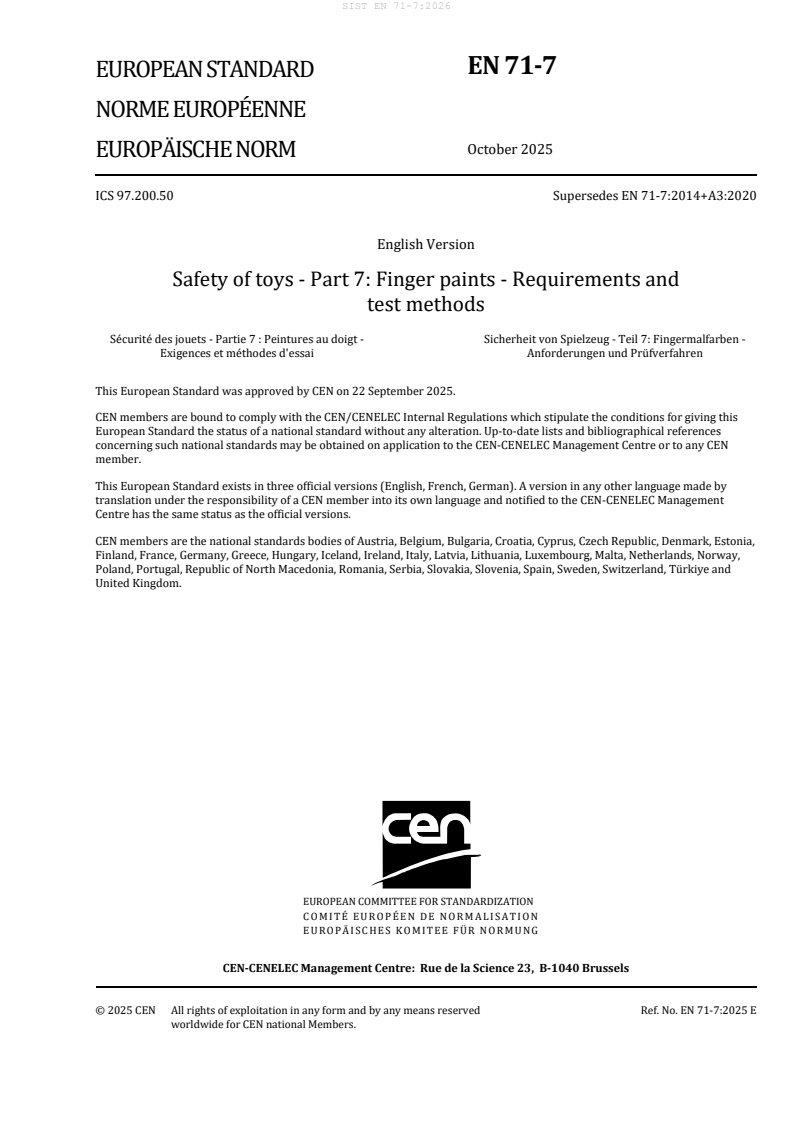
EN 71-7
EUROPEAN STANDARD
NORME EUROPÉENNE
October 2025
EUROPÄISCHE NORM
ICS 97.200.50 Supersedes EN 71-7:2014+A3:2020
English Version
Safety of toys - Part 7: Finger paints - Requirements and
test methods
Sécurité des jouets - Partie 7 : Peintures au doigt - Sicherheit von Spielzeug - Teil 7: Fingermalfarben -
Exigences et méthodes d'essai Anforderungen und Prüfverfahren
This European Standard was approved by CEN on 22 September 2025.
CEN members are bound to comply with the CEN/CENELEC Internal Regulations which stipulate the conditions for giving this
European Standard the status of a national standard without any alteration. Up-to-date lists and bibliographical references
concerning such national standards may be obtained on application to the CEN-CENELEC Management Centre or to any CEN
member.
This European Standard exists in three official versions (English, French, German). A version in any other language made by
translation under the responsibility of a CEN member into its own language and notified to the CEN-CENELEC Management
Centre has the same status as the official versions.
CEN members are the national standards bodies of Austria, Belgium, Bulgaria, Croatia, Cyprus, Czech Republic, Denmark, Estonia,
Finland, France, Germany, Greece, Hungary, Iceland, Ireland, Italy, Latvia, Lithuania, Luxembourg, Malta, Netherlands, Norway,
Poland, Portugal, Republic of North Macedonia, Romania, Serbia, Slovakia, Slovenia, Spain, Sweden, Switzerland, Türkiye and
United Kingdom.
EUROPEAN COMMITTEE FOR STANDARDIZATION
COMITÉ EUROPÉEN DE NORMALISATION
EUROPÄISCHES KOMITEE FÜR NORMUNG
CEN-CENELEC Management Centre: Rue de la Science 23, B-1040 Brussels
© 2025 CEN All rights of exploitation in any form and by any means reserved Ref. No. EN 71-7:2025 E
worldwide for CEN national Members.
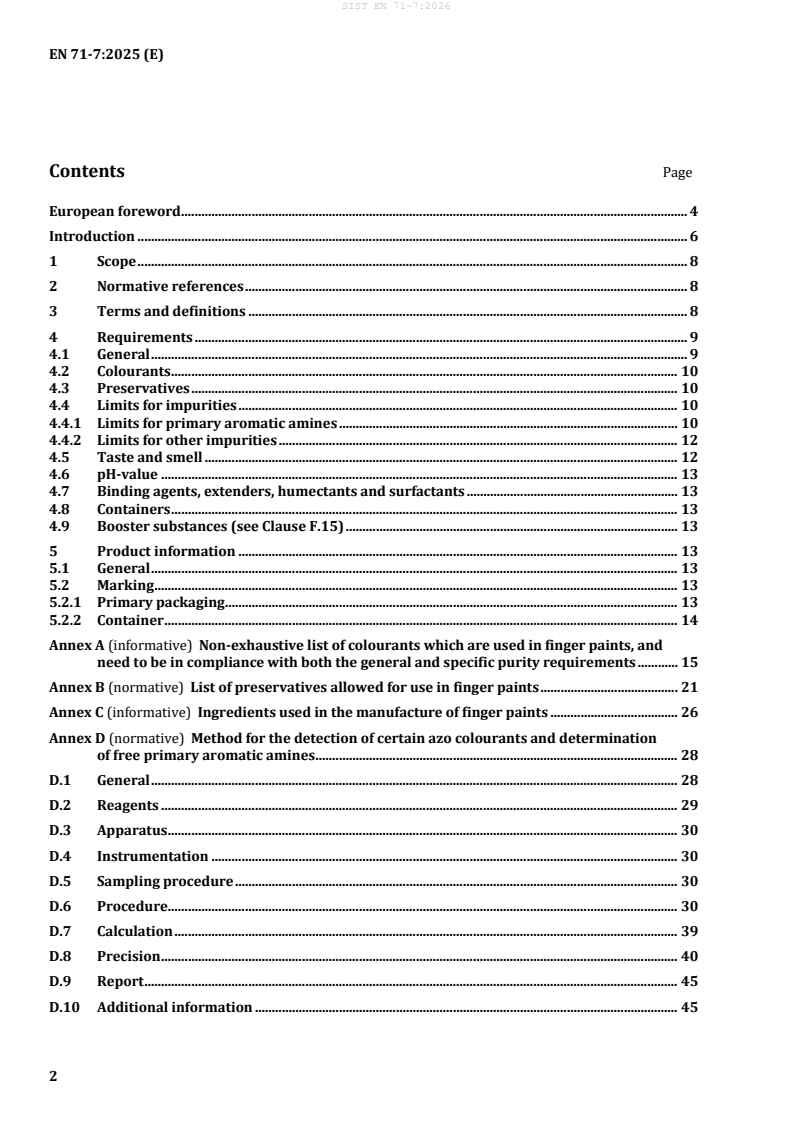
Contents Page
European foreword . 4
Introduction . 6
1 Scope . 8
2 Normative references . 8
3 Terms and definitions . 8
4 Requirements . 9
4.1 General . 9
4.2 Colourants . 10
4.3 Preservatives . 10
4.4 Limits for impurities . 10
4.4.1 Limits for primary aromatic amines . 10
4.4.2 Limits for other impurities . 12
4.5 Taste and smell . 12
4.6 pH-value . 13
4.7 Binding agents, extenders, humectants and surfactants . 13
4.8 Containers . 13
4.9 Booster substances (see Clause F.15) . 13
5 Product information . 13
5.1 General . 13
5.2 Marking . 13
5.2.1 Primary packaging . 13
5.2.2 Container . 14
Annex A (informative) Non-exhaustive list of colourants which are used in finger paints, and
need to be in compliance with both the general and specific purity requirements . 15
Annex B (normative) List of preservatives allowed for use in finger paints . 21
Annex C (informative) Ingredients used in the manufacture of finger paints . 26
Annex D (normative) Method for the detection of certain azo colourants and determination
of free primary aromatic amines . 28
D.1 General . 28
D.2 Reagents . 29
D.3 Apparatus . 30
D.4 Instrumentation . 30
D.5 Sampling procedure . 30
D.6 Procedure. 30
D.7 Calculation . 39
D.8 Precision . 40
D.9 Report . 45
D.10 Additional information . 45
Annex E (normative) Method for the determination of hexachlorobenzene, polychlorinated
biphenyls and benzo[a]pyrene . 46
E.1 Principle . 46
E.2 Standards, reagents and solvents . 46
E.3 Apparatus . 48
E.4 Instrumentation . 48
E.5 Sampling . 49
E.6 Procedure . 49
E.7 Calculation. 54
E.8 Precision . 56
E.9 Report . 58
E.10 Additional information . 59
Annex F (informative) Background and rationale for this European Standard . 66
F.1 Finger paints (see 3.1) . 66
F.2 Colourants (see 4.2) . 66
F.3 Preservatives (see 4.3) . 66
F.4 Migration of elements . 67
F.5 Primary aromatic amines (see 4.4.1, Tables 1 and 2 and Annex D) . 67
F.6 Limits for benzo[a]pyrene and further impurities (see 4.4.2) . 67
F.7 Embittering agents (see 4.5) . 68
F.8 pH value (see 4.6) . 68
F.9 N-Nitrosamines . 68
F.10 Container (see 4.8) . 68
F.11 Labelling phrases (see 5.2.1.1) . 68
F.12 List of polychlorinated biphenyl congeners (see Annex E) . 69
F.13 Reference materials (see Annex D and E) . 69
F.14 PCB analytical method (see E.6) . 69
F.15 Booster substances (see 4.9) . 69
Annex ZA (informative) Relationship between this European Standard and the essential
requirements of Directive 2009/48/EC aimed to be covered . 71
Bibliography . 72
European foreword
This document (EN 71-7:2025) has been prepared by Technical Committee CEN/TC 52 “Safety of toys”,
the secretariat of which is held by DS.
This European Standard shall be given the status of a national standard, either by publication of an
identical text or by endorsement, at the latest by April 2026, and conflicting national standards shall be
withdrawn at the latest by October 2026.
Attention is drawn to the possibility that some of the elements of this document may be the subject of
patent rights. CEN shall not be held responsible for identifying any or all such patent rights.
This document supersedes EN 71-7:2014+A3:2020.
This document has been prepared under a standardization request addressed to CEN by the European
Commission. The Standing Committee of the EFTA States subsequently approves these requests for its
Member States.
For the relationship with EU Legislation, see informative Annex ZA, which is an integral part of this
document.
Additional information on the background and rationale for various requirements of this European
Standard is given in Annex F.
This document constitutes the seventh part of the EN 71 series of standards on safety of toys.
EN 71, Safety of toys, consists of the following parts:
— Part 1: Mechanical and physical properties
— Part 2: Flammability
— Part 3: Migration of certain elements
— Part 4: Experimental sets for chemistry and related activities
— Part 5: Chemical toys (sets) other than experimental sets
— Part 7: Finger paints — Requirements and test methods
— Part 8: Activity toys for domestic use
— Part 10: Organic chemical compounds — Sample preparation and extraction
— Part 11: Organic chemical compounds — Methods of analysis
— Part 12: N-Nitrosamines and N-nitrosatable substances
— Part 13: Olfactory board games, cosmetic kits and gustative games
— Part 14: Trampolines for domestic use
— Part 15: Formamide in foam toy materials (content)
— Part 16: Certain chlorinated phosphorus flame retardants (TCEP, TCPP, TDCP) in toy materials
— Part 17: Certain isothiazolinones (MIT, CIT, BIT) in aqueous toy materials
— Part 18: Phenol in aqueous (content) and polymeric (migration) toy materials
— Part 19: Migration of bisphenol A from toy materials
— Part 20: Microbiological safety of toys containing accessible aqueous media (under development)
It is up to the user of the standard to determine whether or not a toy is included in the scope of several of
the above parts of the EN 71 series, and to apply each applicable standard accordingly. Normative
references from one part of the EN 71 series to another, are therefore normally not provided in the
individual parts.
NOTE 1 In addition to the above parts of EN 71, the following deliverables have been published:
— CEN/TR 15071, Safety of toys — National translations of warnings and instructions for use in the EN 71 series,
— CEN/TR 15371 (all parts), Safety of toys — Interpretations,
— CEN/TR 16918, Safety of toys — Children’s mouthing behaviour in contact with toys,
— CEN/TR 17695, Safety of toys — Mechanical and physical properties — Guidance on categorisation of projectile
toys within EN 71-1,
— CEN/TS 17973, Safety of toys — Categorization of slime type materials,
— CEN/TR 18217, Safety of toys — Migration of certain elements from polymers (under development),
— CEN/TR 18240, Safety of toys — Mechanical and physical properties — Guidance on the requirements for food-
imitating toys in EN 71-1 (under development), and
— CEN ISO/TR 8124-8, Safety of toys — Part 8: Age determination — First age grade for the appropriate play of
toys.
NOTE 2 Words in italics (apart from document titles) are defined in Clause 3 (Terms and definitions).
The following significant changes have been implemented in this new edition:
Clause/Paragraph/Table/Figure Change
3 New terms and definitions for pigment (3.3), dyestuff (3.4), and
booster substance (3.11) have been added and the definition of
colourant (3.2) has been revised.
Former 4.4 The requirements on migration of certain elements (normative
reference to EN 71-3) have been deleted as EN 71-3 applies to
finger paints anyway.
4.6 (former 4.7) The requirements on pH-value have been revised replacing the
normative reference to EN ISO 787-9 by a reference to
EN ISO 19396-1:2025.
Clause/Paragraph/Table/Figure Change
Former 4.9 The requirements on N-nitrosamines (normative reference to
EN 71-12) have been deleted as EN 71-12 applies to finger
paints anyway.
4.9 Requirements for booster substances have been added.
Annex A The informative “non-exhaustive list of colourants which are
used in finger paints, and need to be in compliance with both
the general and specified purity requirements” has been
revised.
Annex B The normative “list of preservatives allowed for use in finger
paints” has been revised.
Annex C The examples of “ingredients used in the manufacture of finger
paints” have been revised, in particular by adding booster
substances.
Annex D The method for the detection of certain azo colourants and
determination of free primary aromatic amines has been
slightly revised.
Any feedback and questions on this document should be directed to the users’ national standards body.
A complete listing of these bodies can be found on the CEN website.
According to the CEN-CENELEC Internal Regulations, the national standards organisations of the
following countries are bound to implement this European Standard: Austria, Belgium, Bulgaria, Croatia,
Cyprus, Czech Republic, Denmark, Estonia, Finland, France, Germany, Greece, Hungary, Iceland, Ireland,
Italy, Latvia, Lithuania, Luxembourg, Malta, Netherlands, Norway, Poland, Portugal, Republic of North
Macedonia, Romania, Serbia, Slovakia, Slovenia, Spain, Sweden, Switzerland, Türkiye and the United
Kingdom.
Introduction
This European Standard contains requirements which are intended to reduce the risks to children when
finger paints are used as intended or in a foreseeable way, bearing in mind the behaviour of children. It is
intended to complete the essential safety requirements of Directive 2009/48/EC [13] by providing
special requirements for finger paints.
It is recognized that finger paints when compared to other toy products present different risks because
of the intended use by fingers or hands and the age of the child. For example, prolonged skin contact or
possible ingestion of paint material cannot be ruled out. Therefore, the safety requirements outlined in
other parts of EN 71 needed to be expanded upon for finger paints. In order to address the risks associated
with the use of finger paints by children, this part of EN 71 contains requirements relating to preservatives
as well as other ingredients that may be used in the manufacture of finger paints and requirements
relating to impurities and other attributes.
Chemical Abstract Service Registry Number (CAS), European Inventory of Existing Chemical Substances
Number (EINECS) or Colour Index Number given in the tables are provided for information purposes
only.
1 Scope
This part of EN 71 specifies requirements for the substances and materials used in finger paints and
applies to finger paints only.
Additional requirements are specified for markings, labelling and containers.
NOTE EN 71-3 and EN 71-12 specify requirements and test methods for finger paints for the migration of
certain elements (see Clause F.4) and N-nitrosamines (see Clause F.9).
2 Normative references
The following documents, in whole or in part, are normatively referenced in this document and are
indispensable for its application. For dated references, only the edition cited applies. For undated
references, the latest edition of the referenced document (including any amendments) applies.
EN ISO 19396-1:2025, Paints and varnishes — Determination of pH value — Part 1: pH sensors with glass
membrane (ISO 19396-1:2025)
3 Terms and definitions
For the purposes of this document, the following terms and definitions apply.
ISO and IEC maintain terminology databases for use in standardization at the following addresses:
— ISO Online browsing platform: available at https://www.iso.org/obp
— IEC Electropedia: available at https://www.electropedia.org/
3.1
finger paint
aqueous semi-solid or liquid, coloured mixture specially designed for children to apply directly to suitable
surfaces with the fingers and hands
Note 1 to entry: In the case of powdered finger paints, where water needs to be added before use, the
requirements of this document apply to the finger paint prepared according to the instructions for use.
3.2
colourant
colouring material
substance that confers colour to other materials
Note 1 to entry: Colouring materials comprise pigments (3.3) that are insoluble in the application medium as well
as dyestuffs (3.4) that are soluble in the application medium.
[SOURCE: EN ISO 4618:2023, 3.57]
3.3
pigment
colourant consisting of particles, insoluble in the application medium (e.g. coating material or plastic)
[SOURCE: EN ISO 4618:2023, 3.193]
3.4
dyestuff
colourant, soluble in the application medium
[SOURCE: EN ISO 4618:2023, 3.92]
3.5
extender
material in granular or powder form, practically insoluble to somewhat soluble in the application medium
and used to modify or influence certain physical properties
Note 1 to entry: Whether a given substance is to be considered as pigment (3.3) or extender depends on its
application.
[SOURCE: EN ISO 4618:2023, 3.104, modified – Note 2 to entry has been deleted]
3.6
humectant
substance that delays the drying process
3.7
binding agent
water soluble or miscible, non-volatile component that binds the paint to the surface to which it has been
applied
3.8
preservative
substance that prevents the growth of undesirable micro-organisms
3.9
surfactant
surface active substance
3.10
embittering agent
substance that gives the product a bitter taste
3.11
booster substance
substance used for increasing the efficacy of preservatives
4 Requirements
4.1 General
The requirements of this standard apply to finger paints in the form used by the child. In the case of
powdered finger paints where water needs to be added before use, the requirements apply to the finger
paint prepared according to the instructions for use.
Finger paints shall not fulfil the criteria of any of the following hazard classes:
— “Acute toxicity” (hazard class 3.1),
— “Skin corrosion/irritation” (hazard class 3.2),
— “Serious eye damage/eye irritation” (hazard class 3.3),
— “Respiratory or skin sensitisation” (hazard class 3.4),
— “Germ cell mutagenicity” (hazard class 3.5),
— “Carcinogenicity” (hazard class 3.6),
— “Reproductive toxicity” (hazard class 3.7),
— “Specific target organ toxicity — single exposure” (hazard class 3.8),
— “Specific target organ toxicity — repeated exposure” (hazard class 3.9),
— “Aspiration hazard” (hazard class 3.10),
— “Endocrine disruption for human health” (hazard class 3.11).
NOTE The classification is detailed in Regulation (EC) No. 1272/2008 [1] (Annex I, Part 3: Health Hazards).
4.2 Colourants
Only colourants which are not fulfilling the hazard criteria in 4.1 shall be used in finger paints.
NOTE A non-exhaustive list of colourants, subject to meeting purity requirements, is given in Annex A
consisting of colourants falling in one or more of the following categories: Colourants permitted for use in food
and/or cosmetics and other pigments which meet the general requirements of 4.1.
Finger paints shall not contain azo colourants that by cleavage of one or more azo groups can produce the
primary aromatic amines listed in Tables 1 and 2 when tested in accordance with the test method
specified in Annex D.
4.3 Preservatives
Finger paints shall be preserved using only the preservatives listed in Annex B.
NOTE Combinations with booster substances are acceptable (see 4.9).
The determination of preservatives shall be in accordance with the methods approved under EU
Cosmetics Legislation, where available (see Directive 82/434/EEC [6], Directive 83/514/EEC [7],
Directive 85/490/EEC [8], Directive 93/73/EEC [9], Directive 95/32/EC [10], Directive 96/45/EC [11]).
When tested in accordance with these methods, the maximum concentrations specified in the column
”maximum allowed concentration” of Table B.1 and Table B.2 and the limitations and requirements
specified in the column ”Limitations and requirements” of Table B.1 and Table B.2 shall be observed.
4.4 Limits for impurities
4.4.1 Limits for primary aromatic amines
In finger paints the primary aromatic amines listed in Table 1 shall be less than the “limit of
quantification” when tested in accordance with the test method in Annex D.
Table 1 — Primary aromatic amines
Primary aromatic amines CAS number
Benzidine 92–87–5
2-Naphthylamine 91–59–8
4-Chloro-2-methyl-aniline (4-Chloro-o-toluidine) 95–69–2
4-Aminobiphenyl 92–67–1
Finger paints shall not contain carcinogenic primary aromatic amines (see Table 2 for a non-exhaustive
list of relevant substances) in a total amount exceeding 20 mg/kg, with no individual primary aromatic
amine exceeding 10 mg/kg, when tested in accordance with Annex D. The limitation does not apply to
aromatic aminocarboxylic acids or aminosulfonic acids.
Table 2 — Other carcinogenic primary aromatic amines (non-exhaustive list)
Carcinogenic primary aromatic amine CAS number
o-Aminoazotoluene (4-o-tolyazo-o-toluidine) 97–56–3
2-Amino-4-nitro-toluene (5-Nitro-o-toluidine) 99–55–8
4-Chloroaniline 106–47–8
2,4-Diaminoanisole 615–05–4
4,4'-Diaminodiphenylmethane (4,4'-Methylenedianiline) 101–77–9
a
3,3'-Dichlorobenzidine 91–94–1
3,3'-Dimethoxybenzidine 119–90–4
3,3'-Dimethylbenzidine 119–93–7
3,3'-Dimethyl-4,4'-diaminodiphenylmethane 838–88–0
p-Cresidine (6-Methoxy-m-toluidine) 120–71–8
2,2’-Dichloro-4,4’-methylenedianiline 101–14–4
(4,4'-Methylene-bis-2-chloroaniline)
4,4'-Oxydianiline 101–80–4
4,4'-Thiodianiline 139–65–1
o-Toluidine 95–53–4
2,4-Xylidine 95–68–1
2,6-Xylidine 87–62–7
4-Amino-3-fluorophenol 399–95–1
6-Amino-2-ethoxynaphthalene 293733–21–8
2-Methoxyaniline (o-anisidine) 90–04–0
4-Aminoazobenzene 60–09–3
4-Methyl-m-phenylenediamine 95–80–7
(Toluene-2,4-diamine)
2,4,5-Trimethylaniline 137–17–7
Carcinogenic primary aromatic amine CAS number
Aniline 62–53–3
a
For certain pigments limit values for 3,3’-Dichlorobenzidine are given in
Annex A.
4.4.2 Limits for other impurities
Finger paints shall not contain the impurities specified in Table 3, column 1 above the limits specified in
Table 3, column 2 when colourants specified in Table 3, column 3 are used, when tested in accordance
with Annex E.
Table 3 — Impurities in finger paints
Impurity Limit Finger paints of concern
mg/kg
Polychlorinated 2 Finger paints containing
biphenyls colourants which contain
chlorine in the chemical
structure or were
manufactured in chlorinated
solvents
Hexachlorobenzene 5 Finger paints containing
colourants which contain
chlorine in the chemical
structure or were
manufactured in chlorinated
solvents
Benzo (a) pyrene 0,05 Only for finger paints
containing carbon black
4.5 Taste and smell
Finger paints shall not be sweetened, flavoured or fragranced.
An embittering agent in accordance with the following list (see Table 4) shall be added in order to
discourage and minimize the ingestion of paint. The bitterness shall stay in the product during product
lifetime.
The bitterness shall be sensorially detectable in a dilution with water 1:100.
Table 4 — Embittering agents
Embittering agent CAS number
Naringin 10236–47–2
Denatonium benzoate 3734–33–6
NOTE The relative bitterness of these substances is approximately 1:3000 (naringin : denatonium benzoate).
The following levels have been found suitable: naringin 1 %; denatonium benzoate 0,0004 % (4 mg/kg).
4.6 pH-value
The pH-value of the finger paint shall be between 4,0 and 10,0 when tested in accordance with
EN ISO 19396-1:2025.
4.7 Binding agents, extenders, humectants and surfactants
Only binding agents, extenders, humectants and surfactants which are not fulfilling the hazard criteria in
4.1 shall be used in finger paints.
NOTE See Annex C for a list of compounds known to be used.
4.8 Containers
The containers used for finger paints shall not possess a form, odour, colour, appearance, packaging,
labelling, volume or size, such that it is likely that consumers, especially children, will confuse them with
foodstuffs and in consequence place them or the finger paints in their mouths, or suck or ingest them.
4.9 Booster substances (see Clause F.15)
Only booster substances (in combination with preservatives) which are not fulfilling the hazard criteria in
4.1 (except for H302, H315, H318, H319, H332, H335) shall be used in finger paints.
NOTE Examples of booster substances are listed in Annex C, e).
5 Product information
5.1 General
Markings shall be clearly visible, easily legible, indelible, understandable and accurate. All markings shall
be in the national language(s) of the country(ies) of sale.
NOTE EN 71-1 contains further marking requirements.
If the container is also the primary packaging all information under 5.2.1 shall also be given on the
container. All information shall draw the attention of users or their supervisors to the inherent hazards
and risks of harm involved in using the finger paint and to the way of avoiding such hazards and risks.
5.2 Marking
5.2.1 Primary packaging
NOTE Primary packaging is referred to as consumer packaging in Directive 2009/48/EC [13] or as outer
packaging in Regulation EC No. 1272/2008.
5.2.1.1 Labelling phrases
The primary packaging shall carry the following warning:
“Warning. Children under 3 years of age should be supervised by adults.”
The word “Warning” may be followed by, e.g. an exclamation mark or other punctuation marks. The word
“Warning” may be written in capital letters.
NOTE H- and P-phrase information specified in Regulation (EC) No. 1272/2008 [1] can be required by certain
dangerous substances and dangerous mixtures supplied in the finger paint (e.g. EUH 208 on sensitization).
Finger paints supplied in powder form shall additionally bear the following warning:
“Warning. Mix with water in accordance with the instructions before giving to a child. Avoid
inhalation of the powder.”
Finger paints supplied in powder form shall bear instructions that indicate how to mix with water and in
particular, the correct ratio of water to powder. This information may alternatively be placed in
documentation supplied with the toy.
Additionally, there shall be information included for finger paints supplied as a powder to avoid
inhalation of the powder.
5.2.1.2 Indication of preservative(s) and embittering agent(s)
The primary packaging shall be labelled with an indication of the preservative(s) and embittering agent(s)
used.
Preservatives shall be identified by their chemical name or INCI (name) or E-number, where available.
5.2.2 Container
The container shall bear the name, trade name and/or trademark and the address of the manufacturer,
his authorized representative or the importer.
Toys shall bear a type, batch, serial or model number or other element allowing their identification. If this
is not possible due to the size or nature of the toy, the required information may be provided on the
packaging or in a document accompanying the toy.
Annex A
(informative)
Non-exhaustive list of colourants which are used in finger paints, and need
to be in compliance with both the general and specific purity requirements
General purity requirements
The colourants used in the manufacture of finger paints should be of a purity suitable for the intended
use.
Specific purity requirements
When using the colourants of Table A.1 in finger paints it is important to apply the restrictions and
specifications set out in column 6 of this table. Certain restrictions, e.g. those referring to Regulation (EC)
No 1223/2009 [5], can mean that the particular colourant is unsuitable for use in a finger paint.
Table A.1 — Organic colourants which are used in finger paints
a
No. Colour C.I. Generic Name CI number CAS number Restrictions, specifications
and information
b
1 Yellow Pigment Yellow 1 11680 2512–29–0 See footnote
Amine limits.
e
Excess coupling component
less than 1 000 ppm
b
2 Pigment Yellow 3 11710 6486–23–3 See footnote
Amine limits.
e
Excess coupling component
less than 1 000 ppm
3 Pigment Yellow 12 21090 6358–85–6 3,3’-
dichlorobenzidine ≤ 5 mg/kg
d
4 Pigment Yellow 13 21100 5102–83–0 See footnote
3,3’-
dichlorobenzidine ≤ 5 mg/kg
5 Pigment Yellow 14 21095 5468–75–7 3,3’-
dichlorobenzidine ≤ 5 mg/kg
6 Pigment Yellow 17 21105 4531–49–1 3,3’-
dichlorobenzidine ≤ 5 mg/kg
7 Pigment Yellow 74 11741 6358–31–2 Amine limits.
e
Excess coupling component
less than 1 000 ppm
8 Pigment Yellow 138 56300 30125–47–4
a
No. Colour C.I. Generic Name CI number CAS number Restrictions, specifications
and information
9 Yellow Pigment Yellow 139 56298 36888–99–0
10 Pigment Yellow 151 13980
11 Pigment Yellow 154 11781 68134–22–5 Amine limits.
e
Excess coupling component
less than 1 000 ppm
12 Pigment Yellow 155 200310 68516–73–4
13 Pigment Yellow 185 56290 76199–85–4
14 Natural Yellow 3 75300 458–37–7 E 100
Food grade, see current
European legislation
(Regulation (EC) No
1333/2008 [3], Commission
Regulation (EU) No 231/2012
[4].)
15 Natural Yellow 6 75100 27876–94–4
16 Natural Yellow 26 75130 E 160 a
“Food Orange 5” Food grade, see current
European legislation
(Regulation (EC) No
1333/2008 [3], Commission
Regulation (EU) No 231/2012
[4].)
17 Natural Yellow 27 75135 502–65–8 E 160 d
Food grade, see current
European legislation
(Regulation (EC) No
1333/2008 [3], Commission
Regulation (EU) No 231/2012
[4].)
18 Orange Pigment Orange 13 21110 3520–72–7 Amine limits and coupling
e
component limits
Combinations with Pigment
Black 7 shall be checked for
release of 3,3’ dichlorobenzene
3,3’-
dichlorobenzidine ≤ 5 mg/kg
19 Pigment Orange 34 21115 15793–73–4 Amine limits and coupling
e
component limits
Combinations with Pigment
Black 7 shall be checked for
release of 3,3’ dichlorobenzene
3,3’-
dichlorobenzidine ≤ 5 mg/kg
a
No. Colour C.I. Generic Name CI number CAS number Restrictions, specifications
and information
b
20 Orange Pigment Orange 43 71105 4424–06–0 See footnote
21 Pigment Orange 71 561200 86432–50–8
22 Pigment Orange 73 56117 84632–59–7
23 Natural Orange 4 75120 1393–63–1 E 160 b
Food grade, see current
European legislation
(Regulation (EC) No
1333/2008 [3], Commission
Regulation (EU) No 231/2012
[4].)
c
24 Red Pigment Red 48:2 15865:2 7023–61–2
c
25 Pigment Red 57:1 15850:1 5281–04–9
26 Pigment Red 63:1 15880:1 6417–83–0
27 Pigment Red 68 15525 5850–80–6
28 Pigment Red 83 58000:1 104074–25–1
d
29 Pigment Red 122 73915 980–26–7 See footnote
30 Pigment Red 181 73360 2379–74–0
31 Pigment Red 214 200660 82643–43–4
32 Pigment Red 242 20067 52238–92–3
33 Pigment Red 254 56110 84632–65–5
34 Pigment Red 255 561050 54660–00–3
35 Pigment Red 264 561300
36 Pigment Red 272 561150
37 Natural Red 4 75470 1390–65–4, E 120
1260–17–9
Food grade, see current
European legislation
(Regulation (EC) No
1333/2008 [3], Commission
Regulation (EU) No 231/2012
[4].)
d
38 Violet Pigment Violet 19 73900 1047–16–1 See footnote
d
39 Pigment Violet 23 51319 215247–95– See footnote
3,
6358–30–1
a
No. Colour C.I. Generic Name CI number CAS number Restrictions, specifications
and information
40 Blue Pigment Blue 15 74160 147–14–8, Limits as specified in existing
12239–87–1, chemical regulations in EU (see
27614–71–7, reg. (EC) No. 1709/2006
68987–63–3, “REACH, Annex XVII)
16040–69–0 respectively EU member states
Pigment Blue 15:2 and 15:4 are
surface treated. Before using
surface treated substances, it is
advisable to contact suppliers
regarding composition and
hazards.
d
41 Pigment Blue 16 74100 574–93–6 See footnote
42 Pigment Blue 60 69800 81–77–6
b
43 Green Pigment Green 7 74260 1328–53–6 See footnote
44 Pigment Green 36 74265 14302–13–7
45 Natural Green 3 75810 8049–84–1, E 140 and E 141
11006–34–1
Food grade, see current
European legislation
(Regulation (EC) No
1333/2008 [3], Commission
Regulation (EU) No 231/2012
[4].)
a
The Colour Index is published by The Society of Dyers and Colourists, PO Box 244, Perkin House 82 Grattan
Road, Bradford, West Yorkshire BD1 2JB, United Kingdom, www.colour-index.com. Colourants are classified
using both their CI Generic name and their constitution number. These relate only to the “essential colourant”
as specified by the Colour Index. The CAS numbers given are also taken from this database and again refer
only to the “essential colourant”.
b
This substance is restricted in Regulation (EC) No 1223/2009 [5] as follows: “Not to be used in eye products”
or “Not to be used in products applied to mucous membranes”, as applicable.
c
The insoluble barium, strontium and zirconium lakes, salts and pigments of these colourants are also
permitted. According to Directive 2009/48/EC [13] requirements on these elements need to be taken in
consideration.
d
This substance is restricted in Regulation (EC) No 1223/2009 [5] as follows: ” Rinse-off products”.
e
Azo colourants are typically formed by a reaction sequence of diazotisation of a primary aromatic amine
which is referred to as the diazo component, followed by reaction (aka coupling) with a compound having
active methylene groups referred to as a coupling component.
Table A.2 — Non organic colourants which are used in finger paints
No. Colour C.I. Generic CI number CAS number Restrictions, specifications
a
Name and information
46 Yellow Pigment Yellow 42 77492 51274–00–1 Iron oxide yellow
E 172
Food grade, see current
European legislation
(Regulation (EC) No
1333/2008 [3], Commission
Regulation (EU) No 231/2012
[4].)
47 Red Pigment Red 101 77491 1309–37–1 E 172
Food grade, see current
European legislation
(Regulation (EC) No
1333/2008 [3], Commission
Regulation (EU) No 231/2012
[4].)
48 Blue Pigment Blue 29 77007 1317–97–1, Ultramarine
57455–37–5
49 White Pigment White 4 77947 1314–13–2 Zinc Oxide
50 Pigment White 6 77891 13463–67–7 E 171
Food grade, see current
European legislation
(Commission Regulation (EU)
No 231/2012 [4])
Classification according to
Regulation 1272/2008 as carc.
2 (inhalative) when > 1 %
particles of < 10µm are
present
51 Pigment White 18 77220 207–439–9, E 170
208–915–9
Chalk
Food grade, see current
European legislation
(Regulation (EC) No
1333/2008 [3], Commission
Regulation (EU) No 231/2012
[4].)
Mixture Calcium carbonate,
Magnesium carbonate
52 Pigment White 19 77004, 8047–76–5 Aluminium silicate, hydrated
53 Silver 77820 E 174
Food grade, see current
European legislation
No. Colour C.I. Generic CI number CAS number Restrictions, specifications
a
Name and information
(Regulation (EC) No
1333/2008 [3], Commission
Regulation (EU) No 231/2012
[4].)
54 White Pigment White 21 77120 7727–43–7 Blancfixe
55 Pigment White 25 77231 91315–45–6 Gypsum
56 Aluminium, zinc, -
magnesium and
calcium stearates
57 Black Pigment Black 6 77266 1333–86–4 Carbon black
food contact quality
58 Pigment Black 7 77266 1333–86–4 Carbon black
food contact quality
59 Pigment Black 11 77499 12227–89–3 E 172
Food grade, see current
European legislation
(Regulation (EC) No
1333/2008 [3], Commission
Regulation (EU) No 231/2012
[4].)
60 Brown Pigment Metal 3 77480 7440–57–5 E 175
Gold
Food grade, see current
European legislation
(Regulation (EC) No
1333/2008 [3], Commission
Regulation (EU) No 231/2012
[4].)
61 Orange Ferrous oxide 77489 Ferrous oxide E 172 (Mix)
Not in CI
Food grade, see current
online
European legislation
(Regulation (EC) No
1333/2008 [3], Commission
Regulation (EU) No 231/2012
[4].)
a
The Colour Index is published by The Society of Dyers and Colourists, PO Box 244, Perkin House 82 Grattan
Road, Bradford, West Yorkshire BD1 2JB, United Kingdom, www.colour-index.com. Colourants are classified
using both their CI Generic name and their constitution number. These relate only to the “essential colourant”
as defined by the Colour Index. The CAS numbers given are also taken from this database and again refer
only to the “essential colourant”.
Annex B
(normative)
List of preservatives allowed for use in finger paints
Table B.1 provides a list of the preservatives which derive from cosmetic preservatives according to
Regulation (EC) 1223/2009 [5] and were specifically reviewed for safe concentrations based on current
toxicological data when used in finger paints.
Table B.1 — Reviewed list of preservatives allowed for use in finger paints
Maximum allowed
Limitations
Ref.
concentration
Substance EC-Number CAS Number and
no.
requirements
% (mass fraction)
Hexa-2,4-dienoic acid
203–768–7 110–44–1 1,8
a
(Sorbic acid)
246–376–1 24634–61–5 (as acid)
a
potassium sorbate
4-Hydroxybenzoic acid 202–804–9 99–96–7
2 Sodiumparaben 204–51–1 114–63–6
Potassiumparaben 240–830–2 16782–08–4 0,1 (as acid)
Calciumparaben 274–235–4 69959–44–0
Methylparaben 202–785–7 99–76–3
3 Sodiummethylparaben 225–714–1 5026–62–0 0,1 (as ester)
Potassiummethylparaben 247–464–2 2611–07–2
Ethylparaben 204–399–4 120–47–8
4 Sodiumethylparaben 252–
...
Questions, Comments and Discussion
Ask us and Technical Secretary will try to provide an answer. You can facilitate discussion about the standard in here.
Loading comments...