


SIST EN ISO 21952:2025
(Main)Welding consumables - Wire electrodes, wires, rods and deposits for gas shielded arc welding of creep-resisting steels - Classification (ISO 21952:2025)
Welding consumables - Wire electrodes, wires, rods and deposits for gas shielded arc welding of creep-resisting steels - Classification (ISO 21952:2025)
This document specifies requirements for classification of wire electrodes, wires and rods for gas shielded metal arc welding and tungsten inert-gas welding of creep-resisting steels, and for their deposits in the as-welded or post-weld heat-treated condition. One wire electrode can be tested and classified with different shielding gases.
This document is a combined specification providing for classification utilizing a system based upon the chemical composition of wire electrodes, wires and rods with requirements for yield strength and average impact energy of 47 J of all-weld metal, or utilizing a system based upon the tensile strength of the all-weld metal deposits and the chemical composition of wire electrodes, wires and rods.
a) Clauses, subclauses and tables which carry the suffix “system A” are applicable only to wire electrodes, wires, rods and deposits classified in accordance with the system based upon the chemical composition with requirements for yield strength and the average impact energy of 47 J of all-weld metal deposits under this document.
b) Clauses, subclauses and tables which carry the suffix “system B” are applicable only to wire electrodes, wires, rods and deposits classified in accordance with the system based upon the tensile strength of all‑weld metal deposits and the chemical composition of wire electrodes, wires and rods under this document.
c) Clauses, subclauses and tables which do not have either the suffix “system A” or the “system B” are applicable to all wire electrodes, wires, rods and deposits classified under this document.
Schweißzusätze - Drahtelektroden, Drähte, Stäbe und Schweißgut zum Schutzgasschweißen von warmfesten Stählen - Einteilung (ISO 21952:2025)
Dieses Dokument legt Anforderungen zur Einteilung von Drahtelektroden, Drähten und Stäben für das Schutzgasschweißen und Wolfram-Inertgasschweißen von warmfesten Stählen fest sowie für ihr Schweißgut im Schweißzustand oder nach einer Wärmebehandlung. Eine Drahtelektrode kann mit unterschiedlichen Schutzgasen geprüft und entsprechend eingeteilt werden.
Dieses Dokument benutzt zur Einteilung ein kombiniertes System, das auf der Einteilung nach der chemischen Zusammensetzung der Drahtelektroden, Drähte und Stäbe mit Anforderungen an Streckgrenze und an die durchschnittliche Kerbschlagarbeit des reinen Schweißgutes von 47 J beruht oder auf der Zugfestigkeit des reinen Schweißgutes und der chemischen Zusammensetzung der Drahtelektroden, Drähte und Stäbe.
a) Abschnitte, Unterabschnitte und Tabellen, die den Zusatz „System A“ tragen, sind nur für Drahtelektroden, Drähte, Stäbe und Schweißgut anwendbar, die nach dem System eingeteilt sind, das auf der chemischen Zusammensetzung mit Anforderungen an Streckgrenze und an die durchschnittliche Kerbschlagarbeit des reinen Schweißgutes von 47 J nach diesem Dokument beruht.
b) Abschnitte, Unterabschnitte und Tabellen, die den Zusatz „System B“ tragen, sind nur für Drahtelektroden, Drähte, Stäbe und Schweißgut anwendbar, die nach dem System eingeteilt sind, das auf der Zugfestigkeit des reinen Schweißgutes und der chemischen Zusammensetzung der Drahtelektroden, Drähte und Stäbe nach diesem Dokument beruht.
c) Abschnitte, Unterabschnitte und Tabellen, die weder den Zusatz „System A“ noch den Zusatz „System B“ tragen, sind für alle nach diesem Dokument eingeteilten Drahtelektroden, Drähte, Stäbe und Schweißgut anwendbar.
Produits consommables pour le soudage - Fils-électrodes, fils, baguettes et dépôts pour le soudage à l'arc sous gaz de protection des aciers résistant au fluage - Classification (ISO 21952:2025)
Le présent document spécifie les exigences relatives à la classification des fils-électrodes, des fils et des baguettes pour le soudage à l'arc avec électrode fusible sous protection gazeuse et pour le soudage TIG des aciers résistant au fluage, ainsi que pour leurs dépôts à l'état brut de soudage ou après traitement thermique après soudage. Un fil-électrode peut être soumis aux essais et classifié en utilisant différents gaz de protection.
Le présent document propose une spécification mixte permettant une classification utilisant soit un système basé sur la composition chimique des fils-électrodes, des fils et des baguettes, avec des exigences sur la limite d'élasticité et l'énergie de rupture moyenne de 47 J pour le métal fondu hors dilution, soit un système basé sur la résistance à la traction des dépôts de métal fondu hors dilution et la composition chimique des fils-électrodes, des fils et des baguettes.
a) Les articles, les paragraphes et les tableaux qui portent le suffixe «système A» ne sont applicables qu'aux fils-électrodes, fils, baguettes et dépôts classifiés d'après le système basé sur la composition chimique avec des exigences sur la limite d'élasticité et l'énergie de rupture moyenne de 47 J du dépôt de métal fondu hors dilution conformément au présent document.
b) Les articles, les paragraphes et les tableaux qui portent le suffixe «système B» ne sont applicables qu'aux fils-électrodes, fils, baguettes et dépôts classifiés d'après le système basé sur la résistance à la traction du métal fondu hors dilution et la composition chimique des fils-électrodes, des fils et des baguettes conformément au présent document.
c) Les articles, les paragraphes et les tableaux qui ne portent ni le suffixe «système A», ni le suffixe «système B» sont applicables à tous les fils-électrodes, fils, baguettes et dépôts classifiés conformément au présent document.
Dodajni in pomožni materiali za varjenje - Žične elektrode, žice, palice in čisti vari za obločno varjenje v zaščitnem plinu za jekla, odporna proti lezenju - Razvrstitev (ISO 21952:2025)
Ta dokument določa zahteve za razvrstitev žičnih elektrod, žic in palic za obločno varjenje v zaščitnem plinu in varjenje po postopku TIG za jekla, odporna proti lezenju, ter za njihove čiste vare v varjenem stanju ali stanju po varjenju s toplotno obdelavo. Eno žično elektrodo je mogoče preskusiti in razvrstiti z različnimi zaščitnimi plini. Ta dokument je kombinirana specifikacija, ki omogoča razvrstitev po sistemu na osnovi kemične sestave žičnih elektrod, žic in palic z zahtevami za mejo prožnosti in povprečno udarno žilavost 47 J čistega vara ali sistema na osnovi natezne trdnosti čistih varov ter kemične sestave žičnih elektrod, žic in palic.
a) Točke, podtočke in preglednice z dodanim besedilom »sistem A« se uporabljajo samo za žične elektrode, žice, palice in čiste vare, ki so razvrščeni po sistemu na osnovi kemične sestave z zahtevami za mejo prožnosti in povprečno udarno žilavostjo 47 J čistega vara v skladu s tem dokumentom.
b) Točke, podtočke in preglednice z dodanim besedilom »sistem B« se uporabljajo samo za žične elektrode, žice, palice in čiste vare, ki so razvrščeni po sistemu na osnovi natezne trdnosti čistih varov ter kemične sestave žičnih elektrod, žic in palic v skladu s tem dokumentom.
c) Točke, podtočke in preglednice brez dodanega besedila »sistem A« oziroma »sistem B« se uporabljajo za vse žične elektrode, žice, palice in čiste vare, ki so razvrščeni v skladu s tem dokumentom.
General Information
- Status
- Published
- Public Enquiry End Date
- 02-Jul-2024
- Publication Date
- 12-Oct-2025
- Technical Committee
- VAR - Welding
- Current Stage
- 6060 - National Implementation/Publication (Adopted Project)
- Start Date
- 29-Apr-2025
- Due Date
- 04-Jul-2025
- Completion Date
- 13-Oct-2025
Relations
- Effective Date
- 01-Nov-2025
Overview
EN ISO 21952:2025 - "Welding consumables - Wire electrodes, wires, rods and deposits for gas shielded arc welding of creep‑resisting steels - Classification" is the CEN-adopted version of ISO 21952:2025. It specifies how to classify welding consumables and their all‑weld‑metal deposits for gas‑shielded metal‑arc welding (GMAW) and tungsten‑inert‑gas (TIG) welding of creep‑resisting steels. The standard supports classification in the as‑welded or post‑weld heat‑treated condition and supersedes the 2012 edition.
Key topics and requirements
- Two alternative classification systems:
- System A - classification based on chemical composition of the consumable plus requirements for yield strength and an average impact energy of 47 J for the all‑weld metal.
- System B - classification based on tensile strength of the all‑weld metal together with chemical composition of the consumable.
- Symbols and markings:
- Standard defines symbols for product/process, chemical composition, mechanical properties and shielding gas used for testing.
- Test and quality requirements:
- Mechanical tests on all‑weld‑metal specimens (yield, tensile, impact energy).
- Chemical analysis criteria for wires, rods and deposits (tables provided in the standard).
- Rules for preheating and interpass temperatures, welding conditions, pass sequence and post‑weld heat treatment.
- Rounding procedure, retest rules and technical delivery conditions for manufacturers and purchasers.
- Administrative details:
- One wire electrode may be tested and classified with different shielding gases.
- The document contains example designations, updated tables (composition and mechanical properties) and guidance on classification symbols.
Practical applications and users
Who uses EN ISO 21952:2025:
- Welding engineers and metallurgists specifying filler materials for high‑temperature, creep‑resisting applications (power plants, boilers, petrochemical).
- Consumable manufacturers certifying wire electrodes, wires and rods for international markets.
- Quality assurance and procurement teams ensuring correct filler selection by yield/tensile and chemical composition.
- Fabricators and inspectors applying preheat/interpass and post‑weld heat treatment regimes for creep‑resisting steels.
Why it matters:
- Ensures consistent classification of welding consumables across regions.
- Helps match weld deposit properties (yield/tensile/impact) to parent material and service requirements.
- Enables clear procurement and traceability of gas shielded arc welding consumables.
Related standards
- ISO 21952:2012 (superseded)
- EN 12070:1999 (historical basis for System A)
- ISO/TC 44 and CEN/TC 121 - technical committees responsible for development
Keywords: EN ISO 21952:2025, welding consumables, wire electrodes, gas shielded arc welding, creep‑resisting steels, classification, shielding gas, all‑weld metal, yield strength, tensile strength, impact energy.
Frequently Asked Questions
SIST EN ISO 21952:2025 is a standard published by the Slovenian Institute for Standardization (SIST). Its full title is "Welding consumables - Wire electrodes, wires, rods and deposits for gas shielded arc welding of creep-resisting steels - Classification (ISO 21952:2025)". This standard covers: This document specifies requirements for classification of wire electrodes, wires and rods for gas shielded metal arc welding and tungsten inert-gas welding of creep-resisting steels, and for their deposits in the as-welded or post-weld heat-treated condition. One wire electrode can be tested and classified with different shielding gases. This document is a combined specification providing for classification utilizing a system based upon the chemical composition of wire electrodes, wires and rods with requirements for yield strength and average impact energy of 47 J of all-weld metal, or utilizing a system based upon the tensile strength of the all-weld metal deposits and the chemical composition of wire electrodes, wires and rods. a) Clauses, subclauses and tables which carry the suffix “system A” are applicable only to wire electrodes, wires, rods and deposits classified in accordance with the system based upon the chemical composition with requirements for yield strength and the average impact energy of 47 J of all-weld metal deposits under this document. b) Clauses, subclauses and tables which carry the suffix “system B” are applicable only to wire electrodes, wires, rods and deposits classified in accordance with the system based upon the tensile strength of all‑weld metal deposits and the chemical composition of wire electrodes, wires and rods under this document. c) Clauses, subclauses and tables which do not have either the suffix “system A” or the “system B” are applicable to all wire electrodes, wires, rods and deposits classified under this document.
This document specifies requirements for classification of wire electrodes, wires and rods for gas shielded metal arc welding and tungsten inert-gas welding of creep-resisting steels, and for their deposits in the as-welded or post-weld heat-treated condition. One wire electrode can be tested and classified with different shielding gases. This document is a combined specification providing for classification utilizing a system based upon the chemical composition of wire electrodes, wires and rods with requirements for yield strength and average impact energy of 47 J of all-weld metal, or utilizing a system based upon the tensile strength of the all-weld metal deposits and the chemical composition of wire electrodes, wires and rods. a) Clauses, subclauses and tables which carry the suffix “system A” are applicable only to wire electrodes, wires, rods and deposits classified in accordance with the system based upon the chemical composition with requirements for yield strength and the average impact energy of 47 J of all-weld metal deposits under this document. b) Clauses, subclauses and tables which carry the suffix “system B” are applicable only to wire electrodes, wires, rods and deposits classified in accordance with the system based upon the tensile strength of all‑weld metal deposits and the chemical composition of wire electrodes, wires and rods under this document. c) Clauses, subclauses and tables which do not have either the suffix “system A” or the “system B” are applicable to all wire electrodes, wires, rods and deposits classified under this document.
SIST EN ISO 21952:2025 is classified under the following ICS (International Classification for Standards) categories: 25.160.20 - Welding consumables. The ICS classification helps identify the subject area and facilitates finding related standards.
SIST EN ISO 21952:2025 has the following relationships with other standards: It is inter standard links to SIST EN ISO 21952:2012. Understanding these relationships helps ensure you are using the most current and applicable version of the standard.
SIST EN ISO 21952:2025 is available in PDF format for immediate download after purchase. The document can be added to your cart and obtained through the secure checkout process. Digital delivery ensures instant access to the complete standard document.
Standards Content (Sample)
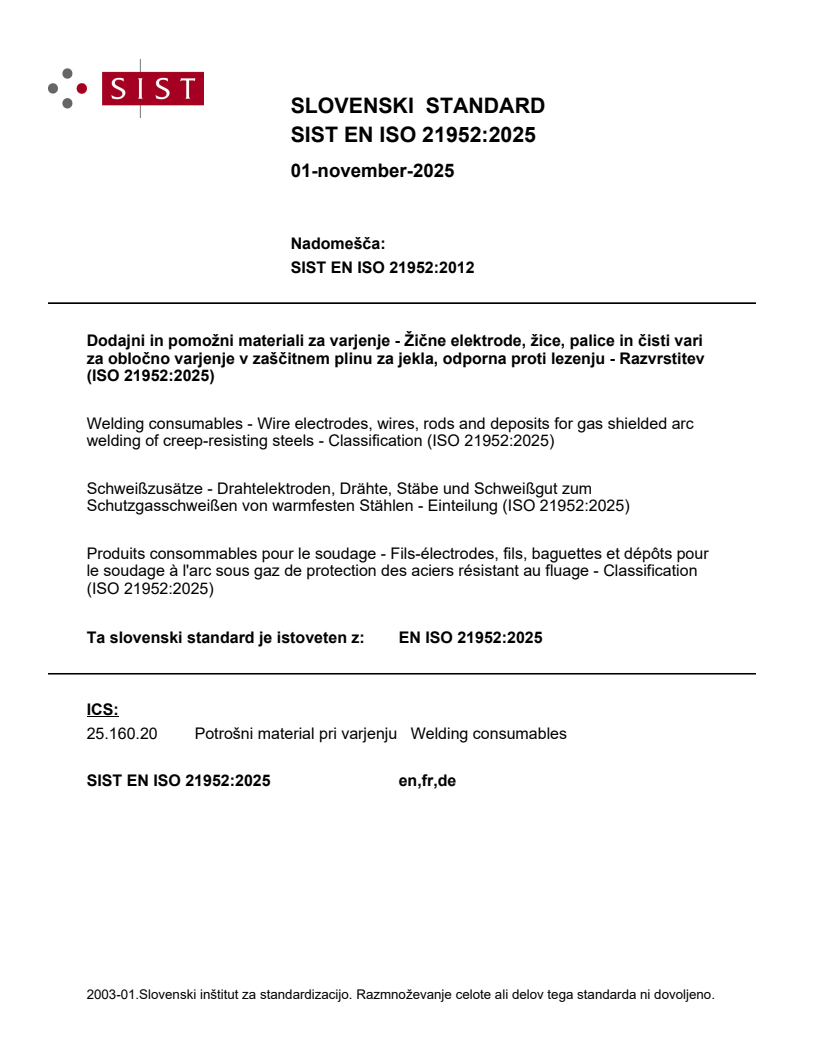
SLOVENSKI STANDARD
01-november-2025
Nadomešča:
SIST EN ISO 21952:2012
Dodajni in pomožni materiali za varjenje - Žične elektrode, žice, palice in čisti vari
za obločno varjenje v zaščitnem plinu za jekla, odporna proti lezenju - Razvrstitev
(ISO 21952:2025)
Welding consumables - Wire electrodes, wires, rods and deposits for gas shielded arc
welding of creep-resisting steels - Classification (ISO 21952:2025)
Schweißzusätze - Drahtelektroden, Drähte, Stäbe und Schweißgut zum
Schutzgasschweißen von warmfesten Stählen - Einteilung (ISO 21952:2025)
Produits consommables pour le soudage - Fils-électrodes, fils, baguettes et dépôts pour
le soudage à l'arc sous gaz de protection des aciers résistant au fluage - Classification
(ISO 21952:2025)
Ta slovenski standard je istoveten z: EN ISO 21952:2025
ICS:
25.160.20 Potrošni material pri varjenju Welding consumables
2003-01.Slovenski inštitut za standardizacijo. Razmnoževanje celote ali delov tega standarda ni dovoljeno.
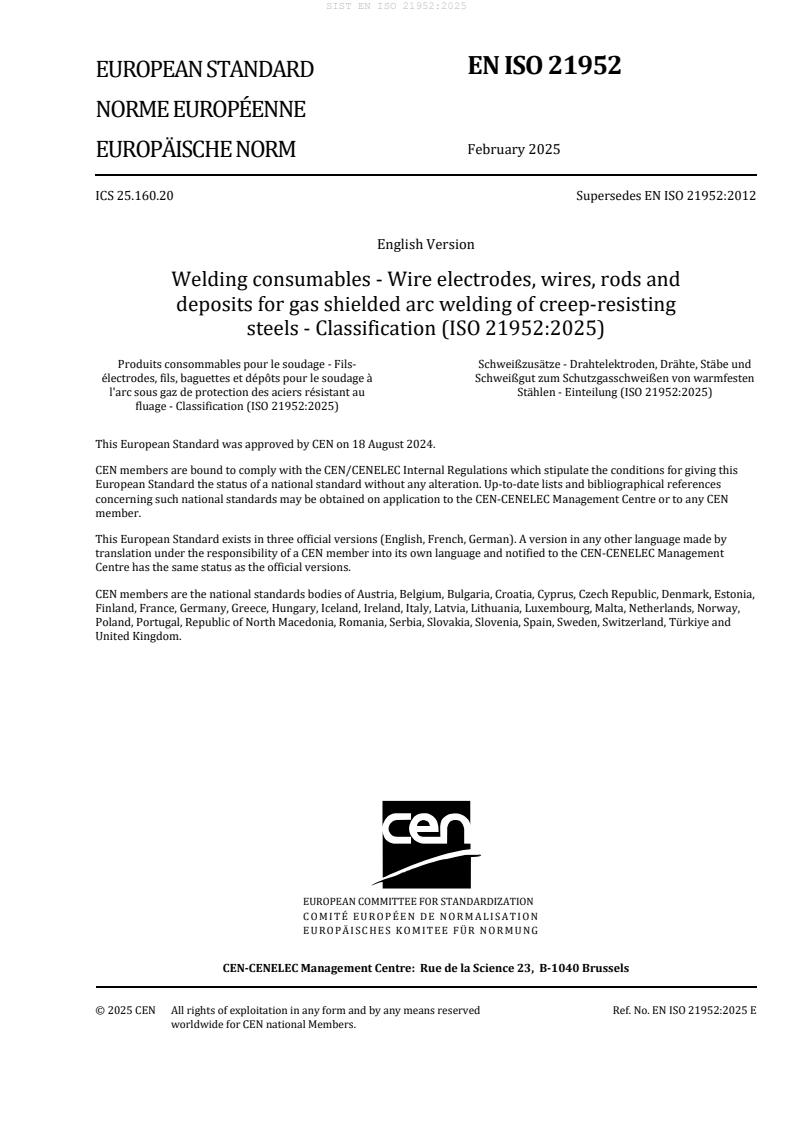
EN ISO 21952
EUROPEAN STANDARD
NORME EUROPÉENNE
February 2025
EUROPÄISCHE NORM
ICS 25.160.20 Supersedes EN ISO 21952:2012
English Version
Welding consumables - Wire electrodes, wires, rods and
deposits for gas shielded arc welding of creep-resisting
steels - Classification (ISO 21952:2025)
Produits consommables pour le soudage - Fils- Schweißzusätze - Drahtelektroden, Drähte, Stäbe und
électrodes, fils, baguettes et dépôts pour le soudage à Schweißgut zum Schutzgasschweißen von warmfesten
l'arc sous gaz de protection des aciers résistant au Stählen - Einteilung (ISO 21952:2025)
fluage - Classification (ISO 21952:2025)
This European Standard was approved by CEN on 18 August 2024.
CEN members are bound to comply with the CEN/CENELEC Internal Regulations which stipulate the conditions for giving this
European Standard the status of a national standard without any alteration. Up-to-date lists and bibliographical references
concerning such national standards may be obtained on application to the CEN-CENELEC Management Centre or to any CEN
member.
This European Standard exists in three official versions (English, French, German). A version in any other language made by
translation under the responsibility of a CEN member into its own language and notified to the CEN-CENELEC Management
Centre has the same status as the official versions.
CEN members are the national standards bodies of Austria, Belgium, Bulgaria, Croatia, Cyprus, Czech Republic, Denmark, Estonia,
Finland, France, Germany, Greece, Hungary, Iceland, Ireland, Italy, Latvia, Lithuania, Luxembourg, Malta, Netherlands, Norway,
Poland, Portugal, Republic of North Macedonia, Romania, Serbia, Slovakia, Slovenia, Spain, Sweden, Switzerland, Türkiye and
United Kingdom.
EUROPEAN COMMITTEE FOR STANDARDIZATION
COMITÉ EUROPÉEN DE NORMALISATION
EUROPÄISCHES KOMITEE FÜR NORMUNG
CEN-CENELEC Management Centre: Rue de la Science 23, B-1040 Brussels
© 2025 CEN All rights of exploitation in any form and by any means reserved Ref. No. EN ISO 21952:2025 E
worldwide for CEN national Members.
Contents Page
European foreword . 3
European foreword
This document (EN ISO 21952:2025) has been prepared by Technical Committee ISO/TC 44 "Welding
and allied processes" in collaboration with Technical Committee CEN/TC 121 “Welding and allied
processes” the secretariat of which is held by AFNOR.
This European Standard shall be given the status of a national standard, either by publication of an
identical text or by endorsement, at the latest by August 2025, and conflicting national standards shall
be withdrawn at the latest by August 2025.
Attention is drawn to the possibility that some of the elements of this document may be the subject of
patent rights. CEN shall not be held responsible for identifying any or all such patent rights.
This document supersedes EN ISO 21952:2012.
Any feedback and questions on this document should be directed to the users’ national standards
body/national committee. A complete listing of these bodies can be found on the CEN website.
According to the CEN-CENELEC Internal Regulations, the national standards organizations of the
following countries are bound to implement this European Standard: Austria, Belgium, Bulgaria,
Croatia, Cyprus, Czech Republic, Denmark, Estonia, Finland, France, Germany, Greece, Hungary, Iceland,
Ireland, Italy, Latvia, Lithuania, Luxembourg, Malta, Netherlands, Norway, Poland, Portugal, Republic of
North Macedonia, Romania, Serbia, Slovakia, Slovenia, Spain, Sweden, Switzerland, Türkiye and the
United Kingdom.
Endorsement notice
The text of ISO 21952:2025 has been approved by CEN as EN ISO 21952:2025 without any modification.
International
Standard
ISO 21952
Third edition
Welding consumables — Wire
2025-02
electrodes, wires, rods and
deposits for gas shielded arc
welding of creep-resisting steels —
Classification
Produits consommables pour le soudage — Fils-électrodes, fils,
baguettes et dépôts pour le soudage à l'arc sous gaz de protection
des aciers résistant au fluage — Classification
Reference number
ISO 21952:2025(en) © ISO 2025
ISO 21952:2025(en)
© ISO 2025
All rights reserved. Unless otherwise specified, or required in the context of its implementation, no part of this publication may
be reproduced or utilized otherwise in any form or by any means, electronic or mechanical, including photocopying, or posting on
the internet or an intranet, without prior written permission. Permission can be requested from either ISO at the address below
or ISO’s member body in the country of the requester.
ISO copyright office
CP 401 • Ch. de Blandonnet 8
CH-1214 Vernier, Geneva
Phone: +41 22 749 01 11
Email: copyright@iso.org
Website: www.iso.org
Published in Switzerland
ii
ISO 21952:2025(en)
Contents Page
Foreword .iv
Introduction .vi
1 Scope . 1
2 Normative references . 1
3 Terms and definitions . 1
4 Classification . 2
4.1 General .2
4.2 Classification systems .2
5 Symbols and requirements . 2
5.1 Symbol for the product or process .2
5.2 Symbol for the chemical composition of wire electrodes, wires, and rods .3
5.3 Symbol for the mechanical properties of all-weld metal .3
5.3.1 Classification by chemical composition – System A .3
5.3.2 Classification by tensile strength and chemical composition – System B . .3
5.4 Symbol for shielding gas .3
5.4.1 Classification by chemical composition – system A .3
5.4.2 Classification by tensile strength and chemical composition – system B .3
6 Mechanical tests .12
7 Preheating and interpass temperatures .12
8 Welding conditions and pass sequence .12
9 Chemical analysis . .13
10 Rounding procedure .13
11 Retest.13
12 Technical delivery conditions .13
13 Examples of designation .13
13.1 General . 13
13.2 Example 1 – Classification by chemical composition – system A . 13
13.3 Example 2 – Classification by tensile strength and chemical composition – system B .14
13.4 Example 3 – Classification by chemical composition – system A .14
13.5 Example 4 – Classification by tensile strength and chemical composition – system B .14
13.6 Example 5 – Classification by chemical composition – system A . 15
13.7 Example 6 – Classification by tensile strength and chemical composition – system B . 15
13.8 Example 7 – Classification by chemical composition – system A . 15
13.9 Example 8 – Classification by tensile strength and chemical composition – system B .16
Bibliography . 17
iii
ISO 21952:2025(en)
Foreword
ISO (the International Organization for Standardization) is a worldwide federation of national standards
bodies (ISO member bodies). The work of preparing International Standards is normally carried out through
ISO technical committees. Each member body interested in a subject for which a technical committee
has been established has the right to be represented on that committee. International organizations,
governmental and non-governmental, in liaison with ISO, also take part in the work. ISO collaborates closely
with the International Electrotechnical Commission (IEC) on all matters of electrotechnical standardization.
The procedures used to develop this document and those intended for its further maintenance are described
in the ISO/IEC Directives, Part 1. In particular, the different approval criteria needed for the different types
of ISO document should be noted. This document was drafted in accordance with the editorial rules of the
ISO/IEC Directives, Part 2 (see www.iso.org/directives).
ISO draws attention to the possibility that the implementation of this document may involve the use of (a)
patent(s). ISO takes no position concerning the evidence, validity or applicability of any claimed patent
rights in respect thereof. As of the date of publication of this document, ISO had not received notice of (a)
patent(s) which may be required to implement this document. However, implementers are cautioned that
this may not represent the latest information, which may be obtained from the patent database available at
www.iso.org/patents. ISO shall not be held responsible for identifying any or all such patent rights.
Any trade name used in this document is information given for the convenience of users and does not
constitute an endorsement.
For an explanation of the voluntary nature of standards, the meaning of ISO specific terms and expressions
related to conformity assessment, as well as information about ISO's adherence to the World Trade
Organization (WTO) principles in the Technical Barriers to Trade (TBT), see www.iso.org/iso/foreword.html.
This document was prepared by Technical Committee ISO/TC 44, Welding and allied processes, Subcommittee
SC 3, Welding consumables, in collaboration with the European Committee for Standardization (CEN)
Technical Committee CEN/TC 121, Welding and allied processes, in accordance with the Agreement on
technical cooperation between ISO and CEN (Vienna Agreement).
This third edition cancels and replaces the second edition (ISO 21952:2012), which has been technically
revised.
The main changes are as follows:
— this document has been reformatted in single column showing System A and System B in tables and
separate clauses and subclauses, some which are new;
— normative references have been updated;
— 5.4.2 additional text was added at the end of the subclause;
— Table 3, new compositions 9C1MV3 and 9C1MV4 were added and footnote b was revised;
— Table 3, the Mn + Ni for 9C1MV was revised;
— Table 3, footnotes f and g were revised;
— Table 4, X62X 9C1MV3 was added to reflect the addition in Table 3;
— Table 6 has been revised;
— Clause 10 was updated to match the rounding procedure used in other current standards;
— Clause 13 examples were revised, and new examples added.
Any feedback or questions on this document should be directed to the user’s
national standards body. A complete listing of these bodies can be found at
iv
ISO 21952:2025(en)
www.iso.org/members.html. Official interpretations of ISO/TC 44 documents, where they exist, are
available from this page: https://committee.iso.org/sites/tc44/home/interpretation.html.
v
ISO 21952:2025(en)
Introduction
This document was prepared in collaboration with the International Institute of Welding. It recognizes that
there are two somewhat different approaches in the global market to classifying a given wire electrode, wire,
rod or deposit, and allows for either or both to be used, to suit a particular market need. Application of either
type of classification designation (or of both where suitable) identifies a product as classified in accordance
with this document. The classification in accordance with system A was mainly based on EN 12070:1999
which has been withdrawn and replaced by this document. The classification in accordance with system B is
mainly based upon standards used around the Pacific Rim.
This document proposes a classification system for wire electrodes, wires and rods in terms of their
chemical composition and, where required, in terms of the yield strength, tensile strength and elongation of
the all-weld metal deposit. The ratio of yield to tensile strength of weld metal is generally higher than that of
parent metal. Users should note that matching weld metal yield strength to parent metal yield strength does
not necessarily ensure that the weld metal tensile strength matches that of the parent material. Where the
application requires matching tensile strength, selection of the consumable should be made by reference to
column 4 of Table 4.
It should be noted that the mechanical properties of all-weld metal test pieces used to classify the electrodes,
wires and rods vary from those obtained in production joints because of differences in welding procedure
such as electrode size, width of weave, welding position and material composition.
vi
International Standard ISO 21952:2025(en)
Welding consumables — Wire electrodes, wires, rods and
deposits for gas shielded arc welding of creep-resisting steels
— Classification
1 Scope
This document specifies requirements for classification of wire electrodes, wires and rods for gas shielded
metal arc welding and tungsten inert-gas welding of creep-resisting steels, and for their deposits in the as-
welded or post-weld heat-treated condition. One wire electrode can be tested and classified with different
shielding gases.
This document is a combined specification providing for classification utilizing a system based upon the
chemical composition of wire electrodes, wires and rods with requirements for yield strength and average
impact energy of 47 J of all-weld metal, or utilizing a system based upon the tensile strength of the all-weld
metal deposits and the chemical composition of wire electrodes, wires and rods.
a) Clauses, subclauses and tables which carry the suffix “system A” are applicable only to wire electrodes,
wires, rods and deposits classified in accordance with the system based upon the chemical composition
with requirements for yield strength and the average impact energy of 47 J of all-weld metal deposits
under this document.
b) Clauses, subclauses and tables which carry the suffix “system B” are applicable only to wire electrodes,
wires, rods and deposits classified in accordance with the system based upon the tensile strength of
all-weld metal deposits and the chemical composition of wire electrodes, wires and rods under this
document.
c) Clauses, subclauses and tables which do not have either the suffix “system A” or the “system B” are
applicable to all wire electrodes, wires, rods and deposits classified under this document.
2 Normative references
The following referenced documents are indispensable for the application of this document. For dated
references, only the edition cited applies. For undated references, the latest edition of the referenced
document (including any amendments) applies.
ISO 544, Welding consumables — Technical delivery conditions for filler materials and fluxes — Type of product,
dimensions, tolerances and markings
ISO 13916, Welding — Guidance on the measurement of preheating temperature, interpass temperature and
preheat maintenance temperature
ISO 14175:2008, Welding consumables — Gases and gas mixtures for fusion welding and allied processes
ISO 14344, Welding consumables — Procurement of filler materials and fluxes
ISO 15792-1:2020, Welding consumables — Test methods — Part 1: Preparation of all-weld metal test pieces
and specimens in steel, nickel and nickel alloys
ISO 80000-1:2022, Quantities and units — Part 1: General
3 Terms and definitions
No terms and definitions are listed in this document.
ISO 21952:2025(en)
ISO and IEC maintain terminology databases for use in standardization at the following addresses:
— ISO Online browsing platform: available at https:// www .iso .org/ obp
— IEC Electropedia: available at https:// www .electropedia .org/
4 Classification
4.1 General
Classification designations are based upon two approaches to indicate:
— the chemical composition of the wire electrode wire or rod;
— tensile properties; and
— impact properties (system A only)
of the all-weld metal deposits obtained with a given wire electrode, wire or rod. The two designation
approaches include additional designators for some other classification requirements, but not all, as is clear
from the following subclauses. In most cases, a given commercial product can be classified in accordance
with both systems. Then, either or both classification designations can be used for the product.
A wire electrode, wire or rod shall be classified in accordance with its chemical composition as given in
Table 3.
When the wire electrode, wire, rod or deposit is classified in combination with a shielding gas, the
classification shall be prefixed with a symbol in accordance with Clause 5 as appropriate.
4.2 Classification systems
Each classification system, A and B, is split into parts as given in Table 1.
Table 1 — Parts of the classification systems, A and B
Classification system
Part of
System A System B
classification
Classification by chemical composition Classification by tensile strength and
designation
chemical composition
1 The first part gives a symbol indicating the product or process to be identified;
The second part gives a symbol indicating the The second part gives a symbol indicating the
chemical composition of the wire electrode, strength and elongation of the all-weld-metal
wire, or rod used (see Table 3). deposit in the post weld heat-treated condition
(see Table 4);
— The third part gives a symbol indicating the
shielding gas used (see 5.4.2);
— The fourth part gives a symbol indicating the
4 chemical composition of the wire electrode, wire
or rod used (see Table 3).
NOTE A dash indicates not applicable
5 Symbols and requirements
5.1 Symbol for the product or process
The symbol for the wire electrode, wire or rod used in the arc welding process shall be the letter G (gas
shielded metal arc welding) and/or W (gas shielded arc welding with non-consumable tungsten electrode).
ISO 21952:2025(en)
5.2 Symbol for the chemical composition of wire electrodes, wires, and rods
The symbol in Table 3 indicates the chemical composition of the wire electrode, wire, and rod determined
under the conditions given in Clause 9.
5.3 Symbol for the mechanical properties of all-weld metal
5.3.1 Classification by chemical composition – System A
No symbol shall be used for the mechanical properties of the all-weld metal. The all-weld metal deposit
obtained with the wire electrodes, wires, and rods in Table 3 under conditions given in Clause 6 shall also
fulfil the mechanical property requirements specified in Table 4.
5.3.2 Classification by tensile strength and chemical composition – System B
The symbol for tensile strength of the all-weld metal deposit produced by the gas shielded metal arc welding
process and the tungsten inert-gas welding process shall be as given in Table 2.
Table 2 — Symbol for tensile strength of all-weld metal deposit –
Classification by tensile strength and chemical composition - System B
Symbol Minimum tensile strength
MPa
49 490
52 520
55 550
57 570
62 620
69 690
78 780
The complete mechanical property requirements that shall be
fulfilled by the various compositions are specified in Table 4.
5.4 Symbol for shielding gas
5.4.1 Classification by chemical composition – system A
No symbol shall be used for the shielding gas.
5.4.2 Classification by tensile strength and chemical composition – system B
The symbols for shielding gases shall be in accordance with ISO 14175:2008, for example:
— the symbol I1 shall be used when the classification has been performed with shielding gas ISO 14175-I1,
100 % argon;
— the symbol M12, for mixed gases, shall be used when the classification has been performed with shielding
gas ISO 14175-M12, but without helium;
— the symbol M13 shall be used when the classification has been performed with shielding gas ISO 14175-M13;
— the symbol M20, for mixed gases, shall be used when the classification has been performed with shielding
gas ISO 14175-M20, but without helium.
— the symbol M21, for mixed gases, shall be used when the classification has been performed with shielding
gas ISO 14175-M21, but without helium;
ISO 21952:2025(en)
— the symbol C1 shall be used when the classification has been performed with shielding gas ISO 14175-C1,
carbon dioxide;
— the symbol Z is used for an unspecified shielding gas.
In all cases, the actual shielding gas used shall be shown on test reports.
ISO 21952:2025(en)
Table 3 — Symbols and chemical composition requirements of wire electrodes, wires and rods
Symbol for classification in Chemical composition
a,b
accordance with % (by mass)
tensile strength
Chemical
and chemical
Other
c
composition
C Si Mn P S Ni Cr Mo Cu Ti V
d
composition
elements
ISO 21952-A
ISO 21952-B
MoSi (1M3) 0,08 to 0,15 0,50 to 0,80 0,70 to 1,30 0,020 0,020 — — 0,40 to 0,60 — — — —
(MoSi) 1M3 0,12 0,30 to 0,70 1,30 0,025 0,025 0,20 – 0,40 to 0,65 0,35 — — —
MnMo 0,08 to 0,15 0,05 to 0,25 1,30 to 1,70 0,025 0,025 — — 0,45 to 0,65 — — — —
e
3M3 0,12 0,60 to 0,90 1,10 to 1,60 0,025 0,025 — — 0,40 to 0,65 0,50 — — —
e
3M3T 0,12 0,40 to 1,00 1,00 to 1,80 0,025 0,025 — — 0,40 to 0,65 0,50 0,02 to 0,30 — —
MoVSi 0,06 to 0,15 0,40 to 0,70 0,70 to 1,10 0,020 0,020 — 0,30 to 0,60 0,50 to 1,00 — — 0,20 to 0,40 —
CM 0,12 0,10 to 0,40 0,20 to 1,00 0,025 0,025 — 0,40 to 0,90 0,40 to 0,65 0,40 — — —
e
CMT 0,12 0,30 to 0,90 1,00 to 1,80 0,025 0,025 — 0,30 to 0,70 0,40 to 0,65 0,40 0,02 to 0,30 — —
CrMo1Si (1CM3) 0,08 to 0,14 0,50 to 0,80 0,80 to 1,20 0,020 0,020 — 0,90 to 1,30 0,40 to 0,65 — — — —
CrMoV1Si 0,06 to 0,15 0,50 to 0,80 0,80 to 1,20 0,020 0,020 — 0,90 to 1,30 0,90 to 1,30 — — 0,10 to 0,35 —
1CM 0,07 to 0,12 0,40 to 0,70 0,40 to 0,70 0,025 0,025 0,20 1,20 to 1,50 0,40 to 0,65 0,35 — — —
1CM1 0,12 0,20 to 0,50 0,60 to 0,90 0,025 0,025 — 1,00 to 1,60 0,30 to 0,65 0,40 — — —
1CM2 0,05 to 0,15 0,15 to 0,40 1,60 to 2,00 0,025 0,025 — 1,00 to 1,60 0,40 to 0,65 0,40 — — —
(CrMo1Si) 1CM3 0,12 0,30 to 0,90 0,80 to 1,50 0,025 0,025 — 1,00 to 1,60 0,40 to 0,65 0,40 — — —
1CML 0,05 0,40 to 0,70 0,40 to 0,70 0,025 0,025 0,20 1,20 to 1,50 0,40 to 0,65 0,35 — — —
1CML1 0,05 0,20 to 0,80 0,80 to 1,40 0,025 0,025 — 1,00 to 1,60 0,40 to 0,65 0,40 — — —
1CMT 0,05 to 0,15 0,30 to 0,90 0,80 to 1,50 0,025 0,025 — 1,00 to 1,60 0,40 to 0,65 0,40 0,02 to 0,30 — —
1CMT1 0,12 0,30 to 0,90 1,20 to 1,90 0,025 0,025 — 1,00 to 1,60 0,40 to 0,65 0,40 0,02 to 0,30 — —
Nb 0,01 to 0,08
2CMWV 0,12 0,10 to 0,70 0,20 to 1,00 0,020 0,010 — 2,00 to 2,60 0,40 to 0,65 0,40 — 0,10 to 0,50
W 1,00 to 2,00
a
A designation in parentheses, e.g. (CrMo1) or (1CM), indicates a near match in the other designation system, but not an exact match. The correct designation for a given composition range is the one without parentheses. A
given product may, by having a more restricted chemical composition which fulfils both sets of designation requirements, be assigned both designations independently, provided that the mechanical property requirements of
Table 4 are also satisfied.
b
Single values shown in this table are maximum values.
c
If not specified, Ni < 0,3 % (by mass), Cu < 0,3 % (by mass), V < 0,03 % (by mass), Nb < 0,01 % (by mass), and Cr < 0,2 % (by mass).
d
The filler metal shall be analysed for the specific elements for which values are shown. If the presence of other elements is indicated in the course of this work, the amount of these elements shall be determined to ensure that
their total (excluding Fe) does not exceed 0,50 % (by mass).
e
Compositions containing approximately 0,5 % (by mass) Mo, without Cr, and with Mn significantly in excess of 1 % (by mass), may not provide optimum creep resistance.
f
Consumables for which the chemical composition is not listed shall be symbolized similarly and prefixed by the letter Z (ISO 21952-A). The chemical composition ranges are not specified and therefore it is possible that two
electrodes with the same Z classification are not interchangeable.
g
Consumables for which the chemical composition is not listed in this table shall be symbolized by the letter G. The chemical composition ranges are not specified and therefore it is possible that two products with a G
classification are not interchangeable.
---------
...
Questions, Comments and Discussion
Ask us and Technical Secretary will try to provide an answer. You can facilitate discussion about the standard in here.
Loading comments...