


SIST-TS CEN/TS 18209:2026
(Main)LPG equipment and accessories - Cylinders transportation racks controls
LPG equipment and accessories - Cylinders transportation racks controls
This document specifies the operational procedures and best practices when checking transportation racks for LPG cylinders before and during loading and unloading prior to the vehicles going on the road and at any break during the journey.
This document applies to racks containing transportable refillable LPG cylinders of water capacity from 0,5 l up to and including 150 l.
This document applies to the following equipment:
- rack frame/structure;
- rack closures;
- rack fixing equipment or accessories on to the vehicle.
This document applies to checks performed:
- at cylinder filling plants and depots;
- or at cylinder manufacturing and/or refurbishment facilities;
- or at any place where racks are used or moved.
This document also provides guidance and examples for rack maintenance and repair procedures, including rejection criteria and for establishing operational procedures. Transportation racks are also called stillages, pallets or racks (see Clause 3).
This document does not cover the design and the manufacturing of racks.
This document does not apply to presentation display racks at points of sale.
Flüssiggas-Geräte und Ausrüstungsteile- Überprüfungen von Flaschentransportgestellen
Dieses Dokument legt die betrieblichen Vorgehensweisen und bewährten Praktiken bei der Überprüfung von Transportgestellen für Flaschen für Flüssiggas vor und während des Be- und Entladens fest, bevor die Fahr
zeuge auf die Straße gehen und bei jeder Unterbrechung während der Fahrt.
Dieses Dokument gilt für Gestelle, die ortsbewegliche wiederbefüllbare Flaschen für Flüssiggas mit einem Fas
sungsraum von 0,5l bis einschließlich 150l enthalten.
Dieses Dokument gilt für die folgenden Geräte:
- Gestellrahmen/-konstruktion;
- Verschlüsse von Gestellen;
- Geräte oder Ausrüstungsteile zur Befestigung von Gestellen am Fahrzeug.
Dieses Dokument gilt für Überprüfungen, die durchgeführt werden:
- in Füllanlagen und Depots für Gasflaschen;
- oder in Einrichtungen zur Herstellung und/oder Überholung von Gasflaschen;
- oder an jedem Ort, an dem Gestelle verwendet oder bewegt werden.
Dieses Dokument enthält auch Anleitungen und Beispiele für Verfahren zur Wartung und Instandsetzung von Gestellen, einschließlich der Zurückweisungskriterien und für die Festlegung von betrieblichen Vorgehenswei
sen. Transportgestelle werden auch als Plattformen, Paletten oder Gestelle bezeichnet (siehe Abschnitt3).
Dieses Dokument umfasst nicht die Auslegung und die Herstellung von Gestellen.
Dieses Dokument gilt nicht für Präsentationsgestelle in Verkaufsstellen.
Équipements pour GPL et leurs accessoires - Contrôle des casiers de transport de bouteilles
Le présent document spécifie les modes opératoires de fonctionnement et les bonnes pratiques lors de la vérification des casiers de transport des bouteilles de GPL avant et pendant le chargement et le déchargement, avant que les véhicules ne prennent la route et lors de toute interruption au cours du trajet.
Le présent document s'applique aux casiers de transport contenant des bouteilles transportables et rechargeables pour GPL d'une capacité en eau comprise entre 0,5 l et 150 l.
Le présent document s'applique aux équipements suivants :
— cadre/structure des casiers de transport ;
— fermetures des casiers de transport ;
— équipements ou accessoires de fixation des casiers de transport sur le véhicule.
Le présent document s'applique aux contrôles effectués :
— aux stations de rechargement et aux dépôts de bouteilles ;
— ou aux installations de fabrication et/ou de remise en état des bouteilles ;
— ou à tout endroit où des casiers de transport sont utilisés ou déplacés.
Le présent document fournit également des recommandations et des exemples pour les modes opératoires d’entretien et de réparation des casiers de transport, y compris des critères de rejet, ainsi que pour la mise en place de modes opératoires de fonctionnement. Les casiers de transport sont également appelés des palettes hautes, des palettes ou des casiers (voir Article 3).
Le présent document ne couvre pas la conception et la fabrication des casiers de transport.
Le présent document ne s'applique pas aux casiers de présentation situés sur les points de vente.
Oprema in pribor za utekočinjeni naftni plin (UNP) - Pregledi nosilcev za prevoz jeklenk
Ta dokument določa operativne postopke in najboljše prakse pri preverjanju transportnih stojal za jeklenke z utekočinjenim naftnim plinom (LPG) pred in med nakladanjem ter razkladanjem, preden vozila odidejo na cesto in ob vsakem postanku med potjo.
Ta dokument se uporablja za stojala, ki vsebujejo prenosljive ponovno napolnljive jeklenke z utekočinjenim naftnim plinom (LPG) z vodno kapaciteto od 0,5 l do vključno 150 l.
Ta dokument se uporablja za naslednjo opremo:
- okvir/struktura stojala;
- zapirala stojala;
- oprema za pritrditev stojala ali dodatki na vozilo.
Ta dokument se uporablja za preverjanja, izvedena:
- v obratih za polnjenje jeklenk in skladiščih;
- ali v obratih za proizvodnjo in/ali obnovo jeklenk;
- ali na katerem koli mestu, kjer se stojala uporabljajo ali premikajo.
Ta dokument prav tako zagotavlja smernice in primere za postopke vzdrževanja in popravila stojal, vključno z merili za zavrnitev in za vzpostavitev operativnih postopkov. Transportna stojala se imenujejo tudi nosilci, palete ali stojala (glej točko 3).
Ta dokument ne zajema zasnove in izdelave stojal.
Ta dokument se ne uporablja za predstavitvena stojala na prodajnih mestih.
General Information
- Status
- Published
- Public Enquiry End Date
- 30-Sep-2025
- Publication Date
- 15-Mar-2026
- Technical Committee
- TLP - Pressure vessels
- Current Stage
- 6060 - National Implementation/Publication (Adopted Project)
- Start Date
- 04-Mar-2026
- Due Date
- 09-May-2026
- Completion Date
- 16-Mar-2026

Relations
- Effective Date
- 28-Jan-2026
- Effective Date
- 28-Jan-2026
- Effective Date
- 28-Jan-2026
Overview
SIST-TS CEN/TS 18209:2026 establishes operational procedures and best practices for controlling and inspecting racks used for the transportation of liquefied petroleum gas (LPG) cylinders. The standard covers checks required before, during, and after loading and unloading of transportation racks, as well as throughout a vehicle’s journey, at filling plants, depots, manufacturing, and refurbishment facilities. This technical specification applies to racks (including stillages and pallets) that hold refillable LPG cylinders with water capacities from 0.5 liters up to 150 liters.
The standard plays a critical role in ensuring safety, minimizing risks during transport, and supporting regulatory compliance throughout the LPG cylinder supply chain. Please note that the document does not address the design or manufacturing of racks, nor does it apply to display racks at points of sale.
Key Topics
- Scope of Inspection: Defines when and where racks must be checked, including at filling plants, depots, and during transport or storage.
- Applicable Equipment:
- Rack frames and structure
- Rack closures
- Fixing equipment and accessories for securing racks onto vehicles
- Inspection Procedures:
- Visual checks for damaged, corroded, or missing parts
- Use of structured checklists and rejection criteria
- Identification of common defects such as cracked welds, damaged floors, corroded structures, or faulty closures
- Operational Procedures:
- Loading and unloading practices for LPG cylinders using racks
- Vehicle and load compatibility checks
- Proper stacking methods and securing requirements per transport regulations
- Maintenance and Repair Guidance:
- Criteria for setting racks aside for repair or further evaluation
- Rejection reporting and defect labeling protocols
- Competency Requirements:
- Inspections must be carried out by competent persons with appropriate training and experience
Applications
The standard addresses practical tasks and quality control for the safe handling of LPG cylinder transportation racks. Typical use cases include:
- LPG Filling Plants & Depots: Ensuring racks are safe before filling or dispatch; periodic inspection during storage.
- Manufacturing & Refurbishment Facilities: Inspection during fabrication, post-manufacture, and after refurbishment.
- Logistics & Distribution: Pre-loading and en-route inspections to prevent incidents, such as cylinder loss or accidental release during road transit.
- Transport Operators: Adopting standardized checklists to verify rack integrity and secure loading, reducing the likelihood of accidents and regulatory noncompliance.
Implementing these inspection controls supports:
- Increased operator and public safety
- Reduced property and environmental risks
- Adherence to European and national dangerous goods transportation laws
Related Standards
For comprehensive safety and regulatory compliance, this standard should be used in conjunction with relevant technical references, including:
- EN 12195-1: Load restraint on road vehicles - Safety requirements for securing forces
- EN ISO 445: Vocabulary and definitions for pallets used in material handling
- CEN/TS 16765: Covers environmental considerations for LPG equipment and accessories
- European Agreement concerning the International Carriage of Dangerous Goods by Road (ADR)
- ISO 13194: Reference for test methods and some requirements for pallets
By aligning with SIST-TS CEN/TS 18209:2026, LPG industry stakeholders ensure consistent and recognized safety controls throughout the LPG cylinder distribution system, helping meet both operational and regulatory demands.
Get Certified
Connect with accredited certification bodies for this standard

Institut za varilstvo d.o.o. (Welding Institute)
Slovenia's leading welding institute since 1952. ISO 3834, EN 1090, pressure equipment certification, NDT personnel, welder qualification. Only IIW Au
Sponsored listings
Frequently Asked Questions
SIST-TS CEN/TS 18209:2026 is a technical specification published by the Slovenian Institute for Standardization (SIST). Its full title is "LPG equipment and accessories - Cylinders transportation racks controls". This standard covers: This document specifies the operational procedures and best practices when checking transportation racks for LPG cylinders before and during loading and unloading prior to the vehicles going on the road and at any break during the journey. This document applies to racks containing transportable refillable LPG cylinders of water capacity from 0,5 l up to and including 150 l. This document applies to the following equipment: - rack frame/structure; - rack closures; - rack fixing equipment or accessories on to the vehicle. This document applies to checks performed: - at cylinder filling plants and depots; - or at cylinder manufacturing and/or refurbishment facilities; - or at any place where racks are used or moved. This document also provides guidance and examples for rack maintenance and repair procedures, including rejection criteria and for establishing operational procedures. Transportation racks are also called stillages, pallets or racks (see Clause 3). This document does not cover the design and the manufacturing of racks. This document does not apply to presentation display racks at points of sale.
This document specifies the operational procedures and best practices when checking transportation racks for LPG cylinders before and during loading and unloading prior to the vehicles going on the road and at any break during the journey. This document applies to racks containing transportable refillable LPG cylinders of water capacity from 0,5 l up to and including 150 l. This document applies to the following equipment: - rack frame/structure; - rack closures; - rack fixing equipment or accessories on to the vehicle. This document applies to checks performed: - at cylinder filling plants and depots; - or at cylinder manufacturing and/or refurbishment facilities; - or at any place where racks are used or moved. This document also provides guidance and examples for rack maintenance and repair procedures, including rejection criteria and for establishing operational procedures. Transportation racks are also called stillages, pallets or racks (see Clause 3). This document does not cover the design and the manufacturing of racks. This document does not apply to presentation display racks at points of sale.
SIST-TS CEN/TS 18209:2026 is classified under the following ICS (International Classification for Standards) categories: 23.020.35 - Gas cylinders. The ICS classification helps identify the subject area and facilitates finding related standards.
SIST-TS CEN/TS 18209:2026 has the following relationships with other standards: It is inter standard links to SIST EN 12195-1:2004, SIST EN 12195-1:2011, SIST EN 15502-2-3:2024. Understanding these relationships helps ensure you are using the most current and applicable version of the standard.
SIST-TS CEN/TS 18209:2026 is available in PDF format for immediate download after purchase. The document can be added to your cart and obtained through the secure checkout process. Digital delivery ensures instant access to the complete standard document.
Standards Content (Sample)
SLOVENSKI STANDARD
01-april-2026
Oprema in pribor za utekočinjeni naftni plin (UNP) - Pregledi nosilcev za prevoz
jeklenk
LPG equipment and accessories - Cylinders transportation racks controls
Flüssiggas-Geräte und Ausrüstungsteile- Überprüfungen von Flaschentransportgestellen
Équipements pour GPL et leurs accessoires - Contrôle des casiers de transport de
bouteilles
Ta slovenski standard je istoveten z: CEN/TS 18209:2025
ICS:
23.020.35 Plinske jeklenke Gas cylinders
2003-01.Slovenski inštitut za standardizacijo. Razmnoževanje celote ali delov tega standarda ni dovoljeno.
CEN/TS 18209
TECHNICAL SPECIFICATION
SPÉCIFICATION TECHNIQUE
December 2025
TECHNISCHE SPEZIFIKATION
ICS 23.020.35
English Version
LPG equipment and accessories - Cylinders transportation
racks controls
Équipements pour GPL et leurs accessoires - Contrôle Flüssiggas-Geräte und Ausrüstungsteile-
des casiers de transport de bouteilles Überprüfungen von Flaschentransportgestellen
This Technical Specification (CEN/TS) was approved by CEN on 17 November 2025 for provisional application.
The period of validity of this CEN/TS is limited initially to three years. After two years the members of CEN will be requested to
submit their comments, particularly on the question whether the CEN/TS can be converted into a European Standard.
CEN members are required to announce the existence of this CEN/TS in the same way as for an EN and to make the CEN/TS
available promptly at national level in an appropriate form. It is permissible to keep conflicting national standards in force (in
parallel to the CEN/TS) until the final decision about the possible conversion of the CEN/TS into an EN is reached.
CEN members are the national standards bodies of Austria, Belgium, Bulgaria, Croatia, Cyprus, Czech Republic, Denmark, Estonia,
Finland, France, Germany, Greece, Hungary, Iceland, Ireland, Italy, Latvia, Lithuania, Luxembourg, Malta, Netherlands, Norway,
Poland, Portugal, Republic of North Macedonia, Romania, Serbia, Slovakia, Slovenia, Spain, Sweden, Switzerland, Türkiye and
United Kingdom.
EUROPEAN COMMITTEE FOR STANDARDIZATION
COMITÉ EUROPÉEN DE NORMALISATION
EUROPÄISCHES KOMITEE FÜR NORMUNG
CEN-CENELEC Management Centre: Rue de la Science 23, B-1040 Brussels
© 2025 CEN All rights of exploitation in any form and by any means reserved Ref. No. CEN/TS 18209:2025 E
worldwide for CEN national Members.
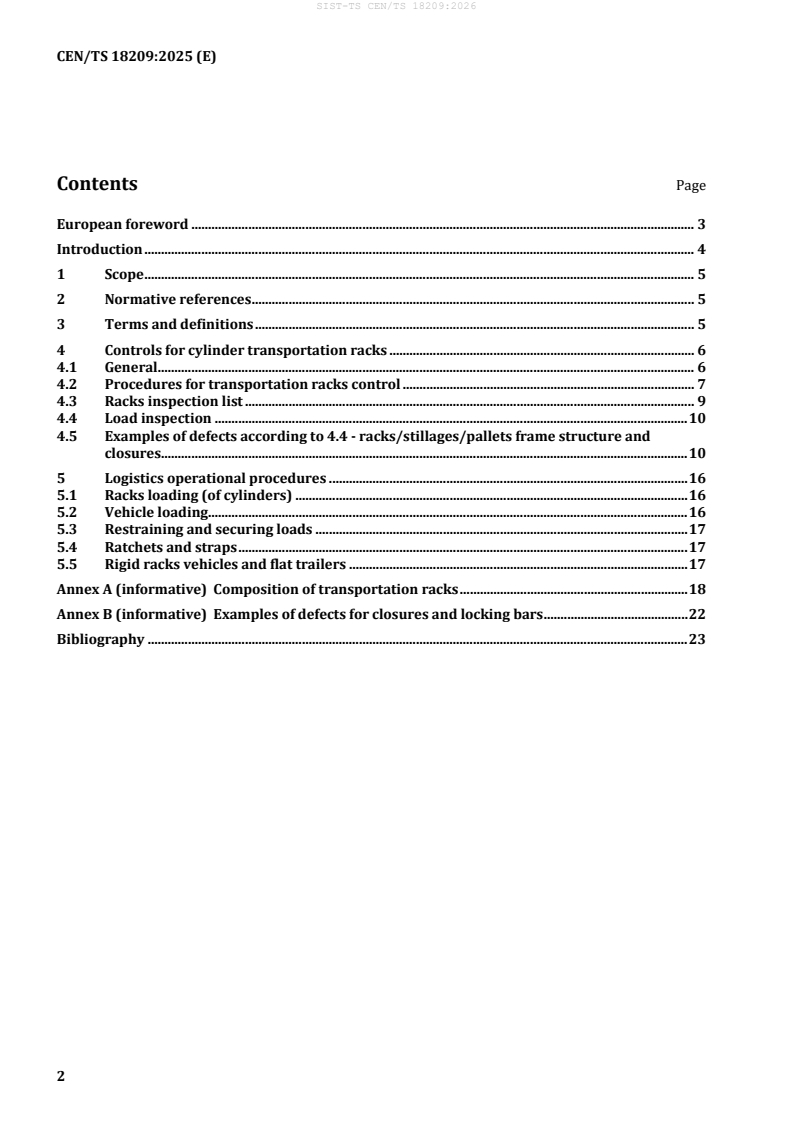
Contents Page
European foreword . 3
Introduction . 4
1 Scope . 5
2 Normative references . 5
3 Terms and definitions . 5
4 Controls for cylinder transportation racks . 6
4.1 General. 6
4.2 Procedures for transportation racks control . 7
4.3 Racks inspection list . 9
4.4 Load inspection . 10
4.5 Examples of defects according to 4.4 - racks/stillages/pallets frame structure and
closures. 10
5 Logistics operational procedures . 16
5.1 Racks loading (of cylinders) . 16
5.2 Vehicle loading . 16
5.3 Restraining and securing loads . 17
5.4 Ratchets and straps . 17
5.5 Rigid racks vehicles and flat trailers . 17
Annex A (informative) Composition of transportation racks . 18
Annex B (informative) Examples of defects for closures and locking bars . 22
Bibliography . 23
European foreword
This document (CEN/TS 18209:2025) has been prepared by Technical Committee CEN/TC 286 “LPG
Equipment and Accessories”, the secretariat of which is held by NSAI.
Attention is drawn to the possibility that some of the elements of this document may be the subject of
patent rights. CEN shall not be held responsible for identifying any or all such patent rights.
Any feedback and questions on this document should be directed to the users’ national standards body.
A complete listing of these bodies can be found on the CEN website.
According to the CEN-CENELEC Internal Regulations, the national standards organizations of the
following countries are bound to announce this Technical Specification: Austria, Belgium, Bulgaria,
Croatia, Cyprus, Czech Republic, Denmark, Estonia, Finland, France, Germany, Greece, Hungary, Iceland,
Ireland, Italy, Latvia, Lithuania, Luxembourg, Malta, Netherlands, Norway, Poland, Portugal, Republic of
North Macedonia, Romania, Serbia, Slovakia, Slovenia, Spain, Sweden, Switzerland, Türkiye and the
United Kingdom.
Introduction
No design and manufacturing standards exist within CEN/TC 286 despite documented cases of logistical
and road incidents where cylinders have fallen from racks either within an operational site or in transit.
Considering the variety of cylinders, operations and racks (cages) in Europe, this document specifies the
operational procedures and best practices when checking transportation racks for LPG cylinders before
and during loading and unloading prior to the vehicles going on the road and at any break during the
journey. This document does not provide requirements for rack design and manufacturing, nevertheless
ISO 13194 has been identified as providing some requirements and test methods for pallets.
Design and manufacturing of such equipment takes into account both the static and dynamic load that
racks will experience in service.
Protection of the environment is a key political issue in Europe and elsewhere. For CEN/TC 286 this is
covered in CEN/TS 16765 and this Technical Specification should be read in conjunction with this
document. The Technical Specification provides guidance on the environmental aspects to be considered
regarding equipment and accessories produced for the LPG industry and the following is addressed:
a) design;
b) manufacture;
c) packaging;
d) use and operation;
e) disposal.
1 Scope
This document specifies the operational procedures and best practices when checking transportation
racks for LPG cylinders before and during loading and unloading prior to the vehicles going on the road
and at any break during the journey.
This document applies to racks containing transportable refillable LPG cylinders of water capacity from
0,5 l up to and including 150 l.
This document applies to the following equipment:
— rack frame/structure;
— rack closures;
— rack fixing equipment or accessories on to the vehicle.
This document applies to checks performed:
— at cylinder filling plants and depots;
— or at cylinder manufacturing and/or refurbishment facilities;
— or at any place where racks are used or moved.
This document also provides guidance and examples for rack maintenance and repair procedures,
including rejection criteria and for establishing operational procedures. Transportation racks are also
called stillages, pallets or racks (see Clause 3).
This document does not cover the design and the manufacturing of racks.
This document does not apply to presentation display racks at points of sale.
2 Normative references
The following documents are referred to in the text in such a way that some or all of their content
constitutes requirements of this document. For dated references, only the edition cited applies. For
undated references, the latest edition of the referenced document (including any amendments) applies.
EN 12195-1, Load restraining on road vehicles — Safety — Part 1: Calculation of securing forces
3 Terms and definitions
For the purposes of this document, the following terms and definitions apply.
ISO and IEC maintain terminology databases for use in standardization at the following addresses:
— ISO Online browsing platform: available at https://www.iso.org/obp/
— IEC Electropedia: available at https://www.electropedia.org/
3.1
transportation rack
rigid structure or assembly designed for the safe storage and transport of LPG cylinders, intended for
manual and/or automatic loading and unloading and designed to be stacked
Note 1 to entry: Details on transportation racks structure and accessories are detailed in Annex A.
3.2
stillage
pallet or skid with a cage, sides or some form of support specifically tailored to the material it is intended
to carry
Note to entry: Some stillage is designed to be stackable.
3.3
pallet
rigid horizontal platform of minimum height, compatible with handling by pallet trucks and/or forklift
trucks and other appropriate handling equipment, used as a base for assembling, loading, storing,
handling, stacking or transporting goods and loads
[SOURCE: EN ISO 445:2013, 2.1, modified — Deleted ‘or displaying’ in the definition and deleted the
Note 1 to entry and Figure 1.]
3.4
competent person
person who by combination of appropriate qualification, training, experience, and resources, is able to
make objective judgments on the subject
4 Controls for cylinder transportation racks
4.1 General
Guidance (e.g. list of potential/possible defects) and rejection criteria for each type of rack shall be
provided. Rack manufacturers, users and any other stakeholders should be consulted in order to establish
the list of potential/possible defects. When such defects are identified and assessed against the rejection
criteria along the distribution chain, then the racks shall be set aside to be further assessed for fitness for
transport.
NOTE 1 See ADR – Janv 2023 – Vol 1 1.4.2, which defines the obligations of the main participants involved in the
transportation of dangerous goods.
When defining the maximum number of racks that can be stacked, consideration shall be given to the
design static and dynamic load bearing capacity of the rack type (including the tare weight of the
cylinders and the weight of the product).
NOTE 2 For information on the possible limitation of the number of racks to be stacked, see local regulations.
NOTE 3 Some types of racks are not designed to be stacked.
When stacking racks, consideration shall be given to their stacking compatibility.
Differentiation should be made between defects which compromise the integrity of the rack and the
safety of operations and transport and those which compromise the integrity but do not compromise the
safety of operations and transport.
When defects compromise the integrity of the rack and the safety of operations and transport:
— either a temporary repair shall be performed in order to enable continuation of transport until the
next plant or depot;
— or the rack shall be set aside for further assessment before being reused.
4.2 Procedures for transportation racks control
Procedures and checklists shall be established by a competent person.
Such procedures shall include: what to check, where to check and who to perform those checks. and with
appropria
...