


SIST EN ISO 11357-6:2025
(Main)Plastics - Differential scanning calorimetry (DSC) - Part 6: Determination of oxidation induction time (isothermal OIT) and oxidation induction temperature (dynamic OIT) (ISO 11357-6:2025)
Plastics - Differential scanning calorimetry (DSC) - Part 6: Determination of oxidation induction time (isothermal OIT) and oxidation induction temperature (dynamic OIT) (ISO 11357-6:2025)
This document specifies methods for the determination of oxidation induction time (isothermal OIT) and oxidation induction temperature (dynamic OIT) of polymeric materials by means of differential scanning calorimetry (DSC). It is applicable to polyolefin resins that are in a fully stabilized or compounded form, either as raw materials or finished products. It can be applicable to other plastics.
Kunststoffe - Dynamische Differenzkalorimetrie (DSC) - Teil 6: Bestimmung der Oxidations-Induktionszeit (isothermische OIT) und Oxidations-Induktionstemperatur (dynamische OIT) (ISO 11357-6:2025)
Dieses Dokument legt Verfahren für die Bestimmung der Oxidations-Induktionszeit (isothermische OIT, en: oxidation induction time) und Oxidations-Induktionstemperatur (dynamische OIT, en: oxidation induction temperature) von polymeren Werkstoffen mittels dynamischer Differenzkalorimetrie (DSC, en: differential scanning calorimetry) fest. Es ist anwendbar auf Polyolefinharze, die in einer vollständig stabilisierten oder vermischten Form entweder als Rohmaterialien oder als Fertigerzeugnisse vorliegen. Es kann auf andere Kunststoffe angewendet werden
Plastiques - Analyse calorimétrique différentielle (DSC) - Partie 6: Détermination du temps d'induction à l'oxydation (OIT isotherme) et de la température d'induction à l'oxydation (OIT dynamique) (ISO 11357-6:2025)
Le présent document spécifie des méthodes de détermination du temps d’induction à l’oxydation (OIT isotherme) et de la température d’induction à l’oxydation (OIT dynamique) des matériaux polymères au moyen de l’analyse calorimétrique différentielle (DSC). Il s’applique aux résines polyoléfines sous forme totalement stabilisée ou sous forme de composition, soit comme matières premières, soit comme produits finis. Il peut s’appliquer à d’autres plastiques.
Polimerni materiali - Diferenčna dinamična kalorimetrija (DSC) - 6. del: Ugotavljanje časa indukcijske oksidacije (izotermični OIT) in temperature indukcijske oksidacije (izodinamični OIT) (ISO 11357-6:2025)
Ta dokument določa metode za ugotavljanje časa indukcijske oksidacije (izotermični OIT) in temperature indukcijske oksidacije (dinamični OIT) polimernih materialov z diferenčno dinamično kalorimetrijo (DSC). Uporablja se za poliolefinske smole, ki so v popolnoma stabilni ali sestavljeni obliki, v obliki surovin ali končnih izdelkov. Lahko se uporablja za druge umetne mase.
General Information
- Status
- Published
- Public Enquiry End Date
- 25-Apr-2024
- Publication Date
- 22-Jul-2025
- Technical Committee
- IPMA - Polimer materials and products
- Current Stage
- 6060 - National Implementation/Publication (Adopted Project)
- Start Date
- 27-Jun-2025
- Due Date
- 01-Sep-2025
- Completion Date
- 23-Jul-2025
Relations
- Effective Date
- 01-Nov-2023
Overview
EN ISO 11357-6:2025 - Plastics - Differential scanning calorimetry (DSC) - Part 6 specifies standardized methods to determine oxidation resistance of polymeric materials using DSC. It covers both oxidation induction time (isothermal OIT) and oxidation induction temperature (dynamic OIT). Published by CEN and aligned with ISO 11357-6:2025, this fourth edition supersedes the 2018 version and includes the addition of an isothermal stepwise temperature calibration for isothermal OIT.
Key topics and technical requirements
- Scope: Applicable primarily to polyolefin resins (stabilized or compounded), raw materials and finished products; can be applied to other plastics.
- Principle: Uses DSC to detect exothermic oxidation events under controlled atmospheres and temperature programs.
- Apparatus & materials: Requirements for a DSC instrument, crucibles, flowmeter, gas selector/regulators and gases (oxygen, nitrogen, air).
- Specimen preparation: Guidance for specimens from compression-moulded plates, injection-moulded parts, melt-extrudates or finished articles.
- Calibration: Dynamic temperature calibration and newly added isothermal stepwise temperature calibration for isothermal OIT.
- Test procedure: Instrument setup, specimen loading, gas flows, sensitivity adjustment, and measurement routines for both isothermal and dynamic OIT.
- Results & reporting: Expression of results, precision and bias statements, and mandatory items for the test report to ensure repeatability and traceability.
- Safety & IP notice: Notes on potential patent rights and the voluntary nature of standards implementation.
Practical applications
- Quality control and batch acceptance testing of polyolefin resins and compounded plastics.
- Screening and comparison of antioxidant packages and stabilizer performance in formulations.
- Material selection and stability assessment for product design, packaging, pipes, films and molded parts.
- R&D and failure analysis where oxidation onset (time or temperature) informs lifetime and thermal-oxidative stability.
- Regulatory or certification testing where standardized DSC methods are required.
Who uses this standard
- Polymer manufacturers and compounders
- Quality control and analytical laboratories
- R&D teams in plastics and materials science
- Certification bodies and testing services
- Product engineers assessing long-term stability of plastic parts
Related standards
- Part of the ISO 11357 series (DSC methods for plastics). For complete cross-references and other parts in the series, consult ISO/CEN publications and national standards bodies.
Keywords: EN ISO 11357-6:2025, DSC, differential scanning calorimetry, oxidation induction time, isothermal OIT, oxidation induction temperature, dynamic OIT, polyolefin resins, plastics testing, ISO 11357.

Frequently Asked Questions
SIST EN ISO 11357-6:2025 is a standard published by the Slovenian Institute for Standardization (SIST). Its full title is "Plastics - Differential scanning calorimetry (DSC) - Part 6: Determination of oxidation induction time (isothermal OIT) and oxidation induction temperature (dynamic OIT) (ISO 11357-6:2025)". This standard covers: This document specifies methods for the determination of oxidation induction time (isothermal OIT) and oxidation induction temperature (dynamic OIT) of polymeric materials by means of differential scanning calorimetry (DSC). It is applicable to polyolefin resins that are in a fully stabilized or compounded form, either as raw materials or finished products. It can be applicable to other plastics.
This document specifies methods for the determination of oxidation induction time (isothermal OIT) and oxidation induction temperature (dynamic OIT) of polymeric materials by means of differential scanning calorimetry (DSC). It is applicable to polyolefin resins that are in a fully stabilized or compounded form, either as raw materials or finished products. It can be applicable to other plastics.
SIST EN ISO 11357-6:2025 is classified under the following ICS (International Classification for Standards) categories: 17.200.10 - Heat. Calorimetry; 83.080.01 - Plastics in general. The ICS classification helps identify the subject area and facilitates finding related standards.
SIST EN ISO 11357-6:2025 has the following relationships with other standards: It is inter standard links to SIST EN ISO 11357-6:2018. Understanding these relationships helps ensure you are using the most current and applicable version of the standard.
SIST EN ISO 11357-6:2025 is available in PDF format for immediate download after purchase. The document can be added to your cart and obtained through the secure checkout process. Digital delivery ensures instant access to the complete standard document.
Standards Content (Sample)
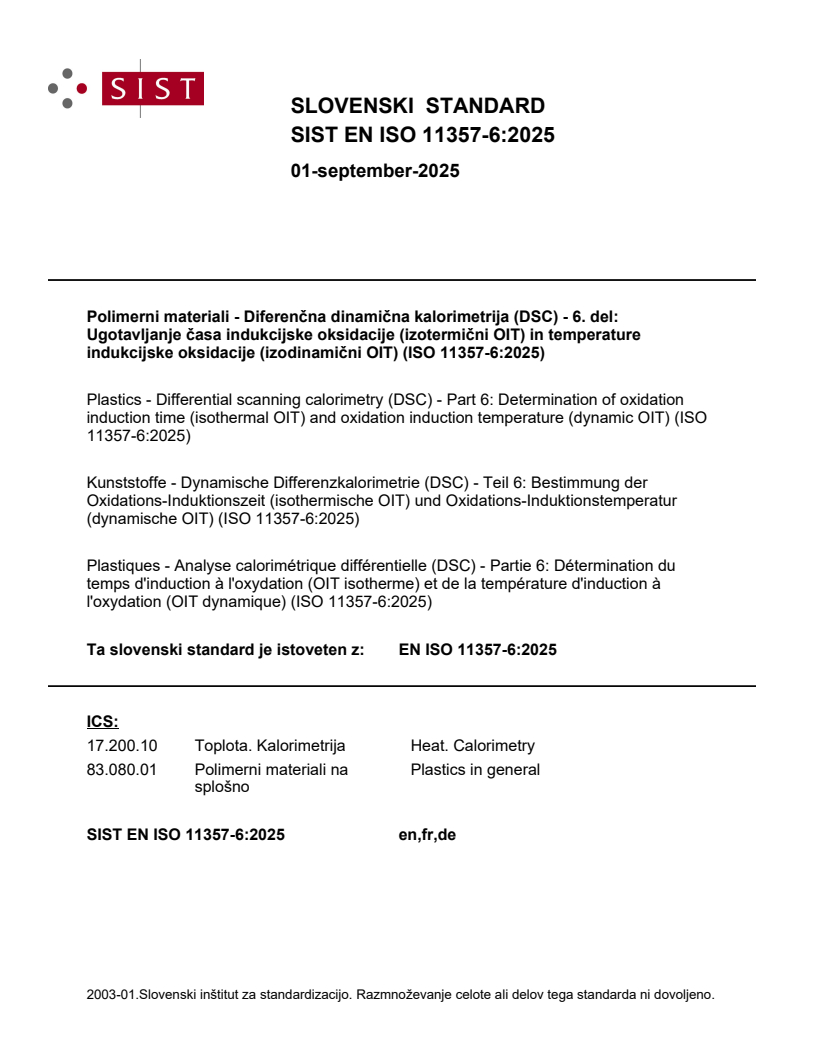
SLOVENSKI STANDARD
01-september-2025
Polimerni materiali - Diferenčna dinamična kalorimetrija (DSC) - 6. del:
Ugotavljanje časa indukcijske oksidacije (izotermični OIT) in temperature
indukcijske oksidacije (izodinamični OIT) (ISO 11357-6:2025)
Plastics - Differential scanning calorimetry (DSC) - Part 6: Determination of oxidation
induction time (isothermal OIT) and oxidation induction temperature (dynamic OIT) (ISO
11357-6:2025)
Kunststoffe - Dynamische Differenzkalorimetrie (DSC) - Teil 6: Bestimmung der
Oxidations-Induktionszeit (isothermische OIT) und Oxidations-Induktionstemperatur
(dynamische OIT) (ISO 11357-6:2025)
Plastiques - Analyse calorimétrique différentielle (DSC) - Partie 6: Détermination du
temps d'induction à l'oxydation (OIT isotherme) et de la température d'induction à
l'oxydation (OIT dynamique) (ISO 11357-6:2025)
Ta slovenski standard je istoveten z: EN ISO 11357-6:2025
ICS:
17.200.10 Toplota. Kalorimetrija Heat. Calorimetry
83.080.01 Polimerni materiali na Plastics in general
splošno
2003-01.Slovenski inštitut za standardizacijo. Razmnoževanje celote ali delov tega standarda ni dovoljeno.
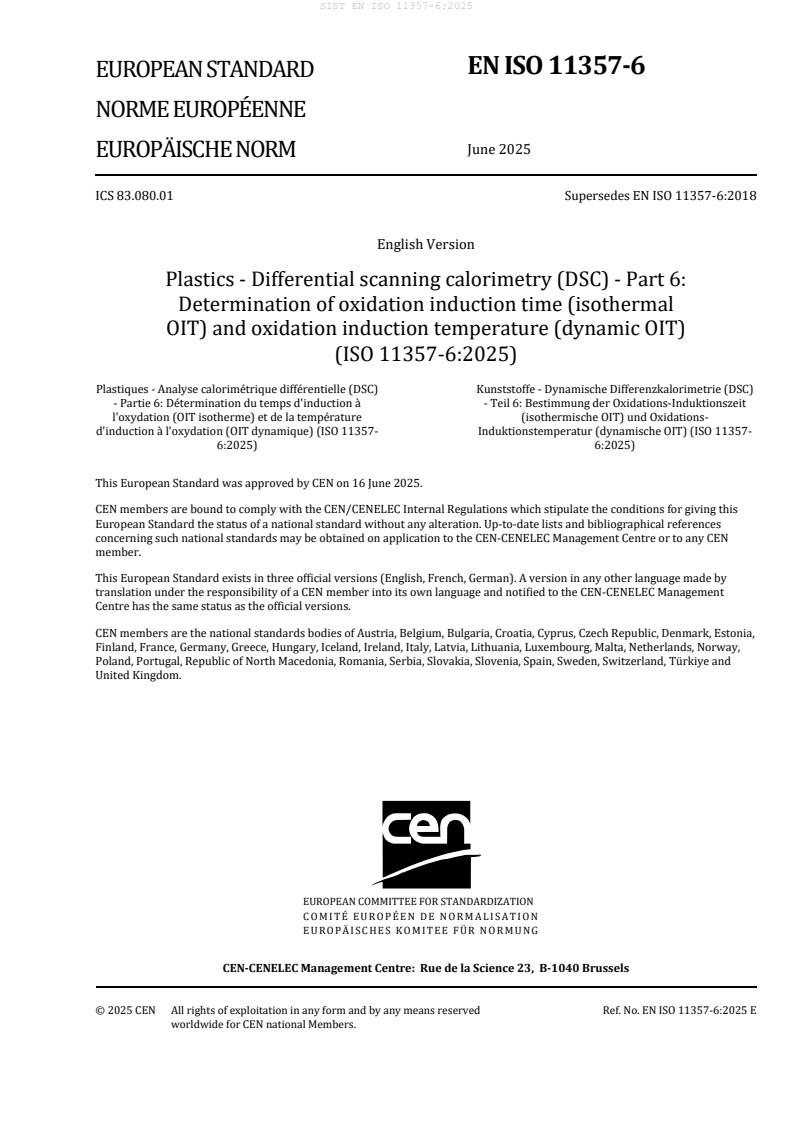
EN ISO 11357-6
EUROPEAN STANDARD
NORME EUROPÉENNE
June 2025
EUROPÄISCHE NORM
ICS 83.080.01 Supersedes EN ISO 11357-6:2018
English Version
Plastics - Differential scanning calorimetry (DSC) - Part 6:
Determination of oxidation induction time (isothermal
OIT) and oxidation induction temperature (dynamic OIT)
(ISO 11357-6:2025)
Plastiques - Analyse calorimétrique différentielle (DSC) Kunststoffe - Dynamische Differenzkalorimetrie (DSC)
- Partie 6: Détermination du temps d'induction à - Teil 6: Bestimmung der Oxidations-Induktionszeit
l'oxydation (OIT isotherme) et de la température (isothermische OIT) und Oxidations-
d'induction à l'oxydation (OIT dynamique) (ISO 11357- Induktionstemperatur (dynamische OIT) (ISO 11357-
6:2025) 6:2025)
This European Standard was approved by CEN on 16 June 2025.
CEN members are bound to comply with the CEN/CENELEC Internal Regulations which stipulate the conditions for giving this
European Standard the status of a national standard without any alteration. Up-to-date lists and bibliographical references
concerning such national standards may be obtained on application to the CEN-CENELEC Management Centre or to any CEN
member.
This European Standard exists in three official versions (English, French, German). A version in any other language made by
translation under the responsibility of a CEN member into its own language and notified to the CEN-CENELEC Management
Centre has the same status as the official versions.
CEN members are the national standards bodies of Austria, Belgium, Bulgaria, Croatia, Cyprus, Czech Republic, Denmark, Estonia,
Finland, France, Germany, Greece, Hungary, Iceland, Ireland, Italy, Latvia, Lithuania, Luxembourg, Malta, Netherlands, Norway,
Poland, Portugal, Republic of North Macedonia, Romania, Serbia, Slovakia, Slovenia, Spain, Sweden, Switzerland, Türkiye and
United Kingdom.
EUROPEAN COMMITTEE FOR STANDARDIZATION
COMITÉ EUROPÉEN DE NORMALISATION
EUROPÄISCHES KOMITEE FÜR NORMUNG
CEN-CENELEC Management Centre: Rue de la Science 23, B-1040 Brussels
© 2025 CEN All rights of exploitation in any form and by any means reserved Ref. No. EN ISO 11357-6:2025 E
worldwide for CEN national Members.
Contents Page
European foreword . 3
European foreword
This document (EN ISO 11357-6:2025) has been prepared by Technical Committee ISO/TC 61 "Plastics"
in collaboration with Technical Committee CEN/TC 249 “Plastics” the secretariat of which is held by SIS.
This European Standard shall be given the status of a national standard, either by publication of an
identical text or by endorsement, at the latest by December 2025, and conflicting national standards
shall be withdrawn at the latest by December 2025.
Attention is drawn to the possibility that some of the elements of this document may be the subject of
patent rights. CEN shall not be held responsible for identifying any or all such patent rights.
This document supersedes EN ISO 11357-6:2018.
Any feedback and questions on this document should be directed to the users’ national standards
body/national committee. A complete listing of these bodies can be found on the CEN website.
According to the CEN-CENELEC Internal Regulations, the national standards organizations of the
following countries are bound to implement this European Standard: Austria, Belgium, Bulgaria,
Croatia, Cyprus, Czech Republic, Denmark, Estonia, Finland, France, Germany, Greece, Hungary, Iceland,
Ireland, Italy, Latvia, Lithuania, Luxembourg, Malta, Netherlands, Norway, Poland, Portugal, Republic of
North Macedonia, Romania, Serbia, Slovakia, Slovenia, Spain, Sweden, Switzerland, Türkiye and the
United Kingdom.
Endorsement notice
The text of ISO 11357-6:2025 has been approved by CEN as EN ISO 11357-6:2025 without any
modification.
International
Standard
ISO 11357-6
Fourth edition
Plastics — Differential scanning
2025-06
calorimetry (DSC) —
Part 6:
Determination of oxidation
induction time (isothermal
OIT) and oxidation induction
temperature (dynamic OIT)
Plastiques — Analyse calorimétrique différentielle (DSC) —
Partie 6: Détermination du temps d'induction à l'oxydation (OIT
isotherme) et de la température d'induction à l'oxydation (OIT
dynamique)
Reference number
ISO 11357-6:2025(en) © ISO 2025
ISO 11357-6:2025(en)
© ISO 2025
All rights reserved. Unless otherwise specified, or required in the context of its implementation, no part of this publication may
be reproduced or utilized otherwise in any form or by any means, electronic or mechanical, including photocopying, or posting on
the internet or an intranet, without prior written permission. Permission can be requested from either ISO at the address below
or ISO’s member body in the country of the requester.
ISO copyright office
CP 401 • Ch. de Blandonnet 8
CH-1214 Vernier, Geneva
Phone: +41 22 749 01 11
Email: copyright@iso.org
Website: www.iso.org
Published in Switzerland
ii
ISO 11357-6:2025(en)
Contents Page
Foreword .iv
Introduction .v
1 Scope . 1
2 Normative references . 1
3 Terms and definitions . 1
4 Principle . 2
4.1 General .2
4.2 Oxidation induction time (isothermal OIT) .2
4.3 Oxidation induction temperature (dynamic OIT) .2
5 Apparatus and materials . 2
5.1 General .2
5.2 DSC instrument .3
5.3 Crucibles .3
5.4 Flowmeter.3
5.5 Oxygen .3
5.6 Air .3
5.7 Nitrogen .3
5.8 Gas-selector switch and regulators .3
6 Test specimens . 4
6.1 General .4
6.2 Specimens from compression-moulded plates .4
6.3 Specimens from injection-moulded plates or melt flow extrudates.4
6.4 Specimens from finished parts .4
7 Test conditions and specimen conditioning . 5
8 Calibration . 5
8.1 Oxidation induction time (isothermal OIT) .5
8.1.1 General .5
8.1.2 Dynamic temperature calibration .5
8.1.3 Isothermal stepwise temperature calibration .5
8.2 Oxidation induction temperature (dynamic OIT) .5
9 Procedure . 6
9.1 Setting up the instrument .6
9.2 Loading the test specimen into the crucible .6
9.3 Insertion of crucibles .6
9.4 Nitrogen, air and oxygen flow .6
9.5 Sensitivity adjustment .6
9.6 Performance of measurement .6
9.6.1 Oxidation induction time (isothermal OIT) .6
9.6.2 Oxidation induction temperature (dynamic OIT) .7
9.7 Cleaning .8
10 Expression of results . 8
11 Precision and bias .10
12 Test report . 10
Bibliography .12
iii
ISO 11357-6:2025(en)
Foreword
ISO (the International Organization for Standardization) is a worldwide federation of national standards
bodies (ISO member bodies). The work of preparing International Standards is normally carried out through
ISO technical committees. Each member body interested in a subject for which a technical committee
has been established has the right to be represented on that committee. International organizations,
governmental and non-governmental, in liaison with ISO, also take part in the work. ISO collaborates closely
with the International Electrotechnical Commission (IEC) on all matters of electrotechnical standardization.
The procedures used to develop this document and those intended for its further maintenance are described
in the ISO/IEC Directives, Part 1. In particular, the different approval criteria needed for the different types
of ISO documents should be noted. This document was drafted in accordance with the editorial rules of the
ISO/IEC Directives, Part 2 (see www.iso.org/directives).
ISO draws attention to the possibility that the implementation of this document may involve the use of (a)
patent(s). ISO takes no position concerning the evidence, validity or applicability of any claimed patent
rights in respect thereof. As of the date of publication of this document, ISO had not received notice of (a)
patent(s) which may be required to implement this document. However, implementers are cautioned that
this may not represent the latest information, which may be obtained from the patent database available at
www.iso.org/patents. ISO shall not be held responsible for identifying any or all such patent rights.
Any trade name used in this document is information given for the convenience of users and does not
constitute an endorsement.
For an explanation of the voluntary nature of standards, the meaning of ISO specific terms and expressions
related to conformity assessment, as well as information about ISO's adherence to the World Trade
Organization (WTO) principles in the Technical Barriers to Trade (TBT), see www.iso.org/iso/foreword.html.
This document was prepared by Technical Committee ISO/TC 61, Plastics, Subcommittee SC 5, Physical-
chemical properties, in collaboration with the European Committee for Standardization (CEN) Technical
Committee CEN/TC 249, Plastics, in accordance with the Agreement on technical cooperation between ISO
and CEN (Vienna Agreement).
This fourth edition cancels and replaces the third edition (ISO 11357-6:2018), which has been technically
revised.
The main changes are as follows:
— the isothermal stepwise temperature calibration has been added for isothermal OIT.
A list of all parts in the ISO 11357 series can be found on the ISO website.
Any feedback or questions on this document should be directed to the user’s national standards body. A
complete listing of these bodies can be found at www.iso.org/members.html.
iv
ISO 11357-6:2025(en)
Introduction
The measurement of oxidation induction time or temperature described in this document provides a tool
to assess the conformity of the material tested to a given formulation of plastics compounds. However, it
is not intended to provide the concentration of antioxidant. Different antioxidants can have different
oxidation induction times or temperatures. Due to interaction of the antioxidant with other substances in
the formulation, different oxidation induction times or temperatures can result even with products having
the same type and concentration of antioxidant.
v
International Standard ISO 11357-6:2025(en)
Plastics — Differential scanning calorimetry (DSC) —
Part 6:
Determination of oxidation induction time (isothermal OIT)
and oxidation induction temperature (dynamic OIT)
1 Scope
This document specifies methods for the determination of oxidation induction time (isothermal OIT) and
oxidation induction temperature (dynamic OIT) of polymeric materials by means of differential scanning
calorimetry (DSC). It is applicable to polyolefin resins that are in a fully stabilized or compounded form,
either as raw materials or finished products. It can be applicable to other plastics.
2 Normative references
The following documents are referred to in the text in such a way that some or all of their content constitutes
requirements of this document. For dated references, only the edition cited applies. For undated references,
the latest edition of the referenced document (including any amendments) applies.
ISO 472, Plastics — Vocabulary
ISO 11357-1, Plastics — Differential scanning calorimetry (DSC) — Part 1: General principles
ISO 17855-2, Plastics — Polyethylene (PE) moulding and extrusion materials — Part 2: Preparation of test
specimens and determination of properties
ISO 19069-2, Plastics — Polypropylene (PP) moulding and extrusion materials — Part 2: Preparation of test
specimens and determination of properties
ISO 21302-2, Plastics — Polybutene-1 (PB-1) moulding and extrusion materials — Part 2: Preparation of test
specimens and determination of properties
3 Terms and definitions
For the purposes of this document, the terms and definitions given in ISO 472, ISO 11357-1 and the
following apply.
ISO and IEC maintain terminology databases for use in standardization at the following addresses:
— ISO Online browsing platform: available at https:// www .iso .org/ obp
— IEC Electropedia: available at https:// www .electropedia .org/
3.1
oxidation induction time
isothermal OIT
relative measure of a stabilized material’s resistance to oxidative decomposition, determined by the
calorimetric measurement of the time interval to the onset of exothermic oxidation of the material at a
specified temperature in an oxygen or air atmosphere, under atmospheric pressure
Note 1 to entry: It is expressed in minutes (min).
ISO 11357-6:2025(en)
3.2
oxidation induction temperature
dynamic OIT
relative measure of a stabilized material’s resistance to oxidative decomposition, determined by the
calorimetric measurement of the temperature of the onset of exothermic oxidation of the material when
subjected to a specified heating rate in an oxygen or air atmosphere, under atmospheric pressure
Note 1 to entry: It is expressed in degrees Celsius (°C).
Note 2 to entry: The oxidation induction temperature is also called oxidation onset temperature (OOT).
4 Principle
4.1 General
The time for which, or the temperature up to which, an antioxidant stabilizer system present in a test
specimen inhibits oxidation is measured while the specimen is held isothermally at a specified temperature
or heated at a constant rate in an oxygen or air atmosphere. The oxidation induction time or temperature is
an assessment of the level (or degree) of stabilization of the material tested. Higher test temperatures will
result in shorter oxidation induction times; faster heating rates will result in higher oxidation induction
temperatures. The oxidation induction time and temperature are also dependent on the surface area of the
specimen available for oxidation. It should be noted that tests carried out in pure oxygen will result in a lower
oxidation induction time or temperature than tests performed under normal atmospheric-air conditions.
NOTE The oxidation induction time or temperature can be indicative of the effective antioxidant level present
in the test specimen. However, deviations between oxidation induction time or temperature results and oxidation
stability at application conditions can occur since oxidation reaction kinetics are a function of temperature and the
inherent properties of the additives contained in the sample. For examp
...
Questions, Comments and Discussion
Ask us and Technical Secretary will try to provide an answer. You can facilitate discussion about the standard in here.
Loading comments...