


SIST EN 16616:2022/kFprA1:2025
(Amendment)Chemical disinfectants and antiseptics - Chemical-thermal textile disinfection - Test method and requirements (phase 2, step 2)
Chemical disinfectants and antiseptics - Chemical-thermal textile disinfection - Test method and requirements (phase 2, step 2)
This document specifies a test method and the minimum requirements for the microbicidal activity of a specified disinfection process for the treatment of contaminated textile. This procedure is carried out by using a washing machine as specified in 5.3.2.18 and refers to the disinfection step without prewash. This procedure is not limited to certain types of textile. The suppliers' instructions are expected to be sufficient if they content the process parameters identified in the test (e.g. dosing disinfectant in whatever washing phase e.g. main wash, rinsing, disinfecting at 40 °C).
This document applies to areas and situations where disinfection is medically indicated. Such indications occur in patient care, for example:
- in hospitals, in community medical facilities, and in dental institutions;
- in clinics of schools, of kindergartens, and of nursing homes;
and could occur in the workplace and in the home.
It could also include services such as laundries and kitchens supplying products directly for the patients.
The method described is intended to determine the activity of a product or product combination under the conditions in which they are used. This is a phase 2, step 2 laboratory test that simulates the conditions of application of the product.
EN 14885 specifies in detail the relationship of the various tests to one another and to “use recommendations”.
Chemische Desinfektionsmittel und Antiseptika - Chemothermische Wäschedesinfektion - Prüfverfahren und Anforderungen (Phase 2, Stufe 2)
Désinfectants chimiques et antiseptiques - Désinfection thermochimique du textile - Méthode d’essai et exigences (phase 2, étape 2)
Kemična razkužila in antiseptiki - Termokemično razkuževanje tekstila - Preskusna metoda in zahteve (faza 2, stopnja 2) - Dopolnilo A1
General Information
- Status
- Not Published
- Public Enquiry End Date
- 01-Aug-2024
- Technical Committee
- KDS - Cosmetics, chemical disinfectants and surface active agents
- Current Stage
- 98 - Abandoned project (Adopted Project)
- Start Date
- 29-Oct-2025
- Due Date
- 03-Nov-2025
- Completion Date
- 05-Nov-2025

Relations
- Effective Date
- 01-Jan-2026
- Effective Date
- 01-Jul-2024
Overview
SIST EN 16616:2022/kFprA1:2025 is a European standard developed by the Slovenian Institute for Standardization (SIST) that addresses the requirements for chemical-thermal disinfection of textiles. This standard specifies an advanced laboratory test method (phase 2, step 2) to evaluate the microbicidal efficacy of chemical disinfectants and antiseptics under conditions that realistically simulate textile disinfection by washing machines. It sets out the minimum performance requirements necessary to claim effective disinfection, including test parameters such as temperature, concentration, contact time, and load.
This standard is applicable across a wide range of healthcare, institutional, and even domestic settings, emphasizing its relevance wherever hygienic textile management is required.
Key Topics
Scope of Application
- Designed for assessing chemical-thermal disinfection processes for textiles, regardless of textile type.
- Particularly significant in environments with medical indications for disinfection, such as hospitals, healthcare facilities, dental practices, schools, kindergartens, and nursing homes.
Test Methodology
- Involves laboratory testing through washing machines at specified parameters (e.g., temperature ≥ 60 °C to 70 °C, without separate prewash).
- Microbicidal activity is measured using criteria and procedures that simulate practical use conditions.
- Focuses on the primary disinfection step to ensure population-relevant reductions in target microorganisms.
Performance Requirements
- Establishes minimum efficacy benchmarks for disinfection products and processes as used on textiles.
- Suppliers' product instructions must align with the tested and validated parameters (e.g., dosage, temperature, and application phase).
Reporting & Documentation
- Details modifications to requirements for test reporting, such as including load weight, liquor ratio, and ballast material composition.
- Provides harmonization with other European testing frameworks for disinfectants.
Applications
This standard supports organizations in establishing and verifying effective disinfection of textiles, with practical implications in:
- Healthcare Settings
- Patient linens, staff uniforms, towels, and curtains in hospitals and clinics demand stringent hygienic maintenance to prevent infection spread.
- Institutional Hygiene
- Schools, kindergartens, community care homes, and dental practices depend on validated processes to ensure textile cleanliness.
- Commercial Laundries and Kitchens
- Industries supplying textiles to healthcare, hotels, and catering services must comply with standardized disinfection protocols.
- Domestic Applications
- Home care for at-risk individuals, promoting safe laundering practices when infection control is needed.
Implementing this standard helps users meet regulatory and quality expectations, reduce risk of cross-contamination, and reassure clients, patients, and regulatory authorities about textile hygiene.
Related Standards
- EN 14885
Specifies the relationship between various disinfectant test methods and their recommendations, offering context for the application of EN 16616. - EN 13727 & EN 13624
Cover wider test methods and efficacy requirements for chemical disinfectants in the medical field. - SIST EN 16616:2022/oprA1:2024
An amendment with detailed procedural updates for the base standard.
These related standards provide further technical guidance and align requirements for chemical-thermal disinfection across different procedures and product uses.
By adopting SIST EN 16616:2022/kFprA1:2025, organizations can ensure robust, validated textile disinfection methods that align with European health and hygiene directives, fostering greater trust and compliance in textile hygiene management.
Get Certified
Connect with accredited certification bodies for this standard

BSI Group
BSI (British Standards Institution) is the business standards company that helps organizations make excellence a habit.

TÜV Rheinland
TÜV Rheinland is a leading international provider of technical services.

TÜV SÜD
TÜV SÜD is a trusted partner of choice for safety, security and sustainability solutions.
Sponsored listings
Frequently Asked Questions
SIST EN 16616:2022/kFprA1:2025 is a draft published by the Slovenian Institute for Standardization (SIST). Its full title is "Chemical disinfectants and antiseptics - Chemical-thermal textile disinfection - Test method and requirements (phase 2, step 2)". This standard covers: This document specifies a test method and the minimum requirements for the microbicidal activity of a specified disinfection process for the treatment of contaminated textile. This procedure is carried out by using a washing machine as specified in 5.3.2.18 and refers to the disinfection step without prewash. This procedure is not limited to certain types of textile. The suppliers' instructions are expected to be sufficient if they content the process parameters identified in the test (e.g. dosing disinfectant in whatever washing phase e.g. main wash, rinsing, disinfecting at 40 °C). This document applies to areas and situations where disinfection is medically indicated. Such indications occur in patient care, for example: - in hospitals, in community medical facilities, and in dental institutions; - in clinics of schools, of kindergartens, and of nursing homes; and could occur in the workplace and in the home. It could also include services such as laundries and kitchens supplying products directly for the patients. The method described is intended to determine the activity of a product or product combination under the conditions in which they are used. This is a phase 2, step 2 laboratory test that simulates the conditions of application of the product. EN 14885 specifies in detail the relationship of the various tests to one another and to “use recommendations”.
This document specifies a test method and the minimum requirements for the microbicidal activity of a specified disinfection process for the treatment of contaminated textile. This procedure is carried out by using a washing machine as specified in 5.3.2.18 and refers to the disinfection step without prewash. This procedure is not limited to certain types of textile. The suppliers' instructions are expected to be sufficient if they content the process parameters identified in the test (e.g. dosing disinfectant in whatever washing phase e.g. main wash, rinsing, disinfecting at 40 °C). This document applies to areas and situations where disinfection is medically indicated. Such indications occur in patient care, for example: - in hospitals, in community medical facilities, and in dental institutions; - in clinics of schools, of kindergartens, and of nursing homes; and could occur in the workplace and in the home. It could also include services such as laundries and kitchens supplying products directly for the patients. The method described is intended to determine the activity of a product or product combination under the conditions in which they are used. This is a phase 2, step 2 laboratory test that simulates the conditions of application of the product. EN 14885 specifies in detail the relationship of the various tests to one another and to “use recommendations”.
SIST EN 16616:2022/kFprA1:2025 is classified under the following ICS (International Classification for Standards) categories: 11.080.20 - Disinfectants and antiseptics; 71.100.35 - Chemicals for industrial and domestic disinfection purposes. The ICS classification helps identify the subject area and facilitates finding related standards.
SIST EN 16616:2022/kFprA1:2025 has the following relationships with other standards: It is inter standard links to SIST EN 16616:2022+A1:2026, SIST EN 16616:2022. Understanding these relationships helps ensure you are using the most current and applicable version of the standard.
SIST EN 16616:2022/kFprA1:2025 is available in PDF format for immediate download after purchase. The document can be added to your cart and obtained through the secure checkout process. Digital delivery ensures instant access to the complete standard document.
Standards Content (Sample)
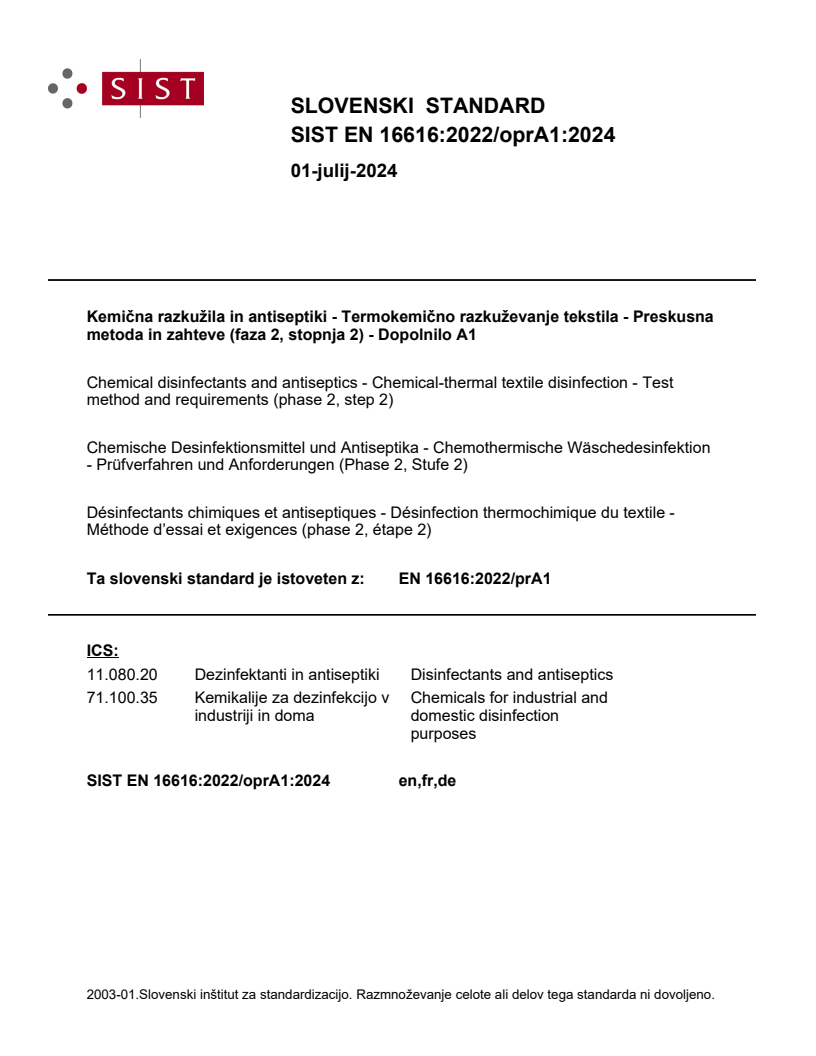
SLOVENSKI STANDARD
SIST EN 16616:2022/oprA1:2024
01-julij-2024
Kemična razkužila in antiseptiki - Termokemično razkuževanje tekstila - Preskusna
metoda in zahteve (faza 2, stopnja 2) - Dopolnilo A1
Chemical disinfectants and antiseptics - Chemical-thermal textile disinfection - Test
method and requirements (phase 2, step 2)
Chemische Desinfektionsmittel und Antiseptika - Chemothermische Wäschedesinfektion
- Prüfverfahren und Anforderungen (Phase 2, Stufe 2)
Désinfectants chimiques et antiseptiques - Désinfection thermochimique du textile -
Méthode d’essai et exigences (phase 2, étape 2)
Ta slovenski standard je istoveten z: EN 16616:2022/prA1
ICS:
11.080.20 Dezinfektanti in antiseptiki Disinfectants and antiseptics
71.100.35 Kemikalije za dezinfekcijo v Chemicals for industrial and
industriji in doma domestic disinfection
purposes
SIST EN 16616:2022/oprA1:2024 en,fr,de
2003-01.Slovenski inštitut za standardizacijo. Razmnoževanje celote ali delov tega standarda ni dovoljeno.
SIST EN 16616:2022/oprA1:2024
SIST EN 16616:2022/oprA1:2024
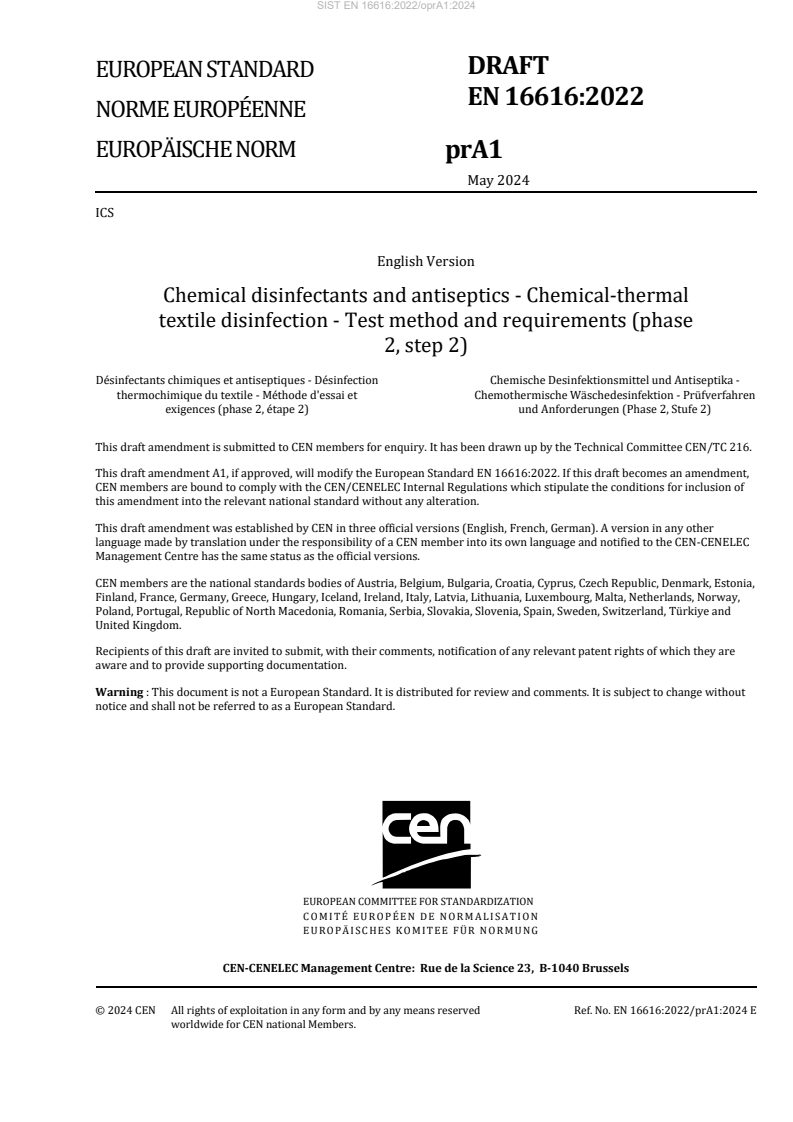
DRAFT
EUROPEAN STANDARD
EN 16616:2022
NORME EUROPÉENNE
EUROPÄISCHE NORM
prA1
May 2024
ICS
English Version
Chemical disinfectants and antiseptics - Chemical-thermal
textile disinfection - Test method and requirements (phase
2, step 2)
Désinfectants chimiques et antiseptiques - Désinfection Chemische Desinfektionsmittel und Antiseptika -
thermochimique du textile - Méthode d'essai et Chemothermische Wäschedesinfektion - Prüfverfahren
exigences (phase 2, étape 2) und Anforderungen (Phase 2, Stufe 2)
This draft amendment is submitted to CEN members for enquiry. It has been drawn up by the Technical Committee CEN/TC 216.
This draft amendment A1, if approved, will modify the European Standard EN 16616:2022. If this draft becomes an amendment,
CEN members are bound to comply with the CEN/CENELEC Internal Regulations which stipulate the conditions for inclusion of
this amendment into the relevant national standard without any alteration.
This draft amendment was established by CEN in three official versions (English, French, German). A version in any other
language made by translation under the responsibility of a CEN member into its own language and notified to the CEN-CENELEC
Management Centre has the same status as the official versions.
CEN members are the national standards bodies of Austria, Belgium, Bulgaria, Croatia, Cyprus, Czech Republic, Denmark, Estonia,
Finland, France, Germany, Greece, Hungary, Iceland, Ireland, Italy, Latvia, Lithuania, Luxembourg, Malta, Netherlands, Norway,
Poland, Portugal, Republic of North Macedonia, Romania, Serbia, Slovakia, Slovenia, Spain, Sweden, Switzerland, Türkiye and
United Kingdom.
Recipients of this draft are invited to submit, with their comments, notification of any relevant patent rights of which they are
aware and to provide supporting documentation.
Warning : This document is not a European Standard. It is distributed for review and comments. It is subject to change without
notice and shall not be referred to as a European Standard.
EUROPEAN COMMITTEE FOR STANDARDIZATION
COMITÉ EUROPÉEN DE NORMALISATION
EUROPÄISCHES KOMITEE FÜR NORMUNG
CEN-CENELEC Management Centre: Rue de la Science 23, B-1040 Brussels
© 2024 CEN All rights of exploitation in any form and by any means reserved Ref. No. EN 16616:2022/prA1:2024 E
worldwide for CEN national Members.
SIST EN 16616:2022/oprA1:2024
EN 16616:2022/prA1:2024 (E)
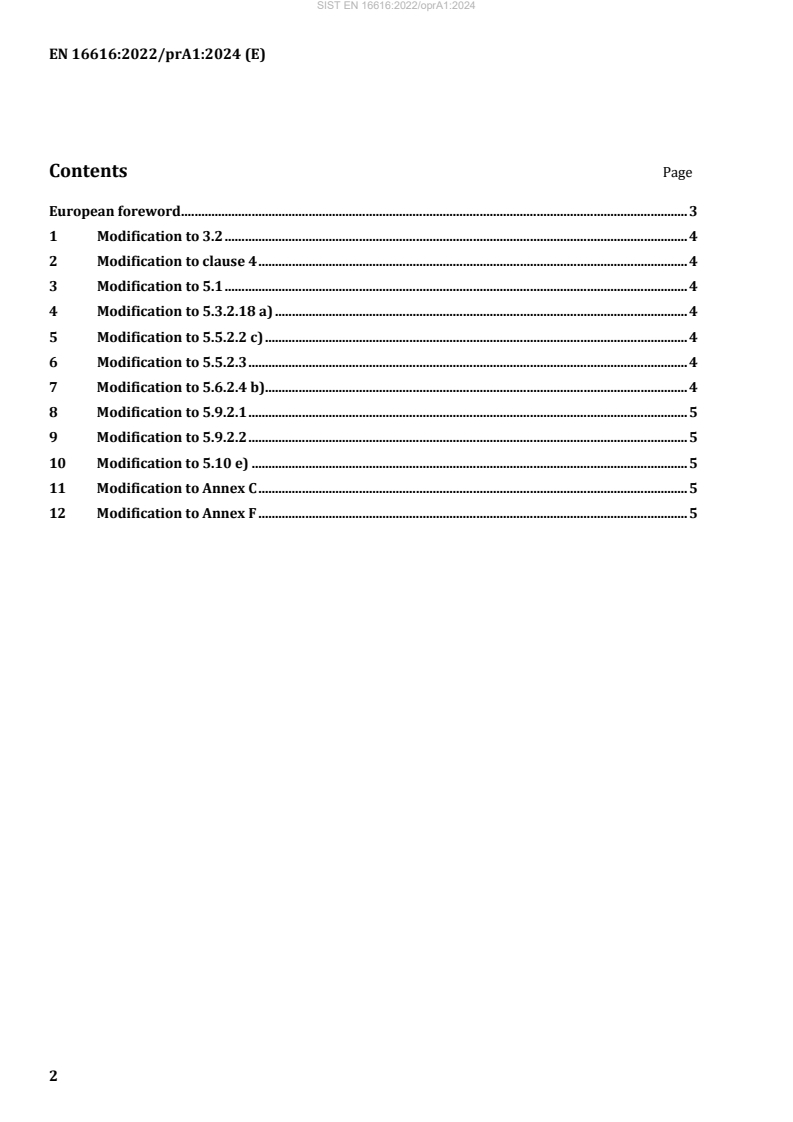
Contents Page
European foreword . 3
1 Modification to 3.2 . 4
2 Modification to clause 4 . 4
3 Modification to 5.1 . 4
4 Modification to 5.3.2.18 a) . 4
5 Modification to 5.5.2.2 c) . 4
6 Modification to 5.5.2.3 . 4
7 Modification to 5.6.2.4 b). 4
8 Modification to 5.9.2.1 . 5
9 Modification to 5.9.2.2 . 5
10 Modification to 5.10 e) . 5
11 Modification to Annex
...