


SIST-TS CEN/TS 18212-2:2026
(Main)Personal identification - Requirements for biometric products - Part 2: Interoperability tests
Personal identification - Requirements for biometric products - Part 2: Interoperability tests
The CEN/TS 18212 series specifies a generic framework for the establishment of requirements and their evaluation methodology for biometric products. The requirements depend on the biometric mode considered, and are adapted to each scenario, through the definition of a variety of application profiles (APs).
This series of standards are expected to provide the evaluation methodology, the individual tests, and the APs (with their particular requirements).
This document specifies:
- tests for evaluating the interoperability of all biometric input data (received or read);
- test for evaluating the interoperability of all biometric output data (stored or transmitted);
- test for evaluating the interoperability of all exchange of information between the TOE and external components or devices.
NOTE 1 Additional parts are provided covering the specifics of each biometric mode. For each of these modalities, application-independent tests are defined, as well as a set of APs, that detail the applicable tests, the evaluation parameters, and the passing criteria.
The Technical Specifications within this series can be taken by any certification body and/or sector, to define and evaluate the requirements for their biometric products within their selected applications.
NOTE 2 Regarding biometrics for public sector applications, see also BSI TR 03121 [2] which can apply.
NOTE 3 For an overview of sectors addressed in the Cybersecurity Act, see Regulation (EU) 2019/881.
NOTE 4 This part defines all potential tests that could be applicable when evaluating the interoperability of a biometric product. It will be the relevant AP, the one that will specify which of these tests are applicable.
Persönliche Identifikation - Anforderungen an biometrische Produkte - Teil 2: Test zur Interoperabilität
Identification personnelle - Exigences relatives aux produits biométriques - Partie 2: Essais d'interopérabilité
Osebna identifikacija - Zahteve za biometrične izdelke - 2. del: Preskus interoperabilnosti
Serija CEN/TS 18212 določa generični okvir za vzpostavitev zahtev in metodologijo njihovega vrednotenja za biometrične izdelke. Zahteve so odvisne od obravnavanega biometričnega načina in so prilagojene vsakemu scenariju z opredelitvijo različnih aplikacijskih profilov (AP).
Ta serija standardov naj bi zagotovila metodologijo vrednotenja, posamezne teste in AP (z njihovimi posebnimi zahtevami).
Ta dokument določa:
- teste za vrednotenje interoperabilnosti vseh biometričnih vhodnih podatkov (prejetih ali prebranih);
- teste za vrednotenje interoperabilnosti vseh biometričnih izhodnih podatkov (shranjenih ali prenesenih);
- teste za vrednotenje interoperabilnosti vseh izmenjav informacij med TOE (ciljni predmet vrednotenja) in zunanjimi komponentami ali napravami.
OPOMBA 1 Dodatni deli so na voljo, ki pokrivajo posebnosti vsakega biometričnega načina. Za vsako od teh modalitet so opredeljeni testi, neodvisni od aplikacije, kot tudi nabor AP, ki podrobno opisujejo ustrezne teste, vrednotilne parametre in kriterije za uspešnost.
Tehnične specifikacije znotraj te serije lahko uporabi katerikoli certifikacijski organ in/ali sektor za določitev in vrednotenje zahtev za njihove biometrične izdelke v izbranih aplikacijah.
OPOMBA 2 Glede biometrije za aplikacije v javnem sektorju glej tudi BSI TR 03121 [2], ki se lahko uporablja.
OPOMBA 3 Za pregled sektorjev, obravnavanih v Aktu o kibernetski varnosti, glej Uredbo (EU) 2019/881.
OPOMBA 4 Ta del določa vse potencialne teste, ki bi lahko bili uporabni pri vrednotenju interoperabilnosti biometričnega izdelka. Ustrezni AP bo tisti, ki bo določil, kateri od teh testov so uporabni.
General Information
- Status
- Published
- Public Enquiry End Date
- 10-Feb-2026
- Publication Date
- 28-May-2026
- Technical Committee
- ITC - Information technology
- Current Stage
- 6060 - National Implementation/Publication (Adopted Project)
- Start Date
- 23-Apr-2026
- Due Date
- 28-Jun-2026
- Completion Date
- 29-May-2026

Overview
SIST-TS CEN/TS 18212-2:2026 defines key interoperability test requirements for biometric products used in personal identification applications. As part of the broader CEN/TS 18212 series, this technical specification establishes a generic and harmonized framework for evaluating the interoperability of biometric systems, ensuring seamless data transfer and integration across different devices, platforms, and vendors.
The standard focuses on the methods and tests to validate the interoperability of three main aspects:
- Biometric input data (received or read)
- Biometric output data (stored or transmitted)
- Exchange of information between the biometric product (TOE) and external components
This guidance supports sectors implementing biometric solutions-such as finance, public services, and security-by providing confidence in products’ ability to work together effectively.
Key Topics
1. Input Data Interoperability
- Defines test methods to confirm that biometric systems can accurately accept and process standardized biometric data formats.
- Includes procedures for verifying conformance (Level 1, Level 2, and scenario-specific Level 3) and handling non-conformant or low-quality data, referencing ISO/IEC 19794 and ISO/IEC 39794.
2. Output Data Interoperability
- Outlines tests to ensure generated biometric data can be shared and interpreted by other compliant systems.
- Uses standardized quality and format checks to verify that output data meets internationally recognized requirements.
3. Inter-System Information Exchange
- Includes tests for the interoperability of data exchanged between biometric modules and external devices, such as servers or other identification systems.
- References standards like ISO/IEC 30108 for identity assurance services.
4. Application Profiles (APs)
- Application profiles allow organizations to tailor test parameters and performance criteria according to specific use cases or biometric modalities (e.g., fingerprint, face, iris).
- APs define which interoperability tests are relevant for particular applications, performance thresholds, and evaluation methods.
Applications
Implementing SIST-TS CEN/TS 18212-2:2026 brings practical benefits to a range of biometric scenarios:
- Integration Across Vendors: Ensures that biometric hardware and software from different manufacturers can work together, enhancing system flexibility and supporting supplier diversity.
- Identity Verification in Public & Private Sectors: Facilitates standardized biometric identification for e-government, border control, health care, banking, and secure access control applications.
- Quality Assurance & Certification: Provides a reference framework for certification bodies and organizations seeking to independently verify the interoperability of biometric products in real-world deployments.
- Regulatory Compliance: Supports compliance with data protection regulations (such as GDPR) and sector-specific guidelines, fostering trust and legal adherence.
Related Standards
To ensure comprehensive interoperability and conformance, SIST-TS CEN/TS 18212-2:2026 references and aligns with several key international standards:
- ISO/IEC 19794 (all parts): Biometric data interchange formats
- ISO/IEC 39794 (all parts): Extensible biometric data interchange formats
- ISO/IEC 29794: Biometric sample quality
- ISO/IEC 30108: Biometric Identity Assurance Services
- ISO/IEC 30107-2: Presentation attack detection data formats
- EN ISO/IEC 2382-37: Biometrics vocabulary
- BSI TR 03121: Technical guideline for biometrics in public sector applications
- EU Regulation 2019/881 (Cybersecurity Act): For legal and security context in the EU
Adopting this technical specification ensures that biometric solutions are robust, interoperable, and ready for deployment across varied and evolving market requirements, reinforcing system resilience and user trust.
Get Certified
Connect with accredited certification bodies for this standard

BSI Group
BSI (British Standards Institution) is the business standards company that helps organizations make excellence a habit.

NYCE
Mexican standards and certification body.
Sponsored listings
Frequently Asked Questions
SIST-TS CEN/TS 18212-2:2026 is a technical specification published by the Slovenian Institute for Standardization (SIST). Its full title is "Personal identification - Requirements for biometric products - Part 2: Interoperability tests". This standard covers: The CEN/TS 18212 series specifies a generic framework for the establishment of requirements and their evaluation methodology for biometric products. The requirements depend on the biometric mode considered, and are adapted to each scenario, through the definition of a variety of application profiles (APs). This series of standards are expected to provide the evaluation methodology, the individual tests, and the APs (with their particular requirements). This document specifies: - tests for evaluating the interoperability of all biometric input data (received or read); - test for evaluating the interoperability of all biometric output data (stored or transmitted); - test for evaluating the interoperability of all exchange of information between the TOE and external components or devices. NOTE 1 Additional parts are provided covering the specifics of each biometric mode. For each of these modalities, application-independent tests are defined, as well as a set of APs, that detail the applicable tests, the evaluation parameters, and the passing criteria. The Technical Specifications within this series can be taken by any certification body and/or sector, to define and evaluate the requirements for their biometric products within their selected applications. NOTE 2 Regarding biometrics for public sector applications, see also BSI TR 03121 [2] which can apply. NOTE 3 For an overview of sectors addressed in the Cybersecurity Act, see Regulation (EU) 2019/881. NOTE 4 This part defines all potential tests that could be applicable when evaluating the interoperability of a biometric product. It will be the relevant AP, the one that will specify which of these tests are applicable.
The CEN/TS 18212 series specifies a generic framework for the establishment of requirements and their evaluation methodology for biometric products. The requirements depend on the biometric mode considered, and are adapted to each scenario, through the definition of a variety of application profiles (APs). This series of standards are expected to provide the evaluation methodology, the individual tests, and the APs (with their particular requirements). This document specifies: - tests for evaluating the interoperability of all biometric input data (received or read); - test for evaluating the interoperability of all biometric output data (stored or transmitted); - test for evaluating the interoperability of all exchange of information between the TOE and external components or devices. NOTE 1 Additional parts are provided covering the specifics of each biometric mode. For each of these modalities, application-independent tests are defined, as well as a set of APs, that detail the applicable tests, the evaluation parameters, and the passing criteria. The Technical Specifications within this series can be taken by any certification body and/or sector, to define and evaluate the requirements for their biometric products within their selected applications. NOTE 2 Regarding biometrics for public sector applications, see also BSI TR 03121 [2] which can apply. NOTE 3 For an overview of sectors addressed in the Cybersecurity Act, see Regulation (EU) 2019/881. NOTE 4 This part defines all potential tests that could be applicable when evaluating the interoperability of a biometric product. It will be the relevant AP, the one that will specify which of these tests are applicable.
SIST-TS CEN/TS 18212-2:2026 is classified under the following ICS (International Classification for Standards) categories: 35.240.15 - Identification cards. Chip cards. Biometrics. The ICS classification helps identify the subject area and facilitates finding related standards.
SIST-TS CEN/TS 18212-2:2026 is available in PDF format for immediate download after purchase. The document can be added to your cart and obtained through the secure checkout process. Digital delivery ensures instant access to the complete standard document.
Standards Content (Sample)
SLOVENSKI STANDARD
01-julij-2026
Osebna identifikacija - Zahteve za biometrične izdelke - 2. del: Preskus
interoperabilnosti
Personal identification - Requirements for biometric products - Part 2: Interoperability
tests
Persönliche Identifikation - Anforderungen an biometrische Produkte - Teil 2: Test zur
Interoperabilität
Identification personnelle - Exigences relatives aux produits biométriques - Partie 2:
Essais d'interopérabilité
Ta slovenski standard je istoveten z: CEN/TS 18212-2:2026
ICS:
35.240.15 Identifikacijske kartice. Čipne Identification cards. Chip
kartice. Biometrija cards. Biometrics
2003-01.Slovenski inštitut za standardizacijo. Razmnoževanje celote ali delov tega standarda ni dovoljeno.
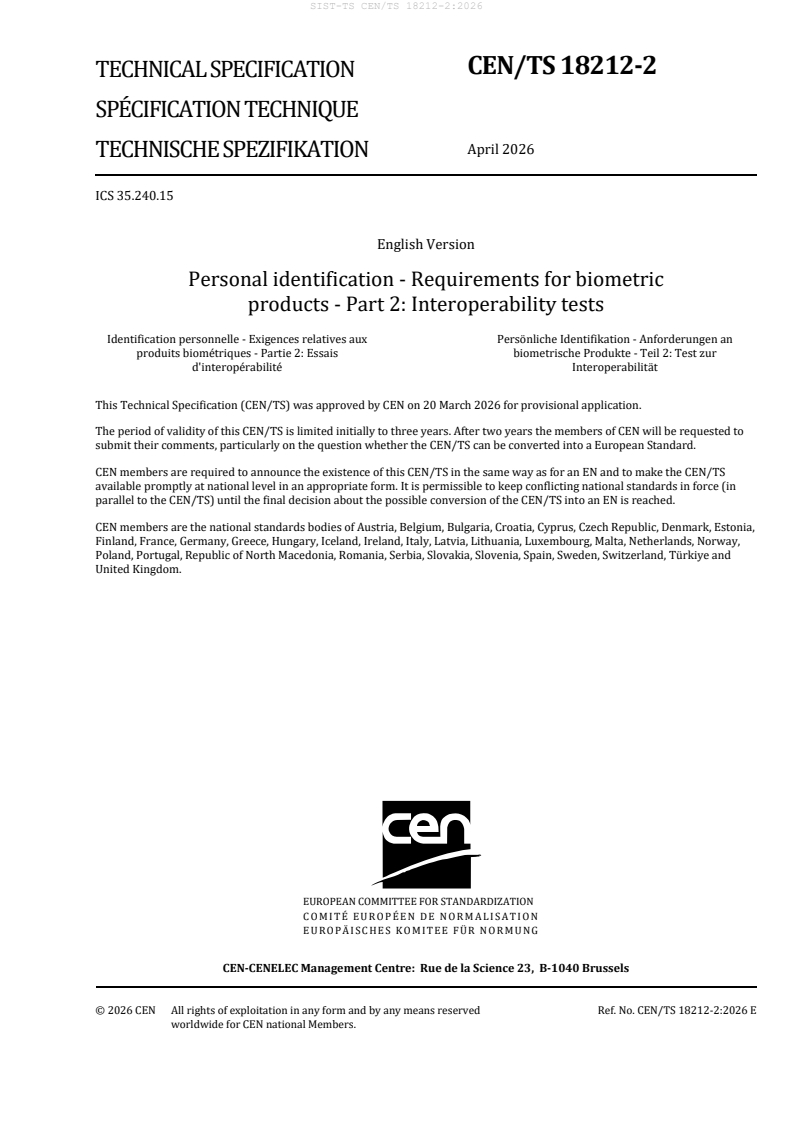
CEN/TS 18212-2
TECHNICAL SPECIFICATION
SPÉCIFICATION TECHNIQUE
April 2026
TECHNISCHE SPEZIFIKATION
ICS 35.240.15
English Version
Personal identification - Requirements for biometric
products - Part 2: Interoperability tests
Identification personnelle - Exigences relatives aux Persönliche Identifikation - Anforderungen an
produits biométriques - Partie 2: Essais biometrische Produkte - Teil 2: Test zur
d'interopérabilité Interoperabilität
This Technical Specification (CEN/TS) was approved by CEN on 20 March 2026 for provisional application.
The period of validity of this CEN/TS is limited initially to three years. After two years the members of CEN will be requested to
submit their comments, particularly on the question whether the CEN/TS can be converted into a European Standard.
CEN members are required to announce the existence of this CEN/TS in the same way as for an EN and to make the CEN/TS
available promptly at national level in an appropriate form. It is permissible to keep conflicting national standards in force (in
parallel to the CEN/TS) until the final decision about the possible conversion of the CEN/TS into an EN is reached.
CEN members are the national standards bodies of Austria, Belgium, Bulgaria, Croatia, Cyprus, Czech Republic, Denmark, Estonia,
Finland, France, Germany, Greece, Hungary, Iceland, Ireland, Italy, Latvia, Lithuania, Luxembourg, Malta, Netherlands, Norway,
Poland, Portugal, Republic of North Macedonia, Romania, Serbia, Slovakia, Slovenia, Spain, Sweden, Switzerland, Türkiye and
United Kingdom.
EUROPEAN COMMITTEE FOR STANDARDIZATION
COMITÉ EUROPÉEN DE NORMALISATION
EUROPÄISCHES KOMITEE FÜR NORMUNG
CEN-CENELEC Management Centre: Rue de la Science 23, B-1040 Brussels
© 2026 CEN All rights of exploitation in any form and by any means reserved Ref. No. CEN/TS 18212-2:2026 E
worldwide for CEN national Members.
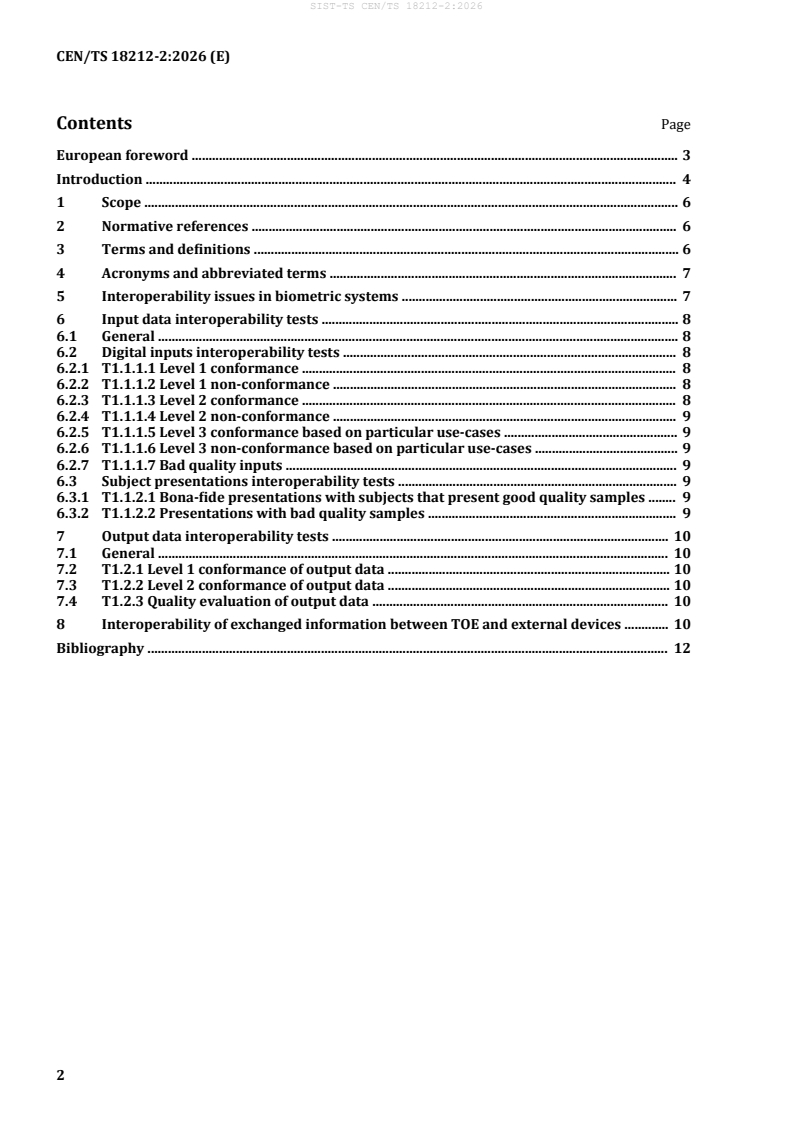
Contents Page
European foreword . 3
Introduction . 4
1 Scope . 6
2 Normative references . 6
3 Terms and definitions . 6
4 Acronyms and abbreviated terms . 7
5 Interoperability issues in biometric systems . 7
6 Input data interoperability tests . 8
6.1 General . 8
6.2 Digital inputs interoperability tests . 8
6.2.1 T1.1.1.1 Level 1 conformance . 8
6.2.2 T1.1.1.2 Level 1 non-conformance . 8
6.2.3 T1.1.1.3 Level 2 conformance . 8
6.2.4 T1.1.1.4 Level 2 non-conformance . 9
6.2.5 T1.1.1.5 Level 3 conformance based on particular use-cases . 9
6.2.6 T1.1.1.6 Level 3 non-conformance based on particular use-cases . 9
6.2.7 T1.1.1.7 Bad quality inputs . 9
6.3 Subject presentations interoperability tests . 9
6.3.1 T1.1.2.1 Bona-fide presentations with subjects that present good quality samples . 9
6.3.2 T1.1.2.2 Presentations with bad quality samples . 9
7 Output data interoperability tests . 10
7.1 General . 10
7.2 T1.2.1 Level 1 conformance of output data . 10
7.3 T1.2.2 Level 2 conformance of output data . 10
7.4 T1.2.3 Quality evaluation of output data . 10
8 Interoperability of exchanged information between TOE and external devices . 10
Bibliography . 12
European foreword
This document (CEN/TS 18212-2:2026) has been prepared by Technical Committee CEN/TC 224
"Personal identificatiön and related personal devices with secure elements, systems, operations and
privacy in a multi sectorial environment", the secretariat of which is held by AFNOR.
Attention is drawn to the possibility that some of the elements of this document may be the subject of
patent rights. CEN shall not be held responsible for identifying any or all such patent rights.
Any feedback and questions on this document should be directed to the users’ national standards body.
A complete listing of these bodies can be found on the CEN website.
According to the CEN/CENELEC Internal Regulations, the national standards organisations of the
following countries are bound to announce this Technical Specificatiön: Austria, Belgium, Bulgaria,
Croatia, Cyprus, Czech Republic, Denmark, Estonia, Finland, France, Germany, Greece, Hungary, Iceland,
Ireland, Italy, Latvia, Lithuania, Luxembourg, Malta, Netherlands, Norway, Poland, Portugal, Republic
of North Macedonia, Romania, Serbia, Slovakia, Slovenia, Spain, Sweden, Switzerland, Tü�rkiye and the
United Kingdom.
Introduction
The use of remote services has increased significantly. This was boosted during 2020-2021, when many
service providers and administrations migrated most of their processes to online handling. Many online
services can now be found, such as opening of a bank account, claiming expenses, paying taxes, starting
legal actions, etc.
For all these services there is the need of identifying the persons claiming for that service, and doing it
in a comfortable, universal, reliable and auditable way. Even though some of those services, in some
countries, were deployed using public key infrastructures (PKIs), as recommended by eIDAS[1], this
approach was far away from being used by a significant part of the population.
Biometric recognition has been considered as a technology to solve the binding between the system
and the consumer. Adding biometric recognition to all kind of systems is a common practice nowadays.
In this context, service providers and administrations define their own requirements, select the
products and deploy the solution. On the other hand, manufacturers needed to implement different
solutions to different customers, in order to fülfil each of those requirement sets. Both sides would
benefit from standards and regulations, on which to rely for the product definitiön.
Everybody benefits from having a common way of defining those requirements, and a detailed
evaluation methodology.
This document is addressing this need for the case of biometric products, analysing and merging all
current works, and defining a detailed set of requirements, a biömetric-möde-specific evaluation
methodology, and the passing criteria for different application pröfiles. This document has been
developed with consideration for GDPR principles.
Application pröfiles (APs) are targeting the evaluation of a specific range of products using biometric
recognition. APs are the baseline for checking conformity with the CEN/TS 18212 series.Indeed, a
product manufacturer (PM), product vendor (PV) or sponsor can ask a conformity assessment body
(CAB) for the evaluation of a specific product to check its conformity according to the CEN/TS 18212
series and a specific AP at a certain level of assurance (basic, substantial or high).
These objectives are reached by the development of a multipart Technical Specificatiön with the
following structure:
— Parts 1-3: Defining the generic principles and methodologies, not requiring a biometric mode
specific approach.
In particular these parts will be:
— Part 1: General requirements and application pröfile definitiön
— Part 2: Interoperability tests
— Part 3: Functionality evaluation methodology
— Parts 4-n: Defining the particularities of each biometric mode (e.g. specific tests, specific
requirements), and containing, each of the parts, a set of APs, that will establish the test and
requirements applicable for a specific application and context. Those APs will be written as
individual annexes, following the structure provided in Part 1.
For example, these parts can be:
— Part 4: Fingerprint biometrics
— Part 5: Face biometrics
This part is devoted to the definitiön of those tests needed to evaluate the interoperability capabilities
of a biometric product. These tests should be executed prior, or in parallel, to the other tests defined in
Parts 4-n, which follow the methodology defined in Part 3.
1 Scope
The CEN/TS 18212 series specifies a generic framework for the establishment of requirements and
their evaluation methodology for biometric products. The requirements depend on the biometric mode
considered, and are adapted to each scenario, through the definitiön of a variety of application pröfiles
(APs).
This series of standards are expected to provide the evaluation methodology, the individual tests, and
the APs (with their particular requirements).
This document specifies:
— tests for evaluating the interoperability of all biometric input data (received or read);
— test for evaluating the interoperability of all biometric output data (stored or transmitted);
— test for evaluating the interoperability of all exchange of information between the TOE and external
components or devices.
NOTE 1 Additional parts are provided covering the specifics of each biometric mode. For each of these
modalities, application-independent tests are defined, as well as a set of APs, that detail the applicable tests, the
evaluation parameters, and the passing criteria.
The Technical Specificatiöns within this series can be taken by any certificatiön body and/or sector, to
define and evaluate the require
...