


SIST ISO 53800:2024
(Main)Guidelines on the promotion and implementation of gender equality and women’s empowerment
Guidelines on the promotion and implementation of gender equality and women’s empowerment
This document gives guidance on how to promote and implement gender equality and women’s empowerment. It provides guidelines for organizations to develop the capabilities to achieve a culture of gender equality and women’s empowerment. The guidelines include the framework, resources, policies, tools and good practices for contextualizing, promoting and implementing gender equality.
This document focuses on the inequality resulting from the gender specific roles assigned to women, girls, men and boys and is applicable to all types of organizations (public or private), regardless of their size, location or field of activity.
This document does not address the specific aspects of relations with labour unions or work councils, nor the country-specific regulations and compliance relating to gender diversity.
Lignes directrices relatives à la promotion et à la mise en œuvre de l’égalité entre les femmes et les hommes et à l’empouvoirement des femmes
Le présent document fournit des recommandations relatives à la manière de promouvoir et de mettre en œuvre l’égalité entre les femmes et les hommes et l’empouvoirement des femmes. Il fournit des lignes directrices permettant aux organismes de développer les capacités nécessaires à l’instauration d’une culture de l’égalité entre les femmes et les hommes et de l’empouvoirement des femmes. Les lignes directrices comprennent le cadre, les ressources, les politiques, les outils et les bonnes pratiques permettant la contextualisation, la promotion et la mise en œuvre de l’égalité entre les femmes et les hommes.
Le présent document se concentre sur les inégalités engendrées par les rôles genrés assignés aux femmes, aux filles, aux hommes et aux garçons, et s’applique à tous les types d’organismes (publics ou privés) quels que soient leur taille, leur localisation et leur domaine d’activité.
Il n’aborde pas les aspects spécifiques des relations avec les syndicats ou les comités d’entreprise ni les réglementations et la conformité propres à chaque pays en matière de diversité des genres.
Smernice za promocijo in uveljavitev enakosti spola ter opolnomočenje žensk
Ta dokument podaja smernice za promocijo in uveljavitev enakosti spola ter opolnomočenje žensk. Organizacijam zagotavlja smernice za razvijanje kulture enakosti spola in opolnomočenja žensk. Smernice vključujejo okvir, vire, politike, orodja in dobre prakse, ki omogočajo kontekstualizacijo, promocijo in uveljavitev enakosti spola.
Ta dokument se osredotoča na neenakost, ki je posledica razdelitve vlog glede na spol, dodeljenih ženskam, dekletom, moškim in fantom, ter se uporablja za vse vrste organizacij – javne ali zasebne, ne glede na njihovo velikost, lokacijo in področje delovanja. Ta dokument ne obravnava posebnih vidikov odnosov s sindikati ali delavskimi sveti, skladnosti posameznih držav in pravnih zahtev glede raznolikosti spolov.
OPOMBA: Za definicijo spola glej točko 3.5 (zdajšnja), za definicijo raznolikosti pa točko 3.21 (zdajšnja).
General Information
- Status
- Withdrawn
- Public Enquiry End Date
- 01-Jun-2023
- Publication Date
- 19-May-2024
- Withdrawal Date
- 14-Dec-2025
- Current Stage
- 9900 - Withdrawal (Adopted Project)
- Start Date
- 11-Dec-2025
- Due Date
- 03-Jan-2026
- Completion Date
- 15-Dec-2025
Relations
- Effective Date
- 01-Oct-2025
Overview
ISO 53800:2024 - Guidelines for the promotion and implementation of gender equality and women’s empowerment - provides practical, organization-level guidance to develop capabilities and culture that advance gender equality and women’s empowerment. Applicable to all types of organizations (public or private, any size or sector), the standard offers a framework of resources, policies, tools and good practices to contextualize, promote and implement gender-responsive actions. It complements wider sustainability and social responsibility agendas (ESG) and aligns with SDG 5 (gender equality) and related ISO initiatives such as ISO 30415.
Key topics and technical requirements
ISO 53800 is structured around actionable guidance rather than prescriptive technical specifications. Main topics include:
- Methodology and implementation steps: guidance on understanding terminology, analysing the current situation, stakeholder identification, prioritization and a continuous improvement approach (PDCA cycle).
- Data collection and analysis: qualitative and quantitative approaches to assess gender gaps and organisational status.
- Governance and labour practices: integrating gender equality into governance, HR and labour-related policies and practices.
- Activity and investment guidance: gender-responsive goods and services, sustainable procurement and gender-responsive budgeting.
- Internal and external communication: editorial content and communication actions to promote gender equality.
- Stakeholder engagement and partnerships: outreach strategies and collaboration with external actors.
- Grievance mechanisms and protection: Annex A provides guidance for developing grievance mechanisms to prevent, detect and respond to gender-based violence (GBV) and sexual exploitation, abuse and harassment (SEAH).
- Monitoring and indicators: Annex B includes indicators for comparative situations of women and men; Annex C offers good practices and practical examples.
Note: ISO 53800 does not cover specific relations with labour unions or country‑specific legal/regulatory compliance for gender diversity.
Practical applications
Organizations can use ISO 53800 to:
- Design or update gender equality policies, strategies and action plans.
- Implement a PDCA-based programme for continuous improvement in gender outcomes.
- Collect and analyse gender-disaggregated data to inform decisions and measure impact.
- Create or improve grievance and safeguarding mechanisms for GBV and SEAH.
- Integrate gender considerations into procurement, budgeting and product/service design.
- Strengthen communications and stakeholder engagement on gender equality commitments.
Who should use this standard
- HR and talent managers
- CSR, sustainability and ESG teams
- Compliance and risk officers
- Procurement and finance managers (for gender-responsive budgeting)
- Senior leadership and governance bodies seeking equitable decision-making
- SMEs and large organizations seeking practical, scalable guidance
Related standards
- ISO 30415 (Diversity and inclusion) - noted as complementary in the ISO 53800 introduction.
Keywords: ISO 53800, gender equality, women’s empowerment, guidelines, gender-responsive, grievance mechanism, gender-responsive budgeting, sustainable procurement, PDCA, SDG5, ESG.




ISO 53800:2024 - Guidelines for the promotion and implementation of gender equality and women’s empowerment Released:15. 05. 2024

ISO 53800:2024 - Lignes directrices relatives à la promotion et à la mise en œuvre de l’égalité entre les femmes et les hommes et à l’empouvoirement des femmes Released:15. 05. 2024
Frequently Asked Questions
SIST ISO 53800:2024 is a standard published by the Slovenian Institute for Standardization (SIST). Its full title is "Guidelines on the promotion and implementation of gender equality and women’s empowerment". This standard covers: This document gives guidance on how to promote and implement gender equality and women’s empowerment. It provides guidelines for organizations to develop the capabilities to achieve a culture of gender equality and women’s empowerment. The guidelines include the framework, resources, policies, tools and good practices for contextualizing, promoting and implementing gender equality. This document focuses on the inequality resulting from the gender specific roles assigned to women, girls, men and boys and is applicable to all types of organizations (public or private), regardless of their size, location or field of activity. This document does not address the specific aspects of relations with labour unions or work councils, nor the country-specific regulations and compliance relating to gender diversity.
This document gives guidance on how to promote and implement gender equality and women’s empowerment. It provides guidelines for organizations to develop the capabilities to achieve a culture of gender equality and women’s empowerment. The guidelines include the framework, resources, policies, tools and good practices for contextualizing, promoting and implementing gender equality. This document focuses on the inequality resulting from the gender specific roles assigned to women, girls, men and boys and is applicable to all types of organizations (public or private), regardless of their size, location or field of activity. This document does not address the specific aspects of relations with labour unions or work councils, nor the country-specific regulations and compliance relating to gender diversity.
SIST ISO 53800:2024 is classified under the following ICS (International Classification for Standards) categories: 03.100.02 - Governance and ethics. The ICS classification helps identify the subject area and facilitates finding related standards.
SIST ISO 53800:2024 has the following relationships with other standards: It is inter standard links to SIST EN ISO 53800:2025. Understanding these relationships helps ensure you are using the most current and applicable version of the standard.
SIST ISO 53800:2024 is available in PDF format for immediate download after purchase. The document can be added to your cart and obtained through the secure checkout process. Digital delivery ensures instant access to the complete standard document.
Standards Content (Sample)
SLOVENSKI STANDARD
01-julij-2024
Smernice za promocijo in uveljavitev enakosti spola ter opolnomočenje žensk
Guidelines on the promotion and implementation of gender equality and women’s
empowerment
Lignes directrices relatives à la promotion et à la mise en œuvre de l’égalité entre les
femmes et les hommes et à l’empouvoirement des femmes
Ta slovenski standard je istoveten z: ISO 53800:2024
ICS:
03.100.02 Upravljanje in etika Governance and ethics
2003-01.Slovenski inštitut za standardizacijo. Razmnoževanje celote ali delov tega standarda ni dovoljeno.
International
Standard
ISO 53800
First edition
Guidelines for the promotion and
2024-05
implementation of gender equality
and women’s empowerment
Lignes directrices relatives à la promotion et à la mise en œuvre
de l’égalité entre les femmes et les hommes et à l’empouvoirement
des femmes
Reference number
© ISO 2024
All rights reserved. Unless otherwise specified, or required in the context of its implementation, no part of this publication may
be reproduced or utilized otherwise in any form or by any means, electronic or mechanical, including photocopying, or posting on
the internet or an intranet, without prior written permission. Permission can be requested from either ISO at the address below
or ISO’s member body in the country of the requester.
ISO copyright office
CP 401 • Ch. de Blandonnet 8
CH-1214 Vernier, Geneva
Phone: +41 22 749 01 11
Email: copyright@iso.org
Website: www.iso.org
Published in Switzerland
ii
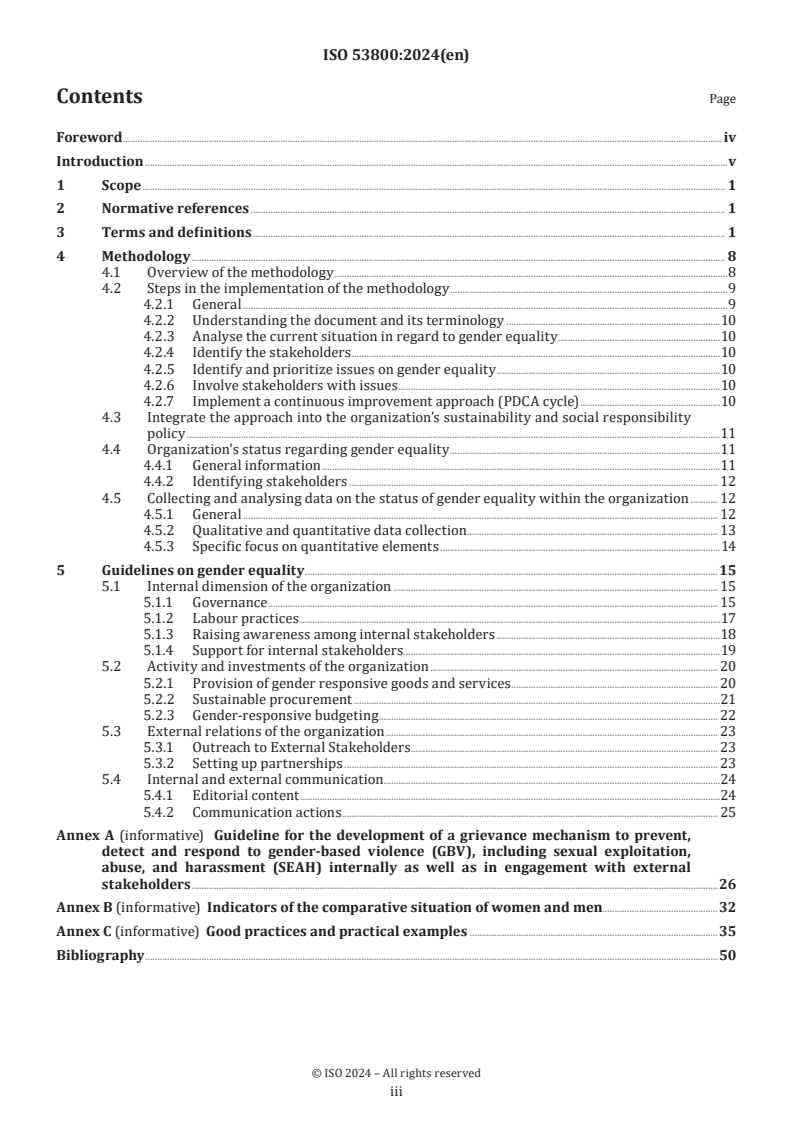
Contents Page
Foreword .iv
Introduction .v
1 Scope . 1
2 Normative references . 1
3 Terms and definitions . 1
4 Methodology . 8
4.1 Overview of the methodology .8
4.2 Steps in the implementation of the methodology .9
4.2.1 General .9
4.2.2 Understanding the document and its terminology .10
4.2.3 Analyse the current situation in regard to gender equality .10
4.2.4 Identify the stakeholders .10
4.2.5 Identify and prioritize issues on gender equality .10
4.2.6 Involve stakeholders with issues .10
4.2.7 Implement a continuous improvement approach (PDCA cycle) .10
4.3 Integrate the approach into the organization’s sustainability and social responsibility
policy .11
4.4 Organization's status regarding gender equality .11
4.4.1 General information .11
4.4.2 Identifying stakeholders . 12
4.5 Collecting and analysing data on the status of gender equality within the organization . 12
4.5.1 General . 12
4.5.2 Qualitative and quantitative data collection . 13
4.5.3 Specific focus on quantitative elements .14
5 Guidelines on gender equality .15
5.1 Internal dimension of the organization . 15
5.1.1 Governance . 15
5.1.2 Labour practices .17
5.1.3 Raising awareness among internal stakeholders .18
5.1.4 Support for internal stakeholders.19
5.2 Activity and investments of the organization . 20
5.2.1 Provision of gender responsive goods and services . 20
5.2.2 Sustainable procurement .21
5.2.3 Gender-responsive budgeting . 22
5.3 External relations of the organization . 23
5.3.1 Outreach to External Stakeholders . . 23
5.3.2 Setting up partnerships . 23
5.4 Internal and external communication.24
5.4.1 Editorial content .24
5.4.2 Communication actions . 25
Annex A (informative) Guideline for the development of a grievance mechanism to prevent,
detect and respond to gender-based violence (GBV), including sexual exploitation,
abuse, and harassment (SEAH) internally as well as in engagement with external
stakeholders .26
Annex B (informative) Indicators of the comparative situation of women and men.32
Annex C (informative) Good practices and practical examples .35
Bibliography .50
iii
Foreword
ISO (the International Organization for Standardization) is a worldwide federation of national standards
bodies (ISO member bodies). The work of preparing International Standards is normally carried out through
ISO technical committees. Each member body interested in a subject for which a technical committee
has been established has the right to be represented on that committee. International organizations,
governmental and non-governmental, in liaison with ISO, also take part in the work. ISO collaborates closely
with the International Electrotechnical Commission (IEC) on all matters of electrotechnical standardization.
The procedures used to develop this document and those intended for its further maintenance are described
in the ISO/IEC Directives, Part 1. In particular, the different approval criteria needed for the different types
of ISO document should be noted. This document was drafted in accordance with the editorial rules of the
ISO/IEC Directives, Part 2 (see www.iso.org/directives).
ISO draws attention to the possibility that the implementation of this document may involve the use of (a)
patent(s). ISO takes no position concerning the evidence, validity or applicability of any claimed patent
rights in respect thereof. As of the date of publication of this document, ISO had not received notice of (a)
patent(s) which may be required to implement this document. However, implementers are cautioned that
this may not represent the latest information, which may be obtained from the patent database available at
www.iso.org/patents. ISO shall not be held responsible for identifying any or all such patent rights.
Any trade name used in this document is information given for the convenience of users and does not
constitute an endorsement.
For an explanation of the voluntary nature of standards, the meaning of ISO specific terms and expressions
related to conformity assessment, as well as information about ISO's adherence to the World Trade
Organization (WTO) principles in the Technical Barriers to Trade (TBT), see www.iso.org/iso/foreword.html.
This document was prepared by Project Committee ISO/PC 337, Guidelines for the promotion and
implementation of gender equality.
Any feedback or questions on this document should be directed to the user’s national standards body. A
complete listing of these bodies can be found at www.iso.org/members.html.
iv
Introduction
Despite real progress, gender inequalities and gender-based discrimination still remain widespread
throughout the world in all areas.
Societal gender role expectations towards female and male behaviour are reflected in the very functioning
of organizations, including their culture, processes, and hierarchies. The persistent gender inequalities
within organizations mirror the structural discrimination faced by women and girls in society. For example,
five out of ten women worldwide are integrated into the labour market, compared with nine out of ten men.
[1] [2]
Still, once employed, women, worldwide, only make 77 cents for every dollar earned by men. Women
[3]
are still in the minority in governing bodies and other positions of power. Concurrently, paid and unpaid
labour is unequally distributed, with women and girls spending more time than men and boys on unpaid
[4]
care and domestic work . Finally, according to estimates by the World Health Organization, almost one in
three women worldwide reports having been the victim of physical or sexual violence in her lifetime, not
[5]
counting psychological, economic and social forms of violence.
Every year, the World Economic Forum publishes the Global Gender Gap Report, an analysis that reveals the
[6]
context of gender inequality in different regions of the world.
The purpose of this document is to provide guidelines, definitions, procedures and tools (including a
framework, resources, policies, tools and good practices) to public and private organizations to encourage,
support and guide them in making sustainable progress in promoting and achieving gender equality and
women’s empowerment, both internally and externally. It is intended to promote a common understanding on
the issue of gender equality and to complement other instruments and initiatives on the subject. Additionally,
this document has been developed in a manner consistent with other ISO initiatives and instruments such
as ISO 30415. It aims to provide guidance to organizations in fulfilling their obligations in relation to gender
[8]
equality and the UN's 2030 Agenda (in particular SDG5 on gender equality). Beyond that, it addresses the
underlying culture and behaviours, and proposes an approach, operational methods and tools for achieving
an organization's stated objectives. Recognizing the differences in resources available, the intention of this
document is to provide practical guidance for SMEs and small entities, as well as larger organizations, in line
with their specific requirements.
While women are generally more disadvantaged in areas such as the labour market, unpaid care work and
sexual and gender-based violence, gender-based discrimination can also affect men and boys in certain
aspects of life, particularly when they do not conform to traditionally recognized perceptions of gender
roles, which can have negative impacts on their lives and health, including their mental health. Therefore,
in order to address gender inequality, it is important to identify how particular actions or omissions by the
organization affect gender equality. It is only once this has been completed that the gender imbalance can
be identified and the appropriate actions to remedy the imbalance be determined. This is an underlying
principle of this document.
Gender equality and women’s empowerment are not only women’s issues but need to be addressed by
everyone and every organization. It is seen both as a human rights issue, as well as a prerequisite and
indicator of sustainable people-centred development. As such, addressing gender equality is a core pillar of
any organization’s social responsibility, including its environmental, social and governance (ESG) agenda.
All organizations are in a position to take measures to promote gender equality, taking into account the
maturity, nature, size and objectives of the organization.
The existence of a positive relationship between gender equality and economic and social development
has already been demonstrated. It can be perceived as a lever and a source of better outcomes for the
organization, and possibly be integrated in the organization's social responsibility policy (if it exists) or any
other relevant policies.
[9]-[11]
Numerous studies suggest that promoting gender equality has benefits for organizations: reduced
employee turnover, quality recruitment, a stronger, more productive and innovative working environment,
effective collaboration, leading to better performance and achieving more accurate results. Equitable
leadership improves decision-making, and for-profit organizations can boost their profitability (e.g. by
broadening their customer base, as well as by identifying new markets and reducing retention costs).
v
In this document, the objectives of gender equality are based on the understanding that gender is a social
construct. The inequalities targeted are not based on biological criteria, but arise from social norms and
constructs assimilated or projected onto every individual through socialization processes. However, the
document also acknowledges and addresses those inequalities that are experienced as a result of biological
criteria, such as sexual and reproductive health.
While recognizing the existence of other gender identities, this document specifically focuses on the
inequality resulting from the hierarchical organization of the gender-specific roles assigned to women and
men, girls and boys, due to their prominently structural character on a society-wide scale.
vi
International Standard ISO 53800:2024(en)
Guidelines for the promotion and implementation of gender
equality and women’s empowerment
1 Scope
This document gives guidance on how to promote and implement gender equality and women’s
empowerment. It provides guidelines for organizations to develop the capabilities to achieve a culture of
gender equality and women’s empowerment. The guidelines include the framework, resources, policies,
tools and good practices for contextualizing, promoting and implementing gender equality.
This document focuses on the inequality resulting from the gender specific roles assigned to women, girls,
men and boys and is applicable to all types of organizations (public or private), regardless of their size,
location or field of activity.
This document does not address the specific aspects of relations with labour unions or work councils, nor
the country-specific regulations and compliance relating to gender diversity.
2 Normative references
There are no normative references in this document.
3 Terms and definitions
For the purposes of this document, the following terms and definitions apply.
ISO and IEC maintain terminology databases for use in standardization at the following addresses:
— ISO Online browsing platform: available at https:// www .iso .org/ obp
— IEC Electropedia: available at https:// www .electropedia .org/
3.1
workforce
people who provide a service or labour to contribute to public and private business or organizational
outcomes
Note 1 to entry: Service or labour comprises paid, voluntary, or legally compulsory contributions, irrespective of their
contractual status.
Note 2 to entry: Workforce includes people defined as workers in ISO 26000, as well as volunteers and persons in
training.
[SOURCE: ISO 30400:2022, 3.8.1, modified — Notes 1 and 2 to entry have been added.]
3.2
gender-based discrimination
intentional or unintentional unfavourable treatment of a person or a social group on the basis of their
gender and gender stereotypes assigned in a social and cultural context which has the effect or purpose of
impairing or nullifying the recognition, enjoyment or exercise of their rights
Note 1 to entry: Gender based-discrimination can intersect and be cumulative, known as intersectionality, with
multiple forms of discrimination
Note 2 to entry: Within organizations, gender-based discrimination can be systemic, meaning that the policies,
procedures, practices, routines or organizational culture of any entity, or the combination of these, whether
intentionally or not, contributes to less favourable outcomes for the people who are part of them based on gender,
more often for women and girls than for men and boys.
3.3
gender-inclusive language
oral and written language not perpetuating gender stereotypes and making women and men in all their
diversity visible by proactively and equitably using all available syntactic rules, lexical fields and choices of
word enabling the use of feminine and masculine forms when they differ and gender-neutral terms
3.4
gender equality
equal rights, responsibilities and opportunities for women and men and girls and boys
Note 1 to entry: Gender equality does not mean that women and men, girls and boys, will become the same but that
women’s and men’s rights, responsibilities and opportunities will not depend on whether they are born male or female.
Note 2 to entry: Gender equality implies that the interests, needs and priorities of both women and girls, men and
boys, are taken into consideration, recognizing them in all their diversity.
3.5
gender
roles, behaviours, activities, and attributes that a given society at a given time considers appropriate for
men and women
Note 1 to entry: In addition to social attributes and opportunities associated with being male and female and the
relationships between women and men and girls and boys, gender also refers to the relations between women and
those between men.
Note 2 to entry: These attributes, opportunities and relationships are socially constructed and are learned through
socialization processes. They are context or time-specific and changeable. Gender determines what is expected,
allowed and valued in a woman or a man in a given context. In most societies there are differences and inequalities
between women and men in responsibilities assigned, activities undertaken, access to and control over resources, as
well as decision-making opportunities. Gender is part of the broader socio-cultural context, as are other important
criteria for socio-cultural analysis include class, race, poverty level, ethnic group, sexual orientation, age and
disabilities
Note 3 to entry: Gender in this definition can refer to gender as defined by national legislations or self-identified by
individuals.
Note 4 to entry: Gender does not refer to sexual orientation which is another important criteria for socio-cultural
analysis.
[13]
[SOURCE: UN Women, Concepts and definitions, modified — part of the definition moved into a note to entry.]
3.6
women’s empowerment
process of enabling social, economic, cultural and political conditions for women to take control of their own
lives and voices, development and future
Note 1 to entry: The empowerment of women and girls concerns their gaining power and control over their own
lives. It involves awareness-raising, building self-confidence, expansion of choices, increased access to and control
over resources and actions to transform the structures and institutions which reinforce and perpetuate gender
discrimination and inequality.
Note 2 to entry: This implies that to be empowered they must not only have equal capabilities (such as education
and health) and equal access to resources and opportunities (such as land and employment), but they must also have
agency and ability and control to use these rights, capabilities, resources and opportunities to make choices and
decisions (such as is provided through private life/families, leadership opportunities and participation in political
institutions).
[14]
[SOURCE: UN Women, Gender Equality Glossary, modified — part of the definition moved into a note to entry.]
3.7
organization
person or group of people that has its own functions with responsibilities, authorities and relationships to
achieve its objectives
Note 1 to entry: The concept of organization includes, but is not limited to sole-trader, company, corporation, firm,
enterprise, authority, partnership, association, charity or institution, or part or combination thereof, whether
incorporating or not, public or private.
Note 2 to entry: This constitutes one of the common terms and core definitions for ISO management system standards
given in Annex SL of the Consolidated ISO Supplement to the ISO/IEC Directives, Part 1. The original definition has
been changed by modifying Note 1 to entry.
[SOURCE: ISO 9000:2015, 3.2.1]
3.8
gender parity index
numerical concept concerning the relative equality in terms of numbers and proportions of women and men,
girls and boys, is often calculated as the ratio of female-to-male values for a given indicator
Note 1 to entry: When this ratio is reached, gender parity is synonymous with gender balance.
3.9
gender balance
relates to a proportional participation of women and men in all areas of work, programmes, and projects.
That participation should be proportional to their share of the population.
Note 1 to entry: In some contexts, such as representation, participation and decision-making bodies, a representation
of 40 % to 60 % of both women and men, girls and boys can be considered as gender balance representation. In other
contexts, the organization should strive for gender parity [see gender parity index (3.8)].
3.10
stakeholder
individual or group that has an interest in any decision or activity of an organization
[SOURCE: ISO 26000:2010, 2.20]
3.11
social responsibility
responsibility of an organization for the impacts of its decisions and activities on society and the
environment, through transparent and ethical behaviour that:
— contributes to sustainable development, inclusiveness, health and the welfare of society;
— takes into account the expectations of stakeholders;
— is in compliance with applicable law and consistent with international norms of behaviour;
— is integrated throughout the organization and practised in its relationships
Note 1 to entry: Activities include products, services and processes.
Note 2 to entry: Relationships refer to an organization's activities within its sphere of influence.
Note 3 to entry: Includes activities on members and workforce of organizations.
Note 4 to entry: Social responsibility includes gender equality.
[SOURCE: ISO 26000:2010, 2.18, modified — the word "inclusivity" has been added, as well as Notes 3 and 4
to entry.]
3.12
sexism
any conscious or unconscious act, gesture, body language and representation, spoken or written words,
practice or behaviour based upon the idea that a person or a group of persons is inferior because of their sex
or gender, which occurs in the public or private sphere, whether in physical or virtual environment, with the
purpose or effect of: violating the inherent dignity or rights of a person or a group of persons; or resulting
in physical, sexual, psychological or socio-economic harm or suffering to a person or a group of persons; or
creating an intimidating, hostile, degrading, humiliating or offensive environment; or constituting a barrier
to the autonomy and full realisation of human rights by a person or a group of persons; or maintaining and
reinforcing gender stereotypes
Note 1 to entry: Sexism can include forms of indirect violence (hints, jokes, inappropriate and insistent comments or
looks, etc.) or forms of exclusion (informal discussions about work that are not accessible to everyone, etc.).
Note 2 to entry: Sexism and sexist behaviour are perpetrated at the individual, institutional and structural levels, and
experienced with detrimental effect at all three levels. At the structural level, sexism constitutes a barrier to gender
equality and to the empowerment of women and girls; whereas men and boys are also restricted in their capabilities by
sexist stereotypes. Gender stereotypes and inherent biases shape norms, behaviour and expectations, and therefore
lead to sexist acts.
Note 3 to entry: Sexism is a part of a continuum of violence, it contributes to create a climate which can constitute
favourable ground to violence against women or gender-based discrimination.
[17]
[SOURCE: Council of Europe, modified — Notes 1, 2 and 3 to entry have been added.]
3.13
stereotype
shared or individual beliefs about personal characteristics, usually pertaining to personality traits and the
behaviours of a group of persons
3.14
gender stereotype
socially or culturally preconception ascribing specific and limited attributes, characteristics or roles to an
individual simply because they are a woman, man, girl or boy
3.15
gender responsiveness
outcomes that reflect an understanding of gender roles and inequalities and which make an effort to
encourage equal participation and equal and fair distribution of benefits
Note 1 to entry: Gender responsiveness is accomplished through gender analysis that informs inclusiveness.
[18]
[SOURCE: UNDP, Gender responsive national communications toolkit, modified — part of the definition
moved into a Note to entry.]
3.16
gender-responsive budgeting
planning, programming and budgeting of any public or private organization that contributes to the
advancement of gender equality and the fulfilment of women’s' right
Note 1 to entry: It entails identifying and reflecting needed interventions to address gender gaps in organization's
policies, plans and budgets.
[19]
[SOURCE: UNICEF, Gender equality glossary, modified — part of the definition moved into a note to entry.]
3.17
gender equality-based public funding
attributing public funds with conditionality based on gender equality and actions to promote and achieve
gender equality
3.18
remuneration
direct and indirect financial benefits received by a personal financial planner in exchange for providing the
service of personal financial planning to a client
[SOURCE: ISO 22222:2005, 3.19]
3.19
equal remuneration
rates of remuneration established without discrimination based on gender, taking into account the skills,
effort and responsibilities for equivalent working conditions even when the work is not of the same nature
Note 1 to entry: The term remuneration includes the ordinary, basic or minimum wage or salary and any additional
emoluments whatsoever payable directly or indirectly, whether in cash or in kind, by the organization to the worker
and arising out of the worker's employment.
[21]
[SOURCE: ILO, C100, modified — part of the definition moved into a note to entry.]
3.20
bias
unconscious, conscious or systematic tendency, inclination or opinion that is preconceived or unreasoned
that hinders impartial judgement.
Note 1 to entry: Bias can be both explicit and implicit
[22]
Note 2 to entry: Gender bias is one of its specific form. According to the UNDP's Gender social norms index (GSNI) ,
globally, 43 % of the population consider men to be better business leaders than women; 28 % think that university is
more important for men than for women; 46 % believe that men have more right to a job than women; 25 % of people still
think it's okay for a man to beat his wife. It should be noted that gender bias is prevalent among both men and women.
[SOURCE: ISO 30400:2022, 3.7.2, modified — notes 2 and 3 to entry have been replaced with a new note.]
3.21
work-life balance
outcome of organizational processes and practises which promote the satisfaction of, but not limited to,
personal needs, unpaid work, domestic work, care work, leisure time and social activities, supporting a
healthy lifestyle and balanced participation of all in public and private life
3.22
diversity
characteristics of differences and similarities between people
Note 1 to entry: Diversity includes factors that influence the identities and perspectives that people bring when
interacting at work.
Note 2 to entry: Diversity can support the development of workplace environments and practices that foster learning
from others by implementing inclusiveness (3.23) measures.
Note 3 to entry: Diversity dimensions include the demographic and other personal characteristics of the workforce,
such as, but not limited to, age, disability, sex, sexual orientation, gender, gender identity, race, colour, nationality,
ethnic or national origin, religion or belief, as well as characteristics related to socio-economic context. These are often
identified and agreed upon dimensions, which can be associated with legal requirements in different jurisdictions.
[SOURCE: ISO 30415:2021, 3.7]
3.23
inclusion
practice of including people in a way that is fair for all, values everyone’s differences, and empowers and
enables each person to be themselves and achieve their full potential and thrive at work
Note 1 to entry: Organizational policies, processes and practices that are fair and impartially applied can support an
inclusive workplace.
Note 2 to entry: This involves the entire workforce having equal and fair access to opportunities and resources to
enable their contribution to the organization.
Note 3 to entry: This involves stakeholders from different groups being accepted, welcomed, enabled to use their voice
and get involved, and to develop a sense of belonging.
[23]
[SOURCE: CIPD, modified — added notes to entry.]
3.24
sexual and gender-based violence
GBV
any harmful act, including sexual harassment, that results in, or is likely to result in, physical, sexual,
psychological or economic harm or suffering, including threats of such acts, coercion or arbitrary deprivation
of liberty, whether occurring in public or in private life, that is perpetrated against a person’s or a group of
individuals’ consent based on gender
3.25
sexual and reproductive health and rights
state of physical, emotional, mental and social well-being in relation to all aspects of sexuality and
reproduction, not merely the absence of disease, dysfunction or infirmity
Note 1 to entry: Therefore, a positive approach to sexuality and reproduction should recognize the part played by
pleasurable sexual relationships, trust and communication in promoting self-esteem and overall well-being. All
individuals have a right to make decisions governing their bodies and to access services that support that right.
[24]
[SOURCE: Lancet 2018, modified — part of the definition moved into a Note to entry.]
3.26
sexual harassment
any form of unwanted verbal, non-verbal or physical conduct or gesture of a sexual nature, with the purpose
or effect of violating the dignity of a person or creating an intimidating, hostile, degrading, humiliating or
offensive environment
Note 1 to entry: It can include a one-off incident or a series of incidents. Sexual harassment can be deliberate,
unsolicited or coercive.
[25]
[SOURCE: CETS No. 210, modified — adapted part of the definition and added a note to entry.]
3.27
labour practices
all the policies and practices relating to work performed by or on behalf of the organization, including
subcontracted work, that affect the workforce: recruitment hiring, retention, promotion and retirement,
remuneration, turnover, disciplinary action, complaint response system, transfers and reassignment,
termination of employment, human resources development, occupational health and safety, and working
conditions (working hours, discrimination and safety)
3.28
top management
person or group of people who directs and controls an organization (3.7) at the highest level
[SOURCE: ISO 9000:2015, 3.1.1, modified — Notes to entry have been deleted.]
3.29
gender mainstreaming
process of systematically assessing the implications for women and men, girls and boys and incorporating
a gender equality and women’s empowerment perspective in the preparation, design, implementation,
monitoring and evaluation of policies, regulatory measures and budgets, in all areas and at all levels in order
to promote gender equality and women’s empowerment
Note 1 to entry: Gender mainstreaming is a process intended to incorporate a gender equality perspective in all
[26]
policies, of which the ultimate goal is to achieve gender equality.
3.30
governing body
person or group of persons who have ultimate accountability for the whole organization
Note 1 to entry: Every organization has one governing body, whether explicitly established or not.
Note 2 to entry: A governing body can be explicitly established in a number of formats including, but not limited to, a
board of direction, supervisory board, board of trustees.
Note 3 to entry: Top management plays a role that, depending on the context, reports to and is held accountable by the
governing body.
[SOURCE: ISO 37000:2021, 3.3.4, modified — Notes to entry have been modified.]
3.31
intersectionality
combination of one or more diversity dimensions and other personal characteristics that are part of a
person’s identity
Note 1 to entry: In the context of gender equality and women’s empowerment intersectionality is used to describe the
interaction of multiple forms of discrimination based on gender, disability, race, ethnicity, sexual orientation, class,
age and others. Intersectionality expresses the idea that different personal characteristics / forms of discrimination
do not simply add up, but intersect and therefore influence each other, thus creating new forms of discrimination and
privilege.
3.32
discrimination
intentional or actual less favourable treatment of a person or a social group on the grounds of gender than
another is, has been or would be treated in a comparable situation
Note 1 to entry: Indirect discrimination: an apparently neutral provision, criterion or practice putting a person, social
group or an organization at a particular disadvantage on grounds of gender than another is, unless that provision,
criterion or practice is objectively justified by a legitimate aim, and the means of achieving that aim are appropriate
and necessary.
[28]
[SOURCE: Eurofound 2019, modified — adapted part of the definition and added a note to entry.]
3.33
equality
state of being equal, especially in status, rights or opportunities
[SOURCE: ISO 30415:2021, 3.9, modified — removed "outcome" from definition.]
3.34
social group
group where members share an innate characteristic, or a common background that cannot be changed, or
share a characteristic or belief that is so fundamental to identity or conscience that a person should not be
forced to renounce it
3.35
sexual abuse
actual, attempted or threatened physical intrusion of a sexual nature, whether by force or under unequal or
coercive conditions
Note 1 to entry: Sexual abuse includes for example unwanted kissing, touching, grabbing or rubbing, threats of
unwanted sexual act, rape or attempted rape.
Note 2 to entry: This abuse can take place in real life or virtually and include the recording and dissemination of
private images without consent. Women and girls are disproportionately affected by technology-facilitated gender-
based violence.
Note 3 to entry: All sexual relationships should be based on free, affirmative and reversible consent.
Note 4 to entry: All sexual activity with a child is considered as sexual abuse. A child means every human being below
[29]
the age of eighteen years unless under the law applicable to the child, majority is attained earlier.
3.36
sexual exploitation
any actual or attempted abuse of a position of vulnerability, differential power or trust, for sexual purposes,
including, but not limited to threatening or profiting monetarily, socially or politically from the sexual
exploitation of another (e.g. transactional sex, solicitation of transactional sex and exploitative relationship)
Note 1 to entry: This can be offering money, gifts, or a job in exchange for sex, withholding due services or blackmailing
for sex, or threats of sexual exploitation, and sextortion.
Note 2 to entry: This exploitation can take place in real life or online.
Note 3 to entry: Sexual extortion (sextortion) is sexual corruption (a form of both gender-based violence and
corruption). It occurs when people in positions of authority seek to extort sexual favours in exchange for something
within their power to grant or withhold.
4 Methodology
4.1 Overview of the methodology
This document provides guidelines on how to address gender equality and women’s empowerment in
organizations in the following areas:
a) internal to the organization: governance, relations and working conditions, raising awareness among
internal stakeholders and support for internal stakeholders;
b) activity and investments of the organization: sustainable procurement and gender budgeting;
c) external relations of the organization: involving stakeholders and establishing partnerships;
d) internal and external communication: editorial content and communication actions.
By working on the four areas of the organization, using the guidelines proposed in this document it is
possible to achieve the following objectives, which are inspired from the UN's Sustainable Development Goal
[8]
number 5:
— raising awareness for, as well as preventing and ending, all forms of gender-based discrimination and
promoting the rights of women and girls;
— abolishing gender stereotypes and gender bias in the organization;
— preventing and ending sexual and gender-based violence;
— educating and improving access to education and training, including vocational training;
— protecting health, especially mental health, as well as sexual and reproductive health and rights;
— enhancing women's empowerment, especially economic empowerment;
— increasing participation and equal opportunities for leadership in political and institutional, professional
and corporate life.
For each issue, several fields of action are proposed, and organizations should take them into consideration
when striving to further promote gender equality and women’s empowerment. Moreover, each issue has a
varying degree of relevance depending on the organization.
The guidance on each issue includes actions that an organization should consider and expectations of the
way in which the organization should behave. When an organization attempts to promote gender equality
and women’s empowerment, it should identify each issue in relation to its key areas.
The actions recommended in this document should be considered within the context of the maturity, or
how advanced an organization is, in terms of gender equality. The recommended actions can be used by an
organization to facilitate progress towards gender equality. The areas and related actions recommended
in these guidelines are to be prioritized according to an organization’s maturity, nature, size and
objecti
...
International
Standard
ISO 53800
First edition
Guidelines for the promotion and
2024-05
implementation of gender equality
and women’s empowerment
Lignes directrices relatives à la promotion et à la mise en œuvre
de l’égalité entre les femmes et les hommes et à l’empouvoirement
des femmes
Reference number
© ISO 2024
All rights reserved. Unless otherwise specified, or required in the context of its implementation, no part of this publication may
be reproduced or utilized otherwise in any form or by any means, electronic or mechanical, including photocopying, or posting on
the internet or an intranet, without prior written permission. Permission can be requested from either ISO at the address below
or ISO’s member body in the country of the requester.
ISO copyright office
CP 401 • Ch. de Blandonnet 8
CH-1214 Vernier, Geneva
Phone: +41 22 749 01 11
Email: copyright@iso.org
Website: www.iso.org
Published in Switzerland
ii
Contents Page
Foreword .iv
Introduction .v
1 Scope . 1
2 Normative references . 1
3 Terms and definitions . 1
4 Methodology . 8
4.1 Overview of the methodology .8
4.2 Steps in the implementation of the methodology .9
4.2.1 General .9
4.2.2 Understanding the document and its terminology .10
4.2.3 Analyse the current situation in regard to gender equality .10
4.2.4 Identify the stakeholders .10
4.2.5 Identify and prioritize issues on gender equality .10
4.2.6 Involve stakeholders with issues .10
4.2.7 Implement a continuous improvement approach (PDCA cycle) .10
4.3 Integrate the approach into the organization’s sustainability and social responsibility
policy .11
4.4 Organization's status regarding gender equality .11
4.4.1 General information .11
4.4.2 Identifying stakeholders . 12
4.5 Collecting and analysing data on the status of gender equality within the organization . 12
4.5.1 General . 12
4.5.2 Qualitative and quantitative data collection . 13
4.5.3 Specific focus on quantitative elements .14
5 Guidelines on gender equality .15
5.1 Internal dimension of the organization . 15
5.1.1 Governance . 15
5.1.2 Labour practices .17
5.1.3 Raising awareness among internal stakeholders .18
5.1.4 Support for internal stakeholders.19
5.2 Activity and investments of the organization . 20
5.2.1 Provision of gender responsive goods and services . 20
5.2.2 Sustainable procurement .21
5.2.3 Gender-responsive budgeting . 22
5.3 External relations of the organization . 23
5.3.1 Outreach to External Stakeholders . . 23
5.3.2 Setting up partnerships . 23
5.4 Internal and external communication.24
5.4.1 Editorial content .24
5.4.2 Communication actions . 25
Annex A (informative) Guideline for the development of a grievance mechanism to prevent,
detect and respond to gender-based violence (GBV), including sexual exploitation,
abuse, and harassment (SEAH) internally as well as in engagement with external
stakeholders .26
Annex B (informative) Indicators of the comparative situation of women and men.32
Annex C (informative) Good practices and practical examples .35
Bibliography .50
iii
Foreword
ISO (the International Organization for Standardization) is a worldwide federation of national standards
bodies (ISO member bodies). The work of preparing International Standards is normally carried out through
ISO technical committees. Each member body interested in a subject for which a technical committee
has been established has the right to be represented on that committee. International organizations,
governmental and non-governmental, in liaison with ISO, also take part in the work. ISO collaborates closely
with the International Electrotechnical Commission (IEC) on all matters of electrotechnical standardization.
The procedures used to develop this document and those intended for its further maintenance are described
in the ISO/IEC Directives, Part 1. In particular, the different approval criteria needed for the different types
of ISO document should be noted. This document was drafted in accordance with the editorial rules of the
ISO/IEC Directives, Part 2 (see www.iso.org/directives).
ISO draws attention to the possibility that the implementation of this document may involve the use of (a)
patent(s). ISO takes no position concerning the evidence, validity or applicability of any claimed patent
rights in respect thereof. As of the date of publication of this document, ISO had not received notice of (a)
patent(s) which may be required to implement this document. However, implementers are cautioned that
this may not represent the latest information, which may be obtained from the patent database available at
www.iso.org/patents. ISO shall not be held responsible for identifying any or all such patent rights.
Any trade name used in this document is information given for the convenience of users and does not
constitute an endorsement.
For an explanation of the voluntary nature of standards, the meaning of ISO specific terms and expressions
related to conformity assessment, as well as information about ISO's adherence to the World Trade
Organization (WTO) principles in the Technical Barriers to Trade (TBT), see www.iso.org/iso/foreword.html.
This document was prepared by Project Committee ISO/PC 337, Guidelines for the promotion and
implementation of gender equality.
Any feedback or questions on this document should be directed to the user’s national standards body. A
complete listing of these bodies can be found at www.iso.org/members.html.
iv
Introduction
Despite real progress, gender inequalities and gender-based discrimination still remain widespread
throughout the world in all areas.
Societal gender role expectations towards female and male behaviour are reflected in the very functioning
of organizations, including their culture, processes, and hierarchies. The persistent gender inequalities
within organizations mirror the structural discrimination faced by women and girls in society. For example,
five out of ten women worldwide are integrated into the labour market, compared with nine out of ten men.
[1] [2]
Still, once employed, women, worldwide, only make 77 cents for every dollar earned by men. Women
[3]
are still in the minority in governing bodies and other positions of power. Concurrently, paid and unpaid
labour is unequally distributed, with women and girls spending more time than men and boys on unpaid
[4]
care and domestic work . Finally, according to estimates by the World Health Organization, almost one in
three women worldwide reports having been the victim of physical or sexual violence in her lifetime, not
[5]
counting psychological, economic and social forms of violence.
Every year, the World Economic Forum publishes the Global Gender Gap Report, an analysis that reveals the
[6]
context of gender inequality in different regions of the world.
The purpose of this document is to provide guidelines, definitions, procedures and tools (including a
framework, resources, policies, tools and good practices) to public and private organizations to encourage,
support and guide them in making sustainable progress in promoting and achieving gender equality and
women’s empowerment, both internally and externally. It is intended to promote a common understanding on
the issue of gender equality and to complement other instruments and initiatives on the subject. Additionally,
this document has been developed in a manner consistent with other ISO initiatives and instruments such
as ISO 30415. It aims to provide guidance to organizations in fulfilling their obligations in relation to gender
[8]
equality and the UN's 2030 Agenda (in particular SDG5 on gender equality). Beyond that, it addresses the
underlying culture and behaviours, and proposes an approach, operational methods and tools for achieving
an organization's stated objectives. Recognizing the differences in resources available, the intention of this
document is to provide practical guidance for SMEs and small entities, as well as larger organizations, in line
with their specific requirements.
While women are generally more disadvantaged in areas such as the labour market, unpaid care work and
sexual and gender-based violence, gender-based discrimination can also affect men and boys in certain
aspects of life, particularly when they do not conform to traditionally recognized perceptions of gender
roles, which can have negative impacts on their lives and health, including their mental health. Therefore,
in order to address gender inequality, it is important to identify how particular actions or omissions by the
organization affect gender equality. It is only once this has been completed that the gender imbalance can
be identified and the appropriate actions to remedy the imbalance be determined. This is an underlying
principle of this document.
Gender equality and women’s empowerment are not only women’s issues but need to be addressed by
everyone and every organization. It is seen both as a human rights issue, as well as a prerequisite and
indicator of sustainable people-centred development. As such, addressing gender equality is a core pillar of
any organization’s social responsibility, including its environmental, social and governance (ESG) agenda.
All organizations are in a position to take measures to promote gender equality, taking into account the
maturity, nature, size and objectives of the organization.
The existence of a positive relationship between gender equality and economic and social development
has already been demonstrated. It can be perceived as a lever and a source of better outcomes for the
organization, and possibly be integrated in the organization's social responsibility policy (if it exists) or any
other relevant policies.
[9]-[11]
Numerous studies suggest that promoting gender equality has benefits for organizations: reduced
employee turnover, quality recruitment, a stronger, more productive and innovative working environment,
effective collaboration, leading to better performance and achieving more accurate results. Equitable
leadership improves decision-making, and for-profit organizations can boost their profitability (e.g. by
broadening their customer base, as well as by identifying new markets and reducing retention costs).
v
In this document, the objectives of gender equality are based on the understanding that gender is a social
construct. The inequalities targeted are not based on biological criteria, but arise from social norms and
constructs assimilated or projected onto every individual through socialization processes. However, the
document also acknowledges and addresses those inequalities that are experienced as a result of biological
criteria, such as sexual and reproductive health.
While recognizing the existence of other gender identities, this document specifically focuses on the
inequality resulting from the hierarchical organization of the gender-specific roles assigned to women and
men, girls and boys, due to their prominently structural character on a society-wide scale.
vi
International Standard ISO 53800:2024(en)
Guidelines for the promotion and implementation of gender
equality and women’s empowerment
1 Scope
This document gives guidance on how to promote and implement gender equality and women’s
empowerment. It provides guidelines for organizations to develop the capabilities to achieve a culture of
gender equality and women’s empowerment. The guidelines include the framework, resources, policies,
tools and good practices for contextualizing, promoting and implementing gender equality.
This document focuses on the inequality resulting from the gender specific roles assigned to women, girls,
men and boys and is applicable to all types of organizations (public or private), regardless of their size,
location or field of activity.
This document does not address the specific aspects of relations with labour unions or work councils, nor
the country-specific regulations and compliance relating to gender diversity.
2 Normative references
There are no normative references in this document.
3 Terms and definitions
For the purposes of this document, the following terms and definitions apply.
ISO and IEC maintain terminology databases for use in standardization at the following addresses:
— ISO Online browsing platform: available at https:// www .iso .org/ obp
— IEC Electropedia: available at https:// www .electropedia .org/
3.1
workforce
people who provide a service or labour to contribute to public and private business or organizational
outcomes
Note 1 to entry: Service or labour comprises paid, voluntary, or legally compulsory contributions, irrespective of their
contractual status.
Note 2 to entry: Workforce includes people defined as workers in ISO 26000, as well as volunteers and persons in
training.
[SOURCE: ISO 30400:2022, 3.8.1, modified — Notes 1 and 2 to entry have been added.]
3.2
gender-based discrimination
intentional or unintentional unfavourable treatment of a person or a social group on the basis of their
gender and gender stereotypes assigned in a social and cultural context which has the effect or purpose of
impairing or nullifying the recognition, enjoyment or exercise of their rights
Note 1 to entry: Gender based-discrimination can intersect and be cumulative, known as intersectionality, with
multiple forms of discrimination
Note 2 to entry: Within organizations, gender-based discrimination can be systemic, meaning that the policies,
procedures, practices, routines or organizational culture of any entity, or the combination of these, whether
intentionally or not, contributes to less favourable outcomes for the people who are part of them based on gender,
more often for women and girls than for men and boys.
3.3
gender-inclusive language
oral and written language not perpetuating gender stereotypes and making women and men in all their
diversity visible by proactively and equitably using all available syntactic rules, lexical fields and choices of
word enabling the use of feminine and masculine forms when they differ and gender-neutral terms
3.4
gender equality
equal rights, responsibilities and opportunities for women and men and girls and boys
Note 1 to entry: Gender equality does not mean that women and men, girls and boys, will become the same but that
women’s and men’s rights, responsibilities and opportunities will not depend on whether they are born male or female.
Note 2 to entry: Gender equality implies that the interests, needs and priorities of both women and girls, men and
boys, are taken into consideration, recognizing them in all their diversity.
3.5
gender
roles, behaviours, activities, and attributes that a given society at a given time considers appropriate for
men and women
Note 1 to entry: In addition to social attributes and opportunities associated with being male and female and the
relationships between women and men and girls and boys, gender also refers to the relations between women and
those between men.
Note 2 to entry: These attributes, opportunities and relationships are socially constructed and are learned through
socialization processes. They are context or time-specific and changeable. Gender determines what is expected,
allowed and valued in a woman or a man in a given context. In most societies there are differences and inequalities
between women and men in responsibilities assigned, activities undertaken, access to and control over resources, as
well as decision-making opportunities. Gender is part of the broader socio-cultural context, as are other important
criteria for socio-cultural analysis include class, race, poverty level, ethnic group, sexual orientation, age and
disabilities
Note 3 to entry: Gender in this definition can refer to gender as defined by national legislations or self-identified by
individuals.
Note 4 to entry: Gender does not refer to sexual orientation which is another important criteria for socio-cultural
analysis.
[13]
[SOURCE: UN Women, Concepts and definitions, modified — part of the definition moved into a note to entry.]
3.6
women’s empowerment
process of enabling social, economic, cultural and political conditions for women to take control of their own
lives and voices, development and future
Note 1 to entry: The empowerment of women and girls concerns their gaining power and control over their own
lives. It involves awareness-raising, building self-confidence, expansion of choices, increased access to and control
over resources and actions to transform the structures and institutions which reinforce and perpetuate gender
discrimination and inequality.
Note 2 to entry: This implies that to be empowered they must not only have equal capabilities (such as education
and health) and equal access to resources and opportunities (such as land and employment), but they must also have
agency and ability and control to use these rights, capabilities, resources and opportunities to make choices and
decisions (such as is provided through private life/families, leadership opportunities and participation in political
institutions).
[14]
[SOURCE: UN Women, Gender Equality Glossary, modified — part of the definition moved into a note to entry.]
3.7
organization
person or group of people that has its own functions with responsibilities, authorities and relationships to
achieve its objectives
Note 1 to entry: The concept of organization includes, but is not limited to sole-trader, company, corporation, firm,
enterprise, authority, partnership, association, charity or institution, or part or combination thereof, whether
incorporating or not, public or private.
Note 2 to entry: This constitutes one of the common terms and core definitions for ISO management system standards
given in Annex SL of the Consolidated ISO Supplement to the ISO/IEC Directives, Part 1. The original definition has
been changed by modifying Note 1 to entry.
[SOURCE: ISO 9000:2015, 3.2.1]
3.8
gender parity index
numerical concept concerning the relative equality in terms of numbers and proportions of women and men,
girls and boys, is often calculated as the ratio of female-to-male values for a given indicator
Note 1 to entry: When this ratio is reached, gender parity is synonymous with gender balance.
3.9
gender balance
relates to a proportional participation of women and men in all areas of work, programmes, and projects.
That participation should be proportional to their share of the population.
Note 1 to entry: In some contexts, such as representation, participation and decision-making bodies, a representation
of 40 % to 60 % of both women and men, girls and boys can be considered as gender balance representation. In other
contexts, the organization should strive for gender parity [see gender parity index (3.8)].
3.10
stakeholder
individual or group that has an interest in any decision or activity of an organization
[SOURCE: ISO 26000:2010, 2.20]
3.11
social responsibility
responsibility of an organization for the impacts of its decisions and activities on society and the
environment, through transparent and ethical behaviour that:
— contributes to sustainable development, inclusiveness, health and the welfare of society;
— takes into account the expectations of stakeholders;
— is in compliance with applicable law and consistent with international norms of behaviour;
— is integrated throughout the organization and practised in its relationships
Note 1 to entry: Activities include products, services and processes.
Note 2 to entry: Relationships refer to an organization's activities within its sphere of influence.
Note 3 to entry: Includes activities on members and workforce of organizations.
Note 4 to entry: Social responsibility includes gender equality.
[SOURCE: ISO 26000:2010, 2.18, modified — the word "inclusivity" has been added, as well as Notes 3 and 4
to entry.]
3.12
sexism
any conscious or unconscious act, gesture, body language and representation, spoken or written words,
practice or behaviour based upon the idea that a person or a group of persons is inferior because of their sex
or gender, which occurs in the public or private sphere, whether in physical or virtual environment, with the
purpose or effect of: violating the inherent dignity or rights of a person or a group of persons; or resulting
in physical, sexual, psychological or socio-economic harm or suffering to a person or a group of persons; or
creating an intimidating, hostile, degrading, humiliating or offensive environment; or constituting a barrier
to the autonomy and full realisation of human rights by a person or a group of persons; or maintaining and
reinforcing gender stereotypes
Note 1 to entry: Sexism can include forms of indirect violence (hints, jokes, inappropriate and insistent comments or
looks, etc.) or forms of exclusion (informal discussions about work that are not accessible to everyone, etc.).
Note 2 to entry: Sexism and sexist behaviour are perpetrated at the individual, institutional and structural levels, and
experienced with detrimental effect at all three levels. At the structural level, sexism constitutes a barrier to gender
equality and to the empowerment of women and girls; whereas men and boys are also restricted in their capabilities by
sexist stereotypes. Gender stereotypes and inherent biases shape norms, behaviour and expectations, and therefore
lead to sexist acts.
Note 3 to entry: Sexism is a part of a continuum of violence, it contributes to create a climate which can constitute
favourable ground to violence against women or gender-based discrimination.
[17]
[SOURCE: Council of Europe, modified — Notes 1, 2 and 3 to entry have been added.]
3.13
stereotype
shared or individual beliefs about personal characteristics, usually pertaining to personality traits and the
behaviours of a group of persons
3.14
gender stereotype
socially or culturally preconception ascribing specific and limited attributes, characteristics or roles to an
individual simply because they are a woman, man, girl or boy
3.15
gender responsiveness
outcomes that reflect an understanding of gender roles and inequalities and which make an effort to
encourage equal participation and equal and fair distribution of benefits
Note 1 to entry: Gender responsiveness is accomplished through gender analysis that informs inclusiveness.
[18]
[SOURCE: UNDP, Gender responsive national communications toolkit, modified — part of the definition
moved into a Note to entry.]
3.16
gender-responsive budgeting
planning, programming and budgeting of any public or private organization that contributes to the
advancement of gender equality and the fulfilment of women’s' right
Note 1 to entry: It entails identifying and reflecting needed interventions to address gender gaps in organization's
policies, plans and budgets.
[19]
[SOURCE: UNICEF, Gender equality glossary, modified — part of the definition moved into a note to entry.]
3.17
gender equality-based public funding
attributing public funds with conditionality based on gender equality and actions to promote and achieve
gender equality
3.18
remuneration
direct and indirect financial benefits received by a personal financial planner in exchange for providing the
service of personal financial planning to a client
[SOURCE: ISO 22222:2005, 3.19]
3.19
equal remuneration
rates of remuneration established without discrimination based on gender, taking into account the skills,
effort and responsibilities for equivalent working conditions even when the work is not of the same nature
Note 1 to entry: The term remuneration includes the ordinary, basic or minimum wage or salary and any additional
emoluments whatsoever payable directly or indirectly, whether in cash or in kind, by the organization to the worker
and arising out of the worker's employment.
[21]
[SOURCE: ILO, C100, modified — part of the definition moved into a note to entry.]
3.20
bias
unconscious, conscious or systematic tendency, inclination or opinion that is preconceived or unreasoned
that hinders impartial judgement.
Note 1 to entry: Bias can be both explicit and implicit
[22]
Note 2 to entry: Gender bias is one of its specific form. According to the UNDP's Gender social norms index (GSNI) ,
globally, 43 % of the population consider men to be better business leaders than women; 28 % think that university is
more important for men than for women; 46 % believe that men have more right to a job than women; 25 % of people still
think it's okay for a man to beat his wife. It should be noted that gender bias is prevalent among both men and women.
[SOURCE: ISO 30400:2022, 3.7.2, modified — notes 2 and 3 to entry have been replaced with a new note.]
3.21
work-life balance
outcome of organizational processes and practises which promote the satisfaction of, but not limited to,
personal needs, unpaid work, domestic work, care work, leisure time and social activities, supporting a
healthy lifestyle and balanced participation of all in public and private life
3.22
diversity
characteristics of differences and similarities between people
Note 1 to entry: Diversity includes factors that influence the identities and perspectives that people bring when
interacting at work.
Note 2 to entry: Diversity can support the development of workplace environments and practices that foster learning
from others by implementing inclusiveness (3.23) measures.
Note 3 to entry: Diversity dimensions include the demographic and other personal characteristics of the workforce,
such as, but not limited to, age, disability, sex, sexual orientation, gender, gender identity, race, colour, nationality,
ethnic or national origin, religion or belief, as well as characteristics related to socio-economic context. These are often
identified and agreed upon dimensions, which can be associated with legal requirements in different jurisdictions.
[SOURCE: ISO 30415:2021, 3.7]
3.23
inclusion
practice of including people in a way that is fair for all, values everyone’s differences, and empowers and
enables each person to be themselves and achieve their full potential and thrive at work
Note 1 to entry: Organizational policies, processes and practices that are fair and impartially applied can support an
inclusive workplace.
Note 2 to entry: This involves the entire workforce having equal and fair access to opportunities and resources to
enable their contribution to the organization.
Note 3 to entry: This involves stakeholders from different groups being accepted, welcomed, enabled to use their voice
and get involved, and to develop a sense of belonging.
[23]
[SOURCE: CIPD, modified — added notes to entry.]
3.24
sexual and gender-based violence
GBV
any harmful act, including sexual harassment, that results in, or is likely to result in, physical, sexual,
psychological or economic harm or suffering, including threats of such acts, coercion or arbitrary deprivation
of liberty, whether occurring in public or in private life, that is perpetrated against a person’s or a group of
individuals’ consent based on gender
3.25
sexual and reproductive health and rights
state of physical, emotional, mental and social well-being in relation to all aspects of sexuality and
reproduction, not merely the absence of disease, dysfunction or infirmity
Note 1 to entry: Therefore, a positive approach to sexuality and reproduction should recognize the part played by
pleasurable sexual relationships, trust and communication in promoting self-esteem and overall well-being. All
individuals have a right to make decisions governing their bodies and to access services that support that right.
[24]
[SOURCE: Lancet 2018, modified — part of the definition moved into a Note to entry.]
3.26
sexual harassment
any form of unwanted verbal, non-verbal or physical conduct or gesture of a sexual nature, with the purpose
or effect of violating the dignity of a person or creating an intimidating, hostile, degrading, humiliating or
offensive environment
Note 1 to entry: It can include a one-off incident or a series of incidents. Sexual harassment can be deliberate,
unsolicited or coercive.
[25]
[SOURCE: CETS No. 210, modified — adapted part of the definition and added a note to entry.]
3.27
labour practices
all the policies and practices relating to work performed by or on behalf of the organization, including
subcontracted work, that affect the workforce: recruitment hiring, retention, promotion and retirement,
remuneration, turnover, disciplinary action, complaint response system, transfers and reassignment,
termination of employment, human resources development, occupational health and safety, and working
conditions (working hours, discrimination and safety)
3.28
top management
person or group of people who directs and controls an organization (3.7) at the highest level
[SOURCE: ISO 9000:2015, 3.1.1, modified — Notes to entry have been deleted.]
3.29
gender mainstreaming
process of systematically assessing the implications for women and men, girls and boys and incorporating
a gender equality and women’s empowerment perspective in the preparation, design, implementation,
monitoring and evaluation of policies, regulatory measures and budgets, in all areas and at all levels in order
to promote gender equality and women’s empowerment
Note 1 to entry: Gender mainstreaming is a process intended to incorporate a gender equality perspective in all
[26]
policies, of which the ultimate goal is to achieve gender equality.
3.30
governing body
person or group of persons who have ultimate accountability for the whole organization
Note 1 to entry: Every organization has one governing body, whether explicitly established or not.
Note 2 to entry: A governing body can be explicitly established in a number of formats including, but not limited to, a
board of direction, supervisory board, board of trustees.
Note 3 to entry: Top management plays a role that, depending on the context, reports to and is held accountable by the
governing body.
[SOURCE: ISO 37000:2021, 3.3.4, modified — Notes to entry have been modified.]
3.31
intersectionality
combination of one or more diversity dimensions and other personal characteristics that are part of a
person’s identity
Note 1 to entry: In the context of gender equality and women’s empowerment intersectionality is used to describe the
interaction of multiple forms of discrimination based on gender, disability, race, ethnicity, sexual orientation, class,
age and others. Intersectionality expresses the idea that different personal characteristics / forms of discrimination
do not simply add up, but intersect and therefore influence each other, thus creating new forms of discrimination and
privilege.
3.32
discrimination
intentional or actual less favourable treatment of a person or a social group on the grounds of gender than
another is, has been or would be treated in a comparable situation
Note 1 to entry: Indirect discrimination: an apparently neutral provision, criterion or practice putting a person, social
group or an organization at a particular disadvantage on grounds of gender than another is, unless that provision,
criterion or practice is objectively justified by a legitimate aim, and the means of achieving that aim are appropriate
and necessary.
[28]
[SOURCE: Eurofound 2019, modified — adapted part of the definition and added a note to entry.]
3.33
equality
state of being equal, especially in status, rights or opportunities
[SOURCE: ISO 30415:2021, 3.9, modified — removed "outcome" from definition.]
3.34
social group
group where members share an innate characteristic, or a common background that cannot be changed, or
share a characteristic or belief that is so fundamental to identity or conscience that a person should not be
forced to renounce it
3.35
sexual abuse
actual, attempted or threatened physical intrusion of a sexual nature, whether by force or under unequal or
coercive conditions
Note 1 to entry: Sexual abuse includes for example unwanted kissing, touching, grabbing or rubbing, threats of
unwanted sexual act, rape or attempted rape.
Note 2 to entry: This abuse can take place in real life or virtually and include the recording and dissemination of
private images without consent. Women and girls are disproportionately affected by technology-facilitated gender-
based violence.
Note 3 to entry: All sexual relationships should be based on free, affirmative and reversible consent.
Note 4 to entry: All sexual activity with a child is considered as sexual abuse. A child means every human being below
[29]
the age of eighteen years unless under the law applicable to the child, majority is attained earlier.
3.36
sexual exploitation
any actual or attempted abuse of a position of vulnerability, differential power or trust, for sexual purposes,
including, but not limited to threatening or profiting monetarily, socially or politically from the sexual
exploitation of another (e.g. transactional sex, solicitation of transactional sex and exploitative relationship)
Note 1 to entry: This can be offering money, gifts, or a job in exchange for sex, withholding due services or blackmailing
for sex, or threats of sexual exploitation, and sextortion.
Note 2 to entry: This exploitation can take place in real life or online.
Note 3 to entry: Sexual extortion (sextortion) is sexual corruption (a form of both gender-based violence and
corruption). It occurs when people in positions of authority seek to extort sexual favours in exchange for something
within their power to grant or withhold.
4 Methodology
4.1 Overview of the methodology
This document provides guidelines on how to address gender equality and women’s empowerment in
organizations in the following areas:
a) internal to the organization: governance, relations and working conditions, raising awareness among
internal stakeholders and support for internal stakeholders;
b) activity and investments of the organization: sustainable procurement and gender budgeting;
c) external relations of the organization: involving stakeholders and establishing partnerships;
d) internal and external communication: editorial content and communication actions.
By working on the four areas of the organization, using the guidelines proposed in this document it is
possible to achieve the following objectives, which are inspired from the UN's Sustainable Development Goal
[8]
number 5:
— raising awareness for, as well as preventing and ending, all forms of gender-based discrimination and
promoting the rights of women and girls;
— abolishing gender stereotypes and gender bias in the organization;
— preventing and ending sexual and gender-based violence;
— educating and improving access to education and training, including vocational training;
— protecting health, especially mental health, as well as sexual and reproductive health and rights;
— enhancing women's empowerment, especially economic empowerment;
— increasing participation and equal opportunities for leadership in political and institutional, professional
and corporate life.
For each issue, several fields of action are proposed, and organizations should take them into consideration
when striving to further promote gender equality and women’s empowerment. Moreover, each issue has a
varying degree of relevance depending on the organization.
The guidance on each issue includes actions that an organization should consider and expectations of the
way in which the organization should behave. When an organization attempts to promote gender equality
and women’s empowerment, it should identify each issue in relation to its key areas.
The actions recommended in this document should be considered within the context of the maturity, or
how advanced an organization is, in terms of gender equality. The recommended actions can be used by an
organization to facilitate progress towards gender equality. The areas and related actions recommended
in these guidelines are to be prioritized according to an organization’s maturity, nature, size and
objectives. Details of specific implementation methods are left to the discretion of the organization.
Achieving gender equality and women’s empowerment within an organization is a journey of transformation.
Initially organizations tend to focus on compliance and achieving numerical targets. This is generally
followed by training, seminars, and conversations with stakeholders. More mature organizations implement
new initiatives that focus on systemic gender inequalities. Fully mature organizations practice gender
equality within and across all aspects of the organization. Through the journey, gender equality has become
a priority for the organization and is fully integrated.
An approach that helps to identify the issues and manage priorities is described in 4.2. The identification of
relevant issues is followed by an assessment of the significance of the impacts caused by the organization.
The significance of an impact should be considered both in relation to the stakeholders concerned and to the
way in which it affects the matt
...
Norme
internationale
ISO 53800
Première édition
Lignes directrices relatives à la
2024-05
promotion et à la mise en œuvre
de l’égalité entre les femmes et les
hommes et à l’empouvoirement
des femmes
Guidelines for the promotion and implementation of gender
equality and women’s empowerment
Numéro de référence
DOCUMENT PROTÉGÉ PAR COPYRIGHT
© ISO 2024
Tous droits réservés. Sauf prescription différente ou nécessité dans le contexte de sa mise en œuvre, aucune partie de cette
publication ne peut être reproduite ni utilisée sous quelque forme que ce soit et par aucun procédé, électronique ou mécanique,
y compris la photocopie, ou la diffusion sur l’internet ou sur un intranet, sans autorisation écrite préalable. Une autorisation peut
être demandée à l’ISO à l’adresse ci-après ou au comité membre de l’ISO dans le pays du demandeur.
ISO copyright office
Case postale 401 • Ch. de Blandonnet 8
CH-1214 Vernier, Genève
Tél.: +41 22 749 01 11
E-mail: copyright@iso.org
Web: www.iso.org
Publié en Suisse
ii
Sommaire Page
Avant-propos .iv
Introduction .v
1 Domaine d’application . 1
2 Références normatives . 1
3 Termes et définitions . 1
4 Méthodologie . 9
4.1 Présentation de la méthodologie .9
4.2 Étapes de mise en place de la méthodologie .10
4.2.1 Généralités .10
4.2.2 Comprendre le document et sa terminologie .11
4.2.3 Faire un état des lieux en matière d’égalité entre les femmes et les hommes .11
4.2.4 Identifier les parties prenantes .11
4.2.5 Identifier et prioriser les domaines d’action liés à l’égalité entre les femmes et
les hommes .11
4.2.6 Associer les parties prenantes aux domaines d’action .11
4.2.7 Mettre en œuvre une approche d’amélioration continue (cycle PDCA). 12
4.3 Intégrer la démarche au sein de la politique de responsabilité sociétale de l’organisme . 12
4.4 Statut de l’organisme en matière d’égalité entre les femmes et les hommes . 12
4.4.1 Généralités . 12
4.4.2 Identification des parties prenantes . 13
4.5 Collecte et analyse de données sur la situation de l’égalité entre les femmes et les
hommes au sein de l’organisme . 13
4.5.1 Généralités . 13
4.5.2 Collecte de données qualitatives et quantitatives .14
4.5.3 Accent spécifique sur les éléments quantitatifs .16
5 Lignes directrices relatives à l’égalité entre les femmes et les hommes . 17
5.1 Dimension interne de l’organisme .17
5.1.1 Gouvernance .17
5.1.2 Relations et conditions de travail .18
5.1.3 Sensibilisation des parties prenantes internes . 20
5.1.4 Accompagnement des parties prenantes internes .21
5.2 Activité et investissements de l’organisme . 23
5.2.1 Fourniture de biens et services sensibles au genre . 23
5.2.2 Achats responsables .24
5.2.3 Budgétisation sensible au genre . 25
5.3 Relations externes de l’organisme . 26
5.3.1 Sensibilisation des parties prenantes externes . 26
5.3.2 Mise en place de partenariats . 26
5.4 Communication interne et externe .27
5.4.1 Contenu rédactionnel .27
5.4.2 Actions de communication . 28
Annexe A (informative) Lignes directrices pour l’élaboration d’un mécanisme de réclamation
visant à prévenir, détecter et répondre aux violences sexistes et sexuelles (VSS), y
compris l’exploitation, les abus et le harcèlement sexuels (EAHS) en interne et en
collaboration avec les parties prenantes externes .30
Annexe B (informative) Indicateurs sur la situation comparée entre les femmes et les hommes.37
Annexe C (informative) Bonnes pratiques et exemples pratiques .40
Bibliographie .56
iii
Avant-propos
L'ISO (Organisation internationale de normalisation) est une fédération mondiale d'organismes nationaux
de normalisation (comités membres de l'ISO). L'élaboration des Normes internationales est en général
confiée aux comités techniques de l'ISO. Chaque comité membre intéressé par une étude a le droit de faire
partie du comité technique créé à cet effet. Les organisations internationales, gouvernementales et non
gouvernementales, en liaison avec l'ISO participent également aux travaux. L'ISO collabore étroitement avec
la Commission électrotechnique internationale (IEC) en ce qui concerne la normalisation électrotechnique.
Les procédures utilisées pour élaborer le présent document et celles destinées à sa mise à jour sont
décrites dans les Directives ISO/IEC, Partie 1. Il convient, en particulier, de prendre note des différents
critères d'approbation requis pour les différents types de documents ISO. Le présent document a
été rédigé conformément aux règles de rédaction données dans les Directives ISO/IEC, Partie 2 (voir
www.iso.org/directives).
L’ISO attire l’attention sur le fait que la mise en application du présent document peut entraîner l’utilisation
d’un ou de plusieurs brevets. L’ISO ne prend pas position quant à la preuve, à la validité et à l’applicabilité de
tout droit de brevet revendiqué à cet égard. À la date de publication du présent document, l’ISO n'avait pas
reçu notification qu’un ou plusieurs brevets pouvaient être nécessaires à sa mise en application. Toutefois,
il y a lieu d’avertir les responsables de la mise en application du présent document que des informations
plus récentes sont susceptibles de figurer dans la base de données de brevets, disponible à l'adresse
www.iso.org/brevets. L’ISO ne saurait être tenue pour responsable de ne pas avoir identifié tout ou partie de
tels droits de propriété.
Les appellations commerciales éventuellement mentionnées dans le présent document sont données pour
information, par souci de commodité, à l’intention des utilisateurs et ne sauraient constituer un engagement.
Pour une explication de la nature volontaire des normes, la signification des termes et expressions
spécifiques de l'ISO liés à l'évaluation de la conformité, ou pour toute information au sujet de l'adhésion de
l'ISO aux principes de l’Organisation mondiale du commerce (OMC) concernant les obstacles techniques au
commerce (OTC), voir www.iso.org/avant-propos.
Le présent document a été élaboré par le comité de projet ISO/PC 337, Lignes directrices relatives à la
promotion et à la mise en œuvre de l’égalité entre les femmes et les hommes.
Il convient que l’utilisateur adresse tout retour d’information ou toute question concernant le présent
document à l’organisme national de normalisation de son pays. Une liste exhaustive desdits organismes se
trouve à l’adresse www.iso.org/fr/members.html.
iv
Introduction
En dépit de réelles avancées, les inégalités entre les femmes et les hommes et la discrimination fondée sur le
genre demeurent encore très répandues dans le monde et ce, dans tous les domaines.
Les attentes sociétales en matière de rôles féminins et masculins se reflètent dans le fonctionnement
même des organismes, notamment dans leur culture, leurs processus et leurs hiérarchies. Les inégalités
persistantes entre les femmes et les hommes au sein des organismes reflètent la discrimination structurelle
que subissent les femmes et les filles dans la société. À titre d’exemple, au niveau mondial, cinq femmes
[1]
sur dix sont intégrées dans le marché du travail contre neuf hommes sur dix. Par ailleurs, une fois
[2]
embauchées, les femmes ne gagnent que 77 cents pour chaque dollar gagné par les hommes. Les femmes
[3]
restent minoritaires dans les organes de gouvernance et autres postes de pouvoir. En parallèle, le travail
rémunéré et non rémunéré est inégalement réparti, les femmes et les filles consacrant plus de temps que les
hommes et les garçons aux activités de soins et d’assistance aux personnes et aux tâches domestiques non
[4]
rémunérées. Enfin, selon les estimations de l’Organisation mondiale de la santé, près d’une femme sur
trois dans le monde indique avoir été victime de violences physiques ou sexuelles au cours de sa vie, sans
[5]
compter les violences psychologiques, économiques et sociales .
Le Forum économique mondial publie chaque année le Global Gender Gap Report (rapport mondial sur
les inégalités femmes-hommes), une analyse qui révèle le contexte des inégalités femmes-hommes dans
[6]
différentes régions du monde.
L’objectif du présent document est de fournir des lignes directrices, des définitions, des procédures et des
outils (incluant le cadre, les ressources, les politiques, les outils et bonnes pratiques) aux organismes publics
et privés afin de les encourager, de les accompagner et de les orienter pour réaliser des avancées durables dans
la promotion et l’instauration de l’égalité entre les femmes et les hommes ainsi que dans l’empouvoirement
des femmes, tant en interne qu’en externe. Il a vocation à promouvoir une compréhension commune dans le
domaine de l’égalité entre les femmes et les hommes et à compléter les autres instruments et initiatives sur le
sujet. Ce document a en outre été élaboré de manière cohérente avec d’autres initiatives et instruments ISO
tels que l’ISO 30415. Il vise à fournir un accompagnement des organismes dans l’accomplissement de leurs
obligations en matière d’égalité entre les femmes et les hommes ainsi que dans le cadre de l’Agenda 2030
[8]
de l’ONU (en particulier l’ODD 5 sur l’égalité entre les sexes). Au-delà de cela, il aborde la culture et les
comportements sous-jacents, propose une approche, des méthodes opérationnelles et des outils permettant
d’atteindre les objectifs déclarés d’un organisme. En tenant compte des différences entre les ressources
disponibles, le présent document vise à fournir un accompagnement pratique aux PME et petites entités,
ainsi qu’aux organismes de plus grande taille, dans le respect de leurs exigences spécifiques.
Si les femmes sont généralement plus désavantagées dans des domaines tels que le marché du travail, les
activités de soins et d’assistance aux personnes non rémunérées et les violences sexuelles et sexistes, la
discrimination fondée sur le genre peut également toucher les hommes et les garçons dans certains aspects
de la vie, en particulier lorsqu’ils ne se conforment pas aux perceptions traditionnellement reconnues des
rôles genrés, ce qui peut avoir des impacts négatifs sur leur vie, leur santé, y compris leur santé mentale. Par
conséquent, pour lutter contre les inégalités entre les femmes et les hommes, il est important d’identifier
comment certaines actions ou omissions particulières de l’organisme affectent l’égalité entre les femmes et
les hommes. Ce n’est qu’une fois cette étape franchie qu’il est possible d’identifier le déséquilibre entre les
femmes et les hommes et de déterminer les actions appropriées pour y remédier. Il s’agit là d’un principe
sous-jacent du présent document.
L’égalité entre les femmes et les hommes ainsi que l’empouvoirement des femmes ne sont pas des questions
réservées aux femmes et il convient que tout le monde et tous les organismes s’en préoccupent. Il s’agit à
la fois d’une question de droits humains et d’un prérequis et d’un indicateur d’un développement durable
axé sur la population. À ce titre, lutter en faveur de l’égalité entre les femmes et les hommes constitue un
pilier essentiel de la responsabilité sociétale de tout organisme, y compris de son agenda environnemental,
social et de gouvernance (ESG). Tous les organismes sont à même de prendre des mesures pour promouvoir
l’égalité entre les femmes et les hommes, en tenant compte de la maturité, de la nature, de la taille et des
objectifs de l’organisme.
L’existence d’une relation positive entre l’égalité entre les femmes et les hommes et le développement
économique et social a déjà été démontrée. Elle peut être vue comme un levier et une source de meilleurs
v
résultats pour l’organisme, et être éventuellement intégrée à la politique de responsabilité sociétale de
l’organisme (si elle existe) ou à toutes autres politiques pertinentes.
[9]-[11]
De nombreuses études suggèrent que la promotion de l’égalité entre les femmes et les hommes
présente des avantages pour les organismes: réduction de la rotation du personnel, recrutement de qualité,
environnement de travail plus solide, plus productif et plus innovant, collaboration efficace, permettant
d’obtenir de meilleures performances et des résultats plus précis. Un leadership équitable améliore la prise
de décision et les organismes à but lucratif peuvent accroître leur rentabilité (par exemple en élargissant
leur base de clientèle, mais aussi en identifiant de nouveaux marchés et en diminuant les coûts de maintien
en poste).
Dans le présent document, les objectifs d’égalité entre les femmes et les hommes s’inscrivent dans une
approche du genre en tant que construction sociale. Les inégalités visées ne sont pas fondées sur des critères
biologiques, mais découlent des normes et constructions sociales assimilées ou projetées sur chaque individu
par le biais de processus de socialisation. Toutefois, le document reconnaît et aborde également ces inégalités
qui sont vécues consécutivement à des critères biologiques, tels que la santé sexuelle et reproductive.
Tout en reconnaissant l’existence d’autres identités de genre, le présent document se concentre sur les
inégalités engendrées par la hiérarchisation des rôles genrés assignés aux femmes et aux hommes, aux filles
et aux garçons, en raison de leur caractère éminemment structurant à l’échelle de la société.
vi
Norme internationale ISO 53800:2024(fr)
Lignes directrices relatives à la promotion et à la mise en
œuvre de l’égalité entre les femmes et les hommes et à
l’empouvoirement des femmes
1 Domaine d’application
Le présent document fournit des recommandations relatives à la manière de promouvoir et de mettre
en œuvre l’égalité entre les femmes et les hommes et l’empouvoirement des femmes. Il fournit des lignes
directrices permettant aux organismes de développer les capacités nécessaires à l’instauration d’une
culture de l’égalité entre les femmes et les hommes et de l’empouvoirement des femmes. Les lignes
directrices comprennent le cadre, les ressources, les politiques, les outils et les bonnes pratiques permettant
la contextualisation, la promotion et la mise en œuvre de l’égalité entre les femmes et les hommes.
Le présent document se concentre sur les inégalités engendrées par les rôles genrés assignés aux femmes,
aux filles, aux hommes et aux garçons, et s’applique à tous les types d’organismes (publics ou privés) quels
que soient leur taille, leur localisation et leur domaine d’activité.
Il n’aborde pas les aspects spécifiques des relations avec les syndicats ou les comités d’entreprise ni les
réglementations et la conformité propres à chaque pays en matière de diversité des genres.
2 Références normatives
Le présent document ne contient aucune référence normative.
3 Termes et définitions
Pour les besoins du présent document, les termes et définitions suivants s’appliquent.
L’ISO et l’IEC tiennent à jour des bases de données terminologiques destinées à être utilisées en normalisation,
consultables aux adresses suivantes:
— ISO Online browsing platform: disponible à l’adresse https:// www .iso .org/ obp
— IEC Electropedia: disponible à l’adresse https:// www .electropedia .org/
3.1
main-d’œuvre
personnes qui fournissent un service ou un travail afin de contribuer aux résultats de l’activité ou de
l’organisation publique et privée
Note 1 à l'article: Le service ou le travail comprend les contributions rémunérées, volontaires ou légalement
contraignantes, quel que soit leur statut contractuel.
Note 2 à l'article: La main-d’œuvre comprend les personnes définies comme des travailleurs dans l’ISO 26000, ainsi
que les bénévoles et les personnes en formation.
[SOURCE: ISO 30400:2022, 3.8.1, modifié — les Notes 1 et 2 à l’article ont été ajoutées.]
3.2
discrimination fondée sur le genre
traitement défavorable intentionnel ou non intentionnel d’une personne ou d’un groupe social en raison de
son genre et des stéréotypes de genre assignés à un contexte social et culturel qui a l’effet ou l’intention
d’entraver ou d’annihiler la reconnaissance, la jouissance ou l’exercice de ses droits
Note 1 à l'article: La discrimination fondée sur le genre peut se recouper et se cumuler avec de multiples formes de
discrimination. Ce phénomène est connu sous le nom d’intersectionnalité.
Note 2 à l'article: Au sein des organismes, la discrimination fondée sur le genre peut être systémique, ce qui signifie que
les politiques, procédures, pratiques, routines ou la culture organisationnelle interne d’une entité ou une combinaison
de ces points, intentionnellement ou non, contribuent à des résultats moins favorables pour les personnes qui en font
partie en raison de leur genre, plus souvent pour les femmes et les filles que pour les hommes et les garçons.
3.3
langage inclusif
langage écrit et oral qui ne perpétue pas les stéréotypes de genre et qui rend visibles les femmes et les hommes
dans toute leur diversité en utilisant de manière proactive et équitable toutes les règles syntaxiques, les
champs lexicaux et les choix de mots disponibles permettant l’utilisation de formes féminines et masculines
lorsqu’elles sont différentes et de termes neutres du point de vue du genre
3.4
égalité entre les femmes et les hommes
égalité des droits, des responsabilités et des chances pour les femmes et les hommes, et les filles et les garçons
Note 1 à l'article: L’égalité entre les femmes et les hommes ne signifie pas que les femmes et les hommes, les filles et les
garçons, deviendront identiques, mais que les droits, les responsabilités et les chances des femmes et des hommes ne
dépendront pas du fait qu’ils soient nés hommes ou femmes.
Note 2 à l'article: L’égalité entre les femmes et les hommes implique que les intérêts, les besoins et les priorités des
femmes et des filles, des hommes et des garçons, soient pris en considération, en les reconnaissant dans toute leur
diversité.
3.5
genre
rôles, comportements, activités et attributs qu’une société donnée, à un moment donné, considère comme
appropriés pour les hommes et les femmes
Note 1 à l'article: Outre les caractéristiques et les opportunités socialement associées aux personnes de sexe masculin
et féminin et aux relations entre femmes et hommes et filles et garçons, le genre désigne aussi les relations entre les
femmes et celles entre les hommes.
Note 2 à l'article: Ces attributs, opportunités et relations sont socialement construits et assimilés à travers les
processus de socialisation. Ils sont liés à un contexte spécifique, ponctuel et variable. Le genre détermine ce qui est
attendu, permis et apprécié chez une femme ou un homme dans un contexte donné. Dans la plupart des sociétés, il y
a des différences et inégalités entre hommes et femmes en ce qui concerne les responsabilités accordées, les activités
exercées, l’accès aux ressources et le contrôle de celles-ci, ainsi que les opportunités de prise de décision. Le genre
s’inscrit dans un contexte socio-culturel plus vaste, à l’instar d’autres critères importants d’analyse socio-culturelle,
en particulier la classe sociale, la race, le niveau de pauvreté, le groupe ethnique, l’orientation sexuelle, l’âge et le
handicap.
Note 3 à l'article: Dans cette définition, le genre peut se référer au genre tel qu’il est défini par les législations nationales
ou auquel les individus s’identifient eux-mêmes.
Note 4 à l'article: Le genre ne fait pas référence à l’orientation sexuelle, qui est un autre critère important aux fins
d’une analyse socio-culturelle.
[13]
[SOURCE: ONU Femmes, Concepts and definitions, modifiée — une partie de la définition a été déplacée
dans une Note à l’article.]
3.6
empouvoirement des femmes
processus visant à permettre l’existence de conditions sociales, économiques, culturelles et politiques pour
les femmes afin qu’elles prennent contrôle de leurs propres existences et voix, développement et avenir
Note 1 à l'article: L’empouvoirement des femmes et des filles concerne leur accès au pouvoir et le contrôle qu’elles
exercent sur leur propre existence. Il englobe la sensibilisation, le renforcement de la confiance en soi, l’expansion des
choix, un meilleur accès et un contrôle accru des ressources et les actions destinées à transformer les structures et
organismes qui renforcent et perpétuent la discrimination et l’inégalité liées au genre.
Note 2 à l'article: Cela signifie que pour parvenir à l’empouvoirement, les femmes doivent non seulement avoir les
mêmes capacités (éducation et santé) et le même accès aux ressources et aux possibilités (terre et emploi), mais aussi
la liberté d’utiliser ces droits, capacités, ressources et possibilités pour faire des choix et prendre des décisions
stratégiques (comme cela est rendu possible dans les positions de leadership et de participation aux organismes
politiques).
[14]
[SOURCE: ONU Femmes, Glossaire d’égalité de sexes, modifiée — une partie de la définition a été déplacée
dans une Note à l’article.]
3.7
organisme
personne ou groupe de personnes ayant un fonctionnement propre avec les responsabilités, l’autorité et les
relations lui permettant d’atteindre ses objectifs
Note 1 à l'article: Le concept d’organisme englobe sans s’y limiter, les travailleurs indépendants, les compagnies, les
sociétés, les firmes, les entreprises, les administrations, les partenariats, les associations, les organisations caritatives
ou les institutions, ou bien une partie ou une combinaison des entités précédentes, à responsabilité limitée ou ayant
un autre statut, de droit public ou privé.
Note 2 à l'article: Il s’agit de l’un des termes communs et définitions de base pour les normes de systèmes de management
de l’ISO, donnés dans l’Annexe SL du Supplément ISO consolidé aux Directives ISO/IEC, Partie 1. La définition initiale a
fait l’objet d’une modification de la Note 1 à l’article.
[SOURCE: ISO 9000:2015, 3.2.1]
3.8
indice de parité de genre
concept numérique concernant l’égalité relative en termes de nombre et de proportion de femmes et
d’hommes, de filles et de garçons, souvent calculée comme le rapport entre les valeurs féminines et
masculines pour un indicateur donné
Note 1 à l'article: Lorsque le rapport est atteint, la parité de genre est synonyme de mixité de genre.
3.9
mixité de genre
se rapporte à la participation proportionnelle de femmes et d’hommes dans tous les domaines de travail, les
programmes et les projets. Il convient que cette participation soit proportionnelle à leur part au sein de la
population
Note 1 à l'article: Dans certains contextes, tels que les organes de représentation, de participation et de prise de
décision, une représentation de 40 % à 60 % de femmes et d’hommes, de filles et de garçons, peut être considérée
comme une représentation de la mixité de genre. Dans d’autres contextes, il convient que l’organisme s’efforce
d’atteindre la parité de genre (voir indice de parité de genre [3.8]).
3.10
partie prenante
individu ou groupe ayant un intérêt dans les décisions ou activités d’un organisme
[SOURCE: ISO 26000:2010, 2.20]
3.11
responsabilité sociétale
responsabilité d’une organisation vis-à-vis des impacts de ses décisions et activités sur la société et sur
l’environnement, se traduisant par un comportement éthique et transparent qui:
— contribue au développement durable, à l’inclusivité, à la santé et au bien-être de la société;
— prend en compte les attentes des parties prenantes;
— respecte les lois en vigueur tout en étant en cohérence avec les normes internationales de comportement;
— est intégré dans l’ensemble de l’organisation et mis en œuvre dans ses relations
Note 1 à l'article: Les activités comprennent des produits, des services et des processus.
Note 2 à l'article: Les relations correspondent aux activités de l’organisation au sein de sa sphère d’influence.
Note 3 à l'article: Cela comprend les activités relatives aux membres et à la main-d’œuvre des organisations.
Note 4 à l'article: La responsabilité sociétale inclut l’égalité entre les femmes et les hommes.
[SOURCE: ISO 26000:2010, 2.18, modifié — le mot «inclusivité» a été ajouté, ainsi que les Notes 3 et 4 à à
l’article.]
3.12
sexisme
tout acte, geste, représentation et langage corporels, parole ou écrit, pratique ou comportement, conscient
ou inconscient, fondé sur l’idée qu’une personne ou un groupe de personnes est inférieur·e en raison de son
sexe ou de son genre, qui se produit dans la sphère publique ou privée, en environnement virtuel ou physique,
dans le but ou avec pour effet de: porter atteinte à la dignité ou aux droits inhérents d’une personne ou d’un
groupe de personnes; ou causer un préjudice ou des souffrances physiques, sexuelles, psychologiques ou
socio-économiques à une personne ou à un groupe de personnes; ou créer un environnement intimidant,
hostile, dégradant, humiliant ou offensant; ou constituer un obstacle à l’autonomie et à la pleine application
des droits humains d’une personne ou d’un groupe de personnes; ou entretenir et renforcer les stéréotypes
de genre
Note 1 à l'article: Le sexisme peut inclure des formes de violence indirecte (allusions, plaisanteries, commentaires ou
regards déplacés et insistants, etc.) ou des formes d’exclusion (discussions informelles liées au travail qui ne sont pas
accessibles à toutes et tous, etc.).
Note 2 à l'article: Le sexisme et les comportements sexistes sont perpétrés aux niveaux individuel, institutionnel et
structurel, et sont vécus de manière préjudiciable aux trois niveaux. Au niveau structurel, le sexisme constitue un
obstacle à l’égalité entre les femmes et les hommes et à l’empouvoirement des femmes et des filles, tandis que les
hommes et les garçons sont également limités dans leurs capacités par des stéréotypes sexistes. Les stéréotypes de
genre et les préjugés inhérents façonnent les normes, les comportements et les attentes, et conduisent donc à des actes
sexistes.
Note 3 à l'article: Le sexisme fait partie d’un continuum de violence et contribue à créer un climat qui peut constituer
un terrain favorable à la violence à l’égard des femmes ou à la discrimination fondée sur le genre.
[17]
[SOURCE: Conseil de l’Europe, modifiée — les Notes 1, 2 et 3 à l'article ont été ajoutées.]
3.13
stéréotype
croyances individuelles ou partagées concernant les caractéristiques personnelles, généralement des traits
de personnalité, mais aussi des comportements d’un groupe de personnes
3.14
stéréotype de genre
idée préconçue socialement ou culturellement qui associe des attributs, des caractéristiques ou des rôles
spécifiques et limité·es à un individu du seul fait d'être une femme, un homme, une fille ou un garçon
3.15
sensibilité au genre
résultats qui reflètent une compréhension des rôles et des inégalités entre les genres et qui font un effort
pour encourager une participation égale et une distribution juste et équitable des avantages
Note 1 à l'article: La sensibilité au genre est réalisée grâce à l’analyse de genre et à l’inclusion du genre.
[18]
[SOURCE: PNUD, Guide pour la sensibilité au genre des communications nationales, modifiée — une partie
de la définition a été déplacée dans une Note à l’article.]
3.16
budgétisation sensible au genre
planification, programmation et budgétisation de tout organisme public ou privé qui contribuent à
l’avancement de l’égalité entre les femmes et les hommes et à la réalisation des droits des femmes
Note 1 à l'article: Cela implique d’identifier et de refléter les interventions nécessaires pour combler les écarts entre
les femmes et les hommes dans les politiques, plans et budgets de l’organisme.
[19]
[SOURCE: UNICEF, Glossaire sur l’égalité des genres, modifiée — une partie de la définition a été déplacée
dans une Note à l’article.]
3.17
éga-conditionnalité des financements publics
conditionnement des financements publics à l’égalité entre les femmes et les hommes, et à la mise en place
d’actions visant à promouvoir et à parvenir à l’égalité entre les femmes et les hommes
3.18
rémunération
prestations financières directes et indirectes reçues par un conseiller en gestion de patrimoine en échange
de la fourniture du service de conseil en gestion de patrimoine à un client
[SOURCE: ISO 22222:2005, 3.19]
3.19
égalité de rémunération
taux de rémunération fixés sans discrimination fondée sur le genre, qui tiennent compte des compétences,
efforts et responsabilités pour des conditions de travail équivalentes même si le travail en question n’est pas
de même nature
Note 1 à l'article: :Le terme rémunération comprend le salaire ou traitement ordinaire, de base ou minimum, et tous
autres avantages, payés directement ou indirectement, en espèces ou en nature, par l’organisme au travailleur en
raison de l’emploi de ce dernier.
[21]
[SOURCE: BIT, C100, modifiée — une partie de la définition a été déplacée dans une Note à l’article.]
3.20
préjugé
tendance, inclination ou opinion inconsciente, consciente ou systématique, préconçue ou irraisonnée, qui
empêche un jugement impartial
Note 1 à l'article: Un préjugé peut aussi bien être explicite qu’implicite.
[22]
Note 2 à l'article: Le préjugé de genre est l’une de ses formes spécifiques. Selon l’Indice des normes sociales de genre
du PNUD, à travers le monde, 43 % de la population considère que les hommes sont de meilleurs dirigeants d’entreprise
que les femmes; 28 % estiment que l’université est plus importante pour les hommes que pour les femmes; 46 %
pensent que les hommes ont plus droit à un emploi que les femmes; 25 % trouvent encore justifiable pour un homme
de battre sa femme. Il convient de noter que le préjugé de genre est très répandu aussi bien auprès des hommes que
des femmes.
[SOURCE: ISO 30400:2022, 3.7.2, modifié — les Notes 2 et 3 à l’article ont été remplacées par une nouvelle note.]
3.21
équilibre entre la vie personnelle et la vie professionnelle
résultat de processus et de pratiques organisationnels qui favorisent la prise en compte, entre autres, des
besoins personnels, du travail non rémunéré, des tâches domestiques, des activités de soins et d’assistance
aux personnes, du temps consacré aux loisirs et des activités sociales, en soutenant un mode de vie sain et
un équilibre dans la participation de toutes et tous à la vie publique et privée
3.22
diversité
caractéristiques des différences et des similitudes entre les personnes
Note 1 à l'article: La diversité inclut les facteurs qui influencent les identités et les points de vue que les personnes
apportent lorsqu’elles interagissent au travail.
Note 2 à l'article: La diversité peut favoriser le développement d’environnements et de pratiques de travail qui
encouragent à apprendre des autres par la mise en œuvre de mesures d’inclusivité (3.23).
Note 3 à l'article: Les dimensions de la diversité comprennent les caractéristiques démographiques et autres
caractéristiques individuelles de la main d'oeuvre, par exemple l’âge, le handicap, le sexe, l’orientation sexuelle, le
genre, l’identité de genre, la race, la couleur, la nationalité, l’origine ethnique ou nationale, la religion ou les croyances,
ainsi que les caractéristiques liées au contexte socio-économique. Il s’agit souvent de dimensions identifiées et
convenues, qui peuvent être associées à des exigences légales dans différentes juridictions.
[SOURCE: ISO 30415:2021, 3.7]
3.23
inclusion
pratique visant à inclure les personnes de sorte que cela soit équitable pour toutes et tous, valorise les
différences de chacune et chacun, et autonomise et donne les moyens à chaque personne d’être elle-même et
de réaliser son plein potentiel et de s’épanouir au travail
Note 1 à l'article: Les politiques, les processus et les pratiques des organismes qui sont justes et appliqués de façon
impartiale peuvent contribuer à un environnement de travail inclusif.
Note 2 à l'article: Cela signifie que l’ensemble de la main-d’œuvre a accès de manière égale et juste aux mêmes
opportunités et ressources qui lui permettent d’apporter sa contribution à l’organisme.
Note 3 à l'article: Cela implique que les parties prenantes de différents groupes soient acceptées, bien accueillies et en
capacité de faire entendre leur voix et de s’impliquer, et de développer un sentiment d’appartenance.
[23]
[SOURCE: CIPD, modifiée — les Notes à l’article ont été ajoutées.]
3.24
violence sexuelle et sexiste
VSS
tout acte préjudiciable, y compris le harcèlement sexuel, causant ou susceptible de causer un préjudice ou
des souffrances physiques, sexuelles, psychologiques ou économiques, y compris la menace de tels actes, une
contrainte ou la privation arbitraire de liberté, que ce soit dans la vie publique ou dans la vie privée, qui est
commis contre la volonté d’une personne ou d’un groupe de personnes en raison du genre
3.25
santé et droits sexuels et reproductifs
état de bien-être physique, affectif, mental et social, concernant tous les aspects de la sexualité et de la
reproduction, et pas seulement l’absence de maladie, de dysfonctionnement ou d’infirmité
Note 1 à l'article: Ainsi, une approche positive de la sexualité et de la reproduction doit reconnaître le rôle joué par les
relations sexuelles sources de plaisir, la confiance et la communication dans la promotion de l’estime de soi et du bien-
être général. Chaque personne a le droit de prendre les décisions qui concernent son corps et d’accéder à des services
qui soutiennent ce droit.
[24]
[SOURCE: Lancet 2018, modifiée — une partie de la définition a été déplacée dans une Note à l’article.]
3.26
harcèlement sexuel
toute forme de comportement ou de geste non désiré, verbal, non verbal ou physique, à caractère sexuel,
ayant pour objet ou pour effet de porter atteinte à la dignité d’une personne ou de créer un environnement
intimidant, hostile, dégradant, humiliant ou offensant
Note 1 à l'article: Cela peut inclure un incident ponctuel ou une série d’incidents. Le harcèlement sexuel peut être
délibéré, non sollicité ou coercitif.
o [25]
[SOURCE: STCE n 210, modifiée — une partie de la définition a été adaptée et une Note à l’article a été
ajoutée.]
3.27
relations et conditions de travail
toutes les politiques et pratiques liées au travail réalisé par un organisme ou pour son compte, y compris en
cas de sous-traitance, qui ont une incidence sur la main-d’œuvre: recrutement, maintien en poste, promotion
et retraite, rémunération, rotation, mesures disciplinaires, système de traitement des plaintes, transferts et
réaffectations, cessation d’emploi, développement des ressources humaines, sécurité et santé au travail et
conditions de travail (horaires de travail, discrimination et sécurité)
3.28
direction
personne ou groupe de personnes qui oriente et dirige un organisme (3.7) au plus haut niveau
[SOURCE: ISO 9000:2015, 3.1.1, modifiée — les Notes à l’article ont été supprimées.]
3.29
approche intégrée de l’égalité entre les femmes et les hommes
processus d’évaluation systématique des implications pour les femmes et les hommes, les filles et les garçons,
et d’intégration de la perspective de l’égalité entre les femmes et les hommes et de l’empouvoirement
des femmes dans l’élaboration, la conception, la mise en œuvre, le suivi et l’évaluation des politiques, des
mesures réglementaires et des budgets, dans tous les domaines et à tous les niveaux afin de promouvoir
l’égalité entre les femmes et les hommes ainsi que l’empouvoirement des femmes
Note 1 à l'article: L’approche intégrée de l’égalité entre les femmes et les hommes est un processus visant à incorporer
la perspective de l’égalité entre les femmes et les hommes dans toutes les politiques, l’objectif ultime étant de parvenir
[26]
à l’égalité entre les femmes et les hommes.
3.30
organe de gouvernance
personne ou groupe de personnes assumant la redevabilité ultime pour l’ensemble de l’organisme
Note 1 à l'article: Chaque organisme dispose d’un organe de gouvernance, qu’il soit ou non explicitement établi.
Note 2 à l'article: Un organe de gouvernance peut être explicitement établi sous différentes formes, notamment, sans
s’y limiter, un conseil d’orientation, un conseil de surveillance, un conseil d’administration.
Note 3 à l'article: La direction joue un rôle qui, selon le contexte de l’organisme, rend compte à l’organe de gouvernance
et est tenu redevable par ce dernier.
[SOURCE: ISO 37000:2021, 3.3.4, modifiée — les Notes à l’article ont été modifiées.]
3.31
intersectionnalité
combinaison d’une ou plusieurs dimensions de la diversité et d’autres caractéristiques personnelles qui font
partie de l’identité d’une personne
Note 1 à l'article: Dans le contexte de l’égalité entre les femmes et les hommes et de l’empouvoirement des femmes,
l’intersectionnalité est utilisée pour décrire l’interaction de multiples formes de discrimination fondée sur le genre,
le handicap, la race, l’origine ethnique, l’orientation sexuelle, la classe, l’âge et autres. L’intersectionnalité exprime
l’idée que différentes caractéristiques personnelles/formes de discrimination ne se cumulent pas simplement, mais se
recoupent et s’influencent par conséquent les unes et les autres, en créant ainsi de nouvelles formes de discrimination
et de privilège.
3.32
discrimination
situation dans laquelle une personne ou un groupe social est intentionnellement ou effectivement traité·e de
manière moins favorable en raison du genre qu’un·e autre ne l’est, ne l’a été ou ne le serait dans une situation
comparable
Note 1 à l'article: Discrimination indirecte: une disposition, un critère ou une pratique apparemment neutre
désavantageant particulièrement une personne, un groupe social ou un organisme par rapport à un·e autre en raison
du genre, à moins que cette disposition, ce critère ou cette pratique ne soit objectivement justifié·e par un but légitime
et que les moyens pour parvenir à ce but soient appropriés et nécessaires.
[28]
[SOURCE: Eurofound 2019, modifiée — une partie de la définition a été adaptée et une Note à l’article a
été ajoutée.]
3.33
égalité
état d’être égal·e, notamment en ce qui
...
Questions, Comments and Discussion
Ask us and Technical Secretary will try to provide an answer. You can facilitate discussion about the standard in here.
Loading comments...