


SIST EN ISO 22775:2005
(Main)Footwear - Test methods for accessories: Metallic accessories - Corrosion resistance (ISO 22775:2004)
Footwear - Test methods for accessories: Metallic accessories - Corrosion resistance (ISO 22775:2004)
ISO 22775:2004 specifies two methods for determining the propensity of a metal surface to either change visually due to contamination by atmospheric pollution (Method 1: sulfide tarnishing), or to corrode due to the action of salt water (Method 2: salt water corrosion).
Schuhe - Prüfverfahren für Zubehör: Zubehör aus Metall - Korrosionsbeständigkeit (ISO 22775:2004)
Dieses Dokument legt zwei Verfahren zur Bestimmung der Neigung einer Metalloberfläche zur Änderung des
äußeren Erscheinungsbildes aufgrund des chemischen Angriffs durch Luftverschmutzung (Verfahren 1:
Anlaufen durch Sulfid) oder Veränderung aufgrund der Einwirkung von Salzwasser (Verfahren 2:
Salzwasserkorrosion) fest.
Chaussures - Méthodes d'essai pour accessoires: accessoires métalliques - Résistance a la corrosion (ISO 22775:2004)
L'ISO 22775:2004 spécifie deux méthodes de détermination de la propension d'une surface métallique à changer d'aspect après contamination par pollution atmosphérique (méthode 1: ternissement au sulfure) ou à se corroder par l'action d'eau salée (méthode 2: corrosion à l'eau salée).
Obutev – Preskusne metode za dodatke: kovinski dodatki - Odpornost proti koroziji (ISO 22775:2004)
General Information
- Status
- Published
- Publication Date
- 31-Mar-2005
- Technical Committee
- SS SPL - Technical Board for the general field
- Current Stage
- 6060 - National Implementation/Publication (Adopted Project)
- Start Date
- 01-Apr-2005
- Due Date
- 01-Apr-2005
- Completion Date
- 01-Apr-2005

Relations
- Effective Date
- 28-Jan-2026
Overview
SIST EN ISO 22775:2005 specifies standardized test methods for evaluating the corrosion resistance of metallic accessories used in footwear. Developed under the joint efforts of international and European standardization bodies, this standard offers a uniform approach to assessing how metal components of shoes withstand atmospheric pollution and salt water exposure. By providing rigorous testing protocols, it ensures the longevity and reliability of metallic footwear accessories such as buckles, eyelets, rivets, and decorative elements.
Key Topics
- Corrosion Resistance Evaluation: The standard focuses on determining a metal surface's tendency to undergo visual changes or corrosion when exposed to common environmental stressors.
- Two Distinct Test Methods:
- Method 1: Sulfide Tarnishing - Assesses visual changes due to atmospheric contamination (specifically hydrogen sulfide exposure).
- Method 2: Salt Water Corrosion - Measures corrosion resulting from salt water exposure using a simulated scenario with sodium chloride solution.
- Subjective Assessment and Grading: Both methods rely on visual comparison between tested and reference specimens, utilizing a standardized grading scale.
- Test Reporting: Detailed guidance is provided for documenting test results, including method used, specimen details, grading, and any relevant observations.
Applications
This standard is essential for manufacturers, laboratories, and quality assurance teams in the footwear industry. Common applications include:
- Quality Control: Ensuring that metallic accessories maintain aesthetic appeal and functional integrity over time, even in challenging environments.
- Product Development: Supporting designers and engineers in selecting and validating metal components that meet durability requirements for various market segments.
- Supplier Assessment: Providing a uniform benchmark for evaluating and comparing accessories sourced from different suppliers.
- Regulatory Compliance: Demonstrating adherence to international and European requirements for resistance to tarnishing and corrosion in footwear parts.
- Brand Reputation: Minimizing the risk of product failure and customer complaints related to discoloured or corroded metallic accessories.
Related Standards
Organizations and professionals working with SIST EN ISO 22775:2005 may also reference the following:
- ISO 20871 - Footwear - Test methods for outsoles - Abrasion resistance
- ISO 20885 - Footwear - Test methods for heels - Fatigue resistance
- ISO 18454 - Footwear - Standard atmospheres for conditioning and testing
- EN ISO 20344 - Personal protective equipment - Test methods for footwear
By adopting SIST EN ISO 22775:2005, stakeholders in the footwear sector benefit from improved product reliability, internationally recognized testing credibility, and enhanced consumer satisfaction. This standard contributes to a more robust, efficient, and consistent approach to corrosion testing of metallic shoe components, creating value across the entire footwear supply chain.
Frequently Asked Questions
SIST EN ISO 22775:2005 is a standard published by the Slovenian Institute for Standardization (SIST). Its full title is "Footwear - Test methods for accessories: Metallic accessories - Corrosion resistance (ISO 22775:2004)". This standard covers: ISO 22775:2004 specifies two methods for determining the propensity of a metal surface to either change visually due to contamination by atmospheric pollution (Method 1: sulfide tarnishing), or to corrode due to the action of salt water (Method 2: salt water corrosion).
ISO 22775:2004 specifies two methods for determining the propensity of a metal surface to either change visually due to contamination by atmospheric pollution (Method 1: sulfide tarnishing), or to corrode due to the action of salt water (Method 2: salt water corrosion).
SIST EN ISO 22775:2005 is classified under the following ICS (International Classification for Standards) categories: 61.060 - Footwear. The ICS classification helps identify the subject area and facilitates finding related standards.
SIST EN ISO 22775:2005 has the following relationships with other standards: It is inter standard links to SIST-TP CEN ISO/TR 20572:2007. Understanding these relationships helps ensure you are using the most current and applicable version of the standard.
SIST EN ISO 22775:2005 is available in PDF format for immediate download after purchase. The document can be added to your cart and obtained through the secure checkout process. Digital delivery ensures instant access to the complete standard document.
Standards Content (Sample)
SLOVENSKI STANDARD
01-april-2005
Obutev – Preskusne metode za dodatke: kovinski dodatki - Odpornost proti
koroziji (ISO 22775:2004)
Footwear - Test methods for accessories: Metallic accessories - Corrosion resistance
(ISO 22775:2004)
Schuhe - Prüfverfahren für Zubehör: Zubehör aus Metall - Korrosionsbeständigkeit (ISO
22775:2004)
Chaussures - Méthodes d'essai pour accessoires: accessoires métalliques - Résistance
a la corrosion (ISO 22775:2004)
Ta slovenski standard je istoveten z: EN ISO 22775:2004
ICS:
61.060 Obuvala Footwear
2003-01.Slovenski inštitut za standardizacijo. Razmnoževanje celote ali delov tega standarda ni dovoljeno.
EUROPEAN STANDARD
EN ISO 22775
NORME EUROPÉENNE
EUROPÄISCHE NORM
December 2004
ICS 61.060
English version
Footwear - Test methods for accessories: Metallic accessories -
Corrosion resistance (ISO 22775:2004)
Chaussures - Méthodes d'essai pour accessoires: Schuhe - Prüfverfahren für Zubehör: Zubehör aus Metall -
accessoires métalliques - Résistance à la corrosion (ISO Korrosionsbeständigkeit (ISO 22775:2004)
22775:2004)
This European Standard was approved by CEN on 23 August 2004.
CEN members are bound to comply with the CEN/CENELEC Internal Regulations which stipulate the conditions for giving this European
Standard the status of a national standard without any alteration. Up-to-date lists and bibliographical references concerning such national
standards may be obtained on application to the Central Secretariat or to any CEN member.
This European Standard exists in three official versions (English, French, German). A version in any other language made by translation
under the responsibility of a CEN member into its own language and notified to the Central Secretariat has the same status as the official
versions.
CEN members are the national standards bodies of Austria, Belgium, Cyprus, Czech Republic, Denmark, Estonia, Finland, France,
Germany, Greece, Hungary, Iceland, Ireland, Italy, Latvia, Lithuania, Luxembourg, Malta, Netherlands, Norway, Poland, Portugal, Slovakia,
Slovenia, Spain, Sweden, Switzerland and United Kingdom.
EUROPEAN COMMITTEE FOR STANDARDIZATION
COMITÉ EUROPÉEN DE NORMALISATION
EUROPÄISCHES KOMITEE FÜR NORMUNG
Management Centre: rue de Stassart, 36 B-1050 Brussels
© 2004 CEN All rights of exploitation in any form and by any means reserved Ref. No. EN ISO 22775:2004: E
worldwide for CEN national Members.
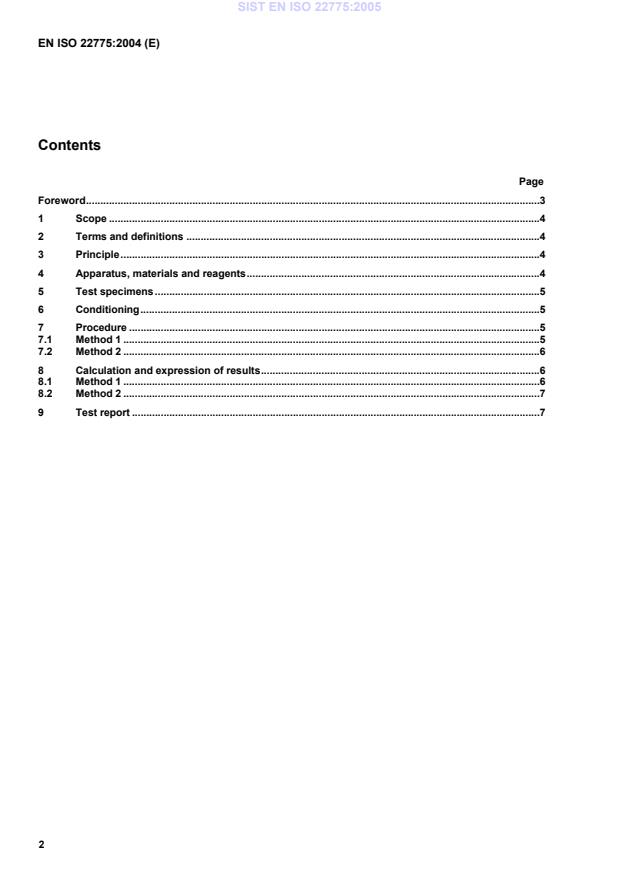
Contents
Page
Foreword.3
1 Scope.4
2 Terms and definitions .4
3 Principle.4
4 Apparatus, materials and reagents.4
5 Test specimens.5
6 Conditioning.5
7 Procedure.5
7.1 Method 1.5
7.2 Method 2.6
8 Calculation and expression of results.6
8.1 Method 1.6
8.2 Method 2.7
9 Test report.7
Foreword
This document (EN ISO 22775:2004) has been prepared by Technical Committee CEN/TC 309 "Footwear",
the secretariat of which is held by AENOR, in collaboration with Technical Committee ISO/TC 216 "Footwear".
This European Standard shall be given the status of a national standard, either by publication of an identical
text or by endorsement, at the latest by June 2005, and conflicting national standards shall be withdrawn at
the latest by June 2005.
According to the CEN/CENELEC Internal Regulations, the national standards organizations of the following
countries are bound to implement this European Standard: Austria, Belgium, Cyprus, Czech Republic,
Denmark, Estonia, Finland, France, Germany, Greece, Hungary, Iceland, Ireland, Italy, Latvia, Lithuania,
Luxembourg, Malta, Netherlands, Norway, Poland, Portugal, Slovakia, Slovenia, Spain, Sweden, Switzerland
and United Kingdom.
1 Scope
This document specifies two methods for determining the propensity of a metal surface to either change
visually due to contamination by atmospheric pollution (Method 1: sulphide tarnishing), or to corrode due to
the action of salt water (Method 2: salt water corrosion).
2 Terms and definitions
For the purposes of this document, the following term and definition applies.
corrosion resistance
propensity of a metal surface either not to change visually due to chemical attack by atmospheric pollution, or
not to be altered due to the action of salt water
3 Principle
3.1 Method 1
A test specimen is stored in a moist atmosphere containing a low concentration of hydrogen sulphide gas for 1
h. The specimen is then assessed subjectively for signs of discoloration.
3.2 Method 2
Cotton lawn, saturated with sodium chloride solution, is wrapped around a test specimen. This assembly is
then stored in a sealed bag for 24 h at room temperature. The test specimen is then subjectively assessed for
signs of corrosion and the lawn assessed for staining.
4 Apparatus, materials and reagents
4.1 Method 1
4.1.1 Kipps generator or other hydrogen sulphide source.
WARNING — This equipment should be used only by qualified personnel owing to the extremely
toxicity of hydrogen su
...