


SIST EN 3475-408:2026
(Main)Aerospace series - Cables, electrical, aircraft use - Test methods - Part 408: Fire resistance
Aerospace series - Cables, electrical, aircraft use - Test methods - Part 408: Fire resistance
This document specifies a method of testing the fire resistance of "fire-proof" electrical cables.
Luft- und Raumfahrt - Elektrische Leitungen für Luftfahrtverwendung - Prüfverfahren - Teil 408: Feuerbeständigkeit
No Scope available
Série aérospatiale - Câbles électriques à usage aéronautique - Méthodes d’essais - Partie 408: Résistance au feu
Le présent document spécifie une méthode pour soumettre à essai la résistance au feu des câbles électriques ignifuges.
Aeronavtika - Električni kabli za uporabo v zračnih plovilih - Preskusne metode - 408. del: Požarna odpornost
Ta dokument določa metodo za preskušanje požarne odpornosti »negorljivih« električnih kablov.
General Information
- Status
- Published
- Public Enquiry End Date
- 04-Jul-2023
- Publication Date
- 07-Jan-2026
- Technical Committee
- I13 - Imaginarni 13
- Current Stage
- 6060 - National Implementation/Publication (Adopted Project)
- Start Date
- 05-Jan-2026
- Due Date
- 12-Mar-2026
- Completion Date
- 08-Jan-2026

Relations
- Effective Date
- 28-Jan-2026
- Effective Date
- 28-Jan-2026
- Refers
SIST EN 2234:2018 - Aerospace series - Cable, electrical, fire resistant - Technical specification - Effective Date
- 28-Jan-2026
- Effective Date
- 28-Jan-2026
- Effective Date
- 28-Jan-2026
- Effective Date
- 28-Jan-2026
- Effective Date
- 28-Jan-2026
- Effective Date
- 28-Jan-2026
- Effective Date
- 28-Jan-2026
- Effective Date
- 28-Jan-2026
- Effective Date
- 28-Jan-2026
- Effective Date
- 28-Jan-2026
- Effective Date
- 28-Jan-2026
- Effective Date
- 28-Jan-2026
- Effective Date
- 28-Jan-2026
Overview
SIST EN 3475-408:2026 is a European standard published by the Slovenski inštitut za standardizacijo (SIST), dedicated to the fire resistance testing of electrical cables for aircraft use within the aerospace sector. Under the broader EN 3475 series, this Part 408 specifically describes precise test methods for assessing the performance of "fire-proof" and "fire-resistant" electrical cables when exposed to flame and mechanical vibration. Compliance with this standard is essential for manufacturers and suppliers of aerospace electrical systems to ensure passenger, crew, and aircraft safety during fire incidents.
Key Topics
- Purpose: Establishes test methods for evaluating the fire resistance of electrical cables intended for use in aircraft, simulating flame exposure under operational vibration conditions.
- Scope: Focuses on single-core, multi-core, and screened cables that claim fire resistance, subjecting them to standardized flame and vibration conditions for defined durations.
- Testing Apparatus:
- Requires specific burner types (kerosene or gas) calibrated for high-temperature and heat flux.
- Utilizes vibration test fixtures and measurement equipment for electrical continuity and insulation resistance.
- Test Fluids: Cables are conditioned in relevant fluids such as kerosene, hydraulic liquids, synthetic oils, cleaning agents, and de-icing fluids before testing.
- Performance Measures:
- Cables must maintain electrical continuity and insulation resistance during and after exposure.
- Leakage current must not exceed set thresholds, and insulation resistance must remain within defined limits.
- Absence of material re-ignition post-flame is mandatory.
- Test Duration:
- 5 minutes for fire resistant cables.
- 15 minutes for fire-proof cables.
- Continuous Monitoring: Ongoing measurement of insulation resistance and conductor continuity ensures reliable results.
Applications
- Aircraft Cable Selection and Qualification: Enables aerospace designers and manufacturers to validate and select appropriate cable types based on proven fire resistance performance for passenger and cargo aircraft.
- Aerospace System Compliance: Assists in meeting regulatory and safety requirements regarding electrical system fire safety in the aviation industry.
- Component Certification: Supports cable producers in obtaining international certification for their products, facilitating cross-border acceptance within the European Union and associated markets.
- Aircraft Maintenance and Upgrades: Used as a reference for MRO (Maintenance, Repair, and Overhaul) operations when selecting or replacing cable assemblies within critical fire zones.
- Safety Assurance: Underpins continued airworthiness by ensuring that cables maintain function during fire incidents, supporting overall aircraft safety.
Related Standards
- EN 2234: Technical specification for fire resistant cables in aerospace.
- EN 3909: Test fluids and test methods for electrical and optical components in aerospace environments.
- EN 4608-001: Technical specification for single and multicore fire-resistant cable assemblies in aerospace with defined operating temperatures.
- ISO 2685: Required test method for aircraft equipment resistance to fire in designated zones used as the foundational fire test procedure referenced by this standard.
Compliance with SIST EN 3475-408:2026, alongside these related standards, ensures robust fire safety for aircraft electrical systems, supporting the aerospace industry's commitment to passenger and crew safety through rigorous product testing and validation.
Get Certified
Connect with accredited certification bodies for this standard

BUREAU VERITAS Certification Germany
Bureau Veritas certification in Germany.

Element Materials Technology
Materials testing and product certification.

IMQ S.p.A. (Certification)
Italian electrical product certification.
Sponsored listings
Frequently Asked Questions
SIST EN 3475-408:2026 is a standard published by the Slovenian Institute for Standardization (SIST). Its full title is "Aerospace series - Cables, electrical, aircraft use - Test methods - Part 408: Fire resistance". This standard covers: This document specifies a method of testing the fire resistance of "fire-proof" electrical cables.
This document specifies a method of testing the fire resistance of "fire-proof" electrical cables.
SIST EN 3475-408:2026 is classified under the following ICS (International Classification for Standards) categories: 29.060.20 - Cables; 49.060 - Aerospace electric equipment and systems. The ICS classification helps identify the subject area and facilitates finding related standards.
SIST EN 3475-408:2026 has the following relationships with other standards: It is inter standard links to SIST EN 3909:2016, SIST EN 4608-001:2019, SIST EN 2234:2018, SIST EN 378-1:2000/A1:2004, SIST EN 4604-005:2015, SIST EN 2713-012:2022, SIST EN 4612-012:2011, SIST EN 2267-009:2017, SIST EN 4611-006:2012, SIST EN 4612-010:2011, SIST EN 4611-006:2018, SIST EN 4681-006:2019, SIST EN 2714-006:2009, SIST EN 2713-007:2006, SIST EN 4612-006:2012. Understanding these relationships helps ensure you are using the most current and applicable version of the standard.
SIST EN 3475-408:2026 is available in PDF format for immediate download after purchase. The document can be added to your cart and obtained through the secure checkout process. Digital delivery ensures instant access to the complete standard document.
Standards Content (Sample)
SLOVENSKI STANDARD
01-februar-2026
Aeronavtika - Električni kabli za uporabo v zračnih plovilih - Preskusne metode -
408. del: Požarna odpornost
Aerospace series - Cables, electrical, aircraft use - Test methods - Part 408: Fire
resistance
Luft- und Raumfahrt - Elektrische Leitungen für Luftfahrtverwendung - Prüfverfahren -
Teil 408: Feuerbeständigkeit
Série aérospatiale - Câbles électriques à usage aéronautique - Méthodes d’essais -
Partie 408: Résistance au feu
Ta slovenski standard je istoveten z: EN 3475-408:2025
ICS:
29.060.20 Kabli Cables
49.060 Letalska in vesoljska Aerospace electric
električna oprema in sistemi equipment and systems
2003-01.Slovenski inštitut za standardizacijo. Razmnoževanje celote ali delov tega standarda ni dovoljeno.
EN 3475-408
EUROPEAN STANDARD
NORME EUROPÉENNE
December 2025
EUROPÄISCHE NORM
ICS 49.060 Supersedes EN 3475-408:2005
English Version
Aerospace series - Cables, electrical, aircraft use - Test
methods - Part 408: Fire resistance
Série aérospatiale - Câbles électriques à usage Luft- und Raumfahrt - Elektrische Leitungen für
aéronautique - Méthodes d'essais - Partie 408 : Luftfahrtverwendung - Prüfverfahren - Teil 408:
Résistance au feu Feuerbeständigkeit
This European Standard was approved by CEN on 26 October 2025.
CEN members are bound to comply with the CEN/CENELEC Internal Regulations which stipulate the conditions for giving this
European Standard the status of a national standard without any alteration. Up-to-date lists and bibliographical references
concerning such national standards may be obtained on application to the CEN-CENELEC Management Centre or to any CEN
member.
This European Standard exists in three official versions (English, French, German). A version in any other language made by
translation under the responsibility of a CEN member into its own language and notified to the CEN-CENELEC Management
Centre has the same status as the official versions.
CEN members are the national standards bodies of Austria, Belgium, Bulgaria, Croatia, Cyprus, Czech Republic, Denmark, Estonia,
Finland, France, Germany, Greece, Hungary, Iceland, Ireland, Italy, Latvia, Lithuania, Luxembourg, Malta, Netherlands, Norway,
Poland, Portugal, Republic of North Macedonia, Romania, Serbia, Slovakia, Slovenia, Spain, Sweden, Switzerland, Türkiye and
United Kingdom.
EUROPEAN COMMITTEE FOR STANDARDIZATION
COMITÉ EUROPÉEN DE NORMALISATION
EUROPÄISCHES KOMITEE FÜR NORMUNG
CEN-CENELEC Management Centre: Rue de la Science 23, B-1040 Brussels
© 2025 CEN All rights of exploitation in any form and by any means reserved Ref. No. EN 3475-408:2025 E
worldwide for CEN national Members.
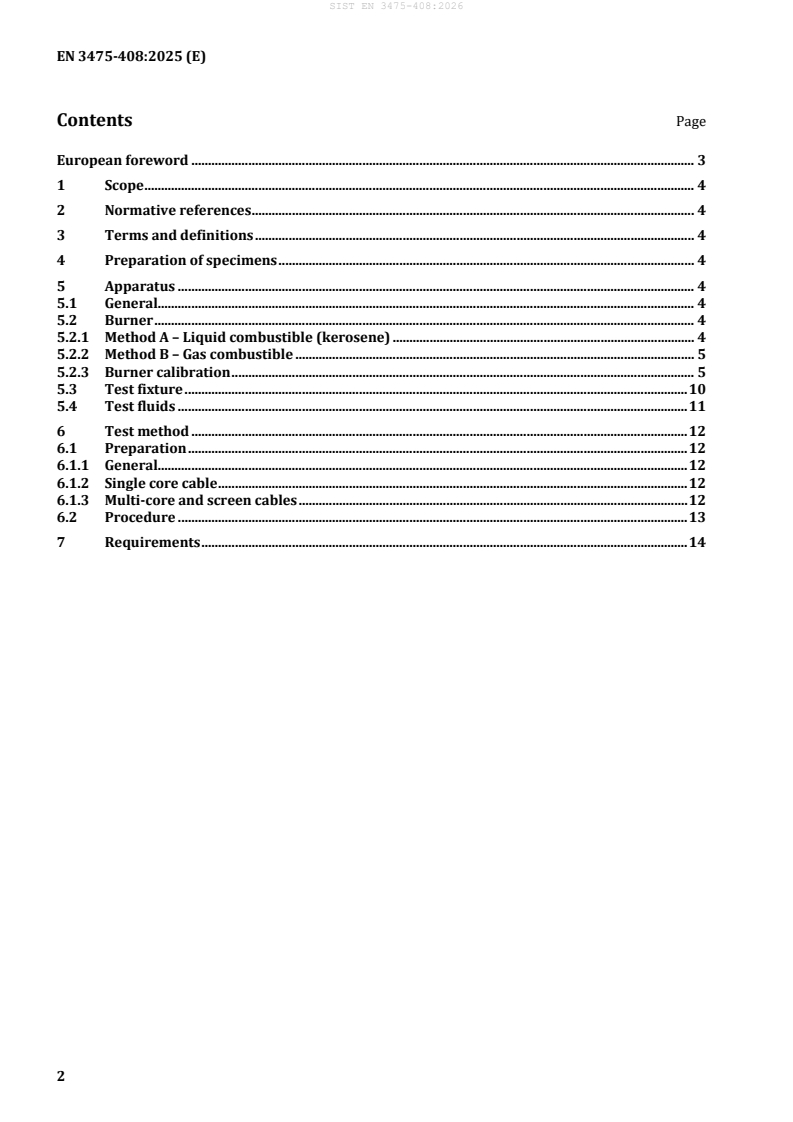
Contents Page
European foreword . 3
1 Scope . 4
2 Normative references . 4
3 Terms and definitions . 4
4 Preparation of specimens . 4
5 Apparatus . 4
5.1 General. 4
5.2 Burner . 4
5.2.1 Method A – Liquid combustible (kerosene) . 4
5.2.2 Method B – Gas combustible . 5
5.2.3 Burner calibration . 5
5.3 Test fixture . 10
5.4 Test fluids . 11
6 Test method . 12
6.1 Preparation . 12
6.1.1 General. 12
6.1.2 Single core cable . 12
6.1.3 Multi-core and screen cables . 12
6.2 Procedure . 13
7 Requirements . 14
European foreword
This document (EN 3475-408:2025) has been prepared by ASD-STAN.
After enquiries and votes carried out in accordance with the rules of this Association, this document has
received the approval of the National Associations and the Official Services of the member countries of
ASD-STAN, prior to its presentation to CEN.
This document shall be given the status of a national standard, either by publication of an identical text
or by endorsement, at the latest by June 2026, and conflicting national standards shall be withdrawn at
the latest by June 2026.
Attention is drawn to the possibility that some of the elements of this document may be the subject of
patent rights. CEN shall not be held responsible for identifying any or all such patent rights.
This document supersedes EN 3475-408:2005.
EN 3475-408:2005:
— editorial improvements, update of Clause 2 and introduction of liquid burner requirements with test
setup configuration.
According to the CEN-CENELEC Internal Regulations, the national standards organizations of the
following countries are bound to implement this document: Austria, Belgium, Bulgaria, Croatia, Cyprus,
Czech Republic, Denmark, Estonia, Finland, France, Germany, Greece, Hungary, Iceland, Ireland, Italy,
Latvia, Lithuania, Luxembourg, Malta, Netherlands, Norway, Poland, Portugal, Republic of North
Macedonia, Romania, Serbia, Slovakia, Slovenia, Spain, Sweden, Switzerland, Türkiye and the
United Kingdom.
1 Scope
This document specifies a method of testing the fire resistance of “fire-proof” electrical cables.
2 Normative references
The following documents are referred to in the text in such a way that some or all of their content
constitutes requirements of this document. For dated references, only the edition cited applies. For
undated references, the latest edition of the referenced document (including any amendments) applies.
EN 2234, Aerospace series — Cable, electrical, fire resistant — Technical specification
EN 3909, Aerospace series — Test fluids and test methods for electrical and optical components and sub-
assemblies
EN 4608-001, Aerospace series — Cable, electrical, fire resistant — Single and twisted multicore assembly,
screened (braided) and jacketed — Operating temperatures between −65 °C and 260 °C — Part 001:
Technical specification
ISO 2685:1998, Aircraft — Environmental test procedure for airborne equipment — Resistance to fire in
designated fire zones
3 Terms and definitions
No terms and definitions are listed in this document.
ISO and IEC maintain terminology databases for use in standardization at the following addresses:
— ISO Online browsing platform: available at https://www.iso.org/obp/
— IEC Electropedia: available at https://www.electropedia.org/
4 Preparation of specimens
Six test specimens, 0,75 m minimum length, shall be selected at random from a quantity of cable.
5 Apparatus
5.1 General
The following shall be required for this test: a burner, a burner calibration, a test fixture, and test fluids.
5.2 Burner
5.2.1 Method A – Liquid combustible (kerosene)
The burner shall be as specified in ISO 2685:1998, Clause A.2, or any other burner or assembly of burners
satisfying the following conditions:
— liquid combustible type of kerosene shall be in accordance with EN 3909;
— the burner outlet shall be equipped with an extension of 318 mm, 152 mm high and 280 mm width;
— cable length exposed to the flame: 280 mm;
— flame characteristics according to ISO 2685:1998:
— temperature: 1 100 °C ± 80 °C;
— heat flux density received by the calorimeter specified in ISO 2685:1998, Annex B:
2 2
116 kW/m ± 10 kW/m .
5.2.2 Method B – Gas combustible
The burner shall be as specified in ISO 2685:1998, Clause A.1, or any other burner or assembly of burners
satisfying the following conditions:
— cable length exposed to the flame: 152 mm;
— diameter or width of the flame at the base of the burner(s) ≥ 2 D (D: diameter of the cable under test);
— flame characteristics according to ISO 2685:1998:
— temperature: 1 100 °C ± 80 °C;
— heat flux density received by the calorimeter specified in ISO 2685:1998, Annex B:
2 2
116 kW/m ± 10 kW/m .
5.2.3 Burner calibration
5.2.3.1 Temperature
5.2.3.1.1 Temperature measurement
The calibration in temperature of the burner consists of adjusting the mixing ratio of air and combustible,
until the flame is delivering a standard flame. A flame is characterized by its temperature and its heat
flux. As the quantitative value is directly dependent on the instrumentation, it is necessary to respect a
common tool to ensure uniformity between tests.
Before calibrating the burner, allow the apparatus to run for at least 5 min for stabilizing the
heating conditions.
During and after calibration, the burner shall not be extinguished until the end of the fire test.
The surface calibrated is only valid as long as the burner settings was not changed or turned off.
The temperature of each thermocouple shall be recorded at least every 5 s intervals during
minimum 3 min.
5.2.3.1.2 Temperature measuring equipment
It is important that the temperature measuring equipment (including the thermocouple and the
acquisition tools) ensures an accuracy and compatible reactivity with the values sought.
The temperature-measuring tool is composed of thermal
...