


SIST-TP IEC TR 60269-5:2022
(Main)Low-voltage fuses - Part 5: Guidance for the application of low-voltage fuses
Low-voltage fuses - Part 5: Guidance for the application of low-voltage fuses
IEC/TR 60269-5:2014 serves as an application guide for low-voltage fuses, shows how current-limiting fuses are easy to apply to protect today's complex and sensitive electrical and electronic equipment. This guidance specifically covers low-voltage fuses up to 1 000 V a.c. and 1 500 V d.c. designed and manufactured in accordance with IEC 60269 series. This guidance provides important facts about as well as information on the application of fuses. This second edition cancels and replaces the first edition published in 2010. This edition constitutes a technical revision. This edition includes the following significant technical changes with respect to the previous edition:
- recommendations for fuse operations in high altitudes added,
- more details for operational voltages added,
- recommendations for photovoltaic system protection added,
- numerous details improved Keywords: application guide for low-voltage fuses, current-limiting fuses
Fusibles basse tension - Partie 5: Lignes directrices pour l'application des fusibles basse tension
L'IEC/TR 60269-5:2014 est un guide d'application des fusibles basse tension, montre que les fusibles limiteurs de courant sont faciles à utiliser pour protéger le matériel électronique complexe et sensible d'aujourd'hui. Ces lignes directrices couvrent spécifiquement les fusibles basse tension de tensions jusqu'à 1 000 V en courant alternatif et 1 500 V en courant continu selon la série IEC 60269. Elles fournissent des informations sur les fusibles ainsi que sur leurs applications. Cette deuxième édition annule et remplace la première édition parue en 2010. Cette édition constitue une révision technique. Cette édition comporte les modifications techniques suivantes en rapport avec l'édition précédente:
- les recommandations et préconisations pour le fonctionnement des fusibles à des altitudes supérieures;
- l'ajout d'informations concernant les différentes tensions de fonctionnement des fusibles;
- l'ajout de recommandations pour la protection des systèmes photovoltaïques;
- l'amélioration de nombreux détails. Mots clés: guide d'application des fusibles basse tension, les fusibles limiteurs de courant
Nizkonapetostne varovalke - 5. del: Navodila za uporabo nizkonapetostnih varovalk
IEC/TR 60269-5:2014 se uporablja kot navodilo za uporabo nizkonapetostnih varovalk in prikazuje, kako je varovalke, ki omejujejo tok, enostavno uporabiti za zaščito današnje kompleksne in občutljive električne ter elektronske opreme. Ta navodila posebej obravnavajo nizkonapetostne varovalke do 1000 V izmenične napetosti in 1500 V enosmerne napetosti, ki so zasnovane in izdelane v skladu s skupino standardov IEC 60269. V teh navodilih so podana pomembna dejstva in informacije o uporabi varovalk. Druga izdaja razveljavlja in nadomešča prvo izdajo, objavljeno leta 2010. Ta izdaja je tehnično popravljena izdaja. Ta izdaja v primerjavi s prejšnjo vključuje naslednje pomembne tehnične spremembe:
– priporočila za delovanje varovalk na visokih nadmorskih višinah,
– več podrobnosti za delovne napetosti,
– priporočila za zaščito fotonapetostnega sistema,
– številne podrobnosti izboljšanih ključnih besed: navodila za uporabo nizkonapetostnih varovalk, varovalke za omejevanje toka
General Information
- Status
- Published In Translation
- Publication Date
- 20-Apr-2022
- Technical Committee
- EVA - Fuses
- Current Stage
- 6100 - Translation of adopted SIST standards (Adopted Project)
- Start Date
- 23-Nov-2022
- Due Date
- 22-Nov-2023
Relations
- Effective Date
- 05-Sep-2023
- Effective Date
- 05-Sep-2023
Overview
IEC TR 60269-5:2014 - Low-voltage fuses, Part 5 - is an application guide for low-voltage fuses. It provides practical guidance on applying low-voltage fuses (designed per the IEC 60269 series) for circuits up to 1 000 V a.c. and 1 500 V d.c. The technical report emphasizes the benefits and correct application of current-limiting fuses, updating the 2010 edition with technical revisions (including high-altitude recommendations, expanded operational voltage guidance, and added photovoltaic system protection).
Key topics and technical requirements
- Fuse construction and operation: components, fuse-links, contacts, indicating devices and bases; how fuses operate under overload and short-circuit conditions.
- Current-limiting behaviour: principles of current limitation and its role in reducing prospective fault energy.
- Utilization categories: guidance for gG, gN, gPV, gBat, gK and other categories for specific applications.
- Selectivity and coordination: methods to verify selectivity between fuses and between fuses and circuit-breakers (procedures for operating times ≥ 0.1 s and < 0.1 s).
- Short-circuit and conditional breaking capacity: rated conditional short-circuit currents and current limitation criteria.
- Protection of equipment: transformer, motor, semiconductor (including inverter) protection - selection criteria, I²t considerations and coordination with starters/contactors.
- Application environments: guidance for DC circuits, fuse installation in enclosures, temperature limits, and operation at high altitudes.
- Photovoltaic and battery systems: dedicated recommendations for PV string and array fuses (gPV), breaking capacity, rated voltage/current and fuse monitoring; selection guidance for battery systems.
- Practical verification: examples, figures and annexes (e.g., coordination with motor-starters) to support selection and testing.
Practical applications
- Fuse selection and sizing for industrial distribution, motor circuits, power electronics and renewable energy systems.
- Designing and verifying protection schemes to ensure selectivity, limit fault energy and protect sensitive electronics.
- Specifying fuses for PV arrays and battery energy storage with required breaking capacity and DC performance.
- Advising on installation constraints (enclosures, altitude, temperature) to maintain safe operation.
Who should use this standard
- Electrical designers and system engineers
- Switchgear and fuse manufacturers
- Protection engineers and consultants
- PV and battery system designers and installers
- Test laboratories and compliance officers
- Maintenance and asset management teams
Related standards
- IEC 60269 series (general requirements and fuse-link types), including IEC 60269-2 referenced for fuse-link details.
Keywords: IEC TR 60269-5:2014, low-voltage fuses, application guide for low-voltage fuses, current-limiting fuses, fuse selection, photovoltaic system protection, battery systems protection.




IEC TR 60269-5:2014+AMD1:2020 CSV - Low-voltage fuses - Part 5: Guidance for the application of low-voltage fuses Released:12/17/2020


IEC TR 60269-5:2014 - Low-voltage fuses - Part 5: Guidance for the application of low-voltage fuses
Frequently Asked Questions
SIST-TP IEC TR 60269-5:2022 is a technical report published by the Slovenian Institute for Standardization (SIST). Its full title is "Low-voltage fuses - Part 5: Guidance for the application of low-voltage fuses". This standard covers: IEC/TR 60269-5:2014 serves as an application guide for low-voltage fuses, shows how current-limiting fuses are easy to apply to protect today's complex and sensitive electrical and electronic equipment. This guidance specifically covers low-voltage fuses up to 1 000 V a.c. and 1 500 V d.c. designed and manufactured in accordance with IEC 60269 series. This guidance provides important facts about as well as information on the application of fuses. This second edition cancels and replaces the first edition published in 2010. This edition constitutes a technical revision. This edition includes the following significant technical changes with respect to the previous edition: - recommendations for fuse operations in high altitudes added, - more details for operational voltages added, - recommendations for photovoltaic system protection added, - numerous details improved Keywords: application guide for low-voltage fuses, current-limiting fuses
IEC/TR 60269-5:2014 serves as an application guide for low-voltage fuses, shows how current-limiting fuses are easy to apply to protect today's complex and sensitive electrical and electronic equipment. This guidance specifically covers low-voltage fuses up to 1 000 V a.c. and 1 500 V d.c. designed and manufactured in accordance with IEC 60269 series. This guidance provides important facts about as well as information on the application of fuses. This second edition cancels and replaces the first edition published in 2010. This edition constitutes a technical revision. This edition includes the following significant technical changes with respect to the previous edition: - recommendations for fuse operations in high altitudes added, - more details for operational voltages added, - recommendations for photovoltaic system protection added, - numerous details improved Keywords: application guide for low-voltage fuses, current-limiting fuses
SIST-TP IEC TR 60269-5:2022 is classified under the following ICS (International Classification for Standards) categories: 01 - GENERALITIES. TERMINOLOGY. STANDARDIZATION. DOCUMENTATION; 29.120.50 - Fuses and other overcurrent protection devices. The ICS classification helps identify the subject area and facilitates finding related standards.
SIST-TP IEC TR 60269-5:2022 has the following relationships with other standards: It is inter standard links to SIST-TP IEC TR 60269-5:2022/AMD1:2023, SIST-TP IEC 60269-5 TRTR Ed. 1.0:2022. Understanding these relationships helps ensure you are using the most current and applicable version of the standard.
SIST-TP IEC TR 60269-5:2022 is available in PDF format for immediate download after purchase. The document can be added to your cart and obtained through the secure checkout process. Digital delivery ensures instant access to the complete standard document.
Standards Content (Sample)
SLOVENSKI STANDARD
01-junij-2022
Nizkonapetostne varovalke - 5. del: Navodila za uporabo nizkonapetostnih
varovalk
Low-voltage fuses - Part 5: Guidance for the application of low-voltage fuses
Fusibles basse tension - Partie 5: Lignes directrices pour l'application des fusibles basse
tension
Ta slovenski standard je istoveten z: IEC TR 60269-5:2014
ICS:
29.120.50 Varovalke in druga Fuses and other overcurrent
nadtokovna zaščita protection devices
2003-01.Slovenski inštitut za standardizacijo. Razmnoževanje celote ali delov tega standarda ni dovoljeno.
IEC TR 60269-5 ®
Edition 2.0 2014-03
TECHNICAL
REPORT
RAPPORT
TECHNIQUE
colour
inside
Low-voltage fuses –
Part 5: Guidance for the application of low-voltage fuses
Fusibles basse tension –
Partie 5: Lignes directrices pour l’application des fusibles basse tension
INTERNATIONAL
ELECTROTECHNICAL
COMMISSION
COMMISSION
ELECTROTECHNIQUE
PRICE CODE
INTERNATIONALE
CODE PRIX XA
ICS 29.120.50 ISBN 978-2-8322-1448-0
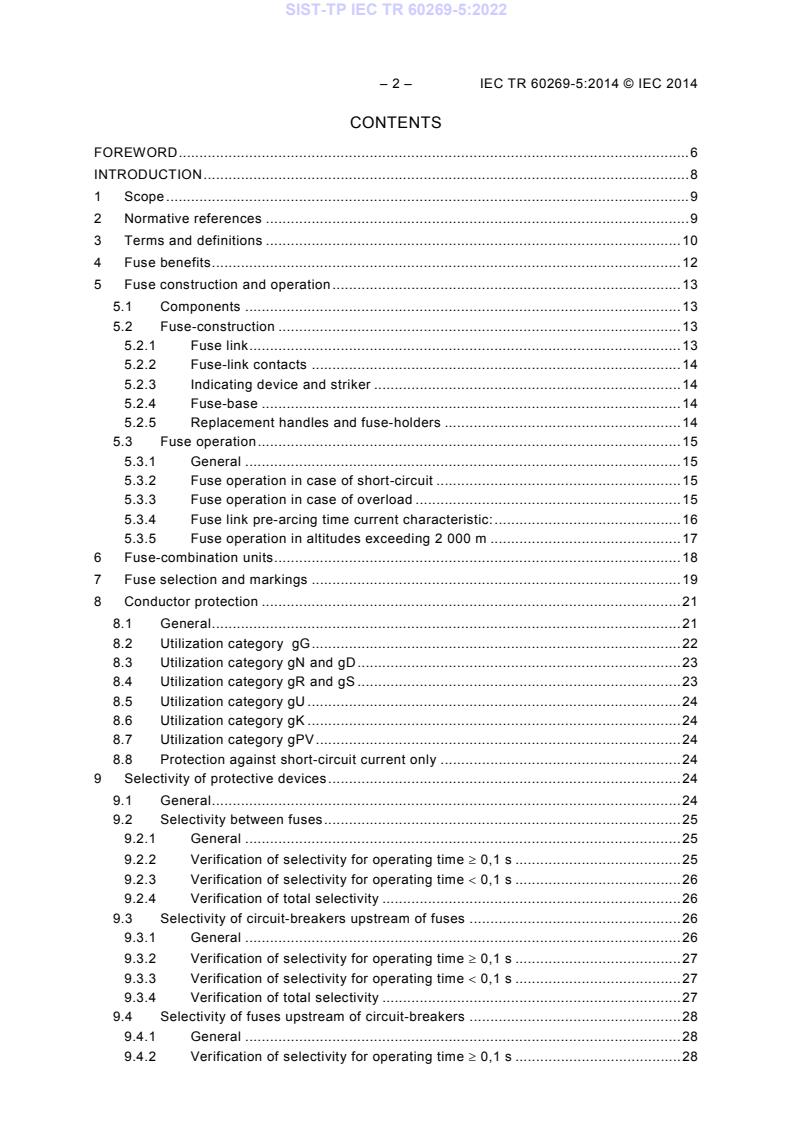
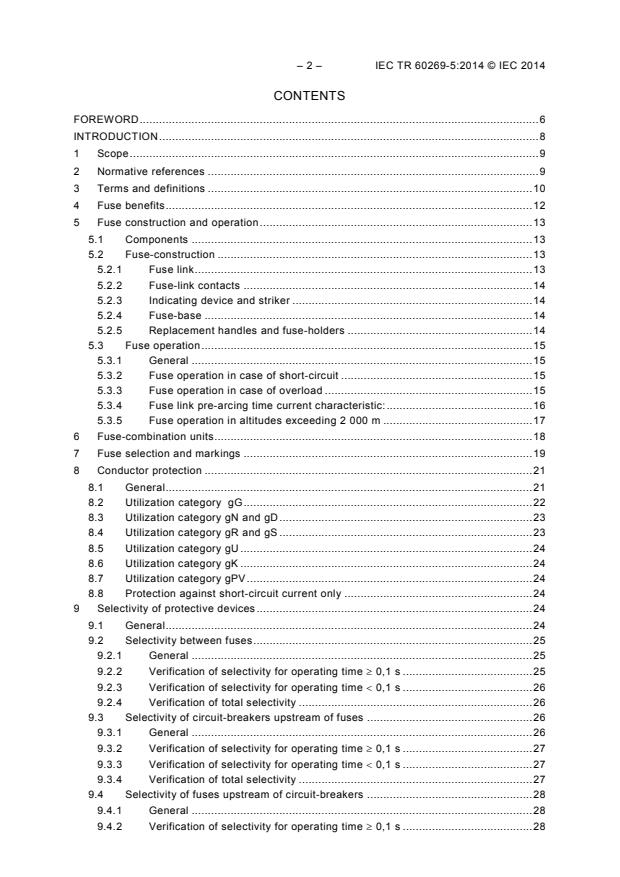
– 2 – IEC TR 60269-5:2014 © IEC 2014
CONTENTS
FOREWORD . 6
INTRODUCTION . 8
1 Scope . 9
2 Normative references . 9
3 Terms and definitions . 10
4 Fuse benefits . 12
5 Fuse construction and operation . 13
5.1 Components . 13
5.2 Fuse-construction . 13
5.2.1 Fuse link . 13
5.2.2 Fuse-link contacts . 14
5.2.3 Indicating device and striker . 14
5.2.4 Fuse-base . 14
5.2.5 Replacement handles and fuse-holders . 14
5.3 Fuse operation . 15
5.3.1 General . 15
5.3.2 Fuse operation in case of short-circuit . 15
5.3.3 Fuse operation in case of overload . 15
5.3.4 Fuse link pre-arcing time current characteristic: . 16
5.3.5 Fuse operation in altitudes exceeding 2 000 m . 17
6 Fuse-combination units . 18
7 Fuse selection and markings . 19
8 Conductor protection . 21
8.1 General . 21
8.2 Utilization category gG . 22
8.3 Utilization category gN and gD . 23
8.4 Utilization category gR and gS . 23
8.5 Utilization category gU . 24
8.6 Utilization category gK . 24
8.7 Utilization category gPV . 24
8.8 Protection against short-circuit current only . 24
9 Selectivity of protective devices . 24
9.1 General . 24
9.2 Selectivity between fuses . 25
9.2.1 General . 25
9.2.2 Verification of selectivity for operating time ≥ 0,1 s . 25
9.2.3 Verification of selectivity for operating time < 0,1 s . 26
9.2.4 Verification of total selectivity . 26
9.3 Selectivity of circuit-breakers upstream of fuses . 26
9.3.1 General . 26
9.3.2 Verification of selectivity for operating time ≥ 0,1 s . 27
9.3.3 Verification of selectivity for operating time < 0,1 s . 27
9.3.4 Verification of total selectivity . 27
9.4 Selectivity of fuses upstream of circuit-breakers . 28
9.4.1 General . 28
9.4.2 Verification of selectivity for operating time ≥ 0,1 s . 28
9.4.3 Verification of selectivity for operating time < 0,1 s . 28
9.4.4 Verification of total selectivity . 28
10 Short-circuit damage protection . 30
10.1 General . 30
10.2 Short-circuit current paths . 30
10.3 Current limitation . 31
10.4 Rated conditional short-circuit current, rated breaking capacity . 31
11 Protection of power factor correction capacitors . 31
12 Transformer protection . 32
12.1 Distribution transformers with a high-voltage primary . 32
12.2 Distribution transformers with a low-voltage primary . 33
12.3 Control circuit transformers . 33
13 Motor circuit protection . 33
13.1 General . 33
13.2 Fuse and motor-starter coordination . 34
13.3 Criteria for coordination at the rated conditional short-circuit current I . 34
q
13.4 Criteria for coordination at the crossover current I . 35
co
13.5 Criteria for coordination at test current “r” . 35
14 Circuit-breaker protection in a.c. and d.c rated voltage circuits . 36
15 Protection of semiconductor devices in a.c. and d.c. rated voltage circuits . 36
16 Fuses in enclosures . 38
16.1 General . 38
16.2 Limiting temperature of utilization category gG fuse-links according to
IEC 60269-2 – System A . 38
16.3 Other fuse-links . 38
17 DC applications . 38
17.1 General . 38
17.2 Short-circuit protection . 38
17.3 Overload protection . 39
17.4 Time-current characteristics . 40
18 Automatic disconnection for protection against electric shock for installations in
buildings . 40
18.1 General . 40
18.2 Principle of the protection . 41
18.3 Examples . 42
19 Photovoltaic (PV) system protection . 43
19.1 General . 43
19.2 Selection of PV fuse-links . 44
19.2.1 Fuse utilization category . 44
19.2.2 PV string fuses . 44
19.2.3 Fuse replacement . 44
19.2.4 Unearthed or Ungrounded PV Systems . 44
19.2.5 Functional earthing fuses . 44
19.2.6 PV array and PV sub-array fuses . 45
19.2.7 Fuse monitoring . 45
19.2.8 Breaking capacity . 45
19.2.9 Voltage of gPV fuses . 45
19.2.10 Rated current of gPV fuses . 45
– 4 – IEC TR 60269-5:2014 © IEC 2014
20 Protection of wind mills . 45
Annex A (informative) Coordination between fuses and contactors/motor-starters . 47
A.1 General . 47
A.2 Examples of suitable fuse-links used for motor protection . 47
A.3 Values of I t and cut-off current observed in successful tests of fuse-
link/motor-starter combinations worldwide . 48
A.4 Criteria for coordination at the rated conditional short-circuit current I . 51
q
A.4.1 General . 51
A.4.2 Maximum operating I t and cut-off current . 51
A.4.3 Guidance for choosing the maximum rated current of an alternative fuse
type . 52
A.4.4 Further guidance . 52
A.5 Criteria for coordination at test current "r" . 53
A.6 Types of coordination . 54
Bibliography . 57
Figure 1 – Typical fuse-link according to IEC 60269-2. 13
Figure 2 – Typical fuse-link according to IEC 60269-2. 14
Figure 3 – Current-limiting fuse operation . 15
Figure 4 – Fuse operation on overload . 16
Figure 5 – Time current characteristic for fuse-links . 17
Figure 6 – Currents for fuse-link selection . 23
Figure 7 – Selectivity – General network diagram . 25
Figure 8 – Verification of selectivity between fuses F and F for operating time t ≥
2 4
0,1 s . 26
Figure 9 – Verification of selectivity between circuit-breaker C and fuses F and F . 27
2 5 6
Figure 10 – Verification of selectivity between fuse F and circuit-breaker C for
2 3
operating time t ≥ 0,1 s . 29
Figure 11 – Verification of selectivity between fuse F and circuit-breaker C for
2 3
operating time t < 0,1 s . 30
Figure 12 – Fuse and motor-starter coordination . 35
Figure 13 – DC circuit . 39
Figure 14 – DC breaking operation . 39
Figure 15 – Fuse operating time at various d.c. circuit time constants . 40
Figure 16 – Time-current characteristic . 42
Figure A.1 – Collation of cut-off currents observed in successful coordination at I . 49
q
Figure A.2 – Pre-arcing and operating I t values of fuses used in successful
coordination tests as a function of contactor rated current AC3 . 50
Figure A.3 – Pre-arcing and operating I t values of fuses used in successful
coordination tests as a function of fuse rated current I . 51
n
Figure A.4 – Illustration of the method of selection of the maximum rated current of a
fuse for back-up protection of a contactor of rating I = X amperes . 54
e
Figure A.5 – Withstand capabilities of a range of contactors and associated overload
relays at test current "r" . 55
Figure A.6 – Illustration of a method of deriving curves of maximum peak current at
test current "r" as a function of fuse rated current . 56
Table 1 – Derating factors for different altitudes . 18
Table 2 – Definitions and symbols of switches and fuse-combination units . 19
Table 3 – Fuse application . 20
Table 4 – Maximum operational voltage of a.c. fuse-links . 21
Table 5 – Typical operational voltage ratings of d.c. fuse-links . 21
Table 6 – Fuse selection for power factor correction capacitors (fuses according to
IEC 60269-2, system A) . 32
Table 7 – Conventional non fusing current . 37
Table 8 – Time constants of typical d.c. circuits . 40
Table A.1 – Examples of typical fuse-link ratings used for motor-starter protection
illustrating how the category of fuse-link can influence the optimum current rating . 48
Table A.2 (Table 12 of IEC 60947-4-1:2009) – Value of the prospective test current
according to the rated operational current . 53
Table A.3 – Types of coordination . 54
– 6 – IEC TR 60269-5:2014 © IEC 2014
INTERNATIONAL ELECTROTECHNICAL COMMISSION
____________
LOW-VOLTAGE FUSES –
Part 5: Guidance for the application of low-voltage fuses
FOREWORD
1) The International Electrotechnical Commission (IEC) is a worldwide organization for standardization comprising
all national electrotechnical committees (IEC National Committees). The object of IEC is to promote
international co-operation on all questions concerning standardization in the electrical and electronic fields. To
this end and in addition to other activities, IEC publishes International Standards, Technical Specifications,
Technical Reports, Publicly Available Specifications (PAS) and Guides (hereafter referred to as “IEC
Publication(s)”). Their preparation is entrusted to technical committees; any IEC National Committee interested
in the subject dealt with may participate in this preparatory work. International, governmental and non-
governmental organizations liaising with the IEC also participate in this preparation. IEC collaborates closely
with the International Organization for Standardization (ISO) in accordance with conditions determined by
agreement between the two organizations.
2) The formal decisions or agreements of IEC on technical matters express, as nearly as possible, an international
consensus of opinion on the relevant subjects since each technical committee has representation from all
interested IEC National Committees.
3) IEC Publications have the form of recommendations for international use and are accepted by IEC National
Committees in that sense. While all reasonable efforts are made to ensure that the technical content of IEC
Publications is accurate, IEC cannot be held responsible for the way in which they are used or for any
misinterpretation by any end user.
4) In order to promote international uniformity, IEC National Committees undertake to apply IEC Publications
transparently to the maximum extent possible in their national and regional publications. Any divergence
between any IEC Publication and the corresponding national or regional publication shall be clearly indicated in
the latter.
5) IEC itself does not provide any attestation of conformity. Independent certification bodies provide conformity
assessment services and, in some areas, access to IEC marks of conformity. IEC is not responsible for any
services carried out by independent certification bodies.
6) All users should ensure that they have the latest edition of this publication.
7) No liability shall attach to IEC or its directors, employees, servants or agents including individual experts and
members of its technical committees and IEC National Committees for any personal injury, property damage or
other damage of any nature whatsoever, whether direct or indirect, or for costs (including legal fees) and
expenses arising out of the publication, use of, or reliance upon, this IEC Publication or any other IEC
Publications.
8) Attention is drawn to the Normative references cited in this publication. Use of the referenced publications is
indispensable for the correct application of this publication.
9) Attention is drawn to the possibility that some of the elements of this IEC Publication may be the subject of
patent rights. IEC shall not be held responsible for identifying any or all such patent rights.
The main task of IEC technical committees is to prepare International Standards. However, a
technical committee may propose the publication of a technical report when it has collected
data of a different kind from that which is normally published as an International Standard, for
example "state of the art".
IEC 60269-5, which is a technical report, has been prepared by subcommittee 32B: Low-
voltage fuses, of IEC technical committee 32: Fuses.
This second edition cancels and replaces the first edition published in 2010. This edition
constitutes a technical revision.
This edition includes the following significant technical changes with respect to the previous
edition:
a) recommendations for fuse operations in high altitudes added
b) more details for operational voltages added
c) recommendations for photovoltaic system protection added
d) numerous details improved
The text of this technical report is based on the following documents:
Enquiry draft Report on voting
32B/621A/DTR 32B/624/RVC
Full information on the voting for the approval of this technical report can be found in the
report on voting indicated in the above table.
This publication has been drafted in accordance with the ISO/IEC Directives, Part 2.
A list of all parts of the IEC 60269 series, under the general title: Low-voltage fuses, can be
found on the IEC website.
The committee has decided that the contents of this publication will remain unchanged until
the stability date indicated on the IEC web site under "http://webstore.iec.ch" in the data
related to the specific publication. At this date, the publication will be
• reconfirmed,
• withdrawn,
• replaced by a revised edition, or
• amended.
IMPORTANT – The 'colour inside' logo on the cover page of this publication indicates
that it contains colours which are considered to be useful for the correct
understanding of its contents. Users should therefore print this document using a
colour printer.
– 8 – IEC TR 60269-5:2014 © IEC 2014
INTRODUCTION
Fuses protect many types of equipment and switchgear against the effects of over-current
which can be dramatic:
– thermal damage of conductors or bus-bars;
– vaporisation of metal;
– ionisation of gases;
– arcing, fire, explosion,
– insulation damage.
Apart from being hazardous to personnel, significant economic losses can result from
downtime and the repairs required to restore damaged equipment.
Modern fuses are common overcurrent protective devices in use today, and as such provide
an excellent cost effective solution to eliminate or minimize the effects of overcurrent.
LOW-VOLTAGE FUSES –
Part 5: Guidance for the application of low-voltage fuses
1 Scope
This technical report, which serves as an application guide for low-voltage fuses, shows how
current-limiting fuses are easy to apply to protect today's complex and sensitive electrical and
electronic equipment. This guidance specifically covers low-voltage fuses up to 1 000 V a.c.
and 1 500 V d.c. designed and manufactured in accordance with IEC 60269 series. This
guidance provides important facts about as well as information on the application of fuses.
2 Normative references
The following documents, in whole or in part, are normatively referenced in this document and
are indispensable for its application. For dated references, only the edition cited applies. For
undated references, the latest edition of the referenced document (including any
amendments) applies.
IEC 60050 (all parts), International Electrotechnical Vocabulary. Available from
http://www.electropedia.org/
IEC/TR 60146-6, Semiconductor convertors – Part 6: Application guide for the protection of
semiconductor convertors against overcurrent by fuses
IEC 60269 (all parts), Low-voltage fuses
IEC 60269-1:2006, Low-voltage fuses – Part 1: General requirements
IEC 60269-2, Low-voltage fuses – Part 2: Supplementary requirements for fuses for use by
authorized persons (fuses mainly for industrial application) – Examples of standardized
systems of fuses A to K
IEC 60269-3, Low-voltage fuses – Part 3: Supplementary requirements for fuses for use by
unskilled persons (fuses mainly for household or similar applications) – Examples of
standardized systems of fuses A to F
IEC 60269-4:2009, Low-voltage fuses – Part 4: Supplementary requirements for fuse-links for
the protection of semiconductor devices
IEC 60269-6, Low-voltage fuses – Part 6: Supplementary requirements for fuse-links for the
protection of solar photovoltaic energy systems
IEC 60364-4-41:2005, Low-voltage electrical installations – Part 4-41: Protection for safety –
Protection against electric shock
IEC 60364-4-43:2008, Low-voltage electrical installations – Part 4-43: Protection for safety –
Protection against overcurrent
IEC 60364-5-52, Low-voltage electrical installations – Part 5-52: Selection and erection of
electrical equipment – Wiring systems
– 10 – IEC TR 60269-5:2014 © IEC 2014
IEC 60947 (all parts), Low-voltage switchgear and controlgear
IEC 60947-3:2008, Low-voltage switchgear and controlgear – Part 3: Switches, disconnectors,
switch-disconnectors and fuse-combination units
IEC 60947-4-1:2009, Low-voltage switchgear and controlgear – Part 4-1: Contactors and
motor-starters – Electromechanical contactors and motor-starters
IEC/TR 61912-1:2007, Low-voltage switchgear and controlgear – Overcurrent protective
devices – Part 1: Application of short-circuit ratings
3 Terms and definitions
For the purposes of this document, the following terms and definitions apply.
3.1
switch (mechanical)
mechanical switching device capable of making, carrying and breaking currents under normal
circuit conditions, which may include specified operating overload conditions and also
carrying, for a specified time, currents under specified abnormal conditions such as those of
short-circuits
Note 1 to entry: A switch may be capable of making but not breaking, short-circuit currents.
[SOURCE: IEC 60050-441:1984, 441-14-10]
3.2
disconnector
mechanical switching device that, in the open position, complies with the requirements
specified for isolating function
Note 1 to entry: Some disconnectors may not be capable of switching load.
[SOURCE: IEC 60050-441:1984, 441-14-05, modified (modified definition and Note 1 to entry
added)]
3.3
fuse-combination unit
combination of a mechanical switching device and one or more fuses in a composite unit,
assembled by the manufacturer or in accordance with his instructions
[SOURCE: IEC 60050-441:1984, 441-14-04, modified (Note removed)]
3.4
switch-fuse
switch in which one or more poles have a fuse in series in a composite unit
[SOURCE: IEC 60050-441:1984, 441-14-14]
3.4.1
single-break and double-break
switch-fuse must be single break (it opens the circuit on one side of the fuse link) or double
break (it opens the circuit on both sides of the fuse link)
3.5
fuse-switch
switch in which a fuse-link or a fuse-carrier with fuse-link forms the moving contact
[SOURCE: IEC 60050-441:1984, 441-14-17]
3.5.1
single-break and double-break
fuse-switch must be single break (it opens the circuit on one side of the fuse link) or double
break (it opens the circuit on both sides of the fuse link)
3.6
Switching device SD
device designed to make or break the current in one or more electric circuits
Note 1 to entry: A switching device may perform one or both of these operations.
[SOURCE: IEC 60050-441:1984, 441-14-01, modified (Note 1 to entry added)]
3.7
short-circuit protective device SCPD
device intended to protect a circuit or parts of a circuit against short-circuits by interrupting
them
3.8
overload protection
protection intended to operate in the event of overload on the protected section
[SOURCE: IEC 60050-448:1995, 448-14-31]
3.9
overload
operating conditions in an electrically undamaged circuit, which cause an over-current
[SOURCE: IEC 60050-441:1984, 441-11-08]
3.10
overcurrent
current exceeding the rated current
[SOURCE: IEC 60050-442:1998, 442-01-20]
3.11
rated conditional short-circuit current (of a switching device)
I
q
prospective current that a switching device, protected by a short-circuit protective device, can
satisfactorily withstand for the operating time of that device under test conditions specified in
the relevant product standard
3.12
selectivity of protection
ability of a protection to identify the faulty sections and/or phase(s) of a power system
Note 1 to entry: Whereas the terms “selectivity” and “discrimination” have a similar meaning according to the IEV
definitions, this report prefers and uses the term “selectivity” to express the ability of one over-current device to
operate in preference to another over-current device in series, over a given range of over-current. The effect of
standing load current on selectivity in the overload zone is also considered.
[SOURCE: IEC 60050-448:1995, 448-11-06, modified (Note 1 to entry added)]
– 12 – IEC TR 60269-5:2014 © IEC 2014
4 Fuse benefits
The current-limiting fuse provides complete protection against the effects of overcurrents by
protecting both, electric circuits and their components. Fuses offer a combination of
advantageous features, for example:
a) High breaking capacity (high current interrupting rating).
b) No need for complex short-circuit calculations.
c) Easy and inexpensive system expansion in case of increased fault currents.
d) High current limitation (low I t values).
e) Mandatory fault elimination before reenergizing.
Fuses cannot be reset, thus forcing the user to identify and correct the fault condition
before re-energizing the circuit.
f) Reliability.
No moving parts to wear out or become contaminated by dust, oil or corrosion. Fuse
replacement ensures protection is restored to its original level when the fuse is replaced.
g) Cost effective protection.
Compact size offers low cost overcurrent protection at high short-circuit levels.
h) No damage for starters and contactors (type 2 protection according to IEC 60947-4-1).
By limiting short-circuit energy and peak currents to extremely low levels, fuses are
particularly suitable for type 2 protection without damage to components in motor circuits.
i) Safe, silent operation.
No emission of gas, flames, arcs or other materials when clearing the highest levels of
short-circuit currents. In addition, the speed of operation at high short-circuit currents
significantly limits the arc flash hazard at the fault location.
j) Easy coordination.
Standardized fuse characteristics and a high degree of current limitation ensure effective
coordination between fuses and other devices.
k) Standardized performance.
Fuse-links designed and manufactured in accordance with IEC 60269 series ensure
availability of replacements with standardized characteristics throughout the world.
l) Improved power quality.
Current-limiting fuses interrupt high fault currents in a few milliseconds, minimizing dips or
sags in system supply voltage.
m) Tamperproof.
Once installed, fuses cannot be modified or adjusted thus preserving their level of
performance and avoiding malfunction.
n) No maintenance.
Properly sized fuses require no maintenance, adjustments or recalibrations. They can
remain in service providing originally designed overcurrent protection levels for many
decades.
o) High level of energy efficiency.
The resistance and therefore the power dissipation of the fuse is very low compared with
other protection devices. The magnitude of power loss compared to the power transmitted
by rated current is much less than 0,1%.
p) Excellent personnel and equipment protection in case of arc flash.
Properly sized current limiting fuses operating in their current limiting range interrupt
currents due to arcing fault in a few milliseconds, keeping arc energy well below
hazardous and damaging levels.
5 Fuse construction and operation
5.1 Components
A fuse is a protective device comprising
• the fuse-link,
• the fuse-base,
• the fuse-carrier or replacement handle.
These components may be integrated in a fuse combination unit.
5.2 Fuse-construction
5.2.1 Fuse link
Figures 1 and 2 show the design of typical low-voltage fuse-links for industrial application.
Such fuse-links are commonly called current-limiting or high breaking capacity fuse-links.
Fuse-links according to IEC 60269-2 (fuses for industrial application) are available in current
ratings up to 6 000 A.
Fuse-links according to IEC 60269-3 (fuses for household application) are available in current
ratings up to 100 A.
The fuse-element is usually made of flat silver or copper with multiple restrictions in the cross-
section, called notches. This restriction (or notch) pattern is an important feature of fuse
design, normally achieved by precision stamping.
M-effect (see 5.3.3) material is added to the fuse-element to achieve controlled fuse operation
in the overload range. The purity of the fuse-element materials and their precise physical
dimensions are of vital importance for reliable fuse operation.
Key
1 Blade contact
2 Fuse-elements
3 Fuse body
4 End cap
5 Filler
Figure 1 – Typical fuse-link according to IEC 60269-2
– 14 – IEC TR 60269-5:2014 © IEC 2014
Key
1 Blade contact
2 Fuse-element
3 Fuse body
4 Endplate (with gripping lug)
5 Indicator wire
6 M-effect material
7 Filler
8 Indicator
Figure 2 – Typical fuse-link according to IEC 60269-2
5.2.2 Fuse-link contacts
Fuse-link contacts provide electrical connection between the fuse-link and fuse-base or fuse
carrier. The contacts are made of copper or copper alloys and are typically protected against
the formation of non-conductive layers by plating.
5.2.3 Indicating device and striker
Some fuses are equipped with indicators or strikers for rapid recognition of fuse-link operation.
Fuses equipped with strikers also provide means for mechanical actuation (e.g. for a switch of
remote signalling) as well as a visual indication.
5.2.4 Fuse-base
The fuse-base is equipped with the matching contacts for accepting the fuse-link, connecting
means for cables or busbars and the base insulator.
5.2.5 Replacement handles and fuse-holders
Replacement handles or fuse-carriers, where applicable, enable changing fuse-links in a live
system under specified safety rules. They are made of insulating material and subjected to
tests as required for safety tools. For some systems, fuse-carriers are an integral part of the
fuse-holder, eliminating the need for an external replacement handle.
5.3 Fuse operation
5.3.1 General
Fuses are designed to operate under both short-circuit and overload conditions. Typically
short-circuits are current levels at or above 10 times the fuse’s rating, and overloads are
current levels below 10 times the fuse’s rating.
5.3.2 Fuse operation in case of short-circuit
During a short-circuit, the restrictions (notches) all melt simultaneously forming a series of
arcs equal to the number of restrictions in the fuse element. The resulting arc voltage ensures
rapid reduction in current and forces it to zero. This action is called “current limitation”.
Fuse operation occurs in two stages (see Figures 3a and 3b):
• the pre-arcing (melting) stage (t ): the heating of the restrictions (notches) to the melting
m
point and associated vaporization of the material;
• the arcing stage (t ): the arcs begin at each notch and are then extinguished by the filler.
a
The operating time is the sum of the prearcing time and arcing time.
The energies generated by the current in the circuit to be protected during pre-arcing time and
2 2
t and operating I t values, respectively.
operating time are represented by the pre-arcing I
The diagrams in Figure 3 illustrate the current-limiting ability of the fuse-link under short-
circuit conditions.
Note that the fuse-link cut-off current i is well below the peak value of the prospective current
c
I .
P
Figure 3a – DC current Figure 3b – AC current
Key
t pre-arcing time
m
t arcing time
a
I prospective current
p
i current limited by the fuse
c
Figure 3 – Current-limiting fuse operation
5.3.3 Fuse operation in case of overload
During an overload, the “M-effect” material melts and an arc forms between the two parts of
the fuse element. The filler (typically clean granulated quartz) which surrounds the fuse
element quickly extinguishes the arc forcing the current to zero. As it cools, the molten filler
turns into a glass like material insulating each half of the fuse element from each other and
– 16 – IEC TR 60269-5:2014 © IEC 2014
preventing arc re-ignition and further current flow. Fuse operation still occurs in two stages
(see Figures 4a and 4b):
• the pre-arcing (melting) stage (t ): the heating of the fuse element to the melting point of
m
the section containing the M-effect material. This period of time is typically longer than a
few milliseconds and is inversely dependent on the magnitude of the overload current.
Low level overloads result in long melting times from several seconds to several hours.
• the arcing stage (t ): the arc initiated at the M-effect section is then extinguished by the
a
filler. This time is dependent on the operating voltage
• Both stages make up the fuse operating time (t + t ).The energy generated in the circuit
m a
to be protected by the overload current during pre-arcing (melting) time and operating time
2 2
can still be represented by the pre-arcing I t and operating I t values, respectively;
however under overload conditions the pre-arcing I t value is so high it provides little
useful application data and the prearcing time is the preferred measure for times longer
than a few cycles or few time constants. In this case, arcing time is negligible compared to
the prearcing time.
t
t m t
t
m a a
Overload current Overload current
I
f
I
f
Time
Time
IEC 2065/10
IEC 2066/10
Figure 4a – AC current Figure 4b – DC current
Figure 4 – Fuse operation on overload
5.3.4 Fuse link pre-arcing time current characteristic:
The melting time of a fuse-link is therefore also termed the "pre-arcing" time. Fuse-links
therefore have a very inverse time-current relationship (higher currents giving shorter pre-
arcing times) as illustrated in Figure 5. This enables extremely short pre-arcing times at high
currents, without limit. It is this apparently simple phenomenon that is primarily responsible for
the universal success fuses have enjoyed for a very long time.
Current (A)
Current (A)
F F
4 2
Current
IEC 2068/10
Key
1 Maximum operating time
2 Minimum pre-arcing time
Figure 5 – Time current characteristic for fuse-links
5.3.5 Fuse operation in altitudes exceeding 2 000 m
Low voltage fuse-links will carry rated current at altitudes of up to 2 000 m without any de-
rating factor required. This is as stated in IEC 60269-1:2006, Subclause 3.2.
For the current carrying capacity of a fuse and the cable is influenced by the cooling
surrounding air, the current carrying capacity is derated with the air pressure. This can be
described by the following approximation:
Above 2 000 m a de-rating factor of 0,5 % for every 100 m above 2 000 m will be required,
due to reduced convection of heat away from the fuse-link with lower air density.
This can be described by the formula:
I h− 2000 0,5
= 1− ⋅
I 100 100
n
I maximum current carrying capacity at altitude h
rated current up to 2 000 m
I
n
h altitude in meters
Time
– 18 – IEC TR 60269-5:2014 © IEC 2014
Table 1 – Derating factors for different altitudes
Altitude h Derating factor
in m I/In
2 000 1,000
2 500 0,975
3 000 0,950
3 500 0,925
4 000 0,900
4 500 0,875
5 000 0,850
6 Fuse-combination units
Fuse-combination units integrate both circuit protection provided by fuse-links and circuit
switching provided by the switch in one unit. Fuse-combination units are standardized in
IEC 60947-3:2008, Table 2.
Two different types of fus
...
IEC TR 60269-5 ®
Edition 2.1 2020-12
CONSOLIDATED VERSION
TECHNICAL
REPORT
colour
inside
Low-voltage fuses –
Part 5: Guidance for the application of low-voltage fuses
All rights reserved. Unless otherwise specified, no part of this publication may be reproduced or utilized in any form
or by any means, electronic or mechanical, including photocopying and microfilm, without permission in writing from
either IEC or IEC's member National Committee in the country of the requester. If you have any questions about IEC
copyright or have an enquiry about obtaining additional rights to this publication, please contact the address below or
your local IEC member National Committee for further information.
IEC Central Office Tel.: +41 22 919 02 11
3, rue de Varembé info@iec.ch
CH-1211 Geneva 20 www.iec.ch
Switzerland
About the IEC
The International Electrotechnical Commission (IEC) is the leading global organization that prepares and publishes
International Standards for all electrical, electronic and related technologies.
About IEC publications
The technical content of IEC publications is kept under constant review by the IEC. Please make sure that you have the
latest edition, a corrigendum or an amendment might have been published.
IEC publications search - webstore.iec.ch/advsearchform Electropedia - www.electropedia.org
The advanced search enables to find IEC publications by a The world's leading online dictionary on electrotechnology,
variety of criteria (reference number, text, technical containing more than 22 000 terminological entries in English
committee,…). It also gives information on projects, replaced and French, with equivalent terms in 16 additional languages.
and withdrawn publications. Also known as the International Electrotechnical Vocabulary
(IEV) online.
IEC Just Published - webstore.iec.ch/justpublished
Stay up to date on all new IEC publications. Just Published IEC Glossary - std.iec.ch/glossary
details all new publications released. Available online and 67 000 electrotechnical terminology entries in English and
once a month by email. French extracted from the Terms and definitions clause of
IEC publications issued between 2002 and 2015. Some
IEC Customer Service Centre - webstore.iec.ch/csc entries have been collected from earlier publications of IEC
If you wish to give us your feedback on this publication or TC 37, 77, 86 and CISPR.
need further assistance, please contact the Customer Service
Centre: sales@iec.ch.
IEC TR 60269-5 ®
Edition 2.1 2020-12
CONSOLIDATED VERSION
TECHNICAL
REPORT
colour
inside
Low-voltage fuses –
Part 5: Guidance for the application of low-voltage fuses
INTERNATIONAL
ELECTROTECHNICAL
COMMISSION
ICS 29.120.50 ISBN 978-2-8322-9218-1
IEC TR 60269-5 ®
Edition 2.1 2020-12
CONSOLIDATED VERSION
REDLINE VERSION
colour
inside
Low-voltage fuses –
Part 5: Guidance for the application of low-voltage fuses
– 2 – IEC TR 60269-5:2014+AMD1:2020 CSV
© IEC 2020
CONTENTS
FOREWORD . 6
INTRODUCTION . 8
1 Scope . 9
2 Normative references . 9
3 Terms and definitions . 10
4 Fuse benefits . 12
5 Fuse construction and operation . 13
5.1 Components . 13
5.2 Fuse-construction . 13
5.2.1 Fuse link . 13
5.2.2 Fuse-link contacts . 14
5.2.3 Indicating device and striker . 15
5.2.4 Fuse-base . 15
5.2.5 Replacement handles and fuse-holders . 15
5.3 Fuse operation . 15
5.3.1 General . 15
5.3.2 Fuse operation in case of short-circuit . 15
5.3.3 Fuse operation in case of overload . 16
5.3.4 Fuse link pre-arcing time current characteristic: . 17
5.3.5 Fuse operation in altitudes exceeding 2 000 m . 18
6 Fuse-combination units . 18
7 Fuse selection and markings . 20
8 Conductor protection . 23
8.1 General . 23
8.2 Utilization category gG . 23
8.3 Utilization category gN and gD . 25
8.4 Utilization category gR and gS . 25
8.5 Utilization category gU . 26
8.6 Utilization category gK . 26
8.7 Utilization category gPV . 26
8.8 Utilization category gBat . 26
8.9 Protection against short-circuit current only . 26
9 Selectivity of protective devices . 26
9.1 General . 26
9.2 Selectivity between fuses . 27
9.2.1 General . 27
9.2.2 Verification of selectivity for operating time ≥ 0,1 s . 27
9.2.3 Verification of selectivity for operating time < 0,1 s . 28
9.2.4 Verification of total selectivity . 28
9.3 Selectivity of between circuit-breakers upstream of and fuses . 28
9.3.1 General . 28
9.3.2 Verification of selectivity for operating time ≥ 0,1 s . 29
9.3.3 Verification of selectivity for operating time < 0,1 s . 29
9.3.4 Verification of total selectivity . 29
9.4 Selectivity of between fuses upstream of and circuit-breakers . 30
© IEC 2020
9.4.1 General . 30
9.4.2 Verification of selectivity for operating time ≥ 0,1 s . 30
9.4.3 Verification of selectivity for operating time < 0,1 s . 30
9.4.4 Verification of total selectivity . 30
10 Short-circuit damage protection . 32
10.1 General . 32
10.2 Short-circuit current paths . 32
10.3 Current limitation . 33
10.4 Rated conditional short-circuit current, rated breaking capacity . 33
11 Protection of power factor correction capacitors . 33
12 Transformer protection . 34
12.1 Distribution transformers with a high-voltage primary . 34
12.2 Distribution transformers with a low-voltage primary . 35
12.3 Control circuit transformers . 35
13 Motor circuit protection . 35
13.1 General . 35
13.2 Fuse and motor-starter coordination . 36
13.3 Criteria for coordination at the rated conditional short-circuit current I . 36
q
13.4 Criteria for coordination at the crossover current I . 37
co
13.5 Criteria for coordination at test current “r” . 37
14 Circuit-breaker protection in a.c. and d.c rated voltage circuits . 38
15 Protection of semiconductor devices in a.c. and d.c. rated voltage circuits . 38
15.1 General recommendations . 38
15.2 Fuse application with inverters . 40
15.2.1 Inverters . 40
15.2.2 Purpose of the fuse . 41
15.2.3 Current carrying capacity . 45
15.2.4 Voltage considerations . 45
15.2.5 I t characteristics . 46
15.2.6 Breaking range . 46
16 Fuses in enclosures . 46
16.1 General . 46
16.2 Limiting temperature of utilization category gG fuse-links according to
IEC 60269-2 – System A . 47
16.3 Other fuse-links . 47
17 DC applications . 47
17.1 General . 47
17.2 Short-circuit protection . 47
17.3 Overload protection . 48
17.4 Time-current characteristics . 49
18 Automatic disconnection for protection against electric shock for installations in
buildings . 49
18.1 General . 49
18.2 Principle of the protection . 50
18.3 Examples . 51
19 Photovoltaic (PV) system protection . 52
19.1 General . 52
19.2 Selection of PV fuse-links . 53
– 4 – IEC TR 60269-5:2014+AMD1:2020 CSV
© IEC 2020
19.2.1 Fuse utilization category . 53
19.2.2 PV string fuses . 53
19.2.3 Fuse replacement . 53
19.2.4 Unearthed or Ungrounded PV Systems . 53
19.2.5 Functional earthing fuses . 53
19.2.6 PV array and PV sub-array fuses . 53
19.2.7 Fuse monitoring . 54
19.2.8 Breaking capacity . 54
19.2.9 Voltage of gPV fuses . 54
19.2.10 Rated current of gPV fuses . 54
20 Protection of wind mills . 54
21 Guidance for the selection of a fuse for the protection of Battery systems . 55
21.1 General . 55
21.2 Voltage characteristics . 55
21.2.1 Rated voltage . 55
21.3 Current carrying capability . 55
21.3.1 Rated current . 55
21.4 Breaking capacity . 55
Annex A (informative) Coordination between fuses and contactors/motor-starters . 56
A.1 General . 56
A.2 Examples of suitable fuse-links used for motor protection . 56
A.3 Values of I t and cut-off current observed in successful tests of fuse-
link/motor-starter combinations worldwide . 57
A.4 Criteria for coordination at the rated conditional short-circuit current I . 60
q
A.4.1 General . 60
A.4.2 Maximum operating I t and cut-off current . 60
A.4.3 Guidance for choosing the maximum rated current of an alternative fuse
type . 61
A.4.4 Further guidance . 61
A.5 Criteria for coordination at test current "r" . 62
A.6 Types of coordination . 63
Bibliography . 66
Figure 1 – Typical fuse-link according to IEC 60269-2. 14
Figure 2 – Typical fuse-link according to IEC 60269-2. 14
Figure 3 – Current-limiting fuse operation . 16
Figure 4 – Fuse operation on overload . 17
Figure 5 – Time current characteristic for fuse-links . 17
Figure 6 – Currents for fuse-link selection . 25
Figure 7 – Selectivity – General network diagram . 27
Figure 8 – Verification of selectivity between fuses F and F for operating
2 4
time t ≥ 0,1 s . 28
Figure 9 – Verification of selectivity between circuit-breaker C and fuses F and F . 29
2 5 6
Figure 10 – Verification of selectivity between fuse F and circuit-breaker C for
2 3
operating time t ≥ 0,1 s . 31
Figure 11 – Verification of selectivity between fuse F and circuit-breaker C for
2 3
operating time t < 0,1 s . 32
Figure 12 – Fuse and motor-starter coordination . 37
© IEC 2020
Figure 13 – DC circuit . 48
Figure 14 – DC breaking operation . 48
Figure 15 – Fuse operating time at various d.c. circuit time constants . 49
Figure 16 – Time-current characteristic . 51
Figure 17 – Inverter double-way connection with arm fuses for regenerative or non-
regenerative load . 40
Figure 18 – Inverter double-way connection with d.c. loop fuses for regenerative or
non-regenerative load . 40
Figure 19 – Multi inverters systems double-way connection with d.c. loop fuses for
regenerative or non-regenerative load . 41
Figure 20 – Capacitor discharge . 42
Figure 21 – Voltage across the capacitor . 43
Figure 22 – Inductance of the circuit . 44
Figure A.1 – Collation of cut-off currents observed in successful coordination at I . 58
q
Figure A.2 – Pre-arcing and operating I t values of fuses used in successful
coordination tests as a function of contactor rated current AC3 . 59
Figure A.3 – Pre-arcing and operating I t values of fuses used in successful
coordination tests as a function of fuse rated current I . 60
n
Figure A.4 – Illustration of the method of selection of the maximum rated current of a
fuse for back-up protection of a contactor of rating I = X amperes . 63
e
Figure A.5 – Withstand capabilities of a range of contactors and associated overload
relays at test current "r" . 64
Figure A.6 – Illustration of a method of deriving curves of maximum peak current at
test current "r" as a function of fuse rated current . 65
Table 1 – Derating factors for different altitudes . 18
Table 2 – Definitions and symbols of switches and fuse-combination units . 19
Table 3 – Fuse application . 21
Table 4 – Maximum operational voltage of a.c. fuse-links . 22
Table 5 – Typical operational voltage ratings of d.c. fuse-links . 22
Table 6 – Fuse selection for power factor correction capacitors (fuses according to
IEC 60269-2, system A) . 34
Table 7 – Conventional non fusing current . 39
Table 8 – Time constants of typical d.c. circuits . 49
Table A.1 – Examples of typical fuse-link ratings used for motor-starter protection
illustrating how the category of fuse-link can influence the optimum current rating . 57
Table A.2 (Table 12 of IEC 60947-4-1:2009) – Value of the prospective test current
according to the rated operational current . 62
Table A.3 – Types of coordination . 63
– 6 – IEC TR 60269-5:2014+AMD1:2020 CSV
© IEC 2020
INTERNATIONAL ELECTROTECHNICAL COMMISSION
____________
LOW-VOLTAGE FUSES –
Part 5: Guidance for the application of low-voltage fuses
FOREWORD
1) The International Electrotechnical Commission (IEC) is a worldwide organization for standardization comprising
all national electrotechnical committees (IEC National Committees). The object of IEC is to promote
international co-operation on all questions concerning standardization in the electrical and electronic fields. To
this end and in addition to other activities, IEC publishes International Standards, Technical Specifications,
Technical Reports, Publicly Available Specifications (PAS) and Guides (hereafter referred to as “IEC
Publication(s)”). Their preparation is entrusted to technical committees; any IEC National Committee interested
in the subject dealt with may participate in this preparatory work. International, governmental and non-
governmental organizations liaising with the IEC also participate in this preparation. IEC collaborates closely
with the International Organization for Standardization (ISO) in accordance with conditions determined by
agreement between the two organizations.
2) The formal decisions or agreements of IEC on technical matters express, as nearly as possible, an international
consensus of opinion on the relevant subjects since each technical committee has representation from all
interested IEC National Committees.
3) IEC Publications have the form of recommendations for international use and are accepted by IEC National
Committees in that sense. While all reasonable efforts are made to ensure that the technical content of IEC
Publications is accurate, IEC cannot be held responsible for the way in which they are used or for any
misinterpretation by any end user.
4) In order to promote international uniformity, IEC National Committees undertake to apply IEC Publications
transparently to the maximum extent possible in their national and regional publications. Any divergence
between any IEC Publication and the corresponding national or regional publication shall be clearly indicated in
the latter.
5) IEC itself does not provide any attestation of conformity. Independent certification bodies provide conformity
assessment services and, in some areas, access to IEC marks of conformity. IEC is not responsible for any
services carried out by independent certification bodies.
6) All users should ensure that they have the latest edition of this publication.
7) No liability shall attach to IEC or its directors, employees, servants or agents including individual experts and
members of its technical committees and IEC National Committees for any personal injury, property damage or
other damage of any nature whatsoever, whether direct or indirect, or for costs (including legal fees) and
expenses arising out of the publication, use of, or reliance upon, this IEC Publication or any other IEC
Publications.
8) Attention is drawn to the Normative references cited in this publication. Use of the referenced publications is
indispensable for the correct application of this publication.
9) Attention is drawn to the possibility that some of the elements of this IEC Publication may be the subject of
patent rights. IEC shall not be held responsible for identifying any or all such patent rights.
This consolidated version of the official IEC Standard and its amendment has been
prepared for user convenience.
IEC 60269-5 edition 2.1 contains the second edition (2014-03) [documents
32B/621A/DTR and 32B/624/RVC] and its amendment 1 (2020-12) [documents
32B/694/DTR and 32B/697A/RVDTR].
In this Redline version, a vertical line in the margin shows where the technical content
is modified by amendment 1. Additions are in green text, deletions are in strikethrough
red text. A separate Final version with all changes accepted is available in this
publication.
© IEC 2020
The main task of IEC technical committees is to prepare International Standards. However, a
technical committee may propose the publication of a technical report when it has collected
data of a different kind from that which is normally published as an International Standard, for
example "state of the art".
IEC 60269-5, which is a technical report, has been prepared by subcommittee 32B: Low-
voltage fuses, of IEC technical committee 32: Fuses.
This second edition constitutes a technical revision.
This edition includes the following significant technical changes with respect to the previous
edition:
a) recommendations for fuse operations in high altitudes added
b) more details for operational voltages added
c) recommendations for photovoltaic system protection added
d) numerous details improved
This publication has been drafted in accordance with the ISO/IEC Directives, Part 2.
A list of all parts of the IEC 60269 series, under the general title: Low-voltage fuses, can be
found on the IEC website.
The committee has decided that the contents of the base publication and its amendment will
remain unchanged until the stability date indicated on the IEC web site under
"http://webstore.iec.ch" in the data related to the specific publication. At this date, the
publication will be
• reconfirmed,
• withdrawn,
• replaced by a revised edition, or
• amended.
IMPORTANT – The 'colour inside' logo on the cover page of this publication indicates
that it contains colours which are considered to be useful for the correct
understanding of its contents. Users should therefore print this document using a
colour printer.
– 8 – IEC TR 60269-5:2014+AMD1:2020 CSV
© IEC 2020
INTRODUCTION
Fuses protect many types of equipment and switchgear against the effects of over-current
which can be dramatic:
– thermal damage of conductors or bus-bars;
– vaporisation of metal;
– ionisation of gases;
– arcing, fire, explosion,
– insulation damage.
Apart from being hazardous to personnel, significant economic losses can result from
downtime and the repairs required to restore damaged equipment.
Modern fuses are common overcurrent protective devices in use today, and as such provide
an excellent cost effective solution to eliminate or minimize the effects of overcurrent.
© IEC 2020
LOW-VOLTAGE FUSES –
Part 5: Guidance for the application of low-voltage fuses
1 Scope
This technical report, which serves as an application guide for low-voltage fuses, shows how
current-limiting fuses are easy to apply to protect today's complex and sensitive electrical and
electronic equipment. This guidance specifically covers low-voltage fuses up to 1 000 V a.c.
and 1 500 V d.c. designed and manufactured in accordance with IEC 60269 series. This
guidance provides important facts about as well as information on the application of fuses.
2 Normative references
The following documents, in whole or in part, are normatively referenced in this document and
are indispensable for its application. For dated references, only the edition cited applies. For
undated references, the latest edition of the referenced document (including any
amendments) applies.
IEC 60050 (all parts), International Electrotechnical Vocabulary. Available from
http://www.electropedia.org/
IEC/TR 60146-6, Semiconductor convertors – Part 6: Application guide for the protection of
semiconductor convertors against overcurrent by fuses
IEC 60269 (all parts), Low-voltage fuses
IEC 60269-1:2006, Low-voltage fuses - Part 1: General requirements
IEC 60269-1:2006/AMD1:2009
IEC 60269-1:2006/AMD2:2014
IEC 60269-2, Low-voltage fuses – Part 2: Supplementary requirements for fuses for use by
authorized persons (fuses mainly for industrial application) – Examples of standardized
systems of fuses A to K
IEC 60269-3, Low-voltage fuses – Part 3: Supplementary requirements for fuses for use by
unskilled persons (fuses mainly for household or similar applications) – Examples of
standardized systems of fuses A to F
IEC 60269-4:2009, Low-voltage fuses – Part 4: Supplementary requirements for fuse-links for
the protection of semiconductor devices
IEC 60269-6, Low-voltage fuses – Part 6: Supplementary requirements for fuse-links for the
protection of solar photovoltaic energy systems
IEC 60364-4-41:2005, Low-voltage electrical installations – Part 4-41: Protection for safety –
Protection against electric shock
IEC 60364-4-43:2008, Low-voltage electrical installations – Part 4-43: Protection for safety –
Protection against overcurrent
IEC 60364-5-52, Low-voltage electrical installations – Part 5-52: Selection and erection of
electrical equipment – Wiring systems
– 10 – IEC TR 60269-5:2014+AMD1:2020 CSV
© IEC 2020
IEC 60947 (all parts), Low-voltage switchgear and controlgear
IEC 60947-3:20082015, Low-voltage switchgear and controlgear – Part 3: Switches,
disconnectors, switch-disconnectors and fuse-combination units
IEC 60947-4-1:2009, Low-voltage switchgear and controlgear – Part 4-1: Contactors and
motor-starters – Electromechanical contactors and motor-starters
IEC/TR 61912-1:2007, Low-voltage switchgear and controlgear – Overcurrent protective
devices – Part 1: Application of short-circuit ratings
3 Terms and definitions
For the purposes of this document, the following terms and definitions apply.
3.1
switch (mechanical)
mechanical switching device capable of making, carrying and breaking currents under normal
circuit conditions, which may include specified operating overload conditions and also
carrying, for a specified time, currents under specified abnormal conditions such as those of
short-circuits
Note 1 to entry: A switch may be capable of making but not breaking, short-circuit currents.
[SOURCE: IEC 60050-441:1984, 441-14-10]
3.2
disconnector
mechanical switching device that, in the open position, complies with the requirements
specified for isolating function
Note 1 to entry: Some disconnectors may not be capable of switching load.
[SOURCE: IEC 60050-441:1984, 441-14-05, modified (modified definition and Note 1 to entry
added)]
3.3
fuse-combination unit
combination of a mechanical switching device and one or more fuses in a composite unit,
assembled by the manufacturer or in accordance with his instructions
[SOURCE: IEC 60050-441:1984, 441-14-04, modified (Note removed)]
3.4
switch-fuse
switch in which one or more poles have a fuse in series in a composite unit
[SOURCE: IEC 60050-441:1984, 441-14-14]
3.4.1
single-break and double-break
switch-fuse must be single break (it opens the circuit on one side of the fuse link) or double
break (it opens the circuit on both sides of the fuse link)
3.5
fuse-switch
switch in which a fuse-link or a fuse-carrier with fuse-link forms the moving contact
© IEC 2020
[SOURCE: IEC 60050-441:1984, 441-14-17]
3.5.1
single-break and double-break
fuse-switch must be single break (it opens the circuit on one side of the fuse link) or double
break (it opens the circuit on both sides of the fuse link)
3.6
Switching device SD
device designed to make or break the current in one or more electric circuits
Note 1 to entry: A switching device may perform one or both of these operations.
[SOURCE: IEC 60050-441:1984, 441-14-01, modified (Note 1 to entry added)]
3.7
short-circuit protective device SCPD
device intended to protect a circuit or parts of a circuit against short-circuits by interrupting
them
3.8
overload protection
protection intended to operate in the event of overload on the protected section
[SOURCE: IEC 60050-448:1995, 448-14-31]
3.9
overload
operating conditions in an electrically undamaged circuit, which cause an over-current
[SOURCE: IEC 60050-441:1984, 441-11-08]
3.10
overcurrent
current exceeding the rated current
[SOURCE: IEC 60050-442:1998, 442-01-20]
3.11
rated conditional short-circuit current (of a switching device)
I
q
prospective current that a switching device, protected by a short-circuit protective device, can
satisfactorily withstand for the operating time of that device under test conditions specified in
the relevant product standard
3.12
selectivity of protection
ability of a protection to identify the faulty sections and/or phase(s) of a power system
Note 1 to entry: Whereas the terms “selectivity” and “discrimination” have a similar meaning according to the IEV
definitions, this report prefers and uses the term “selectivity” to express the ability of one over-current device to
operate in preference to another over-current device in series, over a given range of over-current. The effect of
standing load current on selectivity in the overload zone is also considered.
[SOURCE: IEC 60050-448:1995, 448-11-06, modified (Note 1 to entry added)]
– 12 – IEC TR 60269-5:2014+AMD1:2020 CSV
© IEC 2020
4 Fuse benefits
The current-limiting fuse provides complete protection against the effects of overcurrents by
protecting both, electric circuits and their components. Fuses offer a combination of
advantageous features, for example:
a) High breaking capacity (high current interrupting rating).
b) No need for complex short-circuit calculations.
c) Easy and inexpensive system expansion in case of increased fault currents.
d) High current limitation (low I t values).
e) Mandatory fault elimination before reenergizing.
Fuses cannot be reset, thus forcing the user to identify and correct the fault condition
before re-energizing the circuit.
f) Reliability.
No moving parts to wear out or become contaminated by dust, oil or corrosion. Fuse
replacement ensures protection is restored to its original level when the fuse is replaced.
g) Cost effective protection.
Compact size offers low cost overcurrent protection at high short-circuit levels.
h) No damage for starters and contactors (type 2 protection according to IEC 60947-4-1).
By limiting short-circuit energy and peak currents to extremely low levels, fuses are
particularly suitable for type 2 protection without damage to components in motor circuits.
Compact size offers economical overcurrent protections at high short-circuit levels
i) Safe, silent operation.
No emission of gas, flames, arcs or other materials when clearing the highest levels of
short-circuit currents. In addition, the speed of operation at high short-circuit currents
significantly limits the arc flash hazard at the fault location.
j) Easy coordination.
Standardized fuse characteristics and a high degree of current limitation ensure effective
coordination between fuses and other devices.
k) Standardized performance.
Fuse-links designed and manufactured in accordance with IEC 60269 series ensure
availability of replacements with standardized characteristics throughout the world.
l) Improved power quality.
Current-limiting fuses interrupt high fault currents in a few milliseconds, minimizing dips or
sags in system supply voltage.
m) Tamperproof.
Once installed, fuses cannot be modified or adjusted thus preserving their level of
performance and avoiding malfunction.
n) No maintenance.
Properly sized fuses require no maintenance, adjustments or recalibrations. They can
remain in service providing originally designed overcurrent protection levels for many
decades.
o) High level of energy efficiency.
The resistance and therefore the power dissipation of the fuse is very low compared with
other protection devices. The magnitude of power loss compared to the power transmitted
by rated current is much less than 0,1%.
p) Excellent personnel and equipment protection in case of arc flash.
© IEC 2020
q) Fuse-links will operate independent of the operation position of the fuse. The operation
position is usually vertical. Other positions of use are permissible. The deratings of the
manufacturers of the fuse must be observed.
Properly sized current limiting fuses operating in their current limiting range interrupt
currents due to arcing fault in a few milliseconds, keeping arc energy well below
hazardous and damaging levels.
5 Fuse construction and operation
5.1 Components
A fuse is a protective device comprising
• the fuse-link,
• the fuse-base,
• the fuse-carrier or replacement handle.
These components may be integrated in a fuse combination unit.
5.2 Fuse-construction
5.2.1 Fuse link
Figures 1 and 2 show the design of typical low-voltage fuse-links for industrial application.
Such fuse-links are commonly called current-limiting or high breaking capacity fuse-links.
Fuse-links according to IEC 60269-2 (fuses for industrial application) are available in current
ratings up to 6 000 A.
Fuse-links according to IEC 60269-3 (fuses for household application) are available in current
ratings up to 100 A.
The fuse-element is usually made of flat silver or copper with multiple restrictions in the cross-
section, called notches. This restriction (or notch) pattern is an important feature of fuse
design, normally achieved by precision stamping.
M-effect (see 5.3.3) material is sometimes added to the fuse-element to achieve controlled
fuse operation in the overload range. The purity of the fuse-element materials and their
precise physical dimensions are of vital importance for reliable fuse operation.
– 14 – IEC TR 60269-5:2014+AMD1:2020 CSV
© IEC 2020
Key
1 Blade contact
2 Fuse-elements
3 Fuse body
4 End cap
5 Filler
Figure 1 – Typical fuse-link according to IEC 60269-2
Key
1 Blade contact
2 Fuse-element
3 Fuse body
4 Endplate (with gripping lug)
5 Indicator wire
6 M-effect material
7 Filler
8 Indicator
Figure 2 – Typical fuse-link according to IEC 60269-2
5.2.2 Fuse-link contacts
Fuse-link contacts provide electrical connection between the fuse-link and fuse-base or fuse
carrier. The contacts are made of copper or copper alloys and are typically protected against
the formation of non-conductive layers by plating.
© IEC 2020
5.2.3 Indicating device and striker
Some fuses are equipped with indicators or strikers for rapid recognition of fuse-link operation.
Fuses equipped with strikers also provide means for mechanical actuation (e.g. for a switch of
remote signalling) as well as a visual indication.
5.2.4 Fuse-base
The fuse-base is equipped with the matching contacts for accepting the fuse-link, connecting
means for cables or busbars and the base insulator.
5.2.5 Replacement handles and fuse-holders
Replacement handles or fuse-carriers, where applicable, enable changing fuse-links in a live
system under specified safety rules. They are made of insulating material and subjected to
tests as required for safety tools. For some systems, fuse-carriers are an integral part of the
fuse-holder, eliminating the need for an external replacement handle.
5.3 Fuse operation
5.3.1 General
Fuses are designed to operate under both short-circuit and overload conditions. Typically
short-circuits are current levels at or above 10 times the fuse’s rating, and overloads are
current levels below 10 times the fuse’s rating.
5.3.2 Fuse operation in case of short-circuit
During a short-circuit, the restrictions (notches) all melt simultaneously forming a series of
arcs equal to the number of r
...
IEC TR 60269-5 ®
Edition 2.0 2014-03
TECHNICAL
REPORT
RAPPORT
TECHNIQUE
colour
inside
Low-voltage fuses –
Part 5: Guidance for the application of low-voltage fuses
Fusibles basse tension –
Partie 5: Lignes directrices pour l’application des fusibles basse tension
All rights reserved. Unless otherwise specified, no part of this publication may be reproduced or utilized in any form
or by any means, electronic or mechanical, including photocopying and microfilm, without permission in writing from
either IEC or IEC's member National Committee in the country of the requester. If you have any questions about IEC
copyright or have an enquiry about obtaining additional rights to this publication, please contact the address below or
your local IEC member National Committee for further information.
Droits de reproduction réservés. Sauf indication contraire, aucune partie de cette publication ne peut être reproduite
ni utilisée sous quelque forme que ce soit et par aucun procédé, électronique ou mécanique, y compris la photocopie
et les microfilms, sans l'accord écrit de l'IEC ou du Comité national de l'IEC du pays du demandeur. Si vous avez des
questions sur le copyright de l'IEC ou si vous désirez obtenir des droits supplémentaires sur cette publication, utilisez
les coordonnées ci-après ou contactez le Comité national de l'IEC de votre pays de résidence.
IEC Central Office Tel.: +41 22 919 02 11
3, rue de Varembé Fax: +41 22 919 03 00
CH-1211 Geneva 20 info@iec.ch
Switzerland www.iec.ch
About the IEC
The International Electrotechnical Commission (IEC) is the leading global organization that prepares and publishes
International Standards for all electrical, electronic and related technologies.
About IEC publications
The technical content of IEC publications is kept under constant review by the IEC. Please make sure that you have the
latest edition, a corrigenda or an amendment might have been published.
IEC Catalogue - webstore.iec.ch/catalogue Electropedia - www.electropedia.org
The stand-alone application for consulting the entire The world's leading online dictionary of electronic and
bibliographical information on IEC International Standards, electrical terms containing more than 30 000 terms and
Technical Specifications, Technical Reports and other definitions in English and French, with equivalent terms in 14
documents. Available for PC, Mac OS, Android Tablets and additional languages. Also known as the International
iPad. Electrotechnical Vocabulary (IEV) online.
IEC publications search - www.iec.ch/searchpub IEC Glossary - std.iec.ch/glossary
The advanced search enables to find IEC publications by a More than 55 000 electrotechnical terminology entries in
variety of criteria (reference number, text, technical English and French extracted from the Terms and Definitions
committee,…). It also gives information on projects, replaced clause of IEC publications issued since 2002. Some entries
and withdrawn publications. have been collected from earlier publications of IEC TC 37,
77, 86 and CISPR.
IEC Just Published - webstore.iec.ch/justpublished
Stay up to date on all new IEC publications. Just Published IEC Customer Service Centre - webstore.iec.ch/csc
details all new publications released. Available online and If you wish to give us your feedback on this publication or
also once a month by email. need further assistance, please contact the Customer Service
Centre: csc@iec.ch.
A propos de l'IEC
La Commission Electrotechnique Internationale (IEC) est la première organisation mondiale qui élabore et publie des
Normes internationales pour tout ce qui a trait à l'électricité, à l'électronique et aux technologies apparentées.
A propos des publications IEC
Le contenu technique des publications IEC est constamment revu. Veuillez vous assurer que vous possédez l’édition la
plus récente, un corrigendum ou amendement peut avoir été publié.
Catalogue IEC - webstore.iec.ch/catalogue Electropedia - www.electropedia.org
Application autonome pour consulter tous les renseignements
Le premier dictionnaire en ligne de termes électroniques et
bibliographiques sur les Normes internationales,
électriques. Il contient plus de 30 000 termes et définitions en
Spécifications techniques, Rapports techniques et autres
anglais et en français, ainsi que les termes équivalents dans
documents de l'IEC. Disponible pour PC, Mac OS, tablettes
14 langues additionnelles. Egalement appelé Vocabulaire
Android et iPad.
Electrotechnique International (IEV) en ligne.
Recherche de publications IEC - www.iec.ch/searchpub
Glossaire IEC - std.iec.ch/glossary
La recherche avancée permet de trouver des publications IEC Plus de 55 000 entrées terminologiques électrotechniques, en
en utilisant différents critères (numéro de référence, texte, anglais et en français, extraites des articles Termes et
comité d’études,…). Elle donne aussi des informations sur les Définitions des publications IEC parues depuis 2002. Plus
projets et les publications remplacées ou retirées. certaines entrées antérieures extraites des publications des
CE 37, 77, 86 et CISPR de l'IEC.
IEC Just Published - webstore.iec.ch/justpublished
Service Clients - webstore.iec.ch/csc
Restez informé sur les nouvelles publications IEC. Just
Published détaille les nouvelles publications parues. Si vous désirez nous donner des commentaires sur cette
Disponible en ligne et aussi une fois par mois par email. publication ou si vous avez des questions contactez-nous:
csc@iec.ch.
IEC TR 60269-5 ®
Edition 2.0 2014-03
TECHNICAL
REPORT
RAPPORT
TECHNIQUE
colour
inside
Low-voltage fuses –
Part 5: Guidance for the application of low-voltage fuses
Fusibles basse tension –
Partie 5: Lignes directrices pour l’application des fusibles basse tension
INTERNATIONAL
ELECTROTECHNICAL
COMMISSION
COMMISSION
ELECTROTECHNIQUE
PRICE CODE
INTERNATIONALE
CODE PRIX XA
ICS 29.120.50 ISBN 978-2-8322-1448-0
– 2 – IEC TR 60269-5:2014 © IEC 2014
CONTENTS
FOREWORD . 6
INTRODUCTION . 8
1 Scope . 9
2 Normative references . 9
3 Terms and definitions . 10
4 Fuse benefits . 12
5 Fuse construction and operation . 13
5.1 Components . 13
5.2 Fuse-construction . 13
5.2.1 Fuse link . 13
5.2.2 Fuse-link contacts . 14
5.2.3 Indicating device and striker . 14
5.2.4 Fuse-base . 14
5.2.5 Replacement handles and fuse-holders . 14
5.3 Fuse operation . 15
5.3.1 General . 15
5.3.2 Fuse operation in case of short-circuit . 15
5.3.3 Fuse operation in case of overload . 15
5.3.4 Fuse link pre-arcing time current characteristic: . 16
5.3.5 Fuse operation in altitudes exceeding 2 000 m . 17
6 Fuse-combination units . 18
7 Fuse selection and markings . 19
8 Conductor protection . 21
8.1 General . 21
8.2 Utilization category gG . 22
8.3 Utilization category gN and gD . 23
8.4 Utilization category gR and gS . 23
8.5 Utilization category gU . 24
8.6 Utilization category gK . 24
8.7 Utilization category gPV . 24
8.8 Protection against short-circuit current only . 24
9 Selectivity of protective devices . 24
9.1 General . 24
9.2 Selectivity between fuses . 25
9.2.1 General . 25
9.2.2 Verification of selectivity for operating time ≥ 0,1 s . 25
9.2.3 Verification of selectivity for operating time < 0,1 s . 26
9.2.4 Verification of total selectivity . 26
9.3 Selectivity of circuit-breakers upstream of fuses . 26
9.3.1 General . 26
9.3.2 Verification of selectivity for operating time ≥ 0,1 s . 27
9.3.3 Verification of selectivity for operating time < 0,1 s . 27
9.3.4 Verification of total selectivity . 27
9.4 Selectivity of fuses upstream of circuit-breakers . 28
9.4.1 General . 28
9.4.2 Verification of selectivity for operating time ≥ 0,1 s . 28
9.4.3 Verification of selectivity for operating time < 0,1 s . 28
9.4.4 Verification of total selectivity . 28
10 Short-circuit damage protection . 30
10.1 General . 30
10.2 Short-circuit current paths . 30
10.3 Current limitation . 31
10.4 Rated conditional short-circuit current, rated breaking capacity . 31
11 Protection of power factor correction capacitors . 31
12 Transformer protection . 32
12.1 Distribution transformers with a high-voltage primary . 32
12.2 Distribution transformers with a low-voltage primary . 33
12.3 Control circuit transformers . 33
13 Motor circuit protection . 33
13.1 General . 33
13.2 Fuse and motor-starter coordination . 34
13.3 Criteria for coordination at the rated conditional short-circuit current I . 34
q
13.4 Criteria for coordination at the crossover current I . 35
co
13.5 Criteria for coordination at test current “r” . 35
14 Circuit-breaker protection in a.c. and d.c rated voltage circuits . 36
15 Protection of semiconductor devices in a.c. and d.c. rated voltage circuits . 36
16 Fuses in enclosures . 38
16.1 General . 38
16.2 Limiting temperature of utilization category gG fuse-links according to
IEC 60269-2 – System A . 38
16.3 Other fuse-links . 38
17 DC applications . 38
17.1 General . 38
17.2 Short-circuit protection . 38
17.3 Overload protection . 39
17.4 Time-current characteristics . 40
18 Automatic disconnection for protection against electric shock for installations in
buildings . 40
18.1 General . 40
18.2 Principle of the protection . 41
18.3 Examples . 42
19 Photovoltaic (PV) system protection . 43
19.1 General . 43
19.2 Selection of PV fuse-links . 44
19.2.1 Fuse utilization category . 44
19.2.2 PV string fuses . 44
19.2.3 Fuse replacement . 44
19.2.4 Unearthed or Ungrounded PV Systems . 44
19.2.5 Functional earthing fuses . 44
19.2.6 PV array and PV sub-array fuses . 45
19.2.7 Fuse monitoring . 45
19.2.8 Breaking capacity . 45
19.2.9 Voltage of gPV fuses . 45
19.2.10 Rated current of gPV fuses . 45
– 4 – IEC TR 60269-5:2014 © IEC 2014
20 Protection of wind mills . 45
Annex A (informative) Coordination between fuses and contactors/motor-starters . 47
A.1 General . 47
A.2 Examples of suitable fuse-links used for motor protection . 47
A.3 Values of I t and cut-off current observed in successful tests of fuse-
link/motor-starter combinations worldwide . 48
A.4 Criteria for coordination at the rated conditional short-circuit current I . 51
q
A.4.1 General . 51
A.4.2 Maximum operating I t and cut-off current . 51
A.4.3 Guidance for choosing the maximum rated current of an alternative fuse
type . 52
A.4.4 Further guidance . 52
A.5 Criteria for coordination at test current "r" . 53
A.6 Types of coordination . 54
Bibliography . 57
Figure 1 – Typical fuse-link according to IEC 60269-2. 13
Figure 2 – Typical fuse-link according to IEC 60269-2. 14
Figure 3 – Current-limiting fuse operation . 15
Figure 4 – Fuse operation on overload . 16
Figure 5 – Time current characteristic for fuse-links . 17
Figure 6 – Currents for fuse-link selection . 23
Figure 7 – Selectivity – General network diagram . 25
Figure 8 – Verification of selectivity between fuses F and F for operating time t ≥
2 4
0,1 s . 26
Figure 9 – Verification of selectivity between circuit-breaker C and fuses F and F . 27
2 5 6
Figure 10 – Verification of selectivity between fuse F and circuit-breaker C for
2 3
operating time t ≥ 0,1 s . 29
Figure 11 – Verification of selectivity between fuse F and circuit-breaker C for
2 3
operating time t < 0,1 s . 30
Figure 12 – Fuse and motor-starter coordination . 35
Figure 13 – DC circuit . 39
Figure 14 – DC breaking operation . 39
Figure 15 – Fuse operating time at various d.c. circuit time constants . 40
Figure 16 – Time-current characteristic . 42
Figure A.1 – Collation of cut-off currents observed in successful coordination at I . 49
q
Figure A.2 – Pre-arcing and operating I t values of fuses used in successful
coordination tests as a function of contactor rated current AC3 . 50
Figure A.3 – Pre-arcing and operating I t values of fuses used in successful
coordination tests as a function of fuse rated current I . 51
n
Figure A.4 – Illustration of the method of selection of the maximum rated current of a
fuse for back-up protection of a contactor of rating I = X amperes . 54
e
Figure A.5 – Withstand capabilities of a range of contactors and associated overload
relays at test current "r" . 55
Figure A.6 – Illustration of a method of deriving curves of maximum peak current at
test current "r" as a function of fuse rated current . 56
Table 1 – Derating factors for different altitudes . 18
Table 2 – Definitions and symbols of switches and fuse-combination units . 19
Table 3 – Fuse application . 20
Table 4 – Maximum operational voltage of a.c. fuse-links . 21
Table 5 – Typical operational voltage ratings of d.c. fuse-links . 21
Table 6 – Fuse selection for power factor correction capacitors (fuses according to
IEC 60269-2, system A) . 32
Table 7 – Conventional non fusing current . 37
Table 8 – Time constants of typical d.c. circuits . 40
Table A.1 – Examples of typical fuse-link ratings used for motor-starter protection
illustrating how the category of fuse-link can influence the optimum current rating . 48
Table A.2 (Table 12 of IEC 60947-4-1:2009) – Value of the prospective test current
according to the rated operational current . 53
Table A.3 – Types of coordination . 54
– 6 – IEC TR 60269-5:2014 © IEC 2014
INTERNATIONAL ELECTROTECHNICAL COMMISSION
____________
LOW-VOLTAGE FUSES –
Part 5: Guidance for the application of low-voltage fuses
FOREWORD
1) The International Electrotechnical Commission (IEC) is a worldwide organization for standardization comprising
all national electrotechnical committees (IEC National Committees). The object of IEC is to promote
international co-operation on all questions concerning standardization in the electrical and electronic fields. To
this end and in addition to other activities, IEC publishes International Standards, Technical Specifications,
Technical Reports, Publicly Available Specifications (PAS) and Guides (hereafter referred to as “IEC
Publication(s)”). Their preparation is entrusted to technical committees; any IEC National Committee interested
in the subject dealt with may participate in this preparatory work. International, governmental and non-
governmental organizations liaising with the IEC also participate in this preparation. IEC collaborates closely
with the International Organization for Standardization (ISO) in accordance with conditions determined by
agreement between the two organizations.
2) The formal decisions or agreements of IEC on technical matters express, as nearly as possible, an international
consensus of opinion on the relevant subjects since each technical committee has representation from all
interested IEC National Committees.
3) IEC Publications have the form of recommendations for international use and are accepted by IEC National
Committees in that sense. While all reasonable efforts are made to ensure that the technical content of IEC
Publications is accurate, IEC cannot be held responsible for the way in which they are used or for any
misinterpretation by any end user.
4) In order to promote international uniformity, IEC National Committees undertake to apply IEC Publications
transparently to the maximum extent possible in their national and regional publications. Any divergence
between any IEC Publication and the corresponding national or regional publication shall be clearly indicated in
the latter.
5) IEC itself does not provide any attestation of conformity. Independent certification bodies provide conformity
assessment services and, in some areas, access to IEC marks of conformity. IEC is not responsible for any
services carried out by independent certification bodies.
6) All users should ensure that they have the latest edition of this publication.
7) No liability shall attach to IEC or its directors, employees, servants or agents including individual experts and
members of its technical committees and IEC National Committees for any personal injury, property damage or
other damage of any nature whatsoever, whether direct or indirect, or for costs (including legal fees) and
expenses arising out of the publication, use of, or reliance upon, this IEC Publication or any other IEC
Publications.
8) Attention is drawn to the Normative references cited in this publication. Use of the referenced publications is
indispensable for the correct application of this publication.
9) Attention is drawn to the possibility that some of the elements of this IEC Publication may be the subject of
patent rights. IEC shall not be held responsible for identifying any or all such patent rights.
The main task of IEC technical committees is to prepare International Standards. However, a
technical committee may propose the publication of a technical report when it has collected
data of a different kind from that which is normally published as an International Standard, for
example "state of the art".
IEC 60269-5, which is a technical report, has been prepared by subcommittee 32B: Low-
voltage fuses, of IEC technical committee 32: Fuses.
This second edition cancels and replaces the first edition published in 2010. This edition
constitutes a technical revision.
This edition includes the following significant technical changes with respect to the previous
edition:
a) recommendations for fuse operations in high altitudes added
b) more details for operational voltages added
c) recommendations for photovoltaic system protection added
d) numerous details improved
The text of this technical report is based on the following documents:
Enquiry draft Report on voting
32B/621A/DTR 32B/624/RVC
Full information on the voting for the approval of this technical report can be found in the
report on voting indicated in the above table.
This publication has been drafted in accordance with the ISO/IEC Directives, Part 2.
A list of all parts of the IEC 60269 series, under the general title: Low-voltage fuses, can be
found on the IEC website.
The committee has decided that the contents of this publication will remain unchanged until
the stability date indicated on the IEC web site under "http://webstore.iec.ch" in the data
related to the specific publication. At this date, the publication will be
• reconfirmed,
• withdrawn,
• replaced by a revised edition, or
• amended.
IMPORTANT – The 'colour inside' logo on the cover page of this publication indicates
that it contains colours which are considered to be useful for the correct
understanding of its contents. Users should therefore print this document using a
colour printer.
– 8 – IEC TR 60269-5:2014 © IEC 2014
INTRODUCTION
Fuses protect many types of equipment and switchgear against the effects of over-current
which can be dramatic:
– thermal damage of conductors or bus-bars;
– vaporisation of metal;
– ionisation of gases;
– arcing, fire, explosion,
– insulation damage.
Apart from being hazardous to personnel, significant economic losses can result from
downtime and the repairs required to restore damaged equipment.
Modern fuses are common overcurrent protective devices in use today, and as such provide
an excellent cost effective solution to eliminate or minimize the effects of overcurrent.
LOW-VOLTAGE FUSES –
Part 5: Guidance for the application of low-voltage fuses
1 Scope
This technical report, which serves as an application guide for low-voltage fuses, shows how
current-limiting fuses are easy to apply to protect today's complex and sensitive electrical and
electronic equipment. This guidance specifically covers low-voltage fuses up to 1 000 V a.c.
and 1 500 V d.c. designed and manufactured in accordance with IEC 60269 series. This
guidance provides important facts about as well as information on the application of fuses.
2 Normative references
The following documents, in whole or in part, are normatively referenced in this document and
are indispensable for its application. For dated references, only the edition cited applies. For
undated references, the latest edition of the referenced document (including any
amendments) applies.
IEC 60050 (all parts), International Electrotechnical Vocabulary. Available from
http://www.electropedia.org/
IEC/TR 60146-6, Semiconductor convertors – Part 6: Application guide for the protection of
semiconductor convertors against overcurrent by fuses
IEC 60269 (all parts), Low-voltage fuses
IEC 60269-1:2006, Low-voltage fuses – Part 1: General requirements
IEC 60269-2, Low-voltage fuses – Part 2: Supplementary requirements for fuses for use by
authorized persons (fuses mainly for industrial application) – Examples of standardized
systems of fuses A to K
IEC 60269-3, Low-voltage fuses – Part 3: Supplementary requirements for fuses for use by
unskilled persons (fuses mainly for household or similar applications) – Examples of
standardized systems of fuses A to F
IEC 60269-4:2009, Low-voltage fuses – Part 4: Supplementary requirements for fuse-links for
the protection of semiconductor devices
IEC 60269-6, Low-voltage fuses – Part 6: Supplementary requirements for fuse-links for the
protection of solar photovoltaic energy systems
IEC 60364-4-41:2005, Low-voltage electrical installations – Part 4-41: Protection for safety –
Protection against electric shock
IEC 60364-4-43:2008, Low-voltage electrical installations – Part 4-43: Protection for safety –
Protection against overcurrent
IEC 60364-5-52, Low-voltage electrical installations – Part 5-52: Selection and erection of
electrical equipment – Wiring systems
– 10 – IEC TR 60269-5:2014 © IEC 2014
IEC 60947 (all parts), Low-voltage switchgear and controlgear
IEC 60947-3:2008, Low-voltage switchgear and controlgear – Part 3: Switches, disconnectors,
switch-disconnectors and fuse-combination units
IEC 60947-4-1:2009, Low-voltage switchgear and controlgear – Part 4-1: Contactors and
motor-starters – Electromechanical contactors and motor-starters
IEC/TR 61912-1:2007, Low-voltage switchgear and controlgear – Overcurrent protective
devices – Part 1: Application of short-circuit ratings
3 Terms and definitions
For the purposes of this document, the following terms and definitions apply.
3.1
switch (mechanical)
mechanical switching device capable of making, carrying and breaking currents under normal
circuit conditions, which may include specified operating overload conditions and also
carrying, for a specified time, currents under specified abnormal conditions such as those of
short-circuits
Note 1 to entry: A switch may be capable of making but not breaking, short-circuit currents.
[SOURCE: IEC 60050-441:1984, 441-14-10]
3.2
disconnector
mechanical switching device that, in the open position, complies with the requirements
specified for isolating function
Note 1 to entry: Some disconnectors may not be capable of switching load.
[SOURCE: IEC 60050-441:1984, 441-14-05, modified (modified definition and Note 1 to entry
added)]
3.3
fuse-combination unit
combination of a mechanical switching device and one or more fuses in a composite unit,
assembled by the manufacturer or in accordance with his instructions
[SOURCE: IEC 60050-441:1984, 441-14-04, modified (Note removed)]
3.4
switch-fuse
switch in which one or more poles have a fuse in series in a composite unit
[SOURCE: IEC 60050-441:1984, 441-14-14]
3.4.1
single-break and double-break
switch-fuse must be single break (it opens the circuit on one side of the fuse link) or double
break (it opens the circuit on both sides of the fuse link)
3.5
fuse-switch
switch in which a fuse-link or a fuse-carrier with fuse-link forms the moving contact
[SOURCE: IEC 60050-441:1984, 441-14-17]
3.5.1
single-break and double-break
fuse-switch must be single break (it opens the circuit on one side of the fuse link) or double
break (it opens the circuit on both sides of the fuse link)
3.6
Switching device SD
device designed to make or break the current in one or more electric circuits
Note 1 to entry: A switching device may perform one or both of these operations.
[SOURCE: IEC 60050-441:1984, 441-14-01, modified (Note 1 to entry added)]
3.7
short-circuit protective device SCPD
device intended to protect a circuit or parts of a circuit against short-circuits by interrupting
them
3.8
overload protection
protection intended to operate in the event of overload on the protected section
[SOURCE: IEC 60050-448:1995, 448-14-31]
3.9
overload
operating conditions in an electrically undamaged circuit, which cause an over-current
[SOURCE: IEC 60050-441:1984, 441-11-08]
3.10
overcurrent
current exceeding the rated current
[SOURCE: IEC 60050-442:1998, 442-01-20]
3.11
rated conditional short-circuit current (of a switching device)
I
q
prospective current that a switching device, protected by a short-circuit protective device, can
satisfactorily withstand for the operating time of that device under test conditions specified in
the relevant product standard
3.12
selectivity of protection
ability of a protection to identify the faulty sections and/or phase(s) of a power system
Note 1 to entry: Whereas the terms “selectivity” and “discrimination” have a similar meaning according to the IEV
definitions, this report prefers and uses the term “selectivity” to express the ability of one over-current device to
operate in preference to another over-current device in series, over a given range of over-current. The effect of
standing load current on selectivity in the overload zone is also considered.
[SOURCE: IEC 60050-448:1995, 448-11-06, modified (Note 1 to entry added)]
– 12 – IEC TR 60269-5:2014 © IEC 2014
4 Fuse benefits
The current-limiting fuse provides complete protection against the effects of overcurrents by
protecting both, electric circuits and their components. Fuses offer a combination of
advantageous features, for example:
a) High breaking capacity (high current interrupting rating).
b) No need for complex short-circuit calculations.
c) Easy and inexpensive system expansion in case of increased fault currents.
d) High current limitation (low I t values).
e) Mandatory fault elimination before reenergizing.
Fuses cannot be reset, thus forcing the user to identify and correct the fault condition
before re-energizing the circuit.
f) Reliability.
No moving parts to wear out or become contaminated by dust, oil or corrosion. Fuse
replacement ensures protection is restored to its original level when the fuse is replaced.
g) Cost effective protection.
Compact size offers low cost overcurrent protection at high short-circuit levels.
h) No damage for starters and contactors (type 2 protection according to IEC 60947-4-1).
By limiting short-circuit energy and peak currents to extremely low levels, fuses are
particularly suitable for type 2 protection without damage to components in motor circuits.
i) Safe, silent operation.
No emission of gas, flames, arcs or other materials when clearing the highest levels of
short-circuit currents. In addition, the speed of operation at high short-circuit currents
significantly limits the arc flash hazard at the fault location.
j) Easy coordination.
Standardized fuse characteristics and a high degree of current limitation ensure effective
coordination between fuses and other devices.
k) Standardized performance.
Fuse-links designed and manufactured in accordance with IEC 60269 series ensure
availability of replacements with standardized characteristics throughout the world.
l) Improved power quality.
Current-limiting fuses interrupt high fault currents in a few milliseconds, minimizing dips or
sags in system supply voltage.
m) Tamperproof.
Once installed, fuses cannot be modified or adjusted thus preserving their level of
performance and avoiding malfunction.
n) No maintenance.
Properly sized fuses require no maintenance, adjustments or recalibrations. They can
remain in service providing originally designed overcurrent protection levels for many
decades.
o) High level of energy efficiency.
The resistance and therefore the power dissipation of the fuse is very low compared with
other protection devices. The magnitude of power loss compared to the power transmitted
by rated current is much less than 0,1%.
p) Excellent personnel and equipment protection in case of arc flash.
Properly sized current limiting fuses operating in their current limiting range interrupt
currents due to arcing fault in a few milliseconds, keeping arc energy well below
hazardous and damaging levels.
5 Fuse construction and operation
5.1 Components
A fuse is a protective device comprising
• the fuse-link,
• the fuse-base,
• the fuse-carrier or replacement handle.
These components may be integrated in a fuse combination unit.
5.2 Fuse-construction
5.2.1 Fuse link
Figures 1 and 2 show the design of typical low-voltage fuse-links for industrial application.
Such fuse-links are commonly called current-limiting or high breaking capacity fuse-links.
Fuse-links according to IEC 60269-2 (fuses for industrial application) are available in current
ratings up to 6 000 A.
Fuse-links according to IEC 60269-3 (fuses for household application) are available in current
ratings up to 100 A.
The fuse-element is usually made of flat silver or copper with multiple restrictions in the cross-
section, called notches. This restriction (or notch) pattern is an important feature of fuse
design, normally achieved by precision stamping.
M-effect (see 5.3.3) material is added to the fuse-element to achieve controlled fuse operation
in the overload range. The purity of the fuse-element materials and their precise physical
dimensions are of vital importance for reliable fuse operation.
Key
1 Blade contact
2 Fuse-elements
3 Fuse body
4 End cap
5 Filler
Figure 1 – Typical fuse-link according to IEC 60269-2
– 14 – IEC TR 60269-5:2014 © IEC 2014
Key
1 Blade contact
2 Fuse-element
3 Fuse body
4 Endplate (with gripping lug)
5 Indicator wire
6 M-effect material
7 Filler
8 Indicator
Figure 2 – Typical fuse-link according to IEC 60269-2
5.2.2 Fuse-link contacts
Fuse-link contacts provide electrical connection between the fuse-link and fuse-base or fuse
carrier. The contacts are made of copper or copper alloys and are typically protected against
the formation of non-conductive layers by plating.
5.2.3 Indicating device and striker
Some fuses are equipped with indicators or strikers for rapid recognition of fuse-link operation.
Fuses equipped with strikers also provide means for mechanical actuation (e.g. for a switch of
remote signalling) as well as a visual indication.
5.2.4 Fuse-base
The fuse-base is equipped with the matching contacts for accepting the fuse-link, connecting
means for cables or busbars and the base insulator.
5.2.5 Replacement handles and fuse-holders
Replacement handles or fuse-carriers, where applicable, enable changing fuse-links in a live
system under specified safety rules. They are made of insulating material and subjected to
tests as required for safety tools. For some systems, fuse-carriers are an integral part of the
fuse-holder, eliminating the need for an external replacement handle.
5.3 Fuse operation
5.3.1 General
Fuses are designed to operate under both short-circuit and overload conditions. Typically
short-circuits are current levels at or above 10 times the fuse’s rating, and overloads are
current levels below 10 times the fuse’s rating.
5.3.2 Fuse operation in case of short-circuit
During a short-circuit, the restrictions (notches) all melt simultaneously forming a series of
arcs equal to the number of restrictions in the fuse element. The resulting arc voltage ensures
rapid reduction in current and forces it to zero. This action is called “current limitation”.
Fuse operation occurs in two stages (see Figures 3a and 3b):
• the pre-arcing (melting) stage (t ): the heating of the restrictions (notches) to the melting
m
point and associated vaporization of the material;
• the arcing stage (t ): the arcs begin at each notch and are then extinguished by the filler.
a
The operating time is the sum of the prearcing time and arcing time.
The energies generated by the current in the circuit to be protected during pre-arcing time and
2 2
t and operating I t values, respectively.
operating time are
...
Questions, Comments and Discussion
Ask us and Technical Secretary will try to provide an answer. You can facilitate discussion about the standard in here.
Loading comments...