


SIST EN 2366:2019
(Main)Aerospace series - Sheets and strips - Heat resisting alloys - Cold rolled - Thickness a ≤ 3 mm - Dimensions
Aerospace series - Sheets and strips - Heat resisting alloys - Cold rolled - Thickness a ≤ 3 mm - Dimensions
This document specifies the dimensions and tolerances of cold rolled sheets and strips in heat resisting alloys used in aerospace construction.
Luft- und Raumfahrt - Bleche und Bänder - Aus Hochwarmfesten Legierungen - Kaltgewalzt - Dicke a ≤ 3 mm - Maße
Série aérospatiale - Tôles et bandes - En alliages résistant à chaud - Laminées à froid - Épaisseur a ≤ 3 mm - Dimensions
Le présent document spécifie les dimensions et tolérances des tôles et bandes laminées à froid, en alliages résistant à chaud, utilisées dans les constructions aérospatiales.
Aeronavtika - Listi in trakovi - Zlitine, odporne proti vročini - Hladno valjano - Debelina a ≤ 3 mm - Mere
Ta evropski standard določa mere in tolerance za hladno valjane liste in trakove iz zlitin, odporne proti vročini, za uporabo v aeronavtiki.
General Information
- Status
- Published
- Publication Date
- 17-Sep-2019
- Technical Committee
- I13 - Imaginarni 13
- Current Stage
- 6060 - National Implementation/Publication (Adopted Project)
- Start Date
- 13-Sep-2019
- Due Date
- 18-Nov-2019
- Completion Date
- 18-Sep-2019

Relations
- Effective Date
- 28-Jan-2026
- Effective Date
- 28-Jan-2026
- Effective Date
- 28-Jan-2026
- Effective Date
- 28-Jan-2026
- Effective Date
- 28-Jan-2026
- Effective Date
- 28-Jan-2026
- Effective Date
- 28-Jan-2026
Overview
SIST EN 2366:2019 is a European standard developed by the Slovenian Institute for Standardization (SIST) aimed at the aerospace industry. This standard specifies the dimensions and tolerances for cold rolled sheets and strips made from heat resisting alloys, with a thickness of up to 3 mm. These alloys are critical in aerospace construction due to their ability to maintain mechanical properties and resist degradation at elevated temperatures.
Adhering to SIST EN 2366:2019 helps manufacturers, suppliers, and aerospace engineers ensure compatibility, reliability, and safety in the production and integration of sheet and strip materials within various aerospace components.
Key Topics
Scope:
- Defines cold rolled sheets and strips in heat resisting alloys specifically used in aerospace construction
- Covers thicknesses of up to 3 mm, outlining preferred sizes for industry-wide interoperability
Dimensions and Tolerances:
- Provides precise specifications for thickness, width, and length, ensuring consistent quality
- Details dimensional tolerances for various thickness and width categories to facilitate accurate fabrication and assembly
- Includes squareness, lateral straightness, and flatness tolerances to guarantee material integrity
Designation System:
- Establishes a standardized format for identifying and ordering materials, including references to material standards and size specifications
Conformity with Technical Specifications:
- Requires products to meet all relevant technical standards (e.g., EN 4700 for wrought products), promoting traceability and quality assurance
Applications
The use of heat resisting alloys in the form of cold rolled sheets and strips, as described in SIST EN 2366:2019, is essential across multiple aerospace applications including:
Aircraft and spacecraft structural components:
Sheet and strip materials form part of the critical load-bearing structures, especially in zones exposed to high temperatures.Heat shields and thermal barriers:
Utilizing materials that maintain performance at elevated temperatures is fundamental for the protection of sensitive equipment and structures.Engine and exhaust systems:
Cold rolled, thin-gauge sheets and strips are often employed in parts of aerospace engines and exhaust assemblies that experience regular thermal cycling and high heat.Instrument housings and support brackets:
Components requiring both high-temperature resistance and precise dimensional tolerances benefit from standardized sheet and strip materials.
Implementing this standard ensures that aerospace manufacturers can source and specify materials that guarantee performance, safety, uniformity, and oversight, thereby optimizing supply chain efficiency and product reliability.
Related Standards
For comprehensive compliance and best practices in aerospace material selection and processing, consider the following related standards:
EN 4700 (all parts):
Aerospace series - Steel and heat resisting alloy - Wrought products - Technical specification
(Specifies technical requirements that cold rolled sheets and strips must satisfy.)General materials standards for aerospace:
Support harmonized processes and interoperability across different material types and products.ISO and IEC databases:
Offer terminological consistency and further cross-references for aerospace materials.
By following SIST EN 2366:2019, aerospace industry stakeholders benefit from enhanced interoperability, predictable material behavior, and streamlined adherence to European and international quality standards.
Get Certified
Connect with accredited certification bodies for this standard

BUREAU VERITAS Certification Germany
Bureau Veritas certification in Germany.

Element Materials Technology
Materials testing and product certification.

AQMS Ltd.
AQMS provides ISO certification to SMEs across the UK.
Sponsored listings
Frequently Asked Questions
SIST EN 2366:2019 is a standard published by the Slovenian Institute for Standardization (SIST). Its full title is "Aerospace series - Sheets and strips - Heat resisting alloys - Cold rolled - Thickness a ≤ 3 mm - Dimensions". This standard covers: This document specifies the dimensions and tolerances of cold rolled sheets and strips in heat resisting alloys used in aerospace construction.
This document specifies the dimensions and tolerances of cold rolled sheets and strips in heat resisting alloys used in aerospace construction.
SIST EN 2366:2019 is classified under the following ICS (International Classification for Standards) categories: 49.025.01 - Materials for aerospace construction in general. The ICS classification helps identify the subject area and facilitates finding related standards.
SIST EN 2366:2019 has the following relationships with other standards: It is inter standard links to SIST EN 4700-002:2026, SIST EN 4700-006:2026, SIST EN 4700-001:2025, SIST EN 4700-004:2026, SIST EN 4700-007:2026, SIST EN 4700-005:2026, SIST EN 4700-003:2026. Understanding these relationships helps ensure you are using the most current and applicable version of the standard.
SIST EN 2366:2019 is available in PDF format for immediate download after purchase. The document can be added to your cart and obtained through the secure checkout process. Digital delivery ensures instant access to the complete standard document.
Standards Content (Sample)
SLOVENSKI STANDARD
01-november-2019
Aeronavtika - Listi in trakovi - Zlitine, odporne proti vročini - Hladno valjano -
Debelina a ≤ 3 mm - Mere
Aerospace series - Sheets and strips - Heat resisting alloys - Cold rolled - Thickness a ≤
3 mm - Dimensions
Luft- und Raumfahrt - Bleche und Bänder - Aus Hochwarmfesten Legierungen -
Kaltgewalzt - Dicke a ≤ 3 mm - Maße
Série aérospatiale - Tôles et bandes - En alliages résistant à chaud - Laminées à froid -
Épaisseur a ≤ 3 mm - Dimensions
Ta slovenski standard je istoveten z: EN 2366:2019
ICS:
49.025.01 Materiali za letalsko in Materials for aerospace
vesoljsko gradnjo na splošno construction in general
2003-01.Slovenski inštitut za standardizacijo. Razmnoževanje celote ali delov tega standarda ni dovoljeno.
EN 2366
EUROPEAN STANDARD
NORME EUROPÉENNE
September 2019
EUROPÄISCHE NORM
ICS 49.025.01
English Version
Aerospace series - Sheets and strips - Heat resisting alloys
- Cold rolled - Thickness a ≤ 3 mm - Dimensions
Série aérospatiale - Tôles et bandes - En alliages Luft- und Raumfahrt - Bleche und Bänder - Aus
résistant à chaud - Laminées à froid - Épaisseur a ≤ 3 hochwarmfesten Legierungen - Kaltgewalzt - Dicke a ≤
mm - Dimensions 3 mm - Maße
This European Standard was approved by CEN on 1 May 2017.
CEN members are bound to comply with the CEN/CENELEC Internal Regulations which stipulate the conditions for giving this
European Standard the status of a national standard without any alteration. Up-to-date lists and bibliographical references
concerning such national standards may be obtained on application to the CEN-CENELEC Management Centre or to any CEN
member.
This European Standard exists in three official versions (English, French, German). A version in any other language made by
translation under the responsibility of a CEN member into its own language and notified to the CEN-CENELEC Management
Centre has the same status as the official versions.
CEN members are the national standards bodies of Austria, Belgium, Bulgaria, Croatia, Cyprus, Czech Republic, Denmark, Estonia,
Finland, France, Germany, Greece, Hungary, Iceland, Ireland, Italy, Latvia, Lithuania, Luxembourg, Malta, Netherlands, Norway,
Poland, Portugal, Republic of North Macedonia, Romania, Serbia, Slovakia, Slovenia, Spain, Sweden, Switzerland, Turkey and
United Kingdom.
EUROPEAN COMMITTEE FOR STANDARDIZATION
COMITÉ EUROPÉEN DE NORMALISATION
EUROPÄISCHES KOMITEE FÜR NORMUNG
CEN-CENELEC Management Centre: Rue de la Science 23, B-1040 Brussels
© 2019 CEN All rights of exploitation in any form and by any means reserved Ref. No. EN 2366:2019 E
worldwide for CEN national Members.
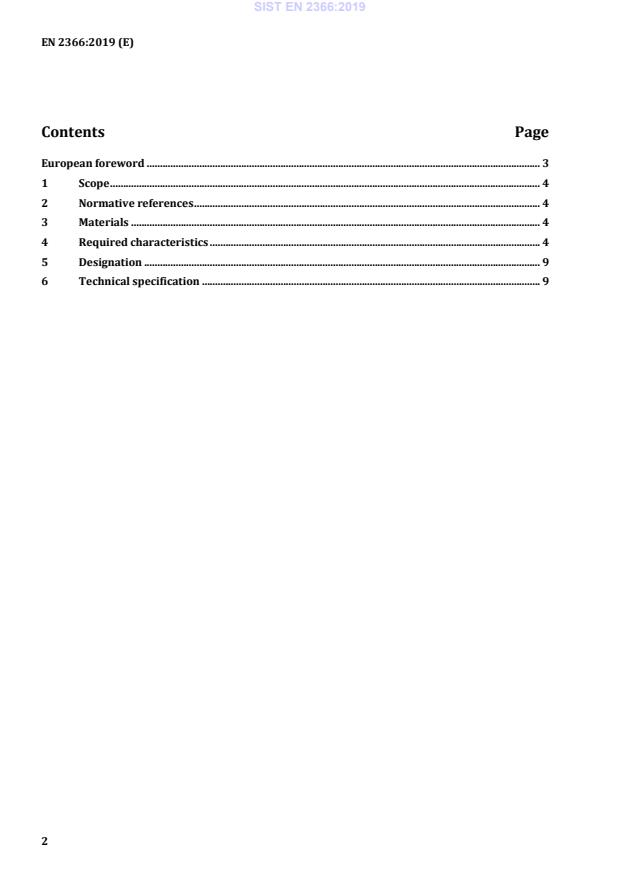
Contents Page
European foreword . 3
1 Scope . 4
2 Normative references . 4
3 Materials . 4
4 Required characteristics . 4
5 Designation . 9
6 Technical specification . 9
European foreword
This document (EN 2366:2019) has been prepared by the Aerospace and Defence Industries Association
of Europe - Standardization (ASD-STAN).
After enquiries and votes carried out in accordance with the rules of this Association, this Standard has
received the approval of the National Associations and the Official Services of the member countries of
ASD, prior to its presentation to CEN.
This European Standard shall be given the status of a national standard, either by publication of an
identical text or by endorsement, at the latest by March 2020, and conflicting national standards shall be
withdrawn at the latest by March 2020.
Attention is drawn to the possibility that so
...