


oSIST prEN ISO 11596:2026
(Main)Jewellery and precious metals - Sampling of precious metals and precious metal alloys (ISO 11596:2021)
Jewellery and precious metals - Sampling of precious metals and precious metal alloys (ISO 11596:2021)
This document specifies a method of sampling precious metals and precious metal alloys for the determination of their precious metal content and for the assessment of their homogeneity. The document is applicable to raw materials, semi-finished products and finished products and is intended to be used only for the sampling of entirely metallic materials.
NOTE 1 Standards for determination of precious metals contents for different metals are listed in the Bibliography.
NOTE 2 For assaying techniques different from the listed ones other sampling procedures can be required.
NOTE 3 For the purpose of production control or lot inspections the International Standards for the sampling indicated in the Bibliography or corresponding guidelines can be applied in addition.
Schmuck und Edelmetalle - Probenahme von Edelmetallen und Edelmetall-Legierungen (ISO 11596:2021)
Joaillerie, bijouterie et métaux précieux - Échantillonnage des métaux précieux et des alliages de métaux précieux (ISO 11596:2021)
Nakit in plemenite kovine - Vzorčenje plemenitih kovin in zlitin plemenitih kovin (ISO 11596:2021)
General Information
Standards Content (Sample)
SLOVENSKI STANDARD
01-januar-2026
Nakit in plemenite kovine - Vzorčenje plemenitih kovin in zlitin plemenitih kovin
(ISO 11596:2021)
Jewellery and precious metals - Sampling of precious metals and precious metal alloys
(ISO 11596:2021)
Schmuck und Edelmetalle - Probenahme von Edelmetallen und Edelmetall-Legierungen
(ISO 11596:2021)
Joaillerie, bijouterie et métaux précieux - Échantillonnage des métaux précieux et des
alliages de métaux précieux (ISO 11596:2021)
Ta slovenski standard je istoveten z: prEN ISO 11596
ICS:
39.060 Nakit Jewellery
2003-01.Slovenski inštitut za standardizacijo. Razmnoževanje celote ali delov tega standarda ni dovoljeno.
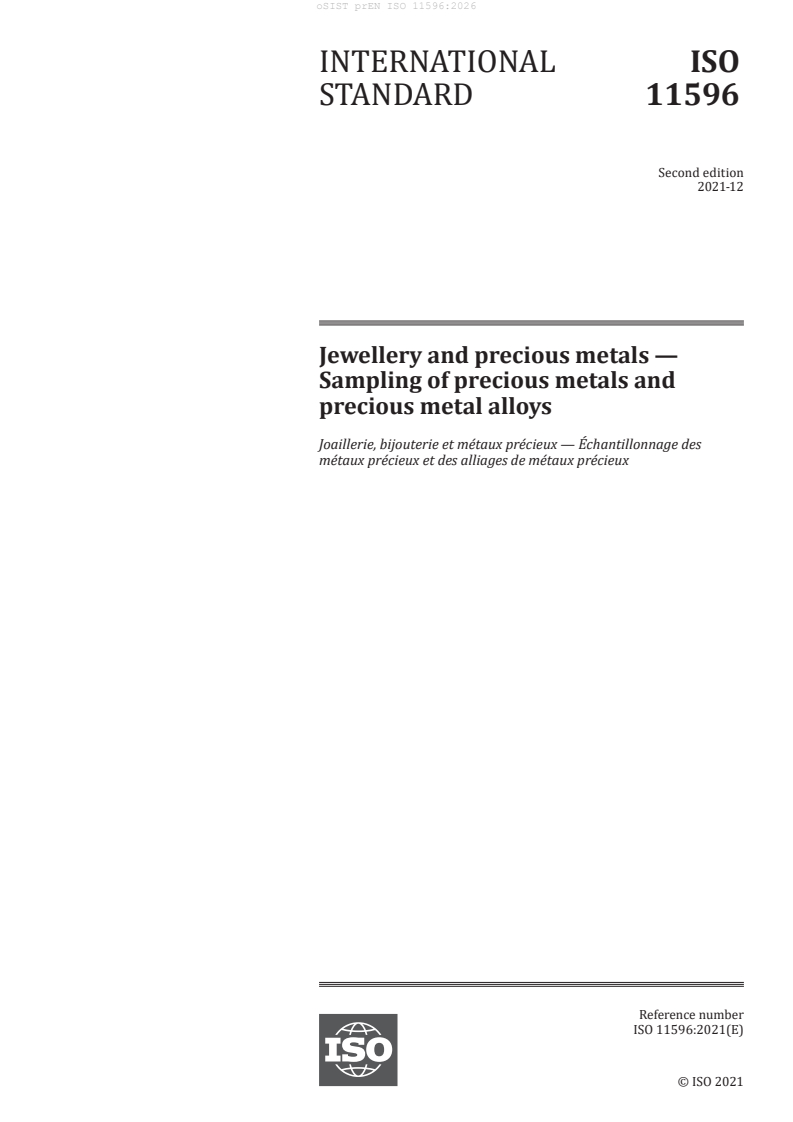
INTERNATIONAL ISO
STANDARD 11596
Second edition
2021-12
Jewellery and precious metals —
Sampling of precious metals and
precious metal alloys
Joaillerie, bijouterie et métaux précieux — Échantillonnage des
métaux précieux et des alliages de métaux précieux
Reference number
ISO 11596:2021(E)
ISO 11596:2021(E)
© ISO 2021
All rights reserved. Unless otherwise specified, or required in the context of its implementation, no part of this publication may
be reproduced or utilized otherwise in any form or by any means, electronic or mechanical, including photocopying, or posting on
the internet or an intranet, without prior written permission. Permission can be requested from either ISO at the address below
or ISO’s member body in the country of the requester.
ISO copyright office
CP 401 • Ch. de Blandonnet 8
CH-1214 Vernier, Geneva
Phone: +41 22 749 01 11
Email: copyright@iso.org
Website: www.iso.org
Published in Switzerland
ii
ISO 11596:2021(E)
Contents Page
Foreword .iv
1 Scope . 1
2 Normative references . 1
3 Terms and definitions . 1
3.1 Sampling . 1
3.2 Precious metals and precious metal articles . 2
3.3 Product classes . 3
3.4 Products and manufacturing methods . 3
4 Tools . 4
4.1 General . 4
4.2 Use of tools . 5
5 Sample selection . . 5
6 Surface preparation before sampling . 5
7 Sampling methods .5
7.1 General . 5
7.2 Dip sampling of molten alloy . 6
7.2.1 General . 6
7.2.2 Method 1 – Pin sampling . 6
7.2.3 Method 2 - Bead sampling, button sampling . 6
7.3 Drilling . 6
7.4 Scraping . 7
7.5 Cutting . . 7
7.6 Sawing or filing . 7
8 Retention of samples .7
Annex A (informative) Guidelines for the sampling of typical products and items .8
Bibliography .13
iii
ISO 11596:2021(E)
Foreword
ISO (the International Organization for Standardization) is a worldwide federation of national standards
bodies (ISO member bodies). The work of preparing International Standards is normally carried out
through ISO technical committees. Each member body interested in a subject for which a technical
committee has been established has the right to be represented on that committee. International
organizations, governmental and non-governmental, in liaison with ISO, also take part in the work.
ISO collaborates closely with the International Electrotechnical Commission (IEC) on all matters of
electrotechnical standardization.
The procedures used to develop this document and those intended for its further maintenance are
described in the ISO/IEC Directives, Part 1. In particular, the different approval criteria needed for the
different types of ISO documents should be noted. This document was drafted in accordance with the
editorial rules of the ISO/IEC Directives, Part 2 (see www.iso.org/directives).
Attention is drawn to the possibility that some of the elements of this document may be the subject of
patent rights. ISO shall not be held responsible for identifying any or all such patent rights. Details of
any patent rights identified during the development of the document will be in the Introduction and/or
on the ISO list of patent declarations received (see www.iso.org/patents).
Any trade name used in this document is information given for the convenience of users and does not
constitute an endorsement.
For an explanation of the voluntary nature of standards, the meaning of ISO specific terms and
expressions related to conformity assessment, as well as information about ISO's adherence to
the World Trade Organization (WTO) principles in the Technical Barriers to Trade (TBT), see
www.iso.org/iso/foreword.html.
This document was prepared by Technical Committee ISO/TC 174, Jewellery and precious metals.
Any feedback or questions on this document should be directed to the user’s national standards body. A
complete listing of these bodies can be found at www.iso.org/members.html.
This second edition cancels and replaces the first edition (ISO 11596:2008), which has been technically
revised.
The main changes are as follows:
— The content has been reviewed to allow a broader field of application of the standard;
— The scope has been aligned with the ISO standards related to the present document and delimited
more clearly;
— Terms and definitions have been reorganized.
Any feedback or questions on this document should be directed to the user’s national standards body. A
complete listing of these bodies can be found at www.iso.org/members.html.
iv
INTERNATIONAL STANDARD ISO 11596:2021(E)
Jewellery and precious metals — Sampling of precious
metals and precious metal alloys
1 Scope
This document specifies a method of sampling precious metals and precious metal alloys for the
determination of their precious metal content and for the assessment of their homogeneity. The
document is applicable to raw materials, semi-finished products and finished products and is intended
to be used only for the sampling of entirely metallic materials.
NOTE 1 Standards for determination of precious metals contents for different metals are listed in the
Bibliography.
NOTE 2 For assaying techniques different from the listed ones other sampling procedures can be required.
NOTE 3 For the purpose of production control or lot inspections the International Standards for the sampling
indicated in the Bibliography or corresponding guidelines can be applied in addition.
2 Normative references
The following documents are referred to in the text in such a way that some or all of their content
constitutes requirements of this document. For dated references, only the edition cited applies. For
undated references, the latest edition of the referenced document (including any amendments) applies.
ISO 3954, Powders for powder metallurgical purposes — Sampling
3 Terms and definitions
For the purposes of this document, the following terms and definitions apply.
ISO and IEC maintain terminological databases for use in standardization at the following addresses:
— ISO Online browsing platform: available at https:// www .iso .org/ obp
— IEC Electropedia: available at https:// www .electropedia .org/
3.1 Sampling
3.1.1
sampling
defined procedure whereby a part of a substance, material or product is taken to provide a
representative sample (3.1.4), or samples, of the whole for analysis
3.1.2
dip sampling
sampling (3.1.1) method intended to produce primary samples representative for a melt
Note 1 to entry: A secondary sampling is then required in order to produce the samples for analysis.
Note 2 to entry: Depending on the specific sampling technique adopted, dip sampling is also referred to as pin
sampling, or as bead (or button) sampling, respectively.
ISO 11596:2021(E)
3.1.3
portion
fraction of a lot, item or sample (3.1.4) obtained by appropriate sample subdivision techniques in order
to represent correctly the properties of the whole to be tested
3.1.4
sample
quantity of representative material taken from a product, or part of a product
Note 1 to entry: In References [7] to [15] of the Bibliography, the term “sample” is used in some instances instead
of the term “test portion”.
3.1.5
sampling position
geometrically defined position specified by a sampling (3.1.1) scheme, from where the sampled material
is taken from an item
Note 1 to entry: Depending on the quantity of material to be drawn it may consist in several individual points
corresponding to the same geometrical definition.
3.1.6
test portion
part of the sample (3.1.4) used for a single determination of the precious metal content
3.1.7
lot
product, or collection of units of product, from which a sample (3.1.4) (or samples) is (or are) drawn
Note 1 to entry: Each lot consists of units of product manufactured under essentially the same conditions and
visibly presenting the same characteristics, i.e. same type, grade, class, size and composition.
3.1.8
homogeneous
presenting the same physical and chemical characteristics down to the scale of the sample (3.1.4) and
within the uncertainty of the relevant assaying method
3.2 Precious metals and precious metal articles
3.2.1
precious metal alloy
metal made by combining at least one precious metal as a major element with one or more metallic
elements, constituted either by a solid solution of the metal elements or by a mixture of metallic phases
at microscopic level
3.2.2
jewellery
jewels made of precious metal or precious metal alloys (3.2.1)
3.2.3
mixed precious metal articles
articles made from two or more separate precious metals, or precious metal alloys (3.2.1)
3.2.4
solder
alloy used to join metal parts
ISO 11596:2021(E)
3.3 Product classes
3.3.1
raw material
unprocessed material used to produce finished products, or intermediate materials which are feedstock
for future finished products
3.3.2
crystals
precious metal in form of metallic crystals constituting the typical product of
...
Questions, Comments and Discussion
Ask us and Technical Secretary will try to provide an answer. You can facilitate discussion about the standard in here.