


SIST EN 12469-5:2026
(Main)Biological safety cabinets - Part 5: Installation, commissioning and routine testing
Biological safety cabinets - Part 5: Installation, commissioning and routine testing
This document gives requirements and recommendations for installation, commissioning and routine testing of BSC.
Biologische Sicherheitswerkbänke - Teil 5: Aufstellung, Inbetriebnahme und Wartung
Dieses Dokument enthält Anforderungen und Empfehlungen für die Installation, Inbetriebnahme und Routineprüfung von BSW.
Postes de sécurité biologique - Partie 5: Installation, mise en service et essais de routine
Le présent document fournit les exigences et recommandations relatives à l'installation, la mise en service et les essais de routine des BSC.
Biološke varnostne omare - 5. del: Vgradnja, prevzemni postopki in rutinsko preskušanje
Ta dokument določa zahteve za vgradnjo, prevzemne postopke in rutinsko preskušanje bioloških varnostnih omar (BSC) ter podaja priporočila v zvezi s tem.
General Information
- Status
- Published
- Public Enquiry End Date
- 18-Sep-2024
- Publication Date
- 07-Dec-2025
- Technical Committee
- I13 - Imaginarni 13
- Current Stage
- 6060 - National Implementation/Publication (Adopted Project)
- Start Date
- 04-Dec-2025
- Due Date
- 08-Feb-2026
- Completion Date
- 08-Dec-2025
- Directive
- Not Harmonized90/219/EEC - Contained use of genetically modified micro-organisms

Relations
- Splited From
SIST EN 12469:2000 - Biotechnology - Performance criteria for microbiological safety cabinets - Effective Date
- 09-Aug-2023
- Effective Date
- 28-Jan-2026
- Effective Date
- 28-Jan-2026
- Effective Date
- 28-Jan-2026
- Effective Date
- 28-Jan-2026
- Effective Date
- 28-Jan-2026
- Effective Date
- 28-Jan-2026
- Effective Date
- 28-Jan-2026
- Effective Date
- 28-Jan-2026
- Effective Date
- 28-Jan-2026
- Effective Date
- 28-Jan-2026
- Effective Date
- 28-Jan-2026
- Effective Date
- 28-Jan-2026
Overview
SIST EN 12469-5:2026 – Biological safety cabinets - Part 5: Installation, commissioning and routine testing provides comprehensive requirements and recommendations for the installation, commissioning, and routine testing of biological safety cabinets (BSC). Developed by the Slovenski inštitut za standardizacijo (SIST) and aligned with European standard EN 12469-5, this standard ensures optimal performance, safety, and compliance when installing and maintaining BSC in laboratories handling biological agents.
Correctly installing and regularly testing biological safety cabinets is crucial to protecting laboratory personnel, the environment, and, in certain classes of BSC, the product itself. Adherence to this standard is essential for laboratories involved in microbiology, biotechnology, biomedical research, and other fields where biological hazards are managed.
Key Topics
Installation Requirements
- Site surveys addressing cabinet size, weight, class, utility services, and environmental conditions.
- Recommendations for placement to minimize airflow disturbances from doors, windows, and other equipment.
- Guidance on space and distance requirements around BSCs to ensure safe and effective operation.
- Consideration of ventilation systems, extract systems, and duct connections including thimble and hard duct types.
Commissioning Procedures
- Verifying correct installation and assessing potential adverse effects from room airflow.
- Visual inspections and basic functional checks (e.g., ventilation, lighting, utility connections).
- Ensuring accessibility for maintenance and confirming conformity with manufacturer specifications.
Routine Testing
- Requirements for annual (minimum) routine testing in line with the standard and manufacturer guidelines.
- Inclusion of corrective and preventive maintenance procedures.
- Need for thorough, documented test reports including identification, test results, and reference to relevant standards or deviations.
Decontamination and Disinfection
- Guidance on procedures for safe decontamination and disinfection, especially when accessing potentially contaminated components.
- Risk-based approach to decontamination when BSCs are taken out of service, or filters are replaced.
Training and Competence
- Emphasis on ensuring all personnel involved in installation, commissioning, and usage are properly trained and competent.
- Documentation of all training activities.
Applications
SIST EN 12469-5:2026 is applicable to any laboratory using biological safety cabinets, particularly in:
- Microbiology, biotechnology, and biomedical laboratories
- Hospital laboratories and research facilities
- Pharmaceutical and food production quality control labs
- Academic institutions and government research centers
The standard helps organizations:
- Ensure the effective containment of biohazards, safeguarding operator and environmental safety
- Standardize installation and commissioning processes for consistency and compliance
- Maintain the functionality and reliability of BSCs through systematic routine testing and maintenance
- Meet regulatory and organizational requirements for biosafety and laboratory quality assurance
Related Standards
SIST EN 12469-5:2026 is part of the broader EN 12469 series on biological safety cabinets, which includes:
- EN 12469-1: Classes, terminology, and basic requirements for BSCs
- EN 12469-2: Requirements for BSC Class II
- EN 12469-3: Requirements for BSC Class III
- EN 12469-4: Requirements for BSC Class I
Additional relevant standards and references:
- CEN/TS 17441: Laboratory installations - Ventilation systems in laboratories
- EN 13306:2017: Maintenance terminology
Compliance with SIST EN 12469-5:2026 ensures laboratories implement best practices for installation, commissioning, and ongoing validation of biological safety cabinets, enhancing overall biosafety and laboratory performance.
Frequently Asked Questions
SIST EN 12469-5:2026 is a standard published by the Slovenian Institute for Standardization (SIST). Its full title is "Biological safety cabinets - Part 5: Installation, commissioning and routine testing". This standard covers: This document gives requirements and recommendations for installation, commissioning and routine testing of BSC.
This document gives requirements and recommendations for installation, commissioning and routine testing of BSC.
SIST EN 12469-5:2026 is classified under the following ICS (International Classification for Standards) categories: 07.080 - Biology. Botany. Zoology; 07.100.01 - Microbiology in general. The ICS classification helps identify the subject area and facilitates finding related standards.
SIST EN 12469-5:2026 has the following relationships with other standards: It is inter standard links to SIST EN 12469:2000, SIST-TS CEN/TS 17441:2020, SIST EN 12469-1:2026, SIST EN 15458:2014, SIST EN 14056:2003, SIST EN 12738:1999, SIST EN 12741:1999, SIST EN 15457:2022, SIST EN 15458:2007, SIST EN 12128:1999, SIST EN 15458:2022, SIST EN 15457:2007, SIST EN 15457:2014. Understanding these relationships helps ensure you are using the most current and applicable version of the standard.
SIST EN 12469-5:2026 is associated with the following European legislation: EU Directives/Regulations: 90/219/EEC, 90/220/EEC, 90/679/EEC; Standardization Mandates: M/BC/CEN/91/19. When a standard is cited in the Official Journal of the European Union, products manufactured in conformity with it benefit from a presumption of conformity with the essential requirements of the corresponding EU directive or regulation.
SIST EN 12469-5:2026 is available in PDF format for immediate download after purchase. The document can be added to your cart and obtained through the secure checkout process. Digital delivery ensures instant access to the complete standard document.
Standards Content (Sample)
SLOVENSKI STANDARD
01-januar-2026
Biološke varnostne omare - 5. del: Vgradnja, prevzemni postopki in rutinsko
preskušanje
Biological safety cabinets - Part 5: Installation, commissioning and routine testing
Biologische Sicherheitswerkbänke - Teil 5: Aufstellung, Inbetriebnahme und Wartung
Postes de sécurité biologique - Partie 5: Installation, mise en service et essais de routine
Ta slovenski standard je istoveten z: EN 12469-5:2025
ICS:
07.080 Biologija. Botanika. Zoologija Biology. Botany. Zoology
07.100.01 Mikrobiologija na splošno Microbiology in general
2003-01.Slovenski inštitut za standardizacijo. Razmnoževanje celote ali delov tega standarda ni dovoljeno.
EN 12469-5
EUROPEAN STANDARD
NORME EUROPÉENNE
November 2025
EUROPÄISCHE NORM
ICS 07.100.01
English Version
Biological safety cabinets - Part 5: Installation,
commissioning and routine testing
Postes de sécurité microbiologique - Partie 5 : Biologische Sicherheitswerkbänke - Teil 5: Aufstellung,
Installation, mise en service et essais de routine Inbetriebnahme und Wartung
This European Standard was approved by CEN on 5 October 2025.
CEN members are bound to comply with the CEN/CENELEC Internal Regulations which stipulate the conditions for giving this
European Standard the status of a national standard without any alteration. Up-to-date lists and bibliographical references
concerning such national standards may be obtained on application to the CEN-CENELEC Management Centre or to any CEN
member.
This European Standard exists in three official versions (English, French, German). A version in any other language made by
translation under the responsibility of a CEN member into its own language and notified to the CEN-CENELEC Management
Centre has the same status as the official versions.
CEN members are the national standards bodies of Austria, Belgium, Bulgaria, Croatia, Cyprus, Czech Republic, Denmark, Estonia,
Finland, France, Germany, Greece, Hungary, Iceland, Ireland, Italy, Latvia, Lithuania, Luxembourg, Malta, Netherlands, Norway,
Poland, Portugal, Republic of North Macedonia, Romania, Serbia, Slovakia, Slovenia, Spain, Sweden, Switzerland, Türkiye and
United Kingdom.
EUROPEAN COMMITTEE FOR STANDARDIZATION
COMITÉ EUROPÉEN DE NORMALISATION
EUROPÄISCHES KOMITEE FÜR NORMUNG
CEN-CENELEC Management Centre: Rue de la Science 23, B-1040 Brussels
© 2025 CEN All rights of exploitation in any form and by any means reserved Ref. No. EN 12469-5:2025 E
worldwide for CEN national Members.
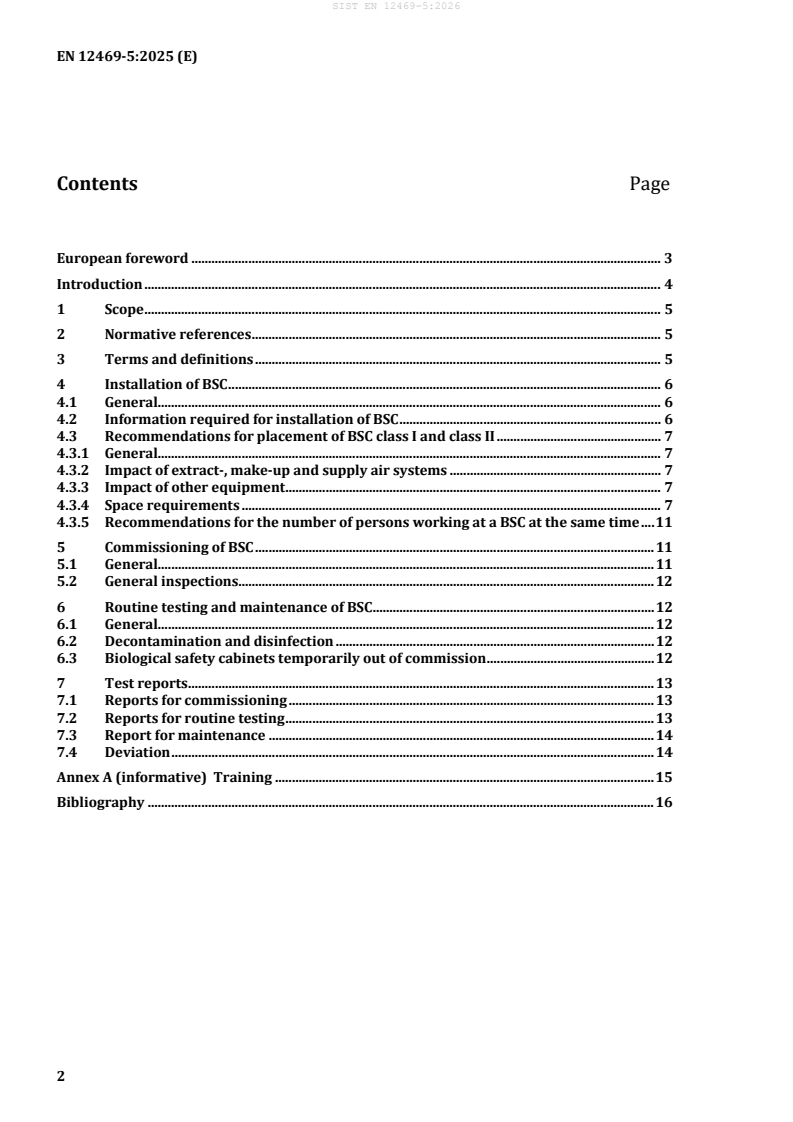
Contents Page
European foreword . 3
Introduction . 4
1 Scope . 5
2 Normative references . 5
3 Terms and definitions . 5
4 Installation of BSC . 6
4.1 General. 6
4.2 Information required for installation of BSC . 6
4.3 Recommendations for placement of BSC class I and class II . 7
4.3.1 General. 7
4.3.2 Impact of extract-, make-up and supply air systems . 7
4.3.3 Impact of other equipment . 7
4.3.4 Space requirements . 7
4.3.5 Recommendations for the number of persons working at a BSC at the same time . 11
5 Commissioning of BSC . 11
5.1 General. 11
5.2 General inspections. 12
6 Routine testing and maintenance of BSC . 12
6.1 General. 12
6.2 Decontamination and disinfection . 12
6.3 Biological safety cabinets temporarily out of commission . 12
7 Test reports . 13
7.1 Reports for commissioning . 13
7.2 Reports for routine testing . 13
7.3 Report for maintenance . 14
7.4 Deviation . 14
Annex A (informative) Training . 15
Bibliography . 16
European foreword
This document (EN 12469-5:2025) has been prepared by Technical Committee CEN/TC 332 “Laboratory
Equipment”, the secretariat of which is held by DIN.
This European Standard shall be given the status of a national standard, either by publication of an
identical text or by endorsement, at the latest by May 2026, and conflicting national standards shall be
withdrawn at the latest by May 2026.
Attention is drawn to the possibility that some of the elements of this document may be the subject of
patent rights. CEN shall not be held responsible for identifying any or all such patent rights.
and
This document, together with EN 12469-1:2025, EN 12469-2:2025, prEN 12469-3:—
prEN 12469-4:— , will partially supersede EN 12469:2000.
— the structure has been changed to emphasize different classes of biological safety cabinets (BSC);
— the text of the entire document has been revised and references have been updated.
EN 12469:2025 consists of the following parts, under the general title Biological safety cabinets:
— Part 1: Classes, terminology and basic requirements
— Part 2: BSC class II
— Part 3: BSC class III
— Part 4: BSC class I
— Part 5: Installation, commissioning and routine testing
Any feedback and questions on this document should be directed to the users’ national standards body.
A complete listing of these bodies can be found on the CEN website.
According to the CEN-CENELEC Internal Regulations, the national standards organisations of the
following countries are bound to implement this European Standard: Austria, Belgium, Bulgaria, Croatia,
Cyprus, Czech Republic, Denmark, Estonia, Finland, France, Germany, Greece, Hungary, Iceland, Ireland,
Italy, Latvia, Lithuania, Luxembourg, Malta, Netherlands, Norway, Poland, Portugal, Republic of North
Macedonia, Romania, Serbia, Slovakia, Slovenia, Spain, Sweden, Switzerland, Türkiye and the United
Kingdom.
Under preparation.
Introduction
Biological safety cabinets (BSC) are designed to protect the operator and the environment against the
risks associated with the handling of biological agents. Depending on the classes, a BSC can additionally
protect the product.
Each BSC class has its own design and performance criteria. The choice of a BSC class depends on the type
of protection required and the assessment of the risk to be controlled.
EN 12469 describes the BSC classes, their design, correct usage, and testing principles.
This document is a product standard. Occupational health and safety assessments methods are not
included.
1 Scope
This document gives requirements and recommendations for installation, commissioning and routine
testing of BSC.
2 Normative references
The following documents are referred to in the text in such a way that some or all of their content
constitutes requirements of this document. For dated references, only the edition cited applies. For
undated references, the latest edition of the referenced document (including any amendments) applies.
EN 12469-1, Biological safety cabinets - Part 1: Classes and basic requirements
CEN/TS 17441, Laboratory installations - Ventilation systems in laboratories
3 Terms and definitions
For the purposes of this document, the terms and definitions given in EN 12469-1 and the following apply.
ISO and IEC maintain terminology databases for use in standardization at the following addresses:
— ISO Online browsing platform: available at https://www.iso.org/obp/
— IEC Electropedia: available at https://www.electropedia.org/
3.1
commissioning
process of ensuring that the BSC is installed and tested according to this document
3.2
corrective maintenance
maintenance carried out after fault recognition and intended to restore an item into a state in which it
can perform a required function
[SOURCE: EN 13306:2017, 7.9]
3.3
hard duct
connection between two air handling devices that does not have any open sections
3.4
installation
physical placement including connection of mechanical, electrical, and communication services within a
building
3.5
maintenance
combination of all technical, administrative and managerial actions during the life cycle of an item
intended to retain it in, or restore it to, a state in which it can perform the required function
Note 1 to entry: Technical maintenance actions include observation and analyses of the item state (e.g. inspection,
monitoring, testing, diagnosis, prognosis, etc.) and active maintenance actions (e.g. repair, refurbishment).
[SOURCE: EN 13306:2017, 2.1, modified, Notes 2 and 3 to entry removed]
3.6
preventive maintenance
maintenance carried out intended to assess and/or to mitigate degradation and reduce the probability of
failure of an item
[SOURCE: EN 13306:2017, 7.1]
3.7
routine testing
test protocols carried out at predetermined intervals, intended to confirm that the BSC is operating within
manufacturers specifications
3.8
thimble
duct connection device that provides an air break between two air handling devices that prevents adverse
pressure situations when either of the devices fail
4 Installation of BSC
4.1 General
This clause gives recommendations and guidance on the installation of BSC, including placement and
connection to and interfacing with building ventilation and utility services.
4.2 Information req
...